Resume Keywords: How to Find and Use the Right Ones to Get Past ATS (2026)
You have the experience. You can do the job. So why does the application disappear into silence? Often it comes down to a handful of words that were never on the page. Before a human reads anything, software scans your resume for the exact keywords in the job description, and a recruiter does the same in a few seconds. Miss those words and you get filtered, even when you are qualified. Here is how to find the right resume keywords, put them where they count, and confirm your match before you apply.
Quick answer
What are resume keywords?
A resume keywordis any specific term a job description treats as a requirement: a hard skill (“SQL,” “Google Ads”), a tool (“Salesforce,” “Figma”), a certification (“PMP,” “CPA”), a methodology (“Agile,” “A/B testing”), or the job title itself. These are the words an applicant tracking system parses out of your resume and compares against the posting, and the same words a recruiter scans for in a quick skim.
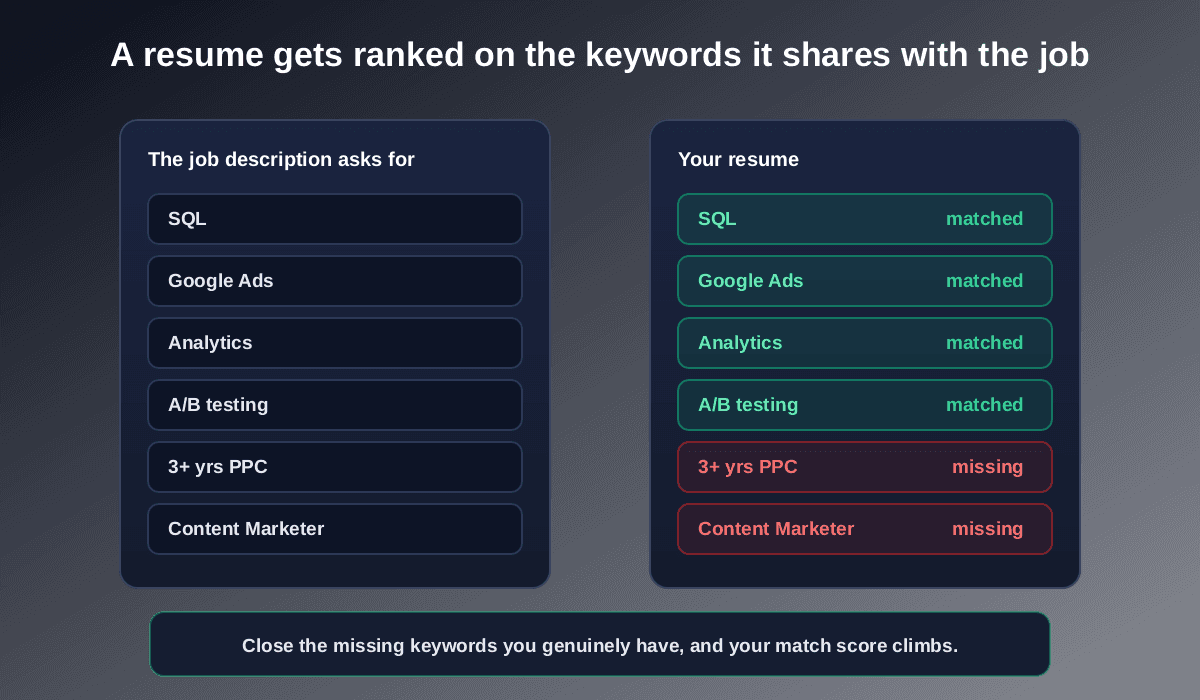
The catch is that software matches words, not meaning. You wrote “ran paid campaigns”; the posting says “PPC” and “Google Ads.” A person knows those overlap. A keyword filter often does not, so it reads as a missing skill and your ranking drops. Resume keywords are how you stop losing credit for experience you actually have.
Keywords are not the trick, the match is
Why the right keywords decide whether you get seen
When you apply, your resume is parsed into plain text and ranked against the job's requirements before a human is involved. If the must-have keywords are missing, you sink in the ranking and the recruiter skimming the top of the pile never reaches you. This is the same filtering we break down in why your resume gets auto-rejected, and the same logic the screener uses in AI resume screening. The keywords are the hinge the whole decision turns on.
How to find the right keywords in a job description
You do not need every word in the posting, only the ones that signal a requirement. Here is what to pull out, in order of weight:
- The job title and its variants.If the role is “Content Marketer,” that exact phrase should appear on your resume if it is true of you, not just “marketing generalist.”
- Hard skills and tools named explicitly. Specific software, languages, platforms, and frameworks. These are the highest-value keywords because they are easy to match or miss.
- Certifications and qualifications. Named credentials, licenses, and degrees the posting lists as required or preferred.
- Repeated terms. Anything mentioned more than once, or in both the responsibilities and requirements, is a priority keyword by definition.
- Methodologies and processes. Ways of working the role names, such as Agile, SEO, financial modeling, or stakeholder management.
Skip the filler
How to use resume keywords the right way
Finding the keywords is half the job. Placing them so they carry weight, without crossing into stuffing, is the other half. Here is the method, and it takes about 10 minutes once you have a base resume.
Build your keyword target list from the posting
Work through the job description and list every hard requirement it names: skills, tools, certifications, the title, and any repeated terms. This list is your target. You are not guessing what the role wants anymore; the posting told you.
Mirror only the keywords you genuinely have
For every target keyword you truly meet, make sure your resume uses the same word the posting does. If you have the skill but called it something else, rename it to match. The rule is non-negotiable: only claim keywords that are true. Mirroring recovers credit for real experience; it is not a license to invent skills.
Place keywords where they are read first
Put your most important keywords in the top third of the page: the title line, a short professional summary, and a dedicated skills section. Then prove each one in your experience bullets. A keyword that appears once near the top and shows up as real evidence below it reads as a strong, credible match.
Check your match and close the keyword gaps
This is the step almost everyone skips. Before you submit, compare your resume against the posting and see which required keywords you are clearly hitting and which are missing or buried. Then fix the gaps and apply knowing you match, instead of hoping you do.
See which keywords your resume is missing, before you apply
Paste a job description and upload your resume into Rankid. You'll get a 0 to 100 match score, the keywords and skills you've matched, and the exact ones you're missing, so you can close the gaps and stop getting filtered. Free to start.
Check your keyword match freeWhere to put keywords on your resume
Placement changes how much a keyword counts. The same term carries more weight at the top of the page than in the last bullet of your oldest role. A reliable structure:
- Title line: the exact role title you are targeting, when it is honestly yours.
- Professional summary: two or three lines that fold in your top three or four priority keywords naturally.
- Skills section: a clean, scannable list of the hard skills and tools the posting names that you actually have.
- Experience bullets: the proof. Each important keyword should map to a real result or responsibility, not just sit in a list.
Keyword mistakes that get you filtered faster
- Keyword stuffing. Repeating terms unnaturally or hiding white text backfires with both ATS and human readers.
- Claiming keywords you cannot back up. A match that collapses in the interview costs you the offer, not just the screen.
- Using one keyword set for every job. Each posting prioritizes different terms, so re-pull the keywords for every serious application.
- Burying keywords on page two. If your most relevant terms only appear at the bottom, the skim never reaches them.
- Relying on synonyms.“Search marketing” is not always read as “SEO.” When the posting names a specific term and you have the skill, use that exact term.
Key takeaways
- Resume keywords are the specific skills, tools, certifications, and titles a job description names as requirements.
- Both an ATS and a recruiter scan for those exact words, so missing them gets you filtered even when you are qualified.
- Find keywords by pulling the hard requirements, repeated terms, and the title out of each posting.
- Mirror only the keywords you genuinely have, place them in the top third, and back each with real evidence.
- Check your resume match score before applying so you can see and close the keyword gaps instead of guessing.
Keywords are not a hack; they are how you make a real match visible to the people and software deciding your application. Pull the right ones from each posting, prove them, and stop losing interviews over words you simply forgot to include. For the full wording playbook, read how to tailor your resume to a job description, then run your next application through Rankid's free match check and close the gaps it surfaces.
Frequently asked questions
What are resume keywords?
Resume keywords are the specific skills, tools, certifications, job titles, and terms a job description names as requirements. Applicant tracking systems and recruiters scan for these exact words to decide how well you match the role, so the keywords on your resume should mirror the ones in the posting you are applying to.
How do I find the right keywords for my resume?
Read the job description and list every hard requirement it repeats or emphasizes: tools, skills, certifications, methodologies, and the job title itself. Those are your target keywords. The fastest way is to compare your resume against the posting with a tool like Rankid, which surfaces the exact keywords you already match and the ones you are missing.
Where should I put keywords on my resume?
Put your most important keywords in the top third of the resume: the title line, a short summary, and a dedicated skills section. Then back each one up with evidence in your experience bullets. Keywords that only appear once, buried on page two, carry far less weight with both the software and the recruiter.
How many keywords should a resume have?
There is no magic number. Cover every must-have requirement the job names at least once, using the same wording, and support the important ones with real evidence. Coverage of the critical requirements matters far more than total keyword count, and stuffing extra terms you cannot back up hurts you.
Is using resume keywords the same as keyword stuffing?
No. Using keywords means naming the real skills you have in the same words the job uses so you stop losing credit for them. Keyword stuffing means repeating terms unnaturally or hiding them in white text. Stuffing backfires with both ATS and human readers and collapses in the interview. Only claim keywords you can prove.
How do I know if my resume has the right keywords before I apply?
Compare your resume against the specific job description and see which required keywords appear and which are missing. Rankid does this in seconds: paste the posting and your resume to get a 0 to 100 match score plus the exact keywords you have matched and the ones you still need to add, so you can fix the gaps before you submit.