Employment Verification Letter: Templates and What to Include (2026)
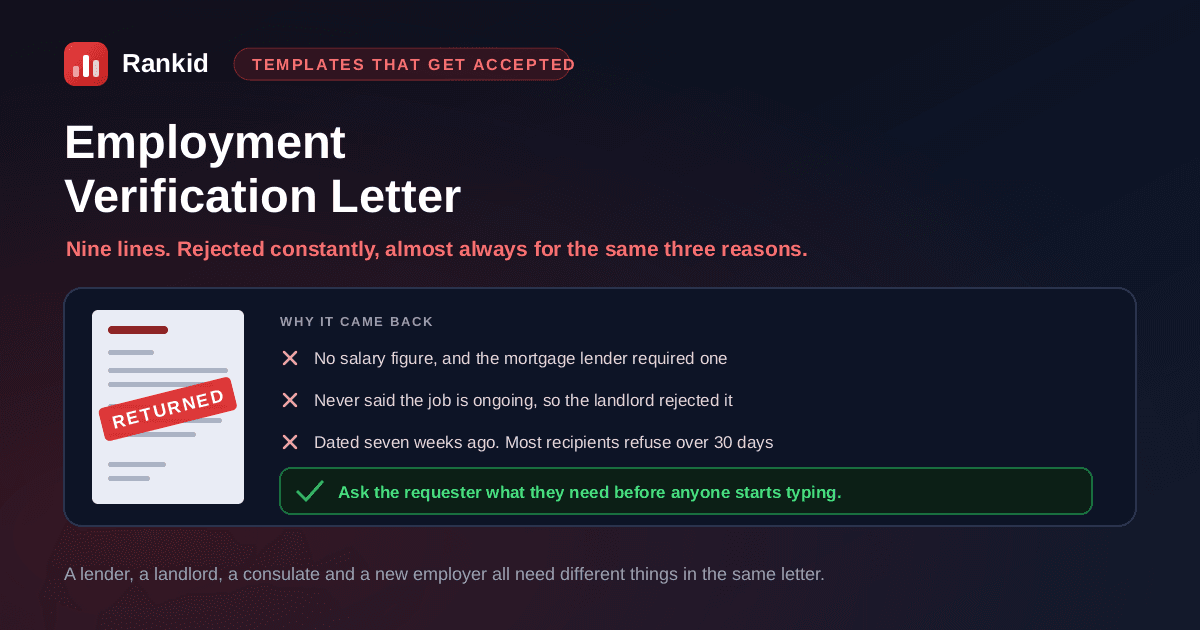
An employment verification letter is a nine-line document that should take an HR team two minutes to produce, and yet it delays mortgage closings, apartment applications and visa appointments constantly. The reason is almost never that the employer refused. It is that the letter arrived saying the wrong things: no salary when the lender needed salary, no statement of continued employment when the landlord needed one, no letterhead when the consulate required it. So a second request goes out, and another week disappears. The fix is to know what your specific requester needs before anyone starts typing.
Quick answer
Every verification letter needs seven things:letterhead, the date, the recipient, the employee's full legal name, job title and status, exact employment dates, and a signature with contact details. Then the requester decides the rest: a mortgage lender needs salary and how variable pay works, a landlord needs income and that the job is ongoing, a consulate needs duties and approved leave, a new employer needs only dates and title. Employers: no performance, no reason for leaving, no medical detail, and no salary without written consent.
What an employment verification letter is
It is a signed statement from an employer confirming that a person works, or used to work, there. Its entire purpose is that a third party can rely on the facts without taking the employee's word for them, which is why the signature and the contact details matter as much as the content.
It is deliberately narrow. A verification letter confirms facts. It does not assess performance, explain why someone left, or recommend them, and three documents get confused with it constantly:
- A reference letteroffers an opinion about someone's work. Lenders and government agencies do not want one, and many employers now refuse to write them at all.
- An offer letter evidences an agreement to employ someone. It proves an intention, not that the employment happened, which is why lenders rarely accept one alone.
- A proof of income letteris a verification letter with compensation detail added. Same document, higher bar, and it needs the employee's written consent.
Not the same as I-9 or E-Verify
What every letter must include
Seven elements, and a letter missing any of them is likely to come back. The two most commonly omitted are the date, because recipients generally refuse anything older than 30 days, and a named human with a direct phone number, because the recipient often intends to call and verify the letter itself.
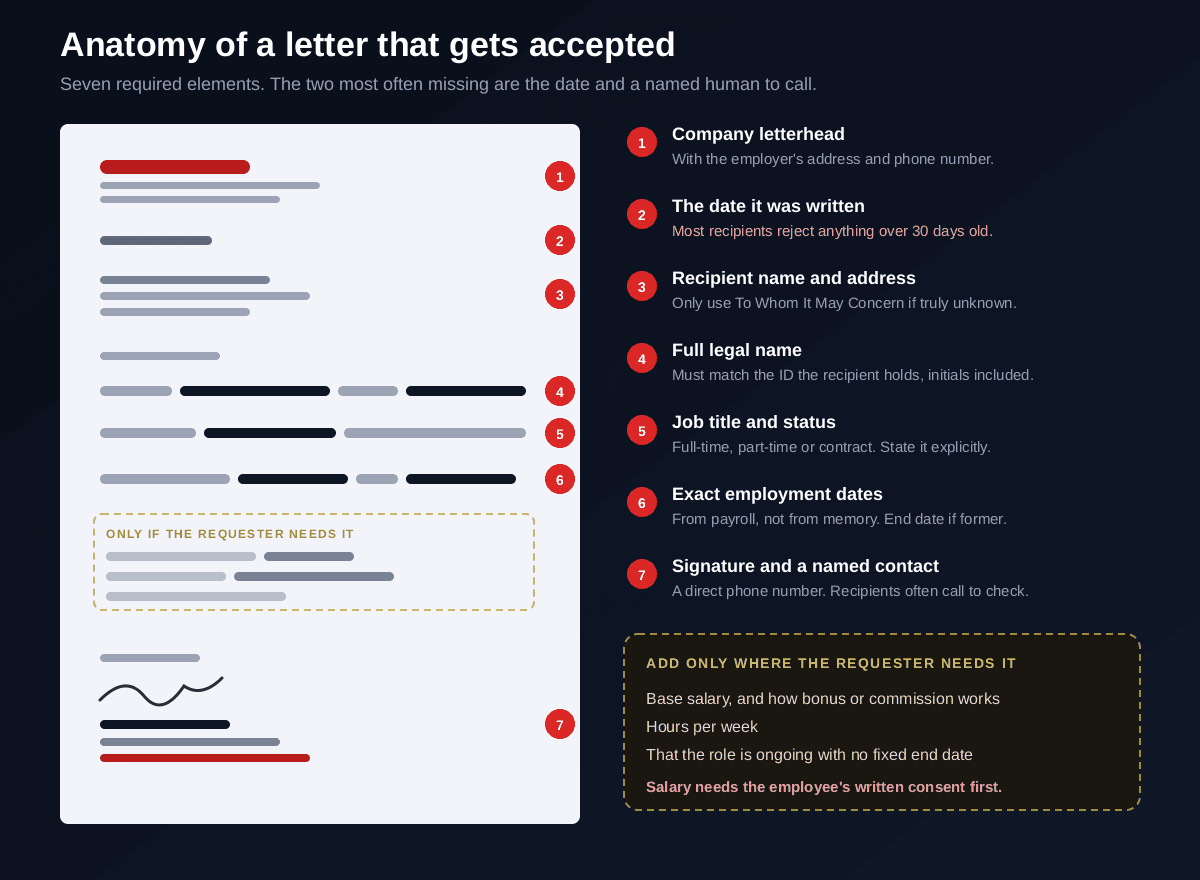
The employee's name is worth one extra note: it must match the identification the recipient holds. A letter for "Dan Whitfield" against a passport reading "Daniel J. Whitfield" is a rejection at a consulate and a delay at a bank, and it is the single easiest thing to get right in advance.
What each requester actually needs
This is the part that decides whether your letter works first time. The base letter is the same; the additions are not optional, and they differ by who is asking.
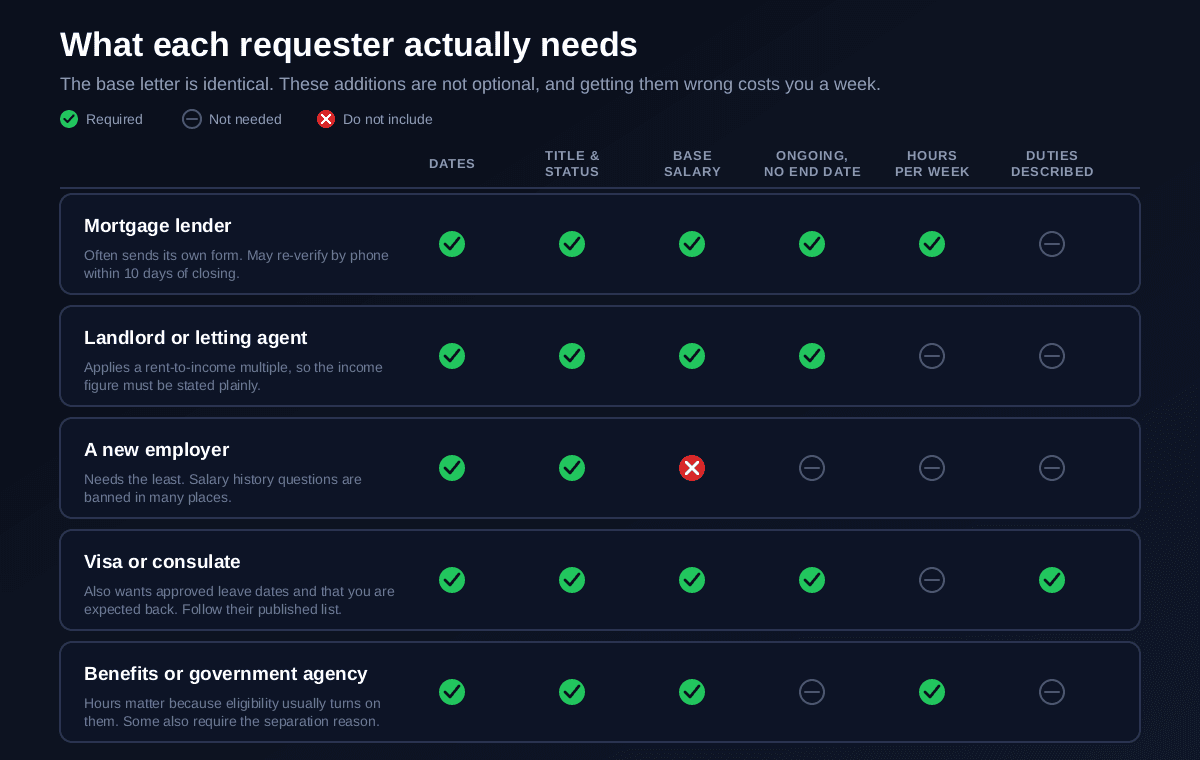
A mortgage lender is the most demanding. They need base salary separated from variable pay, because guaranteed and variable income are underwritten differently, and whether the role is permanent or has an end date. Most lenders send their own standard verification form, which is faster for your employer to complete than drafting prose. Two things catch people out: lenders commonly run a separate verbal verification within ten days of closing, so your employer may get a phone call at the last minute, and changing jobs mid-application can restart underwriting.
A landlord or letting agent needs income and, above all, confirmation that the employment is ongoing with no fixed end date, since they are assessing whether the rent will keep being paid. Most apply a rent-to-income multiple, so the income figure has to be stated plainly rather than implied.
A new employer needs the least: dates, title and status. Note that they usually should not be told your salary, and in many places cannot ask for salary history at all, so a previous employer including your pay is doing you no favours.
A visa or consular application needs the most formal presentation: official letterhead, duties described, salary, and often explicit confirmation that leave has been approved for specific dates and that you are expected back. Requirements vary by country and visa type, so follow the checklist the consulate publishes rather than a generic template.
Employment verification letter templates
Five versions below. Draft the one you need, then send it to whoever will sign it, because a draft turns a request into a two-minute approval. Replace everything in square brackets.
Standard verification letter (current employee)
[Company letterhead]
[Date]
[Recipient name], [Recipient title]
[Organisation and address]
Dear [Recipient name],
This letter confirms that [Employee full legal name] is employed by [Company name] as a [job title]. Their employment began on [start date] and they are currently employed on a [full-time / part-time / contract] basis. Their employment has no fixed end date.
Please contact me directly on [phone] or at [email] if you require any further information.
Sincerely,
[Signature]
[Printed name], [Title]
With income, for a mortgage or loan
...is employed by [Company name] as a [job title] on a full-time basis, and has been continuously employed since [start date]. Their current annual base salary is [amount] paid [monthly / fortnightly]. They are also eligible for [a discretionary annual bonus / commission of approximately X% of base / overtime at their standard rate], which in the last [12 / 24] months totalled [amount]. Their employment has no fixed end date and, to the best of my knowledge, is expected to continue.
[Employee name] has authorised the release of this compensation information in writing.
For a rental application
...has been employed as a [job title] since [start date] on a permanent full-time basis. Their gross annual income is [amount]. Their position is ongoing and I am not aware of any planned change to their employment.
For a visa or consular application
...has been employed by [Company name], [full registered address], as a [job title] since [start date]. Their responsibilities include [two or three duties]. Their current annual salary is [amount].
[Employee name] has been granted approved leave from [date] to [date] and is expected to resume their duties with this company on [return date]. Their position will remain available to them.
For a former employee
This letter confirms that [Employee full legal name] was employed by [Company name] as a [job title] from [start date] to [end date]. At the time their employment ended, they held the title of [final title] and were employed on a [full-time / part-time] basis.
It is our policy to confirm dates of employment and position only.
That final line is worth keeping. It closes the conversation politely and consistently, which protects both the employer and the former employee.
The request email, from the employee
What employers should never include
This section is for whoever is signing. A verification letter answers exactly what was asked, in facts, and volunteers nothing, because everything volunteered is risk with no upside.
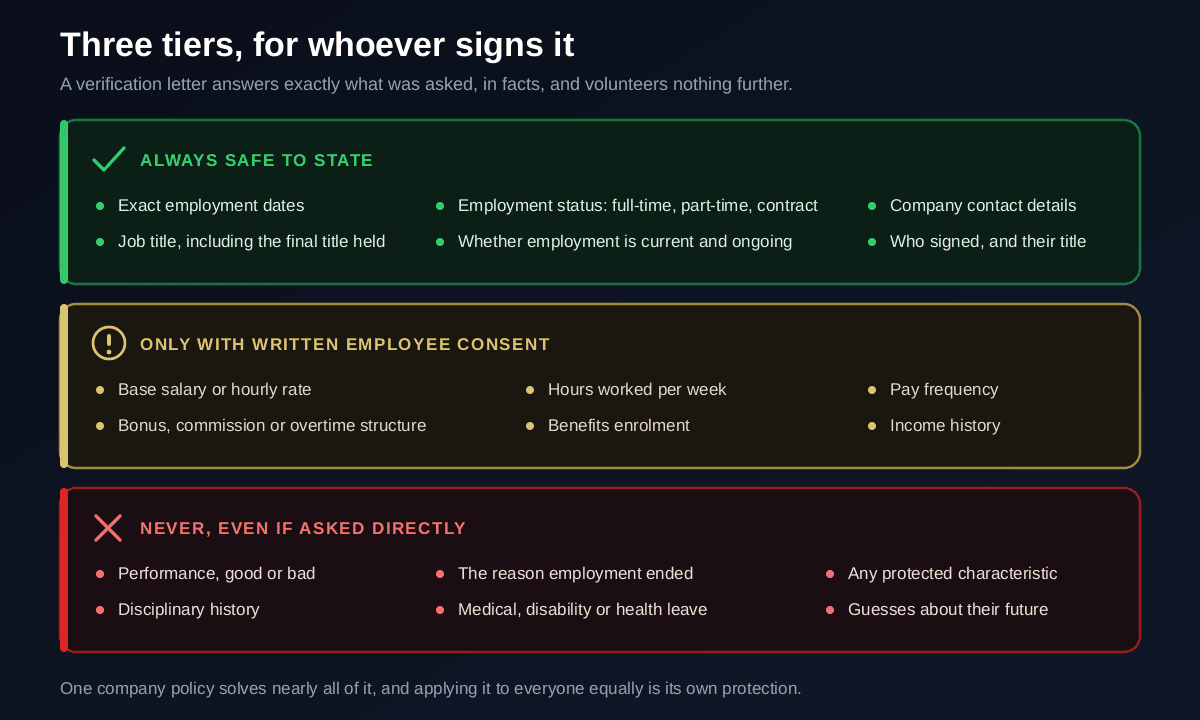
The three that cause the most trouble in practice are worth naming directly. Reason for leaving does not belong in a verification letter, however neutral it seems. Performance, even favourable performance, converts a factual document into an opinion you may later have to defend. Salary without written consent is the one people breach casually, usually while trying to be helpful with a mortgage request.
A single-sentence company policy solves nearly all of it: confirm dates, title and status by default, add compensation only on written employee authorisation, and answer nothing else. Consistency is also its own protection, since treating one former employee differently from another is far harder to defend than a policy applied to everyone.
How to get yours, and what to do when it stalls
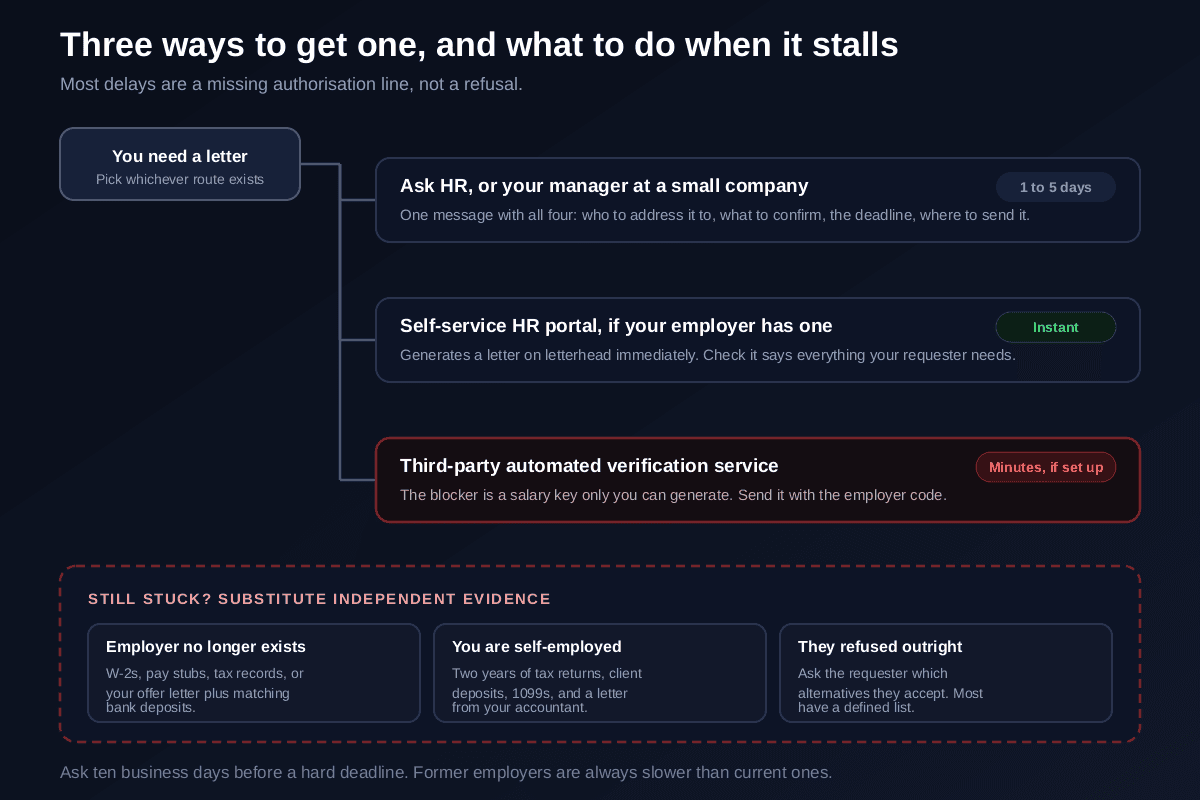
Ask in one message containing all four things: who to address it to, what must be confirmed, the deadline, and where to send it. Add explicit written authorisation for salary if salary is needed, because that single missing sentence is the most common cause of a second round trip. Ask for a PDF on letterhead, since unsigned or photographed copies get refused.
If your employer uses an automated verification service, the usual failure is not refusal but a missing code: the requester needs an employer code and, for income, a salary key that only you can generate. In the United States these services are treated as consumer reporting agencies, which means you can request a copy of your own employment data file and see who has accessed it. That is worth doing if a verification has come back with wrong dates, and any correction should be disputed with the service directly rather than routed through your employer.
If a former employer no longer exists, substitute independent evidence: W-2s or local equivalents, pay stubs, tax records, your original offer letter alongside matching bank deposits. Ask the requester what they accept before assembling anything, because most have a defined alternative list.
If you are self-employed, you cannot credibly issue your own letter. The accepted substitute is a bundle: two years of filed tax returns, bank statements showing client deposits, 1099s or equivalents, and a letter from your accountant confirming your income and how long they have prepared your accounts. A third-party professional attestation is the nearest thing to an employer's signature available to you.
The detail that quietly causes the most trouble: dates
Verification is a comparison, and the thing being compared is usually dates. Payroll records hold exact start and end dates, and those dates are frequently not the ones people remember or the ones they wrote down somewhere else. A resume saying you left in December, against payroll saying August, is a discrepancy on a background check rather than a rounding error.
This matters most when you are being verified as part of a hiring process rather than for a mortgage. Our guide to how long a background check takes covers why employment verification is usually the slowest component and how a mismatch turns a three-day check into a fortnight. If your dates are awkward because of a gap, the right fix is to present them accurately in the first place, which our guide to explaining employment gaps covers without weakening the application.
Make sure your resume matches what will be verified
Employment verification compares your resume against payroll records. Paste your resume and a target job description into Rankid's free checker to see how your history reads, which requirements you evidence, and where the gaps are.
Check your resume freeThe mistakes that cause a second request
- Written for the wrong requester.The single biggest cause. A landlord's letter sent to a lender is missing half of what underwriting needs.
- No date, or a stale one. Most recipients will not accept a letter older than 30 days.
- Name mismatch. The letter must match the identification the recipient holds, including middle initials.
- No letterhead or no signature. An email from an HR address is not a substitute, and a photograph of a letter is not a PDF.
- No named contact. Recipients often intend to phone and verify, and a generic inbox stalls them.
- Salary omitted when it was required, usually because nobody supplied written authorisation.
- Approximate dates. Give exact dates from payroll, not the month you think you started.
- Requested too late. Ask ten business days before a hard deadline. Former employers are slower than current ones.
Key takeaways
- Seven elements every time: letterhead, date, recipient, full legal name, title and status, exact dates, signature with a direct contact.
- The requester decides the rest. Ask what they need before anyone writes anything.
- A mortgage lender needs base salary separated from variable pay, and may re-verify by phone before closing.
- A new employer needs only dates, title and status. Do not volunteer salary.
- Employers: never include performance, reason for leaving, medical detail, or salary without written consent.
- Draft it yourself and send it for signature, but never sign your own or alter a signed letter.
- If HR uses an automated service, the blocker is usually a missing salary key that only you can generate.
- Self-employed: substitute tax returns, bank statements, 1099s and an accountant's letter.
The whole document is nine lines, and nearly every delay attached to it comes from one of two things: nobody asked the requester what they needed, or nobody authorised the salary line. Send one message containing the recipient, the facts to confirm, the deadline and your written authorisation, include a draft, and ask for a PDF on letterhead. If you are on the signing side, adopt the one-sentence policy and answer nothing that was not asked. And because verification ultimately compares your stated history against payroll records, it is worth making sure the history you present is accurate before anyone checks it: paste your resume and a target job description into Rankid's free resume checker and see exactly how it reads.
Frequently asked questions
What is an employment verification letter?
It is a short, signed letter from an employer confirming that someone works or worked there, and it exists so that a third party can rely on the facts rather than on the employee's word. At minimum it states the employee's full name, their job title, their employment dates, and whether the employment is current and ongoing, and it is issued on company letterhead with a signature and a contact for follow-up questions. It is deliberately narrow: it confirms facts rather than offering an opinion about performance, which is what separates it from a reference letter. Depending on who asked for it, the letter may also need to state salary, hours per week, or the expected likelihood of continued employment, and leaving those out is the most common reason a letter comes back rejected.
How do I request an employment verification letter?
Email HR, or your manager at a smaller company, and give them everything they need to write it in one message so that nothing bounces back. Include four things: who the letter should be addressed to, including the exact name and address if you have them; what specifically must be confirmed, such as dates, title, salary or hours; the deadline; and where to send it. Ask whether they need written authorisation from you to release salary, because many employers do and that requirement alone loses several days. Most companies turn these around in one to five business days, and larger ones often have a self-service process or use a third-party verification service you can access yourself in minutes. Always ask for a PDF on letterhead, since scanned or unsigned copies are frequently refused.
What should an employment verification letter include?
Every letter needs seven elements: company letterhead with the employer's address and phone number; the date it was written, since most recipients will not accept one older than 30 days; the recipient's name and address, or a To Whom It May Concern line if genuinely unknown; the employee's full legal name as it appears on their identification; the job title and employment status, meaning full-time, part-time or contract; the exact start date and, for former employees, the end date; and the signature, printed name, title and direct contact details of whoever is confirming it. Add salary, hours per week, or a statement about continued employment only where the requester needs them and, in the case of salary, only with the employee's written consent.
Can I write my own employment verification letter?
You can draft it, and doing so is genuinely helpful, but you cannot sign it yourself and expect it to be accepted. The whole value of the letter is that an independent party is attesting to the facts, so a letter signed by the person it describes verifies nothing. The practical approach is to write the draft, keep it strictly factual, and send it to HR or your manager to review, put on letterhead and sign, which turns a request into a two-minute approval. Never alter a letter after it has been signed, and never sign on someone else's behalf, even with informal permission: a mortgage or visa application containing a document that has been changed after signature is treated as fraud rather than as a clerical error.
What is the difference between an employment verification letter and a reference letter?
An employment verification letter confirms facts; a reference letter offers an opinion. The verification letter says that Jane Okafor has been employed as a senior analyst since March 2022 and is currently employed full-time, and it stops there. A reference letter says that Jane is an outstanding analyst who would be an asset to any team. They serve different audiences: lenders, landlords, consulates and government agencies want the first, because they need checkable facts, while hiring managers and admissions committees want the second. Many employers now have a firm policy of issuing only the factual version, precisely because opinions expressed in writing about former employees create legal exposure. An offer letter is a third thing again: it evidences an agreement to employ someone, not that the employment actually happened.
How long does it take to get an employment verification letter?
Between a few minutes and about two weeks, and the variation is almost entirely about how your employer handles them rather than about how complicated your request is. A large employer with a self-service HR portal or a third-party verification service can produce one instantly. A mid-sized company with a dedicated HR team typically takes one to three business days. A small business where the letter has to be written by the owner between other work often takes three to five, and longer over holiday periods. Former employers are slower again, particularly if the company has been acquired, restructured or has changed HR systems since you left. If you have a hard deadline such as a mortgage closing, ask at least ten business days ahead and say what the deadline is.
What should an employer never include in an employment verification letter?
Keep out anything that is an opinion, a protected category, or a fact you have not been authorised to release. Specifically: performance assessments, disciplinary history and the reason employment ended; medical information, disability status, workers' compensation claims or leave taken for health reasons; anything touching age, national origin, religion, marital or family status, pregnancy, or immigration status beyond a plain confirmation of authorisation to work if that is genuinely what was asked; and salary or benefits details without the employee's written consent. Also avoid speculating about future employment beyond a factual statement such as that the role has no fixed end date. The general rule is that a verification letter answers exactly what was asked, in facts, and volunteers nothing further.
What does an employment verification letter for a mortgage need?
Lenders need more than the standard letter. Expect to have to confirm job title, start date, employment status, whether the position is permanent or has an end date, base salary, and how variable pay such as bonus, commission or overtime is structured, since lenders treat guaranteed and variable income very differently. Many lenders send their own form rather than accepting a free-form letter, commonly a standard verification of employment form, and it is usually faster for the employer to complete that than to draft prose. Be aware of two extra steps that surprise people: lenders often perform a separate verbal verification within ten days of closing, so your employer may be phoned again at the last minute, and a job change mid-application can restart underwriting entirely.
How do I prove employment if I am self-employed?
You cannot issue yourself a verification letter that anyone will rely on, so you substitute a bundle of independent evidence instead. The strongest combination is two years of filed tax returns, recent bank statements showing deposits from clients, and 1099 forms or their local equivalent. Add a letter from your accountant confirming your business income and how long they have prepared your accounts, since a third-party professional attestation is the closest available equivalent to an employer's signature. Signed client contracts, a business licence or registration certificate, and recent invoices with matching payments all strengthen the file. Tell the requester up front that you are self-employed and ask exactly what they accept, because most lenders and landlords have a defined alternative list and will send it to you.
What if my employer uses an automated verification service?
Many large employers have outsourced verification to a third-party service, which is faster when it works and frustrating when it does not. The requester typically needs a salary key or a one-time authorisation code that only you can generate, so the usual failure is not a refusal, it is that nobody told you a code was required. Log into the service, generate the code and pass it to the requester with the employer code. Because these services are treated as consumer reporting agencies in the United States, you also have the right to request a copy of your own employment data file and to see who has accessed it, which is worth doing if a verification has come back with wrong dates. If the file itself is wrong, dispute it with the service directly rather than asking your employer to fix it downstream.
Is an employment verification letter the same as an I-9 or E-Verify check?
No, and conflating them causes real problems. An employment verification letter confirms to an outside party that someone works for you. Employment eligibility verification, which in the United States means the Form I-9 process and optionally E-Verify, is a legal obligation on the employer to confirm that a new hire is authorised to work, and it happens at hire rather than on request. They involve different documents, different timing and different legal consequences: failing to complete an I-9 correctly carries penalties, whereas there is no general federal requirement to issue a verification letter at all. If someone asks you for proof of work authorisation, do not send an I-9 or its supporting documents, which contain identity data you should not distribute.
Does an employer have to provide an employment verification letter?
There is no general federal requirement in the United States that an employer must write one, which surprises people who assume it is an entitlement. In practice almost all employers do, because refusing damages goodwill for no benefit and because most established companies have a standing policy and a template. A handful of states have service letter laws that require employers to provide certain employment facts on a former employee's written request, with the specifics varying by state, and some employment contracts or union agreements create an obligation. If an employer refuses outright, the workable routes are the automated verification service if they use one, pay stubs and W-2s or their local equivalent, an offer letter combined with bank deposits, or asking the requester what alternative evidence they will accept.