How to Explain Employment Gaps on Your Resume (2026 Examples)
A gap in your work history can feel like a flashing red light, the first thing a recruiter will see and the reason your application lands in the reject pile. It almost never is. Career breaks are one of the most common and most survivable things on a resume, and hiring teams see them every single day. What matters is not whether you have a gap, but how you frame it and, far more importantly, whether the rest of your resume is a strong match for the job. This guide shows you exactly how to explain employment gaps on your resume, with word-for-word examples for the six most common reasons, how to format the dates so a short gap quietly disappears, what to say when it comes up in the interview, and why the applicant tracking system never rejects you for the gap itself.
Quick answer
Does an employment gap actually look bad?
Here is the reassuring truth most job seekers do not hear: your employment gap looks far worse in your own head than it does to a recruiter. Since 2020, layoffs, caregiving, health breaks, and career pivots have become so common that hiring managers barely blink at a gap with a reasonable explanation. What they are actually screening for is whether you can do the job, not whether your dates form an unbroken chain.
A gap only turns into a problem in two situations: when it is unexplained and starts to look like something you are hiding, or when it is very recent and very long with zero context. Both of those are fixable, and the fix is never to hide the gap. It is to give it a short, honest label and show you stayed engaged. A well-explained two-year break beats a suspicious, unexplained three-month one every time. So before you spend an ounce of anxiety camouflaging dates, understand what is really deciding your fate on the first pass.
The ATS does not reject you for a gap
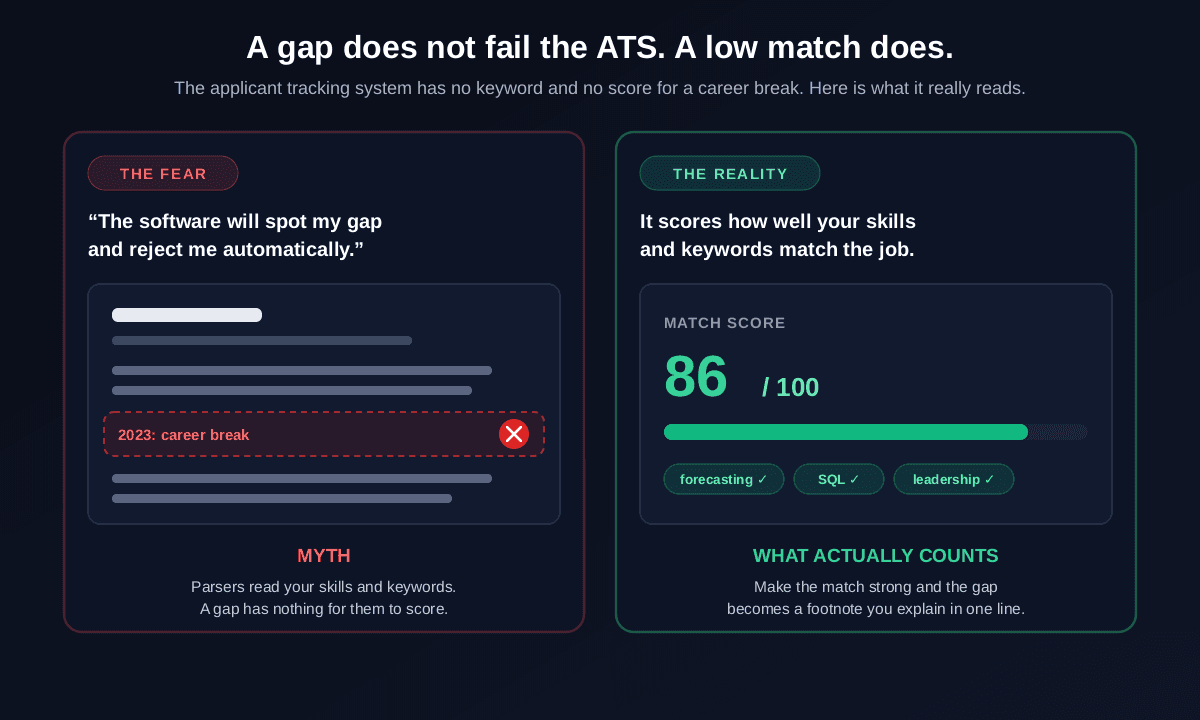
This is the single most important thing to internalize, because it flips the whole problem on its head. An applicant tracking system does not scan your dates, spot a gap, and auto-reject you. That is a myth. The ATS reads the text of your resume and scores how well your skills, job titles, and keywords line up with the job description. A gap in employment has no keyword attached to it and no score of its own, so on its own it literally cannot fail you.
What gets you filtered out is a low match: missing the required skills and keywords the role asks for. This is exactly where people waste their energy. They agonize over how to disguise a gap while the real reason they are not getting interviews is that their resume does not cover the keywords the job wants. The gap is a story you tell a human later. The match is what gets you in front of that human in the first place. So the most productive thing you can do about a gap is make the rest of the resume an unmistakable fit, then explain the gap in one clean line.
Reframe the problem
How to explain the six most common gaps (with examples)
Every good gap explanation follows the same shape: name the reason in a short phrase, then pivot to what you did or learned. Never lie, never over-explain, and never apologize. Here are word-for-word examples you can adapt for the six reasons recruiters see most, whether the break was a layoff, caregiving, health, study, a sabbatical, or a long job search.
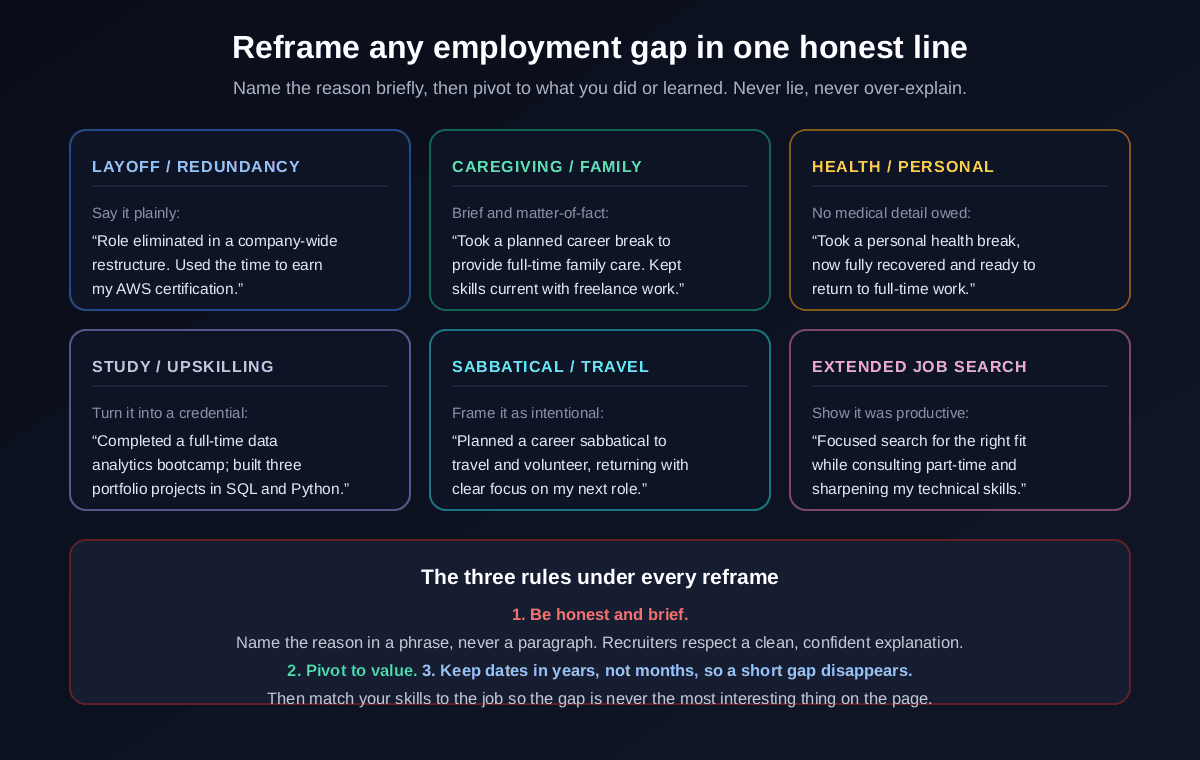
- Layoff or redundancy."Role eliminated in a company-wide restructure. Used the time to earn my AWS certification." A layoff is not a performance issue and recruiters know it. State it plainly and move to what you gained.
- Caregiving or family."Took a planned career break to provide full-time family care. Kept my skills current with freelance projects." Brief and matter-of-fact. This includes explaining a stay-at-home parent gap: you do not need to justify it, just label and pivot.
- Health or personal."Took a personal health break, now fully recovered and ready to return to full-time work." You owe no medical detail to anyone. Neutral, forward-looking, done.
- Study or upskilling."Completed a full-time data analytics bootcamp; built three portfolio projects in SQL and Python." Turn the gap into a credential and list it as its own entry.
- Sabbatical or travel."Planned a career sabbatical to travel and volunteer, returning with clear focus on my next role." Framed as intentional, it reads as confidence, not drift.
- Extended job search."Focused search for the right fit while consulting part-time and sharpening my technical skills." Show the time was productive rather than idle.
The three rules under every reframe
How to format employment gaps on the resume
A lot of the anxiety around gaps is really a formatting problem, and formatting is easy to fix. The way you present dates and fill time can make a short gap invisible and a long one look intentional.
- Use years, not months."2021 to 2023" instead of "March 2021 to January 2023" quietly absorbs a gap of a few months. This is standard practice, not deception.
- Give the break its own dated entry.A line like "Career Break, 2023, full-time caregiving" or "Professional Development, 2023, data analytics certification" keeps the timeline continuous and honest at once.
- List freelance, contract, and volunteer work as real roles. If you did any paid or unpaid work during the gap, it counts. Title it, date it, and add a bullet with a result.
- Consider a skills-forward layout for a long or early gap. Leading with a strong professional summary and a skills section puts your fit first, before the reader reaches the dates.
- Never invent a fake job or stretch real dates to cover a gap. It unravels in reference checks and background screening, and it turns a survivable gap into a fireable lie.
Do not overcorrect
Explaining a gap in your cover letter
Handle the gap in both places, but differently. On the resume you deal with it structurally: a short labeled entry with dates. In the cover letter you have room for exactly one warm sentence that frames the break positively and points forward. Something like: "After a planned career break to care for family, I am excited to return to a marketing role where I can apply my skills again."
Keep both versions short and consistent with each other, and resist the urge to explain the same gap in three different places. The cover letter is not a confession; it is a chance to control the narrative in one confident line and then spend the rest of the letter on why you are a strong fit for this specific job. If you want the gap to shrink into the background, the surest way is to make your match to the job description the loudest thing in both documents.
Make sure your gap is a footnote, not the headline
Paste your resume and the job description into Rankid. You get a 0 to 100 match score plus the exact skills and keywords you match versus the ones you are missing, so you can prove you are a strong fit and let the gap fade into the background. Your first check is free, no signup.
Check your resume freeWhat to say about the gap in the interview
If a gap earns you a first-round conversation, the resume did its job. Now the goal is simply to close the topic calmly. Use the same short, honest line you put on the resume, deliver it without apology, and pivot straight back to the role. Interviewers are not trying to trap you; they just want to confirm there is a reasonable story and that you are ready to work now. The closely related question of why you left the job before the gap deserves its own prepared answer.
- Lead with the one-liner, not the backstory."I was part of a company-wide layoff, and I used the time to complete a certification I had been meaning to finish." Then stop.
- Pivot to the future in the same breath."What excites me about this role is..." moves the conversation off the past and onto your fit.
- Stay calm and unembarrassed. Your tone teaches the interviewer how to feel about it. Treat it as normal and they will too.
- Do not volunteer private details.For health or personal breaks, "a personal matter that is fully resolved" is a complete answer.
Handle any employment gap in four steps
Name the reason in one honest phrase
Write a single line for the gap: the reason, nothing more. Layoff, caregiving, health, study, sabbatical, or focused job search. No paragraph, no apology, no invented job.
Pivot to what you did or learned
Add the value: a certification, freelance work, volunteering, a project, or skills you kept sharp. If you did anything productive, it becomes a dated entry so the timeline reads as continuous.
Format the dates to minimize the gap
Switch to years instead of months, use a clean reverse-chronological layout, and lead with a strong summary and skills so your fit is read before your dates. Never strip dates entirely.
Match the resume to the job, then apply
Make the rest of the resume an unmistakable fit for the target role, so the gap becomes a footnote. Score your match against the job and close any missing-keyword gaps before you hit submit.
Why the match matters more than the gap
Step back and the whole picture gets simpler. A recruiter skims your resume in seconds and the software scores it on relevance. Neither one is hunting for gaps to punish. Both are asking the same question: is this person a strong match for the job in front of me? If the answer is yes, a labeled career break is a footnote. If the answer is no, the gap was never the real reason you got passed over; a missing set of keywords was.
That is the reframe worth keeping: an employment gap is a story problem, and the match is the scoring problem. Solve the story in one honest line, then spend your real energy on the match, because that is what decides whether your resume gets read at all. If you are unsure whether the gap or the match is what is holding you back, stop guessing and measure it.
Key takeaways
- Employment gaps are common and survivable; they look far worse in your head than to a recruiter.
- Explain a gap in one honest line: name the reason, then pivot to what you did or learned. Never lie or over-explain.
- Format dates in years not months, and list study, freelance, caregiving, or volunteering as its own entry.
- The ATS has no keyword or score for a gap, so it cannot reject you for the break itself; a low match can.
- For health or personal gaps you owe no detail; a neutral, forward-looking phrase is a complete answer.
- Explain the gap briefly in both the resume (structurally) and cover letter (one warm sentence), consistently.
- Make the rest of your resume a strong match for the job so the gap becomes a footnote. Check it free with Rankid before you apply.
So, how do you explain employment gaps on your resume? Honestly, briefly, and then you move on, because the gap is not what decides your application. Name the reason in a line, show what you did with the time, format the dates cleanly, and pour your energy into making the resume an obvious match for the job. Then close the loop: paste your resume and the job description into Rankid's free resume checker to see exactly what you match and what you are missing, so your gap stays a footnote and your fit does the talking.
Frequently asked questions
How do you explain employment gaps on your resume?
Explain an employment gap honestly and briefly: name the reason in a short phrase, then pivot to what you did or learned during the time off. For example, 'Role eliminated in a company-wide restructure; used the time to complete my AWS certification.' You do not owe a paragraph or any private detail. Keep dates in years rather than months so a short gap is less visible, list any freelance, volunteer, study, or caregiving as its own entry so the timeline reads as continuous, and never lie or invent a fake job. Recruiters see gaps constantly, especially since 2020, and a clean, confident one-line explanation almost always defuses the concern. What actually decides whether you get screened in is how well your skills and keywords match the job, not the gap itself.
Does an employment gap look bad on a resume?
An employment gap looks far worse in your head than it does to a recruiter. Career breaks are extremely common, and hiring managers care much more about whether you can do the job than about a few unexplained months. A gap only becomes a problem when it is unexplained and looks like something you are hiding, or when it is very recent and very long with no context. The fix is not to hide it but to give it a short, honest label and show you stayed engaged. A well-explained two-year gap beats a suspicious three-month one every time.
Do employment gaps get you rejected by the ATS?
No. An applicant tracking system does not scan for gaps in dates and auto-reject you for a career break. The ATS reads your text and scores how well your skills, job titles, and keywords match the job description. A gap has no keyword and no score attached to it, so on its own it cannot fail you. What gets you filtered out is a low match: missing the required skills and keywords the job asks for. That is why the most useful thing you can do about a gap is make sure the rest of your resume is a strong, keyword-matched fit for the role, which you can check free with Rankid before you apply.
How do you explain a gap in employment due to health reasons?
For a health-related gap, you owe no medical detail to anyone. Use a neutral, forward-looking phrase such as 'Took a personal health break, now fully recovered and ready to return to full-time work.' You can label it 'Personal Health Break' or 'Career Break' on the resume with the dates, and keep it to one line. Do not name a diagnosis, do not apologize, and do not over-explain. The goal is to close the topic calmly and move the conversation back to your skills. If it comes up in the interview, repeat the same short, confident line and pivot to why you are a strong fit now.
How do you explain a 2 year gap on a resume?
A two-year gap needs the same honest, brief treatment as a short one, plus evidence you stayed active. Give the reason in a phrase (a layoff, caregiving, study, health, or a planned break), then show what filled the time: freelance or contract work, volunteering, a course or certification, or a personal project. List that activity as its own dated entry so the two years read as productive rather than empty. Switch your dates to years only, keep the explanation to a line, and make the rest of the resume a tight match for the target job. A long gap with a clear story and continued skill-building is not a dealbreaker.
Should you explain an employment gap in your resume or your cover letter?
Do both, briefly, in different ways. On the resume, handle the gap structurally: a short labeled entry with dates ('Career Break, 2023, full-time caregiving') keeps the timeline honest without drawing a spotlight. In the cover letter you have room for one warm sentence that frames the break positively and points forward, for example, 'After a planned career break to care for family, I am excited to return to a marketing role where I can apply my skills again.' Keep both versions short and consistent. Do not repeat the same explanation in three places, and never let the gap become the theme of either document; your fit for the job should be.