How Long Does a Background Check Take? Timelines by Check Type (2026)
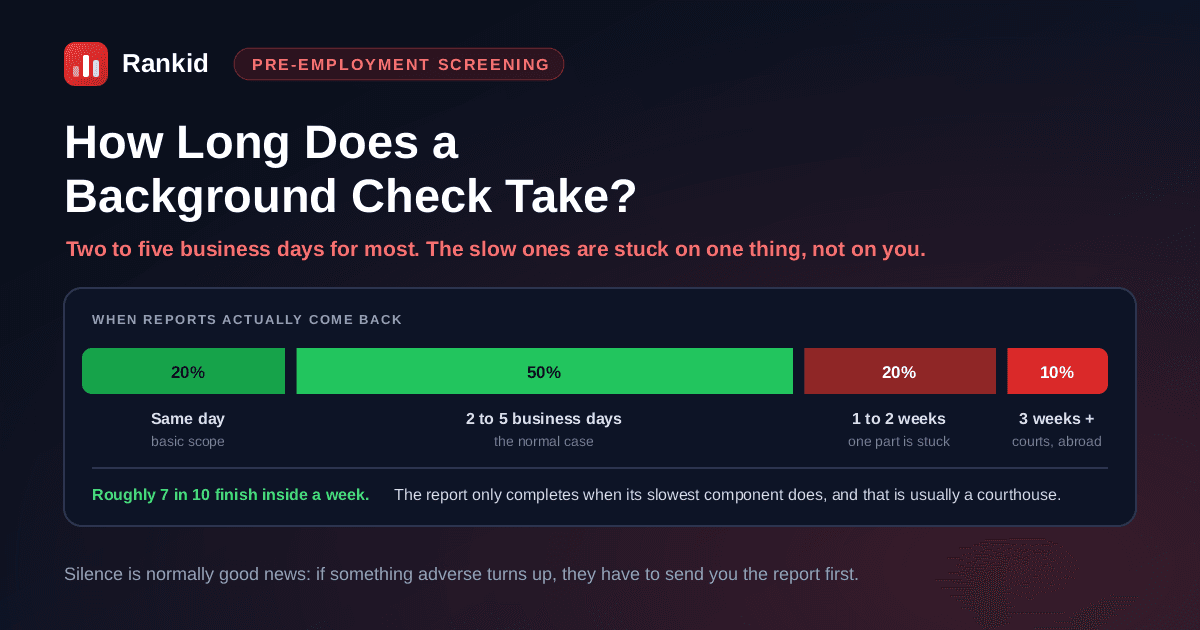
You interviewed well, the offer arrived, you signed a form authorising a background check, and then everything went quiet. Search for how long it takes and every result says two to five business days, which is true, unhelpful, and does nothing for the specific problem you have, namely that it is now day nine. The average is misleading because a background check is not one process. It is six or seven separate lookups running in parallel, and the report only completes when the slowest one does. Understanding which component is slow tells you both how long you are likely to wait and whether it has anything to do with you, which it usually does not.
Quick answer
Two to five business days for most checks, one to two weeks end to end including paperwork. Around seven in ten finish inside a week. The slow ones are almost always stuck on a single component: county court records pulled by hand, education verification, a former employer who no longer exists, or any history in another country. Silence is normally good news, because if something adverse turns up the employer has to send you a copy of the report before deciding. Past ten business days, ask the recruiter one question: has the report come back yet?
How long does a background check take, really?
A typical pre-employment check completes in two to five business days. A minimal one, covering identity validation and a national criminal database search, can come back the same day. The useful number is not the average though, it is the shape of the distribution: most reports are quick, and a meaningful minority take two to three weeks because one component is stuck while everything else sits finished.
This is the part the standard answer hides. Your report is not being reviewed by a person for a fortnight. It is waiting on a courthouse clerk, a registrar or a phone call.
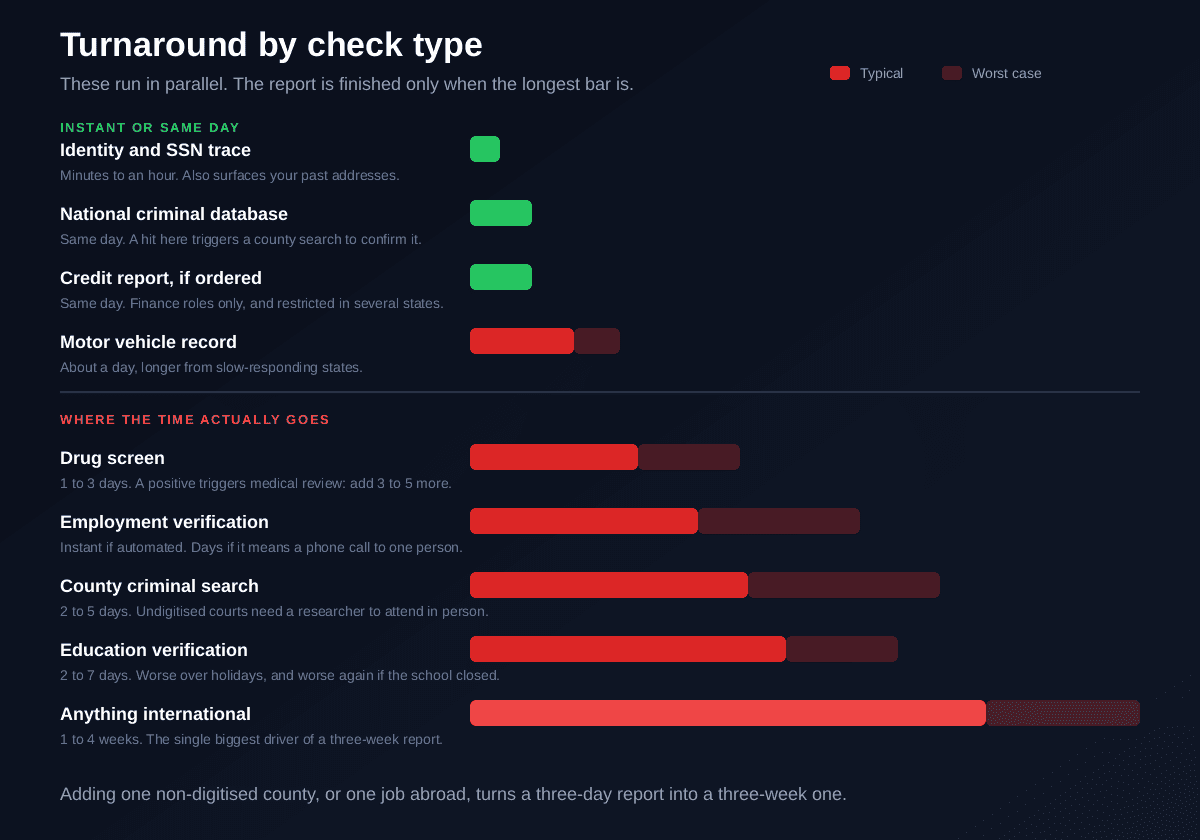
Read that chart as a set of parallel races rather than a sequence. The employer receives nothing until the last bar finishes, which is why adding a single international component or one non-digitised county to an otherwise instant report turns three days into three weeks.
Two clocks, not one
What shows up on a background check, and what does not
There is no single database that returns everything about a person. A background report is assembled from separate sources, each with its own rules, and what appears depends on what the employer ordered for that role. A warehouse job and a bank job are screened very differently.
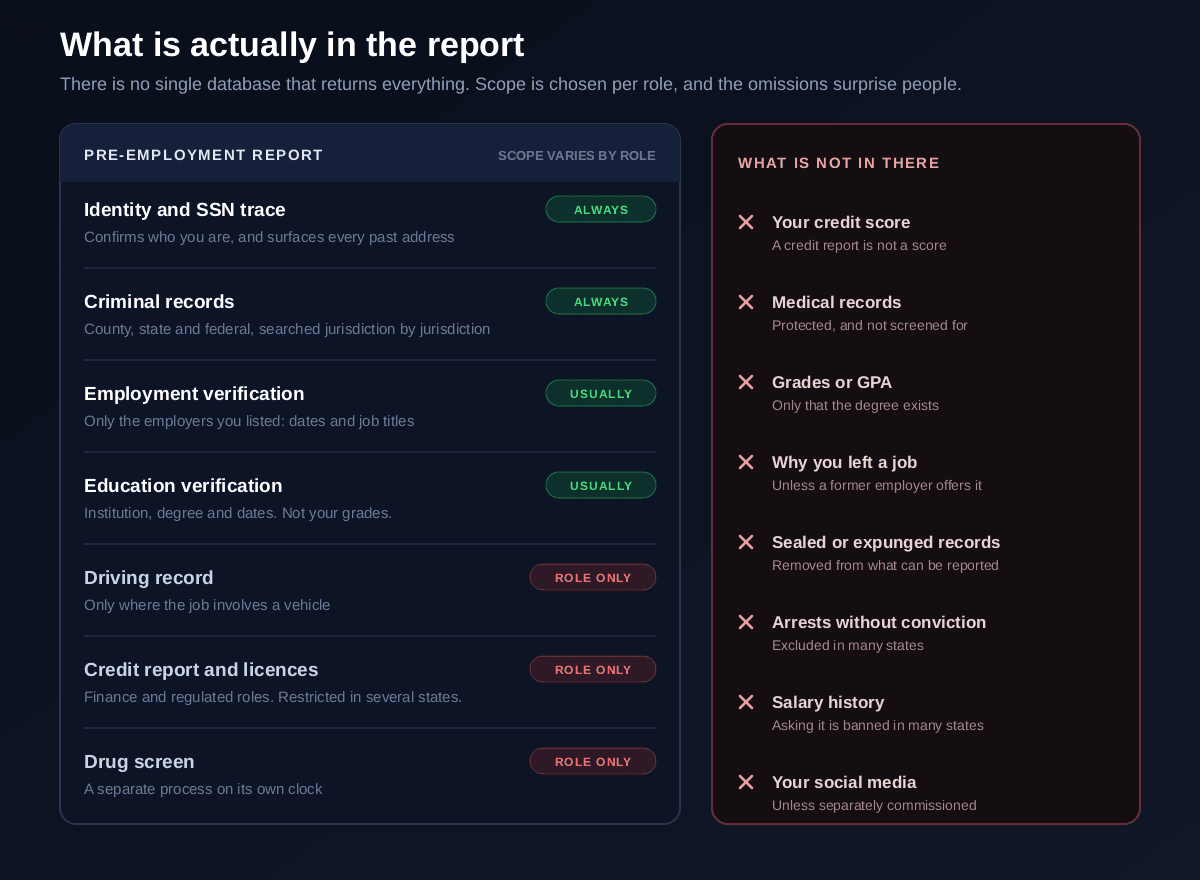
The omissions matter as much as the inclusions. Employers see whether your dates and titles check out; they do not see your credit score, your medical history or, in most cases, why you left. If you are worried about how a departure will be described, the honest framing is something you control in the interview rather than something the report exposes, and our guide to explaining why you left a job covers the harder versions of that conversation.
How far back does a background check go?
Seven years is the reflexive answer and it is roughly right, with three complications worth knowing.
- Non-conviction information: seven years. Arrests that did not lead to a conviction, civil judgments, paid tax liens and collection accounts generally cannot be reported beyond that under federal law. Bankruptcies run to ten.
- Convictions: no federal time limit. Federal rules alone allow convictions to be reported indefinitely. Around a dozen states, California among them, impose their own seven-year cap that covers convictions as well.
- Salary changes the rules. The federal seven-year restrictions stop applying to roles above a salary threshold written into the law decades ago and never adjusted, so higher-paid positions can be screened further back.
- Verification has no lookback limit at all. Employment and education are facts to confirm rather than records to report, so an employer can verify a job from twenty years ago if they want to.
This varies by state, and it is not legal advice
Why your background check is taking so long
Nearly every long check is explained by one of seven things, and it is worth internalising that none of them are findings. They are logistics.
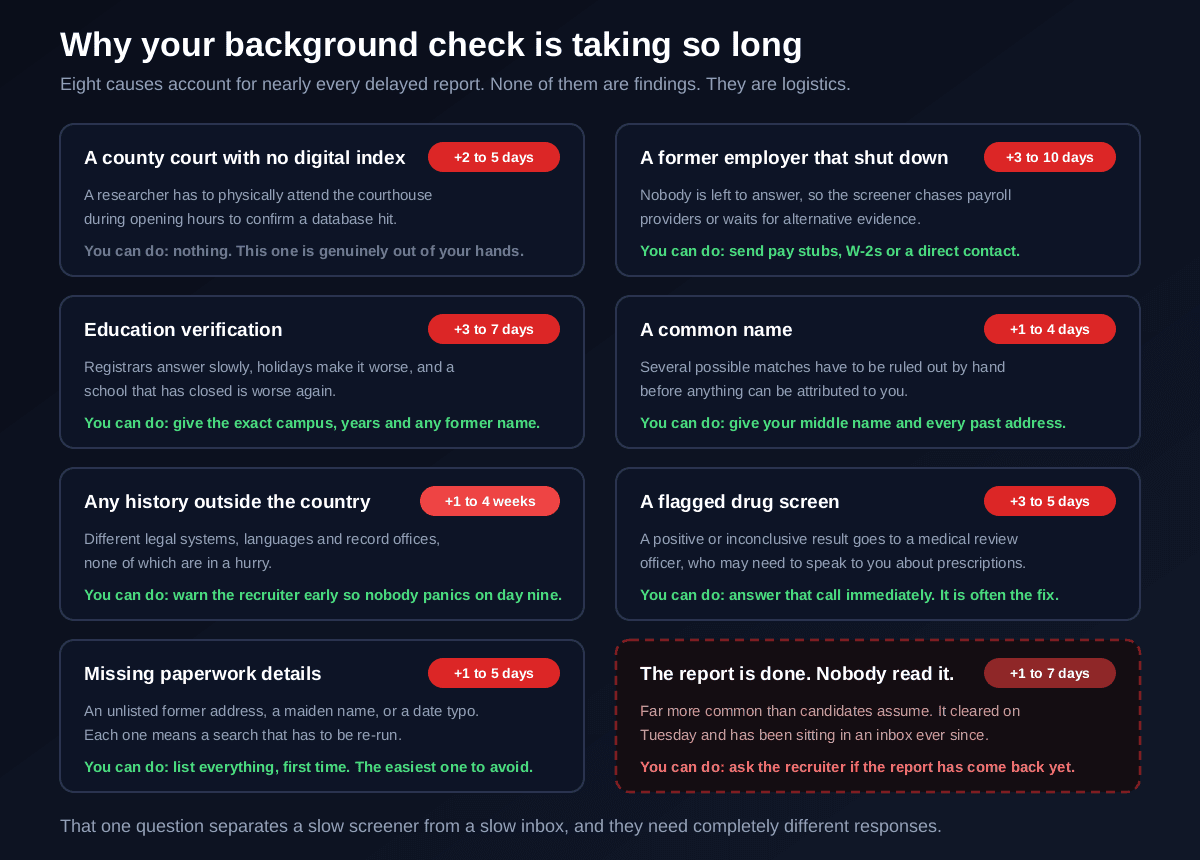
The county courthouse case surprises people most. A large number of United States county courts still have no searchable digital index, so a national database hit has to be confirmed at source by a court researcher physically attending the courthouse. That is a person, in a car, during opening hours, and it is why a report can be four days late for reasons that have nothing to do with the internet.
How do you know if you passed?
Usually nobody tells you, which is why the wait is unnerving. There is rarely a pass message, because employers contact candidates about reports they intend to act on.
- Procedural signals are the real answer. A start date, onboarding paperwork, an equipment request or an IT account setup all mean the report cleared.
- Check the candidate portal. Most screening companies give you a login where the status reads complete, clear or pending.
- You can request the report. You have a right to a copy of a consumer report run on you, and asking for it is unremarkable.
- Silence is a good sign, not a bad one. If an employer intends to reject you over the report, the law requires them to send it to you first. No news genuinely means no news.
Check your resume before the verification stage does
Verification compares your resume against what former employers confirm. Paste your resume and the job description into Rankid's free checker to see how your claims read, which requirements you actually evidence, and where the gaps are.
Check your resume freeIf something turns up: the adverse action process
This is the part almost nobody knows exists, and it is the most useful thing in this article. An employer who uses a third-party screening company cannot simply reject you on the quiet because of what the report says. Federal law requires a two-stage process with a window in the middle that belongs to you.
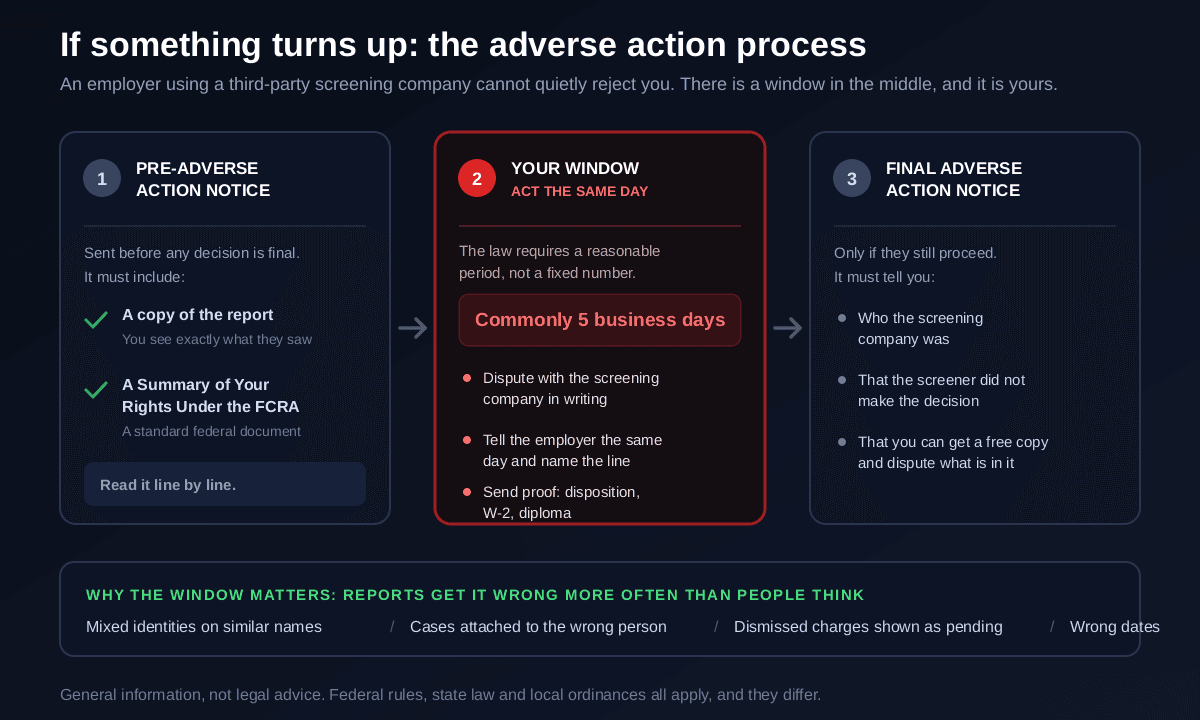
Pre-adverse action notice
Before any decision is final, the employer must send you notice that includes a copy of the report itself and a document called A Summary of Your Rights Under the FCRA. You can see precisely what they saw. Read the report line by line rather than skimming for the worst item.
Your window, commonly five business days
The law requires a reasonable period rather than a fixed number, and five business days is the standard industry convention. This is your time to act, and background reports contain errors more often than people expect: identities mixed up on common names, cases attached to the wrong person, dismissed charges shown as pending, and simply wrong dates.
Final adverse action notice
If the employer proceeds, they send a second notice naming the screening company, confirming that the screening company did not make the decision, and restating your right to a free copy of the report and to dispute what is in it.
What to do if the report is wrong
Act the same day, in writing, and do these three things in parallel rather than in sequence, because the window is measured in days.
- File a dispute with the screening company named on the report. They are obliged to reinvestigate, generally within 30 days, and to correct or delete anything they cannot verify.
- Tell the employer in writing the same day. Name the specific line you are disputing and ask them to hold the decision pending reinvestigation. Many will, and a vague complaint will not get the same response as a precise one.
- Gather the proof. A court disposition showing a case was dismissed, pay stubs, W-2s or an offer letter for employment dates, a diploma or transcript for education.
- Dispute the line, not the report. Targeted corrections resolve quickly. General objections read as an argument rather than a correction.
What you can actually do to speed it up
- Return the authorisation the hour it arrives. The single biggest avoidable delay, and entirely yours.
- List every address for the lookback period. Criminal records are searched by jurisdiction, so a missing address is a missing search, and it will be caught later rather than skipped.
- Include former and maiden names. Records filed under a previous name are a classic cause of a two-week report.
- Give exact employment dates, not approximations. Month and year, matching payroll, not what you remember.
- Supply a direct contact for any employer that no longer exists, plus pay stubs, W-2s or tax records as alternative evidence.
- Warn them about anything you already know is there. A conviction you disclose is a conversation; the same conviction discovered after you implied there was nothing is a credibility problem.
- Check your own dates against your resume before you submit it. Discrepancy, not history, is what actually costs people offers.
That last point is worth dwelling on. Verification compares your resume to reality, so any date you rounded generously when you were papering over a gap becomes a contradiction at exactly the wrong moment. If your dates are awkward, the fix is to present them honestly on the resume itself, and our guide to explaining employment gaps shows how to do that without weakening the application.
Can an offer be rescinded after a background check?
Yes, which is why most offers made before screening are explicitly contingent on a satisfactory check. What surprises people is the ranking of causes. Offers are pulled far more often for a discrepancy than for a criminal record: employment dates that do not match, a title inflated past what the former employer will confirm, or a degree claimed but never completed.
The reason is that the finding is never the only thing being weighed. The employer is also deciding what the gap between your account and the record tells them about working with you. A dismissed charge from eight years ago that you mentioned is usually survivable. A degree you did not finish, discovered by a registrar, usually is not, because it is not a fact about your past, it is a fact about your last few weeks.
Where a withdrawal is based on a third-party report, the adverse action process above applies. Several jurisdictions additionally require an individualised assessment of how the specific conviction relates to the specific job before an offer can be pulled.
For employers: why your checks stall
If you are on the hiring side, screening turnaround is one of the quieter causes of losing candidates, because a strong candidate with two offers rarely waits out a three-week silence.
- Order the right scope for the role. Adding checks a job does not need is the most common self-inflicted delay, and each extra component only ever makes the report slower.
- Send the disclosure and authorisation immediately, and keep the disclosure a standalone document, which is a legal requirement people breach by burying it in a longer offer pack.
- Tell the candidate the expected timeline and that silence is normal. Most anxious follow-ups are caused by never having been given a number.
- Assign someone to read completed reports daily. Reports sitting unread in an inbox are a surprisingly large share of total wait time.
- Screen consistently across candidates for the same role. Inconsistent scope is both a fairness problem and a legal exposure, in the same way that inconsistent resume screening criteria are earlier in the funnel.
Key takeaways
- Most background checks finish in two to five business days; budget one to two weeks end to end including paperwork.
- A report completes only when its slowest component does. One non-digitised county can add a week on its own.
- The common delays are logistics, not findings: courthouses, closed employers, registrars, common names, international history.
- Seven years is the rough lookback, but convictions have no federal limit and state rules and salary thresholds both change it.
- There is usually no pass message. A start date or onboarding paperwork is the real signal.
- If something adverse turns up, you must receive a pre-adverse action notice with a copy of the report first.
- You get a window, commonly five business days, to dispute errors. Dispute the specific line, in writing, the same day.
- Offers are withdrawn for discrepancies far more often than for criminal records. Check your own dates before you submit.
The honest summary is that a background check is a waiting problem far more than a judgment problem. Two to five days is normal, ten days means one component is stuck, and three weeks usually means a courthouse or a registrar rather than a decision about you. Return the paperwork immediately, list every address and former name, make sure your dates match reality, and if the wait passes ten business days, ask the recruiter the one question that separates a slow screener from a slow inbox. And since verification is ultimately a comparison between your resume and the record, it is worth making sure the resume itself is accurate and complete before it ever gets that far: paste it into Rankid's free resume checker alongside the job description and see how it actually reads. If you are still earlier in the process and simply waiting to hear anything, our guide to how long it takes to hear back after applying has the realistic timelines for every stage before this one.
Frequently asked questions
How long does a background check take?
Most pre-employment background checks come back in two to five business days, and a straightforward one covering a national criminal database search and an identity check can finish the same day. The distribution matters more than the average, though: roughly seven in ten finish inside a week, and the remainder stretch to two or three weeks because of one slow component rather than the whole report. The usual culprits are county courthouse records that have to be pulled by hand, education verification from a registrar that answers slowly, employment verification with a former employer who has no HR department left, and any history outside the country you are being hired in. If you are past ten business days with no news, the report is almost certainly waiting on one specific item, not on a decision about you.
How long does a background check take for a job offer to be confirmed?
Budget one to two weeks between signing the authorization and the offer being confirmed, even though the check itself is often faster. Two things sit either side of the screening. Before it, the employer has to send you the disclosure and authorization paperwork and you have to return it, which frequently loses two or three days to nothing but email. After it, someone at the company has to actually read the completed report and release the start date, and that person may be on leave, in back-to-back interviews, or waiting on a second approver. Candidates routinely assume a delay is the screening company when the report has been sitting complete in an inbox since Tuesday. If you are past a week, ask the recruiter directly whether the report has come back yet, because that single question separates the two very different causes.
What shows up on a background check?
A standard employment check typically covers identity and Social Security number validation, criminal records at county, state and federal level, and verification of the employment and education you claimed. Depending on the role it may add a driving record for anything involving a vehicle, a credit report for finance and some management positions, professional licence verification, and a drug screen. What does not appear on a normal employment check surprises people: your credit score, medical records, school grades, the reason a previous job ended unless a former employer volunteers it, arrests that did not lead to a conviction in many states, sealed or expunged records, and your social media unless the employer separately commissions a compliant social media screen. There is no single national database that returns everything, which is exactly why the slow parts are slow.
How far back does a background check go?
Seven years is the usual working answer, but it depends on the item, the state and the salary. Under federal law, non-conviction information such as arrests that did not lead to a conviction, civil judgments, paid tax liens and collection accounts generally cannot be reported after seven years, and bankruptcies drop off after ten. Criminal convictions have no federal time limit, so under federal rules alone they can be reported indefinitely. Two things change that. Around a dozen states, including California, impose their own seven-year cap that covers convictions too, and the federal seven-year limits stop applying when the job pays above a salary threshold set decades ago at $75,000. Employment and education verification are not restricted by a lookback window at all: an employer can verify a job from 1998 if they choose to.
Why is my background check taking so long?
In order of how often they cause it: a county criminal search where the court has no digital index, so a runner has to physically visit the courthouse, which adds two to five business days and much longer in a backlogged county; employment verification with a company that has been acquired, closed or has one person handling HR requests; education verification from a registrar during a holiday period or from a school that has shut down; a common name that produces multiple possible matches and requires manual disambiguation; any part of your history in another country, which routinely takes one to four weeks; a positive or inconclusive drug screen, which triggers a medical review officer step that adds several days; and simple paperwork friction such as a missing former address, a maiden name you did not list, or a typo in a date. Note that almost none of these are findings. They are logistics.
How do you know if you passed a background check?
There is usually no pass notification, which is why the silence feels ominous. Most employers only contact you about the report if it contains something they intend to act on, so the strongest positive signal is procedural rather than verbal: you get a start date, onboarding paperwork, an IT equipment request or a first-day email. Many screening companies also give candidates a portal login where the status shows as complete or clear, and you have a right under federal law to request a copy of the report that was run on you. If something problematic did turn up, you will not simply be ghosted: an employer who uses a third-party screening company and decides not to hire you because of the report has to send you a pre-adverse action notice with a copy of the report first, so receiving nothing at all is generally good news rather than bad.
What is a pre-adverse action notice?
It is the letter an employer must send before rejecting you based on something in a background report prepared by a third-party screening company, and it is required by the Fair Credit Reporting Act. It has to include a copy of the report itself and a document called A Summary of Your Rights Under the FCRA, so that you can see exactly what the employer saw. The point of the notice is to give you a window to respond before the decision becomes final, which matters because background reports genuinely do contain errors: mismatched identities on common names, cases recorded against the wrong person, charges shown as pending that were actually dismissed, and dates that are simply wrong. The law requires a reasonable period before the employer finalises the decision rather than a fixed number of days, and five business days is the widely used industry convention.
What should I do if my background check has a mistake?
Move quickly and in writing, because the window between the pre-adverse action notice and the final decision is short. Do three things in parallel. Contact the screening company named on the report and file a formal dispute, which under federal law obliges them to reinvestigate, generally within 30 days, and to correct or delete anything they cannot verify. Tell the employer in writing, the same day, that you are disputing a specific item and ask them to hold the decision until the reinvestigation is complete, because many will. And gather the documents that prove your version, such as a court disposition showing a case was dismissed, a pay stub or W-2 confirming employment dates, or a diploma. Be specific about which line is wrong rather than disputing the report in general terms, since a targeted dispute is much faster to resolve.
Can a job offer be rescinded after a background check?
Yes, and this is precisely why most offers made before screening are written as contingent on a satisfactory background check. In practice, offers are pulled far more often for a discrepancy than for a criminal record: employment dates that do not match what you put on your resume, a job title inflated beyond what the former employer will confirm, or a degree claimed but not completed. The finding itself is rarely the whole problem, since the employer is also weighing whether you were straightforward with them. If the withdrawal is based on the contents of a third-party report, the adverse action process applies and you must receive a copy of the report plus an opportunity to respond first. Several states and cities additionally require an individualised assessment of how a specific conviction relates to the specific job before an offer can be pulled.
How long does an employment verification take?
Anywhere from a few seconds to a fortnight, and it is the single most variable component of a background check. If your former employer subscribes to an automated verification service, the answer comes back instantly. If it is a small company where verification means someone in HR returning a phone call, expect two to five business days, and considerably longer if that person is on holiday. The hard cases are employers who have been acquired, gone out of business or outsourced their records, where the screener has to chase payroll providers or accept alternative evidence. You can genuinely speed this up: supply the direct contact details of someone who can confirm your dates, and keep pay stubs, W-2s, tax records or offer letters ready as alternative proof for any employer that no longer exists.
How long does a background check take for gig work like DoorDash or Uber?
Usually far faster than a corporate hire, because gig platforms run a narrower check through a screening provider built for volume, and the process is largely automated. A clean result often comes back within a few minutes to two or three days, and it typically covers identity, a motor vehicle record where driving is involved, and a criminal search. The delays follow the same pattern as everywhere else: a county record that needs a manual pull, a name that matches several people, a recent address the system cannot verify, or a driving record from a state that responds slowly. Most platforms show a live status in the app, and if it has been stuck on pending for more than about a week the usual cause is one component waiting on a court or a motor vehicle agency rather than a decision anyone has made about you.
Do background checks show employment history you left off your resume?
Not automatically, because there is no master list of everyone you have ever worked for that an employer can simply pull. Verification is a targeted process: the screener checks the specific employers you listed. Some databases used for income and employment verification do hold payroll-derived records that can surface a job you did not mention, but that is not the standard mechanism. The real risk is not omission, it is contradiction, meaning dates that do not match what a former employer confirms, or a title they will not corroborate. Leaving a short or irrelevant role off a resume is normal and is not dishonesty. Stating that you worked somewhere until December when their records say August is what causes offers to be withdrawn, so it is worth checking your own dates before you submit anything.