How to Use ChatGPT to Tailor Your Resume to a Job Description (2026 Guide + Prompts)
ChatGPT can rewrite your resume for a specific job in about thirty seconds. That is the good news. The bad news is that it can also quietly invent a skill you never had, stuff the same keyword into four bullets, and hand you something that reads beautifully to you and scores badly with the software that actually decides whether a recruiter ever sees you. Used well, AI is the fastest way to tailor your resume to a job description. Used blindly, it is a fast way to get politely ignored. Here is how to do it right.
Quick answer
Why ChatGPT is so good, and so dangerous, for resumes
ChatGPT is a language model. It is exceptional at one thing that matters enormously for resumes: rephrasing what you already wrote to match the language of a target job. Applicant tracking systems and recruiters both reward that alignment, so an AI-assisted rewrite genuinely can lift your match score in minutes.
The danger comes from the same strength. A language model is built to produce text that sounds correct, not text that is true or that a real ATS will score well. It does not know your career, it cannot see the parser that will read your file, and when it is unsure it will confidently fill the gap with something plausible. That is how people end up applying with skills they cannot defend and bullet points that read like the job posting bounced back. Knowing exactly where the tool helps and where it hurts is the whole game.
The one rule that makes AI resumes safe
The five-step workflow to tailor your resume with ChatGPT
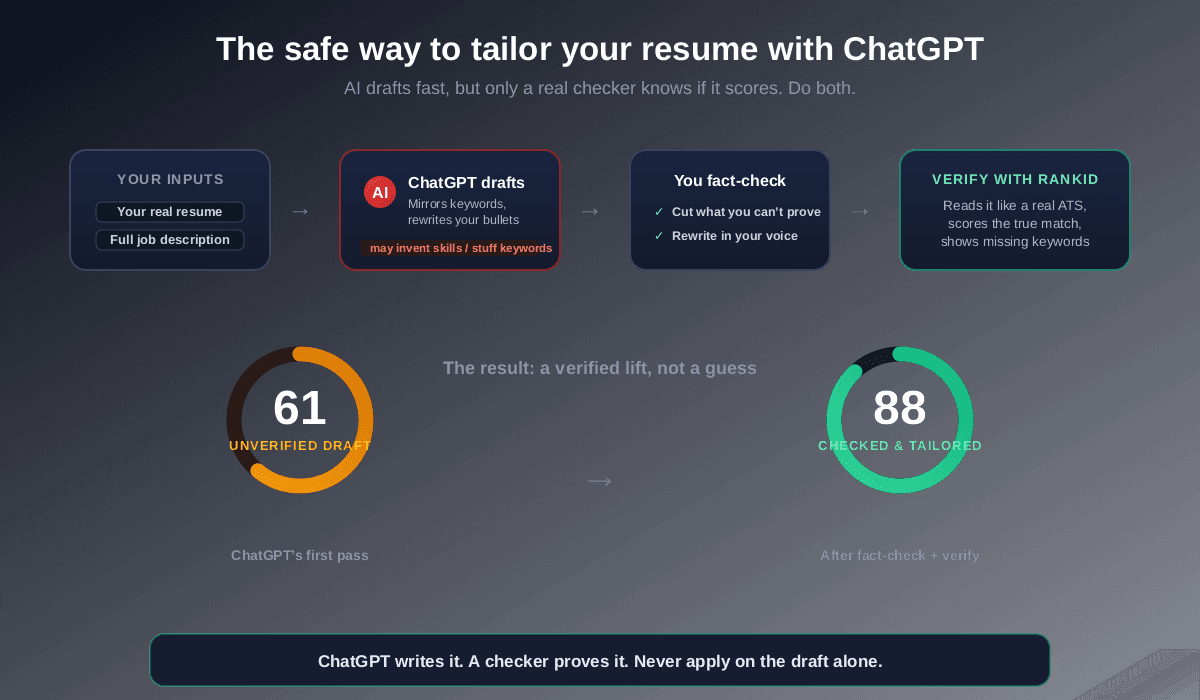
This is the full loop, from a blank prompt to an application you can actually trust. It takes about ten minutes per job and works for any role.
Give ChatGPT both your resume and the full job description
Paste your current resume in full, then paste the entire job posting, not just the responsibilities list. The required skills, tools, job title, and years of experience are the exact things you want the model to align with. Strip your home address and any sensitive identifiers out first, since your resume contains personal data.
Prompt it to rewrite with strict, honest rules
A vague prompt gives you generic filler. A strict prompt gives you a tailored, defensible draft. The rules do the work: use only true facts, mirror the posting's wording, and flag the gaps. Full copy-paste prompts are in the next section.
Fact-check every single line it produces
Read the draft as a skeptical hiring manager would. Delete any skill, tool, metric, or claim you cannot prove in an interview. If ChatGPT added a number you did not give it, either replace it with the real figure or cut it. This is the step people skip, and it is the one that saves the interview.
Rewrite the strongest lines in your own voice
Unedited AI text sounds like everyone else's unedited AI text. Take the bullets that matter most, the top of your most recent role, and rephrase them so they sound like you. Keep the keywords, lose the robotic cadence.
Verify the match with a real ATS checker before you apply
ChatGPT is guessing at how well you match. It cannot parse your file the way an applicant tracking system does or score you against the job. Run the finished draft through Rankid to see whether it parses cleanly, your 0 to 100 match score, and any required keywords still missing. Fix those, then apply.
Verify your ChatGPT-tailored resume before you apply
ChatGPT can't see the ATS. Rankid can. Paste your tailored resume and the job posting into Rankid to get a 0 to 100 match score, the skills you've matched, and the exact keywords you're still missing, so you send a resume that actually scores. Your first check is free, no signup needed.
Check your match freeThe best ChatGPT prompts to tailor your resume
Copy these, replace the bracketed parts, and paste your resume and the job description underneath. Each one is built to keep the output honest and job-specific.
1. The core tailoring prompt. This is your default:
Prompt: tailor to the job, honestly
2. The gap-finder prompt. Run this first if you want the truth before you rewrite anything:
Prompt: show me my gaps
3. The keyword-alignment prompt. For when your skills are real but your wording does not match, which is a common reason qualified resumes get rejected:
Prompt: match the wording
4. The summary and cover-letter prompt. Once your bullets are tailored:
Prompt: a summary that fits this role
Four mistakes that get AI-written resumes rejected
Almost every failed ChatGPT resume falls into one of these traps. Avoid them and you keep all the speed with none of the risk.
- Inventing skills and numbers.The model adds “increased revenue by 40 percent” or a framework you have never touched. It sounds great until an interviewer asks about it. Cut anything you cannot defend.
- Keyword stuffing. Cramming the same term into every bullet does not raise your score, it reads as low quality to both the ATS and the recruiter. Use each key term where it is genuinely earned. Our resume keywords guide shows how to do this naturally.
- Applying with the first draft. The first output is a starting point, not a finished resume. Generic AI phrasing and unverified claims both come straight from the raw draft.
- Trusting the model on formatting. ChatGPT can suggest structure but cannot see how your final file parses. A layout that looks clean can still scramble in an ATS, which is why you still need to test that it passes the ATS.
AI can add keywords, only you can add truth
ChatGPT vs an ATS checker: they do different jobs
People often ask whether they need a resume checker if they already have ChatGPT. They solve two different problems, and you want both.
- ChatGPT writes. It rephrases, aligns wording, drafts summaries, and suggests keywords. It is a writing assistant working from what you tell it.
- An ATS checker measures. It reads your actual file the way real screening software does, scores your match against the specific job, and shows the exact keywords you are still missing. It is a measurement tool working from the real posting.
Writing without measuring is guessing. Measuring without writing is diagnosing a problem you then have to fix by hand. The strong workflow is to draft with ChatGPT and confirm with a checker, the same way you would check how your resume matches a job description for any application. Recruiters run the same measurement at scale when they screen resumes with AI, so verifying your match is simply checking your work against the real scoreboard.
Key takeaways
- Give ChatGPT both your full resume and the full job description, not a vague request.
- Use strict prompts: mirror the posting's keywords, use only true facts, and flag your real gaps.
- Fact-check every line and cut anything you cannot defend in an interview.
- Rewrite the most important bullets in your own voice so it does not sound like generic AI text.
- ChatGPT cannot see the ATS. Verify the match with a checker like Rankid before you apply.
Bottom line: ChatGPT is the fastest resume-tailoring assistant you have ever had, as long as you keep it honest and never let it be the final word. Let it draft, cut everything you cannot prove, put it in your own voice, then run the result through Rankid's free resume checker to confirm it scores for the job before you hit apply. That is how you get AI speed and a resume you can stand behind.
Frequently asked questions
How do I use ChatGPT to tailor my resume to a job description?
Paste your current resume and the full job description into ChatGPT, then ask it to rewrite your experience to emphasize the skills and keywords the posting actually names, using only true information from your resume. Give it a clear rule: do not invent skills, titles, or numbers. Then verify the result against the job with a match checker like Rankid before you apply, because ChatGPT cannot see how a real applicant tracking system scores you.
What is the best ChatGPT prompt to tailor a resume?
A strong prompt gives ChatGPT three things: your real resume, the full job description, and strict rules. For example: "Here is my resume and a job description. Rewrite my experience bullets to mirror the skills and exact keywords in the posting. Use only facts already in my resume, never invent skills or numbers, keep it to one page, and flag any requirement I do not appear to meet." The last instruction is the most useful, because it surfaces your real gaps instead of papering over them.
Does a resume written by ChatGPT pass the ATS?
It can, but not automatically. ChatGPT is good at matching wording and adding relevant keywords, which helps. It does not know how a specific applicant tracking system parses your file, and it will happily produce keyword-stuffed or generic text that reads as low quality. The safe workflow is to let ChatGPT draft, then run the result through an ATS and match checker like Rankid to confirm it parses cleanly and actually scores well for that job.
Will employers know my resume was written with ChatGPT?
There is no reliable AI detector for resumes, and recruiters care far more about relevance than authorship. The real risk is not detection, it is that unedited AI text sounds generic, repeats the job posting too literally, or claims skills you cannot defend in an interview. Use ChatGPT to draft and sharpen, then rewrite in your own voice and cut anything you cannot back up.
Is it safe to paste my resume into ChatGPT?
Your resume contains personal data, so treat it accordingly. Remove your full home address and any sensitive identifiers before pasting, and check your AI tool's data settings. The job description carries no personal risk, so you can always paste that in full. The tailored draft it returns is what you refine and verify offline.
What is the biggest mistake people make tailoring a resume with ChatGPT?
Trusting the first draft and applying with it. ChatGPT optimizes for sounding right, not for being true or for passing a real ATS. The two failure modes are inventing skills you do not have, which collapses in the interview, and keyword stuffing, which reads as low quality. Always fact-check every line and verify the match score against the actual job before you send it.