How to Write a Resignation Letter: 7 Templates for Every Situation
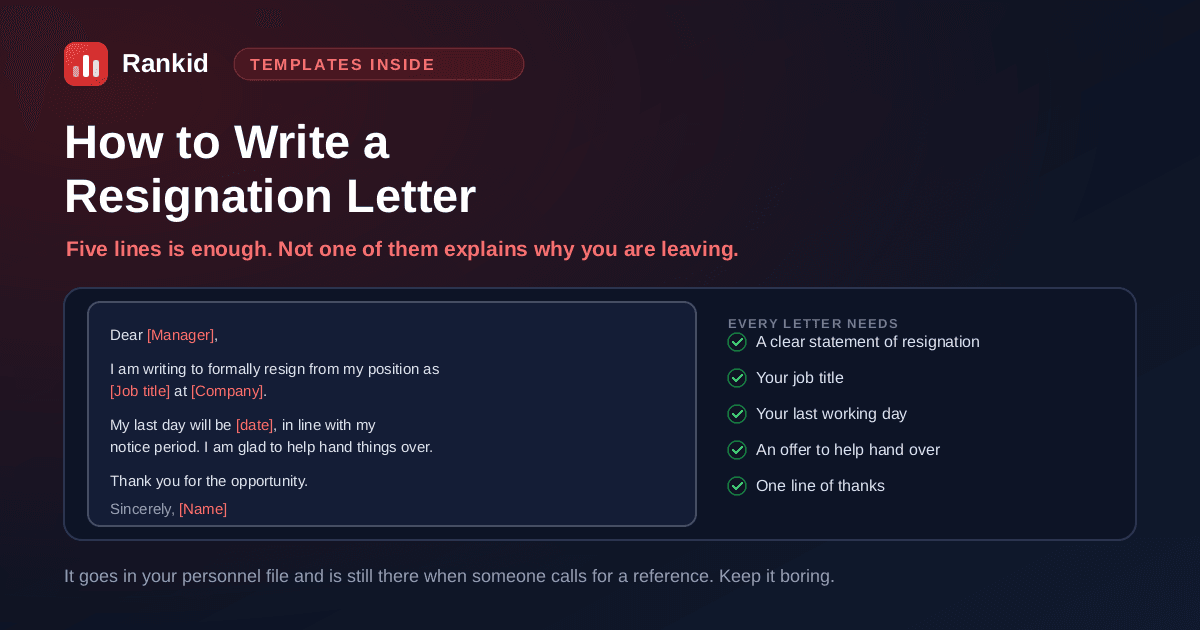
A resignation letter is the easiest document in your career to overthink. It is not a farewell, not a performance review of your employer, and not the place to explain yourself. It is an administrative record with five required facts in it, and it will sit in your personnel file long after everyone has forgotten the conversation. Here are seven templates you can copy for whatever situation you are in, the five things that must never go in one, and the sequence that matters considerably more than the wording.
Quick answer
Five lines is enough: that you are resigning, your job title, your exact last working day, an offer to help hand over, and one line of thanks. Leave out your reason, any criticism, your new employer, and your new salary. Tell your manager out loud first, then send the letter the same day with HR copied. And never resign until the new offer is signed.
The simple resignation letter, in full
If you want one template and nothing else, this is it. It works for the overwhelming majority of resignations, and it is deliberately short.
Template 1: standard two weeks notice
The default. Works in almost any situation.
Subject: Resignation, [Your name]

Dear [Manager's first name],

I am writing to formally resign from my position as [Job title]
at [Company name]. My last day of work will be [day, date],
which gives two weeks' notice from today.

I am glad to help with the handover and to document my current
projects before I go.

Thank you for the opportunities I have had here. I have valued
working with the team.

Sincerely,
[Your name]
[Phone] | [Personal email]
That is 70 words of body text and it is genuinely complete. Notice what is absent: no reason for leaving, no mention of where you are going, no feedback, and no apology. Every one of those omissions is deliberate.
What every resignation letter must contain
There are six components, and they are not equally important. Two are non-negotiable, two protect your reference, and two are simple admin.
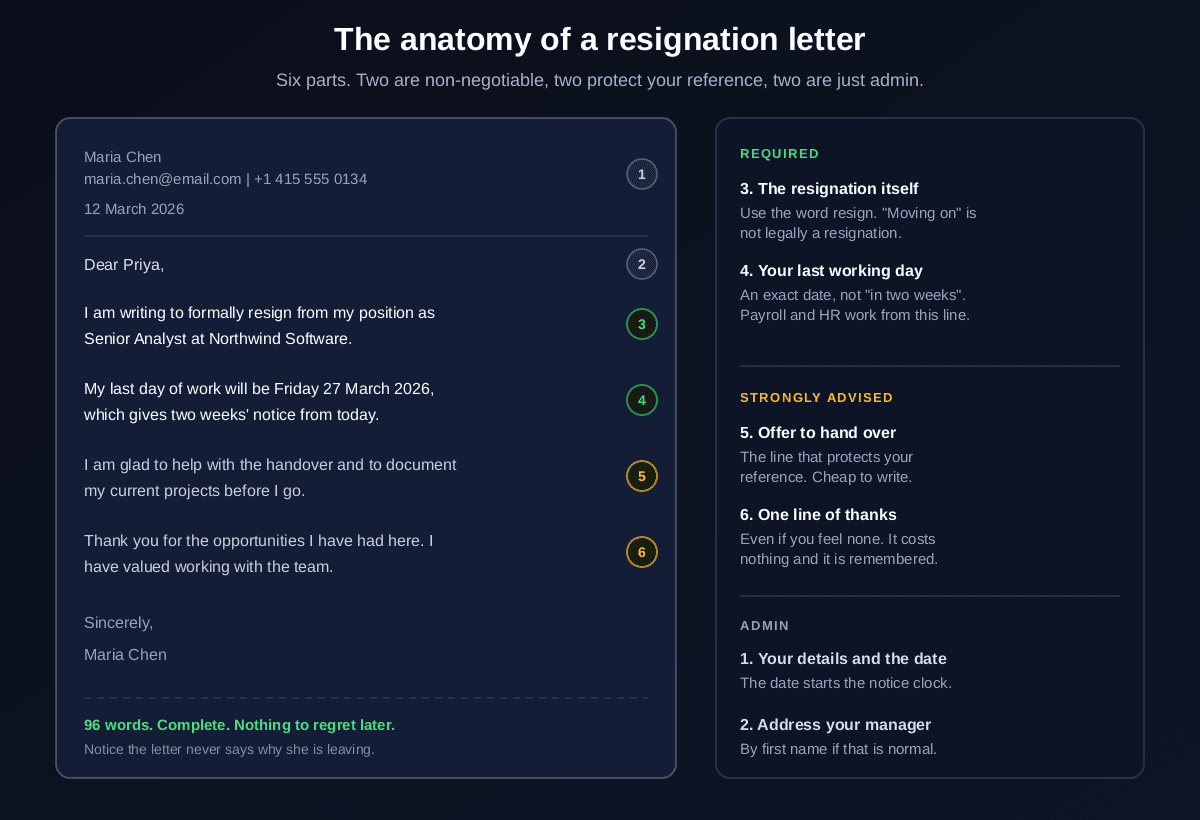
- Use the word "resign".This is the one piece of wording that genuinely matters. "I have decided to move on" or "this will be my last month" is ambiguous, and ambiguity about whether you actually resigned creates real problems around final pay and notice dates. Write "I am writing to formally resign from my position as [title]".
- Give an exact date, not a duration."My last day will be Friday 27 March" rather than "I am giving two weeks". Payroll, HR and IT all work backwards from that single date, and a duration invites a disagreement about which day it lands on. Count your notice from the day you send the letter and check it against your contract.
- Offer to help hand over. One sentence, and the cheapest line in the letter. It costs you nothing to write and it is the sentence a manager remembers when someone later asks what you were like to work with.
- Say thank you, even if you do not mean it. One line. You are not certifying that the job was good, you are declining to make an enemy on the record.
What to leave out, and why
This is the part most templates skip, and it is where the actual risk sits. Your resignation letter is filed permanently. It can be pulled up years later, and in disputes it becomes evidence.
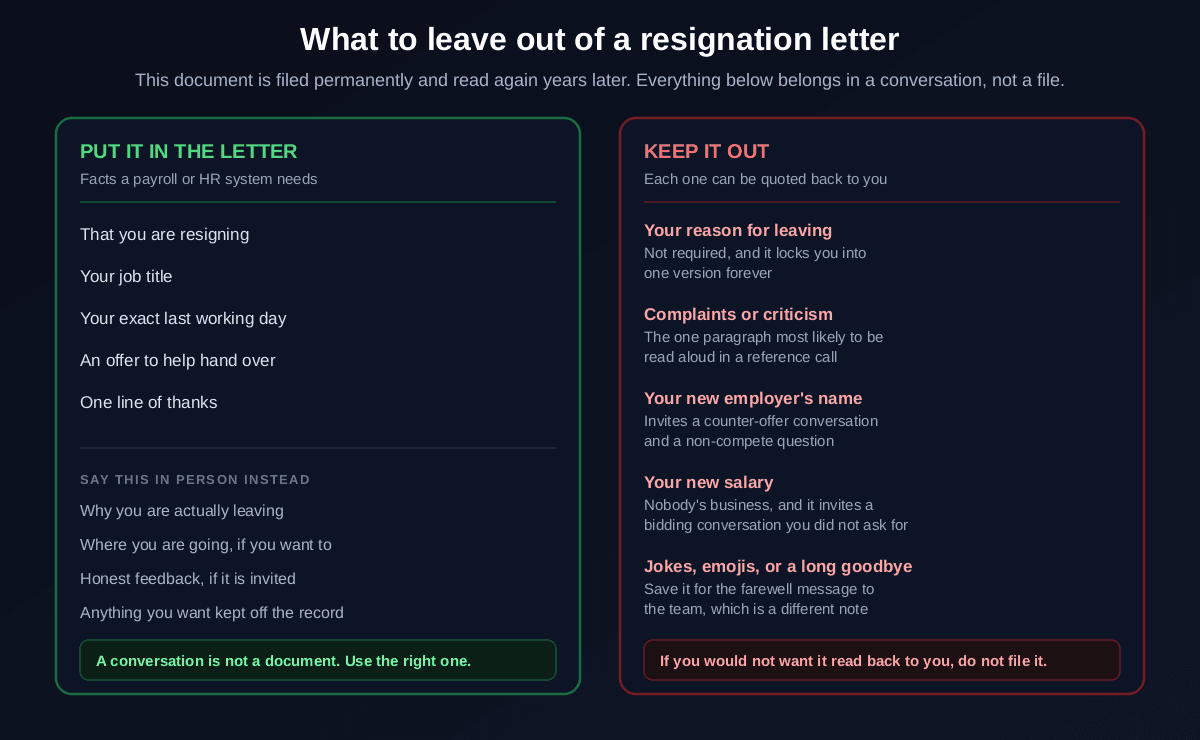
Your reason for leaving.Never required, and putting it in writing commits you to one version permanently. You will be asked in the conversation and in the exit interview, and those are conversations rather than filed documents. If you want something on the record, "to pursue a new opportunity" reveals nothing. The fuller question of how to frame this to your next employer is covered in our guide to your reason for leaving a job.
Any criticism at all. Even mild, even fair, even if you were asked. A grievance paragraph in a resignation letter is the single most quotable thing you can produce, and it is why some people find a former employer strangely unhelpful years later. If you genuinely want to give feedback, the exit interview is the venue and you can decide there how candid to be.
Your new employer and your new salary. Both invite conversations you did not ask for: a counter-offer, a question about a non-compete, or a comparison you have no reason to be drawn into. You can tell your manager verbally if the relationship is good and you want to.
The one test to apply
The order matters more than the wording
Most resignations that go badly do not go badly because of the letter. They go badly because of the sequence.
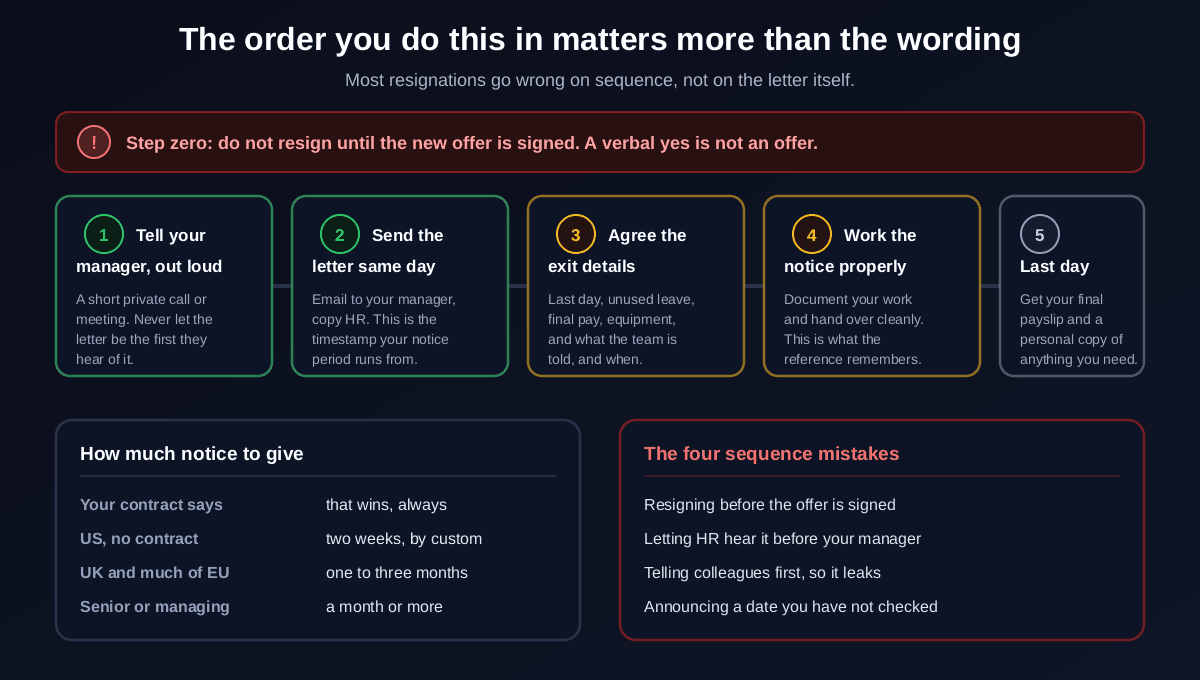
Step zero deserves its own sentence: do not resign until the new offer is signed.A verbal yes, a recruiter's enthusiasm, and a "paperwork is just a formality" are not offers. Offers get pulled, headcount gets frozen, and background checks occasionally turn up administrative problems. Wait for the signed contract and, where relevant, a cleared background check. The number of people who resign on a phone call and then spend three months unemployed is not small.
After that, the order is: tell your manager in a short private conversation, send the letter the same day with HR copied, agree the practical details, then work your notice properly. The most common misstep is letting the letter or HR reach your manager first, which is remembered specifically and for a long time.
On notice length: your contract wins, always. Absent a contract, two weeks is the US custom, one to three months is normal in the UK and much of Europe, and more is worth considering if you manage people or hold client relationships. Working your notice well is what actually protects your reference, far more than anything in the letter.
Still interviewing? Resign only after the offer is signed
If you are writing this letter in advance of an offer, pause. Get the new role locked down first: paste your resume and the job description into Rankid's free checker for a 0 to 100 match score and the exact requirements you are still missing.
Check your match freeSix more templates for specific situations
Find the one that matches your situation. All of them are complete and safe to send as written, once you fill in the brackets.
Template 2: the three-line version
When you want the absolute minimum. Still complete.
Dear [Manager's first name],

I am writing to formally resign from my position as [Job title]
at [Company name]. My last day will be [day, date].

Thank you for the opportunity. I am happy to help with the
handover before I leave.

Sincerely,
[Your name]
Template 3: resignation email
The most common way this is actually sent. Body of the email, not an attachment.
Subject: Resignation, [Your name]
To: [Manager]   Cc: [HR]

Hi [Manager's first name],

Following our conversation this morning, I am writing to confirm
formally that I am resigning from my position as [Job title].
My last day of work will be [day, date].

I will make sure my projects are documented and handed over
before then, and I am happy to help however is most useful.

Thank you for everything I have learned here.

Best regards,
[Your name]
[Phone] | [Personal email]
Template 4: immediate resignation
Shorter and more neutral than you will feel like being. That is deliberate.
Dear [Manager's first name],

I am writing to resign from my position as [Job title] at
[Company name] with immediate effect, as of today, [date].

I appreciate that this is shorter notice than usual and I am
sorry for the disruption. I am willing to answer questions by
email over the next week to help with the transition.

Please let me know the process for returning equipment and for
my final pay and any accrued leave.

Sincerely,
[Your name]
[Phone] | [Personal email]
Template 5: short notice, less than your contractual period
Ask rather than announce, and name what you will do to soften it.
Dear [Manager's first name],

I am writing to formally resign from my position as [Job title]
at [Company name]. I am asking to finish on [day, date], which
is shorter than my contractual notice period of [period].

I understand this is less notice than agreed and I would like to
make it work as smoothly as possible. Before I go I will
document my open projects, write handover notes for [specific
responsibilities], and brief [colleague] on anything urgent.

I am happy to discuss the date if that helps.

Sincerely,
[Your name]
Template 6: warm version, when you genuinely liked the job
Slightly longer is fine here. Still no reason for leaving.
Dear [Manager's first name],

After a great deal of thought, I am writing to formally resign
from my position as [Job title] at [Company name]. My last day
of work will be [day, date].

I am grateful for the [number] years I have spent here. Working
on [specific project or area] taught me a great deal, and the
support you gave me on [specific example] genuinely shaped how
I work.

I want to leave things in good order, so I will document my
projects and put together a full handover for whoever takes
this on. Please tell me how I can be most useful in these
final weeks.

Thank you for everything.

With appreciation,
[Your name]
Template 7: minimal and neutral, for a difficult situation
When the relationship has broken down. Say nothing that can be quoted.
Dear [Manager's full name],

I am writing to formally resign from my position as [Job title]
at [Company name]. My last day of work will be [day, date], in
line with my notice period.

Please confirm the arrangements for my final pay, any accrued
leave, and the return of company property.

Regards,
[Your name]
On template 7
The mistakes that actually cost people something
- Resigning before the offer is signed. The only genuinely expensive mistake on this list.
- Writing the reason in. Free to omit, permanent once included.
- Letting HR or the letter reach your manager first. Remembered longer than anything you write.
- Announcing a last day you have not checked against your contract. Recalculating it afterwards looks careless and can cost you leave payout.
- Telling colleagues before your manager. It always leaks, and it always leaks upward.
- Coasting through the notice period. The two weeks after you resign are, unfairly, what people remember most clearly about working with you.
- Not keeping a copy. Forward the letter to your personal email before your access is cut, along with anything else you are entitled to keep.
- Accepting a counter-offer without thinking. If a resignation is what it took to get the raise, ask yourself what happens at the next review.
Write and send yours in five steps
Confirm the new offer is signed
Signed contract in hand, and background check cleared if there is one. Nothing below this line happens before that.
Check your contract and calculate the exact date
Find your notice period, count forward from today, and land on a specific day. Check it against pay periods and benefits dates while you are there, and confirm what happens to unused leave.
Tell your manager out loud
A short private conversation, early in the week rather than on a Friday afternoon. Two sentences is enough: you are resigning, and your last day is [date]. Expect to be asked why, and have a brief neutral answer ready.
Send the letter the same day
Pick the template above that matches your situation, fill in the brackets, and send it from your work email to your manager with HR copied. Subject line "Resignation, [Your name]". Forward a copy to your personal email.
Work the notice like it counts
Document your projects, write the handover notes nobody asked for, and stay engaged to the last day. This, not the letter, is what shapes the reference. If you are still job hunting after this one, keep your work history current and tailored to each role.
Key takeaways
- Five lines is a complete resignation letter: the resignation, your title, your exact last day, a handover offer, one line of thanks.
- Use the word "resign" and give a specific date, not a duration. Ambiguity causes real problems with pay and notice.
- Never put your reason, any criticism, your new employer, or your new salary in writing.
- Tell your manager out loud first, then send the letter the same day with HR copied.
- Never resign until the new offer is signed. A verbal yes is not an offer.
- Your contract sets your notice period. Two weeks is US custom; one to three months is normal in the UK and EU.
- Resign early in the week, not on a Friday afternoon, so your manager can actually act on it.
- The notice period protects your reference far more than the letter does. Hand over properly.
So, how do you write a resignation letter? Badly, if you treat it as a farewell or a chance to be heard. Well, if you treat it as a form: five facts, no reasons, no feelings, sent after you have already told your manager and after the new offer is signed. Copy whichever template above fits your situation, keep it under a hundred words, and put your real effort into the handover, which is the part anyone will actually remember. And if you are writing this in advance of an offer you have not received yet, close that gap first: paste your resume and the job description into Rankid's free resume checker and see exactly what is standing between you and the role you want to resign for.
Frequently asked questions
How do you write a simple resignation letter?
Five short lines cover it. State that you are resigning, give your job title, give your exact last working day, offer to help with the handover, and add one line of thanks. A complete letter reads: "Dear [Manager], I am writing to formally resign from my position as [Job title] at [Company]. My last day of work will be [date], in line with my notice period. I am glad to help hand over my projects before I go. Thank you for the opportunities I have had here. Sincerely, [Your name]." That is under 70 words and it is genuinely enough. The letter is an HR record rather than a farewell, so length adds risk without adding value. Say the warmer things in person and to your team separately.
What should you not put in a resignation letter?
Five things. Your reason for leaving, which is never required and locks you into one version permanently. Complaints or criticism, which is the paragraph most likely to be read back to you later. Your new employer's name, which invites a counter-offer conversation and a non-compete question you may not want. Your new salary, which is nobody's business and starts a bidding discussion you did not ask for. And jokes, emojis or a long emotional goodbye, which belong in a separate message to your team rather than in a document filed with HR. The test to apply to every sentence is simple: this letter goes into your personnel file and may be read again years later when someone calls for a reference, so if you would not want a line read back to you in that call, leave it out.
How much notice should I give when I resign?
Whatever your contract says, because that overrides custom every time. Check your offer letter or employment agreement first. If there is no contractual notice period, two weeks is the standard expectation in the United States, though it is a courtesy rather than a legal requirement in at-will employment. In the UK and much of Europe, contractual notice of one to three months is normal, and senior or managing roles are frequently longer. If you manage people, hold client relationships, or are mid-project, giving more than the minimum is worth considering purely for the reference. Giving less than the contractual period can in principle expose you to a claim and, far more commonly, costs you the good reference and any rehire eligibility.
Should I resign in person or by email?
Both, in that order, on the same day. Tell your manager first in a short private conversation, in person or on a call, then send the written letter by email immediately afterwards with HR copied. The conversation is the courtesy, and getting it the wrong way round is the single most common resignation mistake: a manager who learns you are leaving from a forwarded email, or from HR, will remember that specifically. The written version matters too, because it timestamps your notice period and creates the record everyone works from. If your manager is unreachable for days and your notice window is tight, send the letter and say in it that you would welcome a conversation as soon as they are free.
Can I resign with immediate effect?
You can resign at any time, but leaving without working your notice has consequences worth weighing. In at-will US employment you can usually walk, though you may forfeit accrued leave payout depending on state and policy, and you will almost certainly lose the reference and rehire eligibility. Where you have a contractual notice period, leaving early is a breach, and while employers rarely pursue it, they can withhold discretionary payments and will note it on your file. Genuine reasons for immediate departure do exist, including safety, harassment, health, or a serious family emergency, and in those cases keep the letter shorter and more neutral than you feel like being: state that you are resigning with immediate effect, give the date, and stop. Ask about your final pay and leave separately, in writing.
Do I have to give a reason for leaving in my resignation letter?
No, and in most cases you should not. There is no requirement to explain yourself in the letter, and a reason in writing works against you in two ways: it commits you to one version of events permanently, and it turns a neutral administrative document into something arguable. "I am writing to formally resign from my position as [title]" is complete on its own. You will be asked why, most likely in the conversation with your manager and again in an exit interview, and those are the right places to answer because they are conversations rather than filed documents. If you want a warmer framing on the record, "to pursue a new opportunity" is the standard neutral phrase and reveals nothing.
Should I resign on a Friday or a Monday?
Early in the week is generally better, and the reason is practical rather than superstitious. Resigning on a Monday or Tuesday gives your manager the rest of the week to process it, talk to HR, and start planning cover while you are still there to discuss it, which makes you look considerate and keeps the conversation constructive. A Friday afternoon resignation leaves your manager stewing over a weekend with no ability to act, and it reads as an attempt to avoid the follow-up conversation. There is also a payroll angle worth checking: aligning your last day with the end of a pay period or a benefits month can simplify final pay and insurance coverage. Beyond that, the day matters far less than telling your manager before anyone else.
What is the best format for a resignation letter?
A short business letter, sent as the body of an email rather than as an attachment in most modern workplaces. Include your name and contact details, the date, a salutation to your manager by the name you normally use, three to five short paragraphs, and a plain sign-off such as Sincerely or Kind regards. Keep it to one page and well under 200 words. Send it from your work email to your manager with HR copied, and use a clear subject line such as "Resignation, [Your name]" so it is findable later. Forward a copy to your personal email before your access is cut, since you will want your own record of what you sent and when.
Will a resignation letter affect my reference?
The letter itself rarely helps you and can certainly hurt you, which is the main argument for keeping it brief. Most employers confirm only your dates, job title and whether you resigned or were terminated, so a warm letter buys you little. A letter containing criticism, however, sits in your file as evidence and can shape how a former manager talks about you informally, which is where real reference damage happens. What actually protects your reference is behaviour rather than prose: giving proper notice, documenting your work, handing over cleanly, and not going quiet for the final two weeks. Write the boring letter and put your effort into the notice period instead.