How Far Back Should a Resume Go? Work History Rules for 2026
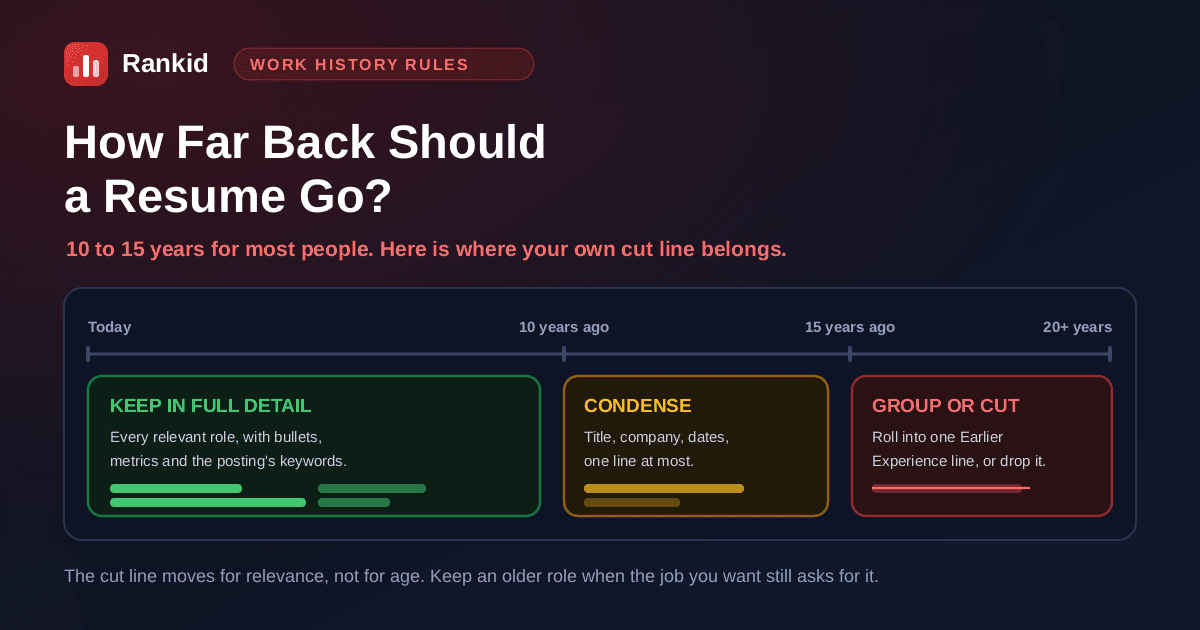
Every resume guide gives you the same number: go back ten years, maybe fifteen. It is roughly right, and it is also close to useless on its own, because it tells you nothing about the twelve years sitting behind the line. Do you delete them? Summarise them? What happens to the gap that appears when you do? And what if the one role that actually proves you can do this job happened in 2009? Here is how to set your own cut line, what to do with everything on the far side of it, and the single test that overrules the rule.
Quick answer
Ten to fifteen years of detailed work history for most people. Your last three to five roles get full bullets, roles from roughly ten to fifteen years back shrink to title, company and dates, and anything older gets grouped into one Earlier Experience line or cut. Education does not expire, so list your highest qualification whatever year it was. The rule has one override: if a job posting asks for something only an older role proves, that role stays and it keeps its bullets.
How far back should a resume go?
Ten to fifteen years, with the detail heavily weighted toward the most recent five. That single sentence covers the large majority of candidates, so if you came here for a number, take it and go. But the number is a by-product of something more useful, which is that space on your resume is rented, not owned. Every line has to earn its place by either matching what the posting asks for or proving that you deliver results. Work from fifteen years ago rarely does either, because the tools have moved on, the scope of the role has changed, and the person reading you is trying to predict what you will do next year rather than catalogue what you did in 2010.
So the practical shape of a work history section looks like this. The most recent role gets the most space, typically four to six bullets. The one before it gets three or four. The one before that gets two or three. Roles that fall into the ten to fifteen year band get a single line: title, company, dates, and nothing else. Everything older than that is either grouped into one short block or omitted. The result is a document that gets shorter as it goes down the page, which is exactly how people read it.
The rented-space test
Why the ten to fifteen year line exists
It is worth knowing where the convention comes from, because knowing the reasons tells you when they do not apply to you.
- Relevance decays. Technical stacks, regulations, platforms and processes turn over on roughly a five to ten year cycle. A bullet about a system that has been retired does not read as experience, it reads as a date stamp.
- Reading time is brutally short. A first pass over your resume lasts seconds, not minutes, which is covered in more depth in our look at how long recruiters actually look at a resume. Anything competing for attention with your best recent work is costing you.
- Age bias is real, and dates are the signal. Nobody sensible advises hiding your career, but there is no reason to lead with a 1997 start date either. Concentrating on the recent decade keeps the first read about your capability.
- Seniority mismatch. Early-career bullets sitting next to senior-level ones flatten the impression of progression. Grouping the junior roles makes your trajectory look like a trajectory.
- Length follows content. Cutting old detail is usually how a three-page resume becomes a focused two-pager. If you are wrestling with that, see how long a resume should be.
Notice what is not on that list: no applicant tracking system has a rule that discards resumes covering more than fifteen years, and no recruiter has a stopwatch on your dates. The limit is a readability convention that happens to serve you well most of the time. Which is precisely why you should feel free to break it when your situation says otherwise.
How far back to go, by career stage
The right cut line depends far more on where you are in your career than on any universal number. Find yourself below.
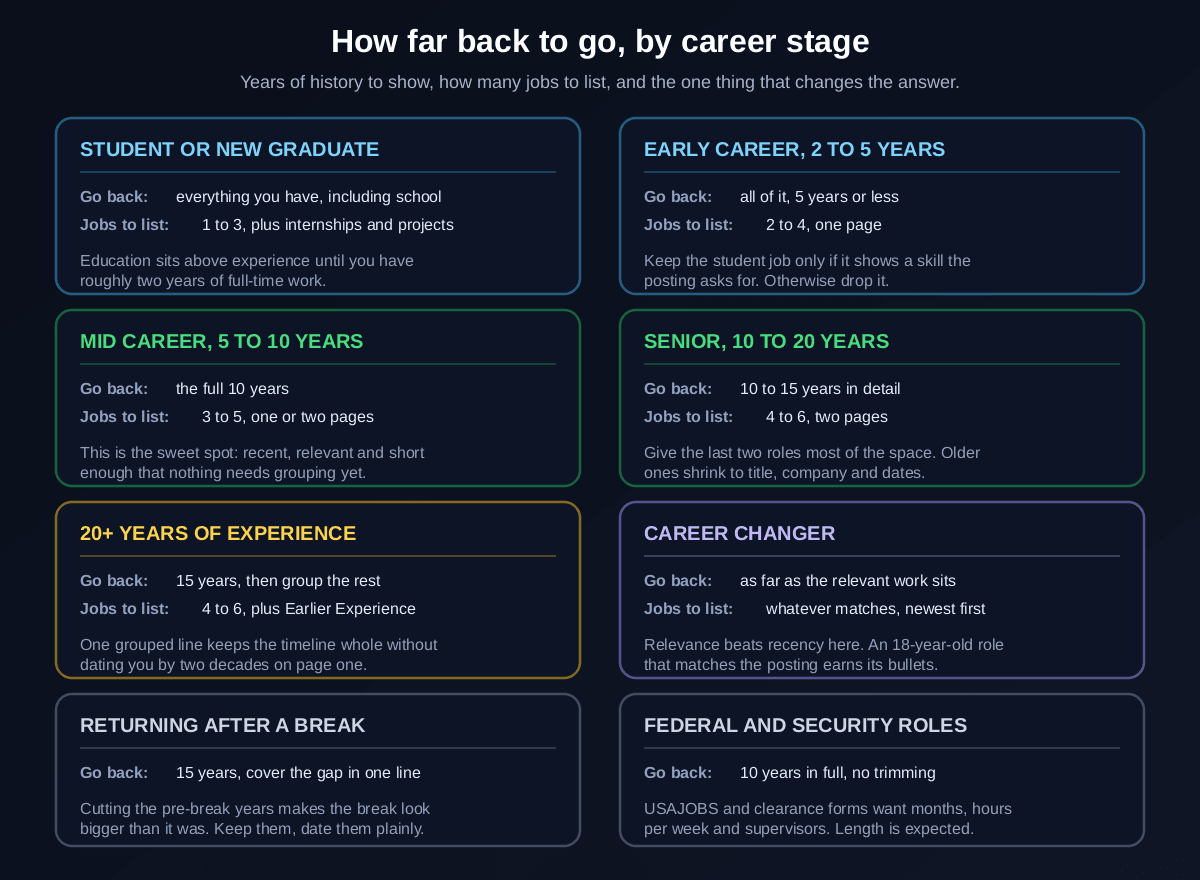
Students and recent graduates. Include everything you have. Nothing needs cutting when you are still accumulating, so internships, summer and part-time jobs, campus positions, volunteering, freelance work and substantial projects all belong on the page, with education near the top. Keep retail and hospitality roles and write the bullets around transferable work: volume handled, new starters trained, problems resolved, cash and stock trusted to you. There is a full playbook for this in writing a resume with no experience.
Early career, two to five years in. Show all of it, which is a page. The only judgement call is the pre-graduation job: keep it if it demonstrates a skill the posting names, otherwise let it go now that you have real full-time work to point at.
Mid career, five to ten years in. Show the full window with three to five roles. This is the easiest position to be in, because everything you have is both recent and relevant and nothing needs grouping yet.
Senior, ten to twenty years in. Ten to fifteen years in detail, four to six roles. Weight the space hard toward the last two positions, and let the older ones compress to a line. This is the stage where people most often go wrong by giving a 2011 role the same four bullets as their current one.
Twenty years and beyond. Fifteen years in detail, then group the rest into one line. Resist the urge to delete the early career entirely, because a resume that starts in 2011 with no explanation invites the question you were trying to avoid. One grouped line answers it in advance and costs you nothing.
Career changers. Ignore recency and follow relevance. If you spent 2008 to 2012 doing something close to the job you now want, that block earns full bullets even though it is fifteen years old, and the intervening roles can compress instead. This inverts the usual advice on purpose, and how to write a career change resume goes through the mechanics.
Returning after a break. Keep the full fifteen years and date the break plainly. Cutting the pre-break years is the instinct, and it backfires: it makes the gap look longer than it was and removes the experience that qualifies you. See how to explain employment gaps for the wording.
Federal, government and cleared roles. Ten years in full, with no trimming. USAJOBS resumes are assessed line by line against the announcement, so they want months as well as years, hours per week, grades and supervisors, and they routinely run four to six pages. Everything else in this article about brevity is suspended here.
Not sure which old roles are still pulling weight?
Paste your resume and the job description into Rankid's free resume checker. You will see a 0 to 100 match score, the skills and keywords you have covered, and the requirements you are missing, which tells you exactly which older roles are earning their space and which are just adding length.
Check your resume freeHow many jobs should you list on a resume?
Three to five is the normal range, and it is worth understanding that this is an output of the date window rather than a separate rule. Two years into a career that means one or two positions plus internships. Ten years in it usually means three to five. Twenty-five years in it means your four to six most recent and relevant roles, followed by one grouped line for the rest.
The question underneath this one is usually a different question: am I allowed to leave a job off? Yes. A resume is a marketing document, not a sworn statement of employment, and you choose what to feature the same way you choose which achievements to highlight. Two caveats keep that safe:
- Keep it consistent with the forms. Background check authorisations and the employment history fields inside most applicant tracking systems do ask for completeness, and those are the documents where omissions cause real problems. Nothing on your resume should contradict what you type into the application.
- Watch the holes you create. Deleting a two-year role from the middle of your timeline trades a harmless old job for a visible gap. Condense it to one line instead.
One special case: multiple roles at the same employer. Do not repeat the company header three times. Stack the promotions under a single company entry with their own date ranges, and put the bullets under the most senior one. It reads as progression, which is what it is, and it saves several lines.
What to do with the older jobs you cut
This is the part the standard advice skips. You are not choosing between full bullets and deletion, because there is a middle option that solves almost every version of this problem: a short Earlier Experience block at the end of your work history.
It is one heading and two or three lines. List the older titles and employers, give a combined date range, and add no bullets at all. Your timeline stays continuous, so nobody wonders what you were doing in 2007, and the recent decade keeps the attention. Something like this:
Earlier Experience
Customer Support Specialist, Halden Telecom. Retail Sales Assistant, Fenwick Stores. 2007 to 2013.
The before-and-after below is a real-shaped example: twenty-two years of history reduced to twelve years of detail without hiding anything or opening a gap.
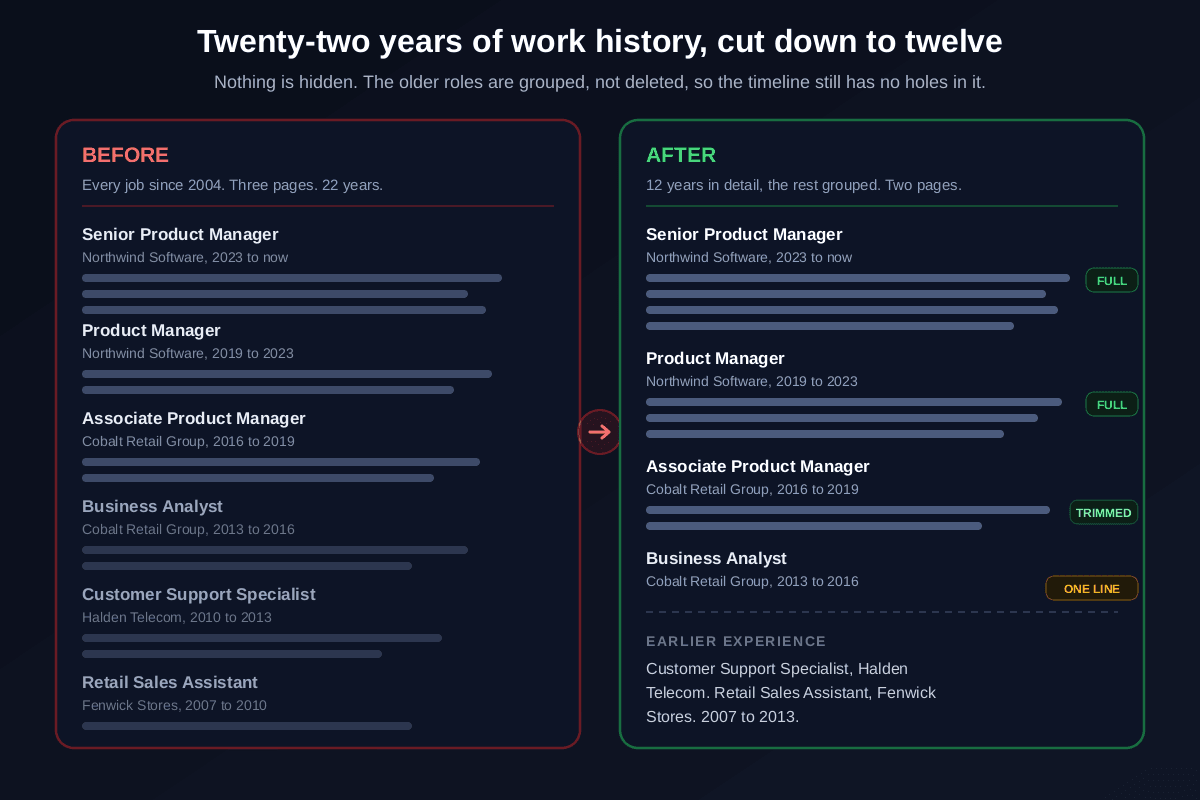
Two details in that example are doing quiet work. The Business Analyst role from 2013 keeps its title and dates but loses its bullets, because it holds the timeline together without needing to argue for itself. And the two oldest roles are grouped rather than deleted, so the dates run unbroken from 2007 to today. The reader gets a complete career in a fraction of the space.
A note on dates
When to keep older experience anyway
The fifteen year line is a default, and defaults lose to evidence. Keep an older role at full detail when any of these are true:
- It is your best match for this posting. If the requirement list names a skill, system, industry or type of project that only your 2009 role proves, it is the most valuable thing on your resume. Promote it, do not group it.
- The employer name opens doors. A well-known company or a marquee client carries credibility that does not expire. One line with the name in it is worth keeping.
- It explains your trajectory. When your current title looks like it came out of nowhere, the older role that shows where the expertise came from is answering a question the reader already has.
- The achievement is genuinely exceptional. Launching a product that is still running, or saving a number that still sounds large today, survives being old.
- The field moves slowly. Law, medicine, academia, skilled trades, civil engineering and regulated industries all treat long histories as normal, and cutting yours to fit a tech-sector convention can read as thin.
A useful reframing: you are not deciding how far back to go, you are deciding what to put in the top third of page one. Everything else is a supporting cast. Once you think of it that way, the old role that matches the job moves up and the recent role that does not moves down, regardless of chronology. That is also the core idea behind tailoring a resume to a job description.
How far back should a resume go for education?
Education does not expire, so it does not follow the work-history rule at all. List your highest and most relevant qualification and leave it there for your entire career. A degree from 1996 is still a degree.
What does change over time is placement and detail:
- Under two years of full-time work: education sits above experience and can carry GPA if it is strong, relevant coursework, honours, societies and leadership positions.
- Beyond two years: it moves below experience and shrinks to degree, subject and institution. Drop the GPA and the coursework, since your work now answers those questions.
- Graduation years: optional. Plenty of experienced candidates leave them off to keep the first read focused on capability. Leaving them off is normal and not treated as evasive.
- High school: remove it as soon as you hold any higher qualification. If it is your highest completed qualification, keep it, with no apology needed.
- Certifications: these do expire, unlike degrees. Cut lapsed ones unless you are mid-renewal, and lead with the current ones the posting asks for.
- Unfinished study: list it honestly as coursework completed toward a named qualification, with the years. Never imply a completed degree you did not finish.
Does the ATS care how far back your resume goes?
No system rejects you for showing eighteen years instead of twelve. There is no date filter, and the belief that there is one causes people to cut good experience for no reason. What actually happens is that your text gets parsed into fields and then searched and ranked by a recruiter against the role, which our guide to AI resume screening covers in detail. Old content affects that in two indirect ways worth knowing.
Dilution. Ranking looks at how strongly your document matches the requirements. Fifteen-year-old bullets about retired tools add text without adding matches, which makes the matching parts a smaller share of the whole. Cutting them raises your signal without you writing a single new word.
Date arithmetic. Many systems compute total years of experience from your dates, and recruiters certainly do. A very long timeline can push you outside a stated range in either direction, and a role listed with mismatched or inconsistent date formats can parse as a gap that is not there. Keep one date format throughout, and check that your history reads cleanly once parsed, which our piece on building an ATS-friendly resume walks through. If you want to know which systems behave which way, the applicant tracking systems list covers the platforms you will actually meet.
Neither point is a reason to hide your history. Both are reasons to concentrate detail where it converts. The only way to know whether your cut helped is to measure the result against a real posting rather than guess, and a good resume match score tells you whether your remaining content still covers the requirements.
How to set your own cut line in five minutes
List every role with its dates
Write out your full history in a scratch document, oldest to newest, with dates. You cannot make good cuts against a document you cannot see whole, and this scratch list becomes the source for application forms later.
Mark anything the posting asks for
Read the job description and highlight every role containing a skill, system, industry or type of project it names. Those are protected regardless of age. Our guide to resume keywords helps you spot the terms that count, and which skills to put on a resume covers how to present them.
Draw the line at ten to fifteen years
Everything newer than the line keeps its bullets. Everything older loses them unless you protected it in step two. If the line falls awkwardly in the middle of a long role, keep the whole role.
Group the remainder, do not delete it
Roll the unprotected older roles into one Earlier Experience line with a combined date range. Then read your dates top to bottom and confirm there are no unexplained holes. If cutting created a gap, put a one-line entry back.
Rewrite the space you just freed
You have gained half a page. Spend it on your two most recent roles: add the numbers, the scope and the outcomes that were squeezed out before. Quantifying achievements is the highest-return use of that space, and a sharper resume summary is the second.
Score it against the job before you send it
Cutting by instinct is how people delete the one role that qualified them. Paste the trimmed resume and the posting into Rankid's free resume checker and confirm your match score held or improved, and that no required skill dropped off the matched list.
Key takeaways
- Ten to fifteen years of detailed work history for most people, weighted heavily toward the last five.
- List three to five roles as a rule; the count follows the date window rather than being a separate target.
- Group older roles into one Earlier Experience line instead of deleting them, so your timeline keeps no holes.
- Relevance overrules recency: a role from 2009 that matches the posting keeps its bullets and moves up.
- Education never expires. List your highest qualification for life, and move it below experience after about two years of work.
- Federal and USAJOBS resumes are the exception: ten years in full, months and hours included, four to six pages is normal.
- No ATS filters you by date. Old content hurts only by diluting your matches and skewing your years-of-experience arithmetic.
- After cutting, score the resume against the real posting with Rankid to confirm you did not remove a required skill.
So, how far back should a resume go? Ten to fifteen years for the detail, a grouped line for whatever came before, and a permanent exception for anything the job in front of you actually asks for. The honest version of the rule is that you are not editing a historical record, you are deciding what a busy person sees in the first few seconds. Cut the years that no longer argue for you, keep the timeline whole, spend the reclaimed space on numbers, then close the loop: paste your resume and the job description into Rankid's free resume checker and see exactly what your shorter, sharper history now matches.
Frequently asked questions
How far back should a resume go?
Go back about 10 to 15 years with full detail, and treat anything older than that as optional. In practice that means your last three to five roles get titles, dates, and bullets with numbers in them, roles from roughly 10 to 15 years ago shrink to a single line of title, company, and dates, and anything beyond 15 years is either grouped into a short Earlier Experience block or left off entirely. The reason for the limit is not a rule that recruiters enforce, it is that older work stops earning its space: the tools have changed, the scope of the role has changed, and a hiring manager decides in seconds based on what you did most recently. The exception matters more than the rule, though. If a job posting asks for something that only an older role proves, that role stays and it keeps its bullets, no matter how long ago it was.
How many jobs should you list on a resume?
Three to five roles is the normal range, and it maps to the same 10 to 15 year window rather than to a fixed count. Someone two years out of university might list one or two positions plus internships. Someone with a decade of experience usually lists three to five. Someone with 25 years lists their four to six most recent and relevant roles, then groups the rest into one line. You are not obliged to list every job you have ever held, because a resume is a marketing document rather than a legal record of employment. The document that does need to be complete is the background check form and, in many applicant tracking systems, the employment history section of the application itself, so keep the two consistent: nothing on the resume should contradict what you enter on the form.
When should you remove old jobs from your resume?
Remove an old role when it fails all four of these tests: it does not contain a skill or keyword the job posting asks for, it does not show progression toward the role you want, it is not needed to explain an otherwise confusing timeline, and it is not a recognisable name that lends you credibility. If it fails all four, it is costing you space and skim time without buying anything back. Short, unrelated jobs from more than fifteen years ago are usually the first to go, along with student and part-time work once you have real full-time experience. Be careful with one thing: if cutting a role opens a visible multi-year hole in your dates, you have swapped a harmless old job for a gap that a recruiter will ask about. In that case condense it to one line instead of deleting it.
How far back should a resume go for education?
List your highest and most relevant qualification and stop there, with no expiry date on it. A degree from 1998 is still a degree, and it belongs on your resume for your whole career, so education does not follow the 10 to 15 year rule that work history does. What changes over time is placement and detail. Early on, education sits above your experience section and can carry your GPA, relevant coursework, honours, and activities. Once you have roughly two years of full-time work, it moves to the bottom and shrinks to degree, institution, and, if you like, the year. Graduation years are optional, and many experienced candidates leave them off to keep age out of the first read. Drop high school entirely once you hold any higher qualification, and drop certifications that have genuinely expired unless you are actively renewing them.
Should I include jobs from 20 years ago on my resume?
Not as full entries with bullets, but usually yes as a single grouped line. The clean way to handle a long career is an Earlier Experience section at the end of your work history: one short block that lists the older titles and employers with a combined date range, and no bullet points. It costs you two or three lines, it keeps your timeline continuous so nobody wonders what you were doing in 2006, and it lets the recent decade get the attention it deserves. Make the exception when an old role is your strongest possible evidence for this specific job, for example a career changer who did exactly this work fifteen years ago, or a candidate whose only experience with a named system or a recognisable employer sits back there. In that case pull it out of the grouped line and give it real bullets.
How far back should a resume go for a college student or recent graduate?
Include everything you have, because at this stage relevance is scarce and nothing needs cutting yet. That means internships, part-time and summer jobs, campus roles, volunteering, freelance work, and substantial coursework or personal projects, all on a single page with education near the top. Retail and hospitality jobs belong there too, as long as the bullets describe transferable work such as handling volume, training new starters, resolving customer problems, or being trusted with cash and stock rather than simply naming the duties. The 10 to 15 year question does not apply to you yet, and it typically starts mattering around six to eight years into a career, when the earliest roles begin to look junior next to what you are applying for now.
How far back should a federal resume go?
Ten years in full detail, and federal hiring is a genuine exception to almost every piece of resume-shortening advice you will read. A USAJOBS resume is assessed against the announcement by an HR specialist who must confirm you meet each stated qualification, so brevity actively works against you. Include month and year for every position, hours worked per week, salary or grade, supervisor details where requested, and enough narrative under each role to prove the specialised experience the announcement names. Federal resumes commonly run four to six pages, and that is normal rather than excessive. Roles older than ten years can be summarised briefly, but if a specific older position is the one that proves a required qualification, describe it fully. The same principle applies to security clearance forms such as the SF-86, which ask for a complete history over a defined period and are separate from your resume.
Does the ATS care how far back your resume goes?
Not directly, and no applicant tracking system rejects you for showing eighteen years instead of twelve. What the system does is parse your text and let a recruiter search and rank against the job's requirements, which means the older content affects you in two indirect ways. The first is dilution: a resume padded with fifteen-year-old bullets about tools nobody uses spreads your relevant keywords across more text, so the parts that match the posting stand out less. The second is date arithmetic, since some systems and most recruiters compute your years of experience from your dates, so a very long timeline can push you out of a stated range in either direction. Neither is a reason to hide your history, and both are reasons to concentrate your detail on the roles that match. The direct way to check the effect is to score your resume against the actual posting and see which requirements come back matched.