Reason for Leaving a Job: Good Answers for Applications and Interviews
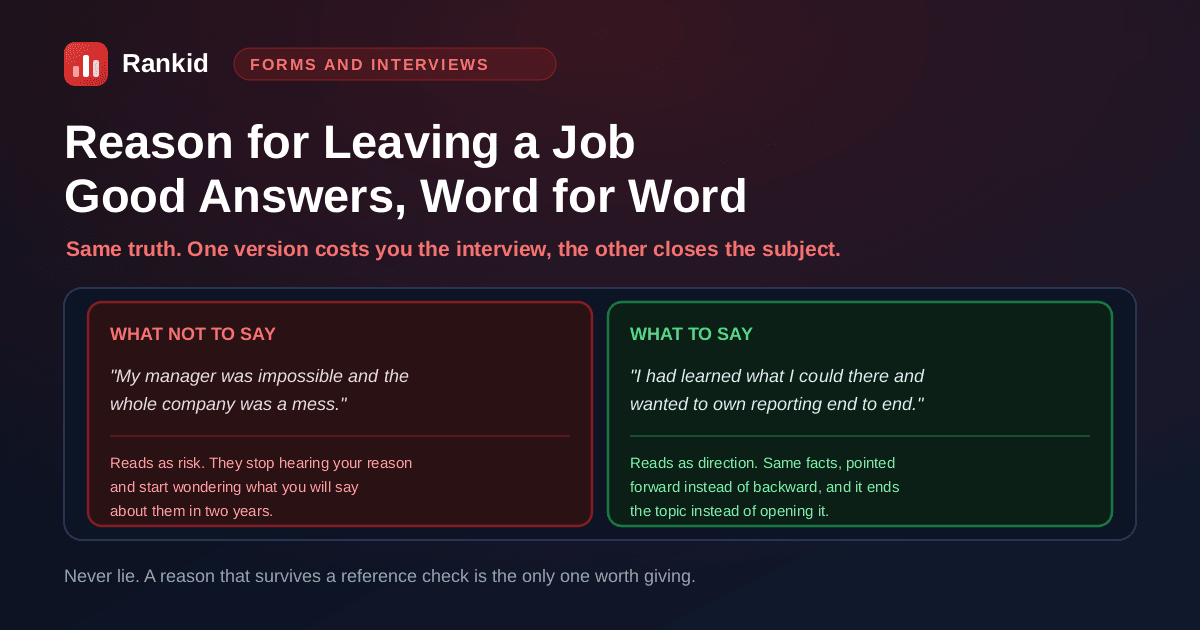
There are two versions of this question and almost every guide answers only one of them. There is the one-line box on an application form that wants two words, and there is your future boss asking you out loud, wanting two sentences and listening for something entirely different. A third version exists too, sitting in a file at your old employer, and it is the one that decides whether the other two survive contact with a background check. Here is what to write, what to say, and how to handle the situations nobody wants to explain, without lying about any of them.
Quick answer
Good reasons are true, forward-looking and short. On an application form, write two to four neutral words: career advancement, role eliminated, contract ended, relocation. In an interview, use three beats and stop: the fact, what you were moving toward, and how it connects to this job. Never criticise a former manager, never write "personal reasons", and never give a version that contradicts what your old employer will confirm.
What is a good reason for leaving a job?
A good reason has three properties. It is true, because anything else eventually meets a reference check. It is forward-looking, describing something you were moving toward rather than something you were escaping. And it is short, because length signals that the subject is unresolved.
That is the whole framework, and it matters more than which reason you have. Consider two answers describing the identical situation: "I was bored and my manager kept blocking me from the projects I wanted" and "I wanted to move into analytics work and my role had no route there." Same facts. The first makes an interviewer wonder how you will describe them in two years. The second makes them ask what kind of analytics work.
The reasons that need no framing at all are the circumstantial ones, because nobody can argue with them: redundancy or a role eliminated, a contract or seasonal position ending, a restructure or acquisition, relocation, a return to study, or caring responsibilities. If one of these is your actual reason, state it plainly and move on. The reasons that need care are the ones involving a person, a conflict, or your own performance, and those get their own section below.
The test to apply to any answer
The same question, in three different places
Before you write anything, work out which version you are being asked for, because the right length and tone are genuinely different in each. This is the part most advice skips, and it is why people paste an interview answer into a form field and wonder why it looks strange.
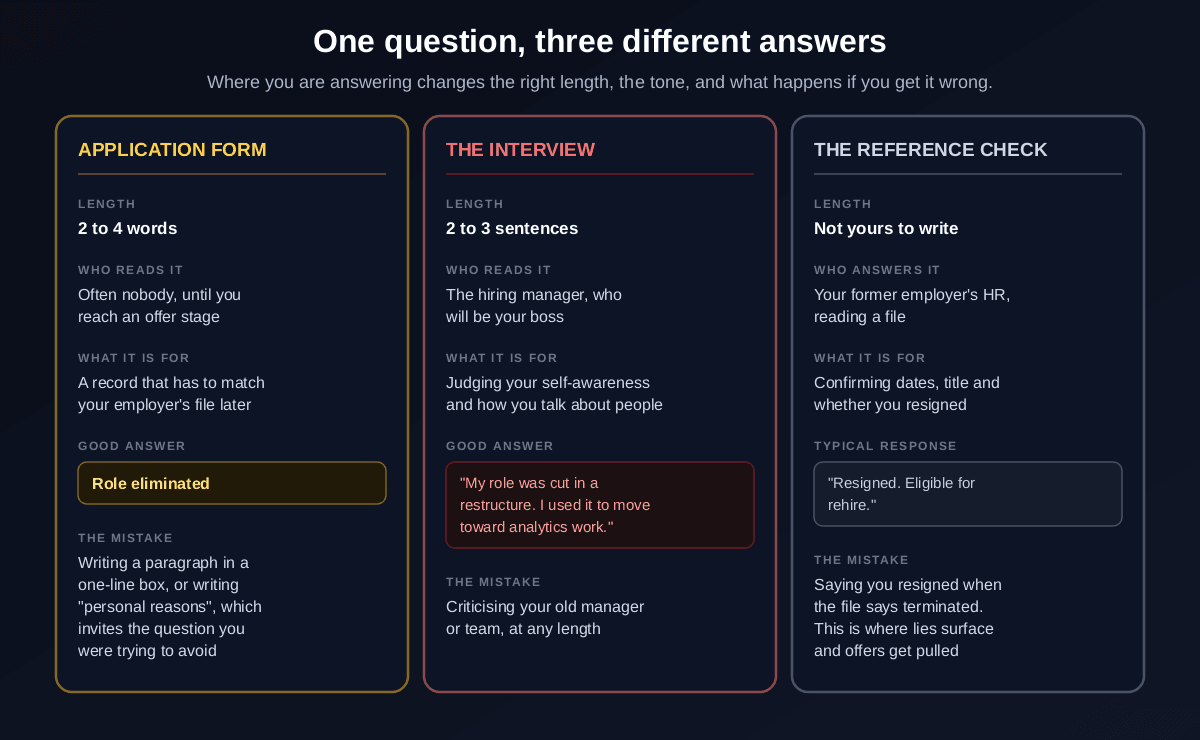
The important relationship is between the first and the third. The form entry is a record, and its real function is to be consistent with what your old employer will confirm at offer stage. The interview answer is a judgement call about you as a colleague. Get the interview answer wrong and you lose the role; get the form entry inconsistent with the file and you can lose an offer you have already accepted, which is a far worse outcome.
What to put for "reason for leaving" on a job application
Application forms give you a small box, usually a single line, sometimes a dropdown. That constraint is a gift: it means the correct answer is short, and you cannot be expected to explain yourself in it.
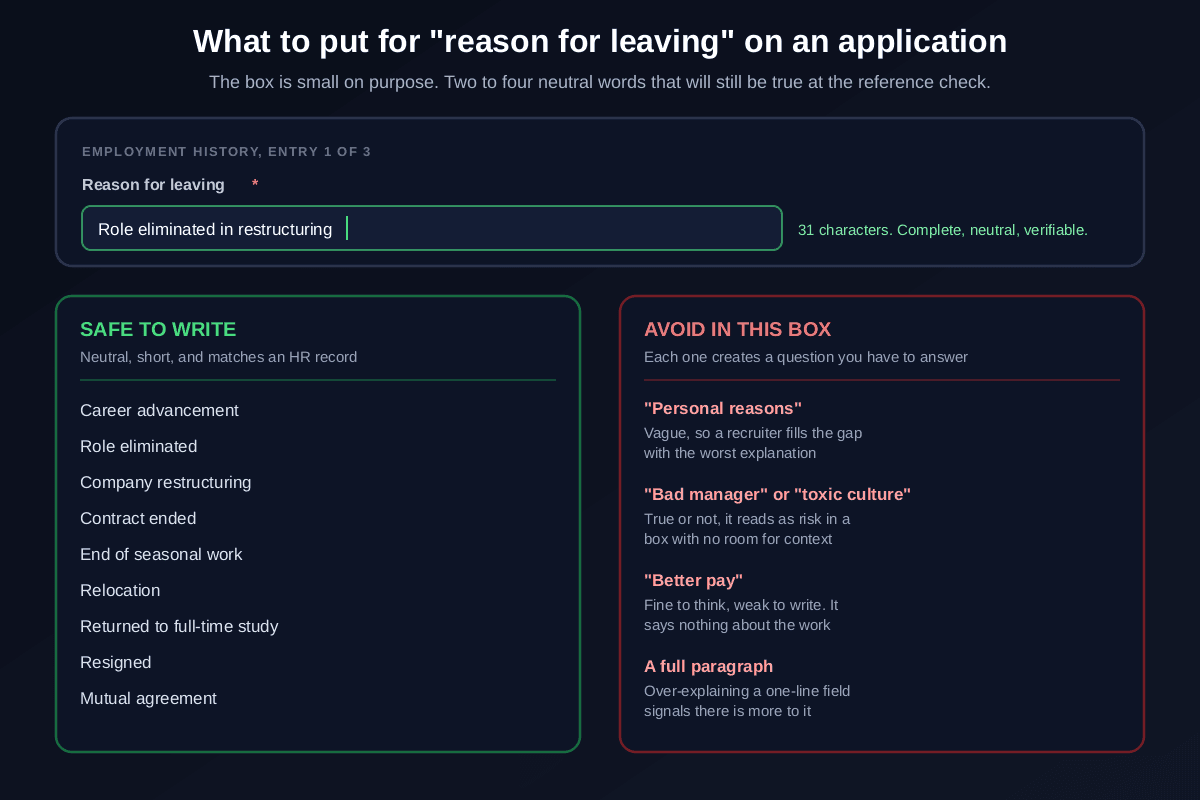
Three rules cover almost every case:
- Match the record, not your feelings. If you resigned, write resigned. If the role was cut, write role eliminated. The entry needs to survive verification more than it needs to be persuasive.
- Keep it to two to four words. A paragraph in a one-line field reads as anxiety. There is no reader on the other side yet who wants the story.
- Never leave it blank. Required fields on application forms behave like the knockout questions covered in our applicant tracking systems guide, and an incomplete employment history can stop the application outright.
One practical note on dropdowns. Some systems offer fixed options such as voluntary, involuntary, laid off or contract ended, with no free text at all. Pick the accurate one even when a neighbouring option looks kinder, because these values are precisely what gets compared against your former employer's answer later.
Before you worry about the form, make sure the resume gets you read
A perfect answer to 'reason for leaving' never gets seen if your resume does not match the job. Paste your resume and the job description into Rankid's free checker for a 0 to 100 match score, the skills you have covered, and the requirements you are missing.
Check your match free15 good reasons for leaving a job, with wording you can use
Find yours below. The label is the reason, the sentence in quotes is a version you can say out loud in an interview without editing.
- Career advancement."I had gone as far as the structure allowed, and the next level up was not going to open."
- You wanted to specialise."The role was broad by design, and I wanted to go deep on one part of it."
- Redundancy or role eliminated."My role was cut when the team restructured. Thirty of us went the same week."
- Contract or seasonal work ended."It was a twelve month contract and it reached its end date."
- Company restructure or acquisition."We were acquired and my function was consolidated into the parent company."
- Relocation."I moved for family reasons and the role was not remote-friendly."
- Return to study."I went back full time to finish a qualification I needed for this kind of work."
- Career change."I decided to move into a different field and needed a role that would actually get me there." If this is you, see our guide to a career change resume.
- You wanted a different size of company."I wanted to be somewhere where I own a whole area rather than a slice of one."
- Better fit for your skills."The job drifted away from the work I am strongest at, and I wanted to get back to it."
- Caring or family responsibilities."I needed to step back for family reasons, and I am now ready to come back full time."
- Health, now resolved."I took time out for health reasons. That is fully behind me and I am ready to work." You owe no detail beyond this.
- The company was struggling."The business was shrinking and hiring had stopped, so there was no path forward."
- Values or ethics mismatch."There were decisions I did not want to be part of, so I chose to leave." Keep it at exactly this length.
- Mutual agreement."It was not the right fit and we agreed to part ways."
What not to say
The list of things to avoid is shorter than the list of good reasons, and it is worth knowing precisely because each item feels reasonable in the moment.
- Anything critical about a named person. Your interviewer cannot verify your old manager was difficult. They can only observe that you are describing a colleague to a stranger in a job interview.
- "Personal reasons" with no category. Vague enough that the reader guesses, and guesses run to the worst option. Give the neutral label instead.
- Money as the headline. Legitimate, but it makes you the candidate who is easiest to outbid. Lead with scope and let pay follow.
- "I was bored." Reads as something you allowed rather than something that happened to you. Convert it to what you wanted to be doing instead.
- Any version of "it was not my fault" at length. Ownership is the trait being assessed. One sentence of it beats five of explanation.
- A story that needs the interviewer to take your side. If your answer only works when someone agrees your old employer behaved badly, it is too long and too invested.
The hard cases
These are the situations people actually search for at eleven at night. None of them require you to lie, and all of them get better with fewer words.
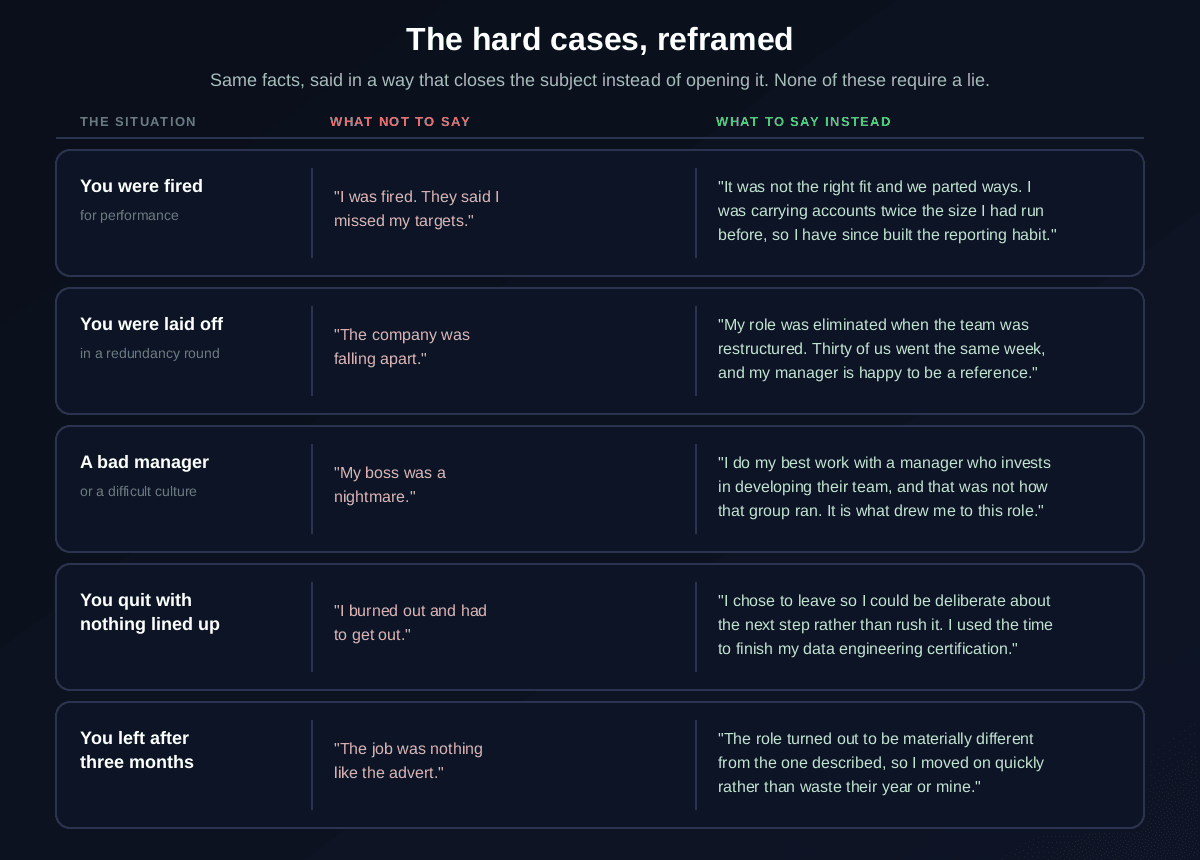
You were fired.Neutral framing is legitimate: "It was not the right fit and we parted ways." Add one sentence of ownership and one about what changed since. Do not volunteer the word fired in an interview, and do not deny it on a form that asks directly, because verification will confirm whether the separation was voluntary. Interviewers hire people who have been fired all the time. They do not hire people who get defensive about it.
You were laid off.This needs no spin at all, and the only mistake is sounding bitter about the company. State the scale if it helps, since "thirty of us went the same week" instantly reframes it as structural rather than personal, and offer your former manager as a reference if you have that relationship.
A bad manager or a difficult culture.Convert the complaint into a preference. "I do my best work with a manager who invests in developing their team, and that was not how that group ran." Then stop, even if the interviewer leans in and invites more. The invitation is often the test.
You quit with nothing lined up. Frame it as a decision rather than an escape, and account for the time: study, a certification, caring, freelance work, or a deliberate search. An unexplained gap does more damage than the resignation, and our guide to explaining employment gaps covers the wording in depth.
A very short tenure. Name the mismatch factually, say what you did, and show what you learned from it. Short stints are survivable individually. A pattern of them is the thing to get ahead of, ideally by making the rest of your history obviously stable.
You are leaving your current job and have not told them.When asked why you are looking, keep it entirely about the new role: "I am not unhappy, but this role does something mine does not, which is why I applied." You are not obliged to manufacture a grievance to justify a job search. Once you have the offer, keep the resignation letter itself just as neutral.
How to answer "Why did you leave your last job?" out loud
Three beats, in order, then silence. The whole thing should take fifteen to twenty seconds.
- The fact.One neutral sentence about what happened. "My role was cut when the team restructured."
- The forward.What you were moving toward. "I had been heading toward analytics work anyway, so I used it to specialise properly."
- The fit.One line tying it to this job. "Which is exactly what this role is built around."
Then stop talking. The silence afterward feels much longer to you than it does to the interviewer, and the urge to fill it is where good answers go to die. If they want more they will ask, and a follow-up question is a good sign rather than a bad one.
Practise it out loud once or twice rather than memorising it word for word, because a recited answer sounds rehearsed in a way that makes a straightforward reason sound managed. If you are getting to interviews and stalling there, our piece on why applications stall covers the earlier stages of the same funnel. For the other half of the conversation, see the questions you should be asking them.
Keep all four versions consistent
This is the part that quietly costs people offers. By the time you accept a job you will have described your departure in up to four places, and they need to agree with each other.
- Your resume. Dates only, no reasons. A resume never explains why you left anything, and adding it looks defensive. Keep your dates consistent in format and coverage, as covered in how far back a resume should go.
- The application form. Two to four factual words that match the HR record.
- The interview. Your three-beat answer, which can be a warmer characterisation of the same fact but must not contradict it.
- The reference or background check. Not yours to write, which is exactly why the other three have to be honest.
Write your form entry first and your interview answer second, from the same fact. Doing it the other way round is how people end up with a persuasive story that does not match the box they ticked six weeks earlier.
How to write yours in five minutes
Write the fact in one neutral sentence
No adjectives, no blame, no context. Just what happened. "My role was eliminated." "I resigned." "We agreed to part ways." This sentence is the foundation for every other version.
Compress it to two to four words for the form
Turn the fact into a label a HR system would recognise, and use the same one on every application. Consistency across applications matters if you end up in the same company's system twice.
Add the forward and the fit
Append what you were moving toward and one line connecting it to the role. Read the result aloud and cut any sentence that criticises somebody or defends you.
Run the reference-check test
Ask whether every version survives being read next to your old employer's record of your dates, title and separation type. If any version only works unchecked, rewrite it now rather than explaining it later.
Make sure the resume gets you to the question at all
None of this matters if you are not being read. Score your resume against the specific job with Rankid's free resume checker, then use tailoring to close the gaps it finds.
Key takeaways
- Good reasons are true, forward-looking and short. Framing matters more than which reason you have.
- On an application form, write 2 to 4 neutral words that match what HR will confirm. Never leave it blank.
- In an interview, use three beats and stop: the fact, what you were moving toward, and how it fits this role.
- Avoid "personal reasons", money as your headline, and anything critical about a named person.
- If you were fired, a neutral framing plus one sentence of ownership is honest and sufficient. Never deny it on a form.
- Convert a bad manager into a statement about the conditions you want, then stop talking.
- Employers verify dates, title and whether you resigned, not your interpretation. Framing is fine, contradiction is fatal.
- Write the form entry and the interview answer from the same single factual sentence so they cannot diverge.
So, what is a good reason for leaving a job? The one that is true, points forward, and takes fifteen seconds. Almost nobody loses an opportunity because of why they left. They lose it because the answer ran too long, blamed somebody, or did not match the record. Write the fact once, compress it for the form, extend it for the interview, and make sure all of it would survive being read aloud next to your old employer's file. Then make sure you actually reach the interview where anyone asks: paste your resume and the job description into Rankid's free resume checker and see what a recruiter will see first.
Frequently asked questions
What is a good reason for leaving a job?
A good reason is true, forward-looking, and short. The strongest answers describe something you were moving toward rather than something you were escaping: you wanted more responsibility, a different specialism, work you could own end to end, a bigger or smaller organisation, or a role that matched where you want your career to go. Circumstantial reasons are equally strong because nobody can argue with them, including redundancy or a role being eliminated, a contract or seasonal position ending, relocation, a company restructure or acquisition, a return to study, or caring responsibilities. What makes any of these work is the framing rather than the fact. "I wanted to move into analytics and my role had no route there" and "I was bored and my manager blocked me" can describe exactly the same situation, and only one of them makes the interviewer want to keep listening.
What should I put for reason for leaving on a job application?
Two to four neutral words that will still be true when someone checks. Safe entries include career advancement, role eliminated, company restructuring, contract ended, end of seasonal work, relocation, returned to full-time study, resigned, and mutual agreement. The field is short because it is a record rather than a conversation, and its main job is to be consistent with what your former employer's HR department will confirm later. Do not write a paragraph, because over-explaining a one-line box signals there is more to the story. Avoid "personal reasons", which is vague enough that a recruiter fills the gap with the worst available explanation. Save the context for the interview, where you can actually give it, and keep the form entry factual.
What is the best answer for reason for leaving a job in an interview?
Use three short beats and then stop: the fact, the forward, and the fit. State what happened in one neutral sentence, say what you were moving toward, then connect it to the role you are interviewing for. For example: "My role was cut when the team restructured. I had been moving toward analytics work anyway, so I used it to specialise. That is exactly what this role is built around." Two or three sentences is the right length. The most common mistake is not a bad reason but too much of it: a long answer signals the topic is unresolved, and every extra sentence gives you another chance to say something critical about your old employer. Answer, connect it forward, and let the interviewer move on.
Should I say I was fired?
Never lie about it, but you do not have to use the word. On an application form, if the field asks directly, answer accurately, because employment verification will confirm whether you resigned or were terminated and a contradiction discovered at offer stage is far more damaging than the dismissal itself. In an interview, a neutral framing is legitimate and expected: "It was not the right fit and we parted ways" is honest and complete. Then add one sentence of ownership and one about what you changed, which is what an interviewer is actually assessing. What sinks candidates is not the dismissal, it is defensiveness, blame, or a version that falls apart under a reference check. Say it plainly, show what you learned, stop talking.
Is personal reasons a good reason for leaving a job?
It is one of the weakest things you can write, and it is unfortunately one of the most common. The phrase is unobjectionable but empty, so it does not close the subject, it opens it: a recruiter reading it has to guess, and people guess badly, filling the gap with dismissal, conflict or a health problem. If the real reason is genuinely private, pick the most accurate neutral label instead and use that: family responsibilities, health, relocation, or a return to study are all specific enough to be believed and general enough to protect you. You are never obliged to disclose medical or family detail, and no reasonable employer will press once you have given a clear category.
How do I explain leaving a job after only a few months?
Address it directly, briefly, and only once. Short tenures raise a genuine question, so leaving it unspoken invites the worst reading. Name the mismatch factually, say what you did about it, and show what you took from it: "The role turned out to be materially different from the one described, so I moved on quickly rather than waste their year or mine, and I ask much sharper questions about scope now." If the job was very short and genuinely irrelevant, you are not obliged to feature it on your resume, though it may still need to appear on application forms and background checks. Consistency matters more than completeness here, so decide once and keep every version aligned.
Can I say I left a job for better pay?
You can, and it is entirely legitimate, but it is a weak headline and a much better second sentence. Compensation is a normal motivator and no interviewer is shocked by it, yet money alone says nothing about the work, so an answer built on pay makes you sound like the easiest person to outbid rather than the person who wanted this job. Lead with the work and let pay be part of the picture: "I was ready for a bigger scope and the market rate for that scope, and this role has both." One exception worth knowing: if you were genuinely underpaid relative to the market for a documented reason, saying so plainly is fine and reads as commercially aware rather than mercenary.
What do I say if I left because of a bad manager?
Describe the working conditions you want, not the person you left. This is the single most common trap in the whole question, because criticising a former manager tells your interviewer nothing verifiable about your old boss and quite a lot about how you might talk about them. Turn it into a preference: "I do my best work with a manager who invests in developing their team, and that was not how that group ran, which is part of what drew me to this role." That is honest, it is not a complaint, and it hands the conversation back. Resist an invitation to elaborate even if the interviewer seems sympathetic, and never name the individual.
Do employers check your reason for leaving a job?
They verify the facts around it rather than your interpretation of it. Standard employment verification confirms your job title, your dates, and in most cases whether you resigned or were terminated, and many employers also ask whether you are eligible for rehire. What they generally do not get is a narrative, because most companies have a policy of confirming only those basic facts to limit legal exposure. That distinction is exactly why framing is legitimate and lying is not: describing a dismissal as "we parted ways" is a reasonable characterisation of a verified fact, while claiming you resigned when the file says terminated is a direct contradiction that surfaces at the worst possible moment. Write the version you would be comfortable having read back to you alongside your old employer's record.