Letter of Recommendation Template: Samples for Every Situation (2026)
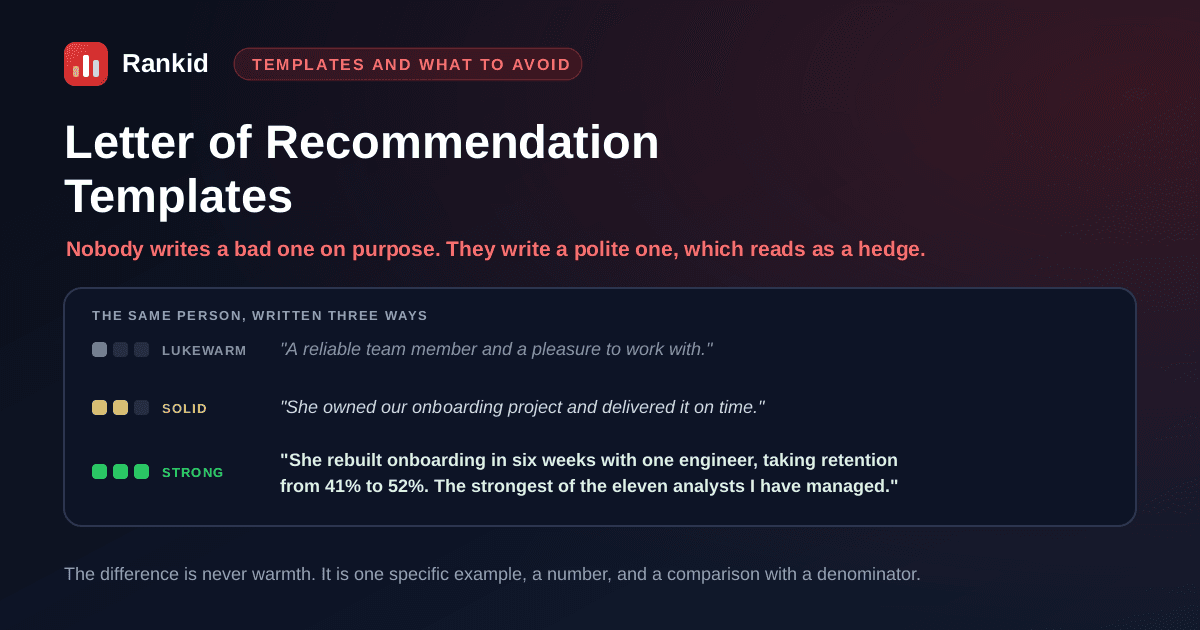
Hardly anyone sets out to write a damaging recommendation letter. They set out to write a kind one, run short of specifics, and reach for the vocabulary of professional politeness: reliable, hard-working, a pleasure to have on the team. The trouble is that admissions committees and hiring managers read hundreds of these, and they have learned to read the absence of detail as a signal. A letter with no evidence in it does not land as neutral. It lands as the best that your strongest available advocate could manage, which is worse than no letter at all.
Quick answer
A strong letter has five things: how you know them, one specific example, evidence (a number, a scope, a constraint), a comparison such as where they rank among people you have managed, and an unhedged endorsement. One page, 250 to 400 words. Templates for six situations below. And the most important rule: if you cannot write a genuinely strong letter, decline, because faint praise does more damage than a refusal the person can work around.
Recommendation letter, reference letter, or verification letter?
These get conflated constantly, and sending the wrong one wastes a week.
- A recommendation letter and a reference letter are the same document in everyday use. The soft convention is that recommendation letters name a specific role or programme and are more common in academic contexts, while reference letters are often addressed generically and are more common in employment.
- A character or personal reference is written by someone who knows you outside work. It speaks to conduct, reliability and circumstances rather than professional output.
- An employment verification letter is not an opinion document at all. It confirms facts such as dates and job title, deliberately contains no assessment, and is what lenders and landlords actually want. Our full guide to employment verification letters covers those, including the templates by requester.
If your employer only permits factual references
The five things every strong letter has
Score your draft against these five before you send it. Most letters that fail do so by having only the first and the last, which is precisely the shape of a polite hedge.
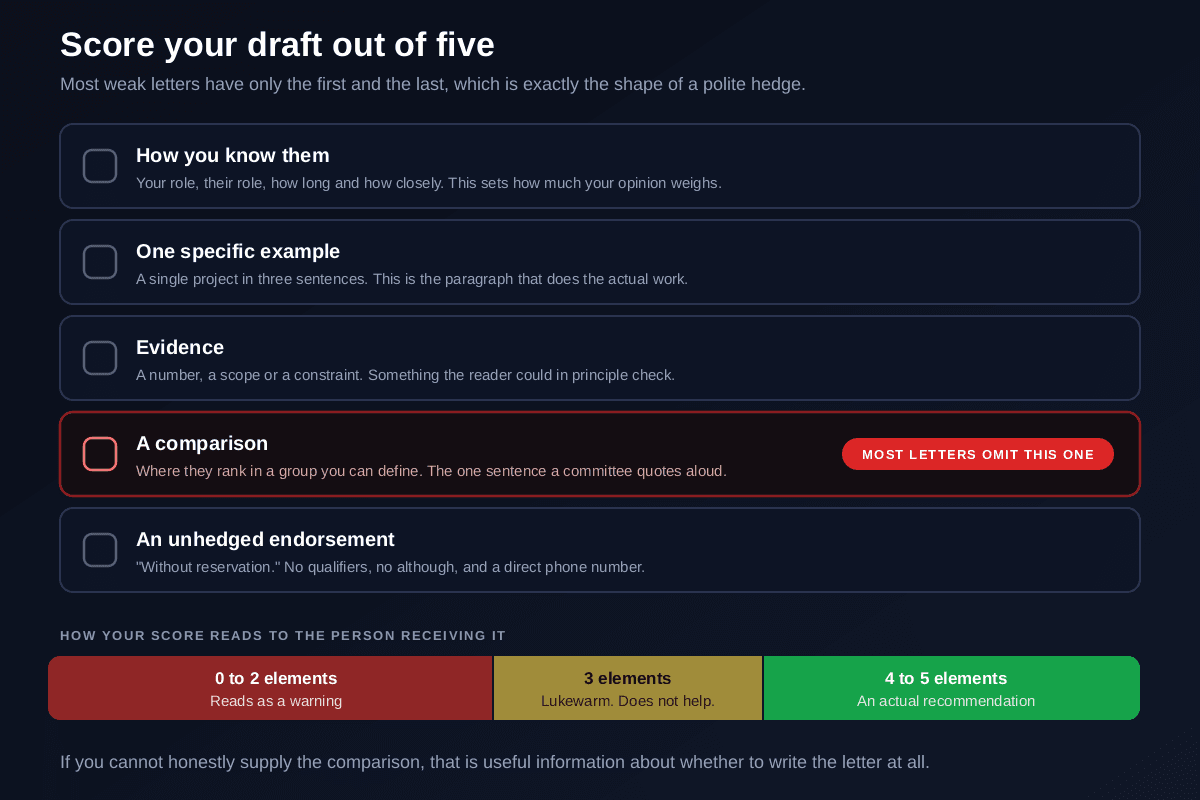
The one people leave out is the comparison, and it is the most persuasive sentence available to you. "She is the strongest of the eleven analysts I have managed" tells a reader something no adjective can, because it is a claim with a denominator. If you cannot honestly rank someone near the top of a group, that is useful information about whether you should be writing the letter.
The faint praise that quietly sinks people
Experienced readers decode recommendation letters the way they decode a job reference given over the phone: by noticing what is missing and what has been qualified. Most of the phrases below were written with warm intentions.
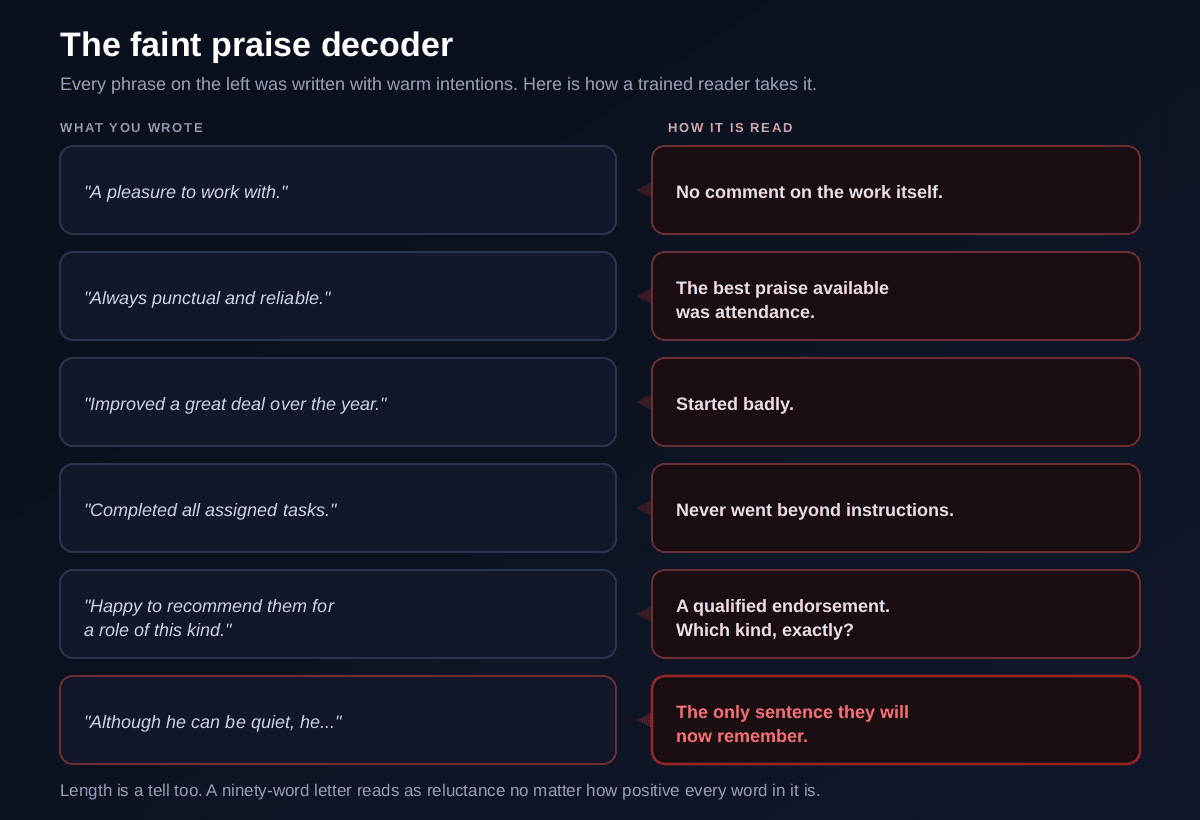
Two structural tells matter as much as vocabulary. The first is length: a 90-word letter reads as reluctance regardless of how positive the words are, because a genuinely enthusiastic person finds more to say. The second is the word although. Any sentence containing it in a recommendation letter becomes the sentence the reader remembers, and it will outweigh three paragraphs of praise.
The structure that works
Five paragraphs, one page. This is the skeleton behind every template below.
Opening: your endorsement and your standing
State plainly that you recommend the person, for what, and why your view is worth having. "I am writing to recommend Priya Raman for the senior analyst role at Northwind. I was her direct manager at Acme for three years and reviewed her work weekly." Never open with "I have been asked to write", which reads as a favour extracted rather than an opinion held.
The specific example, with a number
One project, described in three or four sentences: what the situation was, what they personally did, and what resulted. This is the paragraph that does the actual work, and it is the one most letters skip.
How they work, evidenced
Judgment, collaboration, ownership, whatever the recipient is assessing, each attached to a moment rather than an adjective. "When the timeline slipped she raised it in week two rather than week six" beats "excellent communicator".
The comparison
Where they sit among a group you can define. Among people you have managed, among students in the course, among the team. This is the sentence a committee quotes to each other.
Close: unhedged, with an offer to talk
"I recommend her without reservation" and a direct phone number. The offer to speak signals you are willing to repeat all of this out loud, which is itself evidence.
Templates by situation
Replace everything in square brackets, and replace the example with a real one, since the example is the only part that cannot be templated.
1. For an employee or former employee (from a manager)
Dear [Recipient name],
I am writing to recommend [Name] for [role] at [organisation]. I was [Name]'s [manager / department head] at [Company] from [year] to [year], and I worked with them directly on [area].
The clearest example of their work is [project]. [Name] [what they specifically did], under [constraint such as a deadline, a small team, a budget cut], and the result was [outcome with a number]. What stood out was [the judgment call they made, not the effort they expended].
They are also [quality the recipient is assessing], which I saw most clearly when [specific moment]. Of the [number] [role]s I have managed in [number] years, [Name] is [ranking].
I recommend [Name] without reservation and would gladly work with them again. Please contact me on [phone] or at [email] if it would help to discuss anything further.
Sincerely, [Name], [Title], [Company]
2. For a colleague or peer
...I worked alongside [Name] on the [team] at [Company] for [duration], where we jointly [scope of shared work]. I did not manage them, but I saw their work daily and relied on it.
On [project], [Name] [specific contribution]. I want to be precise about the division of work, because it matters: [what they did versus what the team did]. The result was [outcome with a number].
The thing I would most want a future colleague to know is [specific trait with an example]. They are the person on our team I went to first when [situation], which is the most honest endorsement I can offer.
3. For a student (from a professor or teacher)
...I taught [Name] in [course] during [term], in which they earned [grade], and I supervised their [project or thesis] on [topic].
[Name]'s work on [project] was distinguished by [specific intellectual quality]. Rather than [the obvious approach most students took], they [what they actually did], which required [skill]. The result was [outcome]. Among the [number] students I have taught in this course over [number] years, I would place [Name] in the top [proportion].
I recommend them warmly for [programme] and am happy to elaborate at [email].
4. For graduate school
...I have known [Name] for [duration] as [relationship], most substantially as supervisor of their research on [topic].
[Paragraph on intellectual independence: a question they framed themselves, a method they chose, a result they interpreted without being led.] [Paragraph on rigour and resilience: what happened when the first approach failed.] [Paragraph on collaboration and communication: how they presented or taught.]
[Name] is well prepared for doctoral work in [field], and specifically for [named programme or supervisor], because [reason tied to the programme]. Of the students I have supervised, they are among the [ranking], and I recommend them without qualification.
5. Character or personal reference
...I have known [Name] for [number] years as [neighbour / friend / community role]. In that time I have observed [specific responsibilities they hold, such as caring for a family member, volunteering, running a local group].
[One concrete story that demonstrates the trait in question, such as reliability, honesty or care for others.] I have always found them [trait], and I am confident in vouching for their character.
6. Landlord or tenant reference
...[Name] rented [address] from me from [date] to [date] at a monthly rent of [amount]. They paid on time throughout the tenancy, kept the property in good condition, and there were no complaints from neighbours or disputes over the deposit. I would rent to them again without hesitation.
For court character references
How to ask for one, so you get a good letter and not just a yes
Most people ask badly, and a badly asked-for letter is generic by necessity: the referee had nothing to work from except a vague memory. What you send with the request largely determines what comes back.
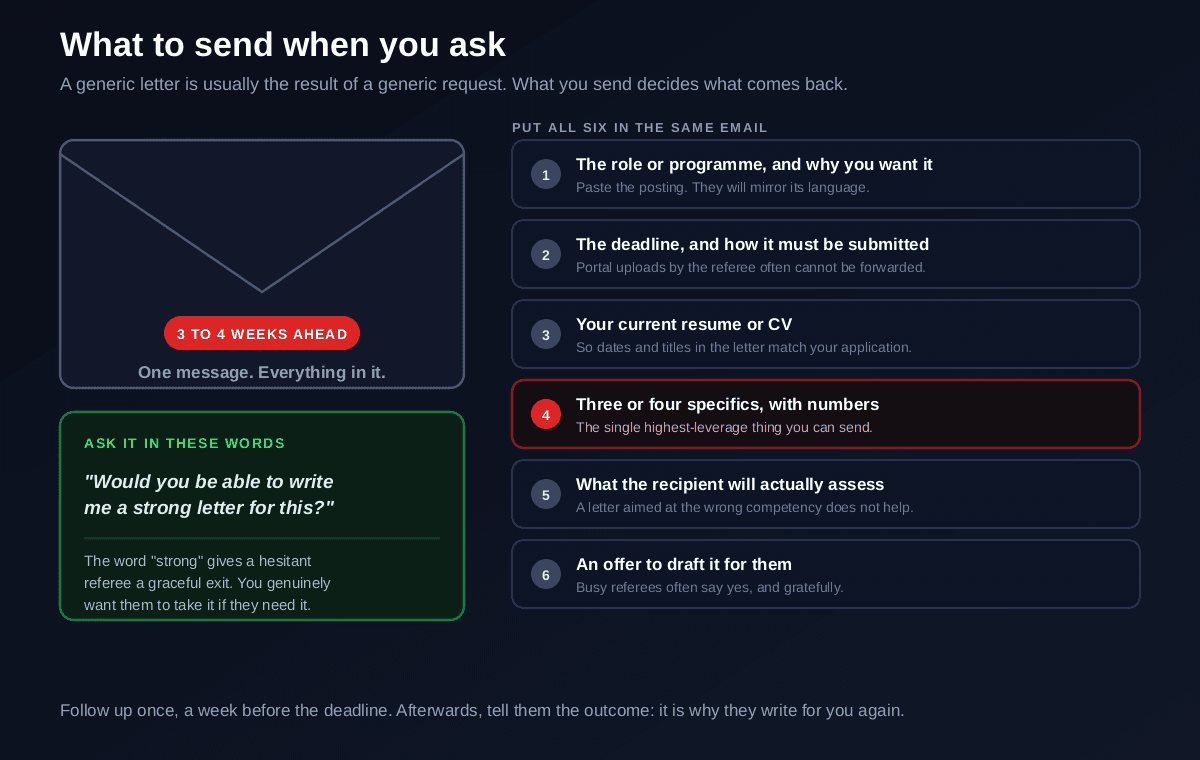
Two details do most of the work. First, use the word strong: "Would you be able to write me a strong letter for this?" This is not a formality. It gives a hesitant person a graceful way to decline, and since a lukewarm letter is worse than no letter, you genuinely want them to take it if they need it.
Second, send the specifics. Three or four bullets of what you actually did together, with numbers, is the difference between a letter that cites your work and one that calls you dependable. If you built that list for your last performance review, reuse it: our guide to writing a self-evaluation covers how to recover those specifics from your calendar and sent mail in about 45 minutes.
Then follow up once, roughly a week before the deadline, and tell them the outcome afterwards. The second part costs you two minutes and is why people write for you again.
How long, and what format
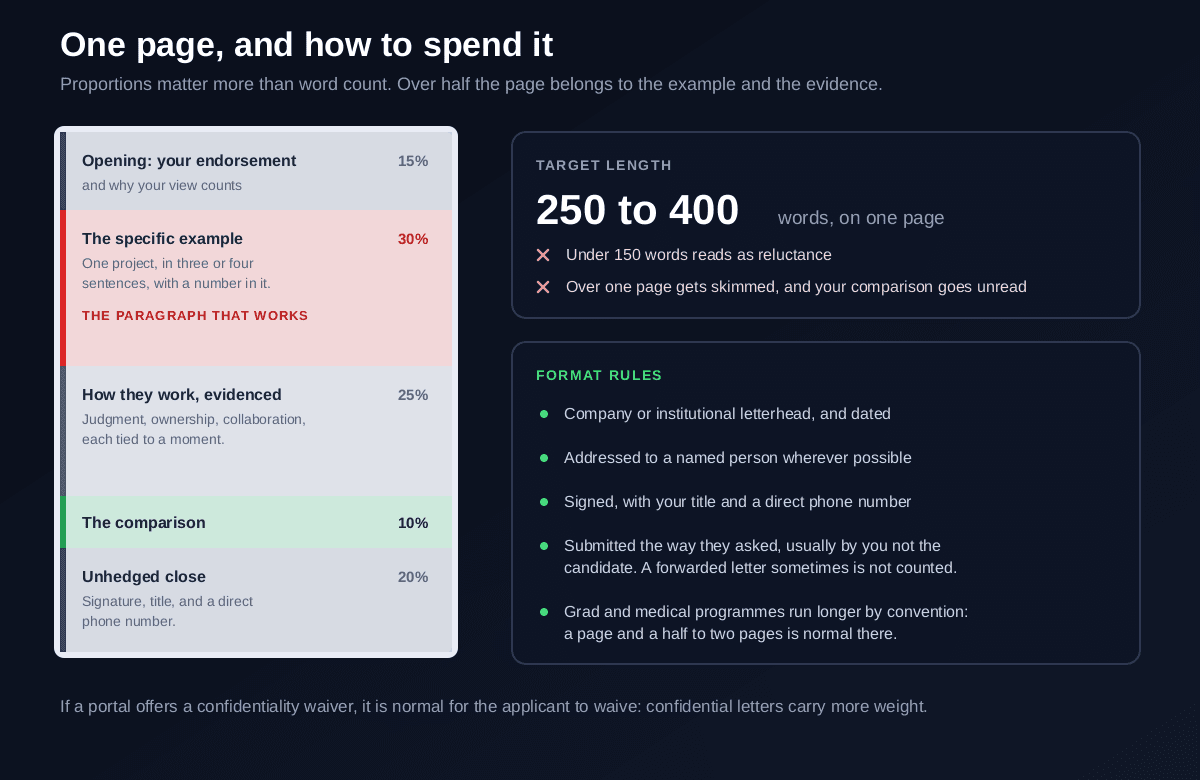
- 250 to 400 words, one page. Under 150 reads as reluctance. Over a page gets skimmed, which means your comparison sentence may go unread.
- Graduate and medical programmes are the exception, running to a page and a half or two by convention, because committees expect detail on research capability.
- Letterhead, dated, addressed to a named personwherever possible. "To Whom It May Concern" is acceptable only when the recipient is genuinely unknown.
- Signed, and submitted the way they asked. Most academic and many corporate applications want the letter uploaded through a portal by the referee, not forwarded by the candidate, and a letter sent the wrong way sometimes simply is not counted.
- Confidential letters carry more weight in academic admissions, where applicants often waive the right to read them. If a portal offers that option, it is normal for the applicant to waive.
Give your referee something concrete to cite
A good letter needs specifics, and so does your resume. Paste your resume and the target job description into Rankid's free checker to see which achievements land against the role, then send those same bullets to whoever is writing for you.
Check your resume freeShould you use AI to write it?
Use it to order and tighten. Do not use it to supply the substance, because the substance is the whole document. A model does not know that the person rebuilt the board report overnight when the data source broke, and that detail is the only thing separating a useful letter from a form.
There are two practical risks. Fully generated letters share a recognisable register, and admissions readers and experienced recruiters increasingly notice it, which converts an intended favour into a liability for the candidate. And some institutions now explicitly prohibit AI-generated recommendations, so a detected letter can be discounted entirely.
A defensible workflow: write the facts and examples yourself as rough bullets, use a model to help with ordering and concision, then rewrite it in your own voice and verify every claim. The test is simple. If you would not be comfortable saying each sentence out loud to the recipient, on a phone call, do not send it.
When to decline, and how
Declining is a service. A tepid letter tells the reader that this candidate's strongest advocate could only manage faint praise, and there is no recovering from that inside the same application.
Decline early, and give a reason the person can act on rather than a vague apology:
- Proximity:"We did not work closely enough for me to speak to the research skills this programme assesses. [Colleague] supervised that work and would write you a much stronger letter."
- Policy:"Our policy limits me to confirming dates and title. I can send that immediately, but you will want an opinion letter from someone outside it."
- Capacity:"I cannot give this the time it needs before your deadline, and a rushed letter would not help you."
What not to do is agree reluctantly and then write something noncommittal, which is the single worst outcome and unfortunately the most common one.
What never to include
- Protected characteristics. Age, health or disability, religion, marital or family status, pregnancy, national origin, immigration status. Even a kind mention creates exposure.
- Salary, disciplinary history, or the reason they left, unless they have asked you to include it and it helps them.
- Unfavourable comparisons to a named person. Rank against a group, never an individual.
- Anything you cannot support. Inflated titles and invented metrics get verified, and one false claim discredits the whole letter.
- Hedge vocabulary: adequate, satisfactory, generally reliable, improved over time, and any sentence containing although.
- Your own reluctance."I was asked to write this" and "I do not know them well, but" are both fatal openings.
Key takeaways
- A letter with no specifics does not read as neutral. It reads as the best your strongest advocate could manage.
- Five elements: relationship, one specific example, evidence, a comparison, an unhedged endorsement.
- The comparison sentence is the most persuasive thing available to you, because it has a denominator.
- 250 to 400 words on one page. Under 150 reads as reluctance; over a page gets skimmed.
- Choose referees by proximity, not seniority. A close team lead beats a distant director every time.
- When asking, use the word "strong" and send three or four specifics with numbers.
- If you cannot write a strong letter, decline early and point them to someone better placed.
- Use AI for ordering and editing only. The specific detail is the entire value, and generated letters get spotted.
The whole thing turns on one paragraph: a real example, with a number, that only you could have written. Everything else in a recommendation letter is scaffolding around that, and every weak letter ever sent was weak because that paragraph was missing. So before you write, find the specific thing the person did, get the number attached to it, and decide honestly where they rank among the people you can compare them with. If the answer to that last question is uncomfortable, the right move is to say so kindly and step aside. And if you are the one asking, make the specifics easy to find: pull your achievements together, check how they read against the role you want with Rankid's free resume checker, and send your referee the three lines that matter most.
Frequently asked questions
What should a letter of recommendation include?
Six things, in this order. How you know the person, including your role, their role and how long you worked together, because a reader weights the letter by how well placed you were to judge. What they did, with at least one specific example rather than a list of qualities. Evidence, meaning a number, a scope or a constraint that makes the example checkable. A comparison, such as where they sit among people you have supervised, which is the single most persuasive sentence available to you. An unqualified statement of endorsement, phrased without hedges. And your contact details with an explicit offer to speak further, which signals you are willing to repeat this out loud. Everything else, including adjectives about their character, is optional padding.
How long should a letter of recommendation be?
One page, which in practice means 250 to 400 words and three to five paragraphs. Shorter than about 150 words reads as reluctance, because a reader assumes anyone genuinely enthusiastic would have found more to say. Longer than a page is usually a sign that the writer has substituted volume for specifics, and it will be skimmed, meaning your best sentence may never be read. Academic letters for graduate or medical programmes run longer by convention, often a page and a half to two pages, because committees expect detail on research capability and intellectual independence. For an employment reference, one page with one strong example beats two pages of general praise every time.
What is the difference between a letter of recommendation and a reference letter?
In everyday use they are the same document and the terms are interchangeable, though there is a soft convention: recommendation letter is more common in academic and formal contexts and usually names a specific programme or role, while reference letter is more common in employment and is often addressed generically. Both are opinion documents, which is what separates them from an employment verification letter, which confirms only facts such as dates and job title and deliberately contains no assessment. A character or personal reference is a third variant, written by someone who knows you outside work, and it speaks to conduct and reliability rather than professional performance. If someone asks for a reference and you are bound by a company policy that permits facts only, say so plainly and offer the factual letter instead.
What is an example of a strong recommendation letter sentence?
The strongest sentences combine a specific achievement, a number and a comparison. For example: "Priya rebuilt our onboarding flow in six weeks with one engineer, moving 30-day retention from 41% to 52%, and she is the strongest of the eleven analysts I have managed in nine years at this company." Compare that with "Priya is a hard-working and dedicated team member who would be an asset to your organisation", which contains no information a reader can act on and could describe anyone. The test is mechanical: strike out the specifics from your sentence, and if it still makes sense, it was not evidence. A letter with one sentence of that quality outperforms a page of warm generalities.
How do I ask for a letter of recommendation?
Ask three to four weeks ahead, in writing, and make it easy to say yes and easy to write well. Ask directly whether they feel able to write a strong letter, using that word, because it gives a reluctant person a graceful exit and a lukewarm letter is worse than no letter at all. Then send everything they need in one message: the role or programme and why you want it, the deadline and submission method, your current resume, three or four specific things you did while working with them including numbers, and any competencies the recipient will assess. Offer to draft it if that helps, which many busy referees genuinely welcome. Follow up once, about a week before the deadline, and tell them the outcome afterwards.
How do I ask a professor for a letter of recommendation?
Ask in person or over email at least a month ahead, and much earlier for graduate admissions cycles where a professor may be writing dozens. Remind them precisely who you are: the course, the term, your grade, and the specific piece of work they might remember, since a professor who taught 300 students needs an anchor. Attach a transcript, your resume or CV, a short statement of what you are applying for and why, and a list of what you would like emphasised. Ask whether they can write a strong letter, and offer to meet if they want more context. If they waive-protect the letter, meaning it goes confidentially to the institution, that is normal and confidential letters generally carry more weight. Always send a thank you afterwards, and tell them where you ended up.
Can I use ChatGPT to write a letter of recommendation?
Use it to structure and tighten, never to supply the substance, because the substance is the entire value of the document. An AI model does not know that the person stayed late to rebuild a report before a board meeting, and specific verifiable detail is the only thing that distinguishes a useful letter from a form. Fully generated letters share a recognisable register, admissions committees and experienced recruiters increasingly spot it, and some institutions now explicitly prohibit AI-generated recommendations, so the downside risk is real. A defensible workflow is to write the facts and examples yourself in rough bullets, ask a model to help order and edit them, then rewrite the result in your own voice and check every claim. If you are not willing to put your name to each sentence out loud, do not send it.
What should you never include in a recommendation letter?
Avoid anything that is unverifiable, protected, or hedged. Do not mention age, health or disability, religion, marital or family status, pregnancy, national origin or immigration status, since these are protected characteristics and referring to them creates exposure for you and your employer even when meant kindly. Do not include salary details, disciplinary history, or the reason someone left unless they have asked you to and it helps them. Do not compare the person unfavourably with a named colleague. Do not exaggerate a title or invent a metric, because recipients verify and one false claim discredits the letter. And avoid the hedge words that read as warnings: adequate, satisfactory, generally reliable, improved over time, and any sentence beginning with the word although.
Should I decline to write a recommendation letter?
Yes, if you cannot write a genuinely positive one, because a lukewarm letter does more damage than a refusal. A reader who receives a tepid letter concludes that the strongest available advocate could only manage faint praise, which is a worse signal than a missing letter the candidate can explain. Decline early and kindly, and give a reason the person can act on: that you did not work together closely enough to speak to what the recipient is assessing, or that company policy limits you to confirming dates and title, or simply that someone else is better placed. Offering the alternative is what makes the refusal helpful rather than wounding. Do not agree reluctantly and then write something noncommittal, which is the worst outcome for everyone.
How do I write a character reference letter for court?
Speak only to what you know about the person, and never argue the case. Address it as directed by their lawyer, state who you are, how long and in what capacity you have known them, and acknowledge the seriousness of the matter, because a letter that appears to minimise the offence damages the person you are trying to help. Then give concrete examples of their character and conduct: responsibilities they hold, dependants who rely on them, work or community contributions, and anything you have observed about how they have responded since the incident. Do not dispute the facts, comment on sentencing, or suggest the person is not really guilty. Sign it with your full name and contact details, and ask their lawyer to review it before it is submitted, since courts often have specific format requirements.
Can a recommendation letter hurt your chances?
Yes, and this is the most under-appreciated risk in the whole process. Three patterns do damage. A lukewarm letter, where every compliment is qualified and the reader infers a hedge. A generic letter, which suggests the writer did not know the person well enough to say anything specific, and therefore that the candidate could not find a better advocate. And a mismatched letter, where the writer praises qualities the recipient is not assessing, such as a letter for a research programme that only mentions punctuality and friendliness. This is why choosing your referee matters more than the letter's wording: a moderately senior person who worked with you closely writes a far better letter than a very senior person who barely knew you.
Who should I ask for a letter of recommendation?
Pick proximity over seniority. The best referee is someone who supervised your actual work closely enough to cite specifics, ideally in the same domain the recipient cares about. A team lead who reviewed your work weekly writes a far more convincing letter than a director who saw you present twice, because only one of them can produce a concrete example. Beyond that, weigh three things: whether they can speak to the competencies being assessed, whether they will actually meet the deadline, and whether they like your work enough to be enthusiastic in writing. For academic applications, a professor whose course you did well in and who supervised a project beats a famous name from a large lecture. Where a recipient asks for several letters, aim for different angles rather than three versions of the same relationship.