Self-Evaluation Examples for Your Performance Review (2026)
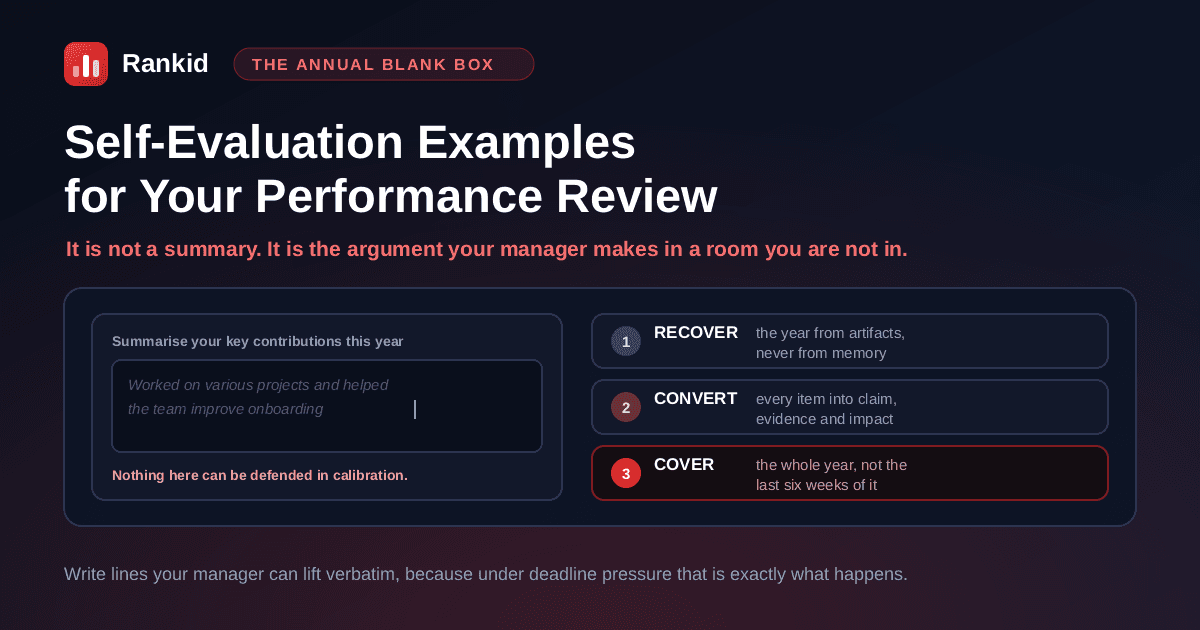
The form is open. The first box says something like "summarise your key contributions this year", and the honest answer is that you cannot remember March. So you search for self-evaluation examples, find a page offering eighty-eight phrases, and discover that none of them are about your work, because they cannot be. You paste something inoffensive about being a collaborative team player who consistently delivers, and your manager writes the review that actually matters from whatever they happen to remember. There is a much better way to do this, and it starts with understanding what the document is genuinely for.
Quick answer
Your self-evaluation is not a summary. It is source material. It is the first thing your manager reads when drafting the review that carries your rating, and under deadline pressure they will lift lines from it verbatim. So write lines worth lifting. The method: recover the year from artifacts rather than memory (45 minutes with your calendar and sent mail), convert each item into claim, evidence, impact, cover the whole year rather than the last six weeks, and name one real development area with the fix already running.
What a self-evaluation is actually for
Most people write a self-review as though the audience is their manager, and as though the purpose is to summarise a year that their manager watched happen. Both assumptions are wrong, and they are why so many self-reviews are bland.
Your manager did not watch most of your year. They watched their own, which contained your work as occasional visible fragments. And they are usually not the final audience: in most organisations of any size, ratings are argued in a calibration meeting where managers defend their people against a fixed distribution, and you are not in the room. Whatever your manager can say about you in that room is roughly the sum of what they remembered plus what you gave them.
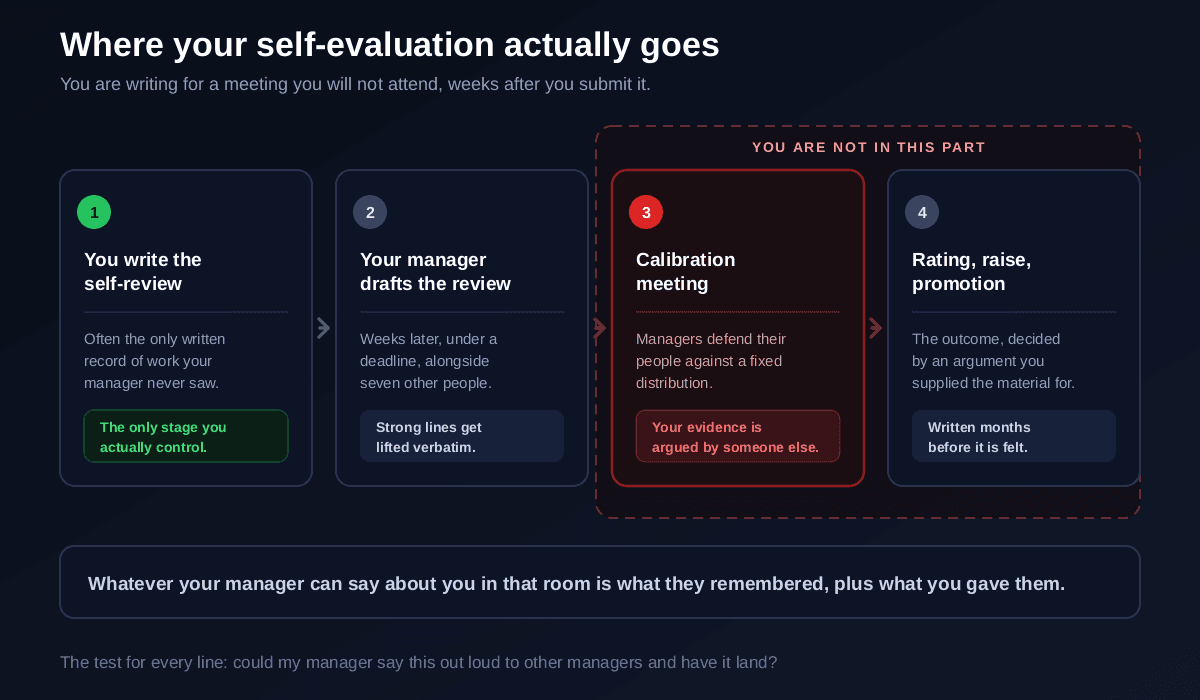
This reframes the writing task completely. You are not confessing, and you are not summarising. You are preparing an argument for someone else to deliver on your behalf, in a meeting you cannot attend, weeks after you wrote it. The practical test for every line becomes: could my manager say this sentence out loud in a room of other managers and have it land? Adjectives fail that test. Numbers and named outcomes pass it.
First, recover the year you cannot remember
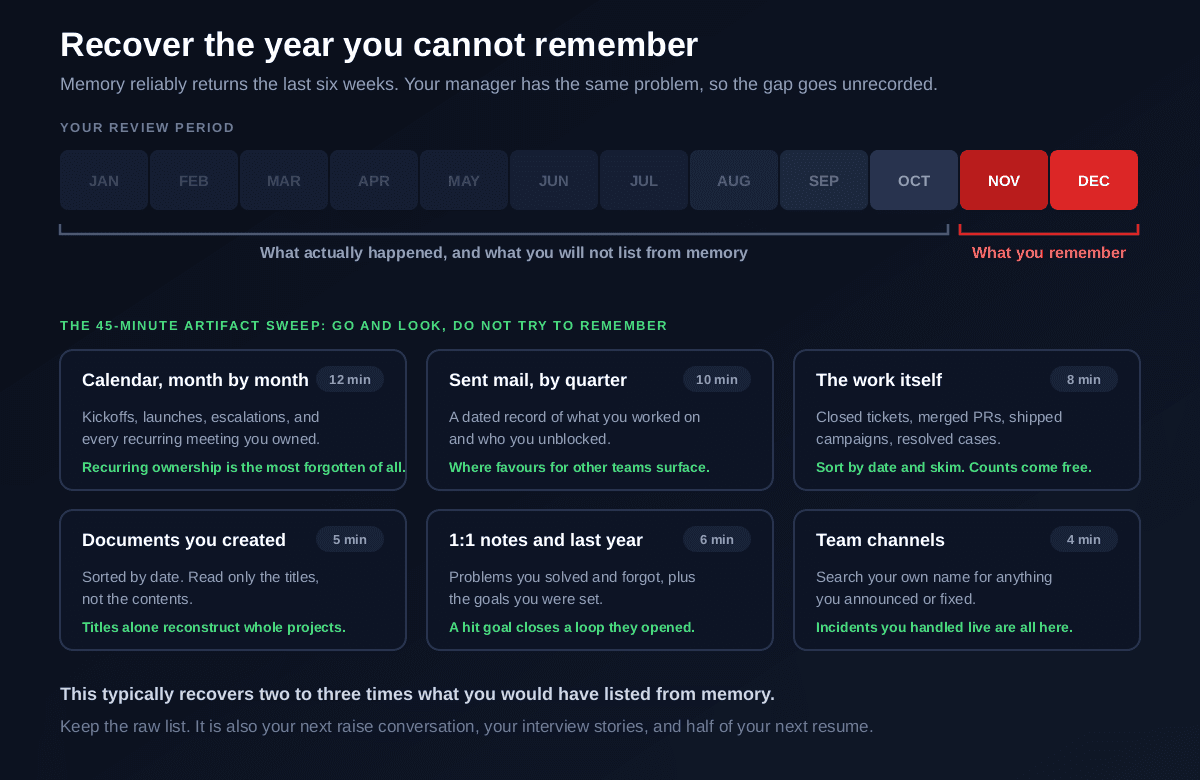
Recency bias is the single biggest structural flaw in self-reviews. Ask anyone to list their achievements from memory and you will get the last six to eight weeks in detail, one big thing from the middle of the year, and nothing at all from the first quarter. Managers have the same bias when writing the review, which means the first four months of your year can vanish from the record entirely unless you put them back.
The fix is mechanical and takes about 45 minutes. Do not try to remember. Go and look.
Scroll your calendar, month by month
Twelve months, roughly two minutes each. Note every project kickoff, launch, review, escalation and recurring meeting you owned. Recurring ownership is the most commonly forgotten contribution of all, because it never felt like an achievement while it was happening.
Search your sent mail, one quarter at a time
Your sent folder is a dated record of what you were actually working on and who you were unblocking. It is also where you will find the things you did for other teams, which almost never make it into a self-review and are exactly the sort of contribution a manager cannot see.
Pull the work artifacts themselves
Closed tickets, merged pull requests, shipped campaigns, resolved cases, published documents, signed contracts, whatever your work produces. Sort by date and skim. Then open your created-documents list, also sorted by date, and read only the titles.
Reread your one-to-ones and last year's goals
Your notes contain problems you solved and forgot about. Last year's goals tell you which items your manager is already primed to care about, and any goal you hit is worth stating explicitly because it closes a loop they opened.
Do this once, use it four times
The three-part line: claim, evidence, impact
Once you have the raw list, every item gets converted into the same shape. This is the whole technique, and it is what separates a self-review that gets reused from one that gets skimmed.
- Claim.What you did, in plain language, with you as the subject of the sentence. Not "the team shipped" but "I rebuilt".
- Evidence. Something checkable: a number, a date, a scope, a constraint you worked under. This is the part almost everyone omits, and it is the part that makes the line defensible.
- Impact. What changed for the organisation as a result, ideally in a measure someone above your manager already tracks.
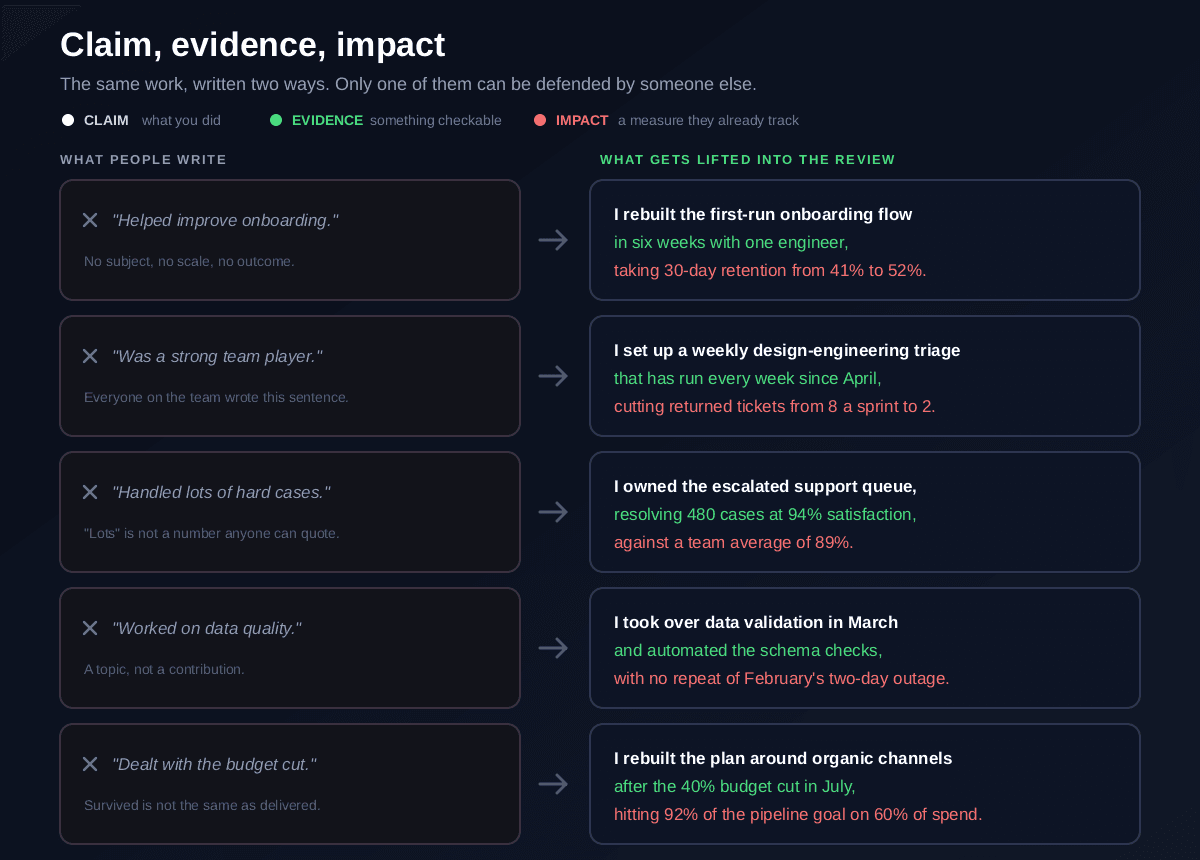
Notice what happens to the sentence length. The strong versions are not longer because they are padded, they are longer because they contain information. If you strike the specifics out of one of your own lines and it still makes sense, it was filler, and the person defending your rating cannot use it.
Self-evaluation examples by section
These are written to be adapted rather than pasted. The point of reading them is the shape, not the wording: each one puts you in the sentence, attaches something checkable, and lands on a consequence.
Achievements and quality of work
"I owned the migration of our billing system off the legacy provider, which I scoped in January and completed in May with no customer-visible downtime. The hardest part was the 4,000 accounts with non-standard plans, which I resolved by writing a reconciliation script rather than handling them manually, saving roughly three weeks of team time. Failed payment retries now recover 12% more revenue than before the migration."
"I handled the most complex tier of our support queue this year, resolving 480 escalated cases with a 94% satisfaction score against a team average of 89%. I also turned the twelve most frequent escalations into self-serve articles, which cut inbound tickets on those topics by about a third."
Collaboration and communication
"When the design and engineering handoff kept slipping in Q2, I proposed and ran a weekly fifteen minute triage between the two teams. It has run every week since April, and the number of tickets returned to design for clarification dropped from about eight a sprint to two. Two other squads have since adopted the same format."
"I mentored two new analysts through onboarding this year. Both were shipping independent analyses within six weeks, against the ten weeks our onboarding plan assumes, largely because I rewrote the starter documentation while working through it with the first of them."
Initiative and ownership
"Nobody owned our data quality checks, so I took them on in March. I built an automated validation step that now catches schema breaks before they reach reporting, and we have had no repeat of the incident that cost us two days of dashboards in February."
"When the campaign budget was cut by 40% in July, I rebuilt the plan around organic and lifecycle channels rather than reducing the target proportionally. We finished the half at 92% of the original pipeline goal on 60% of the spend."
Growth and learning
"I took on my first project with direct executive exposure this year, presenting the pricing analysis to the leadership team in September. My first draft was too detailed for that audience, so I rebuilt it around three decisions and their trade-offs, and that version was used to make the call. I now default to that structure for anything above my manager's level."
Goals for the next period
"Reduce repeat billing questions by half by the end of Q2, measured by tickets tagged billing-confusion, by rewriting the three highest-traffic help articles and adding an in-product explanation at the point of confusion. I would need about a day a week of design support in April to do the in-product piece."
Notice the shape of that last one: a measurable outcome, a date, a mechanism, and an explicit statement of what is needed to achieve it. A goal written that way is a two-way commitment rather than a wish, and it is much harder to quietly deprioritise later.
Those achievements belong on your resume too
The lines you just wrote are the raw material for your next resume. Paste your resume and a target job description into Rankid's free checker to see which of your achievements actually land against the role, and which requirements you have not evidenced.
Check your resume freeAreas for improvement, without hurting yourself
This is the section people either skip, which reads as no self-awareness, or over-answer, which hands their manager a quotable liability. The way through is to treat it as a test of judgment rather than a confession, because that is what it is.
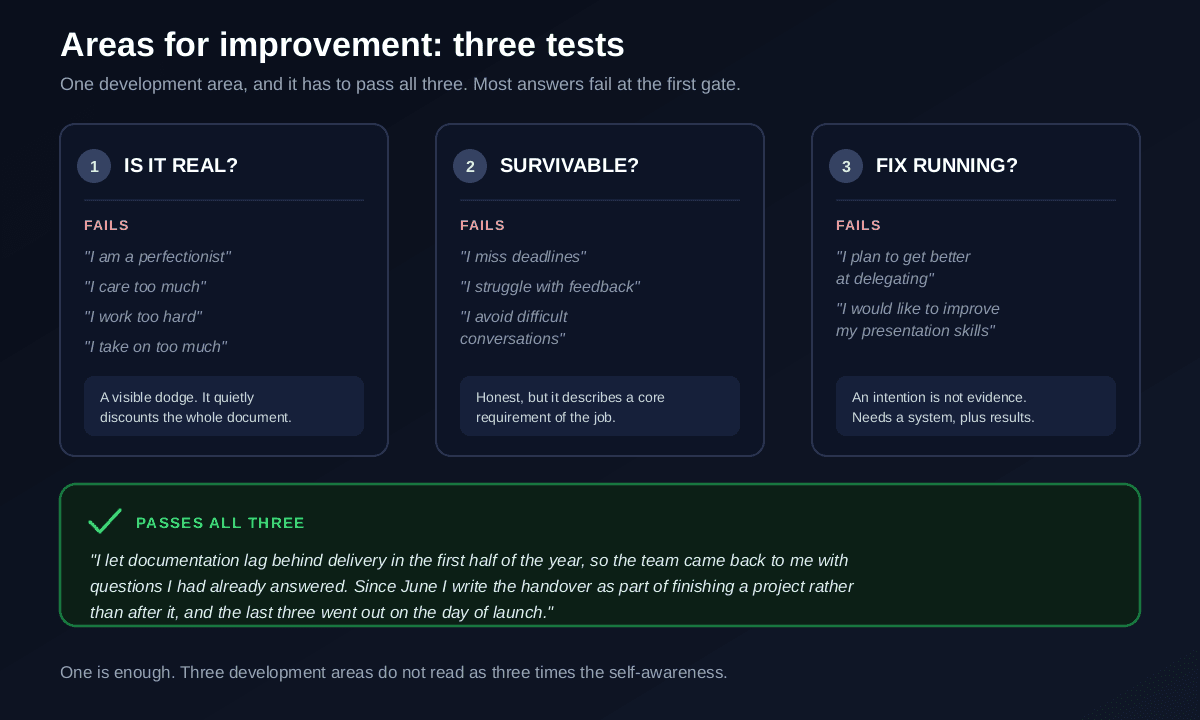
A development area has to pass all three tests. It must be real, because a humblebrag such as caring too much is transparently a dodge and quietly costs you credibility across the whole document. It must be survivable, meaning it is not a core requirement of the job, since "I struggle to meet deadlines" in a delivery role is not honesty, it is a quotable problem. And it must have a system already attached, with some early evidence that the system works.
A worked example that passes all three: "I let documentation lag behind delivery in the first half of the year, which meant the team came back to me with questions I had already answered in my head. Since June I have written the handover as part of finishing a project rather than as a separate task afterwards, and the last three handovers went out on the day of launch. It is deliberate rather than natural, but the gap has closed."
One is enough. Listing three development areas does not read as three times the self-awareness, it reads as a person building the case against themselves.
What not to say in a self-evaluation
- Blame.Even accurate blame. A sentence about another team's failures tells the reader something about you rather than about them, and it is permanent.
- Adjectives without evidence. Hard-working, passionate, detail-oriented and results-driven were claimed by everyone else on the team too, and none of them can be defended in calibration.
- Your job description. Your manager knows what you were hired to do. The review is about what happened.
- Self-undercutting language."I only", "I just helped with", "it was mostly the team". This is the most common self-inflicted wound in the entire document, and it disproportionately affects people who are already underrated.
- A first-time grievance. A self-evaluation is a permanent record read by people you have not met. A serious concern deserves a conversation, not a surprise appearance in a form field.
- Numbers you cannot support. Anything checkable will eventually be checked, and one inflated figure makes the accurate ones around it look like estimates.
- Everything you did. Twenty items with no evidence is weaker than four with evidence. You are being read in an afternoon alongside seven other people.
A self-evaluation template you can paste
If your organisation gives you an empty box rather than a structured form, this is a reliable order. Adapt the headings to whatever language your levelling framework uses, because mirroring that language deliberately makes your manager's job easier.
- Summary, three sentences. The single most important thing you delivered, its impact, and one line on how you worked. Written last, read first.
- Key achievements, three to five items. Each one claim, evidence, impact. Ordered by business impact, not chronologically.
- How I worked. Collaboration, ownership and judgment, evidenced by specific moments rather than described in adjectives.
- Goals from last period. Each one marked hit, missed or changed, with one line of honest explanation. Do not quietly omit a missed goal; the omission is more damaging than the miss.
- Development area, one item. Real, survivable, system already attached.
- Goals for next period, two or three. Outcome, measure, date, and what you need in order to hit them.
If you are writing reviews for other people
The manager side has a mirror-image failure: reviews assembled from phrase banks, which produce documents that are interchangeable between people and therefore useless in calibration and demoralising to receive.
- Write the evidence first, the rating second. Deciding the rating first and then selecting supporting phrases is how bias enters, and it produces reviews that cannot survive a challenge.
- Use their self-review as input, not as the answer. Under-claimers get systematically underrated when managers simply echo what was submitted, and that pattern tracks known demographic lines.
- Every criticism needs an example and a next step. Feedback without a specific instance is unactionable, and it is the most common complaint people have about the reviews they receive.
- No surprises. Anything in a written annual review should already have been said out loud months earlier. A first-time criticism in a permanent document is a management failure, not a candour win.
- Say the rating early in the meeting. Nobody hears the developmental feedback while they are still waiting to find out the number.
After the review: turning it into something
A review that ends with a rating and no follow-up wastes most of the work. Two things are worth doing within a week.
First, if the rating affects pay and you believe the evidence supports more than you were offered, that is a separate conversation with different timing and a different script, which our guide to asking for a raisecovers, including how to time it against your organisation's budget cycle rather than your review date.
Second, harvest the document. The achievements you just wrote with claim, evidence and impact are already in the right shape for a resume bullet and for an interview story. Converting them takes minutes while they are fresh, and our guides to quantifying achievements on a resume and answering interview questions with a story bank both start from exactly this material. Most people rebuild it from scratch two years later under time pressure, badly.
Key takeaways
- Your self-review is source material for a room you are not in. Write lines your manager can lift verbatim.
- Never write it from memory. Recover the year from calendar, sent mail, tickets and documents in about 45 minutes.
- Every item becomes claim, evidence, impact. If striking the specifics leaves the sentence intact, it was filler.
- Three to five achievements with evidence beat a dozen thin bullets. Aim for 400 to 800 words.
- One development area only: real, survivable, and with the system already running and showing results.
- Do not blame, do not list your job description, and never write "I only" or "I just helped with".
- Mark missed goals as missed. The omission does more damage than the miss.
- Harvest the document afterwards. These lines are resume bullets and interview stories already in the right shape.
The reason self-reviews feel like busywork is that most people write them as a summary for someone who was there, which is both unpleasant to produce and worthless to read. Written properly, the same hour produces the argument your manager will make on your behalf in a meeting you cannot attend, the evidence base for your next raise conversation, and about half of your next resume. Go and look at your calendar, put the first quarter of the year back into the record, and give every line something checkable. And when you do come to rebuild the resume, paste it and a target job description into Rankid's free resume checker to see which of those achievements actually land against the role you want next.
Frequently asked questions
What should I write in my self-evaluation?
Write four things, in this order: what you delivered, with evidence attached to each item; the impact that delivery had on something your organisation measures; how you worked, meaning collaboration, ownership and judgment, evidenced by specific moments rather than adjectives; and one genuine development area together with the system you have already put in place for it. Everything else is padding. The structural mistake almost everyone makes is writing a summary of their responsibilities, which your manager already knows, instead of a record of outcomes, which they have largely forgotten. Aim for something your manager could paste directly into the review they file, because in practice that is exactly what a good self-review becomes.
How do I remember what I did all year?
Do not rely on memory, because memory is the reason most self-reviews only describe the last six weeks. Reconstruct the year from artifacts instead, which takes about 45 minutes. Scroll your calendar month by month and note every recurring meeting you owned, every project kickoff and every launch. Search your sent mail by quarter. Pull your closed tickets, merged pull requests, shipped campaigns or completed cases. Open the documents you created, sorted by date. Reread your one-to-one notes and last year's goals. Check your team's channel for anything you announced. You will recover between two and three times as much as you would have listed from memory, and the first quarter of the year, which is otherwise almost always missing, comes back in full.
What are good self-evaluation examples for the achievements section?
The pattern that works is claim, evidence, impact, in three sentences. For example: "I took over the onboarding flow in February and rebuilt the first-run experience. I shipped it in six weeks with one engineer, running four rounds of user testing before launch. Thirty-day retention moved from 41% to 52%, which is roughly 300 additional retained accounts per month." Compare that with what most people write, which is "Worked on improving onboarding and helped increase retention." Same work, completely different value to the person defending your rating in a calibration meeting. Give three to five achievements at this level of specificity rather than a dozen thin ones, and lead with the one that maps most directly to a number your organisation cares about.
What should I write for areas of improvement in a performance review?
Name one real thing, describe the system you have already built for it, and show early evidence that the system is working. That combination is what makes the section safe: you demonstrate self-awareness without handing your manager a new concern. A workable example: "I let documentation lag behind delivery in the first half of the year, which meant the team came back to me with questions I had already answered. Since June I have written the handover as part of finishing a project rather than after it, and the last three handovers went out on the day of launch." Avoid the two failure modes. The humblebrag, such as caring too much or being a perfectionist, reads as a dodge. The confession, such as struggling to meet deadlines, hands your manager a quotable liability with no remedy attached.
What should you not say in a self-evaluation?
Avoid six things. Blaming other people or teams, however justified, because it reads as a person who is hard to work with rather than as an accurate account. Vague adjectives with no evidence, such as hard-working, passionate or detail-oriented, which every colleague also claimed. Listing your job description instead of your outcomes. Undercutting your own work with phrases like "only" or "just helped with", which is the most common self-inflicted wound and disproportionately affects people who are already underrated. Raising a serious grievance for the first time in the form, because a self-evaluation is a permanent HR document and a poor venue for a surprise. And inventing or inflating numbers, since anything checkable will be checked, and one unverifiable claim discredits the accurate ones around it.
How long should a self-evaluation be?
Between 400 and 800 words for a typical annual review, and shorter than you think for a quarterly one. Density matters far more than length, because a manager is often reading eight of these in an afternoon before a deadline. Three to five achievements written properly, at three or four sentences each, will beat a dozen one-line bullets every time, since the one-liners carry no evidence and cannot be reused. If your organisation supplies a form with per-competency boxes, resist writing an essay in every field: put the strongest evidence in the boxes that map to how you are actually rated, and keep the rest brief. As a practical test, if your manager could not read the whole thing in four minutes, cut it.
How do I write a self-review if I had a bad year?
Be accurate about outcomes, precise about causes, and concrete about what changed, in that order. Do not pretend a missed target was hit, because your manager already knows and the pretence costs you more credibility than the miss did. Separate what was within your control from what was not, without turning that into blame: a reorganisation, a cancelled project or a departed teammate are legitimate context when stated plainly and briefly. Then spend most of the section on what you did in response and what you would do differently, since managers weight the response to a bad quarter heavily. It also helps to identify anything you delivered that was not on the original plan, because reorganised years usually contain a lot of unplanned work that nobody wrote down.
Should I mention a promotion or raise in my self-evaluation?
Mention the scope, not the reward. The self-evaluation is where you build the evidence that you are already operating at the next level, and a separate conversation is where you ask for the title or the money. So instead of writing that you would like to be promoted to senior, describe the senior-level work you did: the project you owned end to end, the decision you made without escalating, the person you unblocked or mentored. If your organisation has a written levelling framework, mirror its language deliberately, because the person arguing for you in calibration has to map your evidence onto those exact words. Then have the direct conversation separately, and our guide to asking for a raise covers the timing and the script for that.
What is the difference between a self-evaluation and a performance review?
The self-evaluation is what you write about yourself; the performance review is the document your manager files and delivers, and it usually carries a rating that affects pay. They are connected in a way that is not obvious: your self-evaluation is typically the first input your manager reads when drafting the review, often weeks after the events it describes. It is also frequently the only written record of anything you did that your manager did not personally witness. That is why the useful mental model is not confession or summary but source material. Write lines that can be lifted verbatim into the review, because under time pressure that is exactly what happens, and the alternative is that your manager reconstructs your year from whatever they happen to remember.
What are good performance review phrases for quality of work?
Phrases only work when they are attached to evidence, which is why generic phrase lists produce reviews that all read the same. Build them on a verb plus a specific artifact plus a measurable effect. Strong patterns include: "rebuilt X, reducing Y by Z%"; "caught an error in X before release, avoiding Y"; "raised the standard for X by introducing Y, which the team now uses by default"; "delivered X to spec with no rework required"; and "handled the most complex cases in the queue, resolving N with a satisfaction score of M". Notice that each contains something checkable. If you strike out the specifics and the sentence still makes sense, it was not a real phrase, it was filler, and it will be skimmed past by the person who needs to defend your rating.
How do I set goals in a self-evaluation?
Propose two or three, not six, and make each one a business outcome with a measure and a date rather than an activity. "Improve documentation" is an activity; "cut repeat questions about our billing flow by half by the end of Q2, measured by tickets tagged billing-confusion" is a goal. Tie at least one to something your manager or their manager is already accountable for, since a goal aligned to their pressures is far more likely to be supported with time and budget. Include one stretch goal that requires scope you do not currently have, because that is how the next level gets negotiated in writing rather than argued for later. And state what you need from your organisation to hit each one, which turns the goal into a two-way commitment.
Can I disagree with my performance review?
Yes, and there is a right way to do it. Do not argue in the meeting itself: ask for the specific examples behind the rating, take notes and say you would like to respond in writing, which gives you time and removes the emotion. Then send a short, factual response naming the specific claim you disagree with and the evidence that contradicts it, such as dates, documents or outcomes, and keep it to one page. Ask for the response to be attached to the review record, which most organisations permit. If the disagreement is about a rating that affects pay, ask directly what evidence would have produced a different rating, because that answer is useful whether or not this review changes. Avoid the two things that never work: blaming a colleague, and rewriting your account after seeing theirs.