Questions to Ask in an Interview: 40 Smart Ones for Every Round
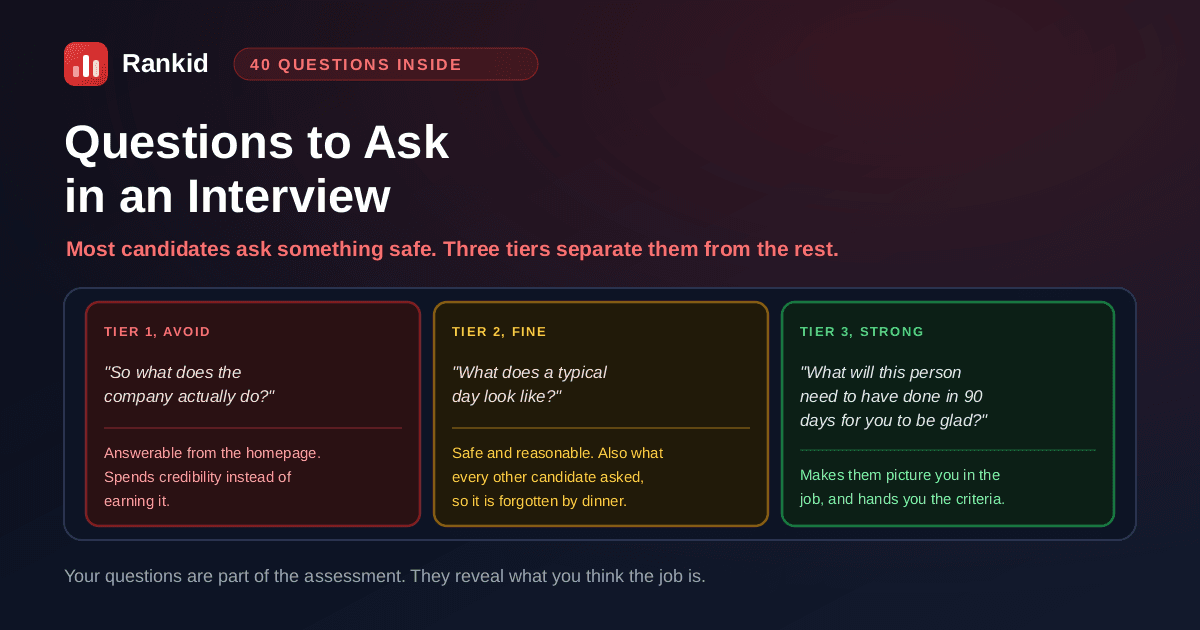
There is no shortage of lists of interview questions to ask. What those lists never tell you is which two to actually use, and that depends almost entirely on who is sitting opposite you. A recruiter genuinely cannot tell you what good performance looks like in the role. A hiring manager does not want to spend their half hour on the interview timeline. A future teammate will tell you things neither of them will. Here are 40 questions sorted by round and interviewer, the five that quietly screen the employer, and the closing question that almost nobody asks.
Quick answer
Prepare six questions, ask two or three. Match them to the person: process and salary to the recruiter, success criteria and challenges to the hiring manager, honest reality to a future peer. The single strongest question in most interviews is "what will this person need to have done in the first 90 days for you to feel this hire worked?" Close with "is there anything about my background you are unsure about?"Never answer "no, you covered everything."
How many questions should you ask?
Prepare six. Ask two or three. Those are different numbers on purpose.
Six is the right number to prepare because a good interview answers half of them for you before you get the chance. If you prepare exactly two and both get covered, you are left improvising or saying nothing. Six gives you a live list you can pick from, and crossing items off as they come up is itself a signal that you were listening.
Two or three is the right number to ask because the invitation at the end is usually a five minute window rather than an open floor. An interviewer with a meeting after yours will remember a candidate who asked two sharp things more warmly than one who worked through eight. If they tell you there is plenty of time, take it.
Bring them written down
Match the question to the person asking you in
This is the part most advice skips, and it is the difference between a question that lands and a wasted slot. The same excellent question can be unanswerable depending on who you put it to.
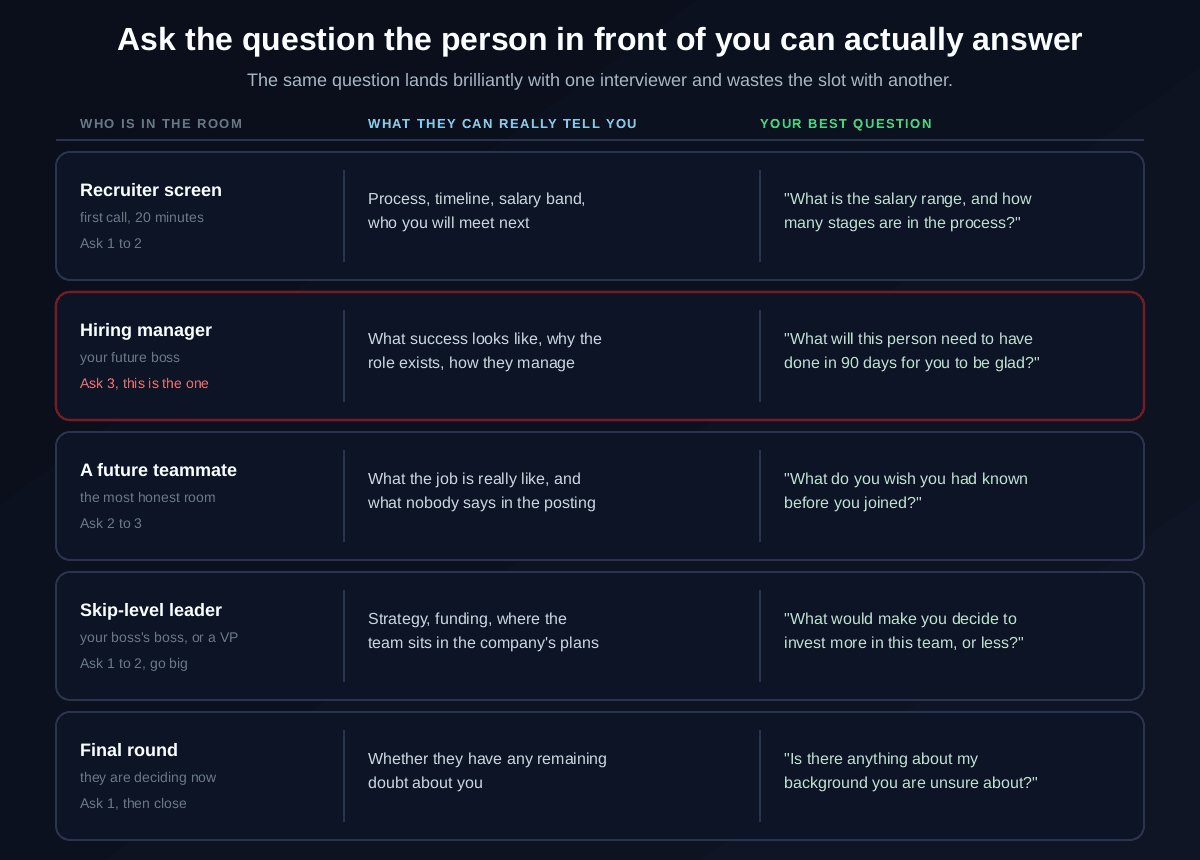
The recruiter screen. They own the process, not the work. Ask about the salary range, the number of stages, who you will meet, the timeline, and whether the role is new or a replacement. Confirming the band on this call is the single most efficient thing you can do, because it prevents four rounds ending in a mismatch. Do not ask them what technical priorities matter, because they usually do not know.
The hiring manager. Your future boss, and the interview where your questions carry the most weight. Bring your best three. Ask how success is measured, why the role exists, what the biggest challenge facing the team is right now, and how they like to manage. Their answers determine whether you actually want the job.
A future teammate. Usually the most honest room you will be in, because they are not the decision maker and they will have to work alongside whoever gets hired. Ask what they wish they had known before joining, what surprised them, and what the job is like on a bad week.
A skip-level leader.Your boss's boss, or a VP brought in for one round. They cannot speak to the day-to-day but they can tell you where the team sits in the company's plans, which is exactly what you want to know about job security. Go broad and strategic with your one or two questions.
The final round. They are deciding now, so use your slot to remove doubt rather than gather information. Ask whether there is anything about your background they are unsure about, then answer it.
The 40 questions
Pick from these rather than working through them. Everything here is safe to ask as written.
About the role itself
- Why is this role open?
- Is this a new position, or am I replacing someone?
- What does this person spend most of their week actually doing?
- Which parts of this job are the ones people underestimate?
- What would you want me to prioritise in the first month, and what could wait?
- How much of this role is defined, and how much would I be shaping?
- Which teams would I work with most closely?
- What does this role look like in two years if it goes well?
About success and how you will be judged
- What will this person need to have done in the first 90 days for you to feel the hire worked?
- How is performance measured in this team?
- What does the review process look like, and how often does it happen?
- What separates someone doing this job well from someone doing it adequately?
- Who was the last person promoted out of this team, and what earned it?
- What would make you decide this hire had not worked out?
About the team and the manager
- How would you describe your management style?
- How often would we meet one to one, and what do you use that time for?
- How does this team make decisions when people disagree?
- How long has the team been at its current size?
- What is the team good at, and what is it still working on?
- How does work usually arrive: planned in advance, or reactive?
- What does a hard week here look like?
About the company and where it is going
- What is the biggest challenge facing the team, or the company, right now?
- What is something the team believes now that it did not believe a year ago?
- How does this team's work connect to what the company is measured on?
- What would make you decide to invest more in this team, or less?
- How has the company changed in the time you have been here?
- What is the plan for the next twelve months that I would be part of?
About process and next steps
- Can you confirm the salary range for this role? (Ask the recruiter.)
- How many stages are there, and who would I meet?
- What is your timeline for making a decision?
- Is there anything you would like me to send or prepare before the next stage?
- When should I expect to hear, and is it alright if I follow up after that?
Closing questions, for the last thirty seconds
- Is there anything about my background you are unsure about?
- Having talked this through, do you have any reservations about my fit for the role?
- Is there anything I have not covered that would be useful for you to know?
- What is the strongest thing a candidate has said to you about this role?
For a second or later interview
- Where do you see the biggest gap between what the role needs and what I bring?
- Now that we have spoken once, what would you want to see more evidence of?
- Who else would I work with most closely, and what do they need from this role?
- What do you wish you had known before you joined? (Best asked of a peer.)
Get to the interview first
Great questions only help once you are in the room. Paste your resume and the job description into Rankid's free checker for a 0 to 100 match score, the skills you have covered, and the requirements you are still missing.
Check your match freeFive questions that quietly screen the employer
An interview runs both ways, and these five sound like ordinary curiosity while telling you a great deal. The question is not clever. The answer is the information.
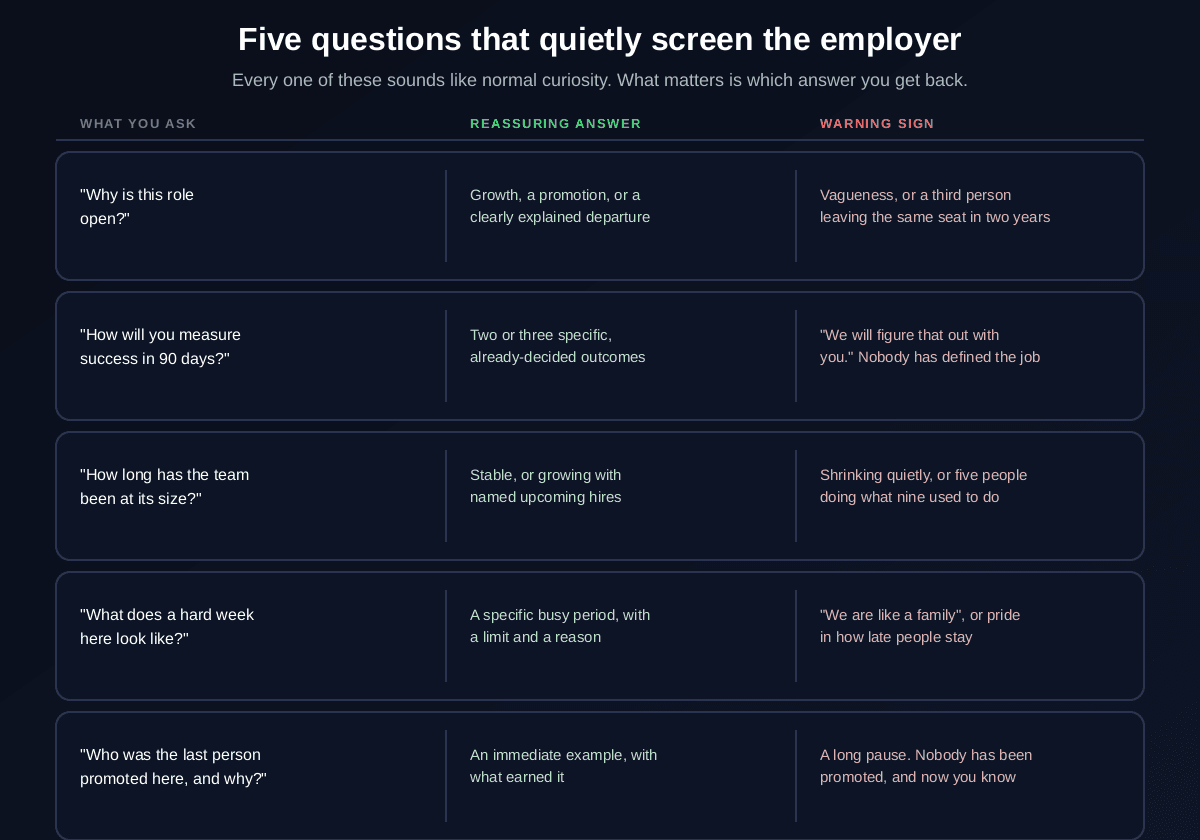
The pattern across all five is the same: you are testing whether specifics exist. A manager who cannot name what success looks like in 90 days has not defined the job, which means you would be judged against a standard nobody has written down. A team that has quietly shrunk from nine people to five is telling you about its budget. And a long pause on "who was the last person promoted here?" answers the progression question more honestly than any policy document.
None of these are reasons to walk away on their own. They are reasons to ask a follow-up, and to weigh the answer when you are comparing offers. If several land badly in the same conversation, that is a pattern worth taking seriously, and our piece on why people end up leaving jobs is largely a list of things these questions would have surfaced up front.
When to ask: you have four openings, not one
Treating "do you have any questions for us?" as your only opportunity is the most common structural mistake candidates make. You have four, and using more than one is what makes an interview feel like a conversation.
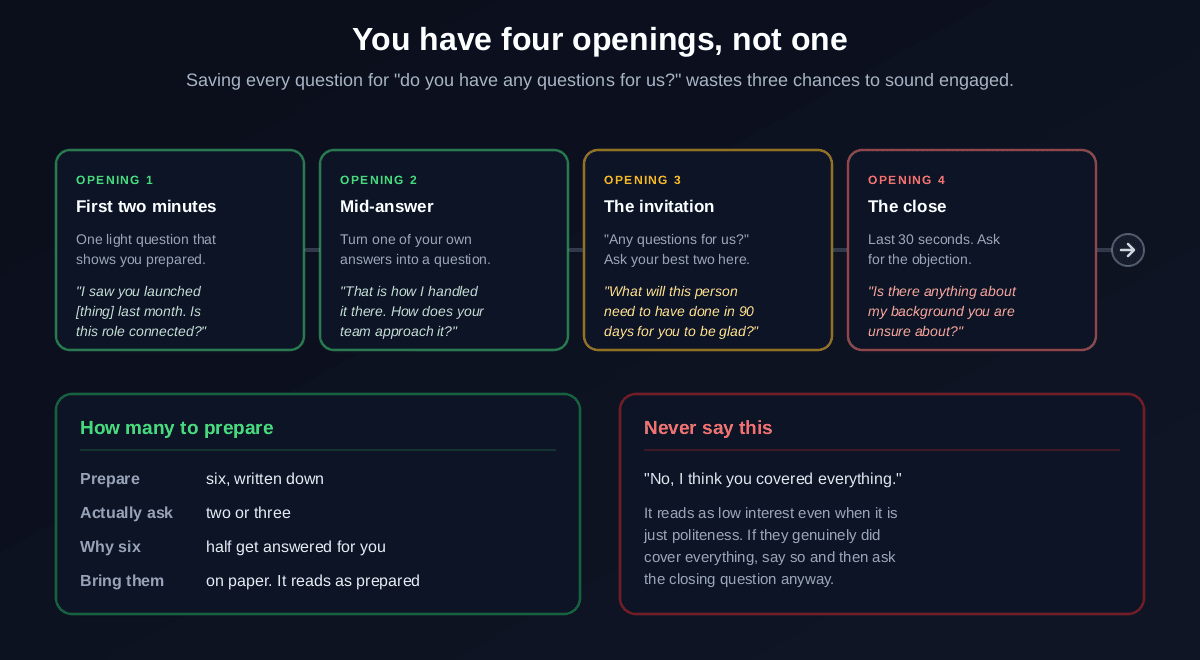
The mid-interview opening is the one worth practising. When you finish describing how you handled something, add a short question: "that is how we approached it there, how does your team handle that?" It costs ten seconds, it turns a monologue into a discussion, and it consistently reads as senior. Interviewers rate conversational candidates above ones who answer passively and then produce a list at the end.
And never say "no, I think you covered everything." It is usually politeness, and it lands as indifference. If they genuinely did cover everything, say exactly that and then ask a closing question anyway: "you have answered what I came in with, so let me just ask whether you have any hesitation about my background."
What not to ask
- Anything on the website. What the company does, how many employees, when it was founded. It costs you credibility for no gain.
- Salary and benefits with the hiring manager in round one. Right subject, wrong person and wrong stage. Take it to the recruiter, or to offer stage.
- Time off and hours framed as limits."How much holiday do I get?" lands differently from "how does the team handle cover during busy periods?"
- Anything about a named person, or gossip. Including asking why the previous postholder left by name.
- Three questions bundled into one. You will get an answer to whichever part they remember.
- "How did I do?" It puts them in an awkward spot and the answer is rarely honest. Ask about remaining doubts instead, which gets you the same information usefully.
- Gimmick questions. Asking what animal the company would be is memorable in the wrong direction. Specific beats quirky every time.
Questions to ask after the interview
Once you are out of the room, the questions change from information gathering to process management. In your follow-up note, keep it to one: confirm the timeline if it was not clear, or offer something concrete you promised to send. If the stated date passes with no word, one polite check-in is entirely reasonable, and our guide to how long it takes to hear back covers what timelines are actually normal.
If you are rejected, it is worth asking one question: whether there was a specific gap that decided it. Most employers will not answer, and a small number will give you something genuinely useful. Ask once, graciously, and do not push.
Prepare yours in four steps
Find out who you are meeting
Ask the recruiter for names and job titles before the interview, then look each person up. This one email determines which questions are even worth preparing.
Write six, mapped to the people
Two about success and how you will be judged, two about the team and the work, one process question for whoever owns process, and one closing question. Adjust the mix for who is actually in the room.
Add one that is specific to this company
Something from a recent launch, a report, an article, or the job description itself. One genuinely specific question does more for you than five polished generic ones, and it is what interviewers mean when they say a candidate had clearly done their homework. Reading the posting closely also sharpens your answers, which is the same work as tailoring your resume to the job description.
Rehearse the closing question out loud
Asking someone whether they have doubts about you feels uncomfortable the first time. Say it out loud twice beforehand and it will come out naturally, which is the whole point: it is the question that lets you fix a problem before it becomes a rejection.
Key takeaways
- Prepare six questions and ask two or three. Half will get answered before you have the chance.
- Match the question to the person: process to the recruiter, success criteria to the hiring manager, honesty to a peer.
- The strongest general question: what will this person need to have done in 90 days for you to be glad?
- Always close with: is there anything about my background you are unsure about?
- You have four openings to ask, not just the one at the end. Use the mid-interview one.
- Five questions quietly screen the employer. The answer, not the question, is the information.
- Never say "no, you covered everything." It reads as indifference even when it is politeness.
- Avoid anything answerable from the website, salary with the hiring manager in round one, and gimmick questions.
So, what should you ask in an interview? Fewer things than you think, aimed at the right person, and at least one of them designed to make the interviewer describe the job concretely rather than sell it. Your questions are part of the assessment: they reveal what you believe the job actually is, which is why a question about 90-day success lands so differently from a question about a typical day. Prepare six, ask three, close by asking for the objection. And to make sure you get into these rooms in the first place, paste your resume and the job description into Rankid's free resume checker and see what a recruiter sees before anyone asks you anything.
Frequently asked questions
What are the best questions to ask in an interview?
The strongest questions make the interviewer describe the job concretely rather than promote it. Three that work in almost any interview: "What will this person need to have done in the first 90 days for you to feel the hire worked?", which hands you the actual scoring criteria. "Why is this role open?", which tells you whether you are replacing someone, joining a growing team, or walking into a seat three people have left. And "Is there anything about my background you are unsure about?", which surfaces the objection while you are still in the room to answer it. What all three share is that they cannot be answered with marketing language, and each one gives you information you can genuinely act on rather than a pleasant non-answer.
How many questions should I ask in an interview?
Prepare six, ask two or three. Six is the right number to prepare because roughly half will be answered during the conversation, and crossing questions off as they are covered leaves you with live ones rather than a scripted list you have to abandon. Two or three is the right number to ask because the invitation at the end is usually a five minute window, not an open floor, and an interviewer with another meeting will remember a candidate who was concise more warmly than one who worked through eight items. If you are told there is plenty of time, you can go further. Write them down and bring them on paper or on your screen, since visibly prepared questions read as diligence rather than as a lack of spontaneity.
What are good questions to ask at the end of an interview?
Save your two strongest for the end, and finish with a closing question. The best end-of-interview questions are forward-looking: "What will success look like in the first 90 days?", "What is the biggest challenge facing the team right now?", and "How would you describe your management style?" if you are speaking with your future manager. Then close with either "Is there anything about my background you are unsure about?" or "What are the next steps and when should I expect to hear?" The first invites them to raise a doubt while you can still answer it, which is the single most underused move in interviewing. The second is basic housekeeping that also signals you are treating this as a process you are actively managing.
What questions should I not ask in an interview?
Anything answerable from the company website, since it signals you did not prepare. Salary and benefits with the hiring manager in a first interview, because that conversation belongs with the recruiter or at offer stage, though answering their question about your expectations is different. Time off, working hours and remote flexibility framed as what you can get away with rather than how the team works. Anything about a named colleague or gossip. Multi-part questions that are really three questions, which tend to get one partial answer. And "how did I do?", which puts the interviewer in an awkward position and rarely produces a truthful reply. One more to avoid: "No, I think you covered everything." It reads as low interest even when it is only politeness.
What questions should I ask a recruiter versus a hiring manager?
Ask each of them only what they can actually answer. A recruiter owns the process, so ask about the salary range, how many stages there are, who you will meet, the timeline, and whether the role is newly created or a replacement. They usually cannot tell you what good performance looks like day to day, so do not spend your slot there. A hiring manager owns the work and will be your boss, so ask how success is measured, why the role exists, what the biggest challenge facing the team is, and how they like to manage. This is the interview where your questions matter most, so bring your best three. Asking a recruiter about technical priorities, or a hiring manager about the interview timeline, wastes a limited opportunity on the wrong person.
What are good questions to ask in a second interview?
By the second round the basics are covered, so go deeper and more specific. Good options: "Now that we have talked once, where do you see the biggest gap between what the role needs and what I bring?", "What would you want me to prioritise in the first month, and what could wait?", "How does this team make decisions when people disagree?", and "Who else would I work with most closely, and what do they need from this role?" If you are meeting new people in the second round, ask them what they wish they had known before joining, since peers are typically the most candid interviewers you will meet. Second interviews are also the right moment to ask about progression and how the last person in a comparable role was promoted.
Is it okay to ask about salary in an interview?
Yes, with the right person at the right time. Ask the recruiter, ideally on the first screening call, because confirming the band early prevents everyone wasting four rounds discovering a mismatch. Phrase it as a range check rather than a demand: "Can you confirm the salary range for this role?" Avoid raising it with the hiring manager in a first substantive interview, where it can read as though compensation is your primary interest in the work. In many US states and several other jurisdictions the posted range is now legally required, so check the listing first and ask only to confirm what is not stated. Once an offer is on the table, salary is the appropriate subject and the balance of leverage has shifted in your favour.
What unique questions can I ask to stand out in an interview?
Distinctive questions work when they are genuinely specific rather than merely unusual. Strong options include: "What is something the team believes now that it did not believe a year ago?", "Who was the last person promoted out of this team, and what earned it?", "What does a hard week here look like?", "What would make you decide to invest more in this team, or less?", and "What is the part of this job that people underestimate?" Each is memorable because it asks for a concrete example the interviewer has to think about, which produces a real conversation rather than a rehearsed reply. Avoid clever-for-its-own-sake questions such as asking what animal the company would be, which tend to land as a gimmick and cost you the slot.
Should I ask questions during the interview or wait until the end?
Both, and treating the end as your only opening is a common mistake. You realistically have four moments. In the first few minutes, one light prepared question shows you did your homework. Mid-interview, turning one of your own answers back into a question makes the conversation two-way, for example describing how you handled something and then asking how their team approaches it. At the invitation, when they ask whether you have questions, use your best two. And in the final thirty seconds, ask the closing question about any remaining doubts. Interviewers consistently rate conversational candidates above ones who answer passively and then produce a list at the end, so spread your questions out.