How Long Does It Take to Hear Back After Applying for a Job? (2026 Timeline)
You found the role, tailored your resume, hit submit, and now you are staring at an inbox that will not fill. It is the most stressful stretch of any job search, the waiting, and the internet is full of contradictory advice about it. So let us answer the question plainly. How long does it take to hear back after applying for a job?In most cases, one to two weeks, with a median around ten days. But the more useful answers are the ones underneath: why so many applications get no reply at all, when silence actually means "no," and what is really deciding whether you hear anything in the first place.
Quick answer
The real timeline, week by week
There is no single number because response time depends on the company, the role, and how many people applied. But across most hiring processes the shape is consistent, and knowing it tells you when to stay calm and when to move on. Here is what is happening on the other side of the screen after you apply.
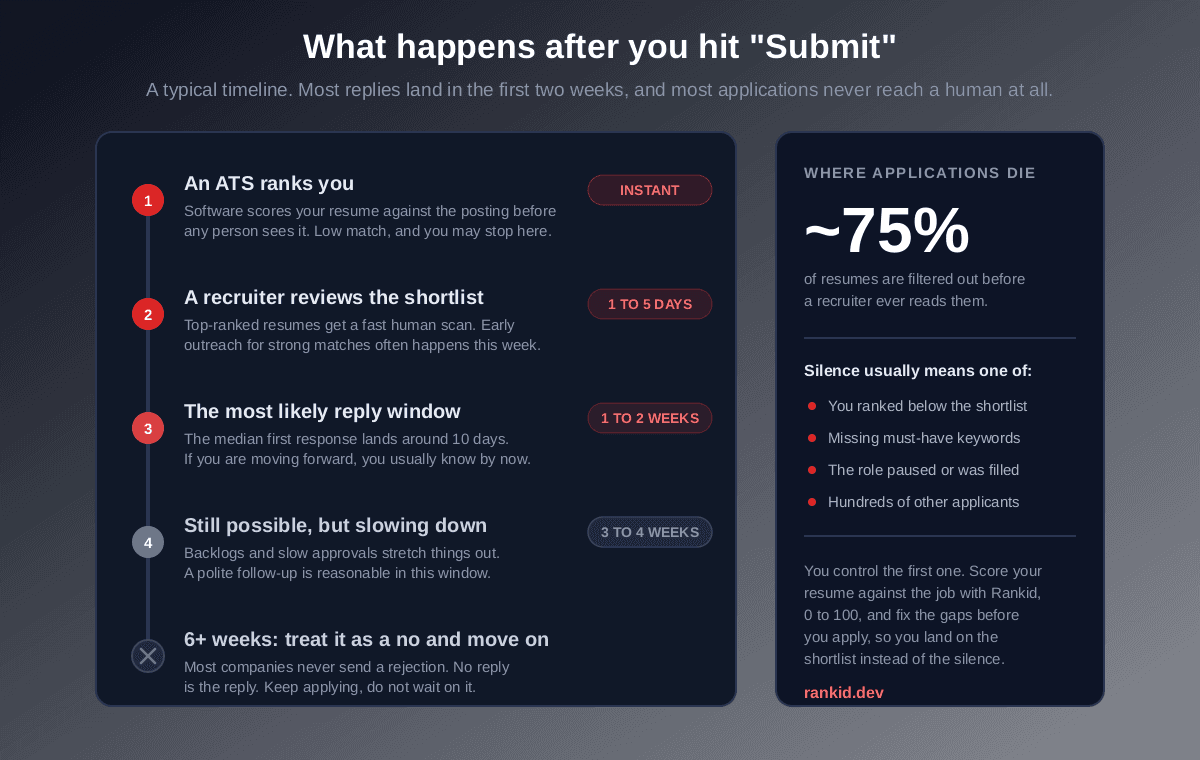
- Seconds to minutes: your resume is parsed and ranked by software before any person sees it. This is the gate almost everyone forgets, and it is where most applications quietly end.
- Day 1 to 5: a recruiter reviews the top of the ranked pile. If you are a strong, obvious match, this is when early outreach tends to happen, sometimes within 48 hours.
- 1 to 2 weeks: the most likely window for a first response, with the median first reply landing around ten days. If you are moving forward, you usually know by the end of this window.
- 3 to 4 weeks: still possible but slowing. Large companies, backlogs, and internal approvals stretch things here. This is the right time for one polite follow-up.
- 6+ weeks: treat it as a no and move on. Most employers never send a rejection, so no reply is the reply. Keep applying rather than waiting.
Company size changes everything
Why you often hear nothing at all
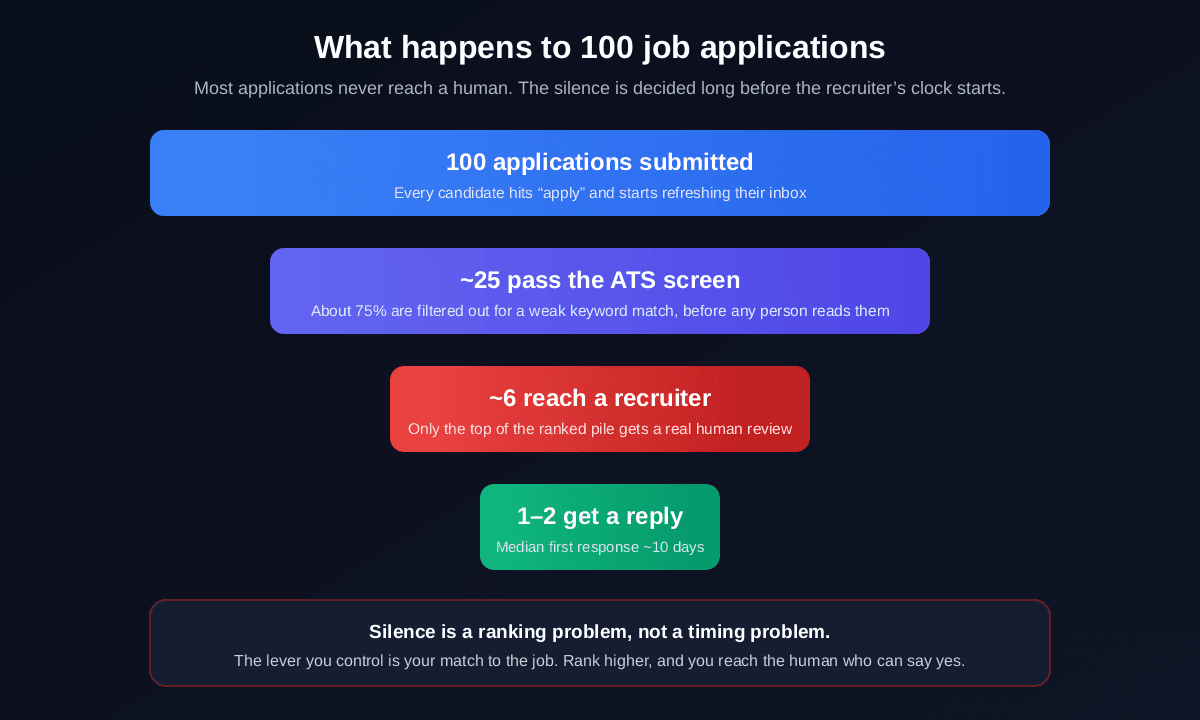
Here is the hard truth that reframes the whole waiting game: for most applications, no response is the default outcome, not a mistake. A large share of resumes, commonly estimated at around three quarters, never reach a human. They are filtered out by an applicant tracking system that parses your resume, scores it against the job's requirements, and surfaces only the top matches to a recruiter. If you rank below that cut, you are not rejected by a person, you are simply never shown to one. And because companies rarely send rejections to applicants they screened out automatically, you get silence instead of a "no."
That means the waiting is often decided before you ever hit submit. The question is not really "how long until they reply," it is "did my resume rank high enough to be seen." When people ask why they are not getting interviews despite dozens of applications, this is almost always the answer. The silence is a ranking problem wearing the mask of a timing problem.
The common reasons an application dies in the software, before a recruiter's two-week clock even starts, are worth naming plainly:
- You ranked below the shortlist. The role pulled hundreds of applicants and the software surfaced only the top handful. A decent resume that is not clearly matched loses to ones that are.
- You were missing must-have keywords.If the posting's required skills and terms are not on your resume in language the system recognizes, your match score drops. See the resume keywords that get you past an ATS.
- The software could not parse your resume. Multi-column layouts, tables, and graphics confuse many parsers, so your experience never lands in the right fields. This is what an ATS-friendly resume is designed to fix.
- The role changed under you. It was paused, filled internally, or reposted. This one is not about you at all, and no amount of following up will change it.
The part you actually control
You cannot make a recruiter reply faster, and you cannot control how many other people applied. What you can control is whether your resume ranks high enough to be seen in the first place, and that is the lever with the most leverage. A resume that clearly matches the job is not just more likely to get a reply, it is more likely to get a fast one, because strong matches sit at the top of the pile where recruiters start.
The way to control it is to stop eyeballing your resume and start measuring it against each specific job before you apply. That is exactly what a resume match checker does: it reads your resume and the job description the way the software does, scores the fit, and shows you the keywords and requirements you match versus the ones you are missing. You fix the gaps, then apply with a resume that is built to rank. If you want the mechanics, we cover them in how to check if your resume matches a job description and what counts as a good resume match score.
Land on the shortlist, not in the silence
Paste your resume and the job description into Rankid before you apply. You get a 0 to 100 match score, the keywords and requirements you match, and the exact ones you are missing, the same signals the ATS ranks you on. Your first check is free, no signup.
Check your resume freeWhen and how to follow up
Following up will not rescue an application the software screened out, but for roles where you may be in the pile, a good follow-up keeps you visible without being a nuisance. The rules are simple.
Wait one to two weeks first
Give the process time to work before you reach out. Following up two days after applying rarely helps and can read as impatient. If the posting stated a review timeline, follow their dates instead of this default.
Send one short, specific message
Email the recruiter or hiring manager if you can find them, reaffirm your interest in the specific role, and name one or two reasons you are a strong fit. Keep it to a few sentences. A wall of text works against you.
Follow up at most twice
One follow-up at the one to two week mark, and at most one more a week or so later, is the ceiling. Beyond that you are spending energy that would earn far more return on new applications.
Then let it go
If the posting is still live after several weeks with no reply, assume it is not happening and redirect your effort. The best candidates are not the ones who chase hardest, they are the ones who keep a full, well-matched pipeline moving.
A quiet advantage: apply early
How long after an interview should you hear back?
The waiting does not end once you interview, and the timeline resets. After an interview, most candidates hear back within one to two weeks, though it stretches when a company is still interviewing others or waiting on approvals. The single best move is to ask at the end of the interview when you can expect to hear about next steps. That turns an anxious open-ended wait into a concrete date you can measure against, and it gives you a clean reason to follow up if that date slips.
If the date they gave you passes by several days, send a brief, warm follow-up thanking them and restating your interest. And as with applications, extended silence after an interview usually means they moved forward with someone else, because many employers still do not notify candidates who were not selected. It stings, but it is information: it frees you to focus fully on the roles still in play.
The mindset that keeps you sane
The reason waiting feels so awful is that it puts your fate in someone else's hands and gives you nothing to do. So change what you are measuring. Instead of tracking how long since you applied, track how well each application was matched before you sent it, and keep enough applications in flight that no single one carries all your hope. A pipeline of ten well-matched applications is not just ten times the odds, it is ten times less anxiety per application, because no single silence can sink you.
And remember what the silence usually is. It is not a verdict on your worth, it is a ranking that happened in seconds, often before a person was ever involved. That is oddly freeing, because rankings are something you can improve. Every application you match more closely to the job is one more that clears the gate and reaches a human, which is the only place a "yes" can come from. If you want the full picture of how fast that first human even looks once you get there, read how long recruiters look at a resume.
Key takeaways
- Most first responses arrive within 1 to 2 weeks, median about 10 days. Strong matches often hear back in the first few days.
- After 3 to 4 weeks a reply gets unlikely, and past 6 weeks you should treat the silence as a no.
- No response is the most common outcome. Around three in four resumes are filtered out by software before a recruiter reads them, and most companies never send a rejection.
- Silence is usually a ranking problem, not a timing problem: your resume did not rank high enough to be seen.
- The lever you control is your match to the job. Score your resume against each posting and fix the missing keywords before you apply.
- Follow up once at the 1 to 2 week mark, at most twice, then move on. Apply early, since many roles are reviewed in the first few days.
- Rankid scores your resume against the job in seconds, showing what you match and what you are missing, and your first check is free.
Bottom line: if you applied and have not heard back, one to two weeks of quiet is completely normal, and no reply after six weeks almost always means no. But the deeper answer is that most of the waiting is decided before you ever hit submit, in a ranking you can influence. So stop refreshing your inbox and start improving your odds: run your resume through Rankid's free resume checker against the job you want, close the gaps it finds, and apply next time as a resume built to be seen, not one built to be skipped.
Frequently asked questions
How long does it take to hear back after applying for a job?
Most first responses arrive within one to two weeks, with a median of roughly 10 days. Strong-match candidates often hear something in the first few days, because top-ranked resumes get reviewed first. After about three to four weeks a reply becomes much less likely, and past six weeks you should treat the silence as a no. Timelines vary a lot by company size and role: startups can move in days, while large enterprises with multiple approval layers can take a month or more. If you have heard nothing after two weeks, that is normal and not yet a reason to worry.
Is it normal to not hear back after applying for a job?
Yes, and it is the most common outcome. A large share of applications, commonly estimated at around three quarters, are filtered out by an applicant tracking system before a recruiter ever reads them, and most companies do not send rejection notices to applicants who are screened out. So no reply is not a system error and usually not a reflection of your worth, it simply means you were not shortlisted for that specific role. The practical response is to keep applying and to make sure your next resume matches the job closely enough to clear the automated screen.
How long should I wait before following up on a job application?
Wait about one to two weeks after applying before sending a follow-up, unless the posting gave a specific timeline, in which case follow their dates. One short, polite message to the recruiter or hiring manager reaffirming your interest and fit is appropriate. Following up sooner rarely helps and can read as impatient, and following up more than once or twice usually does not change the outcome. If a job posting is still live after several weeks with no response, your energy is better spent applying to new roles than chasing the old one.
How long does it take to hear back after an interview?
After an interview, most candidates hear back within one to two weeks, though it can stretch longer when a company is still interviewing others or waiting on internal approvals. It is reasonable to ask at the end of the interview when you can expect to hear about next steps, which gives you a concrete date to measure against. If that date passes by several days with no word, a brief follow-up email is appropriate. As with applications, prolonged silence after an interview often means they moved forward with someone else, since many employers do not notify candidates who were not selected.
Why haven't I heard back after applying to so many jobs?
If you are applying steadily and hearing nothing, the problem is usually happening before a human sees you: your resume is not ranking high enough against the job in the applicant tracking system, most often because it is missing the must-have keywords and requirements from the posting. Other common causes are applying to roles that are a weak fit, a resume format the software cannot parse cleanly, or simply very high applicant volume. The fastest fix is to stop guessing and measure: score your resume against each job before you apply, see exactly which keywords and requirements you are missing, and close those gaps so you land on the shortlist instead of in the silent pile.
Does applying early or late affect how fast I hear back?
Applying early helps. Many recruiters begin reviewing candidates within the first few days a posting is live and sometimes close or fill a role before the listed deadline, so applications submitted in the first 48 to 72 hours tend to get seen sooner and face less competition. Applying weeks after a job posts means you may be joining a pile the recruiter has already started shortlisting from. Speed does not overcome a weak match, though. The best combination is to apply early and apply with a resume that clearly matches the role, so you are both near the top of the queue and near the top of the ranking.