What to Wear to an Interview: Every Dress Code, Decoded
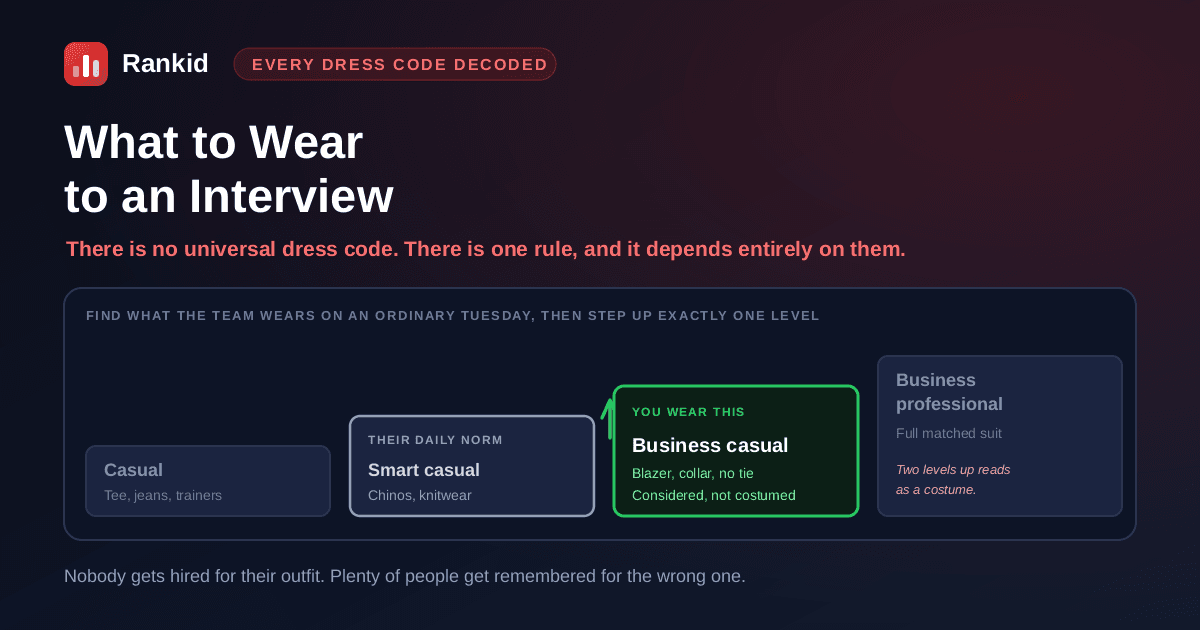
Every guide to interview clothing eventually contradicts itself, because it is trying to give one answer to a question that has a different answer at a law firm, a hospital, a warehouse and a fourteen-person startup. Wear a suit is wrong advice roughly half the time. Dress comfortably is wrong the other half. There is only one rule that holds everywhere: find out what the team wears on an ordinary Tuesday, and dress exactly one level above it. Everything below is either how to find that out, or what to physically put on once you know.
Quick answer
Dress one level above the team's everyday norm. If you cannot find out, wear business casual: blazer plus tailored trousers or a knee-length dress, or blazer plus pressed shirt and no tie. Navy or charcoal, one accent colour at most. Being slightly overdressed is forgotten in ten minutes; being visibly too casual gets mentioned in the debrief. Most of what costs you is fit and condition, not budget.
The one rule that replaces all the others
Interview clothing is not a test of taste. It is a signal about whether you understand the environment you are asking to join. Someone who arrives at a construction firm in a three-piece suit and someone who arrives at a magic circle law firm in a hoodie have made the same mistake in opposite directions: both have shown they do not know what the workplace is like.
One level above the daily norm works because it does two things at once. It shows you made an effort for the occasion, which is the entire social function of dressing up, and it shows you know what the norm is, which is the part people miss. That is why the target moves with the company rather than with the job title.
And be clear-eyed about the stakes: nobody has ever been hired because of an outfit. What clothing can do is cost you a little attention or credibility at the start, or quietly get out of the way so that everything you prepared actually lands. Getting out of the way is the goal.
How to find out what they actually wear
This is the part almost every guide skips, and it takes about ten minutes.
- Ask the recruiter.The single fastest method and completely normal: "Is there a dress code I should know about, or what do people in the team usually wear?" It signals diligence, not uncertainty. Nobody has ever been marked down for asking.
- Look at the company's own photographs. The about page, the careers page and any recent LinkedIn posts. Discount launch parties and conference photos, which are dressed up, and look for candid office shots.
- Check the team on LinkedIn. Profile photos of people who actually hold your target job title, not the executives. Executives dress a level above their own teams, which will skew you.
- Walk past at nine in the morning. If it is a physical office and you can get there, this beats every other method combined. Five minutes watching people arrive tells you exactly what the norm is.
- Read the job posting again. Words like corporate, client-facing, regulated or formal are pushing you up. Words like relaxed, flexible or informal are pushing you down.
- Search recent reviews. Employees on review sites frequently mention the dress code directly, often as a positive.
If you get contradictory signals, go up
The four dress codes, in actual garments
Dress code labels are useless until someone translates them into clothes. Here is that translation, for women and men, at each level.
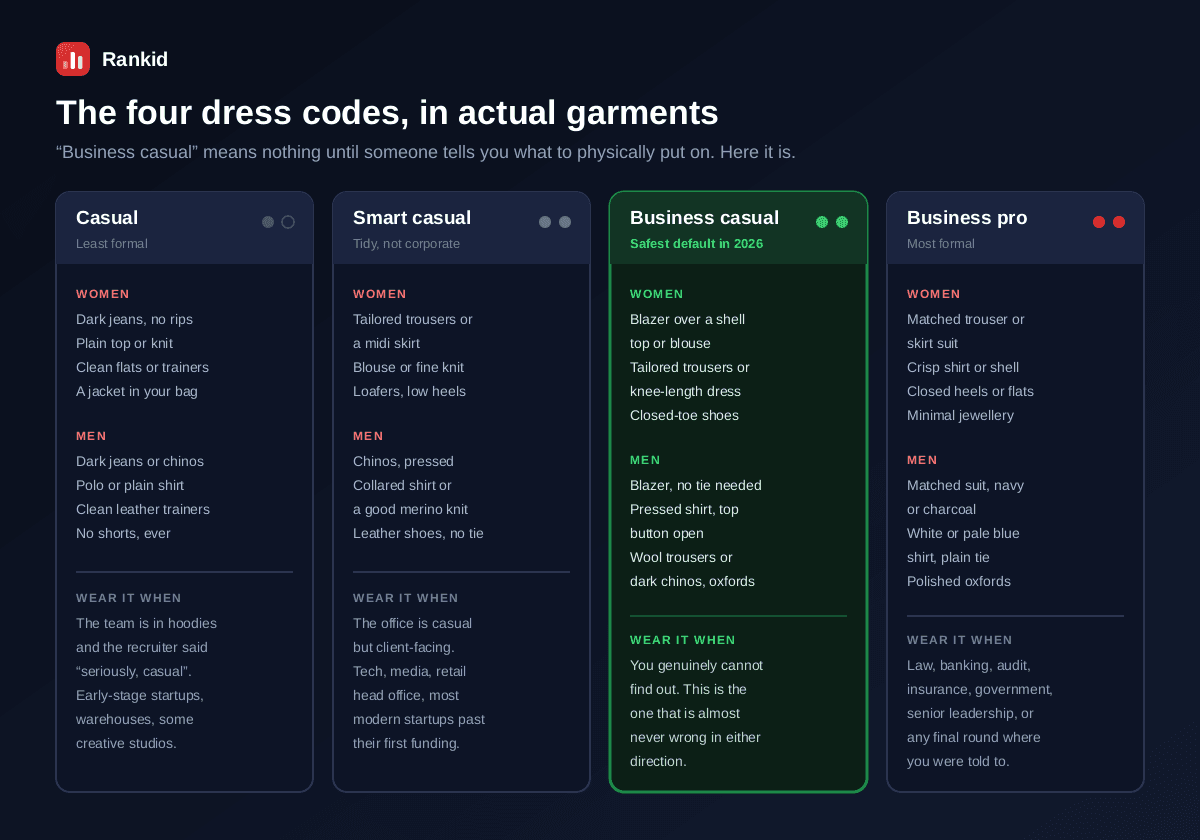
Business casual is the safest default in 2026, and if you take one thing from this article beyond the calibration rule, take that. Most workplaces have drifted more casual over the past decade while interviews have stayed slightly more formal than the day-to-day, which puts business casual in the sweet spot for the large majority of roles. It is smart enough for a conservative office to take you seriously and relaxed enough that you will not look out of place at a startup.
What to wear to an interview: women
The reliable formula is a structured layer, a simple base, and one considered detail. A blazer over a shell top or blouse, with tailored trousers, a knee-length skirt or a simple dress. Trousers are completely standard everywhere and there is no residual expectation of a skirt in any industry worth working in.
Shoes should be closed-toe and, above all, something you can walk in without thinking about it. Office tours happen, buildings are larger than you expect, and unsteady walking undoes a great deal of composure. Flats are entirely acceptable at every level of seniority, and a low block heel is easier than a stiletto if you want the height.
Jewellery, hair and makeup should be quiet rather than absent. The test for any piece is whether it makes noise against a desk or moves distractingly on camera. Hair off your face matters more than any particular style, because touching your hair repeatedly reads as nervousness whether or not you feel it.
Practicalities that catch people out: take a bag that actually holds a folder without crumpling it, so you are not carrying loose paper. Check that a wrap dress or blouse stays put when you sit and reach forward. And if you are wearing tights, put a spare pair in your bag.
What to wear to an interview: men
A navy or charcoal blazer, a pressed shirt with the top button open, wool trousers or dark chinos, and polished leather shoes will be correct for most interviews you will ever attend. Add a plain tie and switch to a matched suit for formal fields; drop the blazer for genuinely casual ones.
Fit is the whole game. A cheap jacket that fits at the shoulders looks considerably better than an expensive one that does not, because the shoulder is the one thing a tailor cannot easily fix. Sleeves should end at the wrist bone with a little shirt cuff showing, and trousers should break once over the shoe rather than pooling. If you own one jacket, spending thirty on having it taken in is the highest-return money in this entire article.
The details that get noticed: dark socks that match your trousers rather than your shoes, a belt in roughly the same tone as the shoes, and no visible logos. Empty your pockets so nothing bulges. If you wear a watch, one is plenty.
On ties: the default is no tie for business casual and a plain or subtly patterned tie for business professional. If you are genuinely unsure, wear one and remove it in the car if you arrive and see an open-collar office. That adjustment is easy in one direction and impossible in the other.
What colour to wear to an interview
Colour matters far less than fit and condition, but it is a free decision so it may as well go your way.
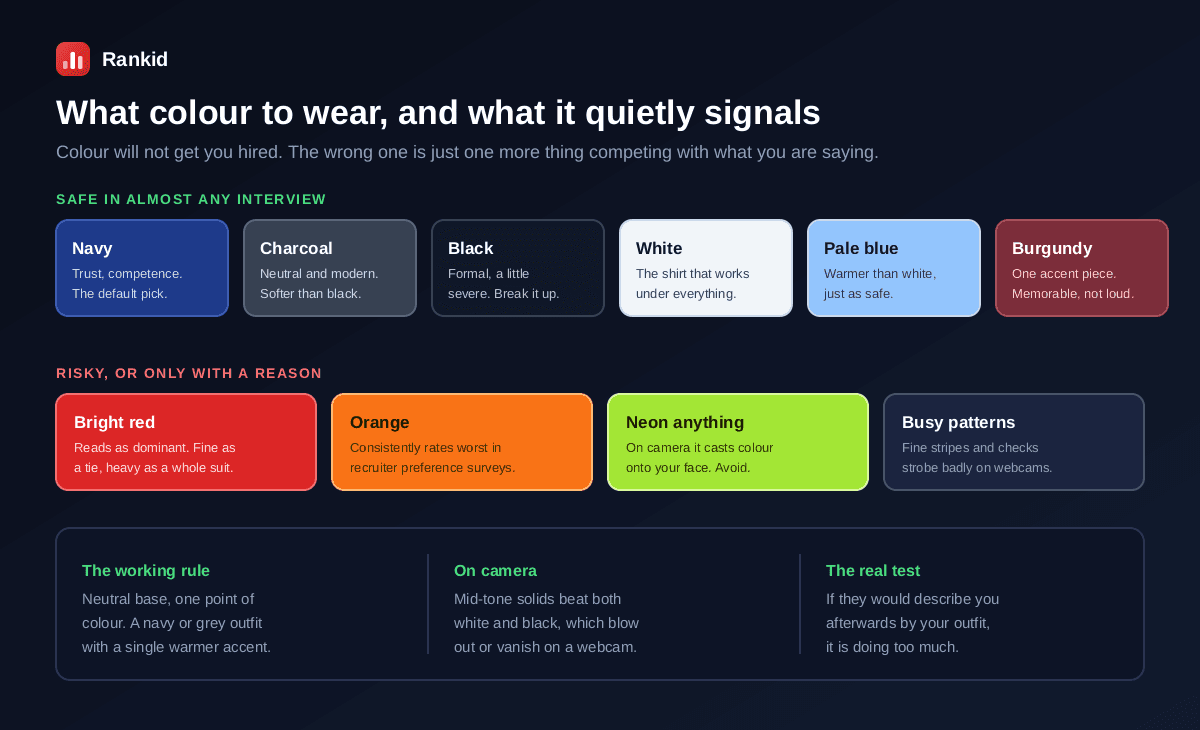
The practical version: build on a neutral base and allow yourself one point of colour. A navy or charcoal outfit with a single warmer accent is both safe and slightly more memorable than head-to-toe black, which is the most common choice and the one that most often reads as a funeral rather than a job interview.
Zoom, Teams and virtual interviews
Dress the same way you would in person, then adjust for the camera. The mistake is not being too casual, it is forgetting that a webcam sees differently from a room.
- Mid-tone solids beat extremes. Pure white blows out under automatic exposure and black collapses into a shape with no detail. Mid blues, greys and greens hold up best.
- Avoid fine patterns. Narrow stripes and small checks shimmer and strobe on compressed video. Plain fabric always looks better on camera than it does in person.
- A blazer reads especially well. On a small tile, a defined shoulder line is most of what makes someone look put together.
- Wear real trousers. You may have to stand, a parcel may arrive, and being fully dressed measurably changes how you sit and speak.
- Check yourself on camera, not in a mirror. Open the meeting software beforehand at the same time of day. Light your face from the front and avoid sitting with a window behind you.
- Skip anything that dangles. Long earrings catch the light and pull the eye on a small screen.
The outfit gets you ten seconds. The match gets you the interview.
Looking right only matters once you are in the room. Paste your resume and the job description into Rankid's free checker for a 0 to 100 match score, the requirements you have covered, and the gaps to close before you apply.
Check your match freeWhat not to wear
The most damaging problems are almost never the dress code. They are condition problems, and most of them are free to fix.
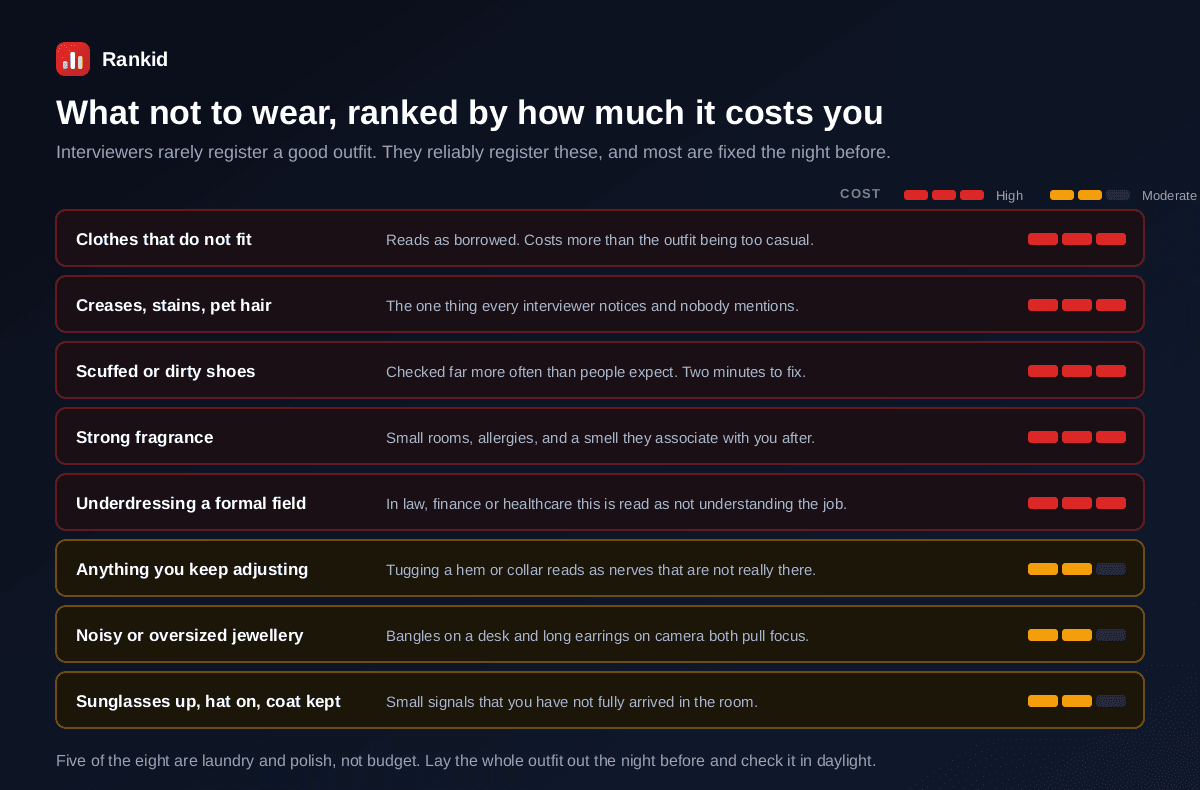
Fragrance deserves a specific mention because people underestimate it. Interview rooms are small, often windowless, and a proportion of interviewers have genuine sensitivities. Something you can barely detect on yourself after an hour of wearing it can be overwhelming to someone meeting you for the first time. Shower, use deodorant, and skip the perfume or aftershave entirely.
By industry
Law, banking, insurance, audit, government. Business professional, no exceptions and no creativity. A matched suit in navy or charcoal. This is one of the few remaining contexts where underdressing is a substantive error rather than a stylistic one.
Healthcare and nursing. Business casual or professional, not scrubs, unless you have been told to attend a clinical assessment. Skip fragrance and nail varnish, keep nails short and hair tied back. Interviewers read these details as evidence you understand infection control.
Technology. Smart casual to business casual. A blazer with a plain shirt and no tie is comfortably correct almost everywhere. A full suit at an engineering interview will read as a misunderstanding of the culture.
Education. Business casual, and lean slightly conservative. Schools are more formal than most people expect, and you will likely be walking a building, so wear shoes that handle it.
Retail and hospitality. Smart casual, and dress in the direction of the brand. Interviewing at a premium retailer is different from interviewing at a discount chain, and showing you understand the customer is itself part of the answer.
Creative and design. Smart casual with room for personality. This is the one field where a distinctive, considered choice actively helps, provided it is deliberate rather than careless.
Trades, warehouse, logistics. Clean casual: dark jeans or work trousers with a plain shirt and solid shoes. If part of the interview is practical, ask what you should turn up able to do, and wear boots if there is any chance you will be on a site.
Special cases
A teenager's first interview. Dark trousers or a knee-length skirt with a plain shirt or top, and clean closed shoes. No suit, because a borrowed-looking suit does more harm than being slightly casual. Clean, ironed and well-fitting matters far more than anything you could buy.
You are interviewing while employed. Turning up to your current job in a suit when you normally wear a fleece announces exactly what you are doing. Change off-site, or book the interview early, late, or on a day off. Our guide to handling the reason-for-leaving question covers the rest of that conversation.
Budget is tight. Prioritise in this order: get one jacket that fits at the shoulders, clean and polish your shoes, iron everything. A charity shop blazer that fits beats a new one that does not. Nobody can identify the price of your clothes; everybody can see whether they fit.
Religious or cultural dress. Wear it, in a smart and well-presented version. A hijab, turban, kippah or other religious dress in a colour that coordinates with your outfit is entirely professional, and in most jurisdictions it is unlawful to discriminate on that basis. Apply the same standard you would to everything else: fit, condition and neutral colours.
Tattoos and piercings. Visible tattoos are unremarkable in most industries now. In law, finance, healthcare and client-facing corporate roles, covering them for the interview is the low-risk choice, and you can reassess once you know the culture. The same applies to facial piercings in formal fields.
The night before
Lay the whole outfit out and look at it in daylight
Every layer, including shoes, socks and the bag. Daylight shows stains, bobbling and colour clashes that indoor lighting hides completely.
Try it on and sit down in it
Sit, cross your legs, reach forward, and stand up. Anything that rides up, gapes or has to be adjusted gets swapped now rather than discovered in the room.
Iron it and polish the shoes
These two steps address more of the high-cost problems than any purchase would. Hang the outfit rather than folding it.
Prepare the backup
Weather changes and coffee spills. Have a second shirt or top identified, keep a stain pen in your bag, and if you are travelling, carry the jacket rather than wearing it.
Check it against what you are walking into
One last look at the team photos, and confirm the format. If the interview turns out to be a video call rather than in person, the colour rules change and the questions you prepared matter a great deal more than the trousers nobody will see.
Key takeaways
- Dress one level above what the team wears on an ordinary working day.
- When you cannot find out, wear business casual. It is almost never wrong in either direction.
- Ask the recruiter directly. It reads as diligence, not uncertainty.
- Fit and condition matter more than price. A jacket that fits at the shoulders beats an expensive one that does not.
- Navy and charcoal are the safest colours. Neutral base, one accent, and skip orange and neon.
- On camera, wear mid-tone solids. White blows out, black loses detail, fine patterns strobe.
- Slightly overdressed is forgotten in ten minutes. Visibly too casual gets discussed afterwards.
- Skip fragrance entirely. Small rooms and allergies make it a real risk with no upside.
The right interview outfit is the one nobody remembers. If the hiring team describes you afterwards as the candidate who had clearly thought about the day-30 retention problem, your clothes did their job. If they describe you as the one in the very bright jacket, or the one whose suit did not fit, something took attention that you needed elsewhere. Work out what the team wears, go one level above it, make sure everything is clean and fits, and then stop thinking about it. And because what actually gets you into the room is matching the role rather than looking the part, paste your resume and the job description into Rankid's free resume checker and close the gaps before you ever need to pick an outfit.
Frequently asked questions
What should I wear to an interview?
Find out what the team wears on an ordinary working day, then dress exactly one level above it. That single rule replaces every generic dress code list, because an outfit that is perfect at a law firm is a costume at a startup and the reverse is equally true. In practice this means asking the recruiter directly, looking at photographs of the team on the company's own site and LinkedIn, or simply walking past the building at nine in the morning. If you genuinely cannot find out, wear business casual: a blazer with tailored trousers or a knee-length dress for women, a blazer with a pressed shirt and no tie for men. Business casual is the one setting that is almost never wrong in either direction, and it is the safest default in 2026.
What should a woman wear to a job interview?
For most interviews, business casual: a well-fitting blazer over a shell top or blouse, with tailored trousers, a knee-length skirt or a simple dress, and closed-toe shoes you can walk in comfortably. Keep jewellery minimal and quiet, since anything that clicks against a desk becomes a distraction. For formal fields such as law, banking or government, step up to a matched trouser or skirt suit in navy or charcoal with a crisp shirt. For genuinely casual workplaces, tailored trousers with a fine knit works, and it is always worth taking a blazer in your bag so you can add a layer if you arrive and find everyone dressed up. Trousers are entirely standard everywhere and there is no expectation of a skirt.
What should a man wear to a job interview?
Business casual covers the majority of interviews: a navy or charcoal blazer, a pressed shirt with the top button open, wool trousers or dark chinos, and polished leather shoes with matching dark socks. No tie is needed unless the field is formal. For law, finance, insurance, audit or government, wear a matched suit in navy or charcoal with a white or pale blue shirt and a plain tie. For openly casual workplaces such as early-stage startups or warehouses, dark chinos with a collared shirt and clean leather shoes is right, and jeans are acceptable only when they are dark, undamaged and the recruiter has explicitly said the setting is casual. Shorts are never appropriate, whatever the weather.
What color should you wear to an interview?
Navy is the most reliable choice, and it is the colour most consistently associated with competence and trustworthiness in recruiter preference research. Charcoal grey is equally safe and reads slightly softer and more modern than black, which can look severe when worn head to toe and is worth breaking up with a lighter shirt. White and pale blue both work under everything. If you want one memorable note, a single accent piece in burgundy or forest green does the job without shouting. Avoid orange, which performs worst in surveys of hiring managers, along with neon shades and anything so bright it competes with your face. The working rule is a neutral base plus one point of colour.
What should you not wear to an interview?
The things that cost you most are not usually the wrong dress code, they are condition problems: clothes that do not fit, visible creases, stains, pet hair, and scuffed or dirty shoes. Five of the most damaging issues are fixed with laundry, an iron and two minutes of polish rather than money. Beyond that, avoid strong fragrance, which is a real problem in small rooms and for people with allergies, anything you have to keep pulling at, because constant adjusting reads as nerves, noisy or oversized jewellery, and loud patterns or neon shades. Keep sunglasses off your head and take your coat off when you arrive. And in formal fields, underdressing is read as not understanding the job rather than as being relaxed.
What should I wear for a Zoom or virtual interview?
Dress exactly as you would in person from the waist up, and dress properly from the waist down too, because you may need to stand and because it genuinely changes how you carry yourself. Mid-tone solid colours work best on camera: pure white tends to blow out under automatic exposure, black loses all detail, and fine stripes or small checks can strobe and shimmer on a webcam. A blazer reads well on video because it gives your shoulders a defined line on a small screen. Skip large or dangly earrings, which catch the light and move distractingly. Check how you actually look on camera beforehand rather than in a mirror, since lighting changes everything, and make sure your face is lit from the front rather than backlit by a window.
Can you wear jeans to an interview?
Sometimes, under narrow conditions. Jeans are acceptable when the workplace is genuinely casual, when the recruiter has told you so directly, and when the jeans themselves are dark, undamaged, unfaded and well-fitting, worn with a smart top and proper shoes rather than trainers. That combination is normal at early-stage startups, some creative studios and many trades or warehouse roles. Everywhere else they will cost you something, and the risk is asymmetric: being slightly too smart is forgotten within ten minutes, while being visibly too casual gets mentioned in the debrief. If you are unsure, wear chinos or tailored trousers instead, which are barely less comfortable and carry none of the risk.
What should a teenager wear to a first job interview?
Smart casual, and nothing needs to be bought new. For a first job in retail, hospitality or an entry-level office role, dark trousers or a knee-length skirt with a plain shirt, blouse or simple top is exactly right, worn with clean closed shoes. A blazer is not required and a full suit will look borrowed, which does more harm than being slightly under-dressed. What matters far more than the clothes is that everything is clean, ironed and fits properly. Skip logos, slogans, ripped denim, hoodies and trainers that are visibly worn out, keep phones in a bag rather than in hand, and tie long hair back if you are interviewing anywhere involving food.
What should I wear to a nursing or healthcare interview?
Business casual or business professional, not scrubs, unless you have been specifically asked to attend a clinical assessment. This surprises people, because scrubs are the day-to-day uniform, but the interview is a professional meeting rather than a shift. Wear tailored trousers with a blouse or shirt, or a simple dress, in a plain colour, with closed-toe shoes and minimal jewellery. Keep nails short and unvarnished, tie hair back, and skip fragrance entirely, since many clinical settings ban it and interviewers in healthcare notice these details as evidence you understand infection control. Bring your documents in a tidy folder. The same guidance applies to most allied health, dental and veterinary interviews.
Is it better to be overdressed or underdressed for an interview?
Slightly overdressed, because the two mistakes carry very different costs. Turning up a little smarter than the room is forgotten within about ten minutes and is generally read as taking the opportunity seriously. Turning up visibly too casual, particularly in a formal field, gets discussed afterwards and is interpreted as not understanding what the job involves. That said, the advantage disappears if you overshoot badly: arriving in a three-piece suit at a startup where everyone wears hoodies makes you look like you have misread the company entirely, which is its own kind of failure. One level above their everyday norm is the target, and two levels above is where being overdressed starts to work against you.