How Long Do Recruiters Look at a Resume? The 6-Second Rule, Explained (2026)
You spent hours on your resume. The recruiter spends about seven seconds on it. That gap is the single most misunderstood fact in the job search, and once you understand what really happens in those seconds, you can stop writing for a careful reader who does not exist and start writing for the fast, skimming, pattern-matching one who does. How long do recruiters look at a resume? On the first pass, roughly six to seven seconds, and this is what they are doing with them.
Quick answer
Where the 6-second rule comes from
The number everyone quotes traces back to eye-tracking studies of recruiters, most famously a piece of research that clocked the average initial scan of a resume at about 7.4 seconds. Earlier studies put it even lower, closer to six, which is where the "6-second rule" nickname stuck. The exact figure matters less than the shape of it: a recruiter's first look at your resume is measured in seconds, not minutes, and it is a glance, not a read.
Here is the part that gets lost. Six to seven seconds is not how long recruiters spend deciding whether to hire you. It is how long they spend deciding whether your resume is worth reading properly at all. The first scan is a filter that splits a stack into "maybe" and "no." The resumes that survive it get a second, slower pass where bullet points actually get read. The ones that do not, most of them, get set aside with the rest of the page unread. So the goal of the top of your resume is narrow and specific: earn the second look.
Why so fast? Do the math.
What recruiters look at first, in order
Eye-tracking makes the pattern visible: recruiters do not read top to bottom, they jump to a handful of predictable zones and pattern-match. Across the first scan, attention lands in roughly this order.
- Your name and current job title. The instant orientation: who are you, and what do you do right now? A current title that echoes the role being filled is the single strongest early signal of fit.
- Your most recent role and its dates. What you are doing now and how long you have been doing it. This is where a recruiter reads seniority and, quietly, checks for gaps or very short stints.
- Your skills and keywords. A fast check for the must-have terms from the posting. If the required tools and skills are not visible without hunting, the skim registers a miss. This is why the right resume keywords matter so much.
- Education and past employers. A quick credibility glance, recognizable names, relevant degree or certification, nothing more than a beat on the first pass.
- Everything else.Older roles, detailed bullets, project write-ups, your carefully worded summary. On the first scan these are skimmed, not read. They earn their read only after the zones above have already said "yes."
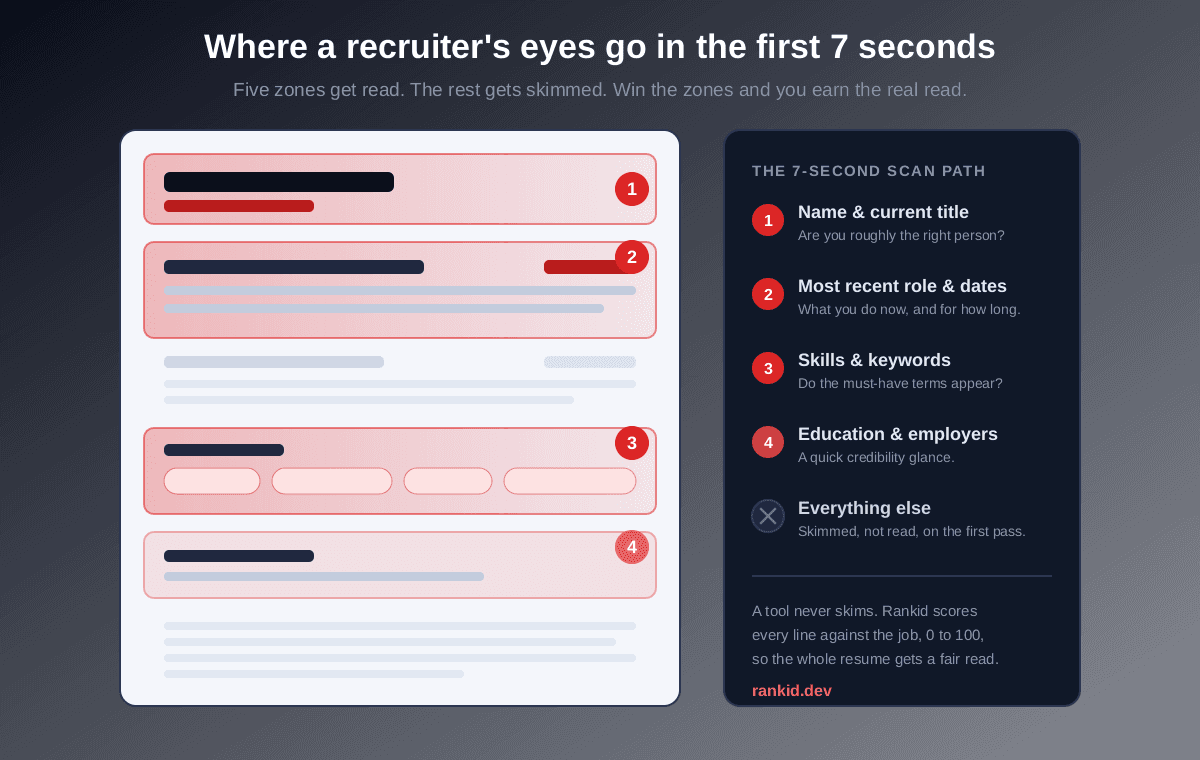
Notice what this means for layout. The zones that get read are almost all in the top third of the page. A brilliant achievement three roles down, or a critical skill tucked into the final bullet of page two, is invisible to the first scan, and if the first scan does not pass, it stays invisible. The seven seconds do not reward the best resume, they reward the best top third.
The scan is the second gate, not the first
Before a human ever spends seven seconds on your resume, software usually decides whether they see it at all. Most companies run resumes through an applicant tracking system that parses your document into structured fields and matches it against the role's criteria. That step is not a skim, it is a near-instant parse-and-match, and it happens before the recruiter's scan.
So there are really two gates, back to back. First the ATS has to parse you cleanly and see the required keywords, which is a question of building an ATS-friendly resume. Then the human has to be able to scan you in seconds. A resume that clears one and fails the other still loses. The good news is that both gates reward the same things: clean structure, relevant keywords in the right places, and a top third that states fit plainly. Fix for one and you largely fix for both.
How to win the six to seven seconds
You cannot make a recruiter read slower. You can make the fast read land on the right things. Here is how to engineer your resume for the scan.
Put a matching title at the very top
The first thing scanned is your current title, so make it echo the role you are applying for. If the posting says "Product Marketing Manager" and your title is "Marketing Lead," add a headline that names the target role. This is the fastest way to signal "right person" in the first second, and it feeds directly into tailoring your resume to the job description.
Front-load skills and keywords above the fold
Do not make a recruiter scroll to find your must-have skills. A visible skills line or block near the top, using the exact terms from the posting, means the keyword check in the scan lands on a match instead of a miss. Mirror the posting's language rather than inventing your own synonyms.
Lead every recent bullet with the result
On the second, slower read, bullets that start with a number or outcome ("Cut onboarding time 40%") get absorbed far faster than ones that bury the result at the end. Put the achievement first, the how second. You are still writing for a skimmer, just a slightly slower one.
Use one clean column and standard headings
Two-column and heavily designed templates scatter a scanning eye and confuse the ATS parse. A single column with conventional section headings (Experience, Skills, Education) lets both the software and the human find each zone instantly. Boring layout, fast scan.
Score it against the job before you send it
The seven-second scan is really asking one question: does this resume match this role? You can answer that yourself, in seconds, before you apply. Paste your resume and the job description into a checker and see your match score plus the exact keywords you are missing, then fix the gaps the recruiter would have caught.
See what a recruiter sees, in seconds
Paste your resume and the job description into Rankid. You get a 0 to 100 match score, the skills and keywords you match, and the ones you are missing, the same fit signals a recruiter skims for. Your first check is free, no signup.
Check your resume freeWhat the 6-second rule does not mean
The stat gets weaponized into bad advice, so let us clear up what it does not license you to do.
- It does not mean content stops mattering. The scan decides who gets read, but the read decides who gets called. A resume engineered to pass the skim and then fall apart on the slow read still fails. You need both a strong top third and real substance underneath.
- It does not mean shorter is always better. The fix for a fast scan is not deleting everything, it is ordering it well. A one-page resume with a weak top third loses to a well-structured two-page one that front-loads fit.
- It does not mean gimmicks help. Bright colors, photos, and clever graphics tend to scatter the scan and break the ATS parse. The resumes that win the seconds look clean and read instantly, not decorated.
- It does not mean the recruiter is your enemy. The skim is triage under load, not a judgment of your worth. Understanding it is not cynicism, it is just meeting the reader where they actually are.
If your resume keeps failing the seven seconds
A resume that consistently gets no response is usually losing at one of the two gates, and the seven-second scan is the one you can feel but not see. If you are applying steadily and hearing nothing, the problem is rarely that you are unqualified, it is that the fit is not landing fast enough, or the ATS never surfaced you. That is the whole subject of why you might not be getting interviews, and the fix starts the same way every time: check how your resume actually matches the specific job before you apply, so you are not guessing what the scan will see.
The most reliable way to do that is to stop eyeballing it and measure it. Scoring your resume against each posting turns the invisible seven-second scan into something concrete: here are the keywords you match, here are the ones you are missing, here is where you would rank. You can read more on the mechanics in how to check if your resume matches a job description.
Key takeaways
- Recruiters spend about 6 to 7 seconds on the first scan of a resume, measured at around 7.4 seconds in eye-tracking research.
- That scan is a fit-or-no-fit filter, not the full decision. Only resumes that pass it get a proper read.
- Five zones get scanned: name and current title, most recent role and dates, skills and keywords, and a glance at education and employers.
- Almost all of those zones sit in the top third of the page, so front-load fit and mirror the job's keywords.
- There are two gates: the ATS parse and the human scan. Clean structure plus matched keywords wins both.
- Rankid scores your resume against the job in seconds so you know what the scan will see before you apply, and your first check is free.
Bottom line: yes, recruiters really do look at your resume for only six or seven seconds, but that scan is a gate, not a grade. Build a top third that answers "right person, right role" instantly, keep the structure clean enough for the software to parse and the human to skim, and you turn those seconds from a threat into an invitation. Run your resume through Rankid's free resume checker against the job you want and see exactly what a recruiter will see in the first seven seconds, before they do.
Frequently asked questions
How long do recruiters actually look at a resume?
On the first pass, roughly 6 to 7 seconds. The widely cited figure comes from eye-tracking research that found recruiters spend an average of about 7.4 seconds on their initial scan of a resume before deciding whether it is worth a closer read. That does not mean the whole hiring decision takes 7 seconds. It means your resume gets a very fast fit-or-no-fit skim first, and only the resumes that survive that skim get read properly. So the 6 to 7 seconds is a gate, not the final verdict, and the job of your resume's top third is to get through it.
What is the 6-second rule for resumes?
The 6-second rule is shorthand for the finding that a recruiter's initial scan of a resume lasts only a handful of seconds, commonly quoted as 6 seconds and measured more precisely at around 7. In that window the recruiter is not reading sentences, they are pattern-matching: name and current title, most recent role and dates, and whether the must-have keywords are present. The practical takeaway is to front-load the information that answers 'is this person plausibly right for the role' into the part of the page a recruiter sees first.
Do recruiters read the whole resume?
Not on the first pass, and often not at all if the top of the page does not earn it. The initial 6 to 7 second scan is a filter. Resumes that clearly match get a second, slower read where the recruiter actually reads bullet points and assesses depth. Resumes that do not signal fit fast usually get set aside without the rest ever being read. This is exactly why burying a critical skill on page two is so costly: the reader may never reach it.
What do recruiters look at first on a resume?
In order, roughly: your name and current job title, your most recent role and how long you have been in it, your skills or keywords, and a quick glance at education and past employers. These are the zones eye-tracking studies light up. Everything else, older roles, detailed bullet points, summaries of projects, is skimmed rather than read until a resume has already passed the first filter. Put your strongest, most relevant signals in those first zones.
How do you get your resume noticed in 6 seconds?
Make the top third of the page do the work: a clear current title that echoes the role you are applying for, your most relevant skills and keywords visible without scrolling, and a clean single-column layout an applicant tracking system and a human can both parse instantly. Mirror the language of the job description so the must-have terms jump out during the skim. A quick way to test this is to score your resume against the job posting before you apply: Rankid shows you in seconds which keywords and requirements you match and which you are missing, and your first check is free with no signup.
Does an ATS look at a resume for only 6 seconds too?
No, that is a separate step. An applicant tracking system does not skim like a human, it parses your resume into fields and matches it against the job's criteria in a fraction of a second, and it either surfaces you to the recruiter or does not. The 6 to 7 second scan is what the human recruiter does after the ATS has passed you through. You have to win both: be parseable and keyword-matched for the software, then be instantly scannable for the person. A tool that scores your resume against the job the way the software does helps you clear the first gate before you ever reach the second.