Why Am I Not Getting Interviews? 7 Real Reasons (and How to Fix Them Fast)
You are qualified. You have the degree, the years, the skills the posting asks for. You have applied to twenty, fifty, maybe a hundred roles, and your inbox is a wall of silence. It is exhausting, and it makes you question yourself. Here is the truth almost nobody tells you: not getting interviews is rarely about your experience. It is almost always about a match that a piece of software scored and quietly rejected before a single human read your name. The good news is that this is fixable, usually this week, once you know which of the seven reasons is actually happening to you.
Quick answer
The uncomfortable truth about where your application dies
When you hit apply, you picture a recruiter reading your resume. That is usually not what happens first. At most mid-size and large companies, your file lands in an applicant tracking system that parses it, compares it against the job description, and ranks every applicant by how well they match. Recruiters then work from the top of that ranked list down, and they rarely reach the bottom. If your resume scores low, you are not rejected by a person. You are filtered out by a number, before anyone forms an opinion about you at all.
That is why a genuinely qualified person can send fifty applications and hear nothing. The system is not asking “is this person good?” It is asking “how closely does this document match this posting?” Those are different questions, and the gap between them is exactly where good candidates disappear. Understanding this reframes the whole problem: you are not being judged and found wanting, you are being scored and ranked, and scores can be raised.
Qualified on paper is not the same as qualified to the software
Reason 1: Your resume does not match the specific job
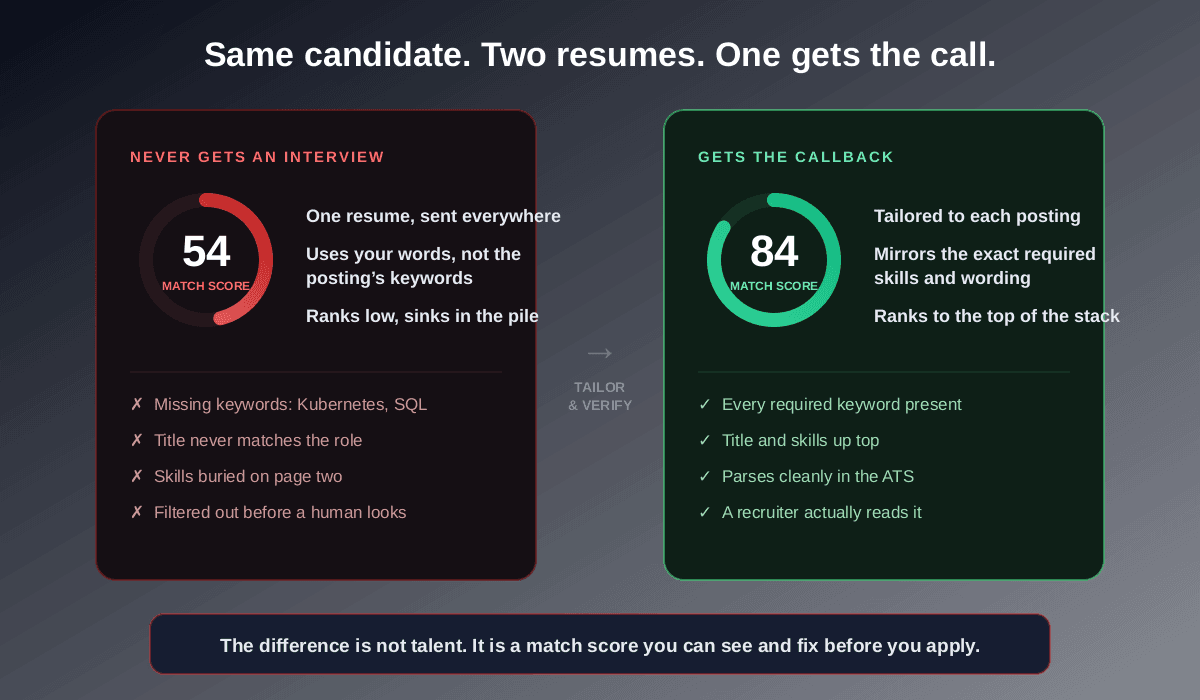
This is the number one cause, and it hides in plain sight. You have a strong, general resume, and you send the same one to every opening. But each posting names different skills, tools, and priorities. A generic resume is, by definition, a mediocre match for all of them and a great match for none. The result is a pile of scores in the 50s and 60s: good enough to feel qualified, too low to ever get ranked to the top.
The fix is to tailor your resume to each job description. That does not mean rewriting from scratch every time. It means reordering, rephrasing, and emphasizing so the skills the posting cares about are front and center, in the posting's own language. This one change moves more people from silence to interviews than anything else on this list.
Reason 2: You are missing the exact keywords the posting uses
You might have the skill and still get filtered out because you named it differently. The posting says “SQL,” your resume says “relational databases.” The posting says “project management,” you wrote “led cross-functional initiatives.” To a human those are the same. To a keyword-matching system, one is a hit and one is a miss. Miss enough of them and your score collapses even though you can do the job.
This is why you need to know the exact keywords to get past the ATS for each role. Pull the required skills and tools straight from the posting, and where you genuinely have them, use the posting's exact wording. Not keyword stuffing, which backfires, but honest alignment of the terms you already own.
Reason 3: Your resume does not parse cleanly
Sometimes the content is perfect and the file format sabotages you. Multi-column layouts, text inside images, tables, headers and footers, and fancy templates can all scramble when a parser reads them. The system ends up with a garbled version of your resume, matches that garbage against the posting, and scores you far below your real fit. You never see this happen, which is what makes it so brutal.
The fix is to build an ATS-friendly resume with a clean, single-column structure and standard headings, then test that it actually passes the ATS by checking how the machine reads your file. If your name, titles, and skills survive the parse intact, you have cleared this hurdle.
You cannot fix what you cannot see
Reason 4: You are playing a volume game instead of a match game
When nothing lands, the instinct is to apply to more jobs, faster. Easy Apply makes it addictive. But blasting the same untailored resume at 200 roles produces fewer interviews than tailoring 20, because every one of those 200 is the same mediocre match. You are multiplying a low score, not fixing it. It feels productive and it is the trap that keeps people stuck the longest.
Flip the strategy. Apply to fewer, more relevant roles, and make each application a strong match. A realistic healthy rate for well-targeted, tailored applications is roughly one interview per 10 to 20 roles. If you are far below that, the answer is not more volume, it is more match.
Reason 5: You are applying to roles you are not actually a fit for
Sometimes the score is telling you the truth. If you are consistently applying a step or two above your experience, or pivoting into a field your resume does not yet support, a low match is honest feedback, not a formatting bug. That does not mean give up on the pivot. It means your resume has to work much harder to bridge the gap, translating your transferable experience into the language of the target role so the overlap is visible.
A match checker helps you tell these two situations apart. A resume that scores 58 because of wording can be fixed in an hour. A resume that scores 40 because you genuinely lack the core requirements is a signal to either target closer-fit roles or invest in the missing skill first.
Reason 6: Your resume reads as generic once a human does see it
Clear the machine and there is still a person at the end. If your resume finally gets read but is a wall of duties with no results, no numbers, and no evidence you did the job well, a recruiter skims it in seven seconds and moves on. Passing the ATS gets you seen. It does not get you the interview by itself.
Lead your bullets with outcomes, not responsibilities. “Cut onboarding time 40 percent” beats “responsible for onboarding.” Specifics signal competence and give the recruiter a reason to want the conversation. This is often the difference between the resumes that get read and the ones that get called.
Reason 7: You are only using one channel
If every application goes through a single job board and nothing else, you are competing in the most crowded, most heavily filtered lane there is. The postings with hundreds of applicants are exactly the ones where match ranking is most ruthless. Relying on that lane alone caps your odds no matter how good your resume is.
Keep applying, but add referrals and direct outreach on top. A referred application often skips part of the ranking gauntlet entirely and lands in front of a human. It is the highest-leverage move you can make once your resume itself is a strong, verified match, because a great resume plus a warm intro is what turns the funnel in your favor.
The three-step fix that gets you interviews
You do not need to guess which of the seven is hurting you. This loop diagnoses and fixes the most common ones in about fifteen minutes per job, and it works for any role.
Check your real match against a job you actually want
Take one specific posting you would genuinely take, and check how your resume matches that job description. A 0 to 100 score tells you instantly whether you have a match problem or a targeting problem. This single number replaces weeks of guessing why you hear nothing.
Fix the specific gaps the score surfaces
The checker shows you the exact required keywords you are missing and whether your file parsed cleanly. Add the skills you honestly have using the posting's wording, fix any formatting that scrambled, and lead your top bullets with results. You are correcting the real problem, not polishing the wrong thing.
Re-check until you clear 80, then apply
Run it again and watch the score move. Once you are at 80 percent or higher and every required keyword is present, you are no longer at the bottom of the ranked list. Now the application is worth sending, and now a referral or direct outreach has a strong resume behind it.
See exactly why you're not getting interviews
Stop guessing. Paste your resume and a job you want into Rankid to get a 0 to 100 match score, the skills you've matched, and the exact keywords you're still missing, so you can see the reason recruiters never called and fix it before your next application. Your first check is free, no signup needed.
Check your match freeFour mistakes that keep the silence going
Even people who know something is wrong often keep doing the things that guarantee no response. Avoid these and the fixes above start working.
- Applying to more jobs instead of better-matched ones. Volume multiplies a low score. One tailored application beats ten generic ones for getting a callback.
- Assuming a human reads it first. At most companies a machine scores and ranks you before anyone reads a word, which is why qualified resumes get rejected without feedback.
- Never checking the actual match. If you have never seen your resume-to-job score, you are optimizing blind. The number tells you exactly what to fix.
- Blaming yourself instead of the system.Silence feels like a verdict on you. It is usually a verdict on a document's match. Fix the document and the calls start.
What is happening on the other side of the screen
It helps to picture the recruiter's view. For a single opening they may receive hundreds of applications, and the same technology you are up against is the technology they use to cope. Recruiters increasingly screen resumes with AI and screen candidates in bulk, ranking everyone by match and starting at the top. They are not ignoring you on purpose. They are working a sorted list and, at your current score, you are below the line they reach.
Which is oddly reassuring: the same scoring that filters you out is completely visible if you check it yourself. When you verify your match before applying, you are simply looking at the same scoreboard the recruiter uses, and making sure you land above the line.
Key takeaways
- Not getting interviews is usually a match problem, not a qualifications problem.
- A machine scores and ranks your resume against the posting before any human sees it.
- The top fixes: tailor to each job, use the posting's exact keywords, and make sure your file parses.
- Quality of match beats quantity of applications: 20 tailored beats 200 generic.
- Check your resume-to-job match score and fix the gaps until you clear 80 before you apply.
Bottom line: if you are qualified and still not getting interviews, you are almost certainly losing to a match score you have never seen. That is a far easier problem to fix than a lack of experience. Pick one job you actually want, run it and your resume through Rankid's free resume checker, fix what it flags, and apply with a resume that finally scores. The silence is not a verdict on you. It is a number, and numbers can be raised.
Frequently asked questions
Why am I not getting interviews even though I'm qualified?
Because qualified on paper and qualified to the software are two different things. Most applications are first read by an applicant tracking system that scores how well your resume matches the specific job description, then ranks applicants. If your resume uses different wording than the posting, is missing the exact required skills, or buries them, you score low and never surface to a human, no matter how strong your background is. The fix is to tailor each resume to the posting and verify the match before you apply.
How many jobs should I apply to before I get an interview?
There is no fixed number, and chasing volume is usually the wrong move. Sending 100 generic resumes typically produces fewer interviews than sending 20 tailored ones, because interviews are driven by match quality, not application count. A realistic healthy rate for well-targeted, tailored applications is roughly one interview for every 10 to 20 relevant roles. If you have sent dozens with near-zero response, the problem is the match, not the quantity.
How do I know if my resume is the reason I'm not getting interviews?
Run your resume and a job description you actually want through a match checker. If it parses cleanly and scores 80 percent or higher but you still hear nothing, the issue is likely targeting, timing, or where you apply. If it scores in the 50s or 60s, or the parser scrambles your file, you have found your problem: recruiters are seeing a low-match, hard-to-read resume and moving on. Rankid gives you that 0 to 100 score plus the exact missing keywords for free.
Does applying through LinkedIn Easy Apply hurt my chances?
It does not hurt the scoring, but it makes the volume problem worse. Easy Apply makes it trivial to fire off the same untailored resume to hundreds of roles, which is exactly the behavior that produces silence. The postings still run your resume through the same match logic. One-click applying only helps if the resume you send is genuinely tailored to that role, so slow down and match before you click.
How long should it take to hear back after applying?
For roles where you are a strong match, first responses usually come within one to two weeks, and often within a few days at fast-moving companies. Total silence past two to three weeks across many applications is a signal, not just slow hiring. It almost always points to a match or visibility problem on your end rather than every employer being slow at once.
What is the single fastest way to start getting more interviews?
Stop sending one resume everywhere. Take the specific job you want, compare your resume against it, and fix the gaps the checker surfaces: add the required keywords you genuinely have, mirror the posting's wording, and make sure your file parses. Doing this for each role turns a stack of ignored applications into a short list of high-match ones, which is what actually generates callbacks.