How Long Should a Resume Be in 2026? (Ideal Length by Experience)
How long should a resume be? It is the most argued-about question in job hunting, and most advice hands you a rule without the reasoning behind it. The short answer is one to two pages for almost everyone. The honest answer is that length is a symptom, not the goal: the right length is however much space it takes to show relevant, keyword-matched experience without a word of filler. This guide gives you the ideal resume length by experience level, when a second page is actually justified, exactly what to cut first, and the part most articles skip: why recruiters and the software both care about match far more than page count.
Quick answer
The short answer: one to two pages
For the vast majority of job seekers, a resume should be one to two pages. One page is the default if you have under roughly 10 years of relevant experience and everything important fits comfortably. Two pages is fine, and often expected, once you have enough relevant, quantified achievements to fill a second page with substance rather than padding. Three pages and beyond is reserved for academic CVs, executive resumes, and a handful of specialized fields where a longer format is the norm.
But before you count pages, understand what actually decides your fate. Your resume is read twice: first by an applicant tracking system that scores how well your content matches the job, then by a recruiter who spends only a handful of seconds on the first pass. Neither of them awards points for hitting a page target. They reward relevance. So the real question is not "how many pages" but "how much of this is relevant enough to earn its place."
Ideal resume length by experience level
The cleanest way to decide is by how much relevant experience you actually have. Here is the guide most recruiters would agree with, followed by the rule that sits underneath it.
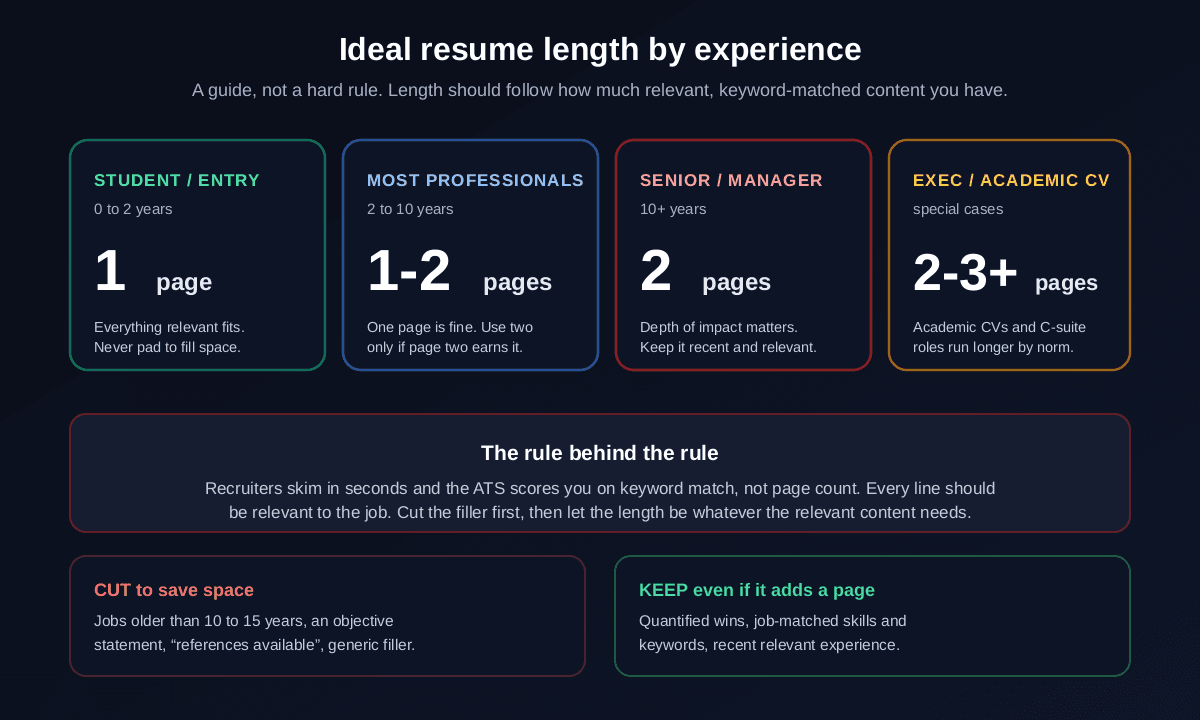
- Students and entry level (0 to 2 years): one page. Education, internships, projects, relevant coursework, and transferable skills all fit on a single focused page. Padding to two pages reads as inexperience, not depth.
- Most professionals (2 to 10 years): one to two pages. One page is perfectly respectable. Move to two only when the second page is full of relevant, quantified wins, not stretched margins and filler bullets.
- Senior, manager, or technical (10+ years): two pages. You have earned the space. A decade or more of quantified impact rarely compresses onto one page without cutting the evidence that wins interviews.
- Executive and academic CVs: two to three or more pages. C-suite resumes and academic CVs (with publications, grants, and teaching) follow their own longer conventions. This is the exception, not permission for everyone else to sprawl. If you are unsure which document you have been asked for, see CV vs resume.
The rule behind the rule
One page or two? A simple test
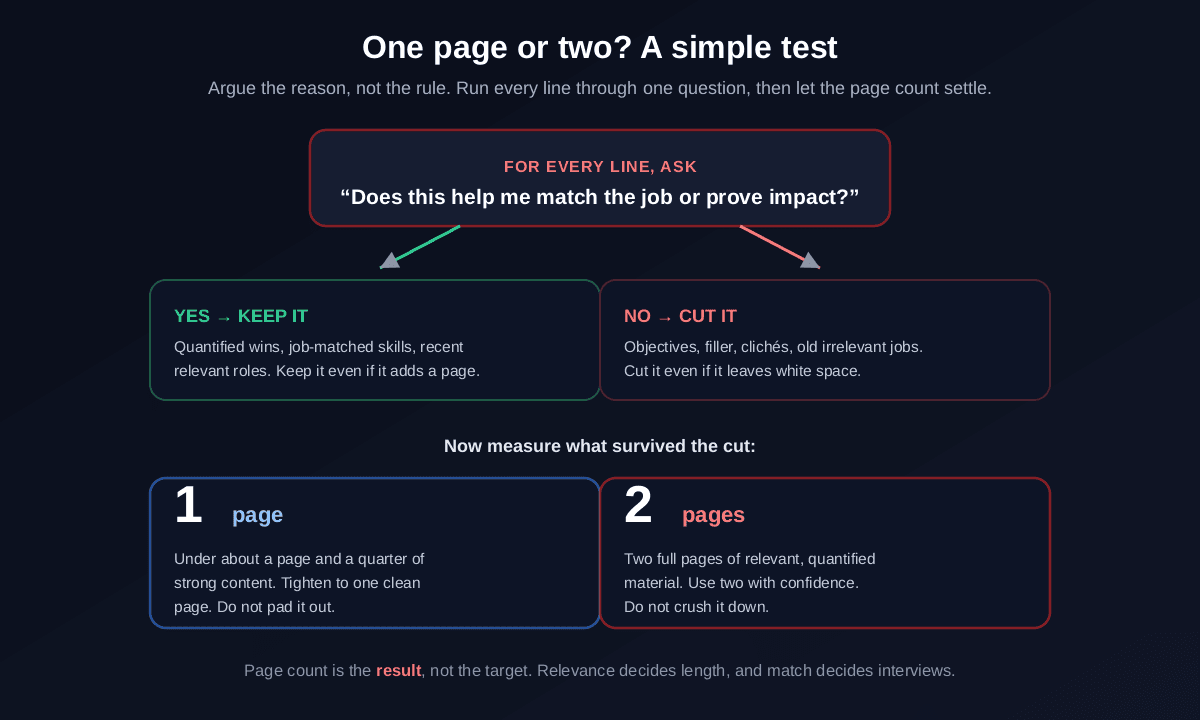
The one-page-versus-two-page debate gets heated because people argue the rule instead of the reason. Ignore the dogma and apply a single test to every line on your resume: does this help me match the job or prove my impact? If yes, keep it, even if it pushes you to a second page. If no, cut it, even if that leaves white space.
A second page is justified when you have more than one page of content that passes that test. It is not justified by widening margins, inflating font size, or adding a list of every tool you have ever opened. If removing the filler drops you back to a page and a quarter, tighten it to one clean page. If you still have two full pages of relevant, quantified material, use two pages with confidence. Recruiters do not penalize a strong second page; they penalize a weak one.
Never do this to hit a length
What to cut first to control length
Most resumes are too long for the wrong reason: they carry weight that adds no relevance. Before you agonize over one page versus two, remove the dead weight. This alone fixes length for a lot of people, and it sharpens your keyword density at the same time.
- Roles older than 10 to 15 years.Condense them into a short "Earlier experience" line or drop them. Old, irrelevant jobs add length and date you. For where to draw your own cut line, see how far back a resume should go.
- The objective statement."Seeking a challenging role" wastes your most valuable space. Replace it with a professional summary packed with job-matched keywords instead.
- "References available on request." Assumed by default. Delete it.
- Generic filler and soft-skill clichés."Hard-working team player," "detail-oriented," "go-getter." They carry no information and no keyword value.
- Duplicated bullets across roles. Say each accomplishment once, in its strongest form, with a number.
- Skills you cannot defend or that the job does not ask for. Trim the list to what is relevant and true. This tightens length and sharpens match at once.
Does length affect the ATS?
Here is the myth worth killing: that an applicant tracking system rejects resumes for being "too long" or automatically prefers one page. It does not score page count. An ATS reads your text and scores how well your skills, job titles, and keywords line up with the job description. Length only matters through its side effects.
Too long, and you dilute your relevant keywords in a sea of filler, which can pull your match down. Too short, and you may leave out required skills you genuinely have, which also costs you. The winning move is not a magic page count; it is keeping every line relevant so your density of job-matched terms stays high. That is the same discipline that makes an ATS-friendly resume and that decides your match score against the role.
This is exactly where people guess wrong. They assume trimming to one page helped, when they actually cut a required keyword and dropped their match. Or they add a second page of filler and wonder why they still are not getting interviews. The only way to know whether your length is helping or hurting is to measure the match, not eyeball the pages.
Is your resume the right length for this job?
Paste your resume and the job description into Rankid. You get a 0 to 100 match score and the exact keywords and requirements you match versus the ones you are missing, so you know whether to cut filler or add relevant detail, not just guess at page count. Your first check is free, no signup.
Check your resume freeLength is a formatting outcome, so format for skim
Whatever length you land on, remember that a recruiter skims it in seconds. The way to make one or two pages work is to format for that skim: clear section headings, reverse-chronological roles, bullets that lead with a verb and land on a number, and generous whitespace so the eye can move. A well-formatted two-pager can read faster than a cramped one-pager. If you want the deeper mechanics of a layout that a machine and a human both read cleanly, see our guide to an ATS-friendly resume.
How to right-size your resume in four steps
Draft everything relevant, ignore length
First pass, get every relevant, quantified achievement and job-matched skill onto the page. Do not think about pages yet. You cannot trim well until you can see the full picture.
Cut the dead weight
Remove old irrelevant roles, the objective, references lines, clichés, and duplicated bullets. Run the "does this help me match the job or prove impact?" test on every remaining line.
Let the page count settle
Now look at length. Under a page and a quarter of strong content? Tighten to one clean page. Two full pages of relevant material? Use two. Do not pad up and do not crush down.
Measure the match, then adjust
Score your resume against the specific job. If you are missing required keywords you genuinely have, add them, even if it costs space. If filler is diluting your match, cut it. Tailoring to the job description is what turns the right length into the right resume.
Key takeaways
- Most resumes should be one to two pages; entry-level and student resumes stay on one page.
- Use two pages only when page two is genuinely full of relevant, quantified content, typically at 10+ years or in senior roles.
- Length should follow your relevant content, not the other way around; a tight one-pager beats a padded two-pager.
- Go back about 10 to 15 years in detail; condense or drop older, irrelevant roles.
- The ATS does not score page count; it scores keyword and skills match, so keep every line relevant.
- Never shrink fonts, kill margins, or pad with filler to hit a page target; format for a fast skim instead.
- Don't guess whether your length helped or hurt. Score your resume against the job with Rankid, free, before you apply.
So, how long should a resume be? Long enough to prove you are a strong match for the job, and not one line longer. For most people that is one to two pages, but the page count is the result, not the rule. Cut the filler, keep the relevant, quantified, keyword-matched content, and format it for a six-second skim. Then close the loop: paste your resume and the job into Rankid's free resume checker to see exactly what you match and what you are missing, so your resume is the right length and the right fit.
Frequently asked questions
How long should a resume be?
For most candidates a resume should be one to two pages. Use a single page if you have under about 10 years of relevant experience and everything important fits, and move to two pages only when the second page is filled with relevant, quantified content rather than padding. Students, recent graduates, and early-career applicants should almost always stay on one page. Senior professionals, managers, and people with 10 or more years of directly relevant experience can use two pages. Executive resumes and academic CVs are the exception and may run longer by convention. The page count itself is not the point: recruiters skim in seconds and applicant tracking systems score you on how well your content matches the job, so the right length is whatever lets you show relevant, keyword-matched experience without filler.
Should a resume be one page or two pages?
Choose one page if you can present your strongest, most relevant experience without cramming or cutting real achievements, which is the case for most people with under 10 years of experience. Choose two pages when you genuinely have more than one page of relevant, results-focused content, typically at 10 or more years of experience or in senior and technical roles with substantial depth. A weak two-page resume padded to look impressive performs worse than a tight one-page resume. The test is simple: if a line does not help you match the job or prove impact, it should not be pushing you onto a second page.
How long should a resume be for 10 years of experience?
With around 10 or more years of relevant experience, two pages is appropriate and expected. You have enough quantified achievements, roles, and job-relevant skills to justify the space, and squeezing a decade of impact onto one page usually means cutting the evidence that actually wins interviews. That said, still cap most roles at the last 10 to 15 years, summarize or drop very old and irrelevant positions, and make sure page two is as strong as page one. Two pages is a ceiling for the vast majority of experienced professionals, not a target to fill.
How long should an entry-level or first-job resume be?
An entry-level, student, or first-job resume should be one page. With limited work history, one focused page of education, internships, projects, relevant coursework, and transferable skills is stronger than a padded two-page document. Never stretch to fill space with filler, generic objectives, or unrelated jobs; a lean, relevant one-pager reads as confident and is easier for both a recruiter and an ATS to parse. Focus on proving capability and direction with concrete, quantified examples rather than on length.
Does resume length affect whether you pass the ATS?
Page count itself is not what an applicant tracking system scores. The ATS reads your text and scores how well your skills, titles, and keywords match the job description, so relevance and keyword coverage matter far more than whether you are on one page or two. Length only hurts you indirectly: a bloated resume dilutes your relevant keywords with filler, and a resume cut too short can leave out required skills you actually have. The reliable move is to keep every line relevant and then check your resume against the specific job to confirm you have covered the keywords that matter, which you can do free with Rankid.