How to Write a Professional Resume Summary (2026 Examples + Formula)
Before a recruiter reads your experience, before they scan your skills, before they decide whether to keep going at all, they read the few lines at the very top of your resume. That block is your professional resume summary, and it is the single most valuable piece of text on the page. Get it right and you frame everything that follows in the reader's first six seconds. Get it wrong, leave it blank, or fill it with "hard-working team player," and you waste the one spot both a human and the software read first. This guide gives you a formula that works, resume summary examples for every situation, and the part most advice skips: how to fill your summary with the keywords that actually get you ranked.
Quick answer
What a professional resume summary actually is
A professional resume summary is a short paragraph, usually two to four lines, that sits at the very top of your resume, right under your name and contact details and above your work history. In three or four sentences it says who you are professionally, how much experience you have, what you are best at, and one or two results you are proud of. It is sometimes called a resume profile, a professional profile, or a summary of qualifications, but the job is always the same: give the reader the gist of your fit almost instantly, and pull your most important keywords high on the page.
Why does the position on the page matter so much? Because of how resumes are actually read. Recruiters spend only a handful of seconds on a first pass, and their eyes start at the top. An applicant tracking system reads top to bottom too, and weighs early text heavily when it scores you against the role. So the summary is doing double duty: it is your six-second human pitch and your first, densest block of machine-readable relevance. That is a lot of leverage packed into four lines.
Summary, objective, or profile: which one?
The 4-part formula for a strong summary
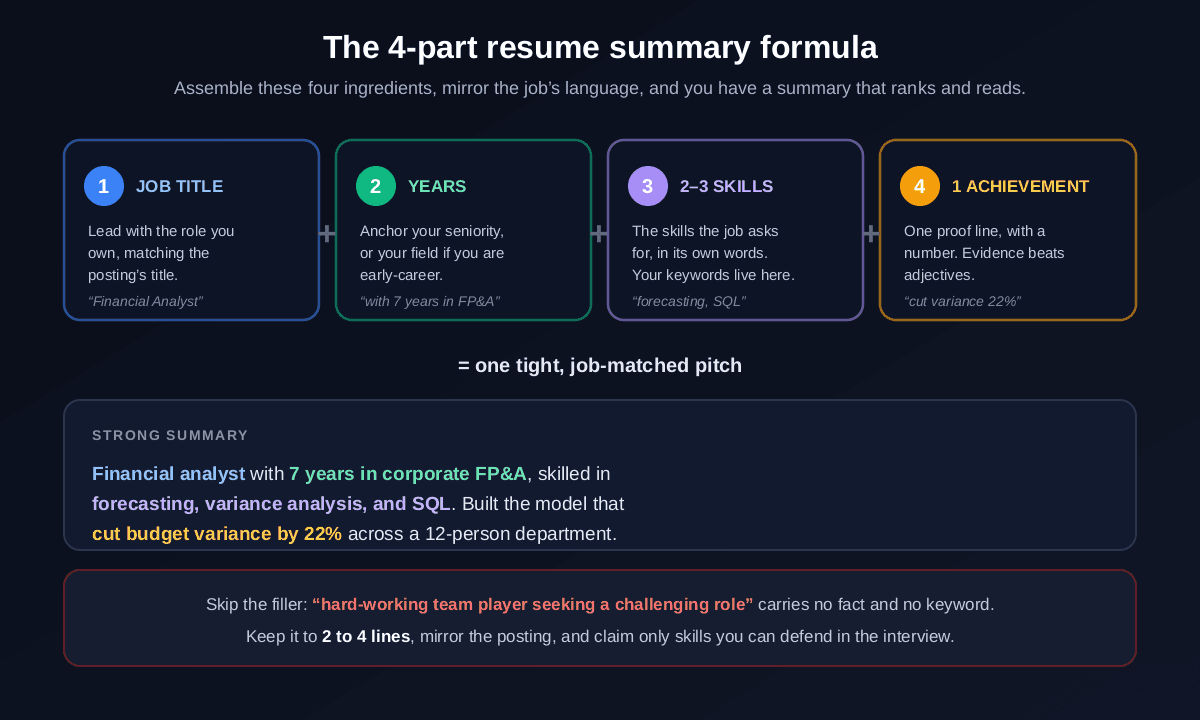
You do not need to be a professional writer to nail this. Almost every excellent resume summary is built from the same four ingredients. Assemble them in order, then tighten the wording, and you have a summary that reads like a pitch instead of a paragraph of filler.
- 1. Your professional title.Lead with the role you own, ideally matching the job title in the posting. "Senior Financial Analyst," not "experienced professional."
- 2. Your years of relevant experience.A quick anchor of seniority: "with 7 years in corporate FP&A." If you are early-career, swap in your field or focus.
- 3. Two or three relevant skills or specialisms.The ones the job actually asks for, named in the posting's own words. This is where most of your keywords live.
- 4. One signature achievement, with a number.The proof line. "Built the forecasting model that cut budget variance by 22 percent." Numbers make a claim believable.
Put together, the formula reads: [Job title] with [years] of experience in [specialism], skilled in [skill], [skill], and [skill]. [Signature achievement with a number]. That is it. Everything else is adapting those four pieces to the specific job in front of you.
How to write your resume summary, step by step
Here is the fastest reliable process. Do it fresh for each application, because the summary should mirror the specific job. It takes about five minutes once you have the habit.
Read the job posting and pull the must-haves
List the job title, the top three to five required skills or tools, and the years of experience they ask for. These are the words you want to echo. If you want a shortcut, compare your resume to the job description and let the tool surface the required keywords for you.
Draft with the 4-part formula
Write one plain sentence for each ingredient: title, years, skills, achievement. Do not polish yet. Getting the four facts down is 80 percent of the work, and it stops you from staring at a blank line.
Mirror the posting's language
Swap your generic phrasing for the exact terms from the job. If the posting says "demand generation," use "demand generation," not "lead marketing." Same skill, recognized wording. This is what lifts both recruiter recognition and your match score.
Add one number
Find a single quantified win to anchor your credibility: a percentage, a dollar figure, a team size, a volume. If you only change one thing about a weak summary, add a number. It converts a claim into evidence.
Cut it to 2 to 4 lines and remove filler
Delete every phrase that could sit on anyone's resume: "results-driven," "go-getter," "seeking a challenging role." If a word does not add a fact or a keyword, cut it. You want density, not adjectives.
Professional resume summary examples you can adapt
Templates are easier to learn from than rules, so here are worked examples across common situations. Notice how each one names a role, anchors experience, lists job-relevant skills, and lands a number. Adapt the wording to your own facts and, crucially, to the posting in front of you.
Experienced professional (mid to senior):
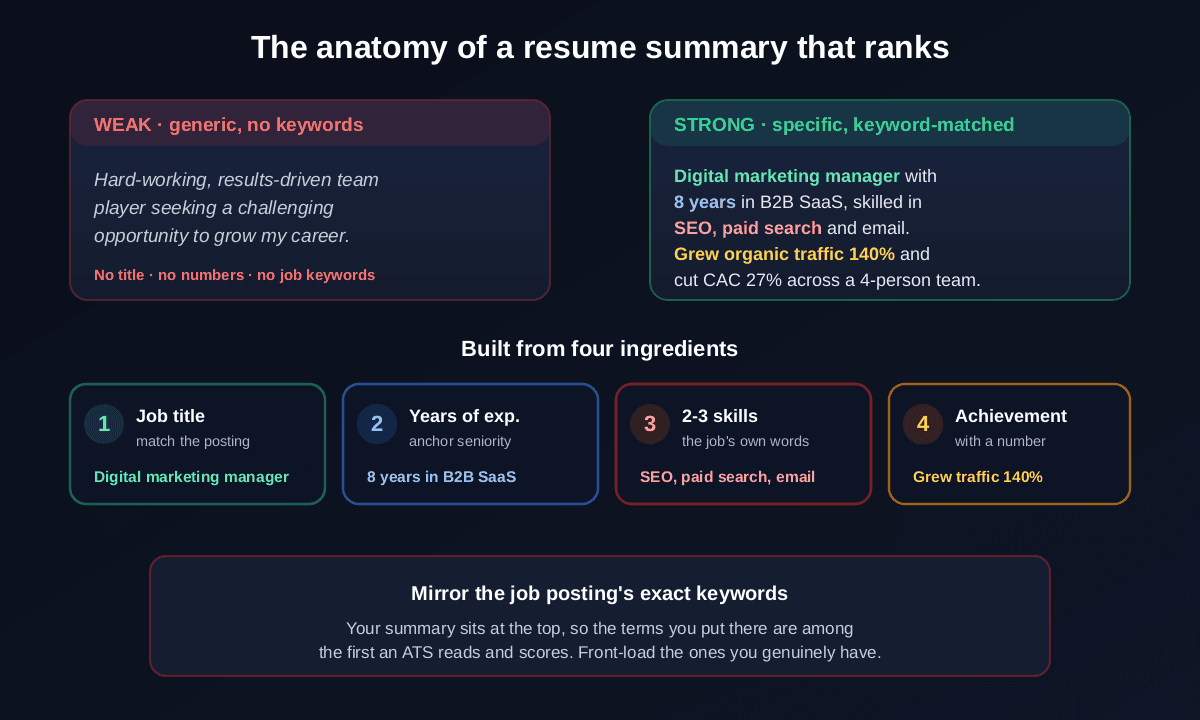
- Digital marketing manager with 8 years in B2B SaaS, specializing in SEO, paid search, and lifecycle email. Grew organic traffic 140 percent in 18 months and cut blended CAC by 27 percent across a 4-person team.
- Registered nurse with 6 years in acute care and the ED, skilled in triage, patient education, and EHR documentation. Precepted 12 new hires and helped raise patient satisfaction scores from 82 to 94 percent.
Entry level or recent graduate:
- Recent finance graduate with internship experience in FP&A and advanced Excel and SQL. Built a forecasting model during a summer internship that reduced a team's manual reporting time by 6 hours a week.
- Marketing graduate with hands-on experience running social campaigns for a 15,000-follower university society. Grew engagement 60 percent in one semester and coordinated three sponsored events.
Resume summary with no experience:
- Detail-oriented recent graduate targeting a junior data analyst role, skilled in Python, SQL, and data visualization. Completed three end-to-end analytics projects and a Google Data Analytics certificate, including a dashboard adopted by a local nonprofit.
Career change:
- Project coordinator transitioning into UX design, combining 5 years of stakeholder management with new hands-on skills in Figma, user research, and prototyping. Completed a UX certificate and 4 client projects, redesigning a checkout flow that lifted task completion 30 percent in testing.
Notice what every strong example has in common
Why your summary is your highest-leverage keyword spot
Here is the part that connects a good summary to actually landing interviews. Most applications are scored by an applicant tracking system before a person reads them, and that system weighs relevance heavily by how well your resume matches the job's required skills and terms. Because your summary sits at the top, the keywords you place there are among the first the software reads, which makes it prime real estate for the terms that matter most.
This is why the "mirror the posting" step is not optional. If the job asks for "demand generation," "Salesforce," and "pipeline forecasting," and you genuinely have those skills, naming them in your summary front-loads your relevance. It is one of the highest-return moves you can make on a resume, and it takes minutes. For the deeper mechanics, see the resume keywords that get you past an ATS and how to tailor your resume to a job description. And remember the golden rule: only claim keywords you can back up, because you will be asked about them in the interview.
The catch is that you cannot eyeball which keywords a job weighs most, or which ones you are missing. People often think their summary is packed with the right terms when it is actually missing half the must-haves, which is a big reason capable candidates keep not getting interviews. The fix is to measure instead of guess.
See exactly which keywords your summary is missing
Paste your resume and the job description into Rankid. You get a 0 to 100 match score and the exact keywords and requirements you match versus the ones you are missing, so you know precisely what to put in your summary. Your first check is free, no signup.
Check your resume freeCommon resume summary mistakes to avoid
Most weak summaries fail in the same few ways. Scan this list against your own draft; fixing even one or two of these usually turns a forgettable opener into a strong one.
- Generic filler."Hard-working, results-driven professional seeking a challenging role." It could belong to anyone, so it tells the reader nothing and carries no keywords.
- Writing about what you want. Leading with your goals instead of your value. Save the objective; open with what you bring.
- No numbers.Claims without evidence. "Improved sales" is weak; "grew sales 34 percent" is believable.
- Ignoring the specific job. One generic summary blasted to every application. If it is not mirrored to the posting, it under-ranks against candidates whose summaries are.
- Too long. A five or six line paragraph is not a summary. Keep it to two to four lines so it gets read in a glance.
- Keyword stuffing skills you do not have. Naming tools you cannot use to game the ATS backfires the moment an interviewer asks a follow-up. Claim only what you can defend.
A quick summary checklist before you apply
Run your finished summary through these questions. If you can answer yes to all six, it is doing its job.
- Does it name a real job title, ideally matching the posting?
- Does it state your years of experience or field?
- Does it include two to three skills pulled from the job's language?
- Does it land at least one number?
- Is it two to four lines, with no generic filler?
- Have you checked your match score to confirm the keywords line up?
Key takeaways
- A professional resume summary is a 2 to 4 line pitch at the top of your resume, read first by both recruiters and the ATS.
- Use the formula: job title + years of experience + 2 to 3 relevant skills + one signature achievement with a number.
- Choose a summary over an objective: lead with the value you offer, not what you want.
- Mirror the job posting's exact language, because your summary is the highest-leverage keyword spot on the page.
- With no experience, substitute transferable skills, projects, coursework, and internships, and never say you lack experience.
- Cut generic filler and add numbers. Specificity and evidence are what make a summary land.
- Don't guess which keywords you're missing. Score your resume against the job with Rankid, free, before you apply.
Your resume summary is the first impression you fully control, and it is over in six seconds. Spend those seconds proving fit: a clear title, real experience, the skills the job actually asks for, and one number that makes it credible. Then close the loop by making sure the keywords in that summary match what the role weighs most. Paste your resume and the job into Rankid's free resume checker, see what you match and what you are missing, and rewrite your summary to rank, not just to read well.
Frequently asked questions
What is a professional resume summary?
A professional resume summary is a short paragraph, usually two to four lines, placed at the very top of your resume just under your name and contact details. It states who you are professionally, your years of experience, your strongest skills, and one or two standout achievements, all framed around the job you are applying for. Its job is to give a recruiter the gist of your fit in about six seconds and to place your most important keywords high on the page where both a human and an applicant tracking system read first. Think of it as the trailer for your resume: it should make the reader want to keep going.
What should I put in a resume summary?
Put four things in a resume summary: your professional title or role, your years of relevant experience, your two or three most relevant skills or specialisms, and one signature achievement, ideally with a number. Then align all four to the specific job by mirroring the language of the posting. For example: 'Customer success manager with 6 years in B2B SaaS, skilled in onboarding, churn reduction, and account expansion. Cut churn 18 percent and grew net revenue retention to 112 percent across a 200-account book.' Avoid vague filler like 'hard-working team player seeking a challenging opportunity,' which says nothing and wastes your most valuable line.
How do I write a resume summary with no experience?
With no experience, lead with your field of study or the role you are targeting, then substitute experience with transferable skills, relevant coursework, projects, internships, and measurable wins from any context, including volunteering, part-time jobs, or academic work. For example: 'Recent computer science graduate with hands-on project experience in Python and SQL. Built a full-stack inventory app used by a 30-person student society and completed a data analytics internship.' You are proving capability and direction rather than tenure. Keep it specific and tied to the job, and never write that you have no experience; frame what you do have.
What is the difference between a resume summary and an objective?
A resume summary describes what you offer an employer, your experience, skills, and results, while a resume objective describes what you want, your career goals. In 2026, a summary is the better choice for almost everyone because it leads with value to the employer and packs in relevant keywords. Objectives can still make sense in narrow cases, such as a career changer or new graduate who needs to explain a pivot in direction, but even then the strongest opening blends a hint of your goal with concrete proof of what you bring. When in doubt, write a summary, not an objective.
How long should a resume summary be?
Keep a resume summary to two to four lines, roughly 30 to 60 words or three to four sentences. Long enough to name your role, experience, top skills, and one achievement, short enough that a recruiter reads all of it in a glance. If it spills past four lines it stops being a summary and starts eating space your experience section needs. Every line at the top of the page is prime real estate, so make each word earn its place and cut any generic phrase that could appear on anyone's resume.
Do resume summary keywords help you get past the ATS?
Yes. The summary sits at the top of the page, so the keywords you place there are among the first an applicant tracking system reads and weighs when it scores your resume against a job. Mirroring the exact skills, tools, and job title from the posting in your summary is one of the highest-leverage things you can do for your match score, because it front-loads relevance. It does not replace a full skills and experience section, but a summary stuffed with the job's real requirements, ones you genuinely have, gives you an early ranking boost. The fastest way to check is to score your resume against the job and see which keywords you still need.