How to Ask for a Raise: Timing, Scripts and How Much to Ask For
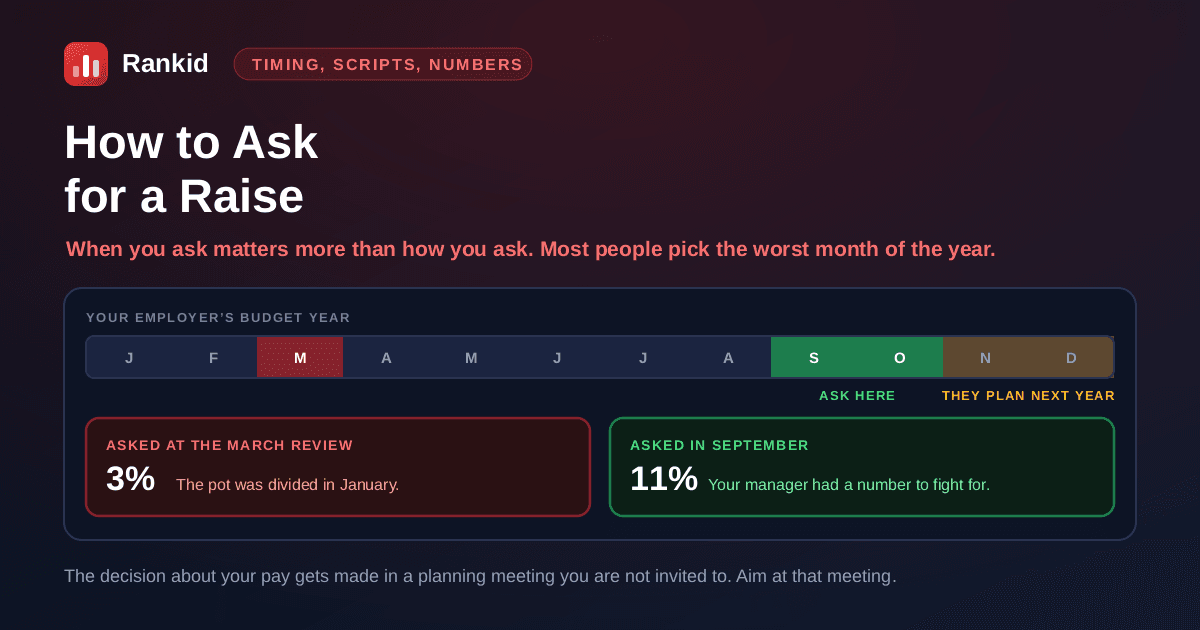
Most people ask for a raise at their performance review. It feels like the designated moment: pay is on the agenda, your manager is already discussing your work, and the conversation has a natural opening. It is also, almost universally, the worst possible time to ask, because the money was divided weeks or months earlier in a planning meeting you were not invited to. By the time you are sitting in that review, your manager is not deciding anything. They are reading out a decision. Here is when to actually ask, how much to ask for, the words to use, and how to get something out of every kind of no.
Quick answer
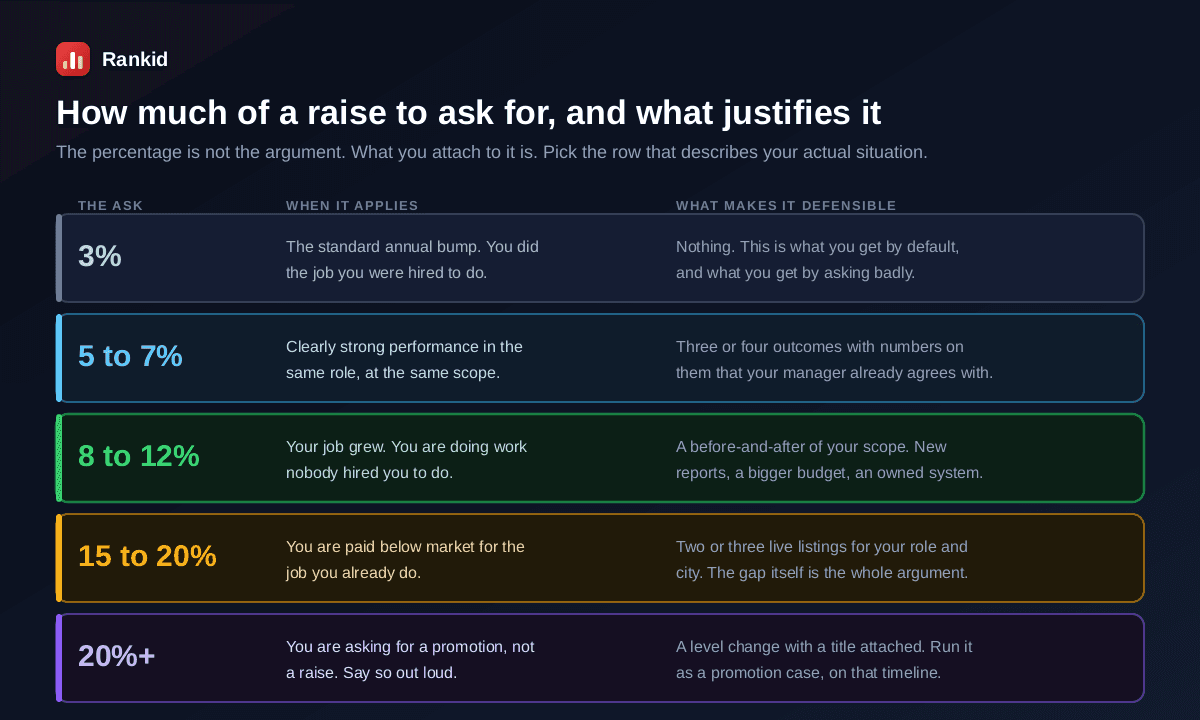
Ask eight to ten weeks before your company plans its compensation budget, not at your review. Match the number to your situation: 5 to 7% for strong performance, 8 to 12% if your job grew, 15 to 20% if you are below market. Bring three or four outcomes with numbers attached, name one specific figure, and ask "what would it take?" Your goal is not a yes in the room. It is a manager who will argue for you when you are not there.
Why most raise requests fail before the meeting starts
Almost all advice about asking for a raise is about the conversation: how to phrase it, how to sit, how to project confidence. That advice is not wrong, it is just aimed at the wrong stage. In most companies of any size, your pay for next year is settled in a compensation planning round where managers are handed a fixed pot and asked to distribute it across their teams.
Two things follow from that, and they change everything about how you should approach this. The first is that your manager is not your opponent in this negotiation, they are your representative in a negotiation happening somewhere else. The second is that the useful outcome of your conversation is not "yes", because your manager usually cannot say yes unilaterally. It is your manager walking into that planning room with your number and your evidence, willing to spend some of their limited credibility on you rather than on someone else.
That reframing is worth sitting with, because it explains why so many well-delivered requests produce nothing. A brilliantly argued case made in February, after the budget locked in January, is a case with nowhere to go. The same case made in October arrives while the pot is still being divided.
When to ask for a raise
Eight to ten weeks before your company's compensation planning. Everything else about timing is secondary to this.
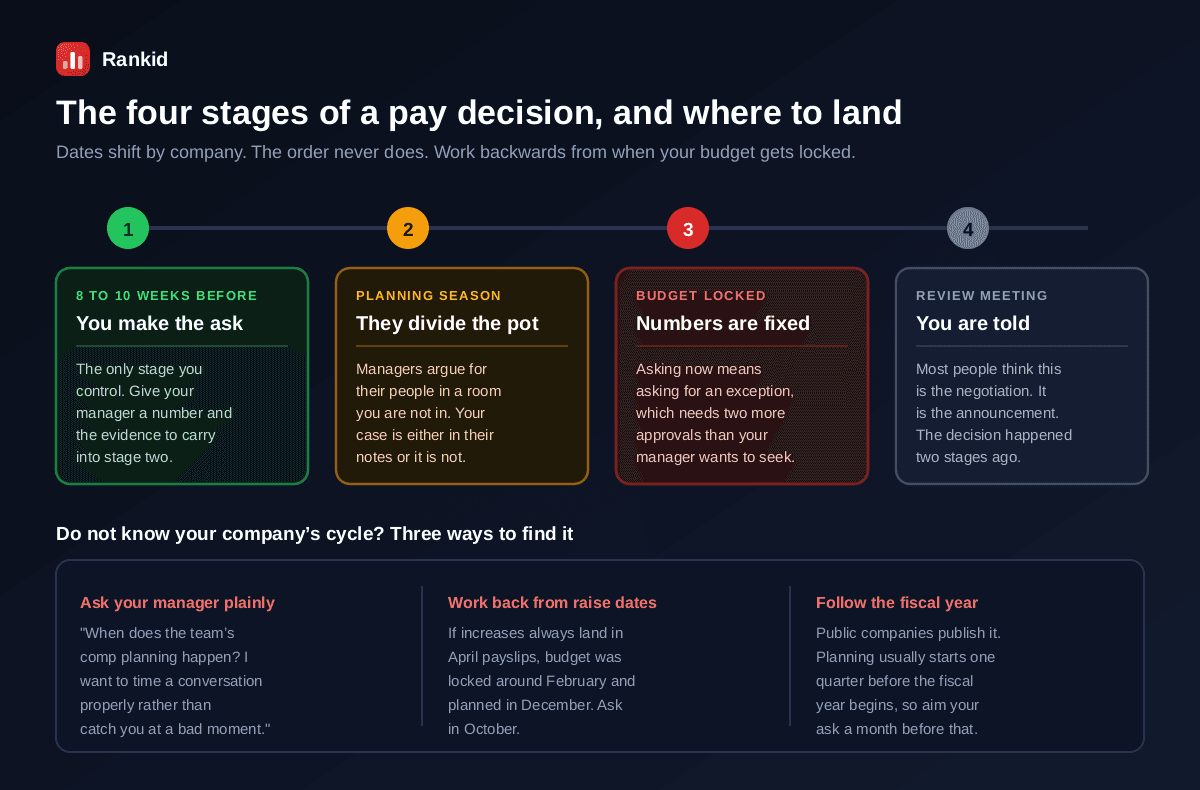
The performance review is the announcement, not the negotiation. You should still make your case there, both because it is on the record and because a strong review feeds the next cycle, but do not expect the number to move on the day. Treat the review as the place your written evidence gets logged, and the pre-planning conversation as the place your raise actually gets decided.
Beyond the budget cycle, a few smaller timing signals genuinely matter. Ask soon after a visible win, while the evidence is fresh and uncontested. Ask when your manager is not in the middle of a crisis or a reorganisation. Do not ask in the week the company announces a hiring freeze, disappointing results or layoffs, because the answer is already no and you will have spent the request for nothing. And if you have been in the role less than six months, wait, unless the job you are doing has visibly diverged from the one you were hired for.
One question to ask right now
How much of a raise should you ask for?
Pick the number from your circumstances, not from your nerve. The percentage itself is rarely what gets challenged. What gets challenged is whether anything justifies it.
Ask for a specific number, not a range and not "more"."I think 8% reflects where I am now" gives your manager something to carry into planning. "I was hoping for a bit of an increase" gives them nothing, and it will be rounded down to whatever the default was going to be anyway. If you are more comfortable with an absolute figure than a percentage, use the figure, and make sure you know what it is as a percentage before you walk in.
Anchor slightly above your target. If you would be content with 8%, ask for 10%. This is not a trick, it is an acknowledgement that pots get trimmed and that your manager may only secure part of what they request. Anchoring at exactly your target guarantees you land below it.
Build the case before you book the meeting
The single highest-leverage thing you can do is keep a running record of your work throughout the year, because nobody can reconstruct twelve months of contributions from memory in the week before a meeting, and the things that get forgotten are usually the ones that mattered.
Keep it to one page and organise it around outcomes rather than activity. Anything with a number attached is worth three things without one: revenue influenced, costs cut, time saved, error rates reduced, customers retained, tickets closed, cycle times shortened. This is the same discipline as quantifying achievements on a resume, and the document you build here becomes the raw material for your next resume update anyway.
- Three or four outcomes with numbers. Not a list of everything, the strongest few. Your manager can only carry a couple of facts into a planning conversation.
- A before-and-after of your scope. What you owned when you started versus what you own now. This is the argument for anything above 8%.
- Two or three market data points. Live listings for your role, level and city. Screenshot them, since postings disappear.
- Anything already praised in writing. A client email, a note from another department, a comment in a review. Second-hand praise is more persuasive than self-assessment.
- What you plan to do next. A raise is a forward-looking bet as much as a reward, so give them something to bet on.
The script
Book a dedicated meeting rather than tacking this onto the end of a one to one, and tell your manager what it is about when you book it. Ambushing someone with a compensation conversation guarantees a deferral, because they will not have checked what is possible. A line as simple as "could we book 30 minutes next week to talk about my compensation?" does the job, and it gives them time to find out what room they have.
Open by naming the subject."Thanks for making the time. I wanted to talk about my compensation, and I have thought about it in terms of what has changed this year." No preamble about the weather, no apology for asking.
Give the evidence, briefly.Three outcomes, with numbers, in under ninety seconds. "I took over the onboarding flow in March and 30-day retention went from 41% to 52%. I have been running the vendor relationship since Priya left, which was not in my remit before. And I trained the two new analysts, both of whom are now independent."
Name the number."Looking at what comparable roles are paying and at how the job has grown, I think 10% reflects where I am now."
Then ask the question that does the real work."What would it take to get there?" This is the most valuable sentence in the entire conversation. It sidesteps a straight no, it makes your manager a collaborator rather than a judge, and whatever they say next tells you exactly what the constraint is: budget, timing, level, or their own view of your performance. Each of those has a different next move.
Then stop talking. The silence after your number will feel much longer to you than to them. Candidates and employees alike lose ground by filling it with qualifiers nobody asked for.
Close by asking for their support explicitly
How to ask for a raise by email
Email is the right tool for booking the conversation and for confirming it afterwards. It is a weaker tool for the ask itself, because it removes your ability to respond to what they say, and it is easy to leave sitting in an inbox. Use a written ask when your manager is remote and genuinely hard to reach, or where your organisation requires a formal written case.
Requesting the meeting
Subject: Time to discuss my compensation
Hi [Name], could we find 30 minutes in the next week or two to talk about my compensation? I would like to walk through what I have taken on this year and where I think my role has moved to. Happy to work around your calendar. Thanks, [Your name]
The written ask, when a meeting is not practical
Subject: Compensation review request
Hi [Name], I wanted to put this in writing so you have it ahead of planning. Over the past year I have [outcome one, with a number], [outcome two, with a number], and taken on [new responsibility] since [context]. Comparable [job title] roles in [city] are currently advertising at [range], and I am at [current figure].
On that basis I would like to request an increase to [specific number], around [X]%. I would welcome the chance to talk it through, and I would also value knowing what you think it would take if now is not the right moment. Thanks, [Your name]
The follow-up after the conversation
Subject: Thanks, and a summary of what we discussed
Hi [Name], thank you for the conversation today. To summarise so we are aligned: I raised [the number], we discussed [what they said about budget, timing or level], and you mentioned [any commitment or criteria]. Next step is [the agreed action] by [date]. I have attached the one-pager in case it is useful in planning. Thanks again, [Your name]
Send this one every time. It is what turns a warm conversation into something with a date attached, and it is the document that gets forwarded when someone else has to approve the number.
Know what you are worth before you ask
The strongest raise case is built on what the market pays for your actual skills. Paste your resume and a live job description for your role into Rankid's free checker to see how you measure against what employers are hiring for right now.
Check your match freeWhat to do when they say no
Some version of no is the most likely single outcome, especially the first time. That is not a failure, it is the opening move of a process that usually takes two conversations. What matters is that you never leave with a bare no, because every variety of it contains something convertible.
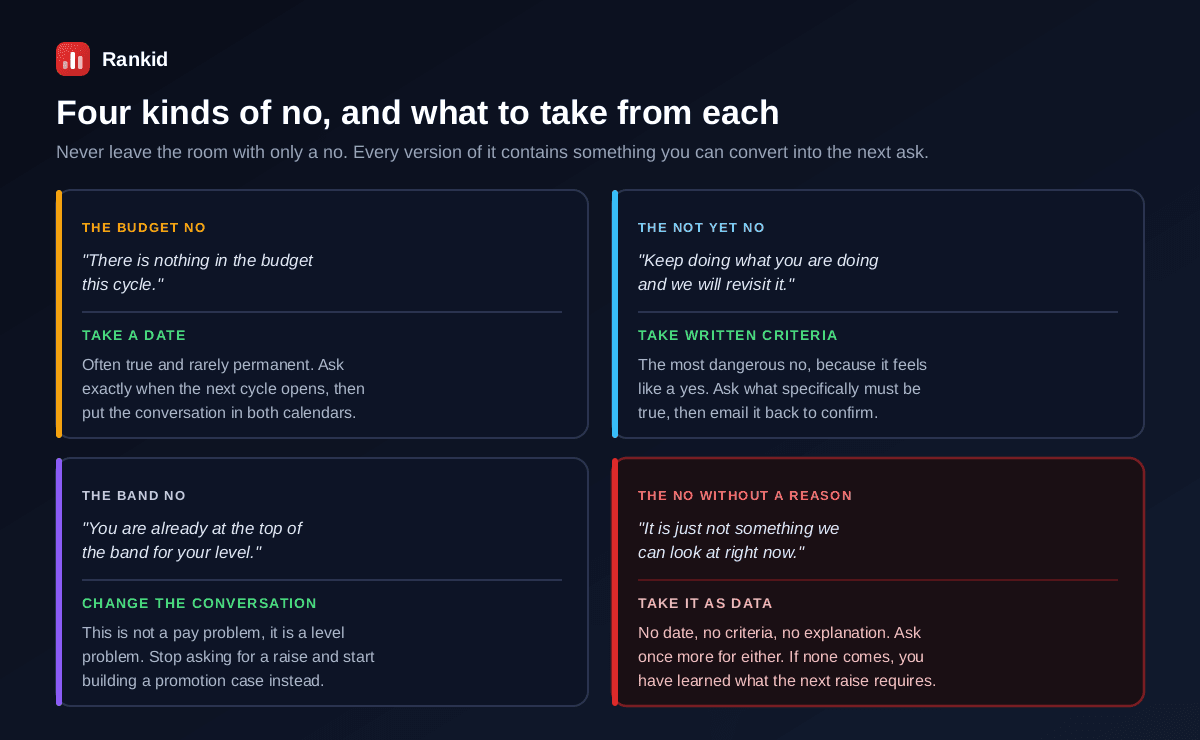
The not-yet no deserves particular caution, because it is the one that quietly costs people years. "Keep doing what you are doing and we will revisit" feels like encouragement and contains no commitment at all. Convert it immediately: "That is good to hear. What specifically would need to be true for this to be a yes, and when should we look at it again?" Then email the answer back the same day. If your manager cannot name criteria, the encouragement was not real.
And take the pattern seriously over time. One no with a clear reason and a date is a normal part of working somewhere. Three vague nos in a row, while your responsibilities keep growing, is a stable answer to a question you have been asking, and it is one of the more common reasons people end up leaving jobs.
Special cases
You are paid below market.Lead with live listings rather than with fairness, and frame it as a correction. Never name a colleague's salary, because it moves the conversation to how you know it. Be realistic that internal corrections are usually capped by band structures, which is why market gaps often close faster by moving than by asking.
You are paid hourly.Convert everything to annual figures before you walk in, because a request for "two dollars more an hour" sounds larger to a manager than the same request expressed as a percentage. Lean on reliability, cross-training and any shift or coverage you take that others avoid, since these are measurable and directly reduce your manager's problems.
There is no formal review process. Common at small companies, and it works in your favour, because there is no locked cycle and the person you are asking usually controls the budget directly. Ask for a dedicated meeting, bring the same one-pager, and propose a review rhythm as part of the conversation.
It is your first time asking. Rehearse the three sentences out loud beforehand, badly, in an empty room. Almost all of the difficulty is in saying the number, and the second time you say it out loud it stops being difficult. The same principle applies to the scripts for negotiating a new job offer, which is the other side of this conversation.
You have a competing offer. Only mention it if you are genuinely prepared to leave, because the conversation changes permanently once you do. Counter-offers frequently work in the short term and often leave you flagged as a flight risk. Decide which outcome you actually want before you raise it.
What not to do
- Do not ask at your performance review and expect the number to move. By then it is arithmetic someone else already did.
- Do not justify it with personal costs. Rent, bills and childcare are real and completely unusable by the person trying to get your number approved.
- Do not compare yourself to a named colleague. The conversation becomes about how you know their salary.
- Do not threaten to leave unless you mean it.A bluff that gets called ends the relationship on someone else's terms.
- Do not lead with time served. Two years in the same seat doing the same work is what the standard annual increase is for.
- Do not apologise or hedge."Sorry, I know this is awkward" invites them to agree that it is.
- Do not ask over instant message. It is too easy to answer with a deferral and no reason.
- Do not accept a vague promise. No date and no criteria means nothing was actually agreed.
Do it in five steps
Find out when comp planning happens
Ask your manager directly, or work backwards from when increases historically appear in payslips. Everything else keys off this date.
Build the one-pager
Three or four outcomes with numbers, a before-and-after of your scope, two or three market data points, and anything already praised in writing.
Pick your number and anchor above it
Choose the band that matches your situation, then ask for slightly more than you would accept, because pots get trimmed on the way through.
Book the meeting and say what it is about
Thirty minutes, dedicated, with advance notice so your manager can find out what is possible. Then deliver the evidence, the number, and "what would it take?"
Send the summary email the same day
Restate the number, what they said, and any commitment or criteria with a date. This is the artefact that survives into planning, and the thing you return to at the next conversation.
Key takeaways
- Ask 8 to 10 weeks before comp planning, not at your performance review.
- Your goal is a manager who will argue for you in a room you are not in.
- Match the percentage to your situation: 5 to 7% strong performance, 8 to 12% grown scope, 15 to 20% below market.
- Above 20% is a promotion request. Say so and run it as one.
- Bring three or four outcomes with numbers, and anchor slightly above your target.
- "What would it take?" is the highest-value sentence in the conversation.
- Never leave with a bare no. Take a date, written criteria, or a level conversation.
- Email the summary the same day. Undocumented agreements do not survive planning.
Asking for a raise feels like a test of nerve, and it is really a test of timing and preparation. The people who do well are rarely the boldest ones in the room; they are the ones who worked out when the decision gets made, showed up two months before it with three numbers and a specific figure, and made it easy for their manager to advocate on their behalf. Do that, ask what it would take, and get whatever you are told in writing. And because the fastest correction to being underpaid is often knowing exactly what the market wants, paste your resume and a live job description for your role into Rankid's free resume checker and see how you measure against what employers are actually hiring for.
Frequently asked questions
When is the best time to ask for a raise?
Eight to ten weeks before your company's compensation planning happens, which for most organisations means asking in the autumn for increases that land the following spring. This matters more than anything else you do, because by the time you sit down for a performance review the money has already been divided. Your manager argued for their people in a planning meeting weeks earlier, and either your case was in their notes or it was not. If you do not know your company's cycle, ask your manager directly when comp planning takes place, or work backwards: if increases always show up in April payslips, the budget was locked around February and planned in December, so you want to be having the conversation in October.
How much of a raise should I ask for?
Match the percentage to your situation rather than picking a number that sounds brave. Around 3% is the standard annual increase for doing the job you were hired to do, and you generally get it without asking. Five to seven percent is right for clearly strong performance in the same role at the same scope. Eight to twelve percent fits when your job has actually grown and you are doing work nobody hired you for. Fifteen to twenty percent is the range when you are demonstrably paid below market for the work you already do, and the market data is then your entire argument. Anything above about twenty percent is not a raise request, it is a promotion request, and you should say so and run it on the promotion timeline instead.
Is it unreasonable to ask for a 10 percent raise?
No, provided you can point to something that changed. Ten percent is a normal and achievable ask when your responsibilities have genuinely expanded, when you have taken on work that used to belong to someone more senior, or when you are sitting below the market rate for your role. It becomes unreasonable only when the justification is time served, because another year in the same seat doing the same work is what the standard annual increase is for. The number is never the problem on its own. What determines whether ten percent lands is whether your manager can repeat your reasoning to their own boss without having to defend it themselves.
Is a 20 percent raise a lot to ask for?
It is a lot to ask for as a raise, and entirely normal as a promotion. Twenty percent usually crosses the top of the salary band for your current level, which means it cannot be approved as an ordinary increase no matter how well the conversation goes, because the constraint is structural rather than a matter of goodwill. If that is genuinely the gap between your pay and your market value, you have two honest routes: make a promotion case for the next level, with the title attached, or accept that the fastest correction is likely to be an external offer. Asking for twenty percent while framing it as a raise usually produces a confused no, because you are asking your manager for something they are not able to grant.
How do you politely ask for a salary increase?
Book a dedicated meeting rather than raising it at the end of a one to one, tell your manager in advance what it is about so they can prepare, then lead with evidence and finish with a specific number. A structure that works: "I would like to talk about my compensation. Over the last year I have taken on X and Y, and delivered Z with these results. Looking at the market for this role, I think 8% would reflect where I am now. What would it take to get there?" Politeness comes from being specific and giving them room to act, not from hedging. Ending on a question rather than a demand is what turns it into a conversation your manager can join rather than a request they have to rule on.
What is the best wording to ask for a raise?
Use language that makes your manager an ally rather than an opponent. The single most useful phrase is "what would it take?", because it converts a yes-or-no decision into a plan. Say "I would like to talk about my compensation" rather than "I want more money", state what has changed with evidence attached, give one specific number or percentage, and then stop talking and let them respond. Avoid apologising, avoid "I was wondering if maybe", and avoid explaining that you need it because of your own costs. And ask directly whether they support it: a manager who says yes out loud has effectively agreed to argue for you in the planning meeting where the decision actually happens.
How do you ask for a raise in writing or by email?
Use email to request the meeting and to follow up afterwards, not to make the ask itself. A short note beforehand lets your manager prepare rather than being ambushed: "Could we book 30 minutes next week to talk about my compensation? I would like to walk through what I have taken on this year." Then have the conversation in person or on a call. Afterwards, send a summary email with your accomplishments, the number you discussed and anything they committed to, because that document is what gets forwarded to HR or referenced in planning. Written asks are appropriate when your manager is remote and rarely available, or where your organisation formally requires a written case.
How often should you ask for a raise?
Once every twelve months in normal circumstances, timed to the compensation cycle rather than to the anniversary of your start date. Asking more often than annually makes the request routine and easy to defer, and it uses up goodwill you will want later. There are two legitimate exceptions. If your role has changed substantially, taking on reports, a significantly larger budget or a different scope of work, you can ask when that change becomes permanent regardless of when you last asked. And if you were given specific criteria and a date at a previous no, returning on that date with the evidence is not a new request, it is closing the one you already opened.
How do you ask for a raise when you are underpaid?
Lead with the market gap rather than with fairness, and keep the tone unemotional. Gather two or three current job listings for your role, level and city that show the going rate, ideally including a couple from your own employer if they are hiring for similar positions. Then present it as a correction rather than a complaint: "Comparable roles are advertising at 95 to 110, and I am at 82. I would like to close that gap." Avoid comparing yourself to a named colleague, which shifts the conversation onto how you know their salary and away from your own case. Be aware that internal corrections are often capped by band structures, and that the market gap frequently closes faster by moving than by asking, which is worth knowing before you decide how hard to push.
What should you do if your manager says no to a raise?
Never leave with only a no, because each version of it contains something you can use. If it is a budget no, ask exactly when the next cycle opens and put the follow-up conversation in both calendars. If it is a not-yet no, which is the most dangerous because it feels like encouragement, ask what specifically would need to be true and then email it back to confirm what you both agreed. If you are told you are at the top of your band, that is a level problem rather than a pay problem, so switch to building a promotion case. And if you get no date, no criteria and no explanation even after asking again, that is useful information too: it tells you what your next raise is likely to require, which may be a different employer.