How to Negotiate Salary: Scripts, Emails and What to Counter
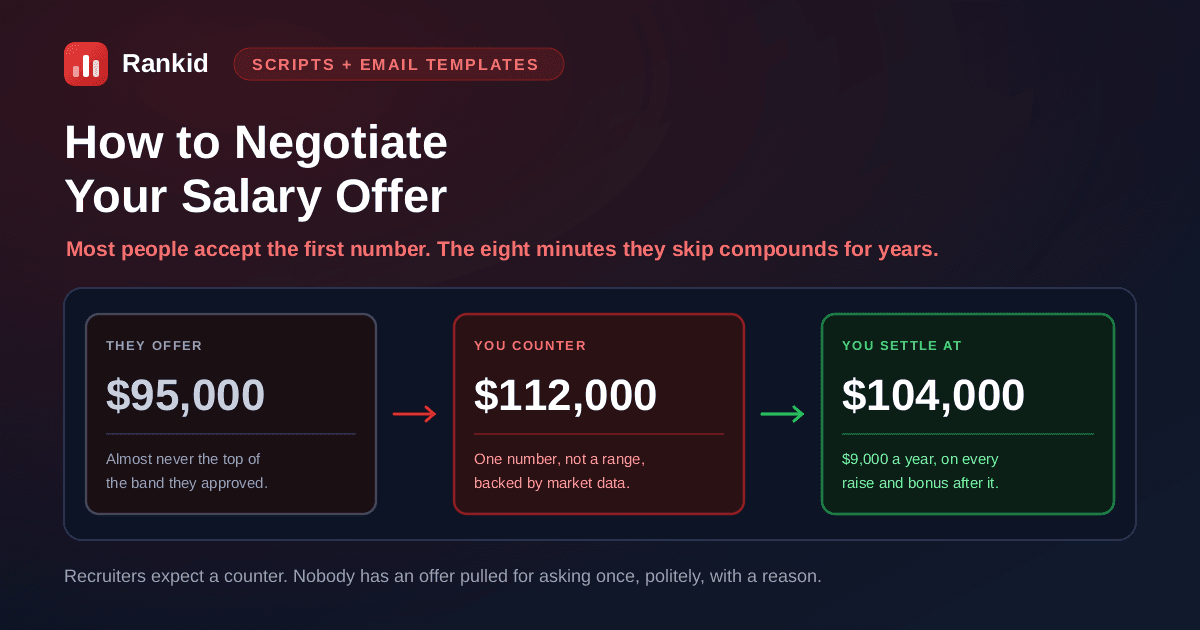
The number in your offer letter is not a verdict on your worth. It is a position inside a band someone already got approved, chosen because it is low enough to leave room and high enough that you will probably say yes. Most candidates say yes. They say yes because they are afraid of an outcome, the offer being pulled, that almost never happens, and because nobody ever told them what the actual words are. Here is how much to counter, the exact sentences for each moment, an email you can adapt in five minutes, and what is still on the table when base pay genuinely will not move.
Quick answer
Never name the first number. Counter 10 to 20% above the offer with a single figure, not a range. Justify it with market rates rather than personal need, then stop talking. Expect to land near the midpoint. If base is fixed, ask for a signing bonus or a written six month review instead. One clear ask, once, framed as "if we can do this, I am ready to sign".
Should you always negotiate salary?
Almost always. The two real exceptions are a published public-sector or union pay grid where the figure is set by a table you can look up, and the case where you were told an exact number earlier in the process and explicitly said you would take it. Everywhere else, asking once is routine and expected.
The reason to bother is compounding. Raises, bonuses and often your next job's offer are all calculated as a percentage of your base. A $9,000 gap at the start is not $9,000, it is $9,000 every year plus the extra on every percentage increase layered on top of it, and it follows you to the next employer who asks what you currently earn. Eight minutes of mild discomfort is the highest hourly rate most people will ever earn.
The fear that stops people is the offer being withdrawn. It happens, but it happens to candidates who become aggressive, invent competing offers, or come back four separate times with escalating demands. It does not happen to someone who asks once, politely, with a reason, and makes clear they want the job. By the time an offer exists the company has spent weeks and real money getting there, and restarting the search over one reasonable counter is not a trade any hiring manager wants.
The leverage is real, and it is temporary
When to negotiate salary
After the written offer, never before it. Until the offer exists you are one of several candidates and any number you name is a filter you might fail. Once it exists, you are the person they chose, and the cost of losing you is at its peak.
That gives you three distinct phases. In early screens, deflect and gather: find out the budgeted band without committing to a figure. Between the final interview and the offer, do your research so you already know your number before the call comes. Then, in the 24 to 72 hours after the offer arrives, make one counter. Ask for time to review rather than reacting live, because "can I come back to you Thursday?" is both normal and the single easiest way to avoid accepting on reflex.
Do your homework in that gap rather than on the call. Check the posted range if there is one, since many US states and other jurisdictions now require it. Then triangulate with two or three sources for your role, seniority and city, and settle on a figure you can say out loud without flinching.
What to say when they ask your salary expectations
This question usually arrives on a 20 minute recruiter screen, long before anyone has decided anything, and it is the moment most negotiations are quietly lost. Whoever names a number first sets the ceiling for everything that follows.
Turn it around: "Happy to talk about it. What range have you budgeted for the role? I would rather check we are in the same place before I anchor us." Recruiters ask precisely because they have a band and want to screen out mismatches, so most will simply tell you. That single exchange is worth more than any other tactic in this article, because from then on you are negotiating up from their number instead of down from yours.
If they push back and insist you answer first, give a researched range with your target at the bottom of it, because the bottom is the only part of a range anyone remembers. If your target is $112,000, say "110 to 125", not "100 to 120". And confirm the band on the screening call rather than four rounds later, which is one of the more useful questions to ask in an interview.
How much to counter a salary offer
Ten to twenty percent above the offer, as a single number. That range is not arbitrary: it is large enough to move the figure meaningfully, and small enough that the recruiter can usually approve it themselves without reopening a sign-off with finance. The thing standing between you and a yes is often nothing more than whether someone has to ask permission again.
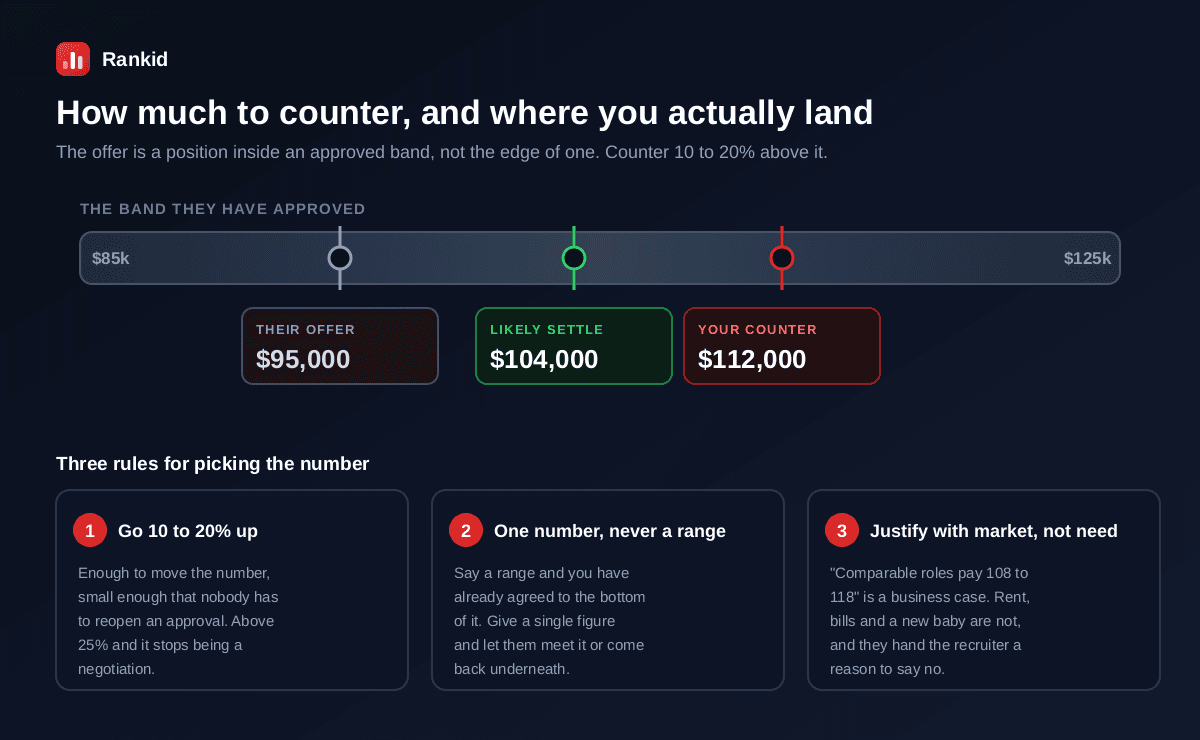
Give one number, never a range.If you counter with "somewhere between 108 and 115", you have already agreed to 108 and the conversation is over. A single figure forces an actual response: they meet it, they come back underneath it, or they explain why they cannot. All three outcomes are better than negotiating against yourself.
Justify with the market, not with your life."Comparable roles in this city pay 108 to 118" is a business case a recruiter can forward to a budget holder. "My rent went up and I have a second child on the way" is true, sympathetic, and completely unusable by the person trying to help you, because no company approves a pay band on the basis of an individual's costs. Keep your reasons external and verifiable.
Expect to land somewhere near the midpoint between their number and yours. That is not a failure of the counter, it is how the mechanism works, and it is why anchoring above your target rather than at it matters.
The four scripts
Negotiation feels hard mostly because people improvise it while adrenaline is running. It gets dramatically easier once the sentences are decided in advance. Say each of these out loud twice before the call, badly, in an empty room. That is the whole preparation.
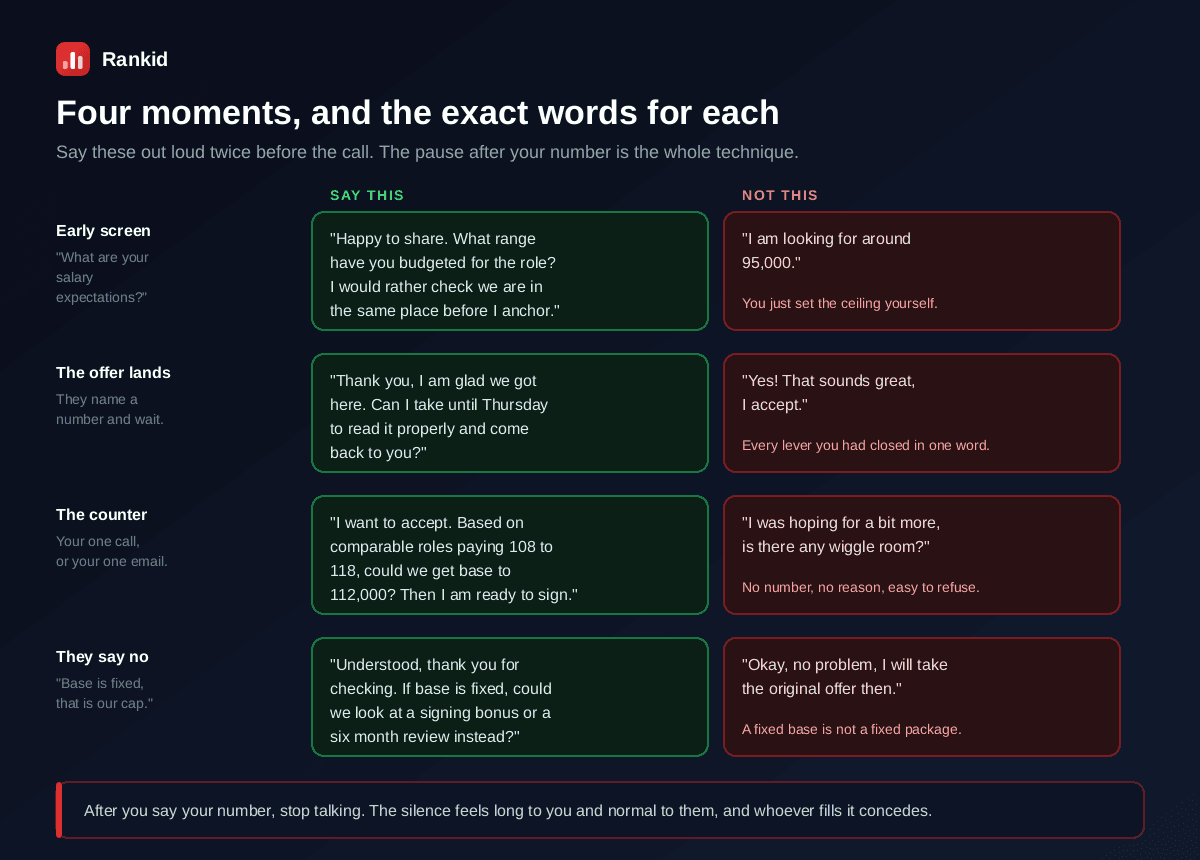
The technique hiding inside all four is the pause. After you say your number, stop. The silence will feel excruciating to you and entirely ordinary to them, because they have had this conversation forty times this year and you have had it twice in your life. Candidates lose thousands in that gap by filling it: "but obviously I am flexible", "I mean, whatever works", "it does not have to be exactly that". Say the figure, give the reason, and let them answer.
Email or phone?
Salary negotiation email template
Five short lines. Thank them, commit to the role, name one number with one reason, offer a secondary path, and close by making yes the fast option.
The standard counter, after a written offer
Subject: Re: Offer, [Job Title]
Hi [Name], thank you for sending this through, and I am genuinely pleased. I want to accept and I am excited about [something specific about the team or the work].
Having looked at comparable [Job Title] roles in [city or market] paying [X to Y], I would be able to accept straight away at a base of [your number]. If base is fixed at this level, I would be glad to look at a signing bonus or an agreed compensation review at six months instead.
Either way I am keen to get started. Thanks again, [Your name]
When the offer is clearly below the posted range
Subject: Re: Offer, [Job Title]
Hi [Name], thanks for the offer, and I would like to accept. One thing I wanted to raise: the posting listed the range as [X to Y], and the offer comes in at [Z], below the bottom of it. Given [one line on the relevant experience you bring], I had expected to land nearer [your number]. Could we get there? Happy to talk it through on a call if that is easier.
Best, [Your name]
When you have a genuine competing offer
Subject: Re: Offer, [Job Title]
Hi [Name], thank you, and I want to be straightforward with you. [Company] is my first choice, and I also have an offer at [amount] from another process. I would rather join you. If you can get the base to [your number], I will accept today and withdraw from the other process.
Best, [Your name]
Only send this if it is true. Recruiters talk, offers get verified more often than people expect, and being caught inventing leverage ends the conversation permanently.
Accepting gracefully after a no
Subject: Re: Offer, [Job Title]
Hi [Name], understood, and thank you for checking with the team. I am happy to accept at [their number]. Could we note the six month review we discussed in the offer letter? Looking forward to starting on [date].
Best, [Your name]
Leverage starts before the offer does
The strongest negotiating position is being an obvious fit for the role. Paste your resume and the job description into Rankid's free checker for a 0 to 100 match score, the requirements you have covered, and the gaps worth closing first.
Check your match freeWhen base pay is fixed, eight things still are not
"That is the top of the band" is often true. It is also not the end of the conversation, because base salary is the single most constrained part of a package. Almost everything else sits in a different budget line or inside one manager's discretion.
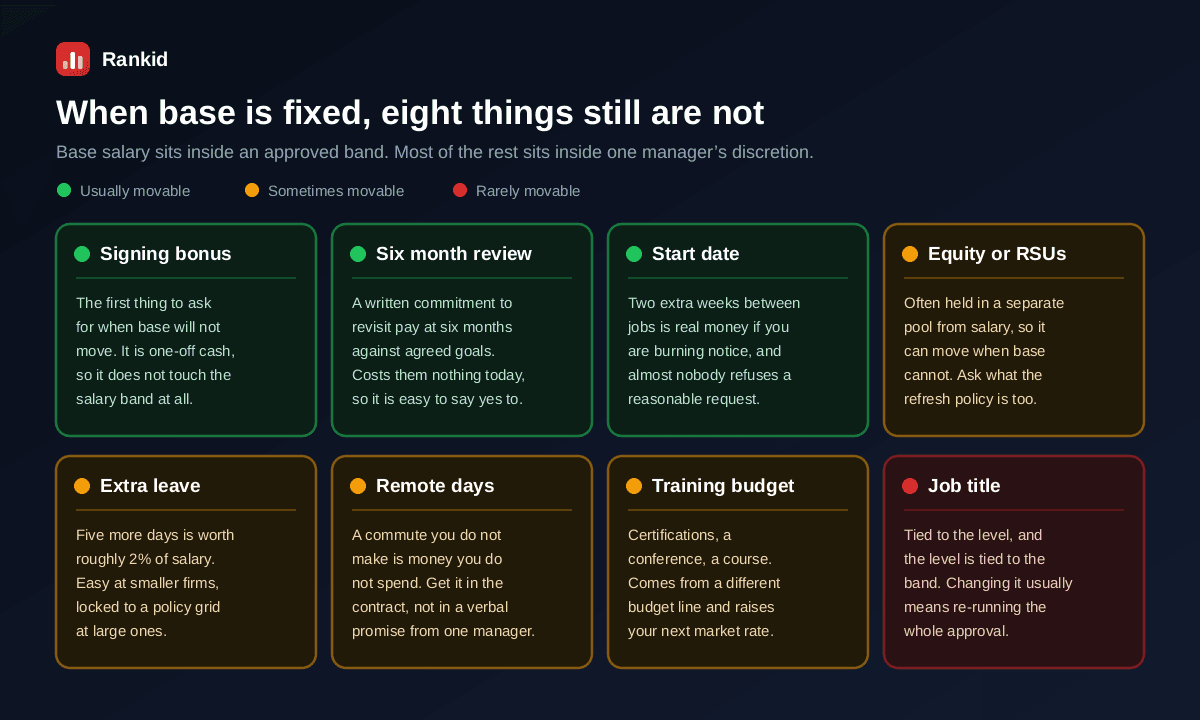
Lead with the signing bonus. It is one-off cash that never touches the salary structure, which means nobody has to justify a band exception, and it is by some distance the easiest yes in the list. A written six month review is the next best ask, because it costs the company nothing today and gives you a scheduled second attempt with evidence behind you. Make sure it lands in the offer letter rather than in a verbal promise from a manager who may not be there in six months.
One caution: pick two things, not seven. A list of eight requests reads as someone who will be difficult to manage, and it dilutes the one ask you actually cared about.
What not to say when negotiating salary
- "I need at least..." Need is not a business case, and the word invites a conversation about your circumstances rather than the market rate.
- Anything about rent, bills, childcare or a mortgage. All real, none usable by the person trying to get your number approved.
- An invented competing offer. It gets verified more often than people expect, and the downside is not a lower salary, it is the offer disappearing.
- "I was hoping for a bit more." No number, no reason, and trivially easy to answer with a sympathetic no.
- Your current salary, unprompted. It is irrelevant to what this role is worth, and in several jurisdictions they are not permitted to ask.
- "Sorry to ask, but..." Do not apologise for a routine professional conversation. It signals you expect to be refused.
- An ultimatum you will not honour. Never say you will walk unless you are genuinely willing to walk.
- A second, third and fourth request. Drip-feeding new demands is the one behaviour that genuinely annoys hiring teams. Bundle everything into one ask.
The rules people ask about
The number one rule is not to name the first number. Anchoring decides the range everyone then argues inside, and a candidate who volunteers a figure on a screening call has usually capped their own offer before anyone assessed them. If you take one thing from this article, take the deflection script.
The 70/30 rule is the listening ratio: spend roughly 70 percent of the conversation listening and 30 percent talking. It is a useful corrective because the failure mode in salary conversations is nervous over-talking, and most of the information you need, the band, the constraints, what they can flex, comes from letting them fill the space instead.
On how many rounds: one counter, then accept or decline. A second round is defensible if they came back with a partial move and you want to close a small remaining gap. A third makes you the candidate everyone remembers for the wrong reason.
Negotiating a raise in your current job
The mechanics differ in one important way: you have no offer, so you have to manufacture the leverage that an offer would have supplied. That means evidence and timing rather than a moment of maximum demand.
Build a one page record of what you delivered, with numbers, before you ask. Time the conversation to the budget cycle rather than to your frustration, which usually means raising it one to two months before planning rather than at your review, when the pot is already allocated. Ask for a specific figure or percentage, not "a raise". And separate the conversation from your performance review, because that meeting has a different agenda and your request will get absorbed into it.
If the answer is no, ask what specifically would need to be true in six months for the answer to be yes, and get it written down. A no with defined criteria is genuinely useful. A no with vague encouragement is information too, and it is often the point at which people start reading job postings, which is a large part of the reasons people end up leaving jobs.
Do it in five steps
Find the band before you need it
Check the posted range, then triangulate with two or three market sources for your role, level and location. Decide your target number and your walk-away number before any call happens.
Deflect the expectations question
Ask what they have budgeted. If forced to answer, give a range with your target at the bottom of it. Get this right and everything downstream is easier.
Buy time when the offer lands
Thank them warmly, ask for the offer in writing if it came by phone, and request until a specific day to review it. Do not respond to the number in the moment.
Make one counter, 10 to 20% up
One number, one market-based reason, one sentence confirming you will sign if they can do it. Then stop talking, or hit send and close the laptop.
Get every agreed thing in the letter
Signing bonus, six month review, remote days, start date. If it is not in the written offer it does not exist, regardless of how warmly it was promised. Once it is signed, the follow-up etiquette that got you here applies one last time: thank the people who interviewed you.
Key takeaways
- Never name the first number. Ask what range they have budgeted instead.
- Negotiate only after a written offer exists. That is the moment your leverage peaks.
- Counter 10 to 20% above the offer, as one number, never a range.
- Justify with market rates. Rent and bills are real but unusable by the recruiter.
- Say your figure, then stop talking. The silence is normal to them, not to you.
- If base is fixed, ask for a signing bonus or a written six month review.
- One clear ask, once. Drip-feeding new demands is what actually irritates hiring teams.
- Offers are almost never rescinded for a single polite, reasoned counter.
Salary negotiation feels like a confrontation and is really just an administrative conversation about where in an approved band you land. The recruiter is not offended, they have done this hundreds of times, and a well-framed counter often makes their job easier by giving them something concrete to take to a budget holder. Decide your number in advance, ask once with a reason, and be genuinely gracious whichever way it goes. And because the strongest negotiating position of all is being the obvious choice for the role, paste your resume and the job description into Rankid's free resume checker and close the gaps long before anyone puts a number in front of you.
Frequently asked questions
Should you always negotiate salary?
Almost always, with two narrow exceptions. Recruiters build negotiation into the process, the first number is rarely the top of the approved band, and a single polite counter backed by a reason is completely routine. Declining to ask is the only guaranteed way to leave money on the table, and because raises and bonuses are usually calculated as a percentage of base, a gap at the start compounds for as long as you stay. The exceptions: a genuinely fixed public-sector or union pay scale where the number is set by a published grid, and a case where you have already been told the exact figure and explicitly confirmed you would accept it. Everywhere else, ask once, ask well, and accept the answer gracefully if it is no.
How much should you counter a salary offer?
Counter 10 to 20 percent above the offer, and give a single number rather than a range. That band is large enough to move the figure meaningfully but small enough that the recruiter can usually approve it without reopening a sign-off with finance, which is the practical thing standing between you and a yes. On a $95,000 offer that means countering somewhere between $105,000 and $114,000. Above about 25 percent you stop being a negotiation and start being a different candidate, which invites them to reconsider the level rather than the number. Anchor your figure to market data for the role and location, not to what you currently earn, and expect to land near the midpoint between their offer and your counter.
When should you negotiate salary?
After you have a written offer, and not before. Until the offer exists you have no leverage, because they have not yet decided they want you specifically. Once it exists, they have invested weeks of interviewing, secured a budget, and told their manager the search is over, which is exactly when the cost of losing you is highest. In practice this means deflecting the salary question during early screens, confirming the band the recruiter has budgeted, then doing your negotiating in the 24 to 72 hours after the written offer lands. Ask for time to review it rather than responding to the number on the spot, and come back once with your counter rather than negotiating in a drip over several days.
How do you politely negotiate salary?
Lead with acceptance, attach a reason, name one number, then stop talking. A line that works in almost any context: "I am really pleased with this and I want to accept. Based on comparable roles paying 108 to 118, could we get the base to 112,000? If we can do that, I am ready to sign today." That phrasing is polite because it signals commitment rather than hesitation, it gives the recruiter a business case they can repeat to a budget holder, and it makes saying yes the fastest route to closing the role. The politeness comes from the framing, not from hedging. Vague softeners like "I was hoping for a bit more" feel more polite and are far easier to refuse.
What should I say when asked about salary expectations?
Turn the question around before you answer it, because whoever names a number first sets the ceiling. Try: "Happy to talk about it. What range have you budgeted for the role? I would rather check we are in the same place before I anchor us." Recruiters ask this early to screen out mismatches, so they usually have a band and will share it. If they insist you go first, give a researched range with your target at the bottom, not the middle, since the bottom is the only part of a range anyone hears: "Based on what I am seeing for this role, I am looking at 110 to 125." In many US states, and several other jurisdictions, the range must be posted, so check the listing before the call.
What is the number one rule of salary negotiation?
Never name the first number if you can avoid it. Whoever anchors first defines the range everyone argues inside, and in practice the candidate who blurts a figure on a screening call has capped their own offer before anyone has assessed them. If the employer names it first, you are negotiating up from their position rather than down from yours. The close second rule is to say your number and then stay silent. The pause after a counter feels far longer to the person who made it than to the person receiving it, and candidates routinely talk themselves down during that silence by adding qualifiers nobody asked for. Say the figure, give the reason, and let them respond.
What should you not say when negotiating salary?
Avoid anything based on personal need, anything you cannot back up, and anything that reads as an ultimatum. Rent, bills, childcare and a mortgage are real but they are not a business case, and they hand the recruiter a reason to decline. Do not invent a competing offer, because the bluff is often called and it is the fastest way to lose trust. Do not say "I need at least" unless it is genuinely true, and do not apologise for asking. Also avoid negotiating in a drip: coming back three times with a new request each time is the one behaviour that genuinely irritates hiring teams and makes them wonder about the rest of the relationship. One clear ask, once.
Can a company rescind a job offer if you negotiate?
It is possible in theory and very rare in practice, and the fear of it costs candidates far more than the event itself. By the time an offer is issued, the company has spent weeks and real money on the search, and pulling it over a single reasonable counter would mean restarting from scratch. What does occasionally happen is a firm no, sometimes with a note that the figure is final, and that is a normal outcome you can accept gracefully. Offers do get withdrawn when a candidate is aggressive, makes repeated escalating demands, invents leverage, or turns the conversation adversarial. Ask once, politely, with a reason, and confirm you are enthusiastic either way, and the risk is close to zero.
How do you write a salary negotiation email after a job offer?
Keep it to five short lines: thank them, say clearly that you want the job, state one number with a one-sentence justification, name anything secondary you would accept instead, and close by confirming you are ready to sign. Something like: "Thank you for the offer, I am excited about the role and the team. Having looked at comparable positions in the area paying 108 to 118, I would be able to accept immediately at a base of 112,000. If base is fixed at this level, I would be glad to discuss a signing bonus or an agreed six month review instead. Either way I am keen to get started." Email suits this better than a call for most people, because it gives you control of the wording and gives the recruiter something forwardable to a budget holder.
What can you negotiate if the salary is fixed?
Quite a lot, because base pay is the one component locked to an approved band while most of the rest sits inside a manager's discretion. The strongest ask is a signing bonus, since it is one-off cash that does not touch the salary structure at all. Next is a written commitment to a compensation review at six months against agreed goals, which costs the company nothing today. Then a later start date, which is worth real money if you are between jobs; additional annual leave, worth roughly two percent of salary for every five days; equity or RSUs, which often come from a separate pool; guaranteed remote days written into the contract rather than promised verbally; and a training or certification budget, which raises your market rate for the next move. Job title is usually the hardest, because it is tied to the level and therefore back to the band.