How to Quantify Achievements on a Resume (Examples, Even With No Numbers, 2026)
Two people can do the exact same job and write two completely different resumes. One writes "responsible for improving customer response times." The other writes "cut average support response time from 8 hours to 2 across a team of 5." Same work, but only one of them gets the interview, because only one gave the recruiter proof. Learning how to quantify achievements on a resume is the single highest-leverage edit most job seekers can make, and the good news is that it works even if you never tracked a metric in your life. This guide shows you the four kinds of numbers hiding in every job, a simple three-question method to surface them, and quantified bullet examples for real roles, including the ones that feel impossible to measure.
Quick answer
Why quantifying achievements changes everything
A recruiter spends only a few seconds on the first pass of a resume, and in those seconds they are not reading, they are scanning for evidence. A number is the fastest possible evidence. "Increased sales" is a claim you are asking them to take on faith. "Grew regional sales 42 percent in two quarters" is a fact they can picture, trust, and remember. That is the whole reason quantified achievements outperform duties: they do three jobs in a single line.
- They prove the claim.A metric turns an opinion ("improved efficiency") into evidence ("cut processing time 30 percent") the reader does not have to take on trust.
- They create scale and context. A number tells the reader instantly whether you led a team of 3 or 30, or managed a 10,000 dollar budget or a 10 million dollar one. Without it, they cannot size your impact.
- They add specificity that matches the job. Quantified bullets are concrete, so they naturally carry the exact skills and terms a posting asks for, which reads as a stronger match to a recruiter and to the software screening you.
This is also why quantifying is often the fix when applications go quiet. If you have been wondering why you are not getting interviews despite the right experience, a resume full of vague duty statements is one of the most common and most fixable causes.
The four kinds of numbers hiding in every job
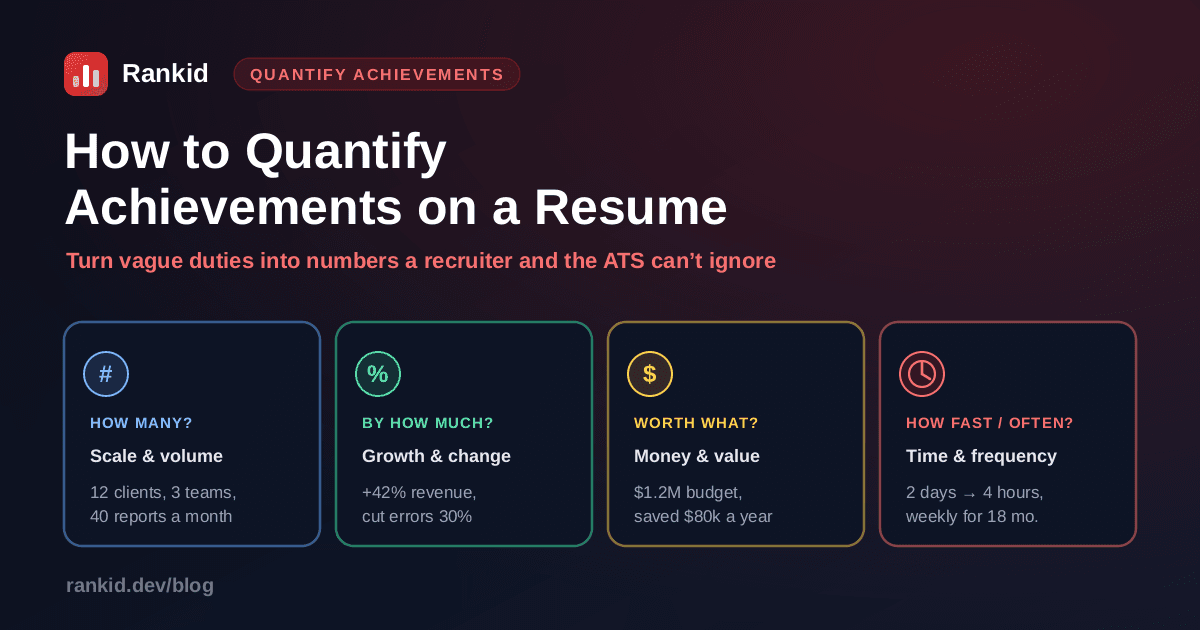
People freeze on quantifying because they think it means big, dramatic percentages they do not have. It does not. Almost every achievement can be measured with one of four ordinary questions, and most jobs answer several of them. When you get stuck, run your work through these four lenses and a number usually appears.
- How many? (scale and volume.) The size of what you handled: 12 clients, 3 teams, 40 reports a month, 500 users, 15 events a year. This is the easiest number to recover and it works for almost any role.
- By how much? (growth and change.) A percentage or a before-and-after: grew revenue 42 percent, cut errors 30 percent, raised satisfaction from 3.8 to 4.6. Change is the most persuasive number because it shows impact, not just activity.
- Worth what? (money and value.) Dollars touched, earned, or saved: a 1.2 million dollar budget, 80,000 dollars saved a year, 1.4 million in closed deals. Money is the language of business and it travels across industries.
- How fast or how often? (time and frequency.) Speed and cadence: cut a process from 2 days to 4 hours, delivered weekly for 18 months, reduced onboarding from 6 weeks to 4. Time metrics prove efficiency when you have no revenue number to point to.
Pick the metric that flatters the work honestly
How to quantify achievements with no numbers (the three-question method)
This is the objection that stops most people: "My job was never measured, so I have nothing to quantify." You almost certainly do. The numbers were just never written down, and they are recoverable from memory with an honest estimate. You do not need a report to prove a figure on a resume, you need a number you could explain and defend if an interviewer asked how you got it. Take any vague duty and run it through three questions.
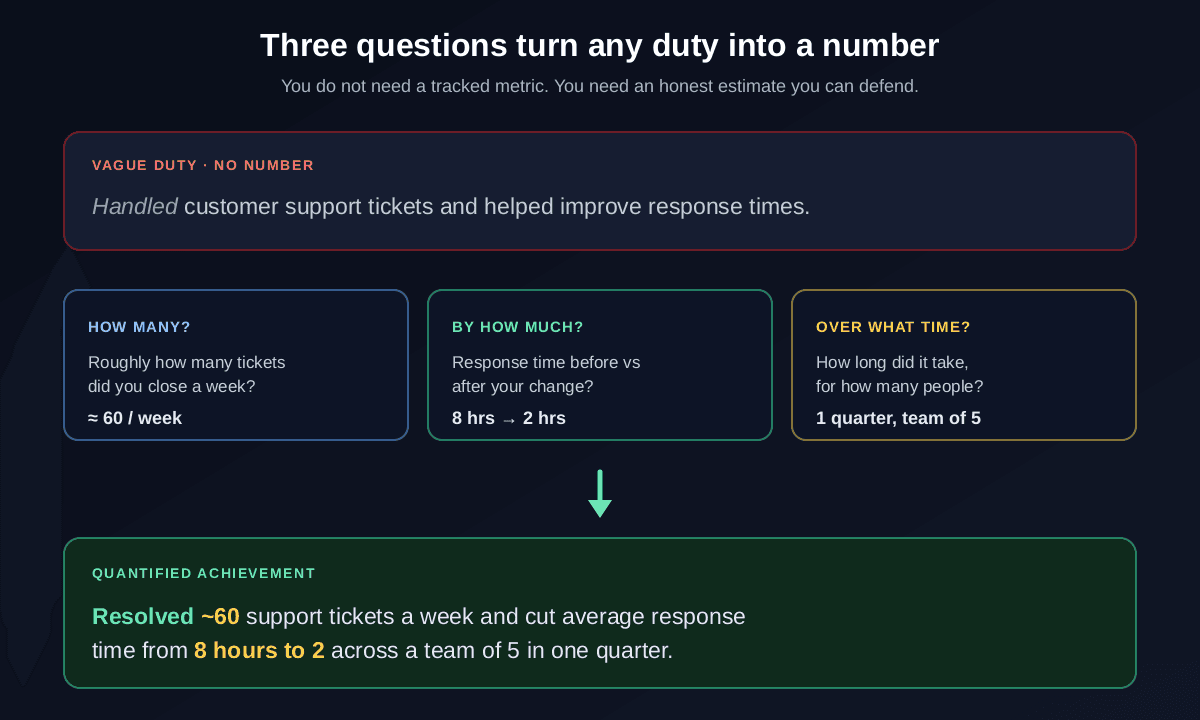
Notice what happened. "Handled customer support tickets and helped improve response times" carried zero information. Three questions later, none of which needed a spreadsheet, it became "Resolved approximately 60 support tickets a week and cut average response time from 8 hours to 2 across a team of 5 in one quarter." Every number in that line is an honest estimate the writer could defend, and the bullet is now specific, credible, and full of matchable detail.
The rules that keep estimating legitimate are simple: reconstruct from real memory, never invent; round conservatively rather than optimistically; add a hedge word ("approximately," "around," "over") when the figure is an estimate; and never quote a number you could not calmly walk an interviewer through. A conservative real figure beats a precise-looking fake one every time.
Where lost numbers are usually hiding
Quantified achievement examples by role
Here is what the finished product looks like across very different jobs, including one that people always insist cannot be measured. Read these less as templates to copy and more as proof that the four-question method produces a real, specific line no matter what field you are in.
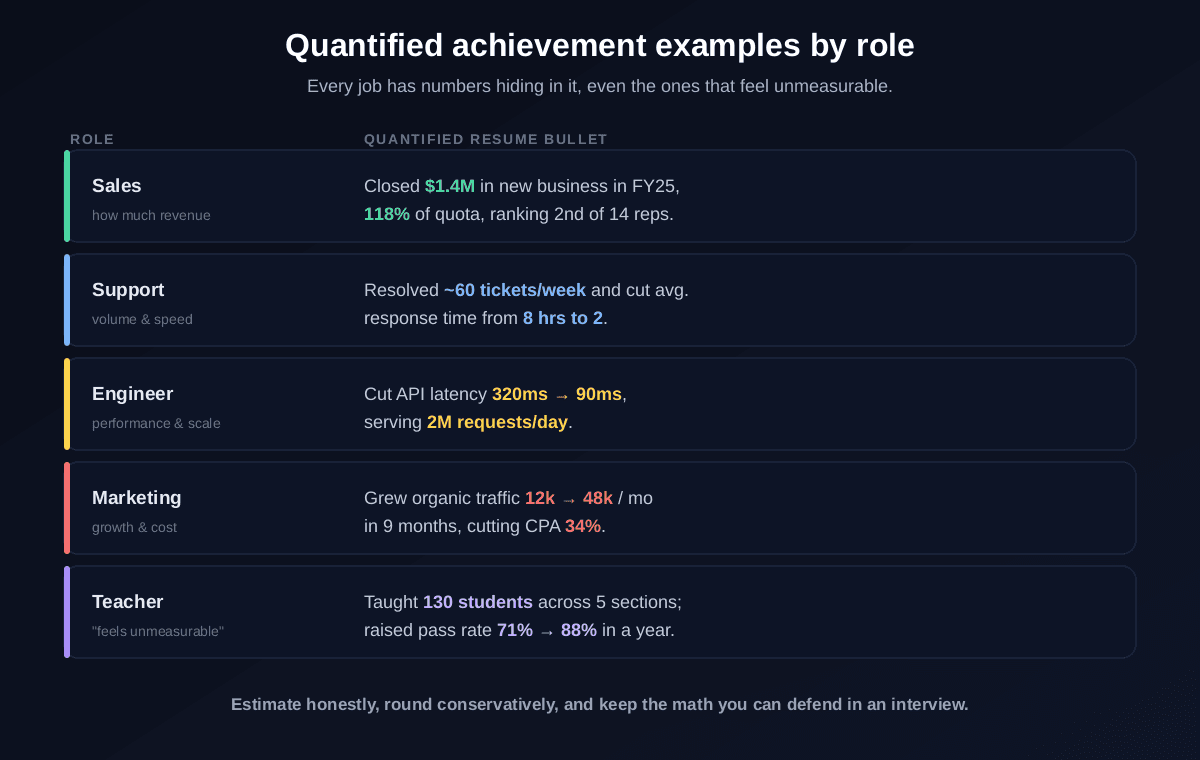
- Sales."Closed 1.4 million dollars in new business in FY25, 118 percent of quota, ranking 2nd of 14 reps." Money plus growth plus scale in one line.
- Customer support."Resolved approximately 60 tickets a week and cut average response time from 8 hours to 2." No revenue to point to, so volume and speed carry it.
- Software engineer."Cut API latency from 320ms to 90ms while serving 2 million requests a day." Performance and scale, the two numbers engineering hiring managers look for.
- Marketing."Grew organic traffic from 12,000 to 48,000 monthly visits in 9 months while cutting cost per acquisition 34 percent." Growth plus efficiency beats "managed campaigns."
- Teacher (the "unmeasurable" one)."Taught 130 students across 5 sections and raised course pass rate from 71 percent to 88 percent in a year." Countable inputs plus a before-and-after outcome.
See if your new numbers actually match the job
Quantifying works best when the specifics you add are the ones the role is looking for. Paste your resume and a job description into Rankid and get a 0 to 100 match score, the skills and keywords you match, and the ones you are still missing, so you know your quantified bullets are landing on target. Your first check is free, no signup.
Check your resume freePair every number with a strong verb and the right keyword
A number on its own is stronger than a duty, but a number inside a well-built bullet is stronger still. The most effective quantified bullets follow a simple shape: a strong action verb, the real number, and the specific skill or keyword the job asks for. "Was involved in the migration" becomes "Led the migration of 240 services to AWS with zero downtime." The verb shows ownership, the number shows scale, and "AWS" is the exact term the posting and the screening software are scanning for.
If your bullets still open with weak phrases like "responsible for" or "helped with," fix the verb at the same time you add the number, using our list of resume action verbs. And choose which numbers and skills to feature by reading the posting, not a generic list, the way we describe in which skills to put on a resume. Quantifying and keyword-matching are the same move done well: both come from making the line specific to the job.
How to quantify your whole resume, step by step
Do not try to perfect one bullet in isolation. Run the entire resume through the same pass so the numbers are consistent and the strongest ones land first.
Highlight every vague or duty-only bullet
Go line by line and mark anything that describes a responsibility without a result: "responsible for," "helped with," "involved in," "worked on," "managed" with no scale. Those are your candidates. A bullet that already has a number and an outcome can be left alone.
Run each one through the four questions
For every highlighted bullet ask: how many, by how much, worth what, and how fast or often. You only need one question to land. Write the number down even if it is a rough estimate for now.
Reconstruct honest estimates for the missing numbers
Where nothing was tracked, reconstruct a defensible figure from memory, round it conservatively, and add a hedge word. The test is whether you could explain the number in an interview without flinching. If not, lower it or drop it.
Rewrite as verb plus number plus keyword
Turn each duty into a result: open with a strong action verb, attach the number, and use the skill or tool in the exact words the job posting uses. This is where quantifying and keyword-matching merge into one specific line.
Lead each role with its strongest quantified bullet
Reorder so the most impressive, most relevant metric sits first under each job. Recruiters read top-down and often stop early, so your best number should never be buried at the bottom of a list.
Test the quantified resume against the job description
Once the numbers are in, confirm the added specifics actually match what the role wants. Check your resume against the posting to see your match score and which skills you are hitting versus missing, then adjust before you send.
Common mistakes when quantifying achievements
- Forcing a number onto everything.If every line has a metric, the trivial ones ("attended 4 meetings a week") dilute the impressive ones. Quantify the results that mattered, not the routine.
- Inflating figures you cannot defend. A number you fumble in the interview is worse than no number at all. Round down when unsure and only claim what you can explain.
- Measuring activity instead of outcome."Sent 500 emails" is effort; "Booked 45 meetings from a 500-email campaign" is a result. Push past the input to what it produced.
- Vague scale words dressed up as numbers."Significantly increased," "many clients," "a large budget" are still opinions. Replace them with an actual figure or an honest estimate.
- Adding numbers but ignoring the keyword.A quantified bullet that misses the posting's language still under-matches. Pair the number with the exact skill or tool the job asks for. See how the ATS reads it in our guide to resume keywords to get past the ATS.
Do quantified achievements help you pass the ATS?
Indirectly, and it is worth understanding why. An applicant tracking system does not award points for the digit "42" itself. What it rewards is the specificity that quantifying forces on you. "Managed social media" is generic and matches almost nothing. "Grew Instagram and LinkedIn following 148 percent and drove 2,400 monthly leads through paid and organic campaigns" is packed with concrete, matchable terms: the platforms, the channels, the outcome. When you quantify honestly, you almost always end up naming the exact skills a posting is scanning for, so your resume matches the job description more closely as a side effect.
Because the benefit is indirect, do not assume, verify. After you quantify a resume, run it against the specific posting to see whether the specifics you added actually raised your match. Understanding what a good resume match score looks like tells you when your quantified version is strong enough to send, and when a role still needs more targeted numbers.
Key takeaways
- Quantifying attaches a real number to the result of your work, and it is the highest-leverage edit most resumes need.
- Every job answers at least one of four questions: how many, by how much, worth what, and how fast or often.
- No tracked data is fine. Reconstruct an honest estimate, round conservatively, and only claim numbers you can defend.
- Build each bullet as strong verb plus real number plus the job's exact keyword.
- Quantify the results that mattered and lead each role with its best number. Do not force a metric onto every line.
- Even roles that feel unmeasurable have countable inputs and a before-and-after outcome you can point to.
- Quantifying makes bullets specific, which raises your ATS match. Test against the posting with Rankid to confirm.
Quantifying is not about inventing an impressive career, it is about telling the truth in a way a busy reader can actually see. The work you already did has numbers in it: the people you helped, the time you saved, the money you moved, the things you shipped. Find them with the four questions, estimate honestly where nothing was tracked, and rebuild each duty as a result. When your resume is full of specifics instead of vague claims, paste it and the job description into Rankid's free resume checker to see your match score and confirm the numbers you added are the ones the role is looking for, so your achievements do the talking before anyone reads a word of the job history below them.
Frequently asked questions
How do you quantify achievements on a resume?
You quantify an achievement by attaching a real number to the result of your work, using one of four kinds of metrics: how many (scale and volume, like 12 clients or 40 reports a month), by how much (growth or change, like a 42 percent increase), worth what (money, like a 1.2 million dollar budget or 80,000 dollars saved), and how fast or how often (time and frequency, like cutting a process from two days to four hours). Take a plain duty such as "handled customer support," ask those questions about it, and rewrite it as a result with the number attached: "Resolved about 60 support tickets a week and cut average response time from 8 hours to 2." You do not need a formally tracked metric to do this, only an honest estimate you could defend in an interview.
How do I quantify achievements on my resume when I never tracked any numbers?
Reconstruct the numbers with an honest estimate rather than leaving the bullet vague. Most numbers are recoverable from memory even if no one measured them: how many people were on your team, how many customers or tickets or accounts you handled in a typical week, roughly how long a task took before and after you changed it, or the size of the budget or project you touched. Pick a defensible figure, round it conservatively, and add a hedge word like "approximately" or "around" if you are estimating. "Trained new hires" becomes "Trained approximately 15 new hires over 18 months, cutting ramp time from 6 weeks to 4." The estimate is legitimate as long as you can explain how you arrived at it and it is not inflated. A conservative real number beats a precise-looking fake one and beats no number at all.
Why should you quantify achievements on a resume?
Numbers do three jobs at once. First, they prove the claim: "improved efficiency" is an opinion, while "cut processing time 30 percent" is evidence a recruiter can trust in the six seconds they spend scanning. Second, they create scale and context, so the reader understands whether you managed a team of 3 or 30, or a 10,000 dollar budget or a 10 million dollar one. Third, quantified bullets are more specific, which means they naturally include the concrete nouns and skills a job description asks for, so they read as a stronger match to both the recruiter and the applicant tracking system. Vague duty statements do none of this, which is why two resumes with identical experience can get very different results based purely on whether the achievements are quantified.
How many bullet points on a resume should have numbers?
Aim to quantify most of your bullet points, and at minimum the top one or two under each recent role, but do not force a number onto every single line. A good target is that roughly half to two thirds of your bullets carry a concrete metric, with your most impressive, most relevant results quantified first. If you try to put a number on everything, some figures will feel padded or trivial ("attended 4 meetings a week"), which weakens the strong ones. Lead each role with your best quantified achievement, quantify the results that genuinely had measurable impact, and let a few purely qualitative bullets describe scope or responsibility without a number. Quality and relevance beat blanket coverage.
How do you quantify soft skills or achievements that feel unmeasurable?
Measure the outcome the soft skill produced, not the skill itself. You cannot put a number on "good communication," but you can quantify what it led to: "Rewrote onboarding docs, cutting new-hire support questions 40 percent," or "Facilitated weekly cross-team standups that reduced project handoff delays from 3 days to same-day." Leadership becomes team size and retention or a delivery result; collaboration becomes a cross-functional outcome; teaching or mentoring becomes how many people and what improved for them. Roles that feel unmeasurable, teaching, care work, administration, creative work, almost always have countable inputs (people served, items produced, time spent) and a before-and-after you can point to. Quantify the effect and the soft skill is proven implicitly.
Do quantified achievements help a resume pass the ATS?
Indirectly, yes. Applicant tracking systems and the recruiters using them rank resumes largely on how well your content matches the job description's skills and keywords. Quantified achievements are more specific than vague duties, so they tend to name the exact tools, skills, and outcomes a posting asks for, which raises your keyword and skills overlap. "Managed social media" is generic; "Grew Instagram and LinkedIn following 148 percent and drove 2,400 monthly leads via paid and organic campaigns" contains far more matchable terms. The numbers themselves are not what the ATS scores, but the specificity that comes with quantifying almost always improves the match. The reliable way to confirm it worked is to test your resume against the specific job description before you apply.