Thank You Email After an Interview: 9 Templates and When to Send
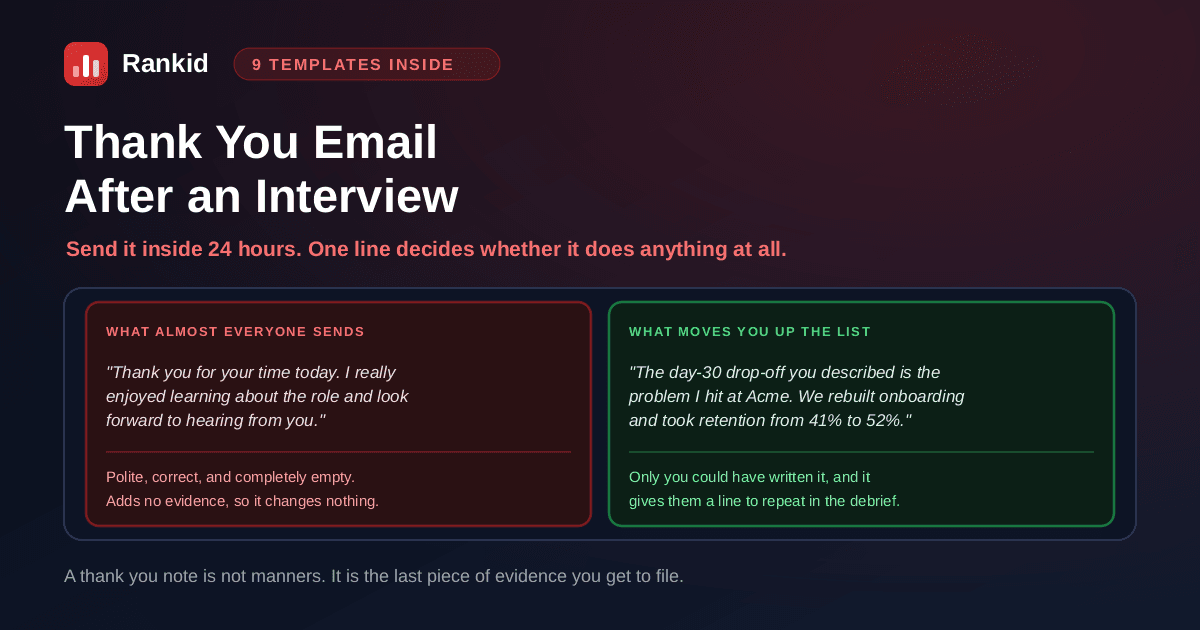
Almost every thank you email after an interview says the same four things: thank you for your time, I enjoyed learning about the role, I am very excited about the opportunity, I look forward to hearing from you. It is polite, it is correct, and it does absolutely nothing. The hiring manager reads it in two seconds, feels mildly warm towards you, and forgets it. Meanwhile the one genuinely useful thing you could have done with that email, which is to hand them a reason to argue for you in the debrief, goes unused. Here is what to send instead, when to send it, and nine templates you can adapt in about ten minutes.
Quick answer
Send it within 24 hours, ideally within six. Keep it under 150 words. Reply to the existing email thread rather than starting a new one. The only paragraph that matters is the one naming a specific thing they said plus evidence you have solved that exact problem, with a number if you have one. Add one line answering the doubt you saw land in the room. If you cannot name something specific from the conversation, your email is not ready yet.
Does a thank you email after an interview actually matter?
It matters, but not for the reason the advice usually gives. It is not about being polite, and it will not rescue an interview that went badly. What it does is far more mechanical: it is the last piece of evidence you can put into your file before the decision gets made, and it is the only part of the entire hiring process you control completely. Everything else was a conversation someone else steered.
Picture what happens after you leave. Four people who each saw you for 45 minutes sit down, usually the same afternoon or the next morning, and try to reconstruct what they thought. Memory is thin by then. Someone says they liked you but is not sure about the B2C background. Someone else says you were strong on execution. What wins in that room is not the best candidate in the abstract, it is the candidate somebody can describe concretely.
A thank you email that repeats what is already on your resume gives them nothing to say. One that connects a specific problem they raised to a specific thing you have done gives your advocate in that room a sentence to use. That is the whole mechanism, and it is why the generic version is not a weaker attempt at the same thing. It is a different thing that happens to have the same subject line.
What it cannot do
When to send a thank you email after an interview
Two to six hours after the interview ends is the target. Twenty-four hours is the outer edge of good. The logic is entirely about the debrief: if your note arrives before the hiring team compares notes, it can be quoted in that conversation, and if it arrives after, it is a courtesy filed in an inbox.
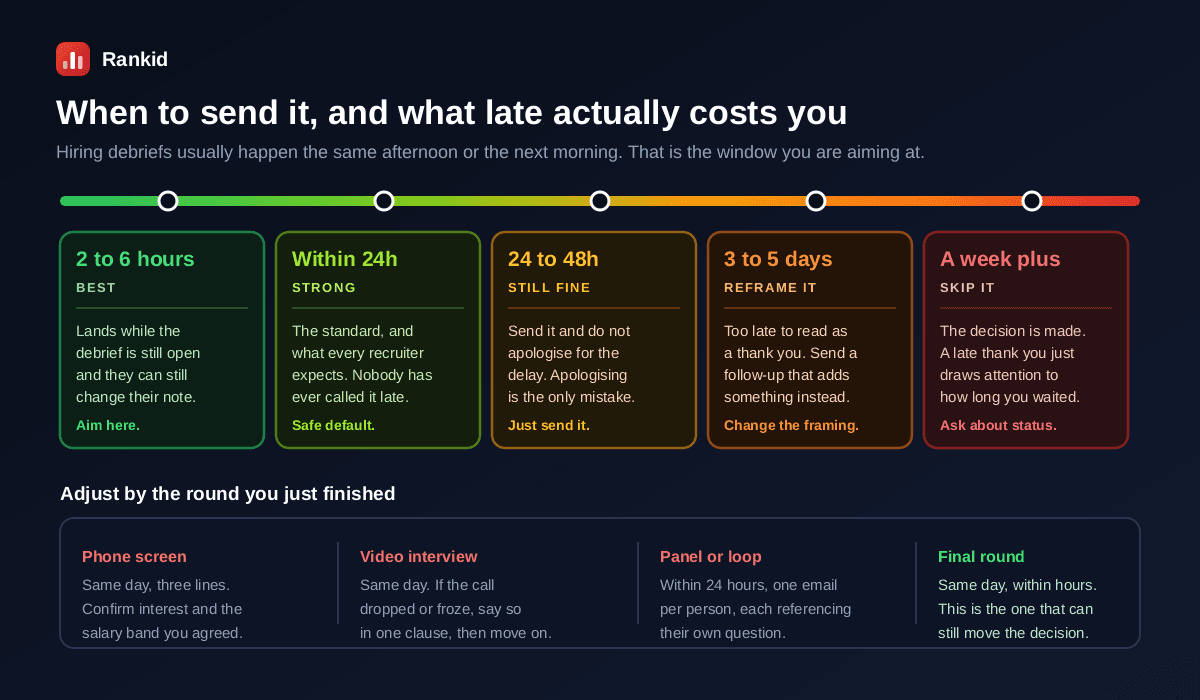
A few practical notes on timing. Do not send it from the car park six minutes after walking out, because it reads as a template you had ready before you met them, and you have not had time to reference anything they actually said. Do not send it at 11pm either, since the timestamp is visible and a note written at midnight suggests you agonised over it. Late afternoon on the day of a morning interview, or first thing the next morning after a late one, is the natural rhythm.
If you are two days late, send it anyway and say nothing about the delay. Nobody was counting, and an apology turns a non-event into a thing they now notice. If you are five days late, change what the email is: lead with something substantive, such as the piece of work you promised or a better answer to a question you fumbled, and let the thanks be a clause rather than the subject.
What to write: the five parts
The structure below fits comfortably in 150 words, which is the right length. A hiring manager working through a dozen of these on a Thursday afternoon skims anything longer, and length is not read as enthusiasm. Part three is the one that does the work. If you only have the energy for one paragraph, write that one.
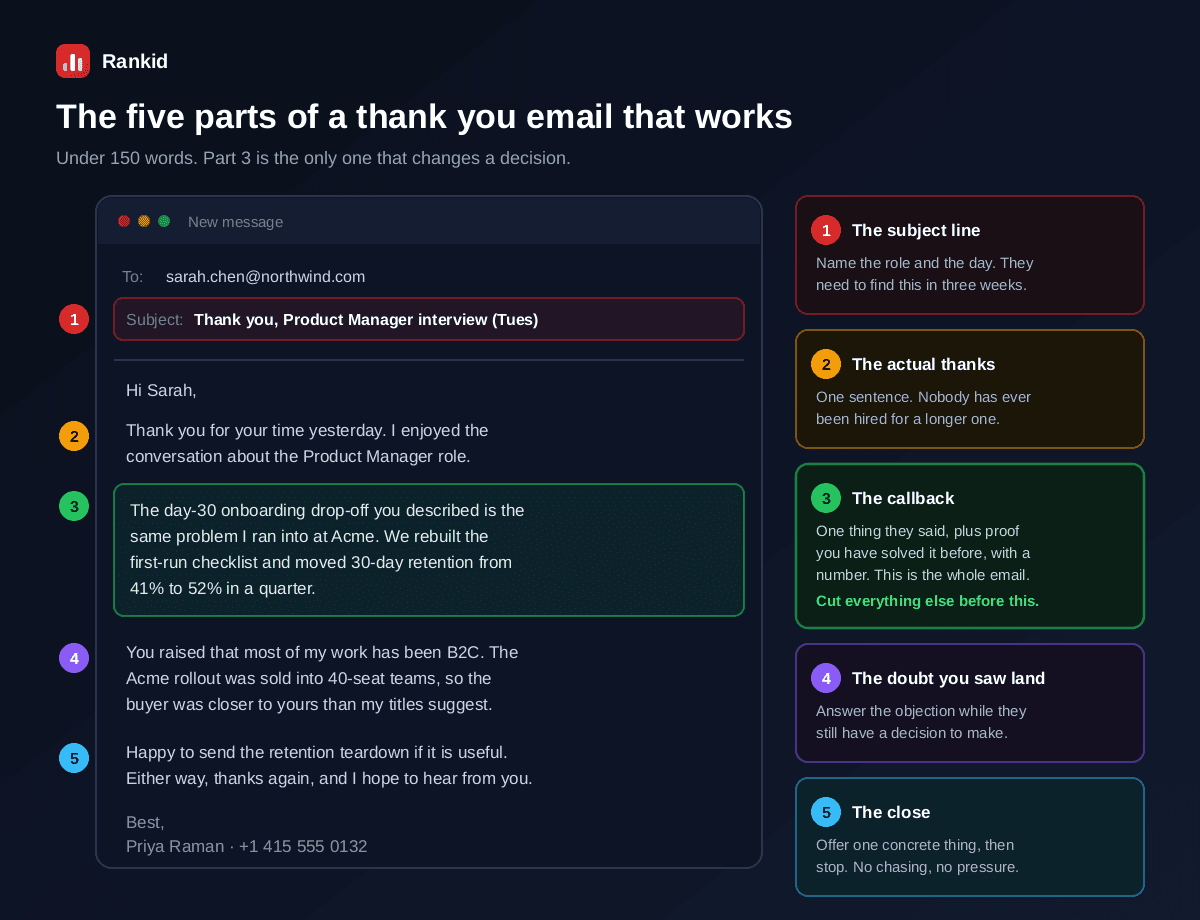
The callback is the entire email.Everything else is packaging. A callback has three components: something the interviewer specifically said, a thing you have done that addresses it, and preferably a number. "You mentioned the day-30 drop-off. I rebuilt onboarding at Acme and moved 30-day retention from 41% to 52%." That sentence is worth more than four paragraphs of enthusiasm, because it is the sentence your advocate repeats when someone asks what was good about you.
This is also the reason to take notes during the interview. You will not remember the phrasing of the problem they described by the time you sit down to write, and paraphrasing it vaguely defeats the point. Two lines scribbled while they were talking is all it takes.
The doubt paragraph is the underused one. In most interviews there is a moment where you can feel a concern land: a follow-up question that came back twice, a pause, a note being written. That concern will be raised in the debrief whether you address it or not. Answering it in writing, briefly and without defensiveness, is the closest thing to being in the room while they decide. It pairs naturally with asking about reservations directly, which is the strongest of the questions to ask in an interview.
The subject line for a thank you email after an interview
The best subject line is one you never write, because you replied to an existing thread instead. Hit reply on the scheduling email or the interview confirmation. Your note then lands inside a conversation that already contains your resume, the calendar invite and the recruiter, which is exactly where you want it, and it saves the hiring manager from cross-referencing anything.
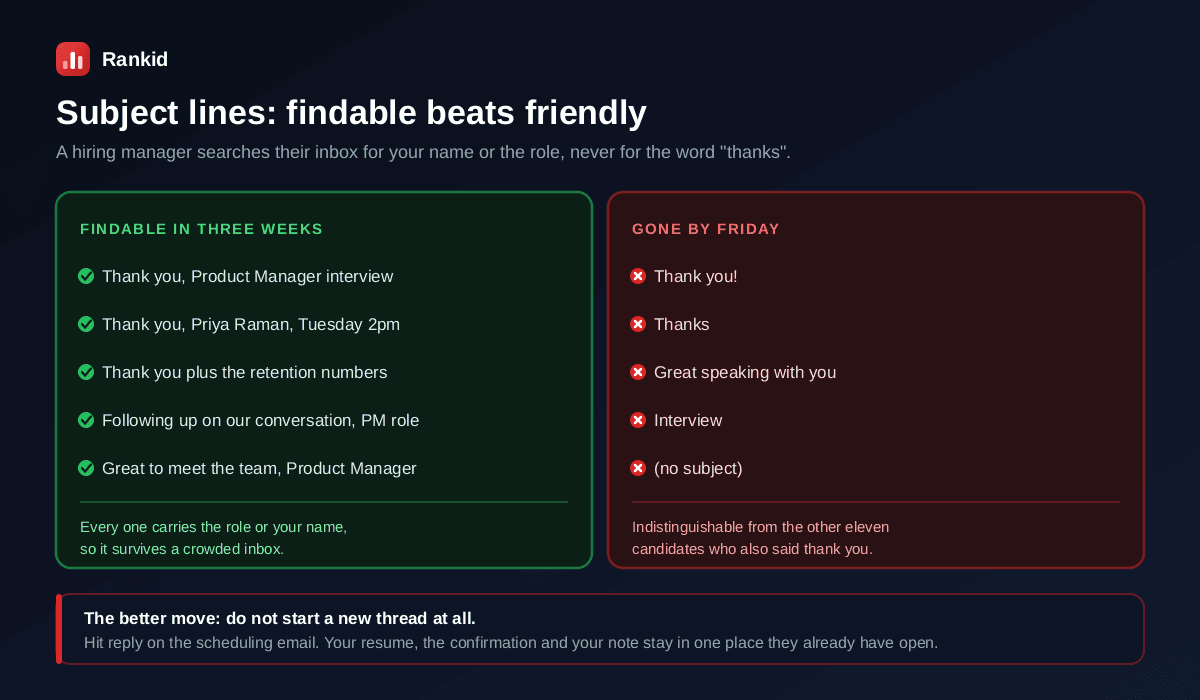
When you do need a new one, optimise for findability rather than warmth. In three weeks someone will search their inbox for your name or the job title, and nobody has ever searched for the word thanks. Include the role, your name, or both, and skip the exclamation mark.
9 thank you email templates
Adapt these rather than sending them as they stand. Every bracketed section is doing real work, and a template with the brackets filled in lazily is just the generic email again with extra steps.
Short and sweet, for any standard interview
Subject: Thank you, [Job Title] interview
Hi [Name], thank you for your time [today/yesterday]. The [specific problem they described] you mentioned is the same one I worked on at [Company], where [what you did] took [metric] from [X] to [Y]. Happy to walk through how we did it if it is useful. Either way, I enjoyed the conversation and hope to hear from you.
Best, [Your name]
After a recruiter phone screen
Subject: Thank you, [Job Title] screening call
Hi [Name], thanks for the call this morning. Confirming I am very interested and would like to move forward. Noting what we discussed: the range is [X to Y], the next step is [stage] with [person], and you expect to come back to me by [date]. My CV is attached again for the hiring manager. Anything else you need from me in the meantime, just say.
Best, [Your name]
After a video or virtual interview
Subject: Thank you, [Job Title] interview [day]
Hi [Name], thank you for making time this afternoon. What stayed with me was [specific thing they said about the team or the problem]. It matches the situation at [Company], where I [action taken] and [result]. If it would help, I can send the [document, teardown, portfolio piece] I mentioned. Thanks again for a genuinely interesting conversation.
Best, [Your name]
After a final round, where it counts most
Subject: Thank you, final interview, [Job Title]
Hi [Name], thank you for the time today, and for a process that has been unusually clear throughout. Having now spoken with [names], the part I keep coming back to is [the challenge they described]. If I join, my first 90 days would go to [one specific priority], because [reason drawn from what they told you]. You raised [the concern]. To address it directly: [one or two sentences, no defensiveness]. I would be glad to do this job and I hope to hear good news.
Best, [Your name]
Panel interview, one email per interviewer
Subject: Thank you, [Job Title] interview
Hi [Name], thank you for your part of yesterday's panel. Your question about [the specific area this person owned] was the one I have thought about most since. [Your considered answer or the relevant experience, two sentences.] I appreciated how directly you described [something they said about the team]. Thanks again.
Best, [Your name]
Write a genuinely different email for each person. Interviewers compare notes, and five identical emails with the names changed is worse than sending one.
After a technical, case or take-home interview
Subject: Thank you, [Job Title] technical interview
Hi [Name], thanks for the session today. I enjoyed the [problem type] problem more than is probably normal. One thing on reflection: on [the part you got stuck on], I would approach it with [better approach] rather than what I reached for under time pressure, because [reason]. Happy to share a cleaner version if useful. Thanks for a well-designed exercise.
Best, [Your name]
After an interview that went badly
Subject: Thank you, and a clearer answer on [topic]
Hi [Name], thank you for your time today. I want to give you a better answer on [the question you fumbled], because what I said did not reflect the actual work. [Two or three sentences with the real answer, specific and calm.] I understand if the decision is already made, but I would rather you judged the right version. Thanks for the conversation either way.
Best, [Your name]
Do not apologise more than once, do not explain that you were nervous, and do not send three paragraphs of reflection. One correction, delivered evenly, occasionally turns a rejection into a second look. Grovelling never does.
When you are late and need to reframe it
Subject: The [thing] I mentioned, [Job Title] role
Hi [Name], I said I would send [the article, framework, portfolio piece], so here it is. It relates to [the problem they described] we talked about on [day]. Thanks again for that conversation, I found it genuinely useful in thinking about the role.
Best, [Your name]
When you have decided to withdraw
Subject: Withdrawing from the [Job Title] process, with thanks
Hi [Name], thank you for the time you and the team gave me. After reflecting, I am withdrawing from the process, as I have accepted a role that is a closer fit for [brief, honest, non-critical reason]. I was impressed by [something specific and true], and I would be glad to stay in touch. Thank you for running a respectful process.
Best, [Your name]
Worth sending properly. Recruiters have long memories and industries are small, and this is the email that determines whether you hear from them about the next role.
The best follow-up is getting to the right interviews
A great thank you email only pays off if you are interviewing for jobs you genuinely match. Paste your resume and the job description into Rankid's free checker for a 0 to 100 match score, the requirements you have covered, and the ones you are missing.
Check your match freeWhat not to put in a thank you email
- Anything that restates your resume. They have it. Repeating your last three job titles uses the space where a callback should be.
- Enthusiasm without evidence."I am so excited about this opportunity" is the single most common sentence in these emails and it carries no information. Show interest by referencing something only an attentive person would have caught.
- Asking about the timeline. You should have asked in the room. Turning your thank you into a status enquiry changes what the email is and makes it feel transactional.
- Salary or negotiation. Wrong email entirely, except for the narrow case of confirming a range a recruiter already stated on a screening call.
- Anything that could read as pressure. Mentioning a competing offer, asking for a decision by a date, or hinting at other processes belongs in a separate conversation with the recruiter.
- Corrections to their business. Sending an unsolicited critique of their product or strategy is a well-known way to lose an offer you already had.
- Obvious AI phrasing. Hiring managers now spot it instantly and it undercuts the one thing the email is meant to demonstrate, which is that you were personally paying attention.
- Attachments nobody asked for. One relevant thing you explicitly offered in the room is fine. A portfolio, a 90-day plan and three references stapled on is not.
Panels, loops and multiple interviewers
Send one email per person and make each substantially different. Interviewers on a loop talk to each other, and several of them will have been assigned deliberately different areas to probe, so referencing the question that specific person asked is both easy and the entire point. Identical notes with swapped names are actively damaging, because they demonstrate the specificity was manufactured.
If you did not collect addresses, most corporate emails follow a visible pattern you can infer from the recruiter's address, or you can simply ask the recruiter to pass your note on. A third option, and often the cleanest, is to write one email to the hiring manager that names each interviewer and what they raised. That takes one message to demonstrate you were listening to all of them.
Who to prioritise if you only send one
The rule of three, and how many follow-ups is too many
The version of the rule of three worth using in interviews is simple: pick three things you want remembered about you, make them land in the conversation, and reinforce one of them in the follow-up. It is a discipline against the far more common failure, which is trying to convey eleven things and leaving no impression at all.
On volume of contact, the ceiling is lower than people think. One thank you email after each round. Then nothing until the date they gave you for a decision has passed, at which point one polite status check is entirely reasonable. If that goes unanswered, one final note a week later, and then stop. Our guide to how long it takes to hear back sets out what timelines are actually normal, which usually explains a silence that feels personal.
Do not follow up on the thank you email itself. Most interviewers never reply to these, many companies route all candidate correspondence through the recruiter, and a second email asking whether the first arrived converts a good impression into a nervous one.
Write yours in four steps
Take two lines of notes during the interview
Write down the exact phrasing of the problem they described and any question that came back twice. This is the raw material for parts three and four, and you will not remember it accurately an hour later.
Draft the callback paragraph first
Not the greeting, not the thanks. Write the sentence that connects their problem to your evidence, with a number in it. If you cannot write that sentence, the interview did not give you enough, and you should go back to the job description to find the connection you missed. That is the same work as tailoring your resume to the job description, just applied after the fact.
Add the doubt line, then cut to 150 words
One or two sentences answering the concern you saw land. Then delete every sentence that would read the same if you sent it to a different company. Whatever survives is the email.
Reply to the existing thread and send it the same day
Find the scheduling email and hit reply. Check the name spelling, check you have not left a bracket in, and send it while the debrief is still ahead of you rather than behind.
Key takeaways
- Send within 24 hours, ideally two to six, so it lands before the hiring debrief.
- Keep it under 150 words. A short thank you email usually beats a long one.
- The callback paragraph is the whole email: their specific problem, your evidence, a number.
- Answer the doubt you saw land in the room. Almost no candidate does this.
- Reply to the existing thread instead of writing a new subject line.
- One email per interviewer after a panel, each genuinely different.
- Never apologise for being late, and reframe anything past three days as a useful follow-up.
- Silence is normal. Do not follow up on the thank you email itself.
The reason most thank you emails after an interview fail is that they are written as a social obligation rather than as the last thing you get to say. Once you treat it as evidence, the format falls out on its own: short, specific, one problem, one proof, one doubt addressed, and a close that offers something without asking for anything. It will not save a bad interview and it is not supposed to. What it does, in the close calls that make up most hiring decisions, is give the person arguing for you something concrete to say. And to make sure you are having those conversations for roles you actually match, paste your resume and the job description into Rankid's free resume checker and see the gaps before the interview rather than after it.
Frequently asked questions
Should I send a thank you email after an interview?
Yes, and the reason is not manners. A thank you email is the last piece of evidence you can add to your file before the hiring decision gets made, and it is the only communication in the whole process that you control completely. It will rarely rescue a bad interview, and no serious employer rejects someone for skipping it, but in a close call between two candidates it is a free opportunity to restate why you fit and to answer the doubt you watched land in the room. Recruiters consistently report that a minority of candidates send one at all, and that most of those that arrive are interchangeable. Sending something specific therefore costs you ten minutes and puts you in a small group. The exception is a first-round mass screening where you spoke to an automated system rather than a person, in which case there is nobody to write to.
When should I send a thank you email after an interview?
Aim for two to six hours after the interview ends, and treat 24 hours as the outer edge of the ideal window. The reason is mechanical rather than etiquette: hiring teams usually debrief the same afternoon or the following morning, and a note that arrives before that conversation can still be quoted in it. If you interviewed in the morning, send it that afternoon. If you interviewed late in the day, send it that evening or first thing the next morning rather than at 11pm. Between 24 and 48 hours is still perfectly fine, and the only mistake at that point is apologising for the delay, which draws attention to something nobody noticed. After three days, stop calling it a thank you and send a short follow-up that adds something useful instead.
What should I say in a thank you email after an interview?
Five parts, in this order. A subject line that names the role and the day so it can be found later. One sentence of actual thanks, because nobody has ever been hired for writing two. Then the paragraph that carries the entire email: one specific thing the interviewer said, connected to evidence that you have solved that exact problem before, ideally with a number attached. Then one short paragraph answering the doubt you saw land during the conversation, which is the part almost nobody includes. Then a close that offers one concrete thing, such as a document or a reference, and stops. Keep the whole email under 150 words. If you cannot name something specific from the conversation, the email is not ready to send, because a note without a callback is indistinguishable from every other note in their inbox.
What is a good subject line for a thank you email after an interview?
The best option is not to write one at all: reply to the existing thread, usually the scheduling or confirmation email, so your note lands in a conversation that already contains your resume and the interview details. When you do need a new subject line, make it findable rather than friendly, because the hiring manager will search their inbox for your name or the job title three weeks later and never for the word thanks. Strong examples: "Thank you, Product Manager interview", "Thank you, Priya Raman, Tuesday 2pm", or "Following up on our conversation, PM role". Weak examples that vanish into an inbox: "Thank you!", "Thanks", "Great speaking with you", and worst of all no subject at all. Include the role, your name, or both.
How long should a thank you email after an interview be?
Under 150 words, and a short thank you email of 60 to 80 words often outperforms a long one. Length is not a measure of enthusiasm and a hiring manager reading twelve of these on a Thursday afternoon will skim anything longer. The structure that fits comfortably in that budget is one line of thanks, three or four lines of specific callback with evidence, one optional line answering a doubt, and a one-line close. Cut anything that restates your resume, anything that describes how excited you are without evidence, and any sentence that would read identically if you sent it to a different company. If you are torn between two paragraphs, keep the one containing a number.
Do employers respond to thank you emails after an interview?
Often not, and silence tells you nothing about your chances. Interviewers receive these notes in the middle of a hiring loop, many companies discourage individual interviewers from corresponding with candidates outside the recruiter, and plenty of managers read a thank you email, register it positively, and simply never reply. Recruiters reply more often than hiring managers do, usually with a short acknowledgement and a timeline. Do not read a non-reply as rejection, do not send a second email asking whether the first arrived, and do not follow up on the thank you itself. If the date they gave you for a decision passes with no word, that is the moment for one polite status check, which is a different email with a different purpose.
Should I send a separate thank you email to each interviewer after a panel?
Yes, one per person, and each one must be genuinely different. Interviewers on the same loop forward notes to each other or compare them in the debrief, and five identical emails with the names swapped is worse than sending nothing, because it proves the specificity was fake. Reference the question that particular person asked you, since in a well-run loop each interviewer was assigned a different area. If you did not catch everyone's email address, send yours to the recruiter and ask them to pass it on, or send one note to the hiring manager and mention the others by name and by what each of them raised. Between a generic email to five people and a specific email to one, the specific email to one wins.
Is it too late to send a thank you email three days after an interview?
It is late for a thank you, but not too late to send something useful. At three to five days, a note that only says thank you draws attention to the delay and adds nothing, so change the framing. Send a short follow-up that leads with substance instead: the article or portfolio piece related to something they raised, a clarified answer to a question you fumbled, or a brief note on how you would approach the problem they described. Thanks then becomes one clause near the end rather than the subject of the email. Past a week, skip the thank you entirely and send a straightforward status enquiry if the timeline they gave you has passed.
Should I send a thank you email after a phone interview or screening call?
Yes, and keep it to three or four lines, because a 20 minute recruiter screen does not warrant a full note. The job of this one is narrower than after a real interview: confirm you are still interested, restate the single strongest reason you fit, and lock in anything you agreed verbally, particularly the salary range and the next step. That last part is genuinely useful later, since a written record of "you mentioned the band is 95 to 115" is worth having when an offer arrives. Send it the same day. Recruiters move fast and often submit a shortlist within hours of finishing their calls, so a note arriving the next afternoon can miss the moment entirely.
Is an email or a handwritten thank you note better after an interview?
Email, in almost every case. A handwritten card takes two to four days to arrive, which means it lands after the decision has been made, and hybrid work makes it likely nobody is in the office to receive it. Email arrives inside the window that matters and can be forwarded into the hiring thread, which is what you actually want. The narrow exception is a field where the note itself is a work sample or the culture expects it, such as some traditional law, luxury retail, hospitality or executive search settings. Even then, send the email first and let the card arrive afterwards as a supplement. Never send only the card.