How to Shortlist Candidates: From 200 Resumes to a Top 10 in Minutes (2026)
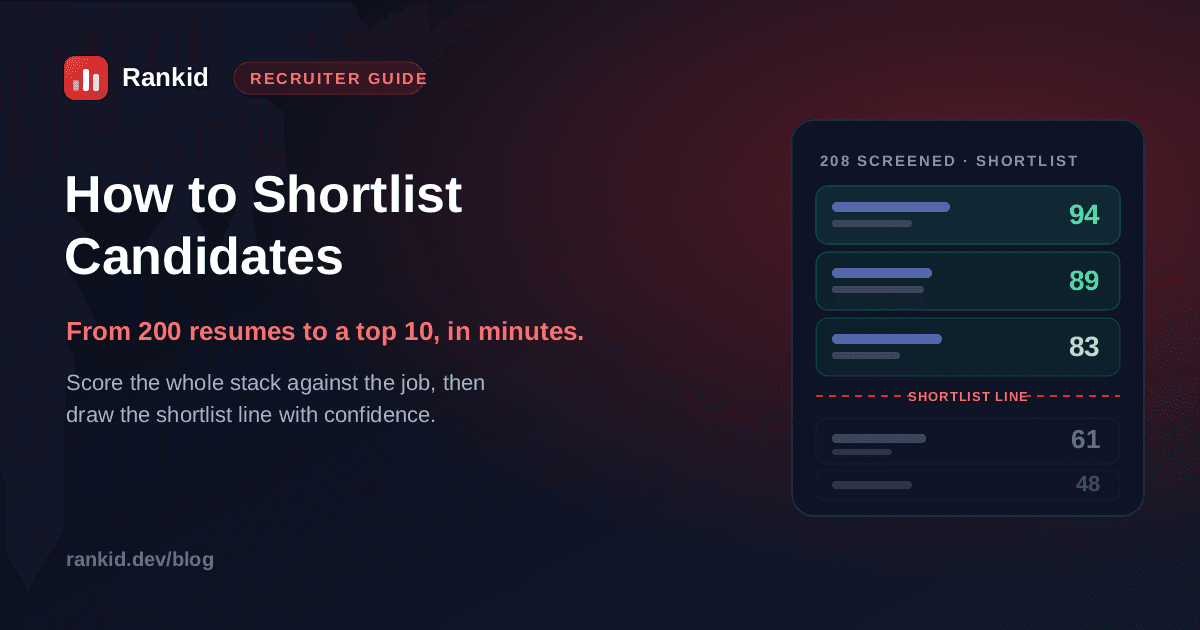
Two hundred applicants. One role. A calendar with room for maybe ten interviews. Somewhere in that stack are the people you should be talking to next week, and the honest problem is that you cannot read your way to them: by resume 150 the standard you applied to resume 3 has quietly drifted, and the strong candidate near the bottom gets the same tired glance as everyone else. Shortlisting candidates is the skill of cutting that pile down to the few worth interviewing without missing the good ones. Here is the exact process recruiters use to do it in minutes, not days.
Quick answer
What is candidate shortlisting?
Candidate shortlisting is the process of narrowing a full applicant pool down to a small group of the strongest matches worth interviewing. It sits between two other steps: it comes after screening filters out the clear non-fits, and before the interviews that decide the hire. The output is not a folder of documents, it is a decision: a ranked, defensible list of the people you are going to spend real time on.
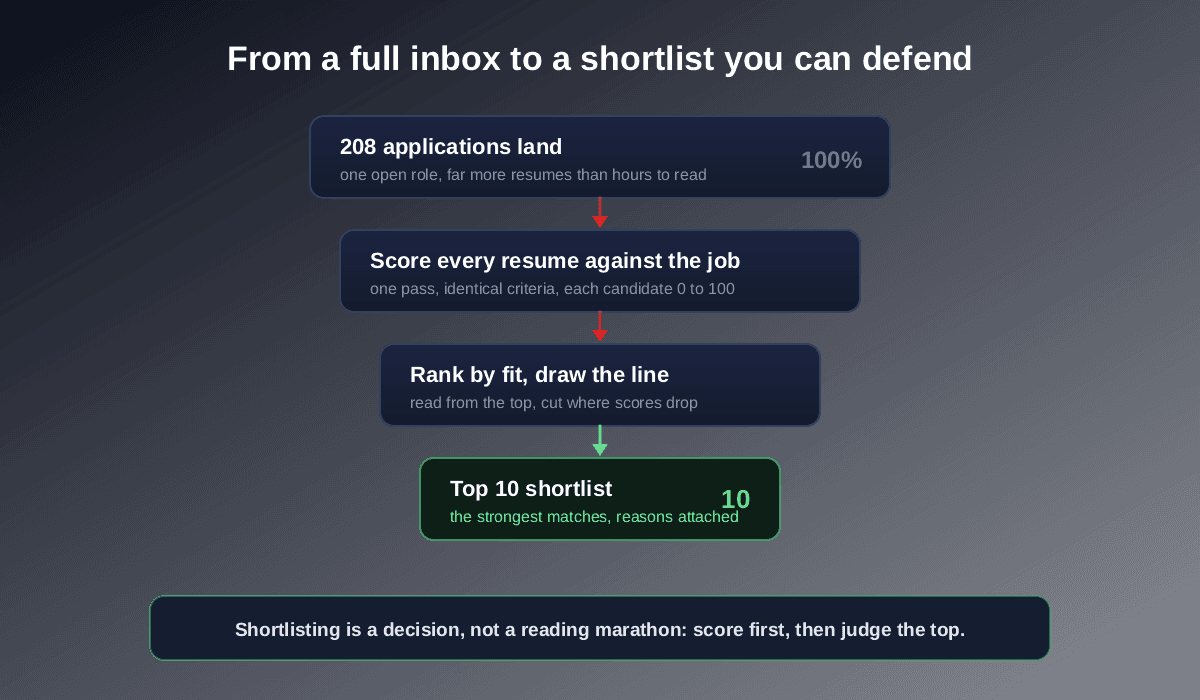
The distinction that matters is shortlisting versus reading. Reading is linear and it does not scale, twice the applicants means twice the hours. Shortlisting, done well, is a decision you make on top of a consistent evaluation of the whole pool, so the time you spend stops scaling with the size of the pile. That is why the first move in modern shortlisting is to score every resume against the job description on the same criteria, then decide from the ranking rather than from the order the resumes arrived in.
Shortlisting is a decision, not a reading marathon
How to shortlist candidates, step by step
The fastest and most consistent way is to let a tool do the first-pass evaluation the way an applicant tracking system reads resumes, then draw the shortlist line yourself. Here is the full process.
Define your must-haves before you look at anyone
Read the role and separate the requirements into must-haves and nice-to-haves. The must-haves are your shortlisting criteria; the nice-to-haves are tie-breakers, not filters. Doing this first stops the classic mistake of sinking a strong candidate over an optional tool, and it means every applicant is judged against the same bar instead of whatever caught your eye that minute.
Score every resume against the job in one pass
Upload the whole batch of resumes together, a folder of PDFs and .docx files in one go, and paste the job description once. A scoring tool parses each candidate and rates them 0 to 100 by fit against the skills, keywords, seniority and relevant experience the posting names. This is the part that used to eat your week, and it now takes minutes. With Rankid you can score up to 200 resumes per batch. It mirrors how AI resume screening already reads nearly every application, only now it is in your control.
Read the ranking and draw the shortlist line
You get every candidate sorted highest to lowest by fit, each with the skills and keywords they match and miss. Read from the top down and watch for where the scores clearly drop off, that gap is usually a cleaner cutoff than a round number. Everyone above the line is your shortlist. This is the moment reading turns into a decision.
Give the borderline candidates a human look
Scores cluster into a strong top tier, a clear bottom, and a middle band worth judgment. This is where the detail earns its keep: skim the middle for transferable experience or skills phrased differently from the posting, and pull anyone who deserves a closer read up onto the shortlist. The tool ranks; you decide.
Turn a pile of resumes into a shortlist, free
Upload your resumes and paste the job description into Rankid. You'll get every candidate scored 0 to 100 by fit, with the skills and keywords each one matches and misses, so you can draw a defensible shortlist in minutes. Your first 5 resumes are free, no signup needed.
Shortlist candidates freeWhat criteria should you shortlist candidates on?
A good shortlist is only as good as the criteria behind it. Shortlist against the requirements the role genuinely depends on, and apply them identically to everyone. In practice that comes down to four things, the same four a strong recruiter scans for, just measured consistently across the whole pool at once:
- Hard skills and tools.The specific technologies, methods, and certifications named as must-haves, matched against each resume as a coverage ratio rather than a vague impression of whether someone “seems technical enough.”
- Keywords and phrasing. Whether the candidate describes their work in the language the posting uses. Someone who has the skill but named it differently can slip down the ranking, which is exactly why a good tool surfaces the covered and missing terms instead of hiding them. It is the hiring-side view of our resume keywords guide.
- Job title and seniority.Whether the candidate's level lines up with what the role expects, so a senior shortlist is not topped by a junior profile with lucky keyword overlap.
- Relevant experience. Not just total years, but years in a field related to the role, so unrelated tenure does not inflate an otherwise weak match.
Separate must-haves from nice-to-haves first
How many candidates should you shortlist?
The common rule of thumb is 5 to 10 candidates per role for a first interview round, but the number matters less than where you draw the line. Instead of forcing a fixed count, look at the ranked scores and find the natural break: often there is a tight top tier, then a visible drop, then the long tail. Cutting at that drop gives you a shortlist grounded in the data rather than an arbitrary “top 8 because 8 felt right.”
If your top tier is unusually deep, it is fine to carry more names forward and add a short screening call before committing interview slots. If it is thin, that is useful signal too: it may mean the posting is too narrow, or that it is worth widening the search rather than interviewing weak matches to fill a quota.
Manual shortlisting vs scored shortlisting
The problem with manual shortlisting is not that recruiters are slow. It is that manual evaluation scales linearly and human attention does not. The applicant you would have loved gets missed not because they were weak, but because they were near the bottom of the stack when your focus ran out, and because the bar you set at resume 3 is not the bar you are still applying at resume 180.
Scored shortlisting fixes both halves of that. It applies identical criteria to candidate 1 and candidate 208, so consistency is built in, and it does the heavy parsing in seconds, so your attention goes to comparing the strongest matches instead of grinding through the whole pile. If you want the reasoning behind each score rather than just the ranking, that is the job of bulk resume analysis, which shows the matched and missing requirements for every candidate. The result is a first pass that is both faster and fairer than a human doing it by hand.
Shortlisting mistakes that cost you good candidates
Shortlisting is high-leverage, which means a careless setup quietly buries people you wanted. Avoid these:
- Auto-rejecting on raw score. Never silently discard the bottom of the list. Score to prioritize who you read, then let a human decide. Strong people with transferable experience often land in the middle band.
- Trusting the number without the breakdown. A score is a summary, not the whole story. Read the matched and missing skills before you cut anyone close to the line.
- A thin job description. If your criteria are two vague lines, the ranking has little to measure against. Give it the full set of real requirements so the shortlist means something.
- Weighting nice-to-haves like must-haves. Penalizing candidates for missing an optional tool buries qualified people. Keep the shortlist focused on the requirements that actually decide success in the role.
- Shortlisting on arrival order or gut alone. The first ten resumes are not the best ten. Rank the whole pool on the same criteria before you decide who is worth an interview.
Keep a human in the loop
How shortlisting works with your ATS
Shortlisting and your applicant tracking system solve different problems and work well together. Your ATS stores candidates and moves them through the pipeline, and many filter on keywords. What most do not give you is a clean, ranked evaluation of every applicant against one specific posting. A scoring tool focuses on exactly that: it parses each resume the way an ATS does, compares it to the job description, and hands you the whole batch ranked so you can draw the line.
You use both. The ATS is your system of record; the scoring tells you who in that record to shortlist for this role and why. If you are curious how the parsing side shapes results, the candidate-facing version of that story is in how to make an ATS-friendly resume.
Key takeaways
- Shortlisting is a decision on top of a consistent evaluation, not a race to read every resume.
- Define must-haves vs nice-to-haves first, then score every resume against the job on the same criteria.
- Draw the shortlist line where the ranked scores naturally drop off, not at an arbitrary number.
- 5 to 10 candidates per role is a fair starting point, but the natural score gap beats a fixed count.
- Use scoring to prioritize who you read, never to auto-reject, and keep a human on the final call.
- Rankid scores up to 200 resumes per batch, and your first 5 are free with no signup.
Bottom line: when the applicants outnumber the hours, do not read faster, shortlist smarter. Score the whole pool against the job description, draw the line where the fit drops off, and spend your attention on the people worth interviewing. Run your next batch through Rankid's free candidate shortlisting tool and turn a wall of resumes into a ranked, defensible shortlist in minutes.
Frequently asked questions
What is candidate shortlisting?
Candidate shortlisting is the process of narrowing a full pool of applicants down to a small group of the strongest matches worth interviewing. Instead of reading every resume in depth, you evaluate each applicant against the job's core requirements, rank them by how well they fit, and draw a line: the people above it become your shortlist. In modern hiring this first pass is usually done by scoring every resume against the job description on the same criteria, so the shortlist is based on measured fit rather than the order the resumes happened to arrive in.
How do you shortlist candidates from a large number of resumes?
You stop reading resume by resume and score the whole batch at once. Upload every resume for the role, paste in the job description as your criteria, and let a tool parse and score each candidate 0 to 100 by fit against the required skills, keywords, seniority and relevant experience. Then you read the ranked list from the top down, draw a shortlist line where the scores clearly drop off, and give the borderline candidates a closer human look. That turns a pile of 200 resumes into a top 10 shortlist in minutes instead of days. Rankid can score up to 200 resumes in a single batch.
What criteria should you use to shortlist candidates?
Shortlist against the requirements the role actually depends on, not everything in the posting. The four criteria that matter most are: the hard skills and tools named as must-haves, the keywords and phrasing the job uses, job title and seniority alignment, and the amount of relevant (not just total) experience. Separate must-haves from nice-to-haves before you start, so an optional skill never sinks an otherwise strong candidate. Applying the same criteria to every applicant is what makes a shortlist both faster and fairer than reading on gut feel.
How many candidates should you shortlist?
A common rule of thumb is to shortlist 5 to 10 candidates per open role for a first round of interviews, though it depends on how many strong matches you have and how many interview slots you can fill. Rather than forcing a fixed number, score every resume against the job and look at where the scores naturally drop off; that gap is usually a cleaner place to draw the line than an arbitrary cutoff. If your top tier is unusually deep, it is fine to shortlist more and add a screening call before committing interview time.
How long should shortlisting candidates take?
Done by hand, shortlisting scales with the size of the pile: at roughly two minutes per resume, 200 applicants is close to seven hours of reading before you have even compared anyone. Done by scoring the batch against the job description in one pass, the parsing takes minutes and your time goes into reviewing a ranked shortlist rather than the whole stack, usually well under an hour to reach a confident top 10. The larger the applicant pool, the bigger the difference.
Is it fair to shortlist candidates using software?
It is fair when you use it to prioritize who you read first, not to auto-reject anyone. Scoring every resume against the same job description on the same criteria is more consistent than a tired recruiter evaluating applicant 180 differently from applicant 3, and it makes your shortlist easier to explain because the reasons are attached to each score. Good practice is tool-scores, human-decides: let software rank and surface the matched and missing requirements, then have a person make the final shortlist call and review the borderline candidates.
Is there a free tool to shortlist candidates from resumes?
Yes. Rankid lets you upload a batch of resumes, paste the job description, and instantly get every candidate scored 0 to 100 by fit, with the skills and keywords each one matches and misses, so you can draw a shortlist in minutes. Your first 5 resumes are free with no signup required, and you can score up to 200 resumes per batch once you sign up.