How to Answer Interview Questions: 12 Answers, One Method
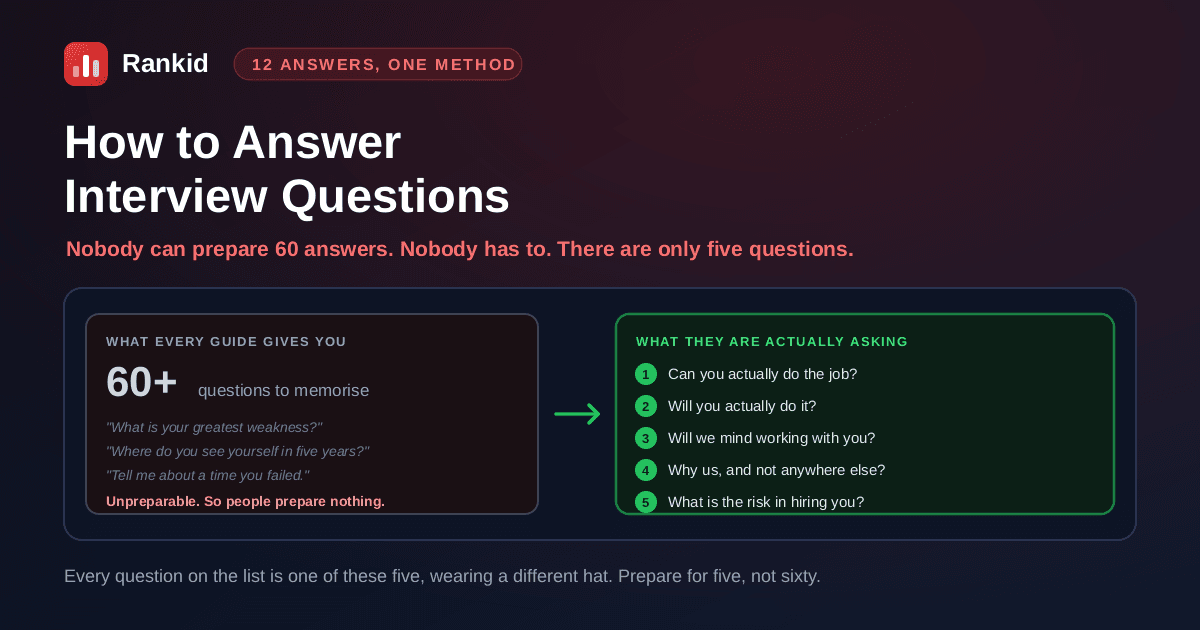
Search for interview questions and you will be handed a list of sixty, or a hundred, with a model answer under each. Nobody has ever prepared from one of those lists, because sixty answers is not a preparable amount of material, so most people read the first eight, feel vaguely reassured, and improvise on the day. The lists are also misleading in a more useful way: they are not sixty questions. They are five questions, asked in sixty different sets of words. Learn to hear which of the five is being asked, bank six stories to answer them with, and the list stops mattering.
Quick answer
Every interview question is asking one of five things: can you do the job, will you actually do it, will we mind working with you, why us specifically, and what is the risk in hiring you. Prepare six stories, not sixty answers, then reframe whichever story fits the intent in front of you. Keep answers to about a minute. Every answer needs a point, a proof with a number, and a line tying it back to their job.
There are only five questions
An interviewer has a small number of things they need to find out and a limited amount of time. They are not working through a list of clever questions; they are trying to close five gaps in what they know about you. Recognising which gap a question is aimed at is more useful than any individual model answer, because it tells you what has to be in your response for it to count.
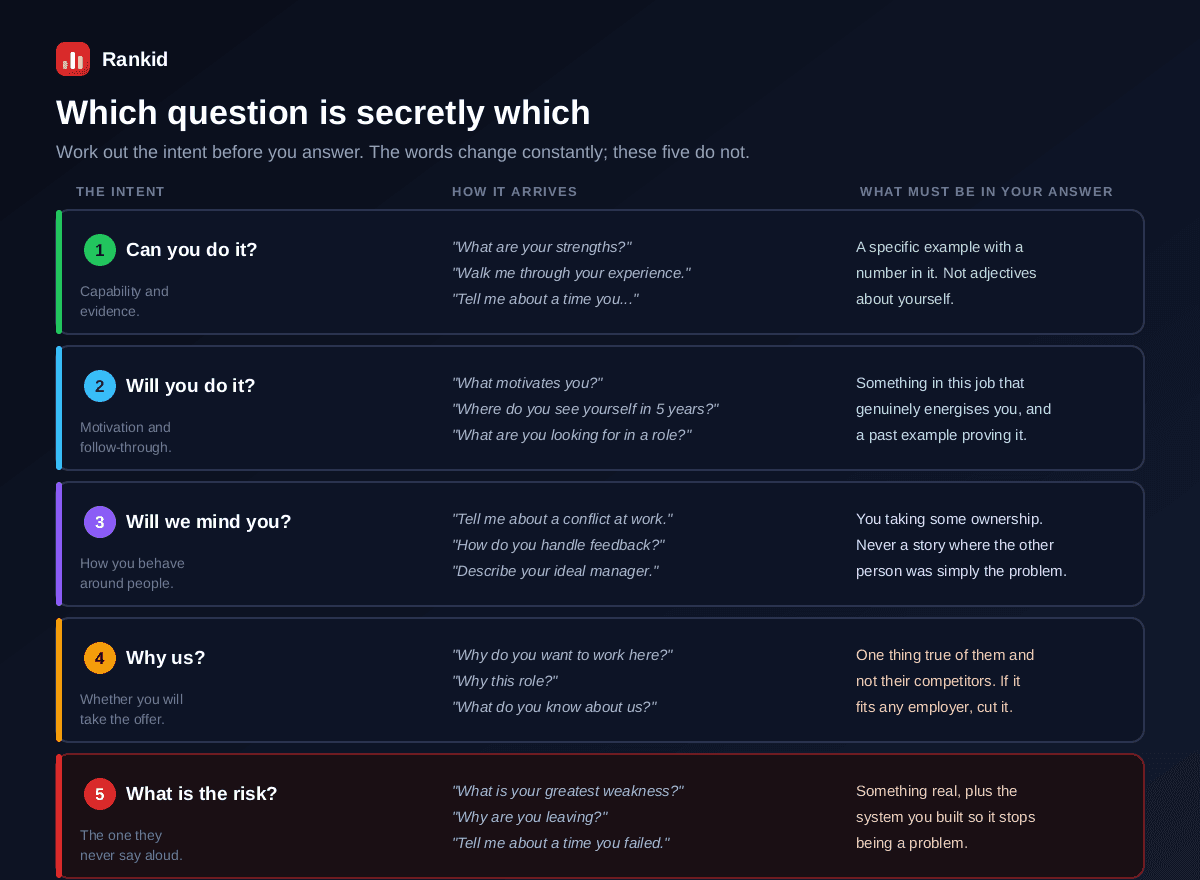
The practical payoff comes when you get a question you did not prepare. "What would your last manager say frustrated them about you?" is not on most lists, but it is transparently intent five, the risk question, so it needs the same shape as the weakness answer: something real, plus the system you built. "What kind of team do you do your best work in?" is intent three. You are never actually improvising once you can classify.
Prepare six stories, not sixty answers
Memorised answers fail in a specific way: they sound memorised, and they break the moment the interviewer words the question slightly differently, because you are retrieving a script rather than thinking. Stories do not have this problem. A story is a thing that happened, so you can reshape which parts you emphasise depending on what was asked.
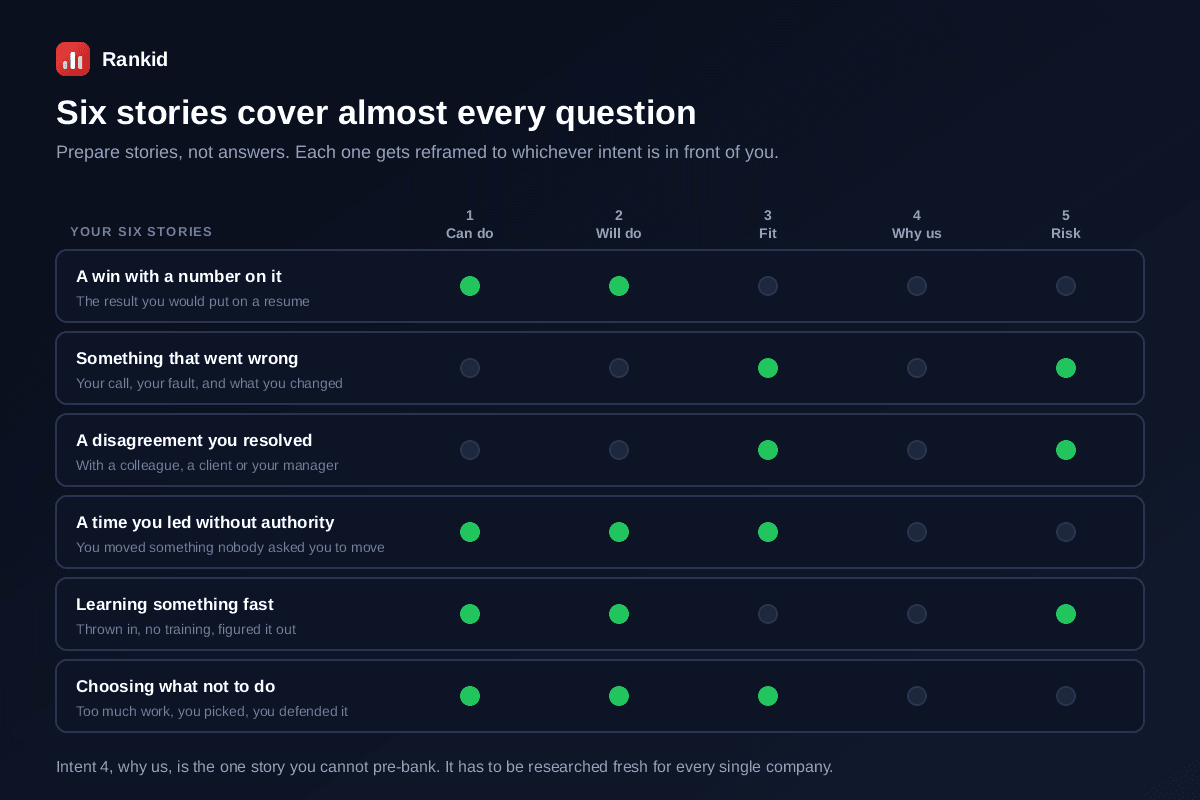
Write each story in five or six lines, not as prose you would read aloud. What the situation was, what you specifically did, what happened, and the number if there is one. That is enough to reconstruct it fluently under pressure, and building the list is the same work as quantifying achievements on a resume, so it pays twice.
The one story you cannot bank
"Tell me about yourself"
The most common opener and the most commonly wasted. It is not an invitation to walk through your CV chronologically, and it is not a personal question. It is a request for a headline.
Three parts, about a minute: where you are now, the one achievement that proves you can do this job, and why you are in this room.
"I am a product manager at Acme, where I own onboarding and activation. The piece I am proudest of is rebuilding the first-run flow, which took 30-day retention from 41% to 52% in a quarter. I am here because your posting described an activation problem, and that is the work I want to keep doing."
That is roughly 55 seconds spoken. This is the one answer worth learning close to word for word, because it sets the frame for everything after it, and because the third part quietly tells the interviewer which parts of your background to ask about next.
"Why should we hire you?"
This feels like an invitation to boast, which is why people either shrink or produce a list of adjectives. It is actually a request for a closing argument, and it has a reliable three-sentence structure: the requirement they care about most, your evidence, and the risk you remove.
"You need someone who can own activation without much support, because the team is small. I have done exactly that at Acme, where I rebuilt onboarding on my own and moved retention 11 points. What that means for you is that there is no ramp-up on the problem itself, so I would be contributing in weeks rather than months."
Forty-five seconds. The third sentence is the one almost everyone omits, and it is the one that matters, because it translates your experience into their benefit. Do not say you are passionate, hard-working and a fast learner. Every candidate said that, and none of it is evidence.
"Why do you want to work here?"
There is one test for this answer: if you could paste in a different company name and the answer would still work, you have not answered it. Market leader, great culture, growth opportunity and exciting mission all fail that test.
What passes: a product decision they made, a recent launch or change, a technical approach, something specific in the job description, or a person you spoke to and what they told you.
"Two things. You are the only team I have found that treats onboarding as a product with an owner rather than as a marketing funnel, and that is a structural choice, not a slogan. And the posting mentions the activation drop at day 30, which is the exact problem I spent last year on. I would rather work on a problem I already care about than learn to care about a new one."
"What motivates you?"
The interviewer is checking whether the work will hold you once the novelty has gone, so point at the day-to-day rather than at rewards. Money and promotion are honest answers to a different question.
"Problems where I can watch the number move. At Acme I asked to take the activation metric specifically because it was measurable, and checking it on a Monday morning was genuinely the best part of my week. Not every job has a number that responds to what you did that fortnight. This one does, which is unusual."
One motivation with proof beats three without. Then stop talking.
"What are your greatest strengths?"
Pick one strength, not three, and choose the one the job description asks for most loudly. A single strength with evidence is memorable; three with none is noise.
"Turning a vague problem into something a team can actually ship. When I joined Acme, retention was just described as bad. I broke it into four drop-off points, showed that one of them accounted for most of the loss, and got the team to fix only that. Narrowing it was most of the work, and it is the part I am reliably good at."
Notice the structure is identical to the answer anatomy below: a claim, an example with specifics, and an implicit relevance to the job. That repeatability is the point of the method.
"What is your greatest weakness?"
Two ways to fail. The humblebrag, which everyone recognises: I am a perfectionist, I care too much, I work too hard. And the disqualifier: I miss deadlines, I struggle with feedback, I find it hard to work with people.
What the question is really testing is whether you can see yourself accurately and do something about it. So name something real and small, then describe the mechanism you built.
"I used to move on to the next thing before documenting the last one, which meant my team came back to me with questions I had already answered in my head. I now treat the handover as part of finishing rather than something after it, and I block the time in the same session. It is deliberate rather than natural, but the gap has effectively closed."
Never say you do not have any weaknesses. It answers the risk question in the worst possible way.
"Where do you see yourself in five years?"
Nobody knows, and the interviewer knows nobody knows. They are asking two practical things: does your direction make this job a sensible step, and are you going to leave in ten months.
Answer in terms of the work and the depth of skill, never a job title or a timeline.
"In five years I would want to be the person a team turns to on activation problems, which probably means having owned it at a bigger scale than I have, and having coached one or two people through it. That is actually why this role interests me: it is a step up in scale on exactly that problem rather than a sideways move."
Avoid naming your interviewer's job, avoid running my own business, and avoid I honestly have no idea, even though it is the most truthful answer available.
"Why are you leaving your current job?"
This is a risk question wearing a neutral face. Say nothing critical about your current employer, your manager or your colleagues, however justified, because the interviewer cannot verify the story and will simply note that you criticise employers in interviews.
Frame it as moving towards something rather than away from something.
"I have learned a lot at Acme and I am on good terms with everyone there. What I want next is to own activation end to end rather than one part of it, and that scope does not exist on my current team. This role does have it, which is the whole reason I applied."
If you were made redundant, say so plainly and briefly, since it is common and carries no stigma. Our full guide to answering the reason-for-leaving question covers the harder cases, including being dismissed and leaving after a short stint.
"Tell me about a time you..."
Any question starting tell me about a time or describe a situation where is a behavioural question, and it wants a structured story. Use STAR: Situation, Task, Action, Result.
- Situation and Task: about ten seconds. Context is not the point and this is where people spend half their answer.
- Action: the bulk of it. What you did, decision by decision. This is the only part the interviewer is actually assessing.
- Result: always, with a number if one exists. An answer with no outcome sounds like an anecdote rather than evidence.
- Say "I", not "we". The single most common failure in behavioural answers. Drifting into we leaves the interviewer unable to work out what you personally contributed, and they will not usually ask.
The most frequent behavioural prompts are a conflict, a failure, a deadline under pressure, leading without authority, and persuading someone senior. Your six stories cover all of them, which is the entire reason for building the bank.
Do not force STAR everywhere
How long to talk, and the shape of an answer
Rambling loses more interviews than any wrong answer, and it is the single easiest thing to fix. Time yourself once, out loud, with a stopwatch, and the problem largely solves itself.
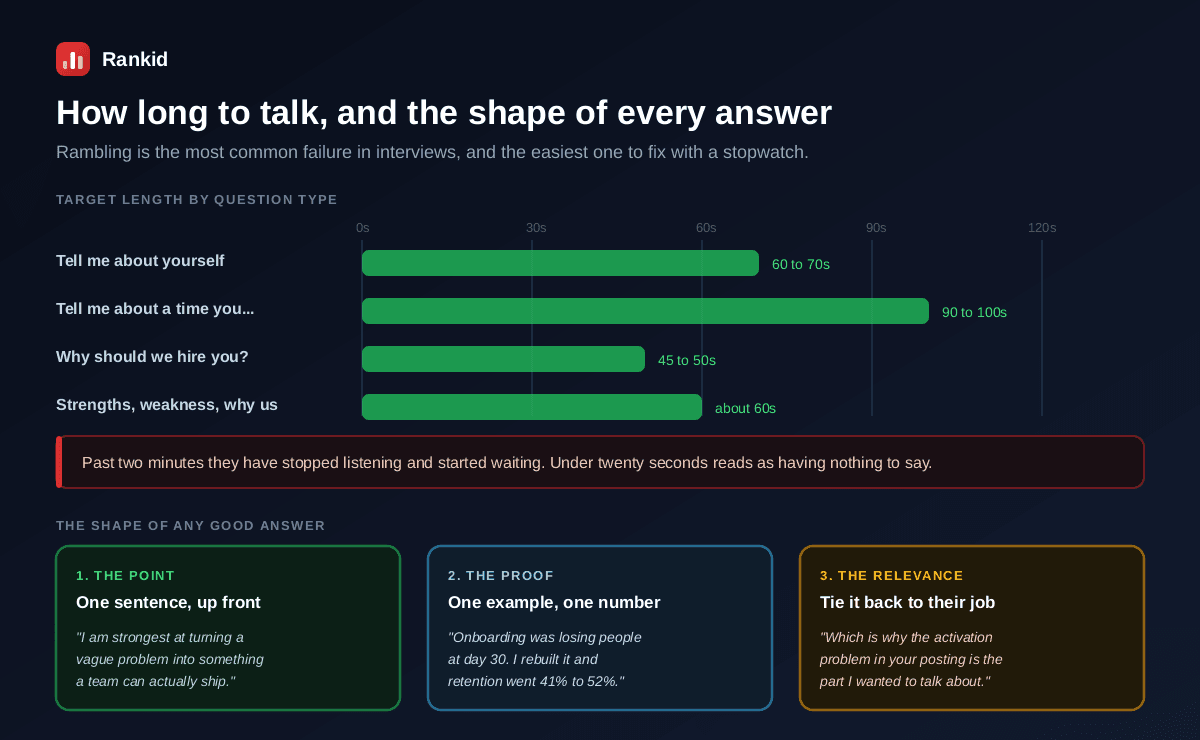
The three-part shape works for every non-behavioural question in this article. Point, proof, relevance. If you can only remember one thing under pressure, remember that the answer starts with a claim and ends with their job, and the specifics go in between.
Know which requirements to build your answers around
Your best answers are aimed at the requirements that actually matter for the role. Paste your resume and the job description into Rankid's free checker to see which requirements you cover, and which gaps you should be ready to address.
Check your match freeThe two closers: salary, and questions for them
"What are your salary expectations?"Turn it around before answering, because whoever names a number first sets the ceiling: "Happy to talk about it. What range have you budgeted for the role?" If pushed to go first, give a researched range with your target at the bottom of it, since the bottom is the only part anyone remembers. The full mechanics are in our guide to negotiating a salary offer.
"Do you have any questions for us?" Never say no, you covered everything, which reads as indifference even when it is politeness. Have two ready, and make one of them about how success is measured. Our list of questions to ask in an interview sorts them by who is actually in the room, since a recruiter and a hiring manager can answer completely different things.
The mistakes that cost most
- Talking past two minutes. The most common and most damaging. They stopped listening a while ago.
- Saying "we" throughout a behavioural answer. Your contribution becomes invisible.
- Adjectives instead of evidence. Hard-working, passionate and detail-oriented are claims every candidate makes and none can prove.
- An answer that fits any employer. Fatal specifically on why do you want to work here.
- Criticising a current or former employer. Unverifiable for them, and it tells them something about you rather than about your old boss.
- Reciting a memorised script. It is audible, and it collapses when the question is worded unexpectedly.
- No number anywhere in the whole interview. Quantified claims are remembered; general ones are not.
- Answering the words rather than the intent. The reason the five-intent map is worth more than any list of model answers.
Prepare properly in one hour
Twenty minutes: write the six stories
A win with a number, something that went wrong, a disagreement, leading without authority, learning something fast, and choosing what not to do. Five or six lines each, bullet form, not prose.
Fifteen minutes: research one specific thing about them
A product decision, a launch, a technical choice, or a line in the posting. This is the only answer you cannot prepare in advance, so it gets dedicated time.
Fifteen minutes: say your opener out loud, timed
Tell me about yourself, three parts, until it lands near a minute without sounding recited. Out loud, not in your head. It will be bad the first two times.
Ten minutes: write two questions for them, and one number
Two questions to ask at the end, plus the salary range you will confirm if it comes up. Then stop preparing, because past this point you are just making yourself nervous.
Key takeaways
- Every question is one of five: can you do it, will you do it, will we mind you, why us, what is the risk.
- Prepare six stories rather than sixty answers. Stories survive rewording; scripts do not.
- Every answer needs a point, a proof with a number, and a line tying it back to their job.
- Aim for about a minute. Past two minutes they have stopped listening.
- Say "I" in behavioural answers. "We" makes your contribution invisible.
- If your "why do you want to work here" answer fits any employer, it is not an answer.
- For weakness, name something real plus the system you built to handle it.
- Only "why us" has to be researched fresh every time. Everything else transfers.
The reason interview preparation feels impossible is that it is usually framed as a memory problem, and sixty answers is more than anyone can hold. It is really a classification problem plus six stories. Once you can hear that "what would your last manager say frustrated them about you?" and "what is your greatest weakness?" are the same question, you stop needing a model answer for each new phrasing, which is liberating in a way that no list of a hundred questions ever manages. Write the six stories, find the one specific thing about the company, time your opener once, and go. And because the best answers are built around the requirements that actually matter, paste your resume and the job description into Rankid's free resume checker first and see exactly which ones those are.
Frequently asked questions
How do you answer "tell me about yourself"?
Answer in three parts and keep it to about a minute: where you are now, the one achievement that proves you can do this job, and why you are in this room today. It is not an invitation to narrate your life story chronologically from university onwards, which is the mistake almost everyone makes. Something like: "I am a product manager at Acme, where I own onboarding and activation. The piece I am proudest of is rebuilding the first-run flow, which took 30-day retention from 41% to 52% in a quarter. I am here because your posting described an activation problem, and that is the work I want to keep doing." Sixty to seventy seconds is the target. Practise it out loud, because this is the one answer you can prepare word for word.
How do you answer "why should we hire you?"
Treat it as a closing argument rather than a personality summary, and structure it as three sentences: the requirement they care most about, your evidence that you have done exactly that, and the risk you remove. For example: "You need someone who can own activation without much support, because the team is small. I have done that at Acme, where I rebuilt onboarding alone and moved retention 11 points. What that means for you is no ramp-up on the problem itself, so I would be useful in weeks rather than months." Keep it to 45 seconds. Do not list adjectives about yourself, and do not claim to be passionate, hard-working and a fast learner, because every other candidate said the same thing and none of it is evidence.
How do you answer "why do you want to work here?"
Name something true of this employer that would not be true of their competitors, then connect it to something specific about you. The test is simple: if your answer would work if you pasted in a different company name, it is not an answer. Weak versions cite the company being a market leader, having great culture, or offering growth opportunities, all of which are interchangeable. Strong versions cite a product decision, a recent launch, a technical approach, something in the job description itself, or a person you spoke to and what they said. "You are the only team I have found treating onboarding as a product rather than a marketing funnel, and that specific choice is the reason I applied" cannot be recycled elsewhere, which is exactly what makes it convincing.
How do you answer "what is your greatest weakness?"
Name a real one, then describe the system you built so it stops being a problem. The system is what the question is actually testing, because the interviewer wants evidence of self-awareness and correction, not a confession. Avoid the two failure modes: the humblebrag, such as saying you are a perfectionist or that you care too much, which everyone recognises as a dodge, and the disqualifier, such as admitting you miss deadlines or dislike feedback. A working answer: "I used to move to the next thing before documenting the last one, which cost my team time. I now write the handover as part of finishing, not after it, and I schedule it in the same block. It is deliberate rather than natural, but the gap has closed." Do not claim to have no weaknesses.
How do you answer "where do you see yourself in five years?"
Describe the kind of work and the depth of skill you want, not a job title or a timeline. Nobody genuinely knows their five-year plan, and interviewers know that, so the question is really asking whether your direction makes this role a sensible step and whether you are likely to leave in ten months. Answer along the lines of: "In five years I would want to be the person a team turns to on activation problems, which probably means having owned it at a larger scale than I have so far, and having coached a couple of people through it. That is why this role interests me, because it is a step up in scale on exactly that." Avoid naming your interviewer's job, avoid saying running my own company, and avoid I have no idea.
How do you answer "what motivates you?"
Pick something genuinely true about you that this specific job supplies, then prove it with a past example. The interviewer is testing whether the work itself will keep you engaged once the novelty wears off, so the answer needs to point at the day-to-day rather than at rewards. Money, promotion and recognition are honest but they answer a different question. Something that works: "I am motivated by problems where I can see the number move. At Acme I asked to take on the activation metric specifically because it was measurable, and checking it every Monday was genuinely the best part of my week. This role has that same property, which is unusual." Then stop. One motivation with proof beats three without.
What are the five hardest interview questions?
In practice they are the five where people improvise and lose ground: your greatest weakness, because it invites either a dodge or a disqualification; why you are leaving your current job, because honesty and discretion pull in opposite directions; tell me about a time you failed, because most candidates either pick something trivial or blame someone else; what are your salary expectations, because whoever names a number first sets the ceiling; and why should we hire you, because it feels like it demands boasting. What they share is that each one has a wrong-feeling honest answer, which is exactly why they need to be prepared in advance rather than navigated live. All five are handled in detail in this guide.
How long should an interview answer be?
Between 30 seconds and two minutes, with most answers landing around a minute. Use roughly 60 to 70 seconds for tell me about yourself, 90 to 100 for a behavioural tell me about a time question, since it has four parts to get through, and 45 for why should we hire you. Past two minutes the interviewer has stopped listening and started waiting for a gap, which is the most common failure in interviews and the easiest to fix by timing yourself once with a stopwatch. Under about 20 seconds reads as having nothing to say. If you genuinely finish early, stop talking rather than padding, and offer to go deeper: "I can give more detail on any part of that if it is useful."
What is the STAR method and when should I use it?
STAR stands for Situation, Task, Action, Result, and it is the structure for any question beginning tell me about a time or describe a situation where. Spend about ten seconds on the situation and task, since context is not the point, most of your time on the action, which is where the interviewer learns what you actually do, and always finish with a result, ideally quantified. The overwhelmingly common mistake is drifting into we rather than I during the action, which leaves the interviewer unable to tell what you personally did. Do not use STAR for opinion questions such as why do you want to work here, where it produces a laboured answer to a question that did not ask for a story.
How should I prepare for interview questions in an hour?
Spend the hour on stories rather than scripts. Twenty minutes writing six short stories: a win with a number attached, something that went wrong and what you changed, a disagreement you resolved, a time you led without authority, something you learned fast, and a time you chose what not to do. Fifteen minutes on the company, hunting for one specific thing to use in why do you want to work here, which is the only answer you cannot prepare in advance. Fifteen minutes saying your tell me about yourself answer out loud, timed, until it lands near a minute. Ten minutes writing down two questions to ask them. Do not write full scripts for every question, because memorised answers sound memorised and collapse the moment the wording changes.