Resume Action Verbs: 200+ Power Words to Get Noticed (2026)
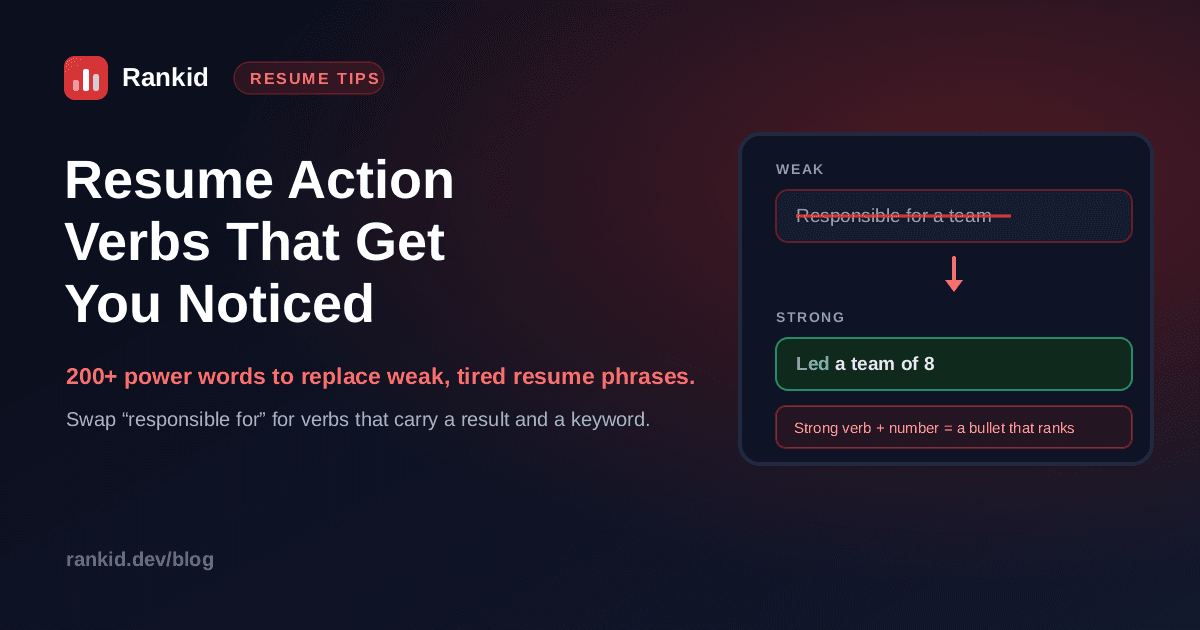
Two people can do the exact same job and describe it in two completely different ways. One writes "Responsible for the company's social media." The other writes "Grew the brand's audience 148% in nine months." Same work, wildly different resume. The difference is almost entirely in the first word of the sentence: the verb. Weak verbs turn achievements into chores, bury your results, and waste the most valuable real estate on the page. Strong resume action verbs do the opposite, they lead with the outcome, make the bullet provable, and pull in the exact keywords the job is scanning for. This is the master list: 200+ power words sorted by what you actually did, the tired phrases to delete on sight, the simple formula that turns a duty into an achievement, and how the right verbs quietly help you get past both the software and the recruiter.
Quick answer
What are resume action verbs, and why do they matter?
A resume action verb is a strong, specific verb that opens a bullet point and describes something you accomplished: Led, Built, Launched, Grew, Reduced, Negotiated, Analyzed. It is the opposite of a passive, generic opener like "Responsible for" or "Involved in," which describe a role rather than a result. The verb matters more than almost any other single word on your resume because it is the first thing the reader's eye lands on when it scans down the left edge of your bullet points.
And the reader is scanning fast. Recruiters spend seconds on a first pass, reading the opening word of each line and moving on. If every bullet starts with "Responsible for," the whole resume reads as a list of chores you were assigned. If bullets start with "Led," "Grew," and "Launched," the same career reads as a list of things you made happen. That shift, from duties to achievements, is what separates a resume that gets a callback from one that gets skimmed and closed.
The verb is a promise the number keeps
The formula: strong verb + real number + the job's keyword
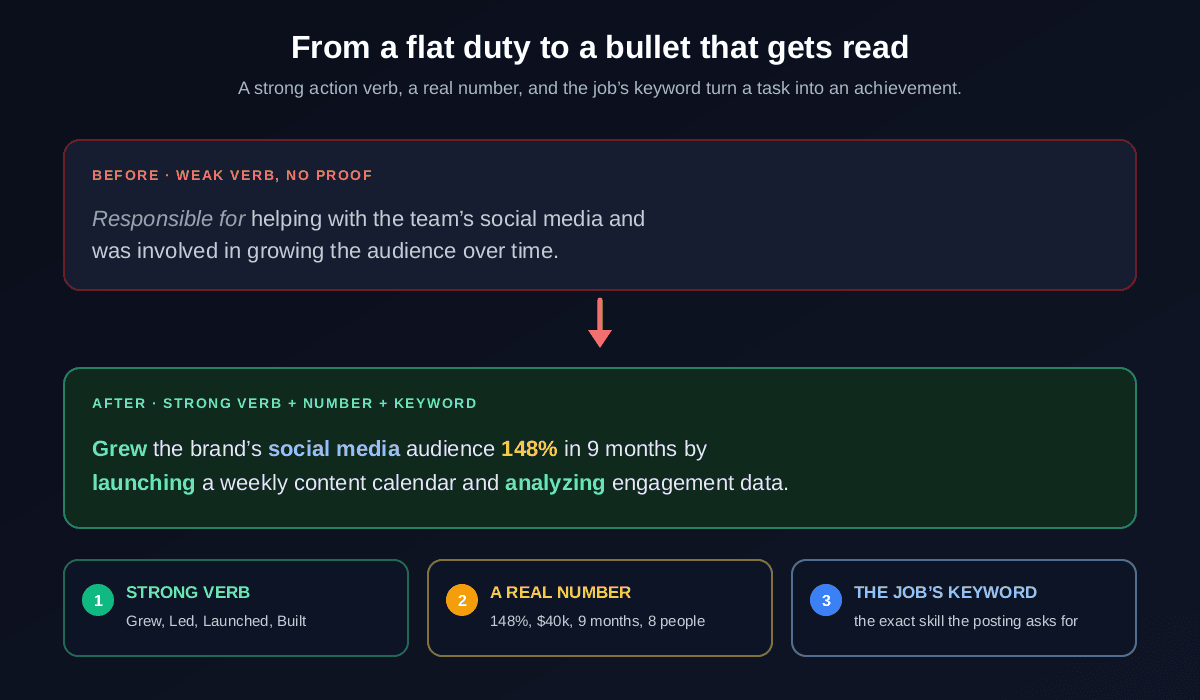
Great bullet points are not written, they are assembled. Every strong bullet has the same three ingredients, and the action verb is only the first of them. Get all three and an ordinary responsibility becomes a provable achievement that also matches the job.
- A strong action verb.Lead with the most specific, honest verb you can. "Led" not "Responsible for," "Built" not "Worked on," "Grew" not "Helped with."
- A real number.A percentage, a dollar figure, a headcount, a timeframe. "40%," "$1.2M," "a team of 8," "in three months." The number is what makes the verb believable.
- The job's keyword. Name the actual skill or tool the posting asks for, in its own words. That is what turns a good sentence into one that also matches on keywords.
Put them together and the transformation is obvious. "Responsible for helping with social media" becomes "Grew the brand's social media audience 148% in nine months by launching a weekly content calendar." Same job, but now it opens with a strong verb, proves the result with a number, and contains the real keyword ("social media") a recruiter or an ATS is looking for. That is the entire game.
200+ resume action verbs by category
Here is the master list, organized by what you actually did rather than alphabetically, so you can jump straight to the category that fits your bullet and pick a verb that matches the result. Choose the truest verb first, then vary your choices across the resume so no two lines feel repetitive.
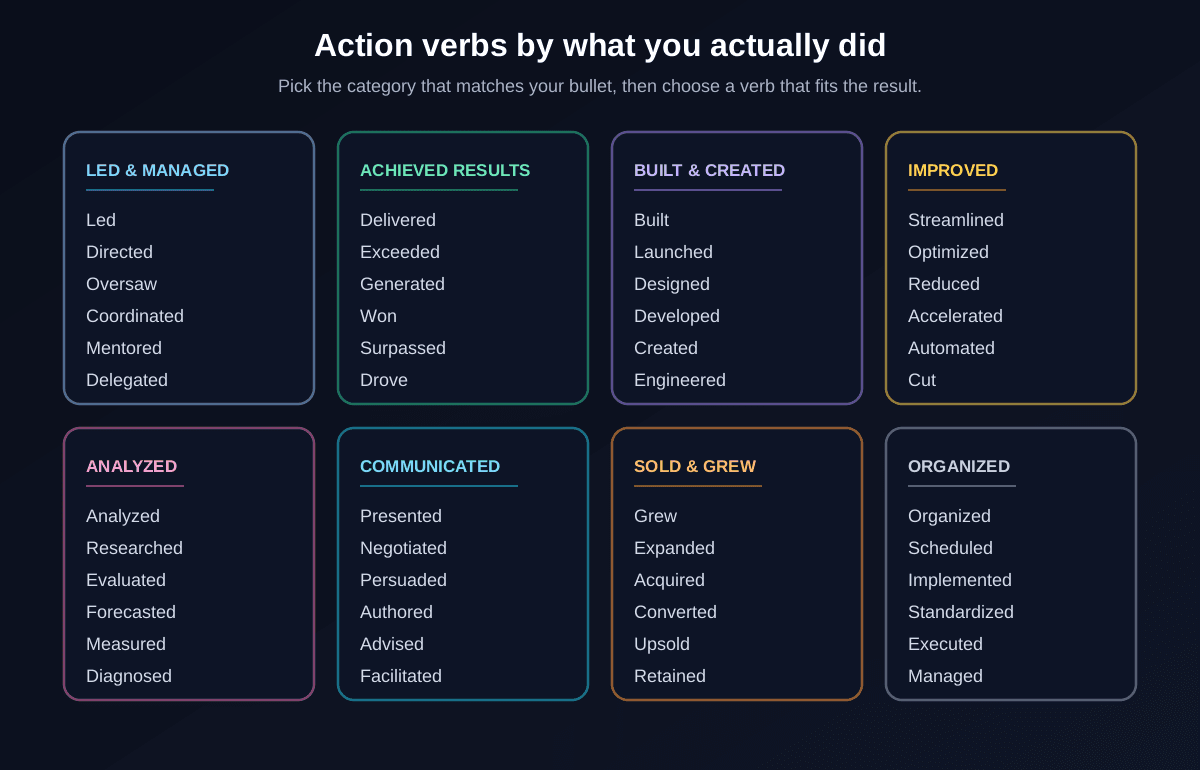
Leadership and management verbs (for leading people, projects, or initiatives): Led, Directed, Managed, Oversaw, Supervised, Coordinated, Headed, Chaired, Mentored, Coached, Delegated, Guided, Orchestrated, Spearheaded, Championed, Mobilized, Unified, Empowered, Cultivated, Fostered.
Achievement and results verbs (for outcomes and wins): Achieved, Delivered, Exceeded, Surpassed, Outperformed, Generated, Produced, Won, Secured, Earned, Attained, Reached, Drove, Boosted, Maximized, Capitalized, Completed, Finalized, Realized, Yielded.
Built and created verbs (for anything you made from scratch): Built, Created, Designed, Developed, Launched, Founded, Established, Engineered, Architected, Formulated, Devised, Pioneered, Introduced, Initiated, Prototyped, Assembled, Constructed, Programmed, Configured, Composed.
Improvement and efficiency verbs (for making something better, faster, or cheaper): Improved, Streamlined, Optimized, Enhanced, Reduced, Cut, Decreased, Accelerated, Automated, Simplified, Consolidated, Restructured, Overhauled, Refined, Upgraded, Modernized, Standardized, Eliminated, Minimized, Strengthened.
Analysis and research verbs (for data, research, and problem-solving): Analyzed, Researched, Evaluated, Assessed, Investigated, Measured, Forecasted, Modeled, Calculated, Diagnosed, Identified, Examined, Audited, Benchmarked, Quantified, Interpreted, Mapped, Tested, Validated, Tracked.
Communication and influence verbs (for writing, speaking, and persuading): Presented, Communicated, Negotiated, Persuaded, Influenced, Authored, Wrote, Edited, Pitched, Advised, Consulted, Advocated, Facilitated, Moderated, Briefed, Documented, Translated, Corresponded, Lobbied, Articulated.
Sales, revenue, and growth verbs (for anything that moved a number up): Grew, Increased, Expanded, Acquired, Converted, Closed, Upsold, Retained, Prospected, Monetized, Sourced, Negotiated, Captured, Landed, Renewed, Scaled, Accelerated, Drove, Generated, Multiplied.
Organization and execution verbs (for running, coordinating, and delivering the work): Organized, Scheduled, Implemented, Executed, Administered, Arranged, Coordinated, Prioritized, Planned, Processed, Deployed, Delivered, Maintained, Monitored, Allocated, Compiled, Systematized, Formalized, Operated, Fulfilled.
Support and service verbs (for customer, client, and team support): Resolved, Supported, Advised, Assisted (with a result), Guided, Trained, Onboarded, Serviced, Handled, Addressed, Counseled, Educated, Answered, Fulfilled, Accommodated, Reconciled, Restored, Championed, Represented, Liaised.
Match the verb to the metric
Words to use instead of "responsible for"
"Responsible for" is the single most common weak opener on resumes, so it deserves its own section. The problem is that it describes a job description, not an achievement, and it spends your two most valuable words saying nothing. Every time you see it, replace it with a verb that names the outcome.
- Responsible for a team becomes Led, Managed, Directed, or Oversaw a team of 8.
- Responsible for social media becomes Grew the brand's following 148%, or Launcheda content program that…
- Responsible for reports becomes Built, Authored, or Automated a weekly reporting dashboard.
- Responsible for customers becomes Retained 95% of accounts, or Resolved an average of 40 tickets a day.
- Responsible for the budget becomes Managed a $1.2M budget, or Cut spend 18% without reducing output.
The same treatment fixes the other tired openers. "Helped with" becomes a verb that names your actual contribution. "Worked on" becomes "Built," "Designed," or "Shipped." "Involved in" becomes whatever you specifically did within that project. If you can honestly claim the stronger verb, always use it.
Resume buzzwords and weak verbs to avoid
Some words actively work against you, not because they are wrong, but because they carry no information. Recruiters have read them ten thousand times, so they add length without adding a single point of signal. Cut these on sight and replace them with a concrete verb plus proof.
- Vague openers: Responsible for, Helped with, Worked on, Involved in, Assisted with, Participated in, Tasked with, Duties included. All describe a role, not a result.
- Filler adjectives: Hard-working, results-driven, detail-oriented, self-starter, go-getter, team player, motivated, passionate, dynamic. These are claims with no evidence.
- Empty jargon: Synergy, think outside the box, move the needle, wear many hats, best of breed, value-add, thought leader. Say the real thing instead.
- Overused "power" verbs with no backup: Spearheaded, Leveraged, Utilized, Orchestrated. These are fine witha number, but empty without one, and "Utilized" is almost always just "Used."
The buzzword test
How action verbs help you get past the ATS and the recruiter
There is a popular myth that action verbs themselves are the keywords an applicant tracking system scores you on. That is not how it works, and understanding the real mechanism will make your resume much stronger. The ATS mostly matches your skills, job titles, and toolsagainst the job description. "Led" and "Built" are usually not the terms it is weighting.
So why do strong verbs matter for the software at all? Because they forceyou to write specific bullets, and specific bullets are the ones that naturally contain the real keywords. Compare the two. "Responsible for marketing" contains almost nothing to match against. "Led SEO and paid search campaigns that grew organic traffic 60%" contains SEO, paid search, and organic traffic, three genuine keywords, plus a provable result. The verb did not match anything by itself. It made you write the sentence that did.
For the human reader it is even simpler. Strong verbs make your achievements scannable in the six seconds a recruiter actually spends, and a page of real outcomes is far more convincing than a page of duties. Verbs sharpen the writing; the sharpened writing is what matches and what persuades. The one thing verbs cannot do is tell you whether you picked the right keywords in the first place, which is the piece most people never check before they hit submit.
Make sure your strong verbs point at the right keywords
Great verbs are wasted on the wrong keywords. Paste your resume and the job description into Rankid and get a 0 to 100 match score plus the exact skills and keywords you match versus the ones you are missing, so your achievement bullets line up with what the job is actually scanning for. Your first check is free, no signup.
Check your resume freeHow to upgrade every bullet on your resume in four steps
Circle every weak opener
Scan down the left edge of your bullets and mark every "Responsible for," "Helped with," "Worked on," and "Involved in." Those are your first targets. Also flag any bullet that starts with a duty instead of an action.
Swap in the truest strong verb
For each one, pick the most specific verb from the category that matches what you did: leading, building, improving, analyzing, growing, or communicating. Choose accuracy over flash, then vary your verbs so no two lines open the same way.
Attach a number to prove it
Add a percentage, dollar amount, headcount, or timeframe to each upgraded bullet. If you genuinely cannot find a metric, add scope or scale instead ("across 3 regions," "for 12 clients"). The number is what turns the verb into evidence.
Match the bullet to the job, then apply
Make sure your upgraded bullets use the actual skills and keywords the posting asks for. Score your match against the job and close any missing-keyword gaps before you submit, so your strong verbs are working on the right targets.
Why the match still matters more than any single verb
Strong verbs are a force multiplier, but they multiply whatever is underneath them. A beautifully written bullet about a skill the job does not want will not save an application, and the most common reason people are not getting interviews is not weak verbs, it is a weak match. The verbs make your real, relevant achievements impossible to miss. They cannot manufacture relevance that is not there.
So use this list to rewrite every duty as an achievement, then take one more step and confirm those achievements are aimed at the right target. Paste your resume and the job description into Rankid's free resume checker and you will see exactly which keywords you match and which you are missing, so your newly sharpened bullets land on the skills the job is actually looking for. Strong verbs plus a strong match is the combination that gets you read.
Key takeaways
- Start every bullet with a specific, past-tense action verb, never with 'Responsible for' or 'Helped with'.
- Use the formula strong verb + real number + the job's keyword to turn a duty into a provable achievement.
- Pick verbs by what you actually did (led, built, improved, analyzed, grew) and vary them so no line reads flat.
- Replace 'Responsible for' with Led, Managed, Built, Grew, or whatever names the real outcome.
- Cut filler buzzwords like 'hard-working' and 'results-driven'; let an achievement imply the adjective.
- Action verbs are not the ATS keywords themselves; they force you to write the specific bullets that contain the keywords.
- Strong verbs multiply relevance but cannot create it. Check your match to the job free with Rankid before you apply.
The right resume action verbs will not rewrite your career, but they will finally make it read the way it actually happened: as a list of things you led, built, grew, and improved, not a list of tasks you were assigned. Rewrite your weakest bullets first, prove each one with a number, and then close the loop by checking your match to the job description so every strong verb is pointing exactly where it counts.
Frequently asked questions
What are the best action verbs for a resume?
The best resume action verbs are specific, past-tense verbs that describe a concrete accomplishment, not a duty. Strong all-purpose choices include Led, Built, Launched, Delivered, Grew, Reduced, Streamlined, Negotiated, and Analyzed. The best verb for your bullet is the one that most precisely matches what you actually did: use Led or Directed for people management, Grew or Generated for revenue, Streamlined or Automated for process work, and Analyzed or Forecasted for data work. Avoid vague openers like 'Responsible for', 'Helped with', 'Worked on', and 'Assisted', which describe a role rather than a result. The verb only does half the job, so pair it with a number ('Grew signups 40%') so the achievement is provable, and mirror the wording the job description uses so your resume also matches on keywords.
What words should I use instead of 'responsible for' on a resume?
Replace 'Responsible for' with a strong past-tense verb that names the outcome. Instead of 'Responsible for a team of 8', write 'Led a team of 8'. Instead of 'Responsible for social media', write 'Grew the brand's social media audience 148% in 9 months'. Good drop-in replacements depending on the task include Led, Managed, Directed, Oversaw, Owned, Drove, Delivered, Built, Launched, and Coordinated. The phrase 'responsible for' is weak because it describes a job description, not an achievement, and it wastes the most valuable words on the line. Start every bullet with the strongest, most specific verb you can honestly use, then add the scope and the result.
How many different action verbs should I use on a resume?
Use a different action verb to start most of your bullet points, and try not to repeat the same verb more than two or three times across the whole resume. Recruiters skim, and a page that opens every line with 'Managed' reads as flat and repetitive. Variety signals range: leading, building, analyzing, improving, and communicating are all different skills, and different verbs make that range visible at a glance. That said, do not swap in a fancier synonym just to avoid repetition if it makes the bullet less accurate. Precision beats variety. Pick the truest verb first, then vary where you genuinely can.
Do action verbs help you get past the ATS?
Action verbs help indirectly, and the way they help is often misunderstood. An applicant tracking system mostly scores how well your skills, job titles, and keywords match the job description, and verbs like 'Led' or 'Built' are usually not the keywords it is weighting. What strong verbs do is force you to write specific, achievement-focused bullets, and specific bullets naturally pull in the exact skill keywords the ATS is looking for. 'Responsible for marketing' contains almost nothing to match; 'Led SEO and paid search campaigns that grew organic traffic 60%' contains SEO, paid search, and organic traffic, which are real keywords. So the verb sharpens the sentence, and the sharpened sentence is what matches. You can check exactly which keywords your resume matches against a job with Rankid before you apply.
What resume buzzwords should I avoid?
Avoid filler adjectives and vague verbs that carry no fact: 'hard-working', 'team player', 'go-getter', 'results-driven', 'detail-oriented', 'synergy', 'think outside the box', and 'responsible for'. These are claims about yourself with no evidence, and recruiters have read them thousands of times, so they add length without adding signal. The fix is not a fancier buzzword, it is a concrete verb plus proof. Do not write 'results-driven marketer'; write 'Grew qualified leads 35% in two quarters'. Do not write 'strong communicator'; write 'Presented quarterly results to a 200-person org'. Let the achievement imply the adjective.
Should I use present or past tense for resume action verbs?
Use past tense for every role you have left, and either present or past tense for your current role, as long as you are consistent within each job. Past tense ('Led', 'Built', 'Delivered') is the safest default and reads as completed, provable work. For your current position, present tense ('Lead', 'Build', 'Manage') is acceptable for ongoing responsibilities, but many people still use past tense for specific completed achievements even in the current role. The one rule that matters: never mix tenses inside the same job's bullets, and never use future or gerund forms like 'Leading' or 'Will lead' to open a bullet.