Exempt vs Non-Exempt Employees: The Three Tests, the Duties Rules, and Why 1099 Is a Different Question (2026)
A retail chain classified 300 assistant managers as exempt. They were salaried, the title said manager, and payroll had done it that way for years. Then somebody added up what those people actually did in a week: stocking shelves, working the till, covering shifts, and supervising nobody in particular. Being salaried had satisfied one of three tests. The chain had never checked the other two, and unpaid overtime does not get calculated one person at a time.
Quick answer
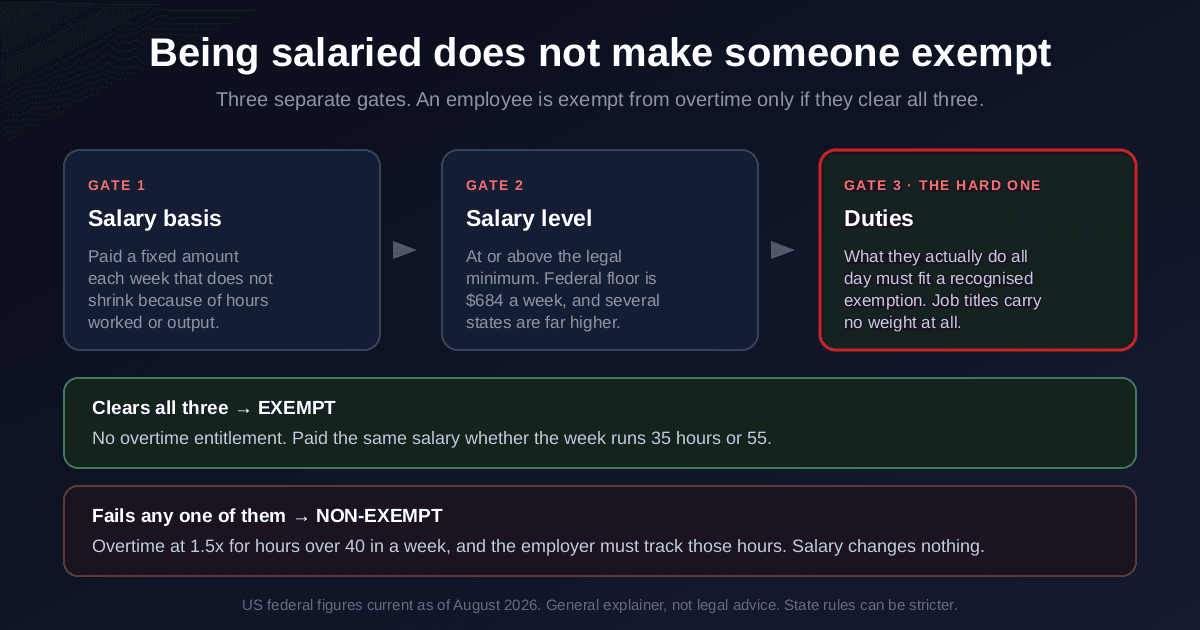
Quick answer: non-exempt employees are owed overtime, usually 1.5x for hours over 40 a week, and their hours must be tracked. Exempt employees are not. An employee is exempt only if they clear all three gates: salary basis (fixed weekly pay), salary level ($684 a week federally as of August 2026, far higher in several states), and the duties test (what they actually do fits a recognised exemption). Salaried does not mean exempt, job titles carry no weight, and 1099 vs W-2 is a completely separate question asked before this one.
What this article is, and is not
What do exempt and non-exempt actually mean?
Under the Fair Labor Standards Act, a non-exempt employee is entitled to overtime pay, normally one and a half times their regular rate for hours worked beyond 40 in a workweek, and their employer must keep records of those hours. An exempt employee is exempt from that requirement and receives the same salary whether the week runs 35 hours or 55.
Two things about this framing matter and are routinely missed.
- It is a legal conclusion, not a company decision. An employer does not grant exempt status; it either applies to the facts of a role or it does not. Configuring payroll a certain way does not make it true.
- The burden sits with the employer.Exemptions are narrowly construed, and it is the employer who must show one applies. "We assumed it did" is not a defensible position.
One clarification on the word itself: exempt here means exempt from the overtime and minimum wage provisions specifically. It does not mean the employee has fewer rights in general, and it does not exempt an employer from anything else.
The three tests, in order
All three must be satisfied. Any single failure ends the enquiry and the employee is non-exempt, whatever the offer letter says.
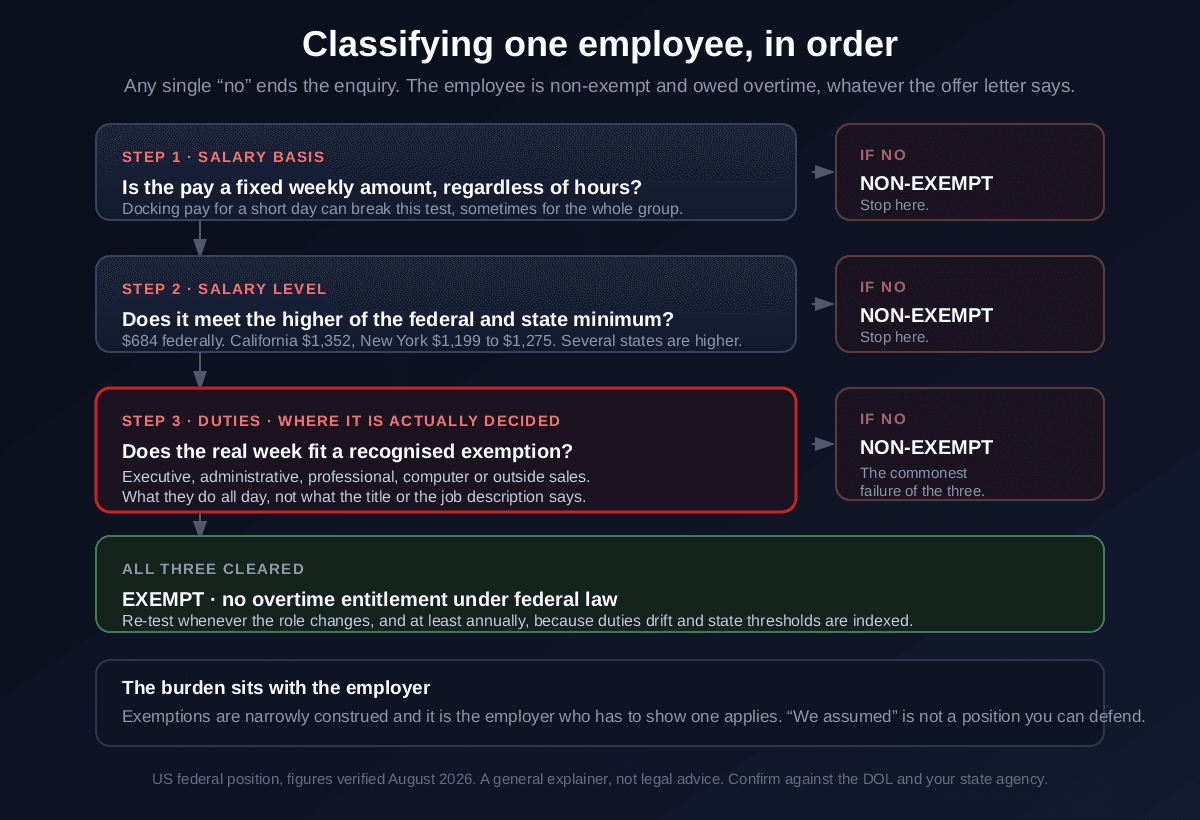
Salary basis: is the pay genuinely fixed?
Salary level: does it clear the applicable minimum?
Duties: does the real week fit an exemption?
Why "salaried" and "exempt" are not the same word
This is the misunderstanding that generates most of the exposure. Salary satisfies gate one and contributes to gate two. It says nothing at all about gate three.
A salaried receptionist, a salaried dispatcher, a salaried junior coordinator and a salaried social media assistant are all quite likely to be non-exempt as a matter of law, because none of those roles obviously involves managing a department, exercising independent judgement on matters of significance, or advanced knowledge acquired through prolonged specialised study. Paying them a salary is entirely legal. Treating them as ineligible for overtime because of it is not.
Salaried non-exempt is a real and legitimate category
The duties tests, and where each one fails
The governing concept is primary duty: the principal, main or most important thing the person does, judged on the reality of the working week. Not the title. Not the job description. Not the intention when they were hired.
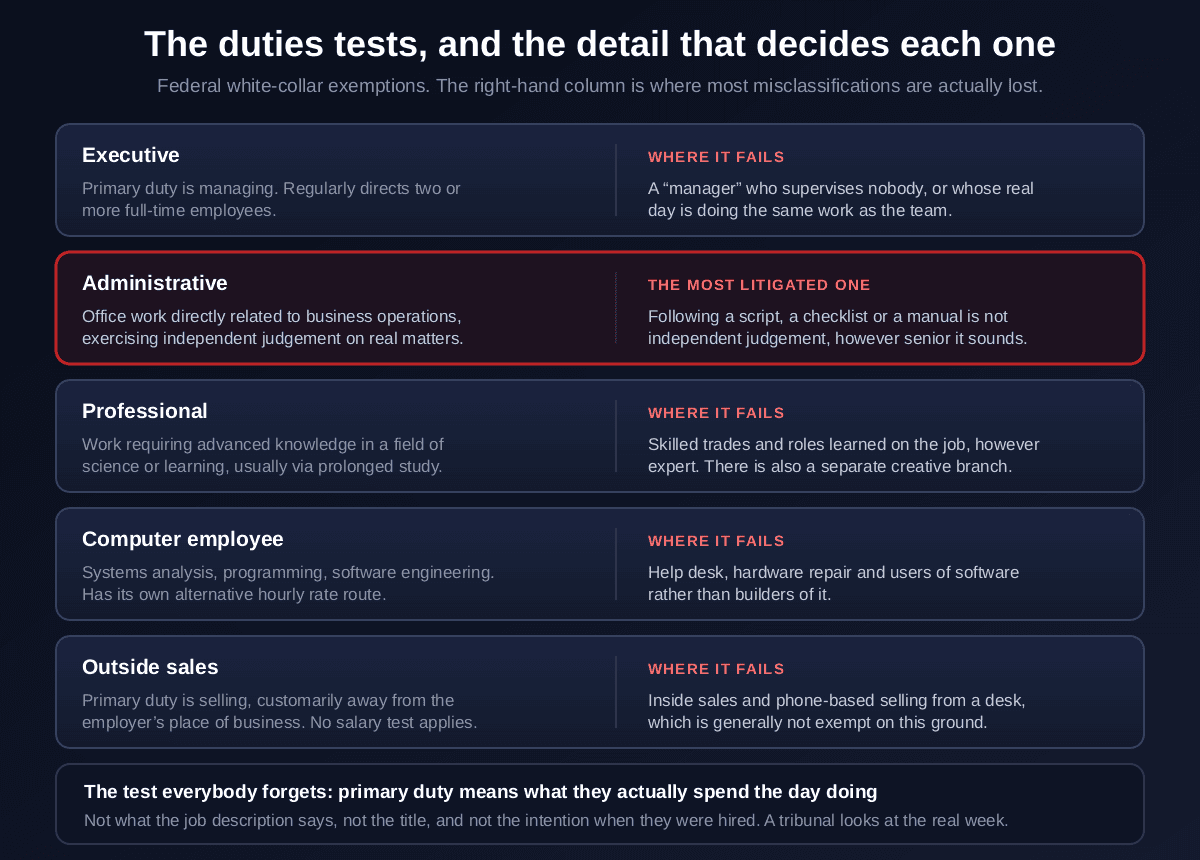
Executive. Primary duty is managing the business or a recognised department, customarily and regularly directing at least two full-time employees or the equivalent, with genuine authority over hiring and firing or recommendations that carry particular weight. All the elements need to be present. Note the arithmetic: two half-time employees can be the equivalent of one full-timer, not two.
Administrative. The most litigated of the five, because both halves of the definition are ambiguous in real jobs. The recurring failure is independent judgement: working from a detailed script, a decision tree, a checklist or a policy manual is generally not the exercise of independent judgement, however senior the title sounds. Matters of significance is a real limit too, and frequent small decisions do not add up to it.
Professional. Work requiring advanced knowledge in a field of science or learning, customarily acquired through prolonged specialised study. Skilled trades and roles learned on the job generally do not qualify however expert the person is, and there is a separate creative-professional branch with its own requirements.
Computer employee. Systems analysis, programming and software engineering, with its own alternative hourly-rate route. Help desk work, hardware repair and being a skilled user of software rather than a builder of it generally fall outside it.
Outside sales.Primary duty is selling, customarily and regularly away from the employer's place of business. No salary test applies to this one at all. Inside sales conducted from a desk is generally not exempt on this ground, which surprises a lot of sales organisations.
The 2026 salary thresholds, and the litigation that confused them
As of August 2026, the federal minimum for the executive, administrative and professional exemptions is $684 per week, or $35,568 a year.
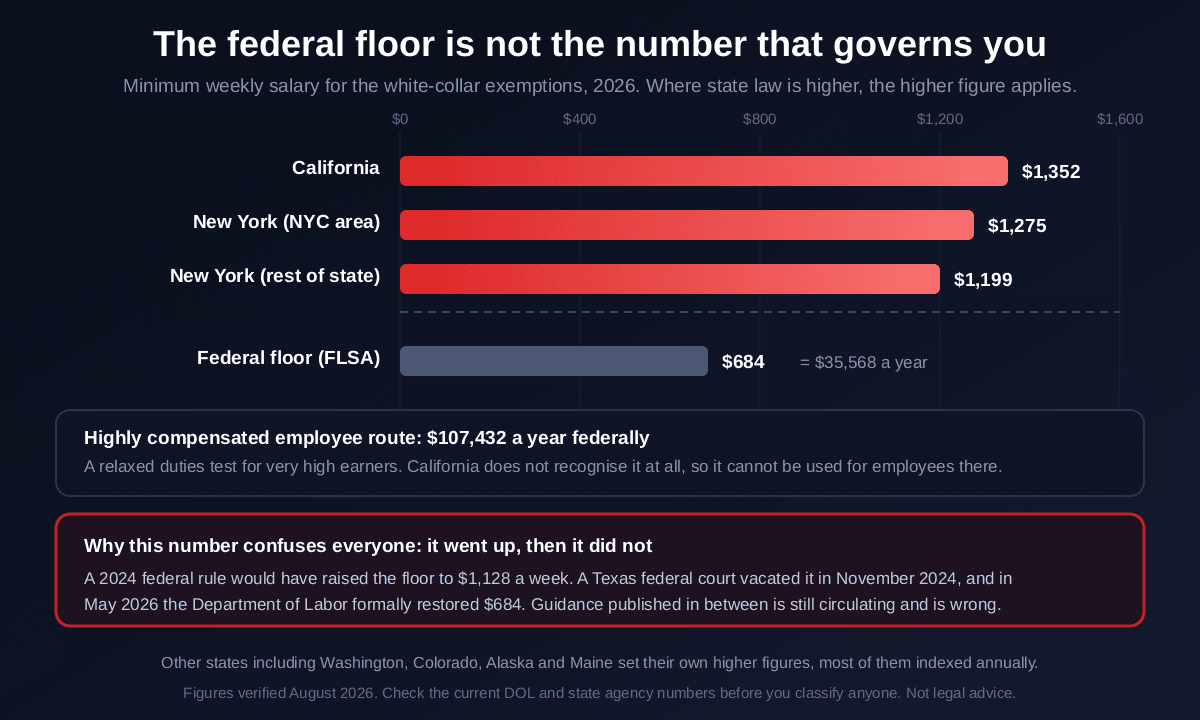
Why that number confuses people. A 2024 Department of Labor rule would have raised the floor in stages to $1,128 per week. That rule was vacated by a federal court in the Eastern District of Texas in November 2024, and in May 2026 the DOL formally restored $684 to the regulations. A large volume of guidance published in between quotes the higher figure, and a lot of it is still online and still being followed.
The federal figure is a floor, not your number. As of 2026, California requires $1,352 per week and New York requires $1,275 in NYC, Nassau, Suffolk and Westchester and $1,199.10 elsewhere in the state. Washington, Colorado, Alaska and Maine set their own higher figures, and most of these are indexed annually.
Two practical consequences follow. First, the same job title can be exempt in one state and non-exempt in another, so classification records need to be kept per state rather than per role. Second, a classification that was correct last year can become wrong on 1 January without anybody touching the job, purely because a state threshold moved.
The highly compensated employee route
The HCE exemption offers a relaxed duties test for employees at or above a high annual total, $107,432 a year federally as of 2026, restored to the regulations by technical amendment in May 2026 alongside the standard figure.
It is narrower than employers hope. The employee must still be paid on a salary basis at the standard weekly minimum, and must still customarily and regularly perform at least one exempt duty of an executive, administrative or professional employee. A high salary alone exempts nobody. And California does not recognise HCE at all, so the route is unavailable there regardless of pay.
Exempt vs non-exempt is not 1099 vs W-2
These are two different questions, asked in sequence, and merging them is a more serious error than getting either one wrong on its own.
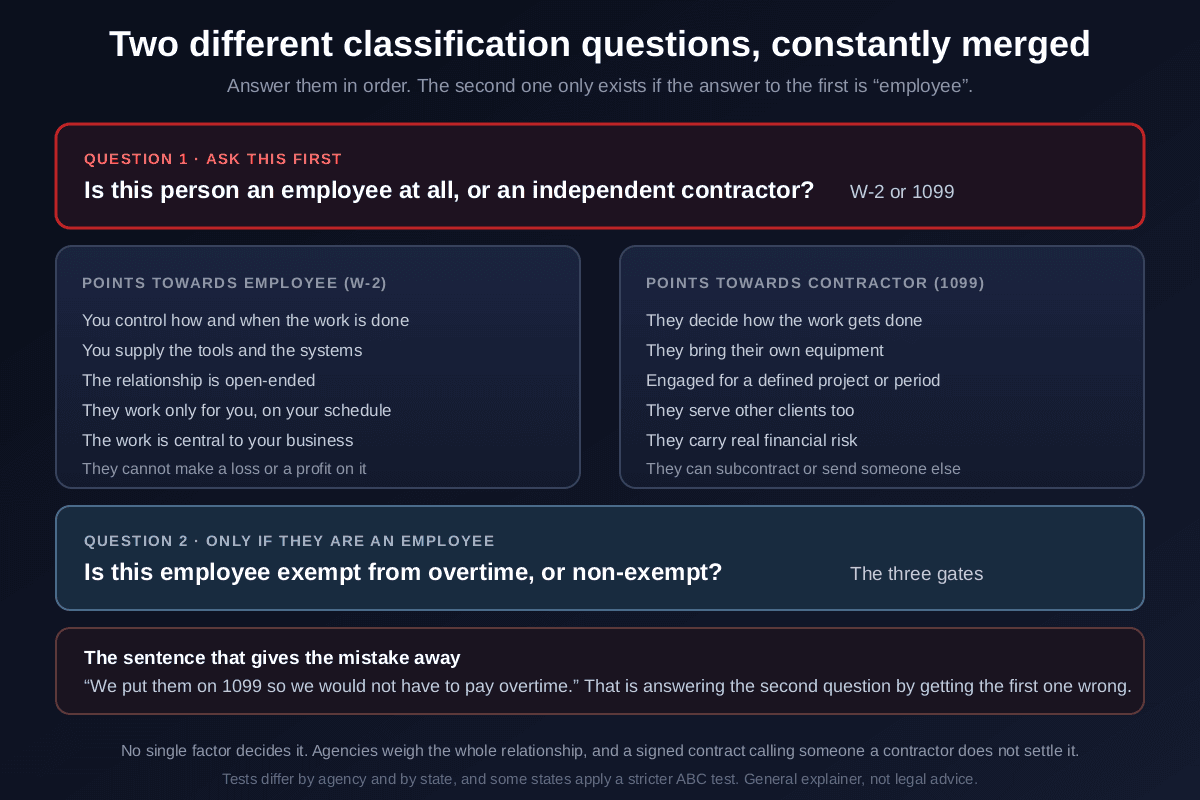
Question one: is this person an employee at all, or an independent contractor? That determines W-2 or 1099 and whether employment law reaches them in the first place. Question two, exempt or non-exempt, only exists if the answer to question one is employee. Contractors are not exempt employees. They are not employees, so the overtime rules do not apply to them at all.
The sentence that gives the mistake awayis "we put them on 1099 so we would not have to pay overtime". That is answering the second question by deliberately getting the first one wrong, and it usually produces a wage claim, a tax exposure and a benefits exposure simultaneously.
On question one itself, no single factor decides it, and a contract calling someone a contractor does not settle it. Agencies weigh the whole relationship. Note also that the applicable test differs by agency and by state, and some states apply a stricter ABC test under which workers are presumed employees unless narrow conditions are met. If you are engaging people this way at any scale, this is a question for counsel rather than for an article. Our guide to hiring remote employees covers some of the practical mechanics around multi-jurisdiction engagement.
The patterns that show up in nearly every claim
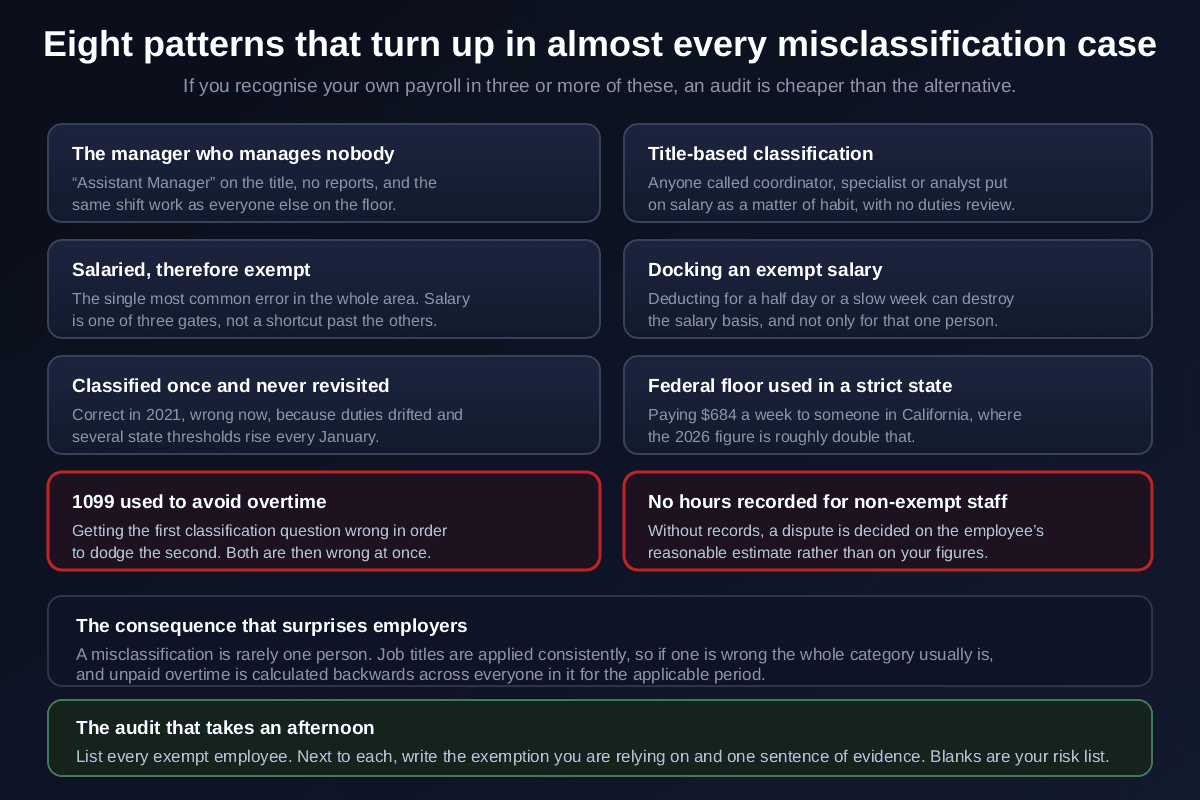
The consequence employers underestimate is scale. Misclassification is rarely one person, because job titles are applied consistently across an organisation. If one assistant manager is misclassified, the whole category usually is, and unpaid overtime is calculated backwards across everyone in it for the applicable period. That is how a quiet payroll assumption becomes a collective action.
The record-keeping flag deserves particular attention. Where an employer has not kept hours records for non-exempt staff, a dispute can be resolved on the basis of the employee's reasonable estimate of hours worked rather than on the employer's figures, because the employer was the party legally required to keep the records.
The classification audit that takes an afternoon
You do not need a project for this. You need a spreadsheet and one honest sentence per person.
- List every employee you currently treat as exempt. One row each.
- Name the exemption you are relying on. Executive, administrative, professional, computer, outside sales or HCE. If nobody can say which, that is already your answer.
- Write one sentence of duties evidence drawn from what that person actually did last month, not from the job description. Blanks and vague entries are your risk list, in priority order.
- Check each salary against the higher of federal and state. Per work location, not per role.
- Check for deductions that could have undermined the salary basis, including partial-day docking.
- Confirm hours are recorded for everyone non-exempt. Including salaried non-exempt staff, who are the ones most often missed.
- Re-run it every December, because state thresholds are indexed and duties drift without anyone deciding to change them.
Two upstream fixes make this permanently easier. Write job descriptionsthat describe the actual work rather than an aspiration, because an accurate description is also your duties-test evidence. And be careful with titles: inflating someone to "manager" as a substitute for a raise creates a classification problem alongside the retention problem it was meant to solve.
If you think you have been misclassified
Gather facts before raising it as an accusation. Four practical steps.
Write down what you actually do in a typical week and roughly how your time splits. Primary duty decides most cases, and your own contemporaneous record of it carries real weight.
Keep your own record of hours, especially weeks above 40. If your employer has not kept records, yours become the starting point rather than a footnote.
Check your state threshold as well as the federal one.You may be below your state's minimum even while clearing $684 a week.
Raise it as a question, not a claim, if you want it fixed internally."Which exemption is this role classified under?" is a reasonable question that a well-run employer can answer, and it is a much easier conversation than an accusation. Beyond that, the Department of Labor's Wage and Hour Division accepts complaints, and an employment lawyer can assess your specific facts. Retaliating against someone for raising a wage claim is itself unlawful.
One thing worth knowing before you decide
Accurate job descriptions are the cheapest classification evidence you have
A job description that describes the real work does double duty: it is your duties-test record and it is what makes screening accurate. Paste the job description and upload your applicant batch, and Rankid scores every candidate 0 to 100 against the role's actual requirements. Up to 200 resumes per batch, first 5 free, no signup.
Score your applicant pool freeWhat non-exempt status actually entitles someone to
Worth stating plainly, because it is narrower and broader than people assume in different places.
- Overtime at one and a half times the regular rate for hours over 40 in a workweek under federal law. The regular rate includes more than base pay: non-discretionary bonuses and shift differentials generally have to be folded in, which employers frequently miss.
- Accurate records of hours worked,which is the employer's legal obligation rather than the employee's.
- Pay for work that is actually performed, including work done before or after a shift or during an unpaid break, where the employer knew or should have known about it.
- No federal entitlement to daily overtime. Federal overtime is weekly. Some states, notably California, add daily thresholds, which is another reason state law matters more than the federal position for many people.
Key takeaways
- Non-exempt means entitled to overtime and hours tracking. Exempt means not entitled to overtime. It is a legal conclusion, not an employer preference.
- Three gates, all required: salary basis, salary level, and duties. Any one failure makes the employee non-exempt.
- Salaried does not mean exempt. Salaried non-exempt is a legitimate category, and it requires tracking hours and paying overtime.
- The duties test decides most cases, and primary duty means what the person actually does all week, not the title or the job description.
- Federal floor is $684 a week, or $35,568 a year, as of August 2026. The 2024 rule raising it to $1,128 was vacated in November 2024 and $684 was restored in May 2026.
- State law often governs instead: California $1,352 a week, New York $1,199 to $1,275 in 2026, and most state figures are indexed annually.
- The highly compensated route is $107,432 a year federally, still requires one exempt duty, and does not exist in California.
- 1099 vs W-2 is a separate, earlier question. Contractors are not exempt employees, they are not employees at all.
- A contract calling someone a contractor does not settle their status, and some states apply a stricter ABC test.
- Misclassification is rarely one person, because titles are applied consistently across a category.
- Docking an exempt employee's pay for a partial day can break the salary basis test, sometimes for the whole job classification.
- Audit annually in December: name the exemption per person, write one sentence of duties evidence, and treat every blank as risk.
The whole area comes down to one question you can ask of any exempt employee on your payroll: which exemption are we relying on, and what did this person actually do last month? If you cannot answer both halves in a sentence, you do not have a classification, you have an assumption that has not been tested yet. And since the honest answer to the second half depends on knowing what the job really involves, it is worth writing that down accurately in the first place: paste the real requirements into Rankid's bulk resume screening and you get an accurate role definition and a shortlist matched to it in the same pass.
Frequently asked questions
What is the difference between exempt and non-exempt employees?
Under the US Fair Labor Standards Act, a non-exempt employee is entitled to overtime pay, normally one and a half times their regular rate for hours worked beyond 40 in a workweek, and their employer must keep records of the hours they work. An exempt employee is exempt from that overtime requirement and is paid the same salary whether the week runs 35 hours or 55. The classification is not a preference or a status the employer grants. It is a legal conclusion that depends on how the person is paid and what they actually do, and the employer carries the burden of showing an exemption applies. The word exempt in this context means exempt from the overtime and minimum wage provisions specifically. It does not mean exempt from other employment protections, and it does not mean the employee has fewer rights generally.
Does being salaried make an employee exempt?
No, and this is the single most common misunderstanding in this area. Being paid a salary satisfies only one of three tests. An employee is exempt only if all three are met: the salary basis test, meaning they receive a fixed weekly amount that does not fluctuate with hours worked or output; the salary level test, meaning that amount is at or above the applicable legal minimum; and the duties test, meaning what they actually do all day fits a recognised exemption category. A salaried employee whose real duties do not fit any exemption is non-exempt and is owed overtime, regardless of what the offer letter says or how the payroll system is configured. Plenty of salaried receptionists, salaried dispatchers and salaried junior coordinators are legally non-exempt, and the salary makes no difference to that conclusion.
What is the current exempt salary threshold?
As of August 2026, the federal minimum for the executive, administrative and professional exemptions is $684 per week, which works out to $35,568 per year. That figure has a confusing recent history worth knowing about. A 2024 Department of Labor rule would have raised it in stages to $1,128 per week, but that rule was vacated by a federal court in the Eastern District of Texas in November 2024, and in May 2026 the DOL formally restored $684 to the regulations. A great deal of guidance published between 2024 and 2026 quotes the higher figure and is simply wrong now. Critically, the federal number is a floor rather than the number that governs you. Several states set their own higher minimums, and where state law is stricter the state figure applies. Always confirm the current federal figure with the DOL and the current figure for your state before classifying anyone.
What are the state exempt salary thresholds for 2026?
Several states require considerably more than the federal $684 per week. As of 2026, California requires $1,352 per week, and New York requires $1,275 per week in New York City, Nassau, Suffolk and Westchester, and $1,199.10 per week in the rest of the state. Washington, Colorado, Alaska and Maine also set their own higher figures, and most of these are indexed so they rise each January, which means a classification that was correct last year can quietly become wrong on 1 January without anybody touching the role. California is also notable for not recognising the federal highly compensated employee exemption at all, so that route cannot be used for California employees. If you employ people in more than one state, the practical consequence is that the same job title can be exempt in one location and non-exempt in another, and your classification records need to be kept per state rather than per role.
What is the duties test, and why does it matter most?
The duties test asks whether what the employee actually spends their time doing fits one of the recognised exemption categories: executive, administrative, professional, computer employee or outside sales. It matters most because it is where the majority of misclassification claims are decided, and because it is the only one of the three tests that cannot be settled by looking at a payslip. The governing concept is primary duty, meaning the principal, main or most important thing the person does, judged on the reality of their working week rather than on the job description, the title, or what anyone intended when they were hired. An assistant manager who spends most of the week doing the same tasks as the team they nominally supervise generally fails the executive test. Someone following a detailed script or manual generally fails the administrative test, because that is not the exercise of independent judgement.
What is the executive exemption?
The executive exemption covers employees whose primary duty is managing the enterprise or a recognised department or subdivision of it, who customarily and regularly direct the work of at least two full-time employees or their equivalent, and who have genuine authority to hire and fire or whose recommendations on hiring, firing and promotion carry particular weight. All of those elements need to be present, which is why the exemption fails so often in practice. The classic failure is a role with manager or supervisor in the title, no direct reports, and a working week largely spent on the same tasks as everyone else. Another common failure is a shift supervisor who directs people but whose input into hiring and firing decisions carries no real weight. Counting reports matters too: two half-time employees can add up to the equivalent of one full-time employee rather than two.
What is the administrative exemption?
The administrative exemption covers employees whose primary duty is office or non-manual work directly related to the management or general business operations of the employer or its customers, and whose work includes the exercise of discretion and independent judgement with respect to matters of significance. It is the most heavily litigated of the exemptions, because both halves of that sentence are genuinely ambiguous in real jobs. The recurring point of failure is independent judgement. Work performed by following a detailed script, a decision tree, a checklist or a policy manual is generally not independent judgement, however senior the job title sounds and however much responsibility the person feels. Matters of significance is also a real limit: making frequent decisions about small things is not the same as having authority over things that matter to the business. Many claims processors, inside sales staff and junior coordinators have been found non-exempt on exactly these grounds.
What is the highly compensated employee exemption?
The highly compensated employee route, usually shortened to HCE, allows a relaxed duties test for employees who earn at or above a high annual total, which is $107,432 per year federally as of 2026, that figure having been restored to the regulations by technical amendment in May 2026 after the 2024 increase was vacated. Under HCE the employee still has to be paid on a salary basis at the standard weekly minimum, and still has to customarily and regularly perform at least one of the exempt duties of an executive, administrative or professional employee, but they do not need to satisfy the full duties test. It is narrower than employers often assume. Earning a large salary does not by itself make anyone exempt, non-management roles can be highly paid and still fail, and California does not recognise the HCE exemption at all, so it is unavailable for California employees regardless of pay.
Is exempt versus non-exempt the same as 1099 versus W-2?
No, and conflating the two is a distinct and more serious error. These are two separate questions asked in sequence. The first is whether the person is an employee at all or an independent contractor, which determines whether they receive a W-2 or a 1099 and whether employment law applies to them in the first place. The second question, exempt or non-exempt, only exists if the answer to the first is employee. Contractors are not exempt employees; they are not employees, so the overtime rules do not reach them at all. The tell that someone has merged the two questions is a sentence like we put them on 1099 so we would not have to pay overtime. That is an attempt to answer the second question by deliberately getting the first one wrong, and it typically produces two violations at once, with tax and benefits exposure on top of the wage claim.
How do you tell an employee from an independent contractor?
No single factor decides it. Agencies weigh the whole working relationship, and a signed contract calling someone a contractor does not settle the question. Factors pointing towards employee status include the business controlling how and when the work is done, supplying the tools and systems, an open-ended rather than project-based relationship, the person working only for that business on its schedule, work that is central to the business rather than ancillary, and no genuine opportunity for the worker to make a profit or a loss. Factors pointing towards contractor status include the worker deciding how the work gets done, bringing their own equipment, being engaged for a defined project or period, serving other clients, carrying real financial risk, and being able to subcontract or send someone else. Note that the applicable test varies by agency and by state, and some states apply a stricter ABC test under which most workers are presumed to be employees unless narrow conditions are met.
What should I do if I think I have been misclassified?
Start by gathering facts rather than raising it as an accusation. Write down what you actually do in a typical week and roughly how your time splits, because primary duty is the question that decides most cases and your own contemporaneous record of it is useful. Keep your own note of hours worked, particularly weeks above 40, since where an employer has failed to keep records a dispute can be decided on the employee's reasonable estimate. Check your state's threshold as well as the federal one, because you may be below the state minimum even if you clear $684. Then, if you want it addressed internally, raise it as a question about the classification rather than about the money: asking which exemption the role is classified under is a reasonable question and a well-run employer can answer it. Beyond that, the US Department of Labor's Wage and Hour Division accepts complaints, and an employment lawyer can tell you what your specific situation is worth. Retaliating against someone for raising a wage claim is itself unlawful.
How should employers audit classification?
There is a version of this that takes an afternoon and removes most of the risk. List every employee you currently treat as exempt. Next to each one, write the specific exemption you are relying on and one sentence of evidence for the duties test, drawn from what that person actually did last month rather than from the job description. Every blank or vague entry is your risk list, in priority order. Then check three things across the whole list: that each salary clears the higher of the federal and applicable state minimum, that no deductions have been made that could undermine the salary basis, and that hours are being recorded for everyone you treat as non-exempt. Re-run it annually in December, because state thresholds are indexed and duties drift without anyone deciding to change them. One structural point: misclassification is rarely a single person, because titles are applied consistently, so if one role in a category is wrong the whole category usually is.