How to Hire Remote Employees: The Process, Screening and Pitfalls (2026)
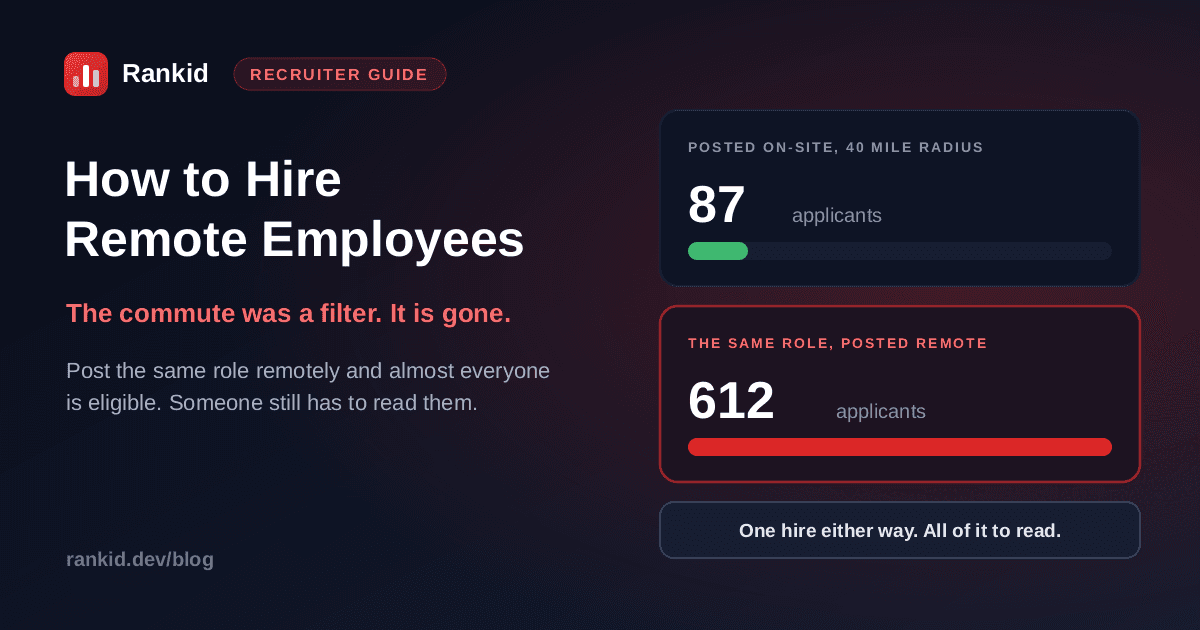
The decision to make a role remote gets discussed as a benefits question, or a culture question, or a real-estate question. Operationally it is none of those. It is a screening decision, because the commute was the strictest filter in your hiring process and it worked for free. Delete it and the same requisition that drew 87 applications can draw several hundred, with exactly one hire at the end of it and the entire difference landing on whoever has to read.
Quick answer
What actually changes when a role goes remote
Start with the mechanic, because most remote hiring advice skips it. An on-site role is open only to people within travelling distance of your office. That is a tiny fraction of everyone qualified to do the job, and it is applied automatically, before anyone reads a single resume. It is the cheapest and most aggressive filter in recruiting.
Make the role remote and that filter disappears. Everyone in your hiring geography is now eligible, which is the entire point and a genuinely good thing: you get access to candidates you could never have reached. What comes with it is that applying is now frictionless for a much larger population, including people making speculative applications, so the volume arriving on the requisition rises sharply while the number of hires stays at one.
The thing to plan for before you post
Decide which kind of remote you mean
The word remote covers four quite different operating models, and the choice determines your pay approach, your compliance load, your timezone constraints and your screening volume. Deciding it explicitly, before the posting, prevents the most common remote hiring failure: rejecting candidates for a rule you never published.
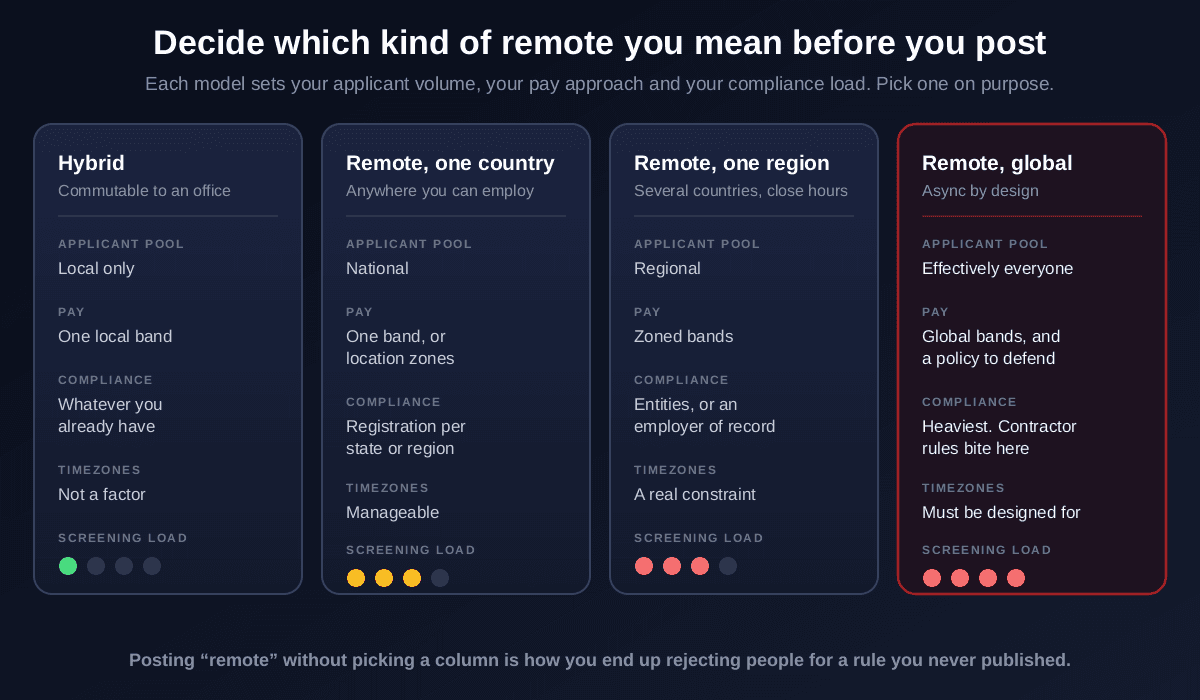
The practical guidance is to pick the narrowest model that gets you the candidates you need. Global sounds generous and is genuinely the right answer for some teams, but it brings the heaviest compliance load, the hardest pay policy to defend and a screening volume that only works if you have already solved reading at scale. Remote within one country is where most teams should start, because it multiplies the candidate pool without multiplying the legal surface area.
Write the posting so it filters honestly
A remote posting has to do work that an on-site posting got for free. If it does not, the filtering it failed to do arrives later as resumes you have to reject manually, which is the expensive way to apply a rule.
- Where you can actually employ. A list of states or countries, not the word anywhere. Anywhere means you will receive applications from everywhere and reject most of them on a technicality you could have published.
- The overlap you require. Expressed as a window in a named timezone, for example at least four hours overlapping 10:00 to 15:00 UK time. Candidates can assess this themselves in seconds, and it is far more precise than naming acceptable countries.
- The salary range. More important for remote roles than on-site ones, because a candidate has no location to infer a band from, and because your pay approach across locations is something they will ask about eventually anyway.
- How the team actually works. How much is synchronous, what gets written down, what meetings exist. This attracts people who want that mode of working and deters those who do not, which is a filter operating on fit rather than on paperwork.
Everything else that makes a posting screenable still applies, and it applies harder at remote volume: six real must-haves rather than twenty aspirational bullets, written in the language candidates would use. Our guide to writing a job description covers the rest.
What predicts remote success on a resume
This is where remote screening genuinely differs from on-site screening, and where most of it goes wrong. Remote roles reward independent delivery and written communication. Resumes are full of claims about both, and the claims are worthless because they are free to make.
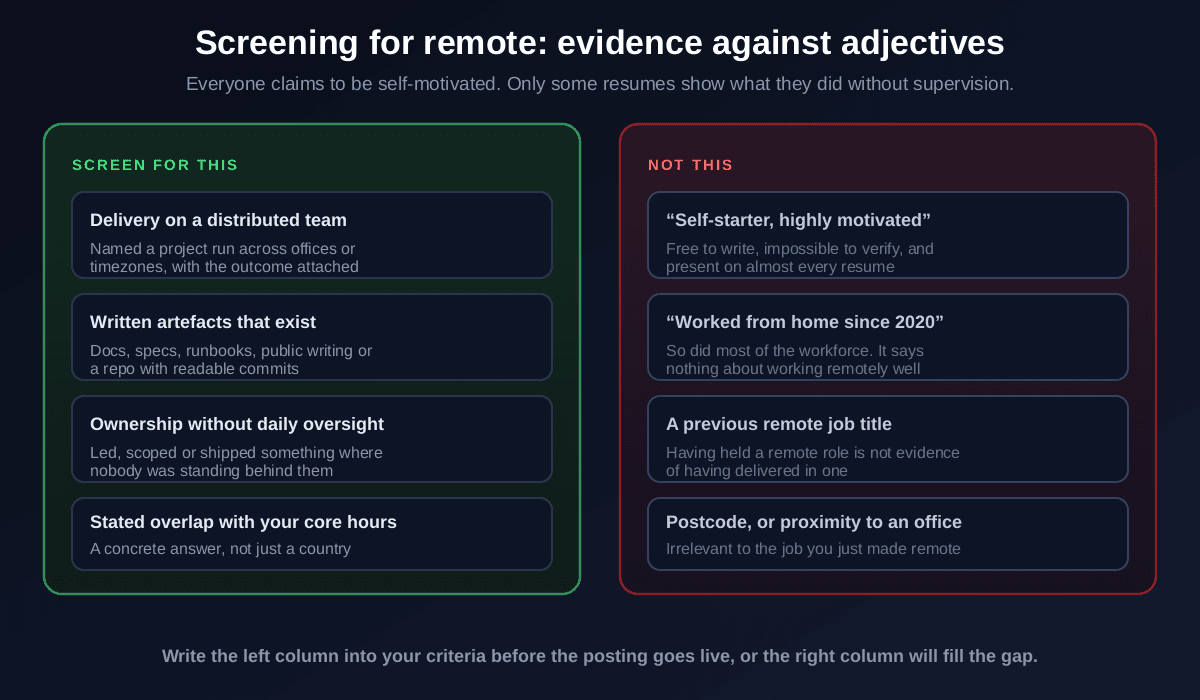
The distinction to hold onto is the same one that separates real skills screening from keyword matching: look for the evidence level, not the assertion. “Self-starter” is an adjective. “Scoped and shipped the reporting migration working with engineers in three timezones” is a claim you can probe in an interview. The same reasoning behind skills-based hiring applies here: define what evidence would satisfy the requirement, then screen for that.
Two proxies deserve specific warnings. Having worked from home since 2020 describes most of the professional workforce and predicts almost nothing. And a previous job title containing the word remote establishes only that someone held such a role, not that they were effective in it, which are very different claims.
Screen on overlap, not on geography
Timezone is the constraint people handle worst, usually by making it a country question. It is not a country question, it is an hours question, and the two do not line up as neatly as you would expect.
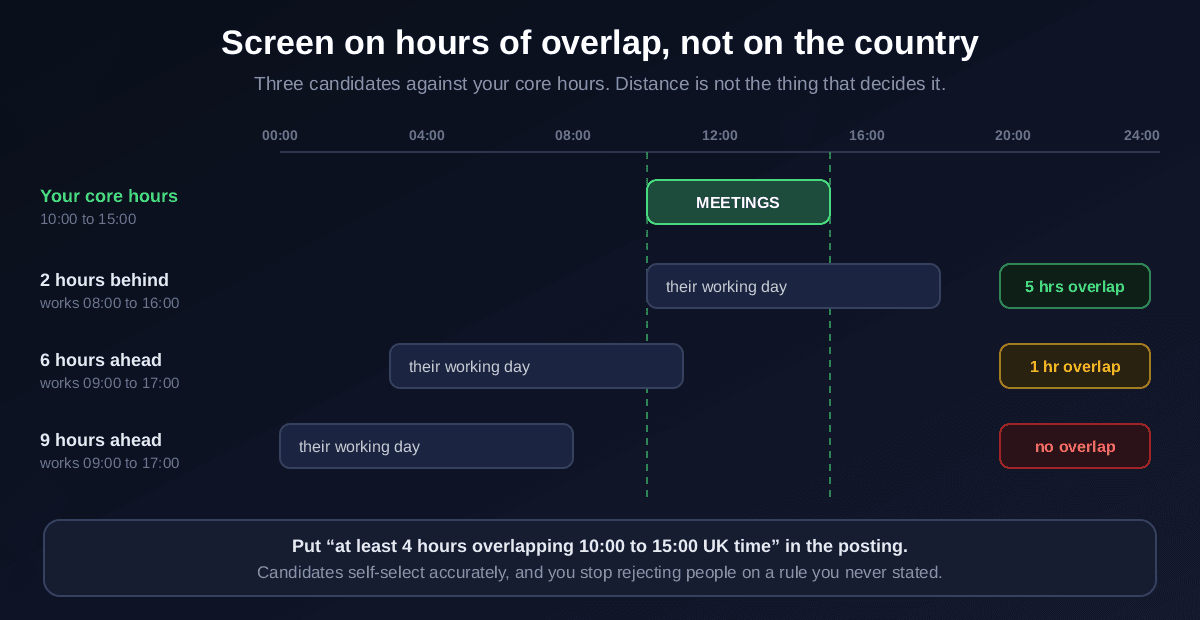
Decide how many overlapping hours the role genuinely needs, and be honest about it. A role with daily standups, pairing and live customer calls needs real overlap. A role that is mostly independent delivery with a weekly review might need two hours. A role that needs none has to be deliberately designed for that, with written handovers and decisions that do not wait on a meeting, and very few teams that claim to work this way actually do.
Then publish it. A stated overlap requirement is the single most effective self-selection filter on a remote posting, and it replaces a large amount of manual rejection with a sentence.
Screening the pool a remote posting produces
Here is where the arithmetic becomes the whole problem. A careful screen against real criteria takes about 90 seconds per resume. At 87 applications, that is roughly two hours: annoying, but it fits in a week. At 612 applications it is over 15 hours for one requisition, and the recruiter carrying it also has five other roles open.
What happens next is predictable and is not a character flaw. The first 60 or 80 resumes get a real read, a shortlist emerges, someone gets hired, and several hundred applications are closed unread when the req closes. The remote posting that was supposed to widen access to talent ends up selecting on arrival time, which is the least job-related criterion available, and the candidates you went remote to reach are disproportionately the ones sitting unopened in the back half of the pile.
The fix is not to read faster, it is to stop reading in order. Score the whole batch against the criteria in a single pass, including the remote-specific ones, then read from the top of a ranking rather than from the top of a queue. That way going remote actually delivers the access it promised, and it keeps your candidate experience from collapsing under volume you invited. The mechanics are in how to screen resumes in bulk.
Read a 600-applicant remote req in an afternoon
Paste the job description with your remote requirements, upload the whole batch, and every candidate comes back scored 0 to 100 with the skills they match and miss. Read from the top of a ranking instead of the top of a queue. First 5 resumes free, no signup.
Screen a batch freeRunning a remote interview process
Send the format before the first call
Stages, who they will meet, what each stage assesses, and roughly how long it takes. Remote candidates cannot read any of this from a building or a reception area, so ambiguity that would be absorbed in person becomes anxiety and drop-off.
Put something written early in the process
A short written response to a realistic question, or a small work sample with a written explanation. Written communication is the highest-frequency activity in most remote roles, so it belongs early rather than being discovered at the final stage. Keep it under an hour of the candidate's time.
Ask everyone the same core questions
Consistency matters more, not less, over video, because you have fewer incidental signals and it is easier for a conversation to drift. Our list of interview questions to ask candidates works as well remotely as it does in a room.
Probe the independent delivery claims specifically
Take the strongest piece of evidence from their resume and go three questions deep on it: what was ambiguous, who did they have to align, what did they decide without asking. Remote work is mostly this, and it is the thing an on-site process never has to check.
Interview on the tools the team really uses
If the team lives in a particular chat and docs setup, run part of the process there. It is a realistic preview for the candidate and a genuine signal for you, and it costs nothing to arrange.
Decide fast and say so
Remote candidates are usually in more processes at once, because they are not geographically constrained either. A two-day debrief deadline is worth more in remote hiring than in any other context.
Compliance, payroll and the boring part that bites
Not legal advice
The core issue is that employing someone usually creates obligations where they live, not where you are. Within one country that typically means registering in additional states or regions and handling local tax and leave rules. Across borders it means either establishing a legal entity, which is rarely justified for one or two hires, or using an employer of record, a company that legally employs the person on your behalf and handles payroll, tax and local compliance while they work for your team.
The tempting shortcut is to engage international hires as independent contractors. Sometimes that is entirely legitimate. Often it is misclassification, because the test in most jurisdictions turns on how the work is actually controlled rather than on what the contract says, and the penalties land on the employer. The practical rule: decide your employment route per location before you advertise there, because discovering it at offer stage is how offers fall through.
Onboarding remote employees
- Have the equipment and accounts ready before day one.The single most common remote onboarding failure, and the one that most damages a new hire's first impression, because they cannot walk to anybody's desk to fix it.
- Write down what an office would have taught them. Who owns what, how decisions get made, which channels matter. Remote hires do not absorb this ambiently, so it has to exist as text.
- Give them a first task that ships in week one. Small, real and completable. Nothing settles a remote starter faster than having contributed something.
- Assign a named person for stupid questions.In an office people find this naturally. Remotely, if it is nobody's job, the questions go unasked.
- Schedule a deliberate 30-day check-in. Remote struggles are quiet. You have to go and look for them rather than noticing them across a room.
Remote hiring mistakes to avoid
- Posting “remote” with no eligibility list. Guarantees a large volume of applications you will reject on location, which is manual work you created for yourself.
- Leaving the timezone requirement unstated and enforcing it anyway. Unfair to candidates and a waste of your own screening time.
- Screening remote candidates on adjectives. Every resume says self-motivated. It is not a signal, it is a convention.
- Running the on-site loop over video and calling it a remote process. It tests presence and conversation, not the written, asynchronous work the job actually consists of.
- Treating the volume increase as a nice problem to have. It is a real problem with a specific cost, and if you do not plan for it the unread half of the pile is where your best access to talent quietly goes.
- Deciding the employment route after choosing the candidate. The fastest way to lose a finalist you spent five weeks finding.
- Assuming remote-first means process-free. Distributed teams need more written structure than co-located ones, and hiring is the first place that shows.
Key takeaways
- Going remote removes the commute filter, which was the strictest and cheapest filter in your process.
- The same requisition can attract several times the applications with no change in the number of hires.
- Pick one of four models before posting: hybrid, remote in one country, remote in one region, or global.
- State location eligibility, required overlap hours and the salary range so candidates self-select accurately.
- Screen for evidence of independent delivery and written artefacts, not for self-starter claims.
- Overlap hours, not countries, are the real timezone constraint. Publish the window you need.
- Plan the screening capacity before the posting goes live, or arrival time becomes your selection criterion.
- Rankid scores up to 200 resumes per batch against your job description, first 5 free with no signup.
Bottom line: remote hiring gives you access to a far larger pool of qualified people, and that access is only real if you can actually read the applications it produces. Everything else on this list, the model, the posting, the overlap window, the interview design, is about making sure the volume you invited is volume you can act on. Decide the operating model, publish the constraints, screen on evidence rather than adjectives, and put the batch through Rankid's bulk resume screening tool so the candidate you went remote to find is not sitting unopened at position 400.
Frequently asked questions
How do you hire remote employees?
Work through five decisions in order. Define which kind of remote the role is, meaning hybrid, remote within one country, remote across a region, or fully global, because that sets everything downstream. Write a posting that states the location eligibility, the required hours of overlap and the salary range so candidates can self-select accurately. Define screening criteria that include evidence of remote delivery rather than adjectives. Score the whole applicant pool against those criteria, since a remote posting typically attracts several times the volume of an on-site one. Then run an interview process that tests written communication and independent delivery, and sort out employment compliance for the locations you are willing to hire in before you make an offer.
Why do remote job postings get so many more applicants?
Because the commute was doing an enormous amount of filtering for free. An on-site role is only realistically open to people within travelling distance, which is a small fraction of the qualified population. Make the same role remote and everyone in your hiring geography becomes eligible, so the eligible population expands by orders of magnitude and the applicant count rises sharply with it. Remote roles also attract more speculative applications, because applying costs a candidate nothing and there is no relocation question to think about. The hire count does not change, so the entire increase lands on your screening stage.
What should you look for when screening remote candidates?
Evidence of delivery without supervision, not claims about being self-motivated. Concretely: a project they owned end to end where nobody was standing behind them, work done with a team spread across offices or timezones with the outcome attached, written artefacts that exist such as documentation, specifications, public writing or a repository with readable commit messages, and a specific answer on hours of overlap with your core working window. Discount weak proxies: having worked from home since 2020 describes most of the workforce, and having held a job with remote in the title is not evidence of having delivered well in one.
How do you write a remote job description?
State four things explicitly that most remote postings leave vague. Where you can legally employ, as a list of states or countries rather than the word anywhere. The hours of overlap you require, expressed as a window in a named timezone. The salary range, which matters more for remote roles because candidates cannot infer it from a location. And how the team actually works, meaning how much is synchronous, what is written down and what meetings exist. Each of those lets the wrong candidates rule themselves out, which is the cheapest screening available to you.
How do you interview remote candidates?
Test the things remote work depends on rather than replicating an on-site loop over video. Ask for a short written response or a small work sample early, because writing quality and the ability to structure a problem in text are the strongest day-to-day predictors of remote effectiveness. Keep the same questions for every candidate so the comparison holds. Be explicit about the format and who they will meet, since remote candidates cannot pick up context from a building. And run the interview on the tools the team actually uses, so the candidate experiences the real working environment.
What is an employer of record and when do you need one?
An employer of record is a third-party company that legally employs someone on your behalf in a country where you have no legal entity, handling payroll, taxes, benefits and local employment compliance while the person works for your team day to day. It is the usual route for hiring a small number of people in countries where setting up an entity is not justified. The alternative, engaging people as independent contractors, carries misclassification risk that varies by jurisdiction and can be expensive to get wrong, so it is worth taking specific advice rather than assuming a contract solves it.
How many time zones apart can a remote team work?
It depends far less on the number of zones than on the hours of overlap you actually require, which is why overlap is the thing to specify and screen on. A candidate six hours ahead of your core window may have only an hour of overlap, while someone nine hours ahead but working evenings could have more. Decide how many overlapping hours the role genuinely needs, state it in the posting as a window in a named timezone, and treat anything below that as a real constraint rather than a detail to resolve at offer stage. Roles that need no overlap have to be designed for that deliberately.
How do you screen hundreds of applicants for a remote role?
Score the whole pool against the same defined criteria in one pass instead of reading until the time runs out, because a remote requisition can easily produce several hundred applications and a careful manual read is about 90 seconds each. Rankid does that scoring step: paste the job description including your remote-specific requirements, upload the batch, and every candidate comes back rated 0 to 100 with the skills they match and miss, so you read from the top of a ranked list rather than from whoever applied first. Your first 5 resumes are free with no signup, and you can score up to 200 per batch after that.