How to Write a Job Description That Attracts the Right Candidates (Template, 2026)
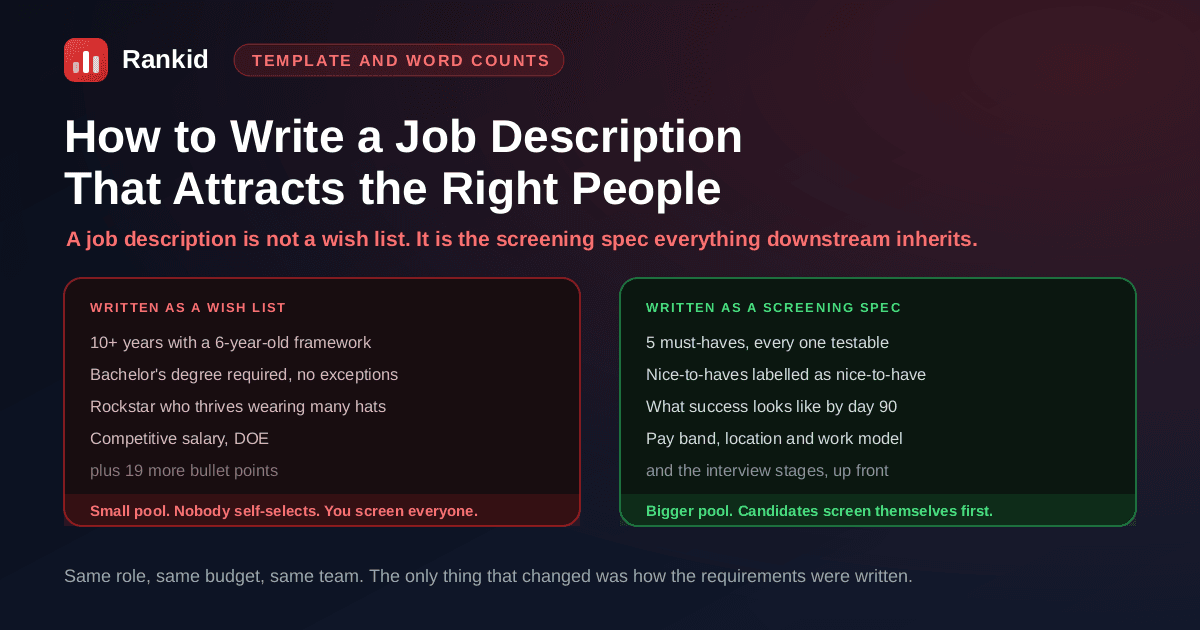
Almost nobody writes a job description from scratch. Someone opens the last one, changes the title, forwards it to the hiring manager, who adds four bullets, then to a second stakeholder, who adds three more. Nothing is ever removed, because removing a requirement feels like lowering the bar. What gets published is a wish list assembled by accretion, and then everyone is surprised when the applicants are wrong. The document is doing exactly what it was built to do. It just was not built to screen anybody.
Quick answer
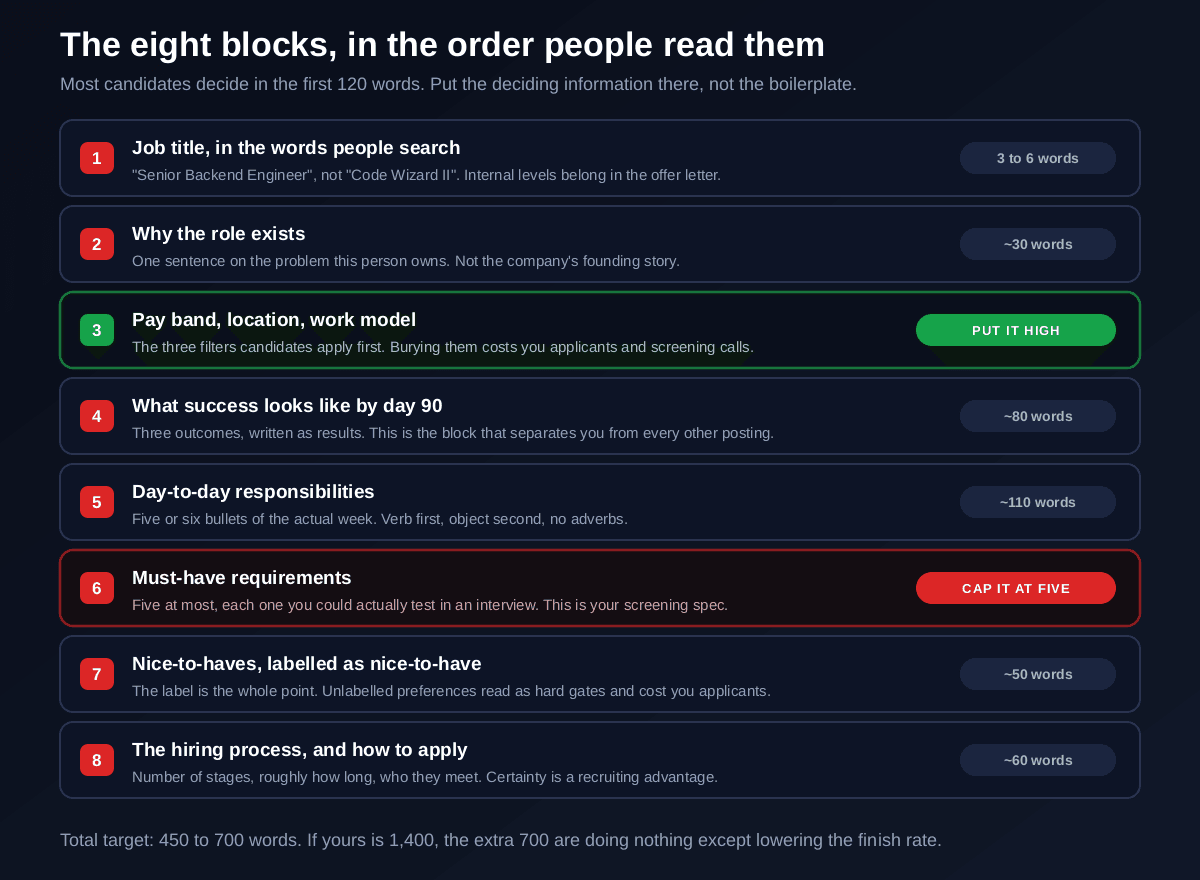
Treat the job description as a screening spec, not an advert. Eight blocks, 450 to 700 words, in the order people read them: title, why the role exists, pay band and location, what success looks like at day 90, real day-to-day work, a maximum of five must-haves, labelled nice-to-haves, and your hiring process. Every requirement has to pass three questions: would you reject a perfect candidate over it, could a strong hire learn it in 90 days, and can you actually test it? Full template and a before-and-after below.
Job description, job posting, or job specification?
These three get used interchangeably, and the confusion is expensive. They have different readers, different jobs, and different lengths, and the single most common hiring mistake is publishing the first one as if it were the second.
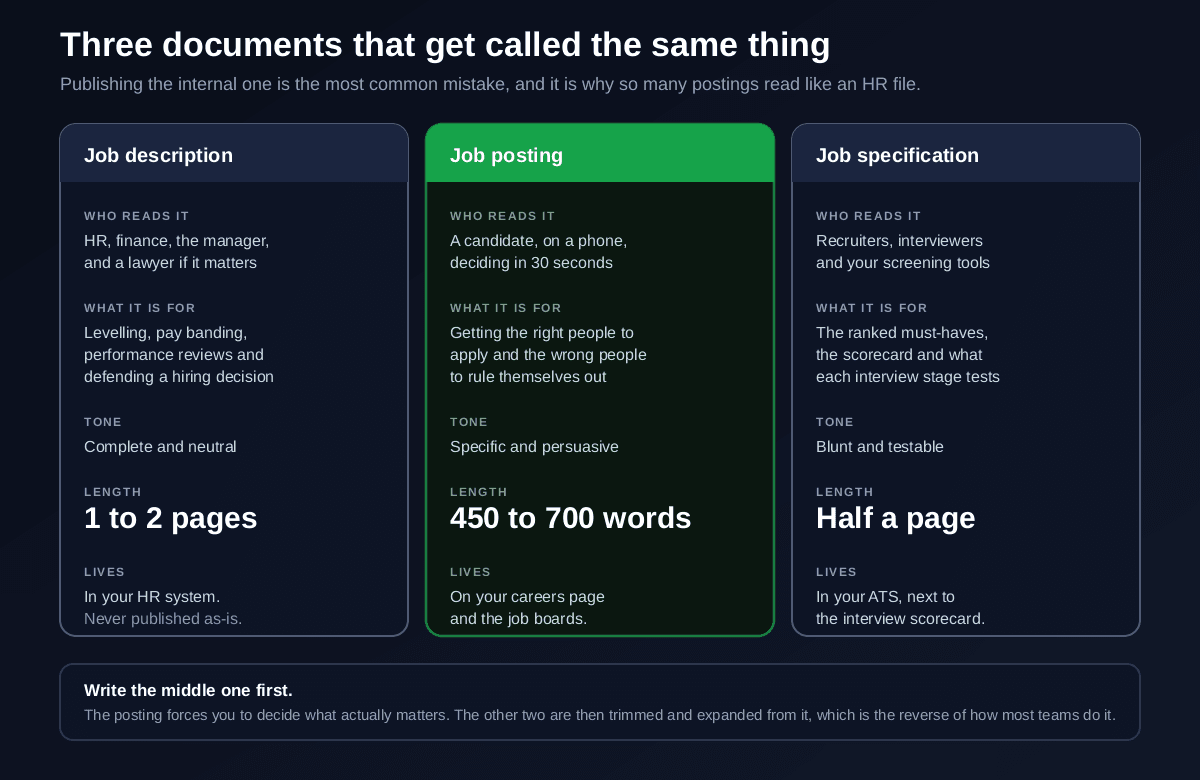
The practical implication is a sequencing one. Most teams write the internal description first and cut it down into a posting, which produces an advert shaped like a policy document. Write the posting first. It forces you to decide what actually matters, because you only have 600 words and a reader who will leave. Then expand it into the formal description for HR, and compress it into the specification your interviewers score against.
What to include in a job description: the eight blocks
Order matters more than completeness here. A candidate reading on a phone decides whether to keep going in the first hundred words or so, and most postings spend those words on the company's founding story. The information that decides whether someone applies should come before the information that describes who you are.
A job title people actually search for
Your internal level is not a title. "Analyst III", "Growth Wizard" and "Member of Technical Staff" are all invisible to somebody typing a role name into a job board. Use the common market title, and if you need the level, attach it plainly: Senior Data Analyst, Staff Product Designer. Title inflation and deflation both cost you: advertising an individual contributor role as a manager brings you managers, and no later screening stage recovers that mistake.
One sentence on why the role exists
Not the company mission. The problem this specific person owns. "We support 40,000 merchants with a three-person support team and no reporting, so we cannot tell which issues are worth fixing. This role builds that visibility." A candidate who reads that knows immediately whether it is their kind of problem, which is the entire point.
Pay band, location and work model, placed high
These are the three filters candidates apply before anything else. Hiding them does not postpone the question, it moves it into a screening call you now have to run, on a candidate who may walk when they hear the number. More on the legal side of this below.
What success looks like by day 90
Three outcomes, written as results rather than activities. "The weekly forecast runs without you chasing three teams for inputs." "Support tickets are categorised well enough that we can name the top five drivers." This block is rare enough that it will differentiate your posting on its own, and it does double duty: it is also the fairest onboarding plan you can give whoever you hire.
The real day-to-day
Five or six bullets describing the actual week. Verb first, real object second, no adverbs, and no "assist with" or "support the team in", which conceal whether the person owns anything. Test it by handing the list to whoever does the job now and asking them to strike anything that does not match their calendar.
Must-have requirements, capped at five
This is the screening spec, and it is where the whole document either works or does not. The next section is entirely about how to get from twenty bullets to five.
Nice-to-haves, labelled as nice-to-have
The label is the functional part. An unlabelled preference reads as a hard gate, and candidates who could do the job well will screen themselves out over it. Write the actual words "nice to have" or "bonus, not required".
Your hiring process, stated up front
How many stages, roughly how long the whole thing takes, who they will meet, and whether there is a take-home task. Certainty is a genuine recruiting advantage, and it costs you nothing to give. If you want to go further, our guide to interview questions that predict performance covers what each stage should actually be testing.
How to write job requirements: must-have versus nice-to-have
Requirement lists grow because adding is polite and deleting is not. Each stakeholder contributes theirs, nobody removes anyone else's, and the role goes live with twenty unranked bullets. The candidate cannot tell which three decide the hire, so the confident apply regardless and the careful do not apply at all. That selection effect is the opposite of what the list was meant to achieve.
The fix is a 30-minute conversation with the hiring manager, running every line through three questions.
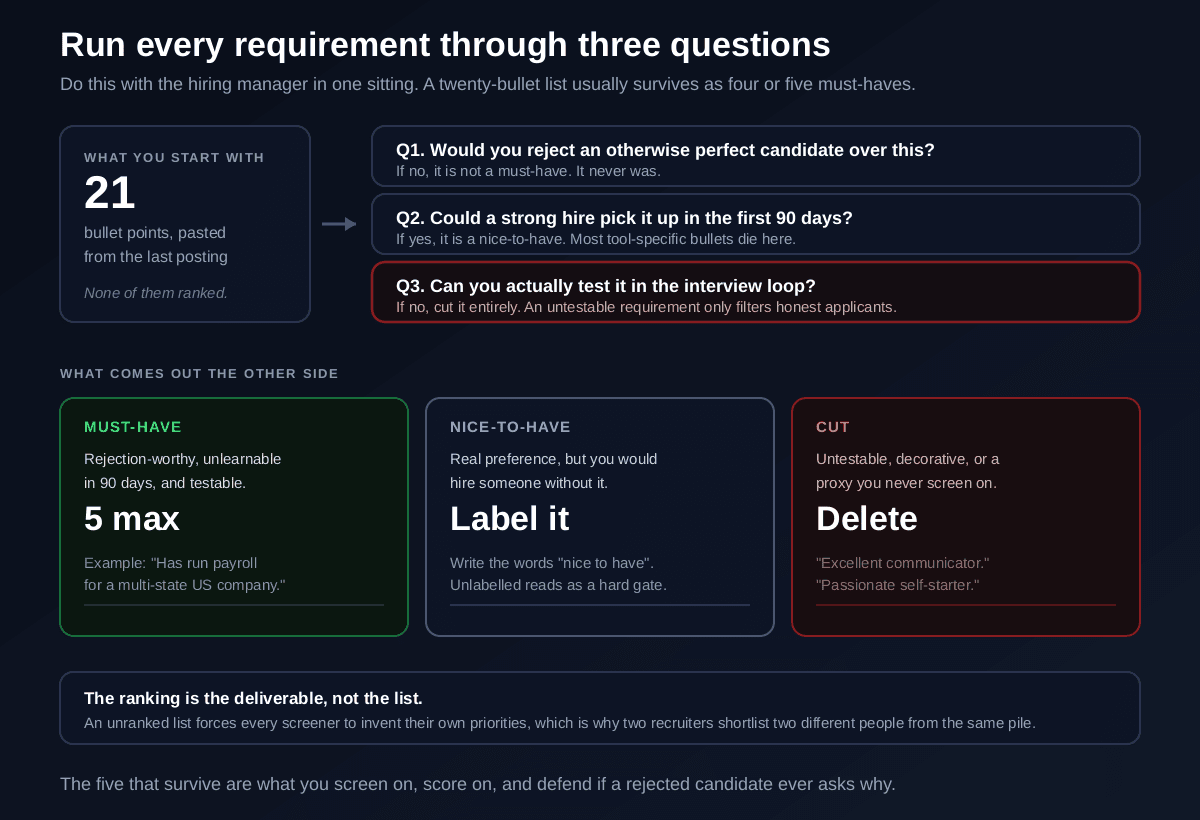
Question three is the one people skip, and it does the most work. "Excellent written communication" survives most reviews because nobody wants to argue against it, but unless you have a stage that actually reads the candidate's writing, it is not a requirement, it is a hope. Every untestable line you publish filters only the applicants honest enough to self-assess.
Watch the years-of-experience number
There is a well-known asymmetry in how candidates respond to unmet requirements, popularised by a Harvard Business Review piece drawing on an internal Hewlett-Packard finding: men tended to apply when they met around 60% of the listed qualifications, women when they met close to all of them. Later survey work by Tara Mohr suggested the driver was not confidence but a belief that the requirements were hard gates that would be enforced during screening. Whatever the exact mechanism, the operational conclusion is the same, and it is cheap: rank your list and label the optional half, because an unranked list is read as a gate by exactly the applicants who take it seriously.
The phrases that quietly shrink your applicant pool
Job posting language is decoded, not read. Candidates who have been through a few hiring processes have learned which cheerful phrases predict which working conditions, and they filter on them before they filter on anything else. Almost none of these were written in bad faith.
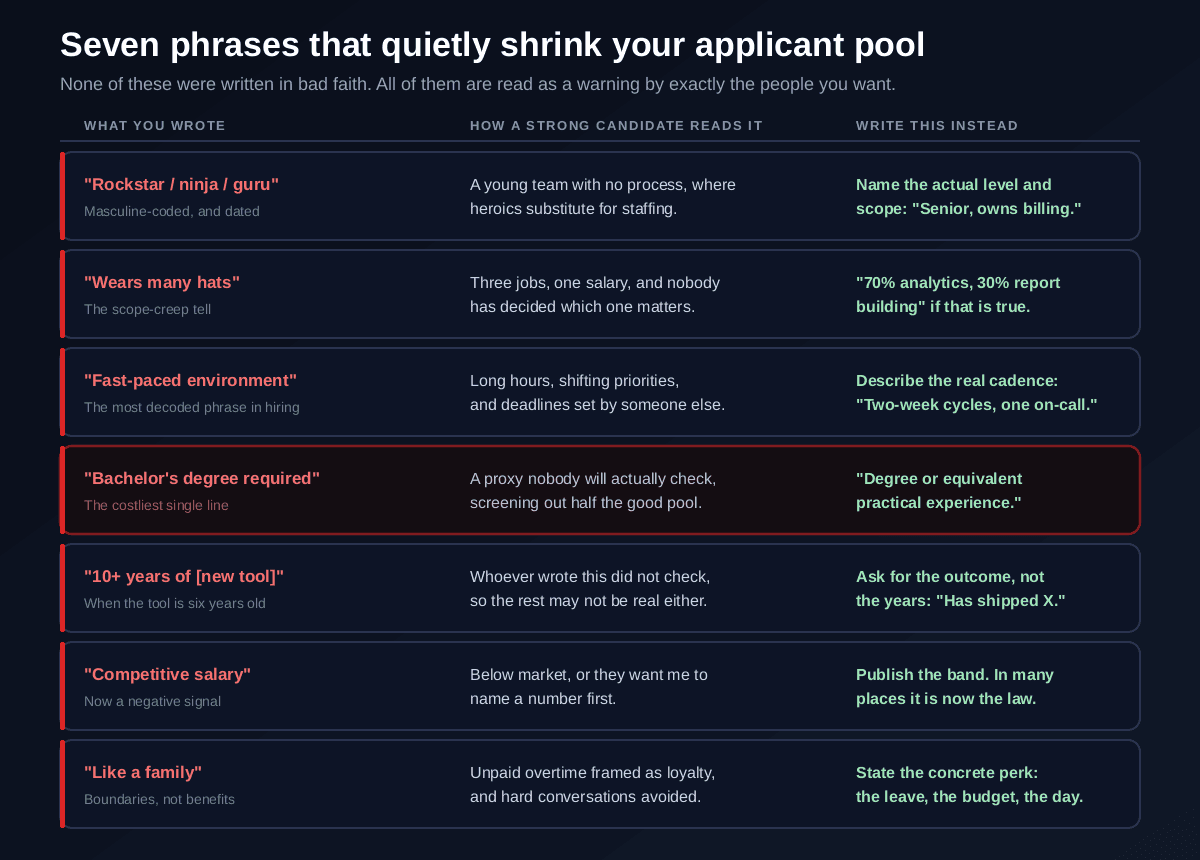
There is also a body of research on gendered wording in job adverts, most cited from work by Danielle Gaucher and colleagues, finding that postings weighted toward masculine-coded language such as competitive, dominant, aggressive and ninja were rated less appealing by women, largely through a reduced sense of belonging rather than any doubt about ability. You do not need to run your posting through a linter to benefit from this. Almost all of those words appear in sentences that are vague anyway, and replacing them with the concrete fact underneath removes the coding as a side effect.
Then there is the filler tier: excellent communicator, detail-oriented, passionate self-starter, team player. These are so universal that they carry no information, and because everyone claims them, they select for nothing except willingness to claim them. Delete the lot. If communication genuinely matters, say what kind: "you will write the weekly summary that the exec team reads, so writing clearly for non-specialists matters".
Should you put the salary range in the job description?
Yes, and increasingly you have no choice. A number of US jurisdictions, including Colorado, California, New York State and New York City, Washington and Illinois, require a good-faith pay range in job postings, and the EU Pay Transparency Directive, which member states were required to transpose into national law by June 2026, requires employers to provide applicants with pay information before the interview stage. The direction of travel is one-way, and postings without a band increasingly look like an outlier rather than a norm.
The commercial case is separate and just as strong. Pay is one of the first filters a candidate applies. Omitting it does not remove the filter, it just relocates it to a screening call you have to staff, on a candidate who may end the conversation the moment they hear the number. "Competitive salary" and "DOE" have both crossed over into negative signals, widely read as below market or as an invitation to bid against yourself.
- Publish a band you would actually honour. A range so wide it spans two levels reads as evasion and invites the same distrust as no number at all.
- Say what moves someone within it.One sentence: "where you land depends on depth of experience with X and whether you have run Y before". This pre-empts the most awkward part of the offer conversation.
- State the rest of the package briefly. Equity, bonus structure, pension, leave. Candidates comparing two offers do it on the total, and you are the only one who can supply the comparison.
See what your job description actually screens for
Paste your job description into Rankid with a batch of resumes and you get each candidate scored against it, with the matched and missing requirements listed. If the scores look wrong, that is usually the description telling you which of its requirements are doing nothing.
Screen resumes freeJob description template (copy and paste)
Replace everything in square brackets. Keep the block order. If a block ends up empty, that is information: it usually means the role has not been thought through yet, and hiring against an unfinished role is how you end up rewriting the posting six weeks in.
[Job title]
[Location] · [On-site / Hybrid, X days · Remote within [region]] · [Full-time] · [£/$ lower] to [£/$ upper] [+ equity / bonus]
Why this role exists
[One or two sentences naming the problem this person owns and why it matters now. No mission statement.]
What you will have done by day 90
[Outcome 1, written as a result.]
[Outcome 2.]
[Outcome 3.]
What the work looks like
[Verb-first bullet describing a real recurring piece of the week.]
[Bullet 2.] [Bullet 3.] [Bullet 4.] [Bullet 5.]
[Who you work with day to day, and who you report to.]
What we need you to have done before (the short list, all five matter)
[Must-have 1, phrased as a thing they have done, not a duration.]
[Must-have 2.] [Must-have 3.] [Must-have 4.] [Must-have 5.]
Nice to have, genuinely not required
[Preference 1.] [Preference 2.] [Preference 3.]
Pay and package
[Band, and one sentence on what determines where in it you land. Then benefits that are actually distinctive.]
How hiring works here
[Number of stages, what each one is, roughly how long from application to offer, and who they will meet.]
[How to apply, and what to send. If a cover letter is optional, say optional and mean it.]
Before and after: the same role, rewritten
A composite of the pattern most postings fall into, and what changes when you apply the rules above.
Before
Marketing Ninja (Rockstar!)
Founded in 2016, [Company] is a fast-growing, mission-driven leader in the [category] space. We are looking for a passionate, detail-oriented marketing rockstar to join our fast-paced team, where you will wear many hats and thrive under pressure. We are like a family here.
Requirements: Bachelor's degree in Marketing or related field required. 7+ years of experience. Excellent written and verbal communication skills. Self-starter with a can-do attitude. Proficiency in Excel, PowerPoint, Word, Google Analytics, GA4, HubSpot, Marketo, Salesforce, Canva, Figma, Hootsuite, SEMrush, Ahrefs, Mailchimp, Klaviyo and Webflow. Experience with SEO, SEM, PPC, ABM, CRO, email, social, content, events, PR, brand and product marketing. Must be a team player. Competitive salary DOE.
Count the failures. The title is unsearchable. The first 40 words are about the company. Twenty-plus tools are listed as though they were all required, which tells a reader that nobody has decided what the role is. Seven years is a proxy standing in for something unstated. Every requirement is either untestable or unranked, and the pay is hidden. This posting will produce a small pool and, within it, mostly people who ignored the list.
After
Lifecycle Marketing Manager
London · Hybrid, 2 days in office · £58,000 to £72,000 + 10% bonus
Why this role exists. We acquire around 3,000 trial signups a month and convert 4% of them. Nobody currently owns what happens between signup and day 30. You will.
By day 90 you will have: mapped the trial-to-paid journey and identified where the drop-off actually happens; shipped a rebuilt onboarding email sequence and measured it against the current one; and established a monthly lifecycle report the exec team reads without asking questions.
The work: own the lifecycle email and in-product messaging calendar; run experiments end to end, from hypothesis to readout; work weekly with one product designer and one data analyst; report to the Head of Growth.
What we need you to have done before (all four matter): built and shipped a lifecycle or onboarding email programme for a self-serve product; run A/B tests and interpreted the results yourself, including deciding when a result is not real; worked directly in an ESP such as Klaviyo, Braze, Customer.io or similar; written customer-facing copy that you were responsible for, not briefed out.
Nice to have, not required: SQL for pulling your own cohorts; B2B SaaS experience; exposure to in-product messaging tools.
Where you land in the band depends on how much of the programme you have owned end to end rather than executed within.
Hiring: a 30-minute call with the recruiter, a 45-minute conversation with the Head of Growth, and a 60-minute working session on a real problem, no take-home. Around two weeks start to finish. Apply with a CV. A cover letter is genuinely optional, and we read the first one either way.
Four testable must-haves instead of twenty-two. A pay band. Three outcomes anyone could verify at the end of a probation period. The posting is now shorter than the original and does far more work, because most of what was cut was doing nothing.
Write it so your screening tools can read it too
The job description is not just an advert. It is the specification every downstream step inherits: the recruiter screen, the interview scorecard, the ATS filter and any matching or ranking tool you run resumes through. Vague requirements degrade all of them at once.
This matters most for automated matching. A tool scoring a resume against a role treats your requirement list as the ground truth. If the list has twenty unranked entries, the tool has no way to know that three of them decide the hire, and a candidate strong on those three can score below one who is weak on them but broadly adjacent. Phrasing has the same effect: "experience with reporting tools" matches nearly any resume, while "has built dashboards in Looker or Power BI for a non-technical audience" matches something real. This is the mirror image of the advice we give candidates on resume keywords, and it is the same mechanism seen from the other side of the table.
- Name skills the way the industry names them,including the common variant. "Power BI" and "PowerBI", "Google Analytics 4 (GA4)". Both humans and parsers are matching strings some of the time.
- Keep each must-have to one requirement."5+ years in a fast-paced agency managing cross-functional stakeholders and reporting" is four requirements in a trench coat, and no scoring system can resolve it.
- Put requirements under a plainly labelled heading. Requirements buried inside narrative paragraphs are invisible to most parsing.
- Use your ranked list as the scorecard. The same five must-haves should drive the resume screen, the phone screen and the interview loop. Our guide to resume screening criteria covers turning them into a usable scoring sheet.
Once the requirements are tight, the volume problem becomes tractable: you can score a whole pile against them consistently rather than having each screener apply their own priorities. That is the process we walk through in how to shortlist candidates from resumes and, for larger volumes, in how to screen resumes in bulk.
Seven mistakes worth checking for before you publish
- Publishing the internal document.If the posting contains phrases like "and other duties as assigned" or a reporting-line hierarchy, you published the wrong file.
- Front-loading the company story. Move it below the responsibilities. Nobody has ever applied because of paragraph one.
- Requirements nobody has ever rejected anyone for. Compare your list against the real reasons your last five rejections happened. Anything that never appears is not a requirement.
- A title that does not match the level. Check it against what the market calls this job and what you are actually paying.
- No named contact or process. Silence about the process reads as a slow process. Our breakdown of how long candidates wait to hear back shows what that silence costs you in drop-off.
- Copying a competitor's posting. You inherit their requirement inflation and their euphemisms, and you describe their role rather than yours.
- Never revisiting it. Re-read the posting against what your last two hires actually did in their first six months. The gap is usually the whole edit.
Key takeaways
- A job description is a screening spec. Every shortlist, scorecard and match score downstream inherits its vagueness.
- Write the external posting first (450 to 700 words), then expand it into the internal description and compress it into the interview specification.
- Eight blocks, in reading order: title, why the role exists, pay and location, day-90 outcomes, real day-to-day, must-haves, labelled nice-to-haves, hiring process.
- Cap must-haves at five. Each one must be rejection-worthy, unlearnable in 90 days, and testable in your interview loop.
- Label the nice-to-haves in words. An unranked list is read as a set of hard gates by exactly the candidates who take it seriously.
- Publish the pay band. It is legally required in a growing number of places, and 'competitive salary' now reads as below market.
- Replace years-of-experience proxies and untestable filler with specific things the person has done before.
- Tight, singular requirements improve human screening and automated matching at the same time, because both read the same document.
Test your job description against real resumes
Drop your job description and a batch of CVs into Rankid. Every candidate comes back scored against your requirements, with the matched skills and the missing ones itemised, so you can see which requirements are actually separating people and which are just sitting there.
Try it freeFrequently asked questions
How do you write a job description?
Write it in eight blocks, in the order a candidate reads them. A plain job title people actually search for. One sentence on why the role exists. The pay band, location and work model, placed high rather than buried. Three outcomes describing what success looks like by day 90. Five or six bullets of genuine day-to-day responsibilities. A maximum of five must-have requirements, each one you could test in an interview. Nice-to-haves, explicitly labelled as nice-to-have. And the hiring process itself: how many stages, roughly how long, who they will meet. Aim for 450 to 700 words. The discipline that matters most is the requirements block: run every bullet past the question "would I reject an otherwise perfect candidate over this?" and demote everything that survives as a no.
What is the difference between a job description and a job posting?
A job description is an internal document. It exists for levelling, pay banding, performance reviews and defending a hiring decision, it is written in complete and neutral language, and it runs one to two pages. A job posting is the external advert. It exists to get the right people to apply and the wrong people to rule themselves out, it is specific and persuasive, and it runs 450 to 700 words. A job specification is a third document, usually half a page, that lists the ranked must-haves and what each interview stage tests, and it lives in your ATS next to the scorecard. The most common mistake in hiring is publishing the internal job description as the advert, which is why so many postings read like an HR file rather than an invitation.
How long should a job description be?
For a published job posting, 450 to 700 words is the practical range, which is roughly a two to three minute read. Below about 300 words you have usually left out the information candidates need to decide, particularly pay and scope, so you get volume without fit. Above about 900 words, completion drops, and the extra length is nearly always boilerplate, legal text, and requirements nobody will screen on. The internal job description can be longer, one to two pages, because its readers are paid to finish it. If your posting is 1,400 words, the fix is not editing sentence by sentence. Delete the blocks that serve the company rather than the reader, then rewrite what remains.
How many requirements should a job description have?
Five must-haves at most, plus a short labelled list of nice-to-haves. Requirement lists grow because each stakeholder adds their own and nobody deletes any, so a role ends up with twenty unranked bullets that no candidate can weigh. Three questions cut it down. Would you reject an otherwise perfect candidate for missing this? If no, it is a nice-to-have. Could a strong hire learn it in the first 90 days? If yes, it is a nice-to-have. Can you actually test it in the interview loop? If no, cut it entirely, because an untestable requirement filters only the honest applicants while everyone else claims it anyway.
Should you include the salary range in a job description?
Yes, and in a growing number of places you are legally required to. Several US states and cities including Colorado, California, New York, Washington and Illinois require a good-faith pay range in job postings, and the EU Pay Transparency Directive, which member states were required to transpose by June 2026, requires employers to give applicants pay information before the interview. Beyond compliance, the practical case is stronger: pay is one of the first filters candidates apply, so omitting it does not delay the conversation, it just moves it to a screening call you now have to hold. "Competitive salary" has become a negative signal, widely read as below market. Publish a real band you would honour, and say what determines where someone lands in it.
What words should you avoid in a job description?
Avoid three families of language. Masculine-coded and hype words such as rockstar, ninja, guru, aggressive and dominant, which research on gendered wording has linked to fewer women applying and which read as dated to senior candidates generally. Euphemisms that experienced candidates decode as warnings: fast-paced environment, wears many hats, like a family, must thrive under pressure. And unfalsifiable filler such as excellent communicator, passionate self-starter and detail-oriented, which appears in almost every posting, cannot be tested, and therefore selects for nothing. Replace each one with the concrete fact underneath it: the actual level and scope, the actual cadence of the work, the actual split of responsibilities.
Why do job descriptions get so many unqualified applicants?
Usually because the posting gave candidates nothing to disqualify themselves with. If the requirements are unranked, the scope is vague and the pay is hidden, applying is close to free and the rational move for a marginal candidate is to apply anyway. Postings that publish a pay band, state the seniority in plain terms, and name three or four concrete must-haves tend to get a smaller and better-fitting pool, because the wrong people opt out before you spend time on them. The second cause is title inflation and deflation: a role advertised as "Marketing Manager" that is really an individual contributor coordinator role will attract managers, and no amount of screening later recovers that.
Do job descriptions affect ATS matching and resume scores?
Directly. Any tool that scores a resume against a role, whether an ATS keyword filter or a semantic matching engine, treats the job description as the specification. If your description contains twenty unranked requirements, the tool has no way to know that three of them decide the hire, so a candidate strong on the three and weak on the other seventeen can score below a candidate who is the reverse. Vague phrasing has the same effect: "experience with reporting tools" matches almost anything, while "has built dashboards in Looker or Power BI for a non-technical audience" matches something specific. Writing tight, testable requirements improves both human screening and automated ranking, because they are reading the same document.
Should a job description require a degree?
Only if the role genuinely cannot be done without one, or a regulator requires it. A blanket degree requirement is a proxy that removes a large share of otherwise capable applicants, and many large employers have removed it from most roles for exactly that reason. The test is whether you would actually reject a candidate who aced every stage of your interview loop but had no degree. If you would not, the line does not belong under must-haves. "Degree or equivalent practical experience" is the standard compromise, and it costs you nothing. Where the degree matters because of a specific licence, accreditation or client requirement, say which one and why, and it stops reading as a gate and starts reading as a fact.
What is a job specification?
A job specification is the internal, screening-facing document that turns a role into criteria. It is typically half a page and lists the ranked must-haves, the nice-to-haves, what each interview stage tests, and what a good answer looks like. Where the job description defines the role and the posting sells it, the specification is what recruiters and interviewers actually score against, which is why it belongs in your ATS next to the scorecard rather than in a shared drive. The practical benefit is consistency: without one, every screener invents their own priorities, which is how two recruiters shortlist two entirely different people from the same pile of resumes.
How do you write the responsibilities section of a job description?
Describe the actual week, not the whole job architecture. Five or six bullets, each starting with a verb, each naming a real object: "Run the weekly forecast cycle with sales and finance" rather than "Responsible for forecasting activities as required". Cut every adverb and every instance of "assist with" or "support the team in", which tell a candidate nothing about ownership. If a responsibility takes less than a few hours a month, it is not a responsibility, it is a task, and it belongs in the interview conversation rather than the posting. A useful check: ask the person currently doing the job to read the list and mark anything that does not match their calendar.
How often should job descriptions be updated?
Review them every time you open the role, and rewrite them properly at least once a year for roles you hire into repeatedly. Job descriptions decay quietly. Tools change, the team around the role changes, and the requirement list keeps accumulating bullets from previous hiring managers that nobody has ever removed. The cheapest audit is to compare the posting with what the last two hires actually spent their first six months doing, and with the reasons your last five rejected candidates were rejected. If a listed requirement has never once been the reason someone was rejected, it is not a requirement, and deleting it will widen your pool at no cost.