Resume Screening Criteria: The Checklist Recruiters Use to Screen Fast in 2026
Screening resumes without a fixed set of criteria is just gut feel with extra steps. You tell yourself you know a strong candidate when you see one, but by the fortieth resume the standard has quietly moved, and the person you rank highly at 9am is not the person you would have ranked highly at 4pm. Resume screening criteria fix that: they are the checklist you decide on before you open a single file, so every candidate is measured against the same bar instead of against your mood and the last resume you read.
Quick answer
Why fixed criteria beat gut feel
The case for a checklist is not bureaucracy, it is accuracy. Human screening has two failure modes that criteria are designed to remove. The first is drift: the standard you apply early in a pile is not the standard you apply late in it, because fatigue and the resumes you just saw keep moving the bar. The second is halo: one impressive line, a big-name employer or a polished summary, colors how you read everything else, and a candidate gets credit for skills they never actually listed.
A fixed, weighted set of criteria neutralizes both. When every resume is scored on the identical list, candidate 1 and candidate 200 are judged the same way, and a strong summary cannot quietly earn points that belong to a missing skill. That is also what makes your decision defensible: instead of "these felt right," you have a score with the reasons attached. This is the same consistency argument we make for doing the first pass in bulk in how to screen resumes in bulk, just focused here on the criteria themselves.
The five resume screening criteria that matter
Almost everything worth scoring a resume on falls into five categories. Together they are the checklist; the weights you give them are what tailor it to a specific role.
- Must-have skills and tools. The specific technologies, methods and certifications the role genuinely cannot be done without. These are pass or fail: a real gap here should sink an application no matter how strong the rest looks. Count them as a coverage ratio (nine of ten) so two candidates are measured on the same denominator.
- Keyword and phrasing match.Whether the resume uses the language of the posting. This matters because it is exactly what an applicant tracking system reads, and because a real skill named differently can otherwise be missed. Score the coverage of the posting's key terms, not just their presence.
- Seniority and title fit.Whether the candidate's level and past titles line up with what the role expects, so a senior posting is not topped by a junior profile that matched on keywords alone.
- Relevant experience. Not total years, but years in a field related to the role. Five years in an unrelated domain should not outweigh three years of directly relevant work, so weight relevance, not raw tenure.
- Nice-to-have skills. The bonus items that separate close candidates but should never be dealbreakers. Give them a small weight so they break ties without burying an otherwise strong applicant who happens to miss one optional tool.
The one rule that prevents most bad screens
Turn the criteria into a weighted scorecard
Criteria only work when they are weighted, because not every requirement matters equally. A scorecard assigns each criterion a share of 100 points, scores the candidate against each, and sums them into a single comparable number. Here is what that looks like for one candidate against a typical role.
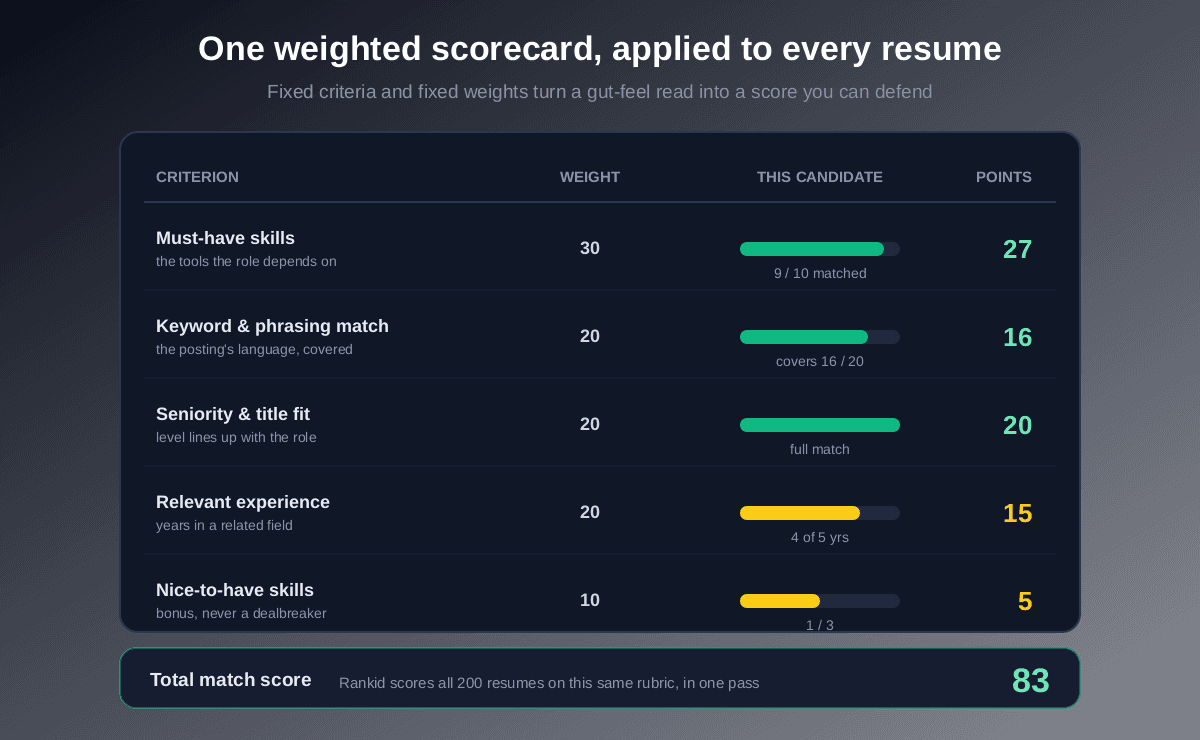
The weights are the judgment call, and they should change per role. A hands-on engineering position might put 30 points on must-have skills; a leadership hire might shift weight onto seniority and relevant experience. What must not change within a single role is the scorecard itself: once set, the same weights apply to every candidate, which is the whole point.
How to screen a resume against the criteria, step by step
Build the checklist from the job description
Read the posting once and pull out the must-have skills, the required seniority, the relevant experience it asks for, and the nice-to-haves. Assign each a weight out of 100. Do this before you open a single resume so the standard is locked in and cannot drift.
Check the must-haves first
Scan each resume for the non-negotiables before anything else. If a genuine must-have is missing, you can stop there. Front-loading the pass or fail criteria means you spend detailed attention only on candidates who can actually do the job.
Score the finer criteria
For candidates who clear the must-haves, score keyword coverage, seniority fit, relevant experience and nice-to-haves against the weights you set. Coverage ratios beat impressions: "matches 16 of 20 keywords" is more useful and more consistent than "seems to fit."
Rank by total score and read top down
Sum each candidate into a single score, sort highest to lowest, and work the list from the top. Draw your shortlist where the scores clearly drop off. This connects directly to how to shortlist candidates, the criteria produce the ranking, the ranking produces the shortlist.
Keep a human on the borderline cases
Scores cluster into a clear top, a clear bottom, and a middle band. Read the middle for transferable experience or a required skill phrased differently from the posting. The scorecard ranks; you decide the close calls.
Apply one scorecard to every resume, free
Paste the job description into Rankid and upload your resumes. It scores every candidate 0 to 100 on the same criteria, the skills, keywords, seniority and relevant experience the role needs, and ranks them so you read the strongest first. Screen up to 200 resumes per batch, and your first 5 are free, no signup needed.
Screen resumes freeApplying the same criteria to a whole stack at once
A scorecard is powerful for one resume and exhausting for three hundred. The moment a role pulls hundreds of applicants, applying the criteria by hand runs straight back into the drift and fatigue the criteria were meant to prevent. This is where the checklist and bulk screening meet: instead of you running the scorecard on each file, you define the criteria once as the job description and let a tool apply them to the entire batch in a single pass.
The mechanic is the same one behind bulk resume analysis and comparing resumes to a job description: every candidate is scored on the identical weighted criteria at once, so consistency is built in and the strongest fits rise to the top. You get the fairness of a rubric with none of the hours, and you spend your judgment on the ranked shortlist rather than on parsing files.
Screening criteria mistakes to avoid
- Treating nice-to-haves as must-haves. The most common and most costly error. Keep optional skills at a low weight so they break ties, not candidates.
- Scoring on total experience instead of relevant experience. Years in an unrelated field are not a qualification. Weight relevance.
- Changing the criteria mid-pile. If you tweak weights after resume 50, the first 49 were scored on a different standard. Lock the scorecard before you start.
- Auto-rejecting on the raw score. Criteria are for prioritizing who you read first, never for silently discarding the bottom. Transferable experience often hides in the middle band.
- Using a vague job description as the source. Thin criteria in, thin screen out. The richer the posting, the sharper every score.
Key takeaways
- Fixed criteria beat gut feel because they remove drift and halo effects, so every candidate is judged on the same bar.
- The five criteria that matter: must-have skills, keyword match, seniority fit, relevant experience, and nice-to-haves as a bonus.
- Weight the criteria into a scorecard out of 100, and separate must-haves from nice-to-haves before you start.
- Check the must-haves first, then score the finer criteria, then rank by total and read top down.
- Rankid applies the same weighted criteria to up to 200 resumes at once, scored 0 to 100, and your first 5 are free with no signup.
Bottom line: the quality of your screen is the quality of your criteria. Define the five that matter, weight them for the role, and apply the same scorecard to everyone, whether that is five resumes or five hundred. Run your next batch through Rankid's free bulk screening and let one consistent scorecard turn a pile of resumes into a ranked, defensible shortlist in minutes.
Frequently asked questions
What criteria should you use to screen resumes?
Screen against the requirements the role actually depends on, not everything in the posting. The five criteria that matter most are: must-have hard skills and tools, how well the resume matches the keywords and phrasing of the posting, job title and seniority alignment, the amount of relevant (not just total) experience, and nice-to-have skills weighted as a bonus rather than a dealbreaker. Decide which items are non-negotiable before you start, give each a weight, and apply that same set to every candidate. A tool like Rankid applies this kind of weighted criteria to a whole batch of resumes at once so every candidate is measured identically.
What is a resume screening checklist?
A resume screening checklist is a fixed list of the criteria you score every applicant against, set before you open the first resume so your standard cannot drift. A good one separates must-haves from nice-to-haves, assigns a weight to each criterion so the important things count more, and turns into a single comparable score per candidate. The point is consistency: candidate 1 and candidate 200 are judged on the identical list, which is both faster and fairer than reading on instinct.
What should you look for first when screening a resume?
Start with the must-have requirements, the two or three things a person genuinely cannot do the job without, usually the core hard skills or tools and the required seniority. If a resume misses a true must-have, no amount of polish elsewhere changes the outcome, so checking these first saves time. Only once a candidate clears the must-haves do the finer criteria like keyword coverage, relevant experience depth, and nice-to-haves decide where they rank.
How do you screen resumes objectively and fairly?
Objectivity comes from applying the same weighted criteria to every candidate and from scoring against the job description rather than against the last resume you read. Fix the criteria and weights up front, separate must-haves from nice-to-haves, and treat the score as a summary you can open up and inspect, not a verdict. Because software applies an identical rubric to every resume at once, it removes the fatigue and drift that make manual screening inconsistent, but a human should still review the evidence behind each score and make the final call.
How long should it take to screen one resume?
A careful manual screen against clear criteria takes roughly one to two minutes per resume, which is fine for a handful but becomes hours once a role pulls hundreds of applicants. That is why the criteria matter more than the speed: a fixed scorecard lets you apply the same standard quickly, and a bulk tool applies it to the entire stack in a single pass so your time is spent reviewing a ranked shortlist instead of grinding through every file.
Can you automate resume screening criteria?
Yes. Once your criteria are defined as a weighted checklist, a tool can apply them to every resume automatically. You paste the job description as the source of the criteria, upload the resumes, and the tool scores each candidate against the same skills, keywords, seniority and experience, then ranks them by fit. Rankid does this for up to 200 resumes in a single batch, and your first 5 are free with no signup, so you get a consistent, defensible score for every candidate instead of a gut-feel read.