Interview Questions to Ask Candidates: 40 That Predict Performance
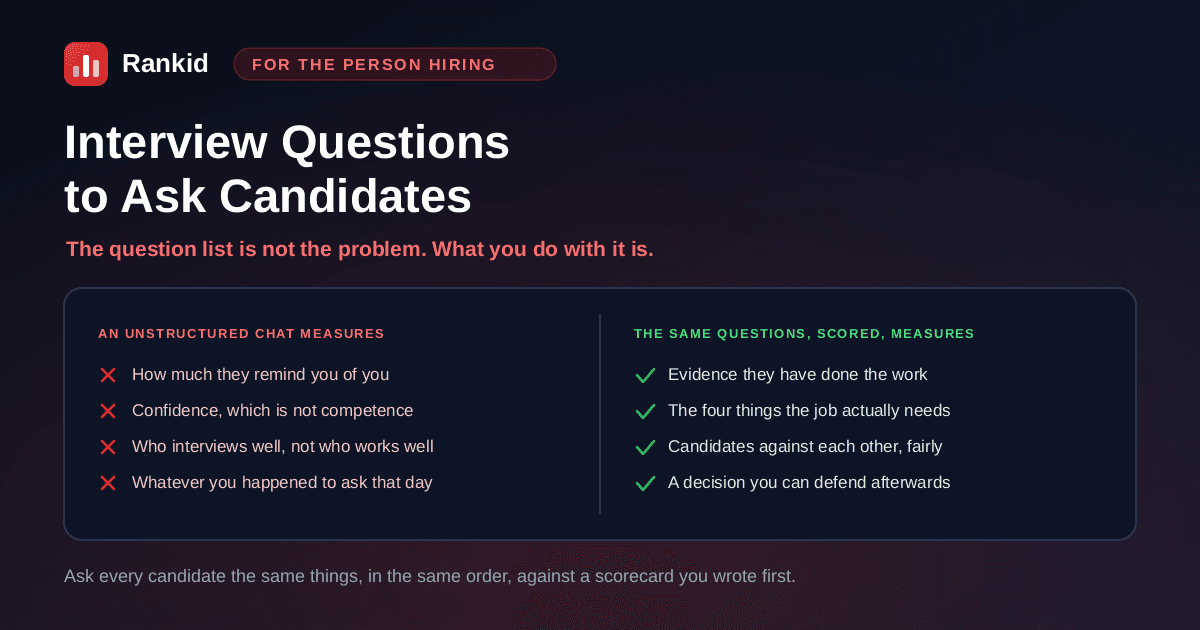
Most hiring managers prepare for an interview by finding a list of questions. That is the wrong preparation, and it explains a lot about why interviews so reliably select the most confident candidate rather than the most capable one. The list is not what determines whether an interview works. What determines it is whether you asked every candidate the same things, and whether you decided in advance what a good answer looks like. Get that part right and a fairly ordinary question set works well. Get it wrong and no question, however clever, saves you.
Quick answer
Write a four-criteria scorecard before you write any questions. Ask the same four to six substantive questions of every candidate, in the same order, then follow up freely. Prefer work samples and past behaviour over hypotheticals and self-assessment. Score immediately and independently, before the debrief. Drop greatest weakness, five-year plans and brainteasers, and never ask about anything on the protected list.
Why most interviews do not work
An unstructured interview, meaning a conversation that goes wherever it goes and is judged on overall impression, is close to the weakest common tool in hiring. It mostly measures three things: how articulate someone is under social pressure, how much they resemble the person interviewing them, and what you happened to be curious about that particular afternoon. None of those is the job.
The fix is not a better list of questions, and this is where most advice goes wrong. It is consistency plus pre-defined criteria. Ask the same core questions of everyone so the answers are comparable, decide beforehand what separates a strong answer from a weak one, and record scores before you talk to your colleagues. Everything else in this article sits on top of that.
Structured does not mean stiff. You can be warm, you can go off on a tangent, and you should follow up hard on whatever the candidate says. What stays fixed is the question set and the scoring, not the tone of the conversation.
Write the scorecard before the questions
This is the step almost everyone skips, and doing it takes about twenty minutes per role. Pick four criteria that genuinely determine success in this job, weight them, and write down what a 1 and a 4 look like in observable terms. Then choose questions that produce evidence against those criteria.
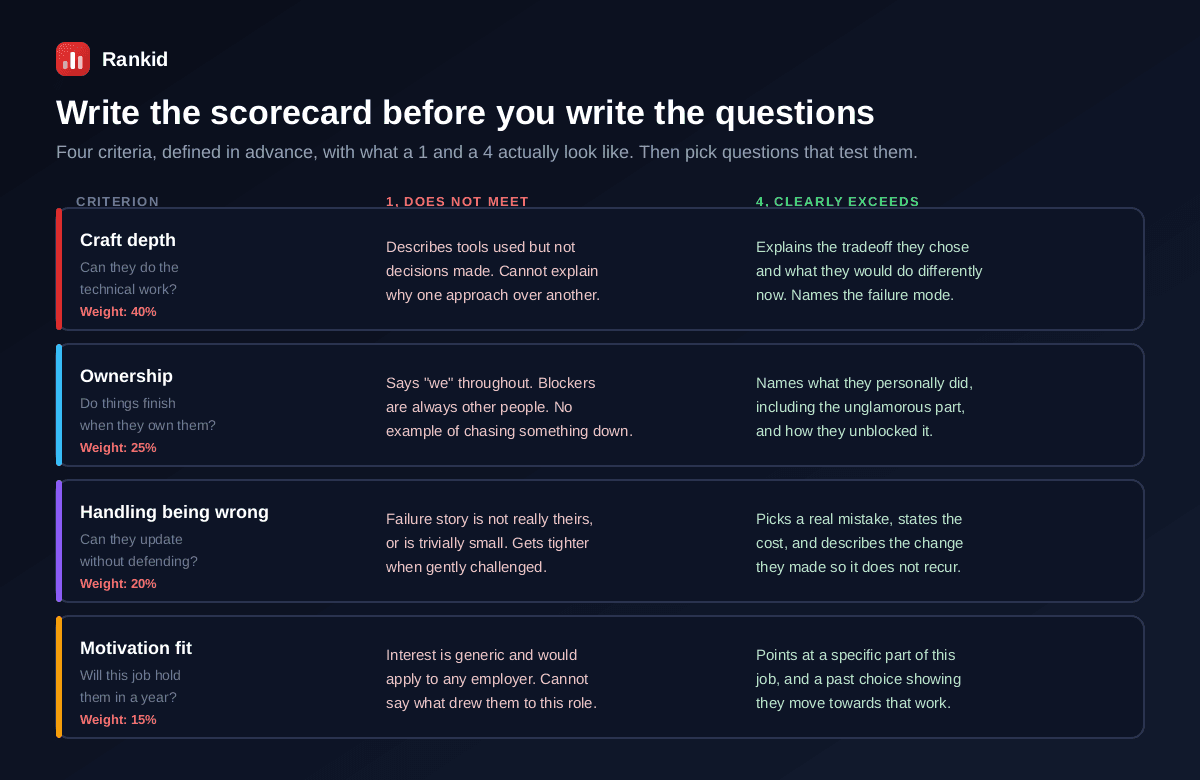
Writing the anchors is what makes a scorecard work rather than just look organised. Without them, two interviewers both give a 3 and mean completely different things, and the debrief becomes a negotiation between impressions. With them, a disagreement is productive, because you can point at what you heard.
Weights matter too. If craft depth is 40% of the decision, then two of your questions should be aimed at it, and a candidate who is delightful but scores a 2 there should not survive on charm. Deciding the weights before you meet anyone is the whole point, because deciding them afterwards is just rationalising a preference. This is the same logic as defining resume screening criteria before you open the pile. For the full anatomy of the sheet itself, including a template, worked anchors and how to run the debrief, see the interview scorecard guide.
Five kinds of question, ranked by what they tell you
Not all questions are equally informative, and the difference is large. Spend your limited slots at the top of this list.
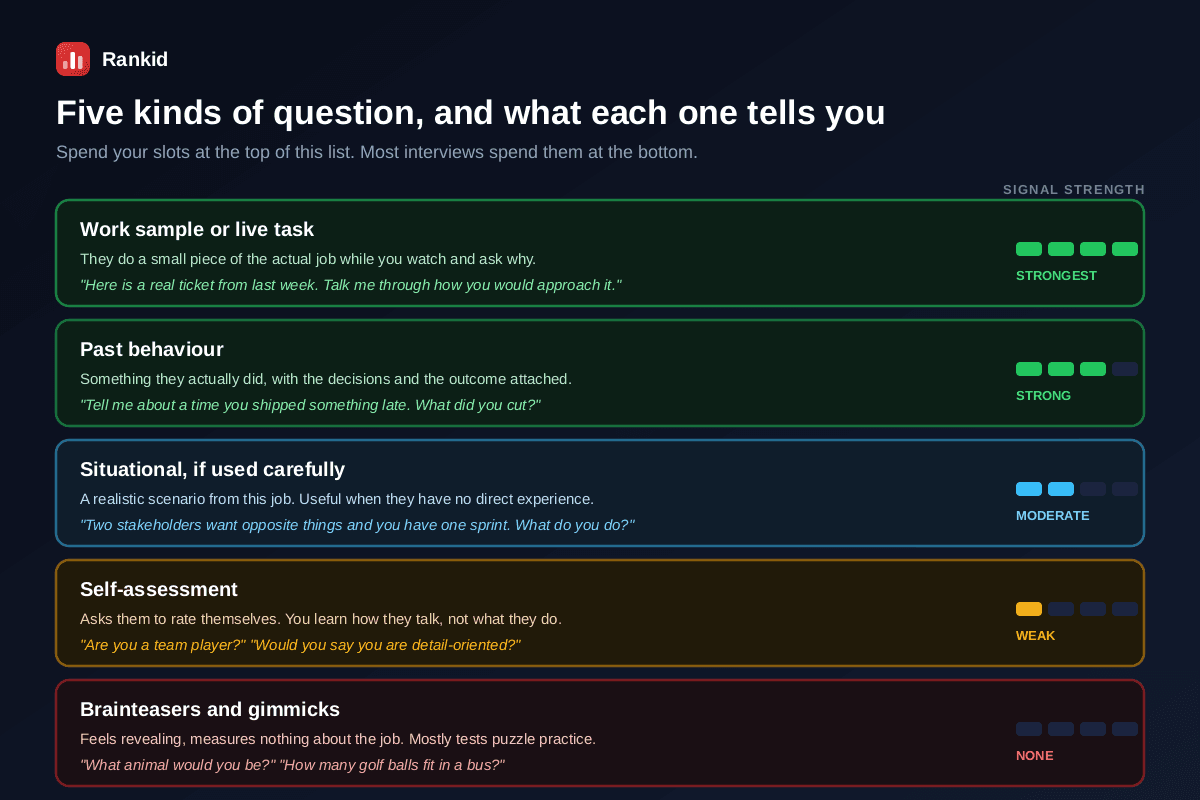
The single most useful shift most interviewers can make is replacing "how would you handle..." with "tell me about a time you did...". Hypotheticals reward people who are good at describing ideal behaviour. Past behaviour forces them to produce something that actually happened, complete with the messy parts, and the follow-up questions have somewhere real to go.
The 40 questions, grouped by what they measure
Pick four to six from these per interview, chosen to hit your scorecard criteria. Do not work through them.
Craft and capability
- Walk me through something you built or owned end to end.
- What was the hardest technical decision in that project, and what did you choose?
- What did you get wrong on it, and when did you realise?
- How do you decide something is finished?
- What part of your last role were you the go-to person for?
- Here is a real problem from last week. How would you approach it?
- What would you have needed to do that project twice as fast?
- Which tools or methods have you dropped, and why?
Ownership and follow-through
- Tell me about something you finished that nobody was chasing you for.
- Describe a time you had to ship with less than you wanted. What did you cut?
- When did you last have to chase something across team boundaries?
- Tell me about a commitment you missed. What happened next?
- What is something you fixed that was not your job?
- How do you keep track of what you owe people?
How they handle being wrong
- Tell me about a real mistake with a real cost.
- What is something you changed your mind about in the last year, and what changed it?
- Describe a time your manager disagreed with your approach.
- When did you last receive feedback you initially disagreed with?
- What would your last manager say you needed to work on?
- Tell me about a project that failed. What was your part in it?
Working with people
- Tell me about a disagreement with a colleague that you resolved.
- Describe a time you had to persuade someone more senior than you.
- How do you handle it when a stakeholder wants something you think is wrong?
- Tell me about someone difficult you worked with productively anyway.
- When did you last have to deliver bad news to someone?
- What do you need from a manager to do your best work?
Motivation and fit for this role
- What made you apply to this role specifically?
- What part of your current job would you be happy never to do again?
- What kind of problem do you find genuinely absorbing?
- What would make you leave a job you were otherwise doing well in?
- Which part of this role do you think you would be least good at?
Judgment and prioritisation
- Tell me about a time you had more work than was possible. How did you choose?
- Describe something you decided not to do, and how you defended it.
- How do you decide between two options when the data does not settle it?
- Tell me about a time you escalated something. Was it the right call?
- What is the last thing you deprioritised, and who was unhappy about it?
Learning and ambiguity
- Tell me about something you had to learn fast with no support.
- Describe a time the goal was unclear. What did you do first?
- How do you get up to speed in an area you know nothing about?
- What have you taught yourself in the last year?
8 strategic interview questions to ask candidates
Strategic questions test how someone reasons about the work rather than whether they have performed a specific task, which makes them most valuable for senior hires, ambiguous roles, and jobs that did not exist last year. They still need a scoring criterion attached, or they are just an interesting conversation.
- If you joined and after 90 days concluded the team was working on the wrong problem, what would you actually do?
- What would you need to stop doing in order to succeed in this role?
- What would you want to be true in your first month for you to feel this was going well?
- If I gave you this team and half the budget, what would you protect?
- What is the part of this job you would be least good at, and how would you cover it?
- What is a widely held view in your field that you think is wrong?
- How would you know, six months in, that you had made a bad decision here?
- What would make you turn this role down?
The last one is not a trick
Unique questions that work, and gimmicks that do not
There is a real appetite for distinctive questions, and a real trap in it. A distinctive question works when it is specific, not when it is merely unusual. The test: does an honest answer require a real example or a genuine opinion?
These work."What is something you believe about this work that most people in your role disagree with?" "What is the best decision you made that looked wrong at the time?" "What would the person who liked working with you least say about you?" "Which of your past projects would you refuse to do the same way again?" Each requires the candidate to have actually thought about their own work.
These do not. What animal would you be, sell me this pen, how many golf balls fit in a bus, and anything requiring a leap of lateral thinking unrelated to the job. They feel penetrating and correlate with having practised puzzles. Several large employers publicly abandoned them for exactly that reason.
Interview the right shortlist
A great interview process cannot fix a badly built shortlist. Rankid scores every resume against your job description and ranks the pile, so the five people you interview are the five worth the hour.
Try bulk screening freeWhat not to ask
Two separate lists. One creates legal exposure, the other just wastes a slot you only have a handful of.
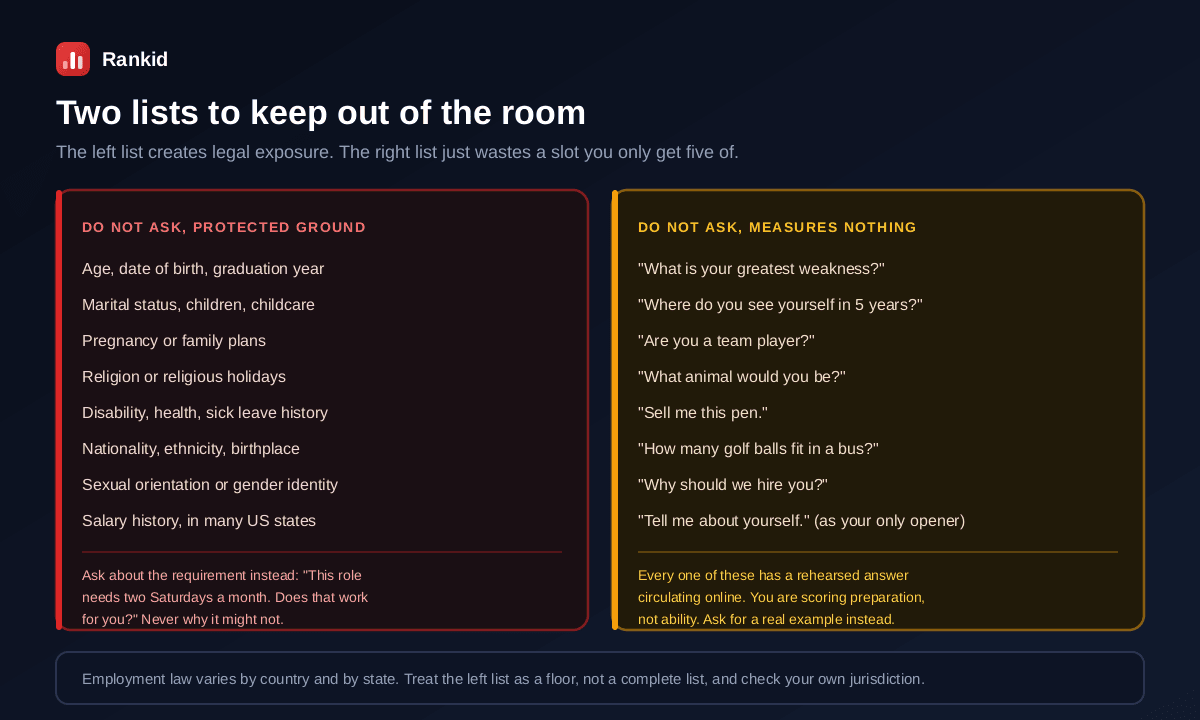
The reframing rule for the legal list is to ask about the job requirement rather than the personal circumstance. You may not ask whether someone has young children; you may absolutely state that the role requires two Saturdays a month and ask whether that works for them. You may not ask about health; you may describe the physical requirements of the job and ask whether they can perform them with reasonable adjustments. Keep the question on the work.
As for the useless list, the reason to drop "what is your greatest weakness?" is not that it is unkind but that every candidate has read the same advice about how to answer it, which means you are scoring how much preparation they did. Our own guide on how candidates are coached to answer these is worth reading precisely so you know what you are actually measuring when you ask them.
By stage: screen, first round, second round
The phone screen, 20 to 30 minutes.You are checking three things and nothing else: do they meet the hard requirements, is the salary band compatible, and are they genuinely interested. Two questions: "walk me through your experience with X" and "what made you apply?" Then confirm the range and the process. Do not attempt to assess craft depth here.
The first substantive interview, 45 to 60 minutes. Four to six questions from your set, aimed at your two heaviest criteria, with hard follow-ups. Leave ten real minutes for their questions. Score before you leave the room.
The second interview.This round exists to close the gaps from round one, so lead with them directly: "last time I came away unsure about X, can you give me an example that speaks to it?" Give the candidate the concern rather than probing around it. Then a work sample if you have not done one, and new interviewers who bring different criteria rather than repeating yours.
Stop asking the same question in every round
The follow-up is where the signal is
A prepared candidate has a polished answer to almost any opening question. What they cannot pre-prepare is the third layer. Four follow-ups that do most of the work:
- "Why did you choose that?" Separates a decision from something that just happened.
- "What did that cost?"Every real decision has a downside. A candidate who cannot name one has either not thought about it or is describing someone else's work.
- "What was your part specifically?"Ask this every time you hear "we". Do it neutrally and often.
- "What would you do differently now?" The single best test of whether someone learns from their own work.
Budget for this. Four questions with real follow-ups beats twelve without, and it is why the answer to "how many questions should I ask?" is far lower than most people expect.
Run it in five steps
Write the scorecard when you open the role
Four criteria, weighted, with a written description of a 1 and a 4 for each. This happens once per role and everything else reuses it.
Pick the question set and assign criteria to interviewers
Four to six substantive questions for the main interview, mapped to criteria. In a multi-stage loop, give each interviewer different criteria so you are not buying the same opinion repeatedly.
Ask everyone the same things, then follow up hard
Same questions, same order. Then push: why that, what did it cost, what was your part, what would you change. Take notes on what they said rather than on how you felt.
Score immediately and independently
Before you leave the room and before you speak to any colleague. Independent scores collected first are worth far more than a group conversation, because the first confident voice in a debrief pulls everyone else along.
Debrief on the disagreements only
Where everyone agrees there is nothing to discuss. Spend the time where scores diverge, and resolve it by pointing at what the candidate actually said against the written anchors. Then close fast, because good candidates have other processes running and slow feedback loses hires.
Key takeaways
- Structure beats question selection. Same questions, same order, criteria written first.
- Write a four-criteria weighted scorecard with anchors for what a 1 and a 4 look like.
- Prefer work samples and past behaviour. Hypotheticals and self-assessment tell you little.
- Ask four to six substantive questions, not twenty. The follow-up carries the signal.
- Ask "why that, what did it cost, what was your part, what would you change" every time.
- Score immediately and independently, before any debrief conversation.
- Assign different criteria to different interviewers so a loop is not four takes on one thing.
- Never ask about protected characteristics. Ask about the job requirement instead.
The uncomfortable thing about interviewing is that most of the quality is decided before anyone sits down. A manager with an ordinary question list, a written scorecard and the discipline to ask everyone the same things will out-hire a brilliant conversationalist working from instinct, consistently and by a wide margin. Write the four criteria, pick five questions, follow up harder than feels natural, and score before you talk to anyone else. And because none of it helps if the shortlist was wrong, let Rankid rank the pile against your job description first, so the hour you spend interviewing is spent on the right five people.
Frequently asked questions
What are the best interview questions to ask candidates?
The best questions ask for something the candidate actually did, in an area the job genuinely requires, and they are asked of every candidate in the same order so the answers can be compared. Three that work in almost any role: "Walk me through something you built or owned end to end, and the decision you got wrong along the way", which tests craft depth and self-awareness at once. "Tell me about a time you had to ship with less than you wanted. What did you cut, and who did you tell?", which tests judgment and communication under constraint. And "What is something you changed your mind about in the last year, and what changed it?", which tests whether they update on evidence. What all three share is that no honest answer is possible without a real example, so a rehearsed script does not survive them.
What are strategic interview questions to ask candidates?
Strategic questions test how someone thinks about the work rather than whether they have done a specific task, which makes them most useful for senior, ambiguous or newly created roles. Strong examples: "If you joined and after 90 days decided the team was working on the wrong problem, what would you do?", "What would you need to stop doing to succeed in this role?", "How would you decide between two options when the data does not settle it?", and "What is the part of this job you would be least good at, and how would you cover it?" The key discipline is that a strategic question still needs a defined scoring criterion before you ask it. Otherwise you are just having an interesting conversation and calling it an assessment.
How many questions should you ask a candidate in an interview?
Four to six substantive questions in a 45 to 60 minute interview, plus follow-ups. That surprises people who arrive with a list of twenty, but the value is almost entirely in the follow-up rather than in the initial question: "why did you choose that?", "what did that cost?", "what would you do differently?" is where a rehearsed answer separates from a real one. Twenty questions produces twenty surface answers and no depth on anything. Budget roughly seven to ten minutes per substantive question, leave ten minutes at the end for the candidate's questions, and five for logistics. Then write your scores immediately, before you speak to any other interviewer.
What is a structured interview and why does it matter?
A structured interview means every candidate for a role gets the same questions, in the same order, scored against criteria that were written before anyone was interviewed. It matters because it is the single biggest determinant of whether an interview predicts job performance at all. An unstructured conversation mostly measures rapport, confidence and similarity to the interviewer, which is why it produces confident hires rather than capable ones and why it is difficult to defend if a hiring decision is ever challenged. Structure does not mean rigid or cold: you still follow up freely and the conversation can be warm. What is fixed is the question set and the scoring criteria, not the tone.
What questions should you not ask a candidate?
Anything touching a protected characteristic, and anything with a rehearsed answer circulating online. On the legal side, avoid age or date of birth, marital status, children or childcare arrangements, pregnancy or family plans, religion, disability or health and sick leave history, nationality or birthplace, sexual orientation or gender identity, and in many US states salary history. Where you have a genuine job requirement, ask about the requirement rather than the circumstance: "this role needs two Saturdays a month, does that work for you?" is fine, while asking why it might not is not. On the useless side, drop greatest weakness, where do you see yourself in five years, are you a team player, and brainteasers, since these measure preparation rather than ability. Employment law varies by jurisdiction, so treat any list as a floor.
What are good interview questions for a second interview?
By the second round the basics are established, so use it for depth, for the concerns from round one, and for the people the candidate has not yet met. Good options: "Round one left me unsure about X. Can you walk me through an example that speaks to it?", which is the highest-value question in any second interview and the one most often skipped. "Here is a real problem we are facing right now. How would you approach the first week of it?" "What questions came up for you after we last spoke?" And if a future peer is interviewing: "What would you need from the rest of the team to do this well?" Give the candidate the concern directly rather than probing around it, since you want their best answer, not a test of whether they can guess the worry.
Should you ask candidates the same questions?
Yes, for the core question set, and this is the part most hiring managers get wrong. If candidate A was asked about handling a difficult stakeholder and candidate B was not, you have no basis for preferring one on that dimension, and you will fill the gap with impression. Keep the same four to six substantive questions and the same order for everyone in a given role, then follow up freely and differently depending on what they say, since follow-ups are where the depth is. The one legitimate variation is role-specific technical probing that depends on their background. Write the question set once when you open the role, and reuse it for every candidate.
How do you score candidates fairly after an interview?
Write the criteria and their weights before you interview anyone, score immediately after each interview, and do not discuss with other interviewers until everyone has submitted. Four criteria is a good number, each with a written description of what a 1 and a 4 look like so that two interviewers mean the same thing by a 3. Scoring immediately matters because memory degrades and gets contaminated within hours. Submitting before discussion matters more than people expect: in a group debrief the first confident voice pulls everyone else towards their view, so independent scores collected first give you genuinely separate signals. Then discuss the disagreements specifically, since those are where the real information is.
What is the best question to ask at the end of an interview?
"What questions do you have for us?", followed by genuinely answering them, and then "is there anything you expected me to ask that I did not?" The second one is underused and often produces the most useful minute of the interview, because candidates frequently have a relevant strength they prepared and never got to use. It also surfaces mismatches between what you assessed and what the role actually needs. Leave a real ten minutes for the candidate's own questions rather than a token two, because what someone chooses to ask is itself strong evidence about how they think, and because a rushed ending is one of the most common reasons a good candidate declines an offer.
How do you interview a candidate with no direct experience?
Replace past-behaviour questions with a work sample and carefully built situational questions. If someone has never done the job, asking for a time they did it produces nothing, but you can still watch them attempt a small, realistic piece of it: give them a real ticket, brief, or dataset and talk through their approach for twenty minutes. Then ask transferable behavioural questions about the underlying capability rather than the job title, since learning quickly, handling ambiguity and taking ownership all show up in other contexts including study, volunteering and unrelated jobs. Score against the same criteria as everyone else. The bar is whether they can do the work, not whether they have already been paid to do it.