Resume Parsing: How It Works and Why Recruiters Lose Good Candidates to It (2026)
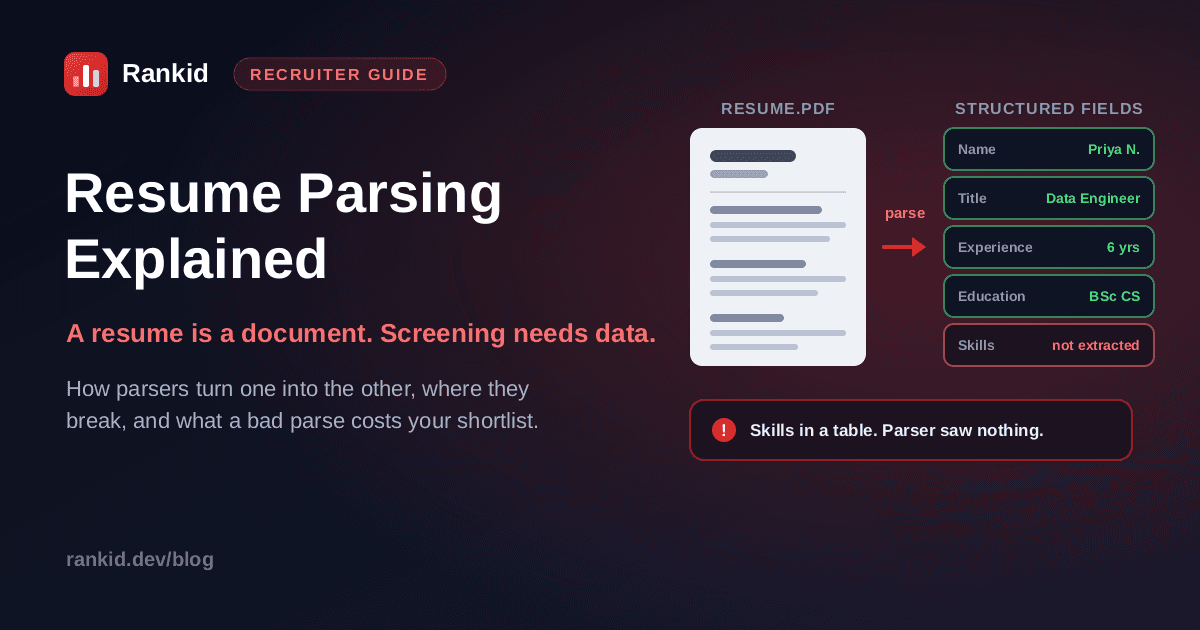
There is a step in your hiring process you have almost certainly never audited, and every single candidate passes through it before you form an opinion of them. Long before a recruiter reads a line, a piece of software opens the file, decides which text is a job title and which is a company name, and writes down what it thinks the person has done. Resume parsing is that step. When it works, it is invisible. When it fails, it is also invisible, which is the actual problem: a candidate whose skills section was silently dropped does not show up as an error. They just look like a weaker applicant.
Quick answer
What is resume parsing?
Resume parsing is the automated process of reading a resume file and converting it into structured, comparable data. A resume is a design artifact: it is written for a human eye, laid out for visual impact, and follows no schema whatsoever. Software cannot compare two design artifacts. It can only compare fields. A parser is the translation layer that turns the first thing into the second.
The output is a candidate record: name and contact details, a list of positions with employers, titles and date ranges, education, and a skills list. Every applicant tracking system performs this on upload, which is why parsing quietly sits underneath nearly every hiring decision made at any scale. Search a candidate database and you are searching parsed fields. Filter on five years of experience and you are filtering on a number a parser calculated. Rank a pool against a job and you are ranking parser output.
The uncomfortable implication
How does resume parsing work?
Parsing is not one operation, it is a pipeline, and understanding the stages is what lets you diagnose failures rather than just noticing that results look odd.
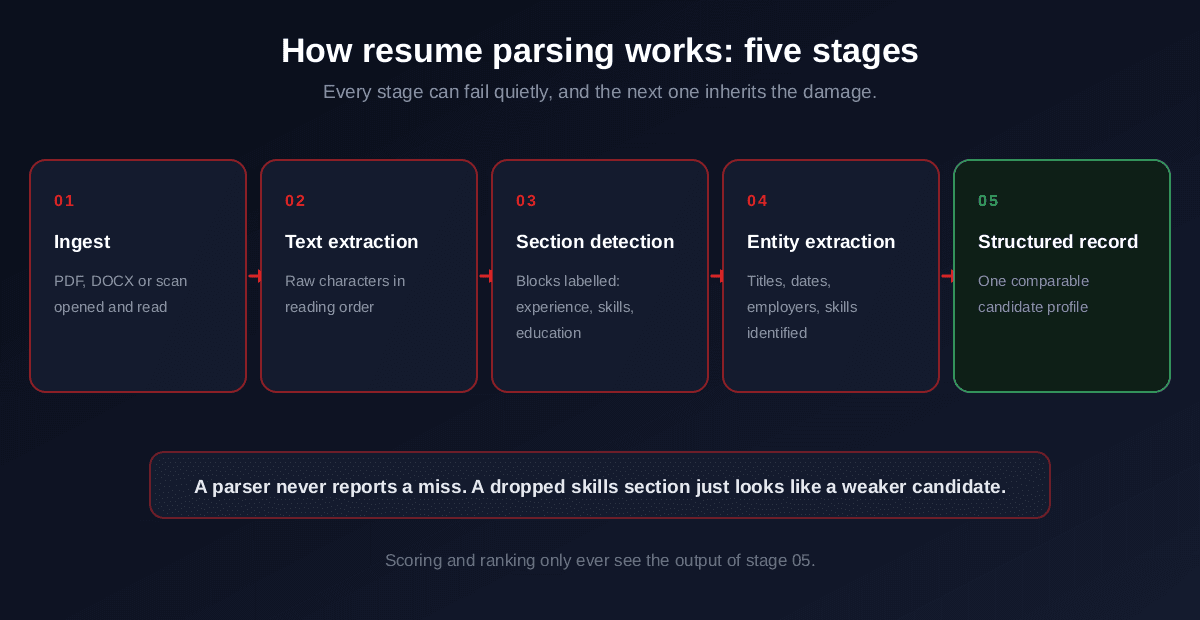
Ingest opens the file. A DOCX carries its text directly. A PDF stores glyphs positioned on a page, which is a harder problem than it sounds. A scanned resume is just an image and needs optical character recognition first, which introduces its own error rate before parsing has even started.
Text extraction pulls the characters out in what the parser believes is the correct reading order. This is where two-column layouts do their damage: the parser may read straight across the page, interleaving a sentence from the left column with one from the right and producing text that means nothing.
Section detectionlabels blocks of text as experience, education, skills or summary. Older parsers looked for literal headings. Modern ones use machine learning over layout and language patterns, which handles creative headings such as “Where I've Worked” far better, though it is still guessing.
Entity extraction finds the specific facts inside each section: which string is the employer and which is the job title, what the date range is, which words are skills rather than prose. This is the hardest stage and the one that most often degrades quietly.
Finally the parser writes the structured record. From this point on, the original document is essentially decorative. Every subsequent search, filter and ranking sees only the fields.
Why resume parsing fails, and what it looks like
Parse failures are not random. They cluster around a small set of formatting choices, and because the candidate cannot see your parser and you rarely inspect it, both sides stay unaware.
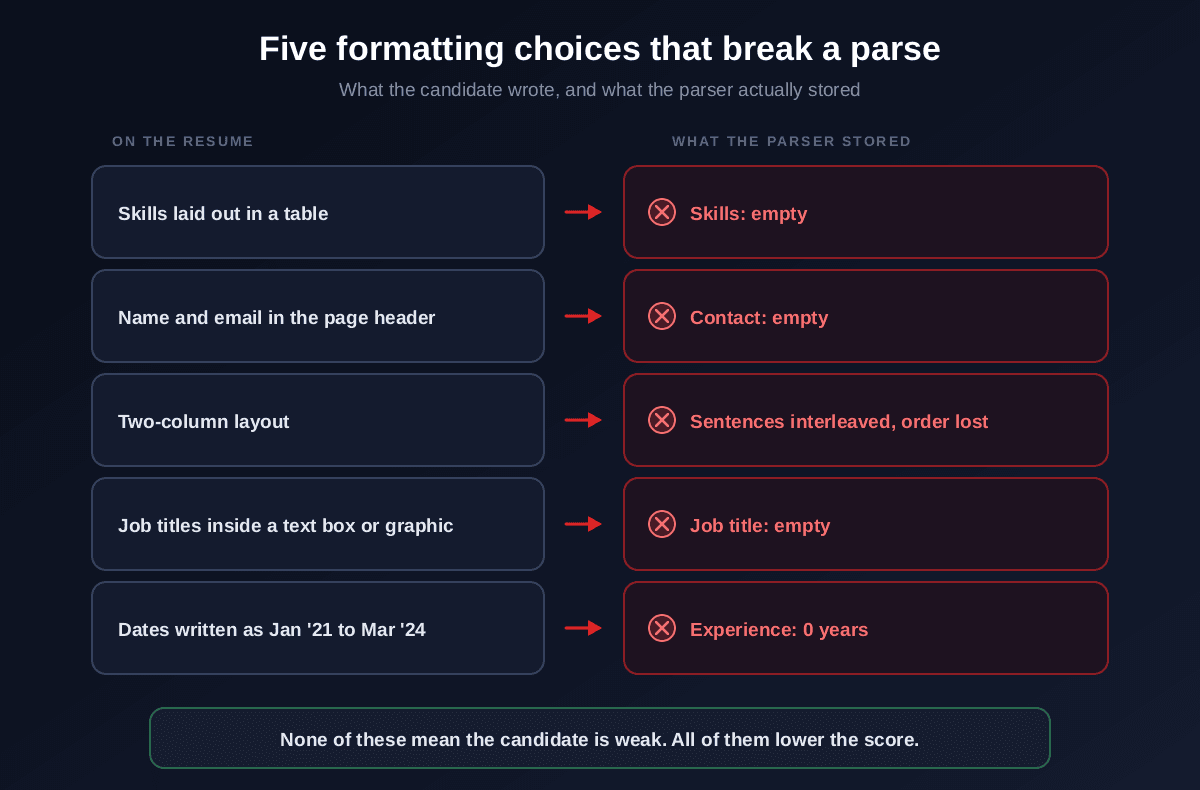
The critical property of every row in that table is that the failure is silent. The parser does not raise an exception when a skills section comes back empty, because an empty skills section is a perfectly valid state: plenty of resumes genuinely lack one. So the record is written, the candidate is scored against the job, and they land in the middle of your ranking looking like someone whose background is a bit thin. There is no error to investigate. There is just a person you never called.
This is also the honest answer to the perennial candidate question about formatting, which we cover from the other side in how to make an ATS-friendly resume. The advice to avoid tables and columns is not aesthetic conservatism. It is a description of where the extraction layer breaks.
What parsing accuracy actually costs you at volume
Parsing vendors advertise 90 to 95 percent accuracy, and that figure is broadly honest but easy to misread. It is usually a field-level average across all fields, which flatters the result, because the easy fields are very easy. Email addresses and phone numbers parse near-perfectly. Education parses well. The fields that drag the average down are skills, job titles and date ranges, which are precisely the ones screening runs on.
Now apply that to a real pool. Take a requisition with 1,200 applicants, the kind of volume covered in our guide to high-volume recruiting. A 5 percent field-miss rate on skills means roughly 60 candidates whose skills list is wrong or empty. Those 60 are not distributed randomly across your ranking. They are pushed systematically downward, because a missing skills list can only ever reduce a match score, never raise it.
Parse errors are biased, not noisy
There is a second-order effect worth naming. Resume formatting correlates with access to advice. Candidates who have been coached, or who used a modern template, produce clean parses. Candidates who built something visually elaborate in a word processor, or who scanned a document, do not. So parse quality quietly tracks something other than capability, which is a fairness problem sitting upstream of every screening decision you make.
See what the parser actually read
Upload a batch of resumes and paste your job description. Rankid parses every candidate, scores them 0 to 100 against the role, and shows the skills and keywords each one matched and missed, so an empty skills list is visible instead of silently sinking someone. First 5 resumes free, no signup needed.
Try bulk screening freeHow to test your own resume parsing accuracy
You do not need a benchmark suite. You need thirty minutes and a recent requisition. This is worth doing once a year and after any ATS change.
Pull a representative sample
Take 20 to 30 real resumes from a recent req, deliberately spanning formats: some plain single-column documents, some designed templates, at least a couple of two-column layouts, and any scans you received. A sample of only clean resumes will tell you your parser is excellent, which is exactly the wrong conclusion.
Compare five fields against the original
Open each parsed record beside the source document and check five things: name, current job title, current employer, total years of experience, and the skills list. Mark any field that is empty, truncated or wrong as a miss. Five fields across 25 resumes is 125 checks, which is a solid sample and takes well under an hour.
Score it and look at the distribution
Calculate the miss rate per field rather than one overall number. The overall number will look reassuring and tell you nothing. What matters is whether skills and titles are materially worse than contact details, because that is the pattern that damages screening, and it is the one an averaged accuracy figure hides.
Flag empty skills lists as a standing rule
Any candidate whose skills list parsed empty should be treated as unscored rather than low-scoring. Make that a habit in your process. It is the single highest-value correction available, because it targets the exact failure that systematically buries qualified people.
Resume parsing software: what actually matters
Most comparisons of resume parsing tools focus on claimed accuracy percentages, which are close to unfalsifiable and measured on the vendor's own test set. These five criteria are more useful:
- Format coverage. PDF, DOCX and scanned images handled reliably. OCR quality matters more than teams expect, particularly in industries where candidates still submit scans.
- Layout resilience. Does it survive columns, tables, headers and text boxes, or only clean single-column documents? This is the difference that shows up in real applicant pools and almost never in a demo.
- Field depth. Contact details are table stakes. Ask specifically about skills extraction and date-range normalization, because those are the weak fields that screening depends on.
- Transparency and correction. Can you see the extracted fields and fix them? A parser you cannot inspect is a parser whose errors you will never find. This is the single most underrated criterion.
- What happens after the parse. A standalone parser hands you structured data, not a decision. Structured data still has to be compared against a specific job before it tells you anything about who to interview.
Parsing, screening and scoring are three different things
This distinction is worth being pedantic about, because conflating the three is the most common reason teams buy tooling that does not reduce their workload.
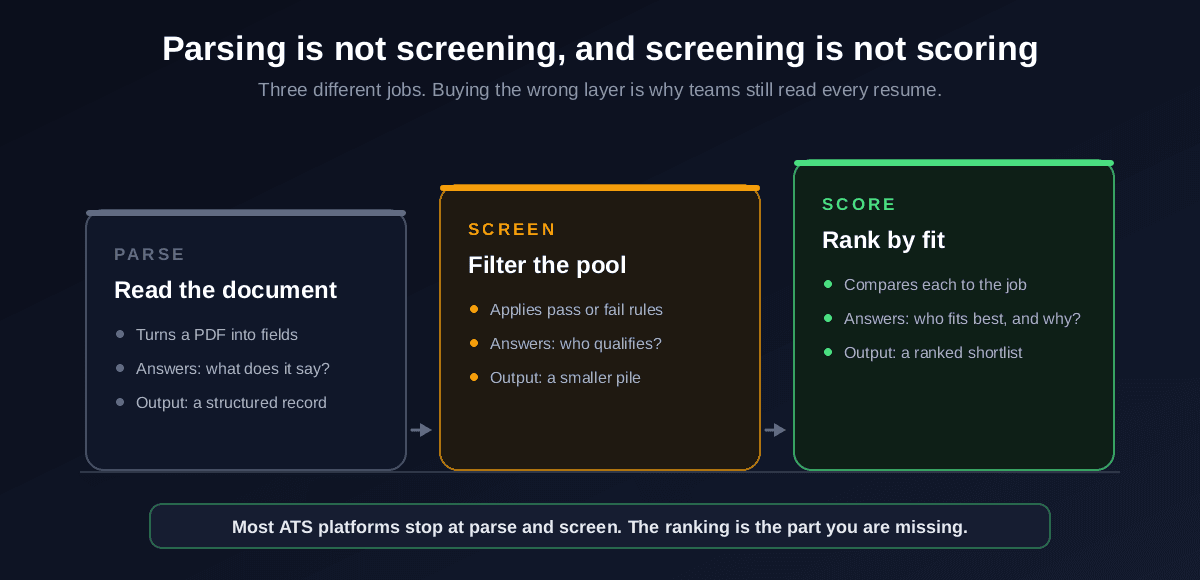
Parsing answers what does this document say. Screening applies rules and answers who qualifies. Scoring compares every candidate against one specific job description and answers who fits best, and why. Only the third produces a shortlist you can act on, and it is the layer most applicant tracking systems do not provide. Our guide to ATS platforms covers where the major ones stop.
That gap explains a situation many recruiters will recognise: the company owns an expensive ATS, parsing works fine, keyword filters are configured, and somebody is still reading 400 resumes by hand. The parse was never the bottleneck. The missing piece is the ranked, reasoned comparison against the role, which is what bulk resume analysis does and what makes screening resumes in bulk tractable at all.
Parsing mistakes that cost recruiters good candidates
- Treating an empty field as a weak candidate. Empty usually means unread, not absent. This is the error that does the most damage, and it is entirely avoidable once you know to look.
- Filtering on parsed years of experience. Years is a calculated field built on date extraction, one of the least reliable stages. Hard-filtering on it discards people whose dates simply failed to convert.
- Searching your candidate database and trusting the silence. A keyword search over parsed records only finds candidates whose relevant section parsed correctly. Nobody who was mis-parsed will ever appear, in any search you run, ever again.
- Assuming a vendor accuracy number applies to your pool.Accuracy depends on the resumes you actually receive. Test on your own sample rather than accepting a benchmark run on somebody else's.
- Never inspecting the output. Most recruiters have never once opened a parsed record beside the original resume. Thirty minutes of that will tell you more about your screening quality than any dashboard.
Key takeaways
- Resume parsing converts a resume file into structured fields, and every screening decision runs on that output.
- It works in five stages: ingest, text extraction, section detection, entity extraction, structured record.
- Failures are silent. Tables, two-column layouts, headers, graphics and odd date formats produce empty fields.
- Vendor accuracy of 90 to 95 percent hides the distribution: skills, titles and dates are the weak fields.
- Parse errors are biased, not random, because a missing field can only ever push a candidate down the ranking.
- Test your own stack: 25 resumes, five fields each, and measure the miss rate per field rather than overall.
- Parsing is not screening and screening is not scoring. Most ATS platforms stop before the ranking layer.
- Rankid parses and scores up to 200 resumes per batch against your job description, first 5 free with no signup.
Bottom line: resume parsing is the least examined and most consequential step in modern hiring. It decides what your software knows about every applicant, it fails quietly, and it fails in one direction. Spend half an hour testing yours, treat empty fields as unread rather than as evidence, and make sure something in your stack does the ranking rather than stopping at extraction. Run a batch through Rankid's bulk resume screening tool and see the matched and missing terms for every candidate, so a bad parse is something you catch instead of something that costs you a hire.
Frequently asked questions
What is resume parsing?
Resume parsing is the process of automatically reading a resume file and converting it into structured data a computer can compare. A resume is a design document written for human eyes, so before any software can screen, search or rank a candidate, a parser has to extract the underlying facts into fields: name, contact details, job titles, employers, dates, education and skills. Every applicant tracking system does this on upload, which is why parsing sits underneath practically every hiring decision made at scale. If the parse is wrong, everything downstream inherits the error.
How does resume parsing work?
It runs in five stages. First, ingest: the file is opened, whether it is a PDF, DOCX or a scanned image needing OCR. Second, text extraction: raw characters are pulled out in what the parser believes is the correct reading order. Third, section detection: blocks of text are labelled as experience, skills, education and so on. Fourth, entity extraction: specific facts such as job titles, employers, date ranges and skills are identified inside those sections. Fifth, the parser writes a structured candidate record. Modern parsers use machine learning for stages three and four rather than fixed rules, which handles unusual layouts far better but still fails on tables, columns and graphics.
How accurate is resume parsing?
Vendors typically claim 90 to 95 percent field-level accuracy, but that number is measured across all fields and hides the distribution. Contact details and education parse very reliably. Skills, job titles and date ranges are substantially weaker, and those are exactly the fields screening depends on. Accuracy also drops sharply on resumes using two-column layouts, tables, text boxes or scanned images. The practical takeaway for a recruiter is that a small single-digit error rate still means dozens of mis-parsed candidates in a pool of several hundred, so it is worth testing your own stack rather than trusting a headline percentage.
What causes resume parsing to fail?
Five formatting choices cause most failures. Skills laid out in a table often extract as empty because the parser reads across rows rather than down columns. Names and contact details placed in the page header or footer are frequently skipped entirely. Two-column layouts cause sentences from different sections to interleave, destroying reading order. Job titles inside text boxes or graphics are invisible to text extraction. And non-standard date formats such as Jan '21 to Mar '24 can fail to convert, leaving a candidate recorded as having zero years of experience. None of these mean the candidate is weak, but all of them lower the score.
What is the difference between resume parsing and resume screening?
Parsing reads the document and answers the question what does it say, producing a structured record. Screening applies pass or fail rules to that record and answers who qualifies, producing a smaller pile. Scoring compares each candidate against a specific job description and answers who fits best and why, producing a ranked shortlist with reasons attached. Most applicant tracking systems stop after parsing and basic keyword screening, which is why recruiters using a full-featured ATS still end up reading hundreds of resumes by hand: the ranking layer, the one that actually saves time, is usually missing.
How do I test my resume parsing accuracy?
Take a sample of 20 to 30 real resumes from a recent requisition, spanning different formats and seniority levels. Upload them, then open each parsed record next to the original document and compare five fields: name, current job title, employer, total years of experience and the skills list. Count any field that is empty, truncated or wrong as a miss. That gives you a real field-level accuracy rate for your own stack and candidate mix. Pay particular attention to any resume where the skills list came back empty, because those candidates are being silently under-scored in every search and ranking you run.
What should I look for in resume parsing software?
Prioritise five things. Format coverage, meaning reliable handling of PDF, DOCX and scanned files. Layout resilience, meaning it survives columns, tables and headers rather than only handling simple single-column documents. Field depth, so it captures skills and date ranges properly rather than just contact details. Transparency, so you can see the extracted fields and correct them instead of trusting a black box. And crucially, what happens after the parse: a parser alone hands you structured data, not a decision. The tools that save recruiters real time are the ones that also score and rank the parsed pool against the job description.
Is there a free tool to parse and score resumes in bulk?
Yes. Rankid parses a whole batch of resumes and then does the part a standalone parser does not, scoring every candidate 0 to 100 against your job description and showing the skills and keywords each one matches and misses. Because the matched and missing terms are visible per candidate, you can spot a bad parse rather than silently ranking someone lower for it. Your first 5 resumes are free with no signup required, and you can process up to 200 resumes per batch once you sign up.