High-Volume Recruiting: How to Hire at Scale Without a Bigger Team (2026)
The req went live on Monday. By Thursday there are 1,200 applications in the system, the hiring manager wants a slate by Friday, and you have four other openings doing exactly the same thing. This is the part of the job nobody writes a playbook for, because the usual advice quietly assumes you can read every resume. High-volume recruiting is what happens when you cannot. It is not a sourcing problem and it is rarely a talent problem. It is a throughput problem, and it has a solvable shape.
Quick answer
What is high-volume recruiting?
High-volume recruiting, also called high-volume hiring or volume hiring, is the practice of filling many similar openings at once, or filling a role that draws far more applicants than any one person can read. The industries that live here are familiar: retail and warehouse seasonal ramps, contact centers, hospitality, logistics and delivery, healthcare support roles, field sales, and startups opening a dozen near-identical seats after a funding round.
What makes it a distinct discipline is not the job title being hired. It is that the usual process stops working. A normal req assumes the recruiter reads the applications, forms a view, and moves the promising people forward. At volume, that first step becomes physically impossible, and every downstream decision inherits the distortion. Candidates get evaluated based on when they applied rather than how well they fit, because the recruiter's attention ran out somewhere around resume 300.
The one-line test for high volume
What is considered high-volume recruiting?
There is no certified threshold, and anyone quoting one precisely is guessing. But the working definitions most talent teams use cluster around three markers, any one of which usually qualifies:
- More than roughly 20 open reqs per recruiter at the same time. Past this point a recruiter is coordinating rather than evaluating, and depth on any single req collapses.
- More than 250 applicants for a single posting. This is the level where reading the pool becomes a multi-day project rather than an afternoon, and where the order resumes arrived in starts driving outcomes.
- 50 or more hires for similar roles in a quarter. Repeated, near-identical hiring is what makes standardization pay off, because the same criteria apply across hundreds of decisions.
The number matters less than the ratio behind it. One recruiter with 300 applicants a week is recruiting at volume; a team of six with the same 300 is not. Diagnose it as applications per available screening hour, and the right response becomes obvious.
The screening math nobody budgets for
Here is the calculation that explains most high-volume failure. Reading a resume properly, meaning actually evaluating it against the role rather than glancing at it, takes somewhere around two minutes. Recruiters can go faster, and the famous six-second scan is real, but a six-second scan is triage, not evaluation. At two minutes a resume, the arithmetic gets ugly fast.
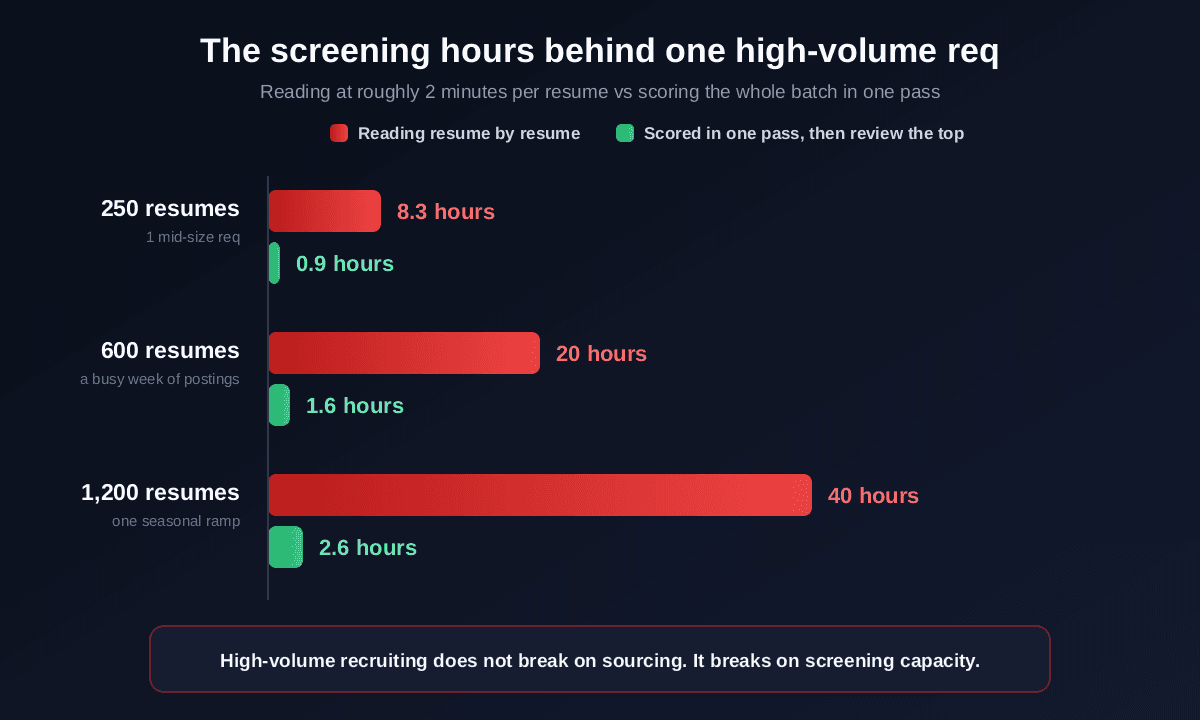
Forty hours for one req. That is a full working week of a recruiter's time spent before a single conversation happens, on a role that probably has four siblings queued behind it. In practice nobody spends that week, so what actually happens is compression: the reading gets thinner, the standard drifts, and somewhere in the back half of the pile a genuinely strong candidate gets the same three-second glance as an obvious non-fit.
This is the specific thing worth understanding about high-volume recruiting. The failure is not that recruiters are careless. It is that manual evaluation scales linearly while human attention does not, so quality degrades as a mathematical certainty rather than as a performance problem. Any strategy that does not change the hours-per-hire equation is just asking the same people to run faster at the same wall.
High-volume recruiting challenges
Six problems show up on nearly every high-volume team, and they compound each other:
- Screening capacity. The one above, and the root of most of the others. The evaluation stage cannot absorb the inbound volume, so everything downstream is fed by a partially-read pool.
- Inconsistency across the pile. The bar you set on applicant 20 is not the bar you are applying on applicant 400. This is not a discipline failure, it is fatigue, and it makes your funnel unauditable because no two candidates were measured the same way.
- Speed to contact. In volume markets the strong candidates are usually hired within days, often by whoever called first. A screening process that takes a week is structurally losing to one that takes a day, regardless of how good your final judgment is.
- Candidate experience at scale. When you leave 1,200 people in silence, you are damaging your employer brand across 1,200 people at once, many of whom are also your customers. Volume multiplies the cost of poor communication.
- Quality drift. The natural way to go faster is to skim, and the natural consequence is that weak matches slip into phone screens and interviews. That pushes the cost of bad screening onto your most expensive stage, where hiring managers pay for it in wasted hours.
- No visibility into the funnel. Without stage-by-stage conversion data you cannot tell whether the problem is the posting, the screen, or the offer. Teams end up optimizing whichever stage is loudest rather than the one that is actually leaking.
The funnel math: how many applicants per hire
Once you accept that volume is a throughput problem, the funnel becomes the planning instrument. A typical high-volume req runs at roughly 200 applicants per hire, though your own number will vary with role, market and how well the posting is targeted.
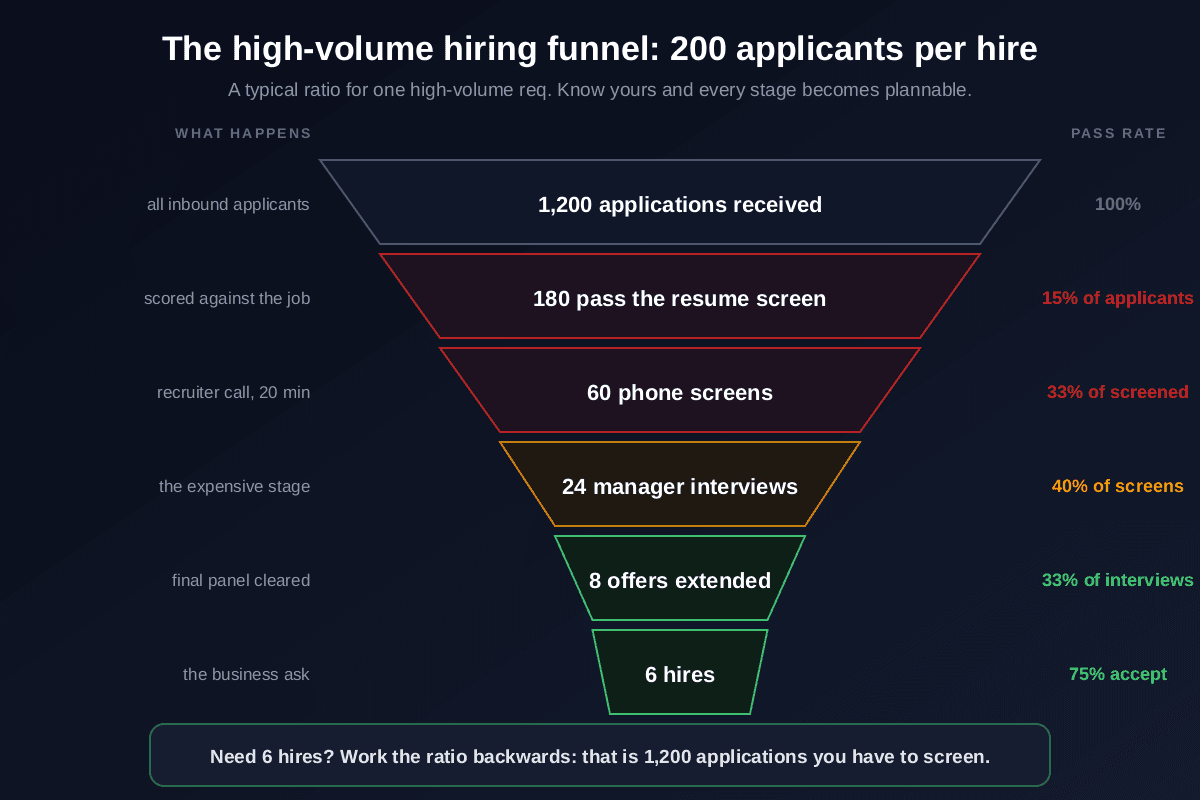
The value of the ratio is that it runs backwards. If the business commits to 6 hires, you are not being asked for 6 hires, you are being asked to screen 1,200 applications and to run 60 phone screens and 24 interviews. Stated that way, capacity planning becomes a real conversation instead of a hope, and you can see immediately which stage needs tooling rather than more headcount.
It also tells you where to look when the numbers go wrong. A low pass rate at the resume screen usually means the posting is attracting the wrong people, which is a job description problem, not a screening one. A high screen-to-interview rate paired with a low interview-to-offer rate means your screening is letting noise through and hiring managers are absorbing the cost. Each ratio points at a specific fix.
Screen a high-volume batch free
Upload your resumes, paste the job description, and Rankid scores every candidate 0 to 100 by fit, with the skills and keywords each one matches and misses. The screening stage of a high-volume req goes from days of reading to minutes of reviewing a ranked list. First 5 resumes free, no signup needed.
Try bulk screening freeHigh-volume recruiting strategies that actually scale
The test for any high-volume strategy is simple: does it reduce human reading hours per hire, or does it just redistribute them? These seven pass that test.
Tighten the job description so the pool self-selects
The cheapest screening happens before anyone applies. Vague postings pull volume you then have to pay to filter out. Name the genuine must-haves explicitly, state the shift pattern, location expectation and pay range, and cut the aspirational requirements nobody actually screens on. A posting that turns away 200 poor-fit applicants has saved you close to seven hours of reading before the req even opens.
Fix your must-haves before applications open
Write down which requirements are dealbreakers and which are tie-breakers, and do it before you see a single candidate. This is what makes consistency possible at scale, because it gives every applicant the same bar to be measured against instead of whatever you happened to be weighting that hour. Our resume screening criteria checklist covers the four dimensions worth fixing in advance.
Score the whole batch instead of reading one by one
This is the change that breaks the linear-hours problem. Upload every resume for the req together, paste the job description once, and let a scoring tool parse each candidate and rate them 0 to 100 on skills, keywords, seniority and relevant experience. You get the entire pool ranked with the matched and missing requirements attached, and your reading time collapses onto the top of the list. With Rankid you can score up to 200 resumes per batch, and the mechanics are covered in detail in how to screen resumes in bulk.
Draw the line from the ranking, not from a quota
Read the ranked list from the top and cut where the scores visibly drop off rather than at a round number. Then give the borderline band a genuine human look, because transferable experience and differently-phrased skills live there. The full method is in how to shortlist candidates. The tool ranks, you decide, and that division of labor is what keeps volume screening defensible.
Standardize and shorten the phone screen
At 60 screens per hire cycle, an unstructured 30-minute call is a staffing decision. Use a fixed set of questions scored on a simple rubric, cap it at 15 to 20 minutes, and make it decision focused rather than exploratory. Structured screens are both faster and more predictive, and they let you compare candidates across recruiters. Our list of interview questions that predict performance is a good source for the rubric.
Batch the interviews instead of scheduling them one at a time
Coordination is the hidden tax of volume hiring. Block two or three fixed interview windows a week and slot candidates into them, rather than negotiating individually with every hiring manager. This shortens time to offer, protects manager calendars, and makes your interview capacity a known quantity you can plan the funnel against.
Automate the communication, never the rejection decision
Acknowledge every application, tell people where they are, and move fast on the ones you want. Automate the sending, but keep a human making the call on who advances. Auto-rejecting on a raw score is where volume hiring earns its bad reputation, and it is unnecessary: scoring is far more useful as a prioritization tool than as a gate.
High-volume recruiting metrics worth tracking
Volume hides problems. Six metrics surface them, and the useful ones measure the funnel rather than the effort:
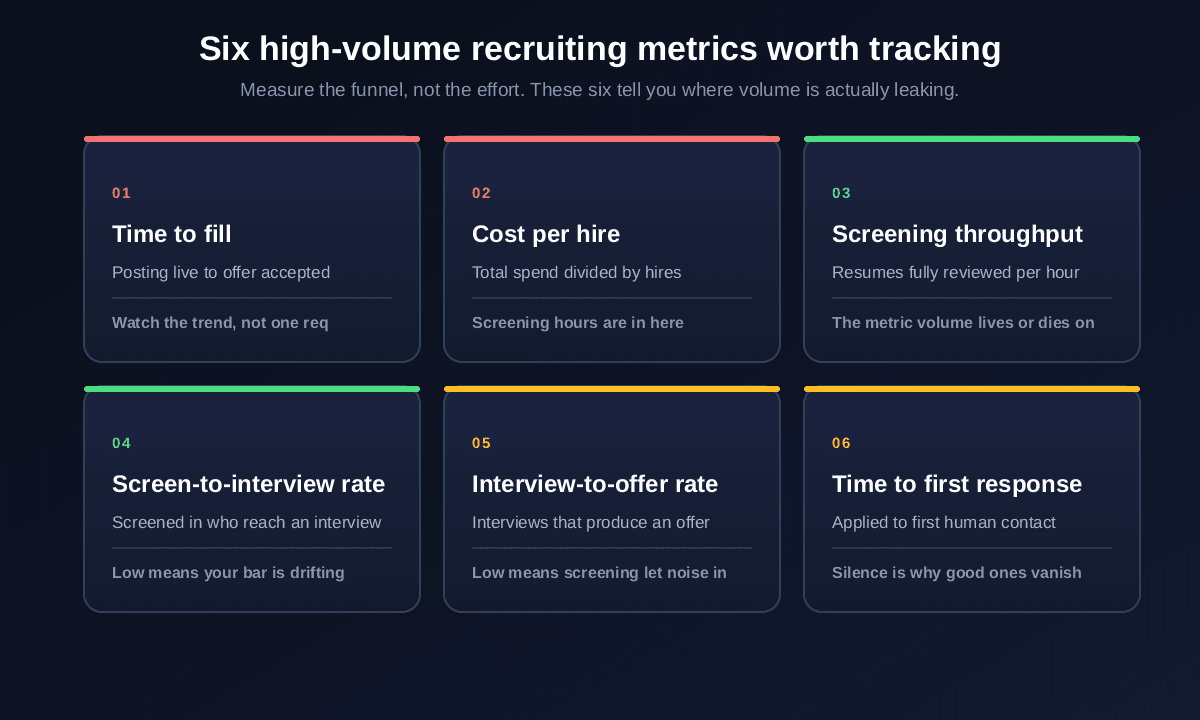
Two of these deserve special attention at volume. Screening throughput, meaning resumes fully evaluated per hour, is the metric high-volume recruiting lives or dies on, and it is the one most teams never measure. And time to first response is the quiet killer: in fast-moving volume markets, the gap between applying and hearing from a human is often the whole reason a strong candidate is unavailable by the time you get to them.
Cost per hire is worth calculating honestly too. Recruiter hours spent screening are a real cost, and 40 hours of reading per req is usually the largest line item nobody has itemized. Once it is visible, the business case for fixing the screening stage tends to make itself.
High-volume recruiting tools: what the stack looks like
A working high-volume stack has three layers, and confusing them is why teams buy tools that do not fix the bottleneck.
- The applicant tracking system. Your system of record. It stores candidates, moves them through pipeline stages, and handles compliance and reporting. Essential, but most ATS platforms filter on keywords rather than genuinely evaluating fit, so they narrow the pile without ranking it. Our guide to ATS platforms covers how the major ones differ.
- The bulk screening layer. This is the piece that addresses the actual bottleneck. It takes a batch of resumes and one job description and returns every candidate scored and ranked by fit, with reasons attached. This is what turns the 40-hour reading week into an afternoon, and it is usually the highest-leverage addition to a volume stack. See bulk resume analysis for what the output looks like in practice.
- Scheduling and messaging automation.Self-serve interview booking, status updates, and templated communication. This does not improve decisions, but it reclaims the coordination hours that otherwise eat a volume recruiter's day.
Buy for the bottleneck, not for the demo
Keeping volume screening fair and defensible
Screening at scale invites a reasonable objection: does speed come at the cost of fairness? Done badly, yes. Done well, automated screening is more consistent than the alternative, because the honest comparison is not against a perfectly attentive human, it is against a human on hour 30 of reading who is applying a visibly different standard than they were on hour 2.
Four practices keep it defensible. Score against the role's real requirements rather than proxies like school or employer prestige. Keep a human making every advance-or-reject call. Review the borderline band deliberately instead of cutting at a round number, since that is where transferable experience hides. And attach reasons to decisions, so a score is always accompanied by the specific matched and missing requirements behind it. That last one matters most: a ranking you cannot explain is not a process, it is a black box, and it will not survive scrutiny from a hiring manager or anyone else.
If you want to see what the candidate is optimizing against on the other side of this, the mirror image is AI resume screening, and comparing multiple resumes to a job description covers the head-to-head mechanics.
Mistakes that make high-volume hiring worse
- Solving a screening problem with more sourcing. Adding job boards to a funnel that is already over capacity makes the constraint worse, not better. More applicants is only useful if you can evaluate them.
- Hiring recruiters to absorb the reading. Headcount scales linearly with the same problem and multiplies the inconsistency, because now several different drifting standards are being applied to one pool.
- Auto-rejecting below a score threshold. This is the practice that gives volume automation its bad name, and it is the one thing scoring is genuinely bad at. Rank with it, decide with a person.
- Screening against a two-line job description. If the criteria are thin, the ranking has nothing meaningful to measure against. Garbage in, confident-looking garbage out.
- Measuring activity instead of conversion. Resumes reviewed and calls made feel like progress. Stage-by-stage conversion tells you whether any of it is working.
- Treating every req as a fresh problem. Volume hiring rewards standardization precisely because the roles repeat. Reusable criteria, rubrics and templates are where the compounding gains live.
Key takeaways
- High-volume recruiting is a throughput problem: applications per recruiter outrun the hours to evaluate them.
- You are at volume past roughly 20 reqs per recruiter, 250 applicants per posting, or 50 similar hires a quarter.
- Screening is the bottleneck, not sourcing: 1,200 resumes is about 40 hours of reading for one req.
- Know your funnel ratio, around 200 applicants per hire, and plan capacity backwards from the hiring target.
- Score whole batches against the job description in one pass, then spend your attention on the ranked top.
- Track screening throughput and time to first response, the two metrics volume hiring actually turns on.
- Rank with automation, decide with a person, and never auto-reject on a raw score.
- Rankid scores up to 200 resumes per batch, and your first 5 are free with no signup.
Bottom line: high-volume recruiting does not get solved by working the pile harder. It gets solved by changing what a pile costs. Fix the criteria before applications open, score the whole batch in one pass instead of reading it candidate by candidate, and spend the hours you win on the people at the top of the ranking and on the conversations that actually decide the hire. Run your next high-volume req through Rankid's bulk resume screening tool and see the whole pool ranked by fit in minutes.
Frequently asked questions
What is high-volume recruiting?
High-volume recruiting is hiring for many openings of the same or similar role at once, or for a single role that attracts far more applicants than one recruiter can read. The defining feature is not the job, it is the ratio: the number of applications per recruiter outruns the hours available to evaluate them. Typical examples are retail and warehouse seasonal ramps, contact centers, hospitality, logistics, healthcare support staff, and fast-scaling startups opening a dozen similar seats at once. Because the bottleneck is screening capacity rather than sourcing, high-volume recruiting is a throughput problem, and it needs a process built around evaluating whole batches consistently rather than reading resume by resume.
What is considered high-volume recruiting?
There is no official threshold, but a common working definition is a recruiter carrying more than about 20 open reqs at once, a single posting drawing more than 250 applicants, or a hiring plan of 50 or more hires for similar roles in a quarter. A more useful test than any number is this: if the applications arriving each week would take more hours to read than the recruiter has in the week, you are recruiting at volume. That is the point where a normal read-every-resume process starts silently failing, because the pile grows faster than anyone can work it down.
What are the biggest high-volume recruiting challenges?
Six recur across almost every high-volume team. Screening capacity is the first and largest: at roughly two minutes per resume, 1,200 applicants is about 40 hours of reading for one req. Second is inconsistency, because the bar a recruiter applies to applicant 20 drifts by applicant 400. Third is speed to contact, since the strongest candidates in volume markets are usually hired within days. Fourth is candidate experience at scale, where silence damages your employer brand across thousands of people at once. Fifth is quality drift, when teams speed up by skimming and let weak candidates through to expensive interview stages. Sixth is the reporting gap, because without funnel metrics you cannot tell which stage is actually leaking.
How many applicants do you need per hire in high-volume recruiting?
A common high-volume ratio is roughly 200 applicants per hire, though it varies widely by role, market and posting quality. A typical funnel looks like this: 1,200 applications, about 15 percent pass the resume screen leaving 180, about a third of those reach a phone screen leaving 60, about 40 percent reach a hiring-manager interview leaving 24, roughly a third get an offer leaving 8, and about 75 percent of offers are accepted for 6 hires. The practical value of knowing your own ratio is that you can work backwards: if the business needs 6 hires, you now know you must be able to screen around 1,200 applications, and you can staff and tool for exactly that.
What are the best high-volume recruiting strategies?
The strategies that hold up at scale all reduce the amount of human reading per hire. Write tighter job descriptions so the pool self-selects. Define must-haves versus nice-to-haves before applications open, so every applicant is measured against the same bar. Score whole batches of resumes against the job description in one pass instead of reading them individually. Run structured, short phone screens with a fixed question set. Batch your interviews into blocks rather than scheduling them one at a time. Automate status communication so nobody is left in silence. Finally, track funnel conversion at every stage so you fix the leaking step rather than working harder on all of them.
What tools do you need for high-volume recruiting?
Three layers cover most of it. An applicant tracking system is your system of record, holding candidates and moving them through pipeline stages. A bulk resume screening tool sits on top and does the part most ATS platforms do poorly: evaluating every applicant against one specific job description and returning a ranked list with reasons. Scheduling and messaging automation handles the coordination load that otherwise consumes a recruiter's day. The screening layer is usually the highest-leverage addition, because screening is where high-volume hiring actually breaks. Rankid scores up to 200 resumes per batch and your first 5 are free with no signup.
Is automated screening fair in high-volume hiring?
It is fair when it is used to rank who gets read first, not to silently auto-reject people. Applying the same criteria to applicant 1 and applicant 1,200 is measurably more consistent than a recruiter whose standard drifts over 40 hours of reading, and it makes decisions easier to explain because the matched and missing requirements are attached to each score. The practices that keep it defensible are: score against the real requirements rather than proxies, keep a human making the final call, review the borderline band rather than cutting at a round number, and never let the tool send a rejection on its own.
Is there a free tool for high-volume resume screening?
Yes. Rankid lets you upload a batch of resumes, paste in the job description, and get every candidate scored 0 to 100 by fit, with the skills and keywords each one matches and misses. That turns the screening stage of a high-volume req from days of reading into minutes of reviewing a ranked list. Your first 5 resumes are free with no signup required, and you can score up to 200 resumes per batch once you sign up.