Termination Letter: 6 Templates, What to Include, and What Must Never Go In One (2026)
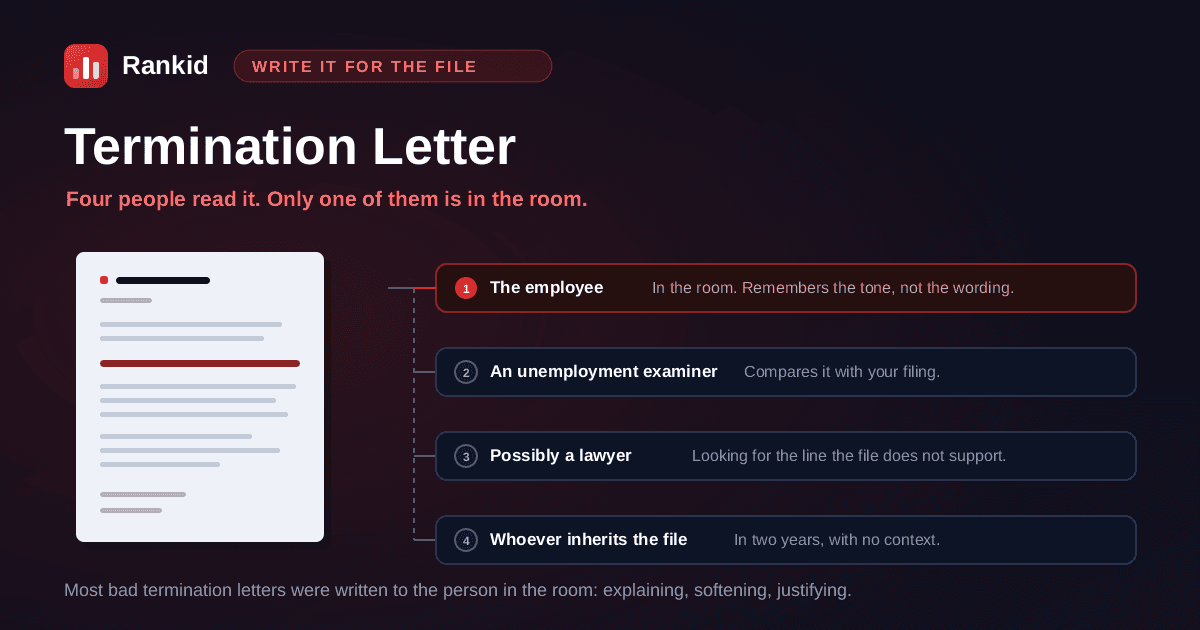
The person sitting across from you is not the main audience for a termination letter. Three other people read it later: an unemployment examiner deciding a claim, possibly a lawyer looking for the sentence that does not match the file, and whoever inherits the folder in two years. Almost every bad termination letter is bad for the same reason. Someone wrote it to the person in the room, explaining, softening, justifying, and in doing so handed the other three readers something to work with.
Quick answer
Quick answer: a termination letter confirms in writing that employment has ended, the effective date, and the consequences: final pay, benefits and continuation coverage, property to return, surviving obligations, and a named contact. Keep the reason to one or two factual sentences, or state none, but whatever you write must match exactly what you tell the unemployment agency. Never include opinion, unsubstantiated allegations, anything touching a protected characteristic, or a promise payroll has not confirmed. No federal law requires the letter, several states require a separation notice, and final pay deadlines are set by state.
General information, not legal advice
What is a termination letter, and is it required?
A termination letter is a written notice confirming that employment has ended, when it ended, and what happens next. You will see the same document called a notice of termination, a letter of termination, a separation notice or, where a fixed term simply expires, an end of contract letter. The name matters less than the discipline: one accurate, dated record that everything downstream can be checked against.
No general federal rule requires one. Several states do impose related obligations, typically a written notice of the separation date or a requirement to hand over specific unemployment insurance information, and the detail varies by state. Your own handbook, an employment contract or a collective agreement can also create an obligation where statute does not, and a promise in your handbook is one you should keep.
Practically, almost every established employer issues one regardless, because a termination with no document is a termination whose date, reason and terms become whatever two people later remember. The letter is cheap. Its absence is not.
Types of termination: the classification decides the paperwork
Getting this label right on day one matters more than people expect, because it drives unemployment eligibility, severance obligations, what goes on any required separation notice, and how the departure is described. Changing the classification later looks exactly like a story changing.
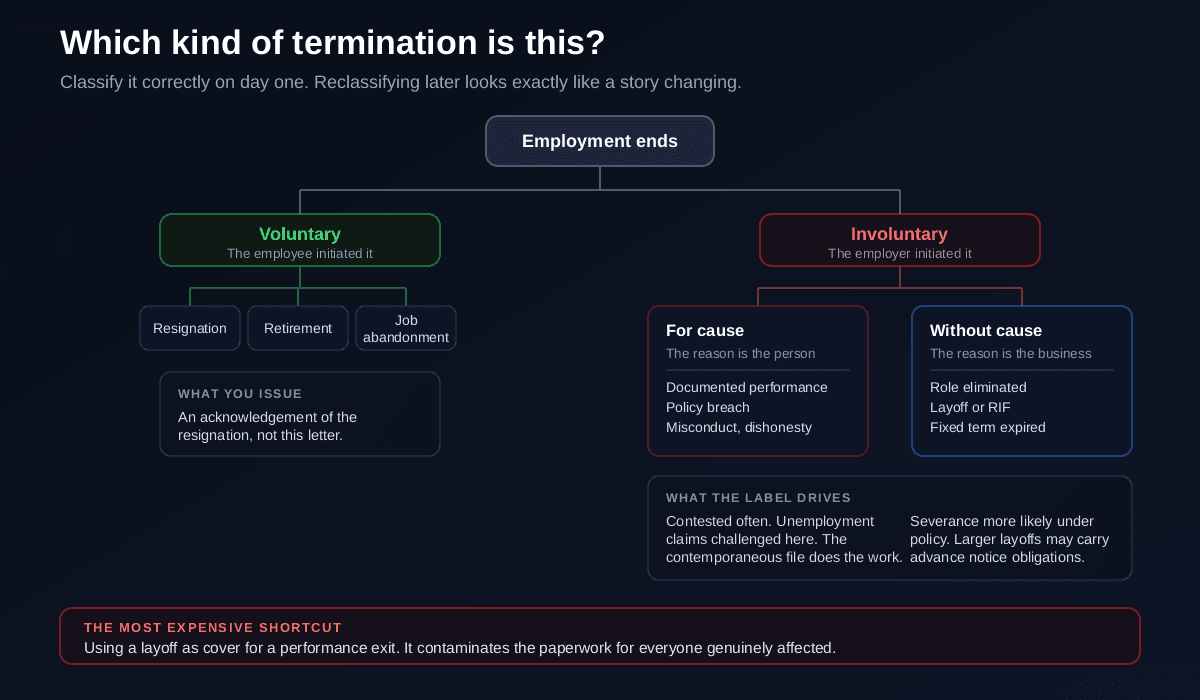
Voluntary means the employee initiated it: a resignation, a retirement, or abandonment. The document you need here is an acknowledgement of resignation rather than a termination letter, and our guide to resignation letters covers the other side of that exchange.
Involuntary, for cause means the reason attaches to the person: documented performance failure, a policy breach, dishonesty, misconduct. These are the ones that get contested, and the ones where the contemporaneous file does all the work.
Involuntary, without cause means the reason attaches to the business: the role went, the function was outsourced, the team was restructured, the budget disappeared. In most states, at-will employment means you do not need cause to end employment, so the label is about accuracy and consequence rather than permission. Where the honest answer is a business reason, say the business reason.
The most expensive shortcut in this whole subject
What to include, and what must never go in
Nine elements, and the discipline is subtractive. Everything you add beyond them is something that can be contradicted.
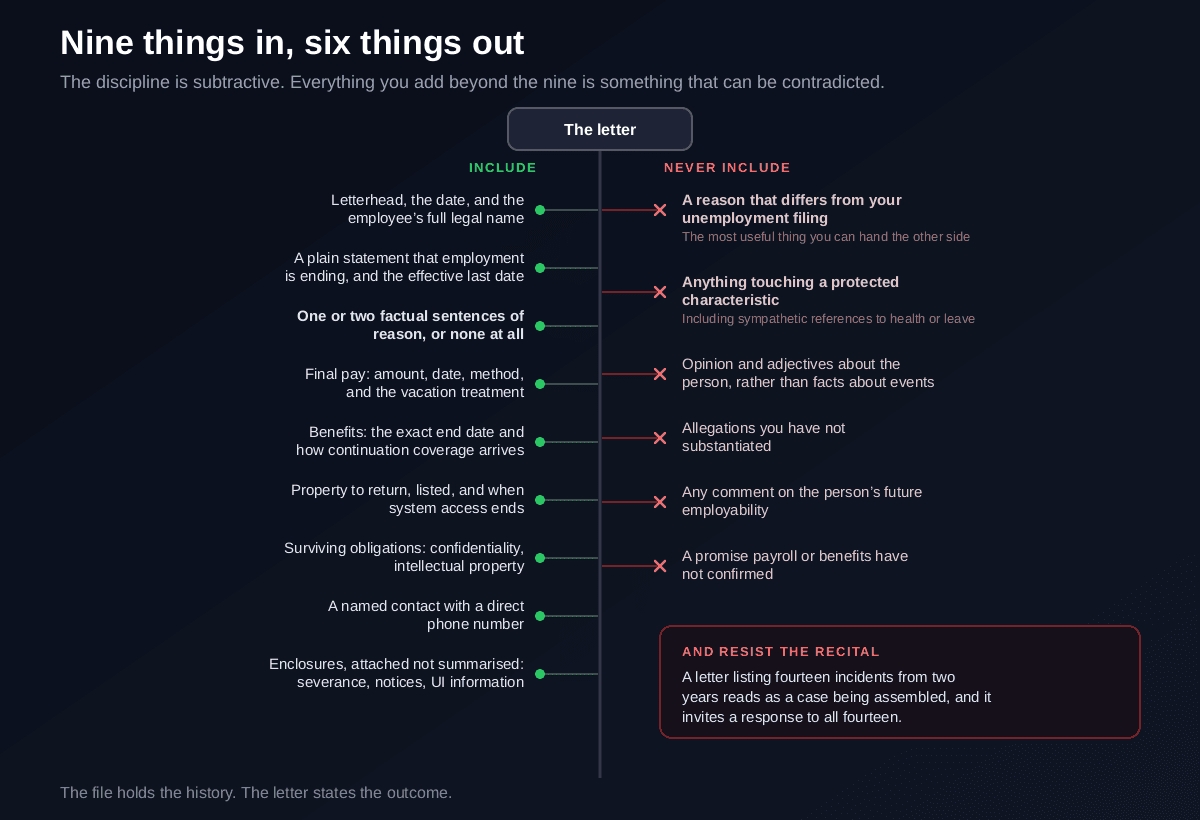
The reason line is the one to get right. You have two defensible options: one or two factual sentences, or nothing at all if that is your consistent practice. What you cannot do is write a reason that differs even slightly from what you report to the unemployment agency. That inconsistency is the single most useful thing you can hand to the other side, and it is almost always created by someone trying to be kind in the letter and accurate on the form.
Resist the recital. A letter listing fourteen incidents from the past two years reads as a case being assembled, and it invites a response to all fourteen. The file holds the history. The letter states the outcome.
Attach, do not restate. Severance agreements, benefits and continuation coverage notices, and unemployment information travel as enclosures. Prose summaries of legal documents inside a letter create discrepancies between the summary and the document.
Termination letter templates
Six versions. The first is complete; the rest show the clauses that change so you can splice them into the same skeleton. Replace everything in square brackets, and have counsel review your standard template once before it goes into rotation.
Termination without cause (role eliminated)
[Company letterhead]
[Date]
[Employee full legal name]
[Address]
Dear [First name],
This letter confirms that your employment with [Company name] as [job title] will end on [effective date]. This decision is the result of [the elimination of your position following a restructure of the [team] function], and it is not related to your conduct or performance.
Final pay. You will receive all wages earned through [effective date], payable on [date] by [method]. This payment will include [payment for [N] hours of accrued and unused vacation / no vacation payout, in line with the company policy set out in [handbook section]]. [Your severance is set out in the enclosed agreement.]
Benefits. Your [medical, dental and vision] coverage will end on [date]. Information about continuation coverage will be sent to you separately by [administrator], and the enclosed notice explains your election rights and the deadline that applies.
Company property. Please return the following by [date]: [laptop, monitor, phone, access badge, keys, corporate card, any documents or files]. Your access to company systems will end at [time] on [date].
Continuing obligations. The confidentiality and intellectual property provisions of your [agreement dated [date]] continue to apply after your employment ends.
Enclosed you will also find [unemployment insurance information / the state separation notice].
If you have any questions about any of the above, contact me directly on [phone] or at [email].
Thank you for your contributions to [Company name], and I wish you well.
Sincerely,
[Signature]
[Printed name], [Title]
Termination for cause, after a documented performance process
...your employment with [Company name] as [job title] will end on [effective date].
As discussed with you on [date of written warning] and again on [date of final warning], the performance expectations set out in your [performance improvement plan dated [date]] have not been met. Specifically, [one factual, measurable statement, for example: the agreed target of [X] was not reached in [period], and [specific requirement] was not completed by the agreed date of [date]].
This decision is final.
Two rules govern this version. Every date you cite must exist in the file with a contemporaneous record behind it, and the wording must match what goes on the unemployment filing. If you cannot point to the document behind a sentence, delete the sentence.
Termination for misconduct, effective immediately
...your employment with [Company name] is terminated effective immediately, [date].
This decision follows [the company's investigation into [subject], concluded on [date]], which established that your conduct on [date] breached [the specific policy, named, and the section]. [Where applicable: you were placed on paid suspension on [date] pending that investigation and were interviewed on [date].]
Your access to company premises and systems ended at [time] on [date]. Please return [items] by [date] or arrange collection with [name].
State the policy breached by name and section, and state the conclusion, not the narrative. An immediate termination with no investigation trail is the version that gets challenged, so where the facts allow it, a brief paid suspension while you establish them is usually the cheaper path.
Layoff or reduction in force
...your position of [job title] is being eliminated as part of a reduction in force affecting [N] roles across [scope]. Your last day of employment will be [effective date].
This decision is not a reflection of your performance. Selection was based on [the criteria applied, for example: business need by function and the elimination of the [team] function in its entirety].
[This separation is permanent and there is no expectation of recall. / This is a temporary layoff and we expect to be able to consider recall from approximately [date], although we cannot guarantee it.]
You will receive [severance of [terms] as set out in the enclosed agreement], [outplacement support through [provider]], and [continued benefits through [date]].
Larger reductions carry notice obligations. The federal WARN Act requires 60 days of advance notice for qualifying mass layoffs and plant closings at employers with 100 or more employees, and several states have their own versions with lower thresholds. Confirm both before you set a date, because the notice period drives the timeline rather than the reverse.
End of a fixed term or contract
This letter confirms that your fixed-term employment as [job title], which began on [start date], will conclude on [end date] as set out in your [agreement dated [date]]. No further notice is required and the company does not intend to extend or renew the term.
[Where relevant: you are welcome to apply for any future openings, which will be assessed through our standard process.]
Mutual or agreed separation
This letter confirms our agreement that your employment with [Company name] will end by mutual agreement on [effective date]. The terms of the separation, including [severance, the reference approach, and the agreed internal and external description of your departure], are set out in the enclosed separation agreement, which controls if anything in this letter differs from it.
Where a separation agreement exists, the letter should defer to it rather than paraphrase it. Two documents that disagree about severance or about the agreed description of a departure is a worse position than either document alone. The same principle applies to an offer letter that sits alongside a contract.
How many write-ups before termination?
There is no legally required number. The belief that three are needed comes from company policies, not from law. In an at-will relationship the number that matters is the one your own policy and your own past practice imply.
That is the actual risk. If your handbook describes progressive discipline of verbal warning, written warning, final warning, termination, then following it for most people and skipping it for one is the inconsistency a claim gets built from. Two rules follow:
- Write it down when it happens. Contemporaneous notes are worth several times a summary composed the week of the termination, and the difference is visible to anyone reading the file.
- Be consistent, or be able to explain why not. Treating two people differently for the same conduct is harder to defend than any single decision you will make.
- Serious misconduct is different. Theft, violence, a safety breach or dishonesty normally justifies immediate termination regardless of prior warnings, provided your policy says so. Check that it does.
Final pay, vacation payout and benefits
This is the section that generates the most avoidable disputes, because the rules are state-level and the deadlines are short.
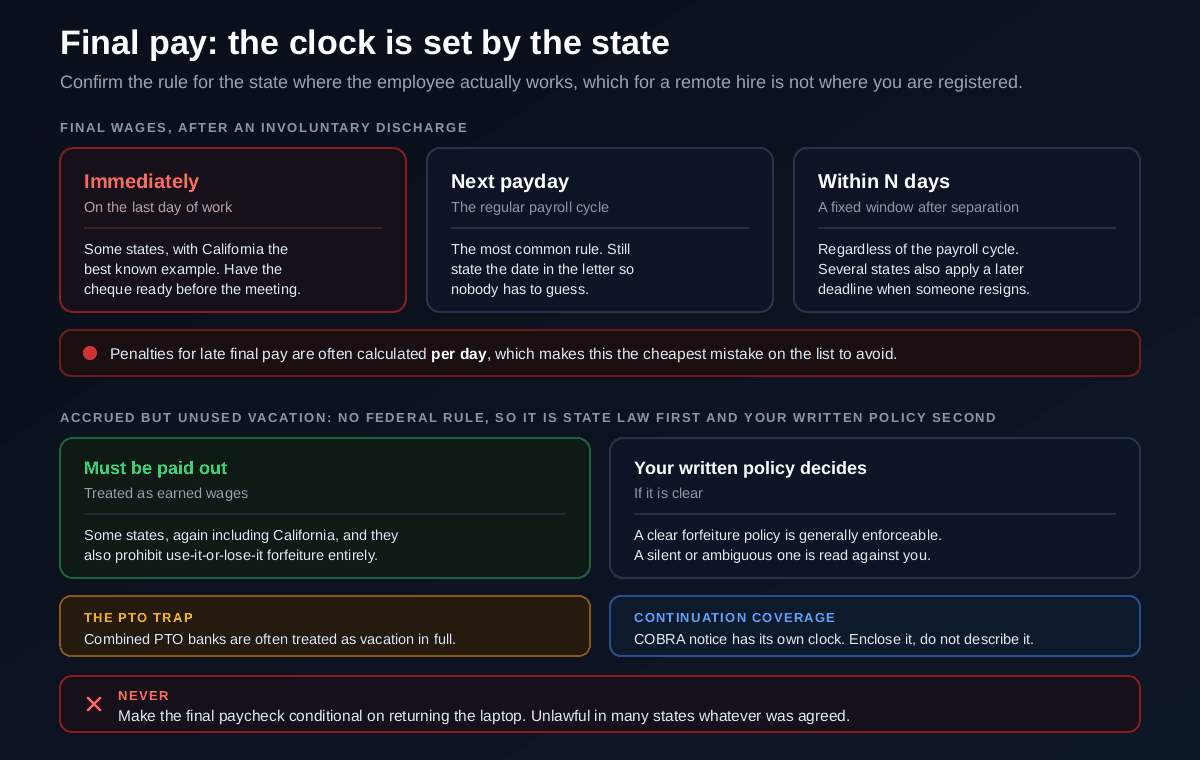
Final wages. Deadlines fall into three groups: immediately on the last day of work for an involuntary discharge in some states, with California the best known example; on the next regular payday in many states; or within a specified number of days in others. Several states also apply a later deadline when the person resigns than when they are discharged, which is one more reason the voluntary or involuntary classification is operational and not cosmetic. Penalties for late payment are often calculated per day.
Accrued vacation.No federal requirement. Some states treat accrued vacation as earned wages that must be paid out and prohibit use-it-or-lose-it forfeiture outright. Others defer to your written policy, which means a clear policy is enforceable and a silent or ambiguous one tends to be read in the employee's favour. Note that combined paid time off banks are frequently treated as vacation in their entirety, which can be more expensive than intended. Whatever the rule where the person works, state the treatment explicitly in the letter.
Benefits and continuation coverage. Give the exact date coverage ends rather than a vague month, because people schedule medical appointments against that sentence. Continuation coverage under COBRA generally applies to employers with 20 or more employees and carries its own statutory notice clock, commonly within about 44 days of the qualifying event where the employer administers the plan. Send the notice through the administrator and enclose it rather than describing it.
Never make final pay conditional on returning property
The termination meeting: the 30 minutes around it
The letter is the record. The meeting is the part people handle badly, usually by talking too much.
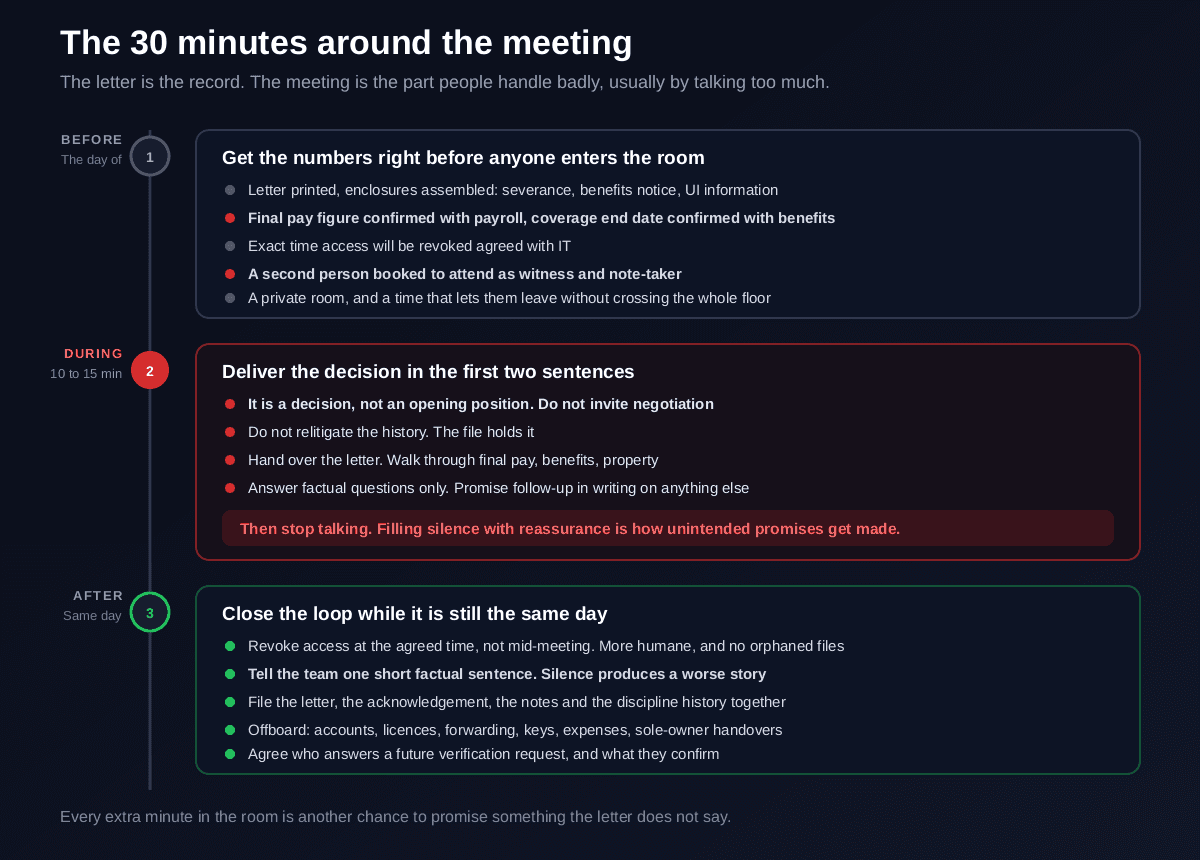
Before. Have the letter printed and the enclosures assembled. Confirm the final pay figure with payroll and the coverage end date with benefits, because a wrong number in that meeting undoes everything else. Agree the exact time access is revoked, and book a second person to attend as a witness and note-taker. Pick a private room and a time that lets the person leave without walking past the whole floor.
During. Deliver the decision in the first two sentences. It is a decision, not an opening position, so do not invite negotiation or relitigate the history. Ten to fifteen minutes is the right length. Hand over the letter, walk through final pay, benefits and property, and answer factual questions only, promising to follow up in writing on anything you are not certain of. Then stop talking. The urge to fill silence with reassurance is how unintended promises get made.
After. Revoke access at the agreed time rather than mid-meeting, which is both more humane and less likely to leave a shared document orphaned. Tell the team the same day, in one short factual sentence, since the alternative is a rumour that is worse for everyone including the person who left. File the letter, the acknowledgement, the notes and the discipline history together. Then complete the offboarding list: accounts, licences, forwarding, keys, expenses, and the ownership of anything the person was the only holder of. If anyone asks for confirmation of employment later, our guide to employment verification letters covers what you should and should not confirm.
What makes a termination unlawful
At-will employment means you can generally end employment for any reason that is not an unlawful one. The unlawful ones cluster into three groups, and knowing them is mostly a checklist you run before the meeting rather than after the claim.
- Discrimination. A decision based on a protected characteristic: race, colour, religion, sex, pregnancy, national origin, age, disability, genetic information, and further characteristics protected under many state and local laws.
- Retaliation. A termination following protected activity: complaining about discrimination or harassment, reporting a safety issue, filing a wage claim, taking legally protected leave, jury service, or protected concerted activity with colleagues.
- Breach. A termination that violates an employment contract, a collective bargaining agreement, or an implied promise created by a handbook or by consistent past practice.
Montana is the notable exception to at-will employment, requiring good cause after a probationary period. And timing is its own risk factor everywhere: a termination that lands shortly after a complaint, a leave request or a diagnosis will be examined on that sequence regardless of the underlying merits, so if the file does not already show the decision predating the event, get advice before the meeting rather than after.
A termination inside 12 months is usually a hiring decision, not a performance one
The cheapest termination is the one you never had to run. Upload your applicant batch and paste the job description, and Rankid scores every candidate 0 to 100 against the role's real requirements, showing exactly what each one evidences and what they are missing before you commit. Up to 200 resumes per batch, first 5 free, no signup.
Score your applicant pool freeThe mistakes that turn a termination into a claim
- A reason in the letter that differs from the unemployment filing. The most common and the most costly. Write one reason and use it everywhere.
- Softening the letter to be kind. Vague or generous wording in the document while the file says something else creates the inconsistency for you.
- No contemporaneous documentation. A file assembled the week of the termination reads exactly like a file assembled the week of the termination.
- Skipping your own process for one person. Inconsistency is the evidence. Follow the policy or change the policy.
- A performance exit dressed as a layoff. Or the reverse. Both contaminate the paperwork.
- Wrong or late final pay. State deadlines are short and penalties are often per day.
- Withholding pay until property is returned. Unlawful in many states whatever was agreed.
- No witness in the room. Two accounts of a meeting with no notes is a dispute about what was said.
- Talking for forty minutes. Every additional minute is another chance to promise something or to say something that contradicts the letter.
- Saying nothing to the team. Silence produces a worse story than the short factual one you could have told.
Key takeaways
- The letter's real audience is the file: an unemployment examiner, possibly a lawyer, and whoever inherits the record.
- Nine elements: letterhead and date, name and position, the effective last date, a factual reason or none, final pay including vacation, benefits and continuation coverage, property and access, surviving obligations, a named contact.
- The reason in the letter must match the unemployment filing word for word in substance.
- Never include opinion, unsubstantiated allegations, anything touching a protected characteristic, or comments on future employability.
- Classify voluntary or involuntary, for cause or without cause, correctly on day one. Reclassifying later looks like a story changing.
- There is no legally required number of write-ups. Your own policy and past practice set the standard you are held to.
- Final pay deadlines and vacation payout are state-level. Confirm the state where the employee actually works.
- Never make final pay conditional on returning company property.
- Ten to fifteen minutes, a witness present, the decision in the first two sentences, then stop talking.
- Attach severance and benefits notices rather than paraphrasing them in the letter.
The version of this that goes well is short and boring. One reason, stated once, used everywhere. A letter that states the outcome rather than arguing the case. Final pay and coverage dates confirmed with payroll and benefits before anyone enters the room. A witness, fifteen minutes, and the discipline to stop talking. And because the cheapest termination is the one that never needed to happen, it is worth looking upstream at how the hire was made: an interview scorecardand a consistent screen against the role's real requirements prevent more exits than any policy does. Paste a job description and your shortlist into Rankid's bulk resume screening and see what the evidence actually supports before you commit.
Frequently asked questions
What is a termination letter?
A termination letter is a written notice from an employer confirming that someone's employment has ended, the date it ended, and the practical consequences: final pay, benefits continuation, return of property, and any agreement that survives the employment. Its purpose is not to persuade or to explain at length. It is to create one accurate, dated record that everyone downstream can rely on, because the letter will outlive the conversation. It goes by several names depending on who is writing it, including notice of termination, letter of termination, separation notice and, where employment simply ends at the close of a fixed term, an end of contract letter. Keep it short, factual and consistent with everything else in the file. A letter that argues its case is a letter that has given someone something to argue with.
Do employers have to give a termination letter?
There is no general federal requirement in the United States that an employer must issue a termination letter, which surprises people who assume it is an entitlement. Several states do impose related obligations: a written notice stating the date of separation, or a requirement to hand the departing employee specific unemployment insurance information, and the details vary meaningfully by state. Separately, an employment contract, a collective bargaining agreement or your own written policy can create an obligation even where the law does not. In practice almost every established employer issues one anyway, for the simple reason that a termination with no document is a termination whose date, reason and terms are whatever the two parties later remember them to be. Check your state requirements, and if your handbook promises a written notice, honour it. This is general information rather than legal advice.
What should a termination letter include?
Nine elements: company letterhead and the date; the employee's full legal name and the position held; a plain statement that employment is ending and the effective last date; the reason, stated in one or two factual sentences or omitted entirely if your practice is to state none; final pay details including the date, method, and the treatment of accrued but unused vacation; benefits information including the end of coverage and how continuation coverage will be offered; company property to be returned, listed specifically, and access that will be revoked; a reminder of any surviving obligations such as confidentiality or intellectual property assignment; and a named contact with a direct phone number for questions. Attach rather than restate: severance agreements, benefits notices and unemployment information travel as enclosures, not as prose inside the letter.
What should never be included in a termination letter?
Anything that is opinion, unverified, unnecessary, or inconsistent with the rest of the file. Specifically: adjectives about the person rather than facts about events; a reason that differs even slightly from what you will tell the unemployment agency, since that inconsistency is the single most useful thing you can hand to the other side; anything about health, disability, medical leave, pregnancy, age, religion, national origin, or any other protected characteristic, including sympathetic references; allegations you have not substantiated; threats, or any suggestion about the person's future employability; sarcasm or any attempt to win the argument; and promises you have not confirmed with payroll and the benefits administrator. Also resist the urge to list every incident from the past two years. A letter that recites 14 grievances reads as a case being built, and it invites a response to all 14.
What is the difference between voluntary and involuntary termination?
Voluntary termination is initiated by the employee, meaning a resignation, a retirement, or simply not returning. Involuntary termination is initiated by the employer, and it splits again into termination for cause, meaning conduct or performance attributable to the employee, and termination without cause, meaning a business reason such as a restructure, a role elimination, a layoff or a reduction in force. The distinction is not cosmetic. It drives unemployment insurance eligibility, whether severance is owed under your policy or a contract, what you report on any required separation notice, and how the departure should be described internally and externally. Get the classification right in the paperwork on day one, because reclassifying a departure later looks exactly like a story changing.
What is the difference between termination for cause and without cause?
For cause means the reason relates to the employee: documented performance failure, a policy breach, misconduct, dishonesty, or a serious single incident. Without cause means the reason relates to the business: the role was eliminated, the function was outsourced, the budget went, or the team was restructured. In most US states employment is at will, so an employer generally does not need cause to end employment, which makes the label a matter of accuracy and consequence rather than permission. The consequences differ: for-cause terminations are far more likely to be contested and are usually where unemployment claims get challenged, while without-cause terminations more often carry severance under policy or contract and may trigger notice obligations for larger layoffs. Where the honest answer is a business reason, say the business reason. Dressing a restructure up as performance creates a dispute you did not need.
How many write-ups do you need before terminating someone?
There is no legally required number, and the common belief that three write-ups are needed comes from company policies rather than from law. In an at-will employment relationship the number that matters is the number your own policy and your own past practice imply. If your handbook describes a progressive discipline process of verbal warning, written warning, final warning and then termination, departing from it for one person while following it for others is what creates exposure, because inconsistency is the evidence a discrimination or retaliation claim is built from. Two practical rules follow. First, write down what happened at the time it happened rather than reconstructing it afterwards, because contemporaneous notes are worth far more than a summary written the week of the termination. Second, serious misconduct such as theft, violence, or a safety breach normally justifies immediate termination regardless of how many prior warnings exist, provided your policy says so.
When is final pay due after termination?
It depends entirely on the state, and the deadlines fall into three broad groups. In some states an involuntary termination requires payment of all wages due immediately, meaning on the last day of work, with California the best known example. In many states final wages are due on the next regular payday. In others the deadline is a specified number of days after separation, commonly within a set window regardless of the payroll cycle. Several states also apply a different, later deadline when the employee resigns than when they are discharged, which is why the voluntary or involuntary classification matters operationally and not just on paper. Penalties for late final pay can be significant and are often calculated per day. Confirm the rule for the state where the employee actually works, which for a remote employee is not necessarily the state your company is registered in.
Do you have to pay out unused vacation when someone is terminated?
There is no federal requirement, and the answer turns on state law first and your written policy second. Some states treat accrued vacation as earned wages that must be paid out on separation and prohibit use-it-or-lose-it forfeiture entirely, California being the clearest example. Other states leave it to the employer's written policy, which means a clear policy stating that unused vacation is forfeited on separation is generally enforceable, while an ambiguous or silent policy tends to be read in the employee's favour. A few states require payout only if the policy or an established practice promises it. Two practical points. Paid time off banks that combine vacation and sick leave are often treated as vacation in their entirety, which can be more expensive than intended. And whatever the rule, state the treatment explicitly in the termination letter so the final payslip does not become the first argument of the following week.
What is the difference between a layoff and a termination?
A layoff is a termination without cause driven by business need, usually affecting a role rather than a person, and it is the case where the person's own conduct and performance are not the reason. That difference should be visible in the paperwork: a layoff letter names the business reason, avoids any performance language, confirms whether the separation is permanent or a possible recall, and normally travels with severance and outplacement information where those are offered. Larger reductions can also carry advance notice obligations, since the federal WARN Act requires 60 days of notice for qualifying mass layoffs and plant closings at employers with 100 or more employees, and several states have their own mini-WARN statutes with lower thresholds. The most common mistake is quietly using a layoff as cover for a performance exit, which contaminates the paperwork for everyone genuinely affected by the reduction.
Can you terminate an employee during their probation period?
Yes, and in an at-will relationship a probationary period does not change the legal position at all, which is exactly why offer letters should not describe one. The risk runs the other way: a stated probationary period implies that employment becomes more secure once it ends, which can undercut at-will status and create an expectation of just cause afterwards. If you use an initial period for structured evaluation, call it an introductory or onboarding period, be explicit that employment remains at will throughout and after it, and hold a genuine review at the end of it rather than letting the date pass in silence. Practically, an early termination should still be documented like any other: a factual reason, consistent treatment against how others in the same period were handled, and final pay and benefits handled to the same standard.
What makes a termination wrongful or unlawful?
At-will employment means an employer can generally end employment for any reason that is not an unlawful one, and the unlawful ones cluster into three groups. Discrimination, meaning the decision was based on a protected characteristic such as race, colour, religion, sex, pregnancy, national origin, age, disability or genetic information, and additional characteristics protected under many state and local laws. Retaliation, meaning the termination followed protected activity such as complaining about discrimination or harassment, reporting a safety issue, filing a wage claim, taking legally protected leave, serving on a jury, or engaging in protected concerted activity. And breach, meaning the termination violated an employment contract, a collective bargaining agreement, or an implied promise created by a handbook or by consistent practice. Montana is the notable exception to at-will employment, where statute requires good cause after a probationary period. This is general information and not legal advice: where there is any doubt, have counsel review before the meeting rather than after the claim.