Offer Letter Template: What to Include, 6 Samples, and the Clauses That Cause Trouble (2026)
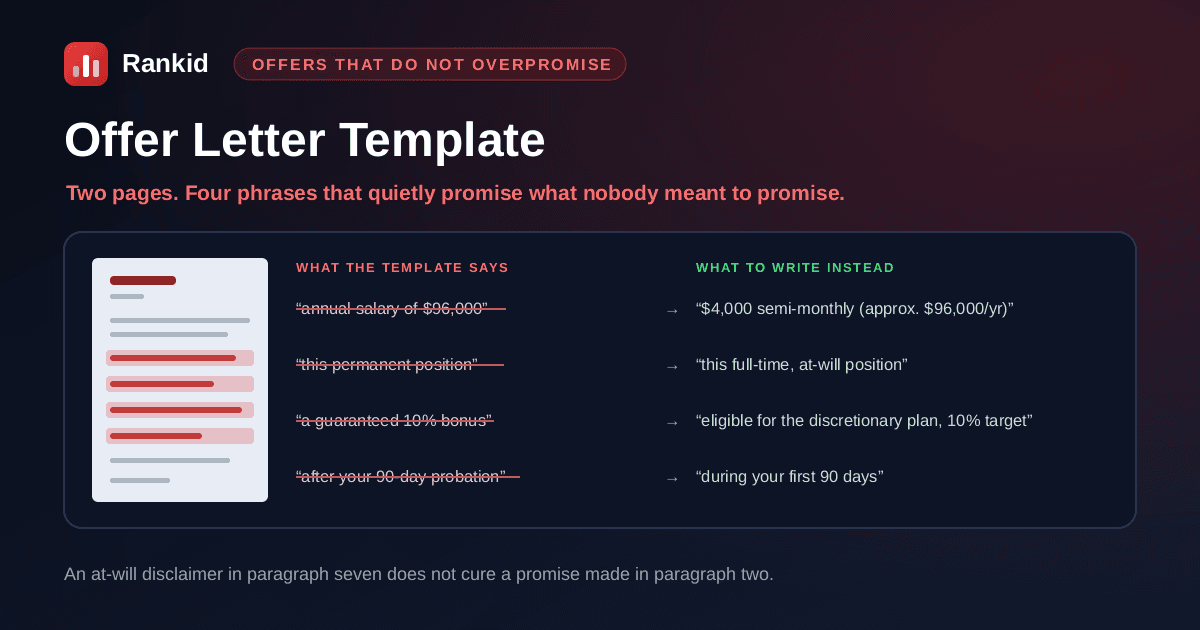
An offer letter is the shortest document in the hiring process and the one most likely to be read in court. Nine out of ten are unremarkable. The tenth promises an annual salary, calls the role permanent, guarantees a bonus, and quietly contradicts the at-will sentence sitting three paragraphs below it. Nobody meant to make a promise. The wording made one anyway. Here is the template that avoids it, six variants for the situations that do not fit the standard version, and the phrases worth striking from whatever template you inherited.
Quick answer
Quick answer: an offer letter formally offers a job on stated terms and the candidate accepts by signing it. Include twelve things: date and letterhead, full legal name, exact title, reporting line, employment type and exempt status, work location, pay stated per pay period, variable pay marked discretionary, a pointer to the benefits summary, the start date, every contingency, and an at-will statement with a signature block and a dated acceptance deadline. It is normally nota contract, so never write "annual salary", "permanent", "guaranteed bonus" or "probationary period". Give five to seven days to sign.
What is an offer letter?
It is a written offer of employment on stated terms, signed by the employer and accepted by the candidate signing and returning it. Its job is to convert a verbal conversation, where two people heard slightly different numbers, into one record both sides can check.
In the United States it is normally not a contract of employment, and a good letter says so. That is the point people miss. The letter is not a formality on the way to the real paperwork, it is the paperwork, and it is the document a dispute will start from two years later when someone remembers being promised a review at six months.
Three documents get confused with it constantly:
- A verbal offer is a statement of intent. Terms move between the verbal and the written version more often than candidates expect, which is why nobody should resign against one.
- An employment contract sets out the full legal relationship: term or notice, termination grounds, severance, confidentiality, intellectual property, restrictive covenants.
- An employment verification letter confirms that employment happened. An offer letter evidences an intention to employ, which is why lenders rarely accept one on its own. Our guide to employment verification letters covers that difference.
Offer letter vs employment contract: what is actually binding?
This is the most consequential distinction in the document, and it is decided by wording rather than by the heading at the top.
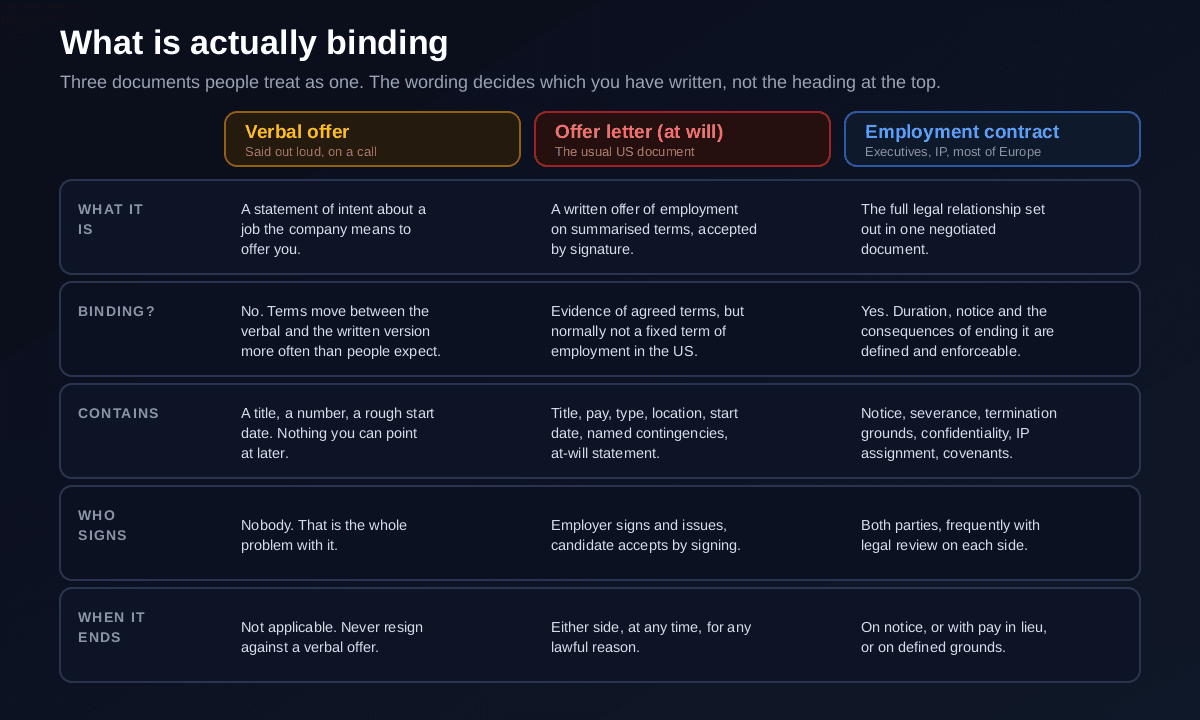
A signed offer letter is evidence of an agreement about terms. In most US states it does not create a fixed term of employment, and the letter should restate that employment remains at will and that nothing in it constitutes a contract for any specific duration. Where employers get caught is contradiction: a disclaimer in paragraph seven does not cure a promise made in paragraph two, and the whole document gets read together.
Outside the United States the default flips. In the UK, much of the EU, India and the Gulf, the offer letter is frequently the contract or is immediately followed by one, statutory notice periods apply, and at-will language is meaningless. If you hire across borders, do not run one template globally. Our guide to hiring remote employees covers the jurisdiction traps that follow.
If you issue both documents
What to include in an offer letter: the 12 components
Twelve elements cover almost every situation. The two most commonly botched are compensation, which should never be a bare annual number, and the contingencies, which have to be named specifically rather than gestured at.
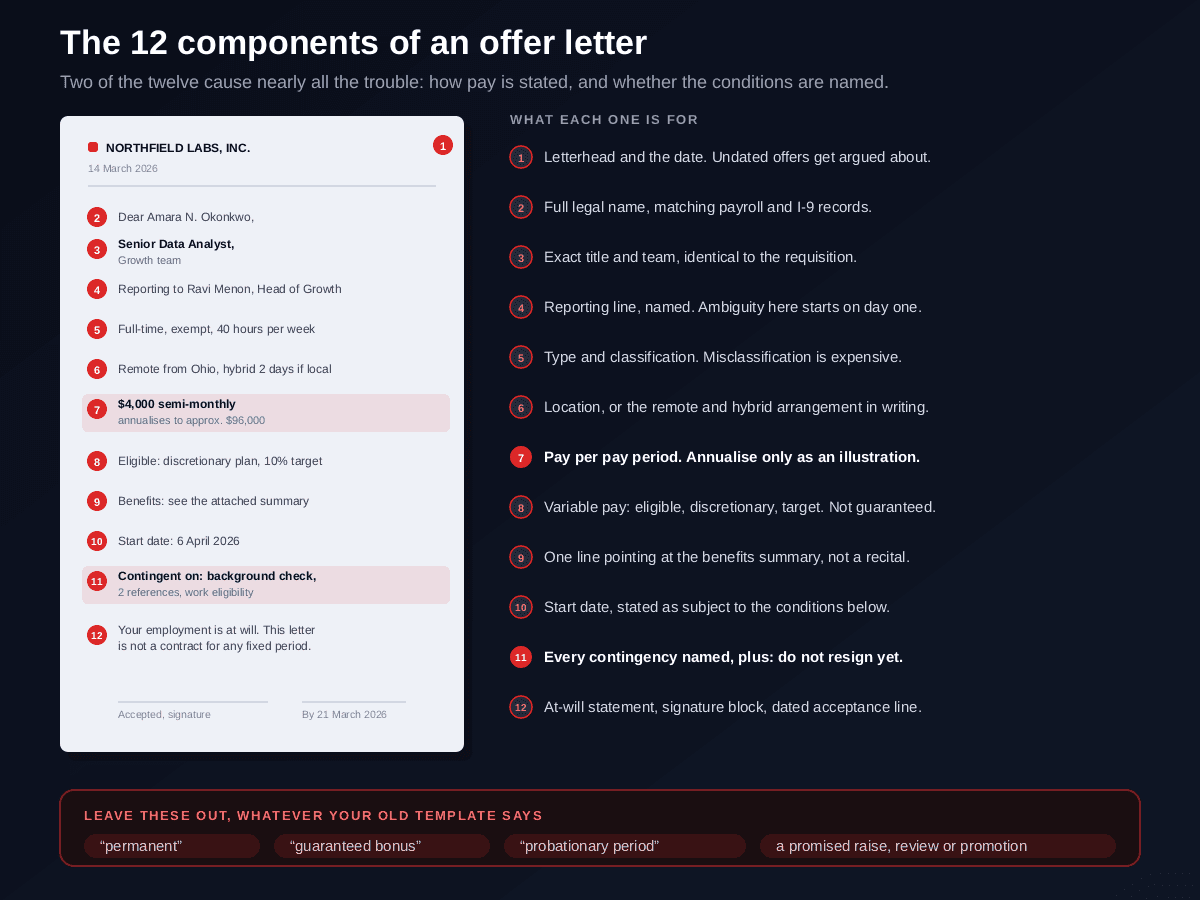
Compensation.State it per pay period or per hour, then annualise as an illustration: "4,000 dollars semi-monthly, which annualises to approximately 96,000 dollars". Writing "an annual salary of 96,000 dollars" has been argued to imply a year of employment, which is precisely what an at-will letter is trying not to say.
Classification. Full-time or part-time, and exempt or non-exempt. For non-exempt roles give the hourly rate and the overtime treatment rather than a salary. Misclassifying an hourly role as salaried exempt is one of the most expensive clerical errors available in hiring.
Variable pay.Describe the plan, not a number you are committing to: "eligible to participate in the annual discretionary bonus plan, with a target of 10 percent of base, subject to company and individual performance and to the terms of the plan as amended from time to time". The words that carry the weight there are eligible, discretionary and target.
Benefits. One line pointing at the summary and the plan documents. Reciting benefits in the letter means every renewal makes your offer letters wrong.
Contingencies. Name each one: background check, reference checks, proof of eligibility to work, licence or certification verification. Add that the offer is withdrawn if any condition is not satisfied. And add the sentence that prevents the worst version of this going wrong: do not resign from your current role until we confirm in writing that all conditions have cleared.
Offer letter templates and samples
Six versions below. The first is the full standard letter; the rest show only the clauses that change, so you can splice them into the same skeleton. Replace everything in square brackets, and have counsel review your standard template once before it goes into rotation.
Standard offer letter, full-time salaried exempt
[Company letterhead]
[Date]
[Candidate full legal name]
[Address]
Dear [First name],
We are delighted to offer you the position of [exact job title] in the [department] team at [Company name], reporting to [manager name], [manager title].
Employment type. This is a full-time, exempt position of [X] hours per week, based at [location / working remotely from [state or country] / hybrid, with [N] days per week at [office]].
Compensation.Your base pay will be [amount] per [semi-monthly / bi-weekly] pay period, which annualises to approximately [annual figure], less applicable withholdings and in line with the company's payroll practices as they may change.
Variable pay. You will be eligible to participate in the [annual discretionary bonus plan] with a target of [X] percent of base pay, subject to company and individual performance and to the terms of the plan as amended from time to time. Bonuses are discretionary and are not guaranteed.
Benefits. You will be eligible for the benefits described in the attached summary, subject to the terms of the applicable plan documents, which the company may change or discontinue at any time.
Start date. Your first day will be [date], subject to the conditions below.
Conditions. This offer is contingent on [satisfactory completion of a background check / receipt of two satisfactory professional references / verification of your eligibility to work in [country]]. Please do not resign from your current position until we have confirmed in writing that all conditions have been satisfied.
At-will employment. Your employment with [Company name] is at will. Either you or the company may end the employment relationship at any time, with or without cause and with or without notice. This letter is not a contract of employment for any specific period and it supersedes any prior verbal or written statements about the terms of your employment.
To accept, please sign and return this letter by [specific date]. If you have any questions at all, contact me directly on [phone] or at [email].
We are looking forward to working with you.
Sincerely,
[Signature]
[Printed name], [Title]
Accepted: [Signature] Printed name: [ ] Date: [ ]
Hourly, non-exempt
...the position of [job title], a [full-time / part-time], non-exempt role of approximately [X] hours per week.
You will be paid [amount] per hour, on a [weekly / bi-weekly] basis. As a non-exempt employee you are eligible for overtime at [one and one-half] times your regular rate for hours worked over [40] in a workweek, in accordance with applicable law, and you are required to record all hours worked accurately. Scheduled hours may vary with business needs.
Never annualise an hourly rate in the letter. An hourly employee who reads "approximately 62,000 dollars per year" has been told something about guaranteed hours that you did not mean to say.
Contingent or conditional offer
This offer is conditional. It becomes effective only upon satisfactory completion of each of the following, in the company's reasonable judgement: [1] verification of your identity and eligibility to work in [country]; [2] a background check covering [scope]; [3] confirmation of [licence / certification / qualification]; [4] receipt of [two] satisfactory professional references.
If any condition is not satisfied, this offer is withdrawn and no employment relationship will have been created. We expect these checks to be completed by approximately [date]. Please do not resign from your current position, give notice on housing, or relocate until we confirm in writing that all conditions have been satisfied.
Two sequencing rules apply in the United States. A medical examination may only be required after a conditional offer has been made. And where a background check surfaces adverse information, there is a pre-adverse and adverse action notice process to complete before the offer can be pulled. Our guide to how long a background check takes explains why employment verification is usually the component that decides your start date.
Internship offer letter
We are pleased to offer you a [paid] internship as a [title] with [Company name], from [start date] to [end date], reporting to [supervisor name].
You will be paid [amount] per hour as a non-exempt employee, for approximately [X] hours per week. During the internship you will [describe the learning component and the projects involved].
This internship ends on [end date] and does not constitute an offer of ongoing employment. Nothing in this letter guarantees that a further role will be offered at the end of the programme.
Internships are one of the few situations where a fixed end date is intentional. In the United States an unpaid internship at a for-profit employer is lawful only in narrow circumstances under the primary beneficiary test, so default to paid and non-exempt unless you have advice saying otherwise.
Independent contractor engagement letter
[Company name] would like to engage you as an independent contractor to provide [scope of services], from [date] until [date or completion of the deliverables described in Schedule A].
You will be paid [amount] per [hour / day / deliverable / month], invoiced [monthly] and payable within [N] days. You are responsible for your own taxes, insurance and equipment, and you will receive a [1099-NEC or local equivalent] rather than a W-2.
You are not an employee of [Company name]. You will not be eligible for employee benefits, you control the manner and means by which the services are performed, and you may work for other clients provided there is no conflict of interest. This engagement is governed by the attached [contractor agreement], which contains the confidentiality and intellectual property terms and which controls if there is any inconsistency with this letter.
Do not use employee vocabulary here. Words such as salary, hire, manager, working hours and probation are the ones that get pointed at in a misclassification claim.
Internal promotion or transfer letter
Congratulations. Effective [date], your role will change to [new title] in the [department] team, reporting to [manager name].
Your base pay will increase to [amount] per pay period, effective [date], and your bonus target will change to [X] percent of base under the [plan name]. Your service date, accrued leave and benefits enrolment carry over unchanged.
All other terms of your employment, including its at-will nature, remain as previously stated.
Internal moves need a written record for the same reason external hires do, and they are the ones most often handled by a verbal conversation and a payroll ticket. Our guide to internal recruitment covers how to run the selection that precedes this letter.
The offer letter email, in four sentences
The clauses that cause trouble
Almost every offer letter problem traces to one of six phrases, and five of the six were inherited from a template nobody has re-read in years.
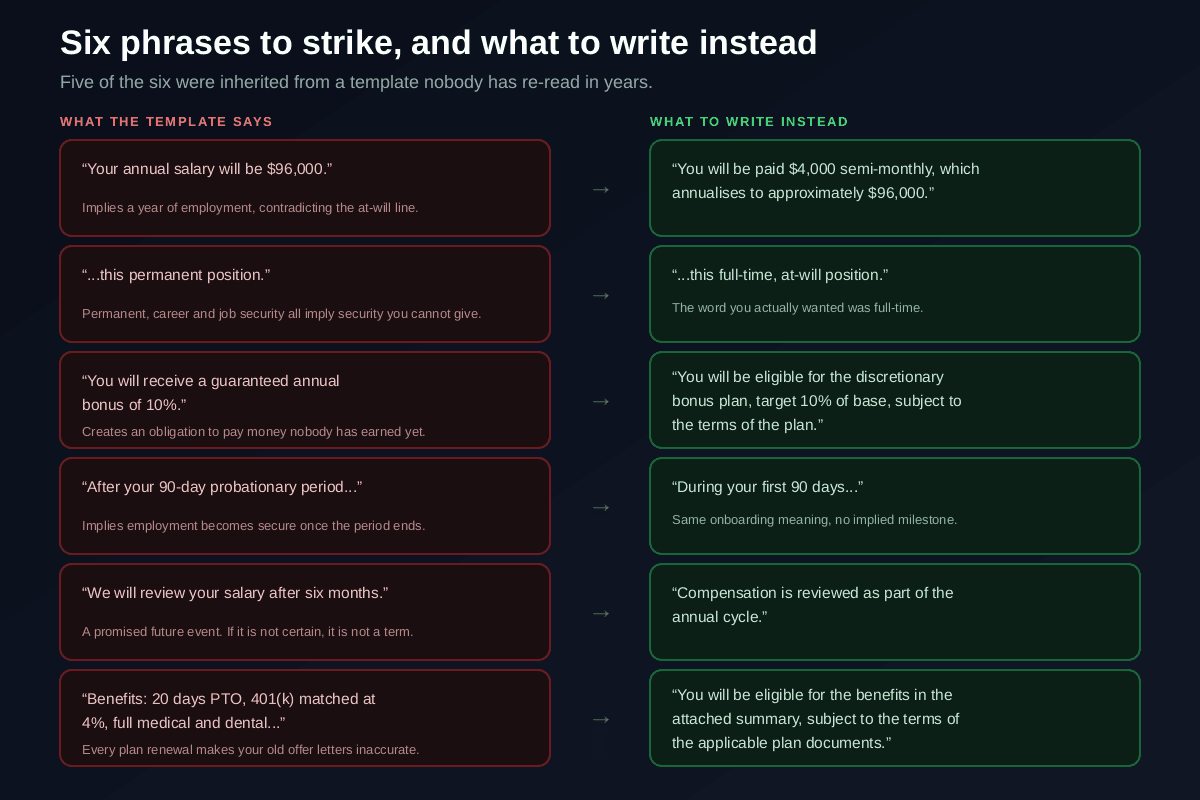
"Annual salary" implies a year. State pay per pay period and annualise as an illustration.
"Permanent" and its cousins, career position and job security, directly contradict an at-will statement. The word you want is simply full-time.
"Guaranteed bonus" creates an obligation to pay money that has not been earned. Say eligible, discretionary, and target.
"Probationary period"is worse than useless in an at-will jurisdiction, because it implies that once the period ends, employment is secure. Write "during your first 90 days" if you need to describe onboarding expectations.
Promised future events, meaning a raise at six months, a promotion after a year, a specific review outcome, or headcount you intend to give someone. If it is not certain, it does not belong in the letter. Put it in a one-to-one plan instead, where it belongs.
A benefits recital. Every plan renewal makes it inaccurate, and inaccuracy in an offer letter is a term you may have to honour.
Also check pay transparency consistency
How long it takes, and how long to give the candidate
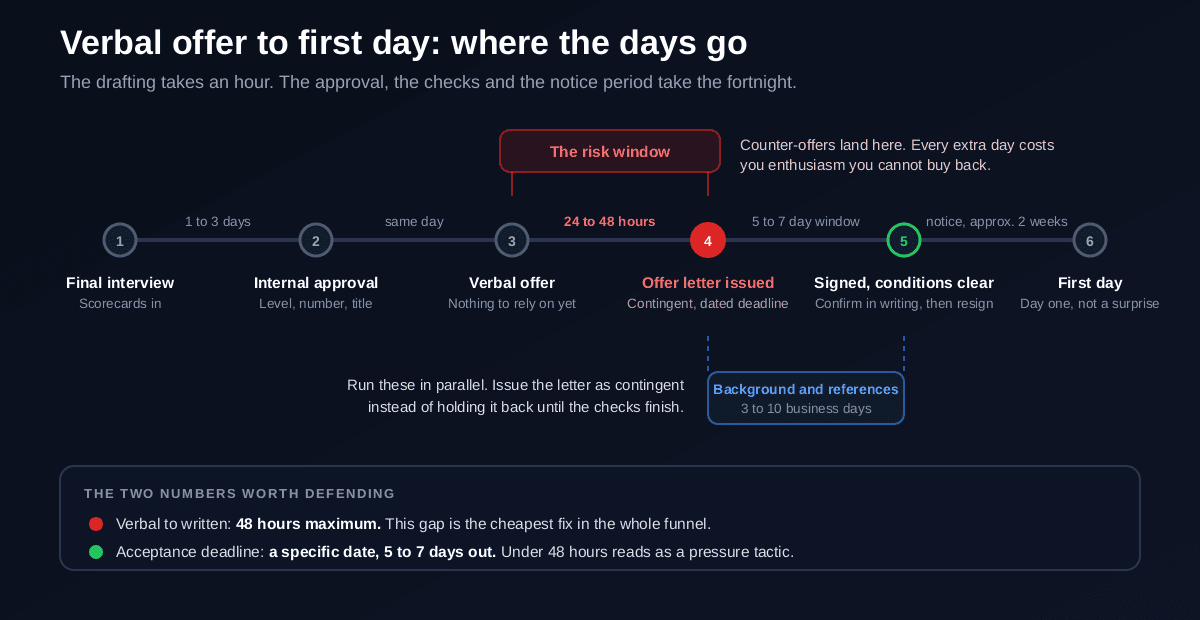
From the candidate's side: two to five business days after a verbal offer is normal, and the delay is approval rather than drafting. Finance confirms the level and the number, HR and the hiring manager settle the title, and in larger companies a compensation committee meets on a fixed day. After a week of silence, one polite email asking whether anything is outstanding is entirely appropriate.
From the employer's side, that gap is the single cheapest thing to fix in your whole funnel. Candidate enthusiasm decays between the verbal yes and the signed document, and it is exactly the window in which counter offers land. Get the letter out within 24 to 48 hours of the verbal, and issue it as contingent rather than waiting for checks to finish.
The acceptance deadlineshould be a specific date, five to seven calendar days out, not a number of days that invites arguments about weekends. Anything under 48 hours reads as a pressure tactic and costs more offers than it closes outside high-volume and graduate hiring. If a candidate asks for more time, grant it in writing with a revised date. What you should not do is let the stated deadline pass with a verbal extension, leaving you with a document whose own terms have expired. The candidate's side of this conversation is covered in our guide to how to respond to a job offer.
Make sure the offer is going to the right person
An offer letter is the last chance to notice you shortlisted on the wrong evidence. Upload your applicant batch and paste the job description, and Rankid scores every candidate 0 to 100 against the role's actual requirements, showing which ones each person matches and misses. Up to 200 resumes per batch, first 5 free, no signup.
Score your applicant pool freeThe mistakes that cost you the hire
- Sending it days late. The verbal-to-written gap is where competing offers land. 24 to 48 hours.
- An editable document. Send a PDF or use e-signature. A Word file comes back with edited terms and an argument about which version was agreed.
- No named human to call. The questions a candidate will not ask by email are the ones that lose the signature. Put a direct line in the letter.
- A number that does not match the conversation. If the offer changed after the verbal, say why in the email before they find it in the letter.
- Vague contingencies."Subject to standard pre-employment checks" tells the candidate nothing and gives you nothing to point at.
- No instruction about resigning. A candidate who resigns before a background check clears is the most damaging way this goes wrong.
- A title that differs from the requisition. Level and title mismatches surface on day one in the HR system and start the relationship with a correction.
- An exploding deadline. Under 48 hours converts enthusiasm into suspicion.
- Silence after signature. The window between signing and starting is when second thoughts and counter offers work. Keep contact warm, and send the first 30-60-90 day plan before day one.
Key takeaways
- Twelve components: letterhead and date, full legal name, exact title, reporting line, employment type and exempt status, location, pay per pay period, discretionary variable pay, a pointer to benefits, start date, named contingencies, at-will statement with a dated signature block.
- State pay per pay period and annualise as an illustration. Never write 'annual salary'.
- Strike 'permanent', 'guaranteed bonus', 'probationary period' and any promised future raise or promotion.
- An offer letter is normally not a contract in the US, but contradictory wording overrides the disclaimer.
- Outside the US the offer letter is often the contract. Do not run one template globally.
- Name every contingency specifically, and tell the candidate in writing not to resign until they clear.
- Issue the letter within 24 to 48 hours of the verbal offer, and give a specific acceptance date 5 to 7 days out.
- Send a PDF or e-signature link with a named human and a direct phone number, never an editable file.
The whole document is two pages, and nearly every problem attached to it comes from wording inherited rather than chosen. Pull your current template, strike the six phrases above, state pay per pay period, name the contingencies, add a dated acceptance line, and get it out within 48 hours of the verbal offer. Then make sure the letter is going to the person the evidence actually supports: upload your shortlist and the job description to Rankid's bulk resume screening and see how every candidate scores against the role before you commit anything to writing.
Frequently asked questions
What is an offer letter?
An offer letter is a written document from an employer formally offering someone a job on stated terms, which the candidate accepts by signing and returning it. It exists to turn a conversation into a shared, checkable record: the job title, who the person reports to, the start date, the pay and how often it is paid, whether the role is full-time or part-time, exempt or non-exempt, the location or remote arrangement, a summary of benefits, and any conditions the offer still depends on such as a background check or proof of work authorisation. In the United States it is normally not a contract of employment and it usually says so explicitly, restating that employment is at will. That distinction is the whole reason offer letters get drafted carefully: the same document that closes a candidate can, if worded loosely, create a promise the employer did not intend to make.
What should an offer letter include?
Twelve elements cover almost every situation: company letterhead and the date; the candidate's full legal name; the exact job title and the department; who the role reports to; employment type and classification, meaning full-time or part-time and exempt or non-exempt; the work location or the remote and hybrid arrangement; compensation expressed per pay period or per hour rather than as a bare annual figure; any variable pay described as discretionary and unguaranteed; a one-line pointer to the benefits summary rather than the benefits themselves; the start date; every contingency the offer depends on; and an at-will statement plus a signature block with an acceptance deadline. Leave out anything you cannot commit to for as long as the person is employed, because the offer letter is the document a dispute starts from.
Is an offer letter legally binding?
It binds less than most people assume, and more than some employers realise. A signed offer letter is evidence of an agreement about terms, but in most US states it does not create a fixed term of employment, and a well-drafted letter says plainly that employment remains at will and that the letter is not a contract for any specific duration. Where employers get caught is language that contradicts that disclaimer. Promising an annual salary of a specific amount, describing the role as permanent, or committing to a bonus without calling it discretionary can all be read as a promise of employment for a period or of money that has not been earned, and courts look at the whole document rather than the disclaimer alone. Outside the US the position is different again: in the UK, much of the EU, India and the Gulf, the offer letter is frequently the contract or is immediately followed by one, and statutory notice and terms apply. Treat this as general information rather than legal advice, and have counsel review your standard template once.
What is the difference between an offer letter and an employment contract?
An offer letter proposes employment on summarised terms and is typically short, one to two pages, at will, and silent on duration. An employment contract sets out the full legal relationship: a term or notice period, termination grounds, severance, confidentiality, intellectual property assignment, restrictive covenants, and a governing law clause. The practical difference shows up when things end. Under an at-will offer letter either side can usually end the relationship at any time for any lawful reason. Under a contract, ending it early has defined consequences, often including pay in lieu of notice. Many US employers issue an offer letter to everyone and add a separate agreement for executives or for anyone touching sensitive intellectual property. A common mistake is issuing both and letting them contradict each other, which is why the letter should state which document controls if they conflict.
What is a contingent offer letter?
A contingent or conditional offer letter is an offer that only becomes effective once stated conditions are satisfied, most commonly a background check, reference checks, proof of eligibility to work, a licence or certification check, a degree verification, or in some safety-sensitive roles a drug screen or medical assessment. The conditions have to be named specifically, with a note that the offer is withdrawn if any is not met to the employer's satisfaction. Sequencing matters: in the United States a medical examination may only be required after a conditional offer has been made, and where a background check produces adverse information there is a pre-adverse and adverse action notice process to follow before the offer can be pulled. Tell the candidate in writing not to resign from their current job until every contingency has cleared, because that single sentence prevents the most damaging version of this going wrong.
How long does it take to get an offer letter?
Usually two to five business days after a verbal offer, and the delay is almost never about drafting. What takes the time is approval: finance confirming the level and the number, the hiring manager and HR agreeing the title, and in larger companies a compensation committee that meets on a fixed day of the week. A background check or reference calls can add three to ten business days on top, though many employers issue the letter as contingent rather than waiting. If a week has passed with nothing in writing, a single polite email asking whether anything is outstanding is normal and appropriate. From the employer's side, the gap is worth closing aggressively: candidate enthusiasm decays measurably between the verbal yes and the signed document, and it is the window in which counter-offers land.
Do offer letters expire?
They expire if the letter says they do, which is why nearly every well-drafted letter carries an acceptance deadline. Five to seven calendar days is the standard, uncontroversial window for a professional role and it should be a stated date rather than a number of days, because dates avoid arguments about counting weekends. Deadlines under 48 hours read as pressure and cost more offers than they close outside high-volume and graduate hiring. If the candidate asks for a few more days, granting it in writing with a revised date costs nothing and preserves goodwill; extending it verbally leaves you with a letter whose stated deadline has passed. Note that an expired deadline does not automatically revoke the offer in every jurisdiction, so if you do intend to withdraw, say so explicitly rather than relying on the clock.
Should salary in an offer letter be stated as an annual figure?
State it per pay period or per hour, then give the annualised figure only as an illustration. Writing that someone will receive an annual salary of 96,000 dollars has been argued to imply employment for a year, which undercuts the at-will statement in the same letter. The safer formulation is that the role pays 4,000 dollars semi-monthly, which annualises to approximately 96,000 dollars, subject to applicable withholdings and to the company's payroll practices. For non-exempt roles state the hourly rate and the overtime treatment rather than a salary, because misclassifying an hourly role as salaried exempt is one of the most expensive administrative errors in hiring. Where pay transparency laws apply, the offer should also be consistent with the range you published in the job posting.
How do you write an offer letter email?
Keep the email short and put the terms in the attachment. Four sentences work: a warm opening naming the role, confirmation that the formal offer is attached, the two or three headline terms restated as a summary rather than as the offer itself, and a clear instruction on how and by when to accept. Name a person for questions and give their direct line, because the questions a candidate is too embarrassed to ask by email are the ones that lose you the signature. Send the letter as a PDF or through an e-signature service, never as an editable document, and copy the recruiter so the thread does not stall if the hiring manager is travelling. If the offer is contingent, say so in the email body as well as in the letter, and repeat the instruction not to resign yet.
Can an employer withdraw an offer letter after the candidate signs?
In the United States, generally yes, because at-will logic extends backwards into the pre-employment period, so a signed offer can usually be withdrawn before the start date. There are real limits. A withdrawal that is discriminatory or retaliatory is unlawful. Where the reason is information from a background check, the pre-adverse and adverse action process applies. And some states recognise a promissory estoppel claim where the candidate gave up something concrete in reliance on the offer, such as resigning or relocating, with availability varying sharply by jurisdiction. Beyond the legal exposure there is a practical cost that recruiting teams underrate: rescinded offers are discussed publicly and they poison a hiring pipeline for months. If a requisition is at risk of being frozen, say so before the offer goes out rather than after.
What should never go in an offer letter?
Anything you cannot honour for the entire duration of the employment, and anything that contradicts the at-will statement. Specifically: the words permanent, career, or job security; a promise of future raises, promotions or a specific review outcome; a guaranteed bonus or commission figure without calling the plan discretionary and subject to change; a detailed recital of benefits, which changes at every renewal and should be a pointer to the plan documents instead; a stated probationary period in an at-will jurisdiction, since it implies employment is secure once the period ends; performance expectations phrased as commitments the company makes; and anything about the person's medical history, immigration status beyond confirming eligibility to work, or family circumstances. Everything you add is a term you may later have to defend.
Does an internship offer letter need to be different?
Yes, in three ways that matter. It should state a defined end date, since an internship is one of the few situations where a fixed term is intentional. It must be explicit about whether the internship is paid, and in the United States an unpaid internship at a for-profit employer is only lawful in narrow circumstances under the primary beneficiary test, so the default assumption should be that it is paid at least minimum wage and treated as non-exempt. And it should describe the learning component, the supervisor, and the expected hours per week, because those are exactly the facts that determine whether the arrangement is an internship or an underpaid job. Keep the at-will language for paid internships, state clearly that the internship does not guarantee an offer of ongoing employment, and if academic credit is involved name the institution's requirements.