Skills to Put on a Resume: Examples for 2026 (Hard, Soft & Technical)
The skills section is the most misused part of a resume. Most people treat it as a junk drawer: a long, generic list of words like "communication," "Microsoft Office," "team player," and "problem-solving" that could belong to literally anyone. That list does almost nothing for you. It does not help a recruiter tell you apart from the other 200 applicants, and it does not help the software that reads your resume first decide you are a match. The skills that actually work are specific, honest, and chosen to mirror the job you want. This guide is the complete list: the hard skills, soft skills, and technical skills to put on a resume, with real examples by field, exactly how many to list and where, how to prove each one, and the single move that separates a skills section that gets you found from one that gets skimmed past.
Quick answer
What counts as a skill, and why the right ones matter
A resume skill is any specific ability that helps you do the job: a tool you can use, a method you know, a language you speak, or a way of working you can demonstrate. The reason the right skills matter so much is that they are the first thing both the software and the human reader look for when deciding whether you are a match. An applicant tracking systemscores how well your skills, titles, and tools line up with the job description. A recruiter, scanning in seconds, is looking for the two or three must-have skills that tell them you belong in the "yes" pile.
That is why a generic skills list is a wasted opportunity. If your section lists the same soft skills everyone else claims, it adds length without adding a single point of differentiation. But if it names the exact hard skills and tools the posting requires, in the posting's own wording, you immediately look like a targeted, relevant candidate instead of a mass applicant. The skills you choose are not decoration. They are the match signal.
Hard skills vs soft skills: what goes where
Skills split into two families, and the biggest mistake people make is presenting them the same way. Hard skills are specific, teachable, and testable: you either know SQL or you do not, and it can be verified. Soft skills describe how you work with people and problems, and they cannot be proven in a single word. Getting the difference right tells you exactly where each type belongs on the page.
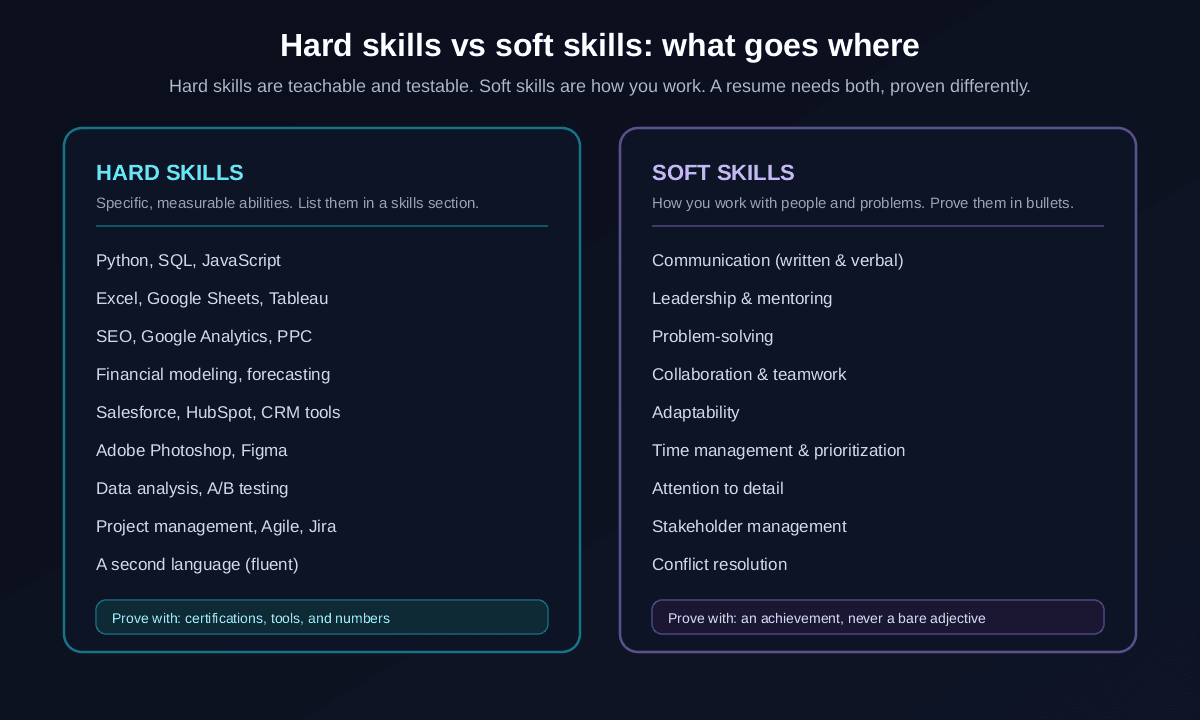
Hard skills belong in a dedicated, scannable skills section, because they are concrete keywords a recruiter and an ATS actively search for. Think programming languages, software and platforms, data and analytics tools, design tools, financial or clinical procedures, certifications, and spoken languages. These are safe to list plainly because they are unambiguous and verifiable.
Soft skillsare far weaker as a bare list, because everyone writes them and none of them are provable on their own. "Leadership" in a list means nothing; "Led a team of 6 through a platform migration delivered two weeks early" proves it. So the right home for a soft skill is usually inside an experience bullet that demonstrates it, using a strong action verb and a real result. Name a couple of soft skills in your section only if the job explicitly calls for them, and let the rest be shown, not told.
The one-word test for any skill
The best skills to put on a resume, by field
Here are strong, specific skills organized by field, so you can find the category that fits and pull the ones you honestly have. Treat this as a prompt list, not a copy-paste list: include only what is true, and always favor the exact skills your target job names.
- Software and engineering: Python, JavaScript, TypeScript, Java, C++, SQL, React, Node.js, AWS, Docker, Kubernetes, Git, CI/CD, REST APIs, system design, unit testing.
- Data and analytics: SQL, Python, R, Excel, Tableau, Power BI, Looker, data cleaning, statistical analysis, A/B testing, data visualization, machine learning, ETL pipelines.
- Marketing and content: SEO, keyword research, Google Analytics, Google Ads, Meta Ads, content strategy, email marketing, HubSpot, copywriting, CRO, marketing automation, social media strategy.
- Sales and account management: Salesforce, CRM management, lead generation, pipeline management, cold outreach, negotiation, forecasting, account planning, upselling, contract management.
- Finance and accounting: financial modeling, forecasting, budgeting, variance analysis, QuickBooks, SAP, Excel (advanced), GAAP, auditing, accounts payable/receivable, reconciliation.
- Design and creative: Figma, Adobe Photoshop, Illustrator, InDesign, UX research, wireframing, prototyping, design systems, typography, user testing, responsive design.
- Operations and project management: Agile, Scrum, Jira, Asana, project planning, resource allocation, process improvement, vendor management, KPI tracking, risk management.
- Healthcare and clinical: patient assessment, EHR/EMR systems (Epic, Cerner), medication administration, care planning, HIPAA compliance, clinical documentation, triage, phlebotomy.
- Transferable and soft skills (prove these in bullets): communication, leadership, problem-solving, collaboration, adaptability, time management, stakeholder management, conflict resolution, attention to detail.
Computer skills are not one skill
How to choose the right skills for each job
The reason a generic skills list fails is that it is aimed at no one. The fix is simple and it is the highest- leverage thing you can do to your skills section: pick your skills from the job posting, not from a template. Every posting hands you the exact list of skills the employer is scanning for, in the exact words they will search. Your job is to mirror the ones you honestly have.
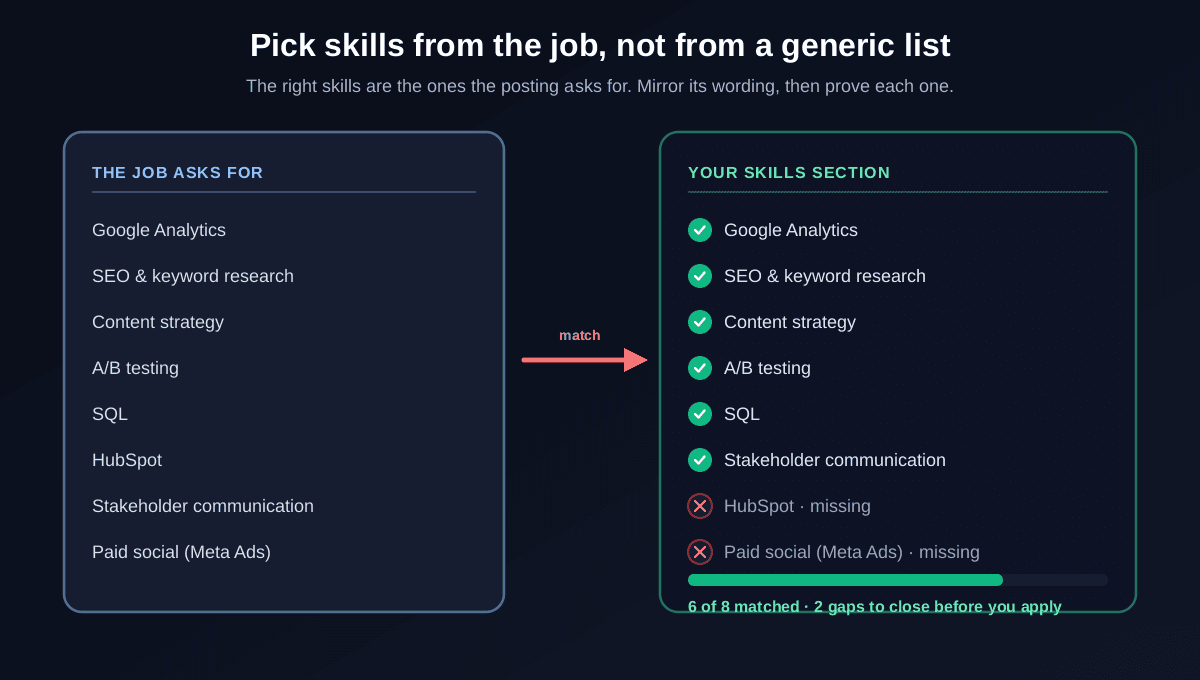
Read the posting and highlight every skill, tool, and qualification it names, especially anything in the "requirements" and "you will" sections. Then build your skills section from the overlap between that list and your real abilities, using the posting's wording. If the job says "paid social," write "paid social," not "social media advertising," because the exact phrase is what matches. This is the same principle behind choosing resume keywords that get past the ATS and behind tailoring your resume to the job description: relevance beats volume every time.
See which of the job's skills your resume actually matches
Stop guessing which skills to list. Paste your resume and the job description into Rankid and get a 0 to 100 match score plus the exact skills you match versus the ones you are missing, so your skills section mirrors what the job is really scanning for. Your first check is free, no signup.
Check your resume freeHow many skills to list, and where to put them
Two practical questions decide the shape of your skills section. First, how many: aim for roughly 8 to 12 skills, prioritizing the hard skills and tools the job explicitly requires. Fewer than about six looks thin; more than about fifteen becomes a keyword dump that buries your strongest skills and reads as padding. Put the must-have skills first, because both scanning eyes and truncated previews favor the top of the list.
Second, where: for most people the skills section sits near the top, just under the summary, so a recruiter sees your key skills in the first few seconds. If your experience is strong and directly relevant, keep skills short and let experience lead. If you are early-career, changing fields, or applying for a technical role where specific tools matter, a prominent skills section higher up helps because it front-loads the keywords. This matters even more given how little time recruiters spend on a first pass.
Keep the skills section machine-readable
How to prove your skills instead of just listing them
A skill in a list is a claim. A skill shown in an achievement is proof. The strongest resumes do both: they name the skill in the section so it is found as a keyword, and they demonstrate the most important skills inside the experience bullets so it is believed. Follow these steps to turn claimed skills into proven ones.
List the job's must-have skills in your section
Build a clean, single-column skills section from the overlap between the posting's required skills and your real ones. Lead with the specific hard skills and tools the job names, in its wording.
Prove your top skills in experience bullets
Take the three or four most important skills and show each one in a bullet with a result. Not "SEO" in a list alone, but "Grew organic traffic 60% by rebuilding the site's SEO and content strategy." The list gets you found; the bullet gets you believed.
Cut the generic and the unbacked
Remove obvious filler ("email," "internet research," "Microsoft Word") and any bare soft-skill adjective you have not proven. Never list a skill you cannot honestly back up in an interview.
Check the match before you apply
Confirm your skills section lines up with the posting. Score your match against the job and close any missing must-have skills, honestly, before you submit.
Common skills-section mistakes to avoid
- The generic dump. A list of soft skills copied from a template that could belong to anyone. It adds length and zero differentiation.
- Vague catch-alls."Computer skills," "Microsoft Office," "good communicator." Name the specific tool or prove the trait, or cut it.
- Skill bars and star ratings."Python: 4 of 5 stars" is unverifiable, subjective, and often unreadable to an ATS. State the skill plainly and prove it in a bullet.
- Listing skills the job never mentioned. A long list of irrelevant skills dilutes the ones that matter. Relevance to this posting beats breadth.
- Claiming skills you do not have. The missing keyword costs you far less than getting caught. Close the gap honestly or target a better-fit role.
Why the match matters more than the list
You can assemble a beautiful, specific skills section and still get passed over if it is aimed at the wrong target. The skills that get you shortlisted are not the most impressive ones in the abstract; they are the ones that overlap with what this particular job is looking for. That is why the same resume can be a strong match for one role and a weak match for another, and it is a big reason capable people are not getting interviews: not a weak skills list, but a weak overlap with the posting.
So use the examples above to build an honest, specific section, then close the loop by checking it against the actual job. Paste your resume and the job description into Rankid's free resume checkerand you will see exactly which of the job's skills you already match and which you are missing, so you list the right skills instead of guessing. The right skills, aimed at the right job, are what turn impressions into interviews.
Key takeaways
- The best skills to put on a resume are the ones the specific job asks for, written in the job's own words.
- Mix hard skills (specific, testable tools and abilities) with a few soft skills the posting actually emphasizes.
- List roughly 8 to 12 skills in a clean, single-column section near the top, must-haves first.
- Put hard skills in the skills section; prove soft skills inside achievement bullets, never as bare adjectives.
- Name specific tools ('Advanced Excel', 'Tableau'), not vague catch-alls like 'computer skills'.
- With no experience, lean on transferable and technical skills backed by projects, coursework, and volunteering.
- Never list a skill you cannot back up. Check which of the job's skills you match, free, with Rankid before you apply.
A skills section is not a place to list everything you can do. It is a place to show, quickly and honestly, that you can do this job. Pick your skills from the posting, prove the important ones with results, cut the generic filler, and confirm the overlap before you apply. Do that and the same experience that used to blend in starts reading as an obvious match, which is exactly what earns the impression, the click, and the interview. If you want a head start, see how to check if your resume matches a job description.
Frequently asked questions
What are the best skills to put on a resume?
The best skills to put on a resume are the ones the specific job description asks for, written in the same words the posting uses. There is no universal 'best' list, because the right skills for a software role and the right skills for a nursing role are completely different. That said, a strong resume usually mixes hard skills (specific, teachable abilities like Python, SQL, Google Analytics, financial modeling, or a second language) with a few soft skills that the job emphasizes (communication, leadership, problem-solving, stakeholder management). The method that works every time is to read the job posting, list every skill and tool it names, and include the ones you honestly have, mirroring its exact wording so both the applicant tracking system and the recruiter can see the match. A generic list of skills you copied from a template is the fastest way to look interchangeable with every other applicant.
How many skills should I put on a resume?
For a dedicated skills section, list roughly 8 to 12 skills, and make them the most relevant ones to the job you are applying for. Fewer than about 6 can look thin; more than about 15 turns into an unreadable keyword dump that dilutes your strongest skills and reads as padding. Prioritize the hard skills and tools the posting explicitly requires, put those first, and cut anything generic or obvious (listing 'Microsoft Word' or 'email' rarely helps). Remember that the skills section is not the only place skills appear. The strongest skills should also show up inside your experience bullets, proven with a result, because a recruiter trusts a skill they can see you used far more than one you simply claimed in a list.
What is the difference between hard skills and soft skills on a resume?
Hard skills are specific, teachable, and measurable abilities, like coding in Python, using Excel or Salesforce, running paid ad campaigns, or speaking a second language. You can be tested on them and often certified in them. Soft skills describe how you work with people and problems, like communication, leadership, adaptability, and time management. The practical difference for your resume is where and how you present them. Hard skills belong in a dedicated skills section as a scannable list, because they are concrete keywords a recruiter and an ATS look for. Soft skills are far weaker as a bare list, because everyone claims them and none of them are provable in a single word. The right home for a soft skill is inside an experience bullet that demonstrates it: instead of listing 'leadership,' write 'Led a team of 6 through a platform migration delivered two weeks early.' A resume needs both kinds, but it proves them in different places.
What skills should I put on a resume with no experience?
With little or no work experience, lean on transferable skills, technical skills, and evidence from school, projects, internships, volunteering, and part-time jobs. Transferable skills are abilities that carry across contexts, like communication, teamwork, research, time management, and problem-solving, and they are legitimate as long as you can point to where you used them. Pair those with any concrete hard skills you have, such as software you know, languages you speak, coursework tools, or certifications, because those are the keywords that help you get found. The key move is to prove the skill with a real example rather than just naming it: a class project, a club you organized, a fundraiser you ran, or a freelance task all count as evidence. Then mirror the exact skills the entry-level posting lists, so your relevant coursework and projects line up with what the employer is scanning for.
Where should the skills section go on a resume?
For most people, the skills section sits near the top of the resume, just under your summary and above or beside your work experience, so a recruiter sees your key skills in the first few seconds of scanning. If you have strong, directly relevant experience, keep the skills section short and let experience lead. If you are early in your career, changing fields, or applying for a technical role where specific tools matter a lot, a prominent skills section higher up helps, because it front-loads the exact keywords the job is looking for. Whatever the placement, keep it as clean, parseable text in a single column. Avoid putting skills only inside graphics, tables, columns, or skill bars, because many applicant tracking systems cannot read those reliably and your skills can silently disappear from the parse.
Should I list skills that are on the job description but that I don't have?
No. Never add a skill you cannot honestly back up, because it will surface in the interview or on the job and cost you far more than the missing keyword ever would. The right response to a required skill you lack is not to fake it but to decide whether the gap is small enough to close or acknowledge. If it is a tool very close to one you know, you can note the adjacent experience honestly. If it is a genuine core requirement you do not meet, that is useful information about fit, not something to paper over. The productive version of this is to compare your real skills against the posting before you apply, see exactly which required skills you match and which you are missing, and then either strengthen the honest matches or target roles where your gaps are smaller.