How to Respond to a Job Offer: Accept, Decline, or Buy Time (Email Templates, 2026)
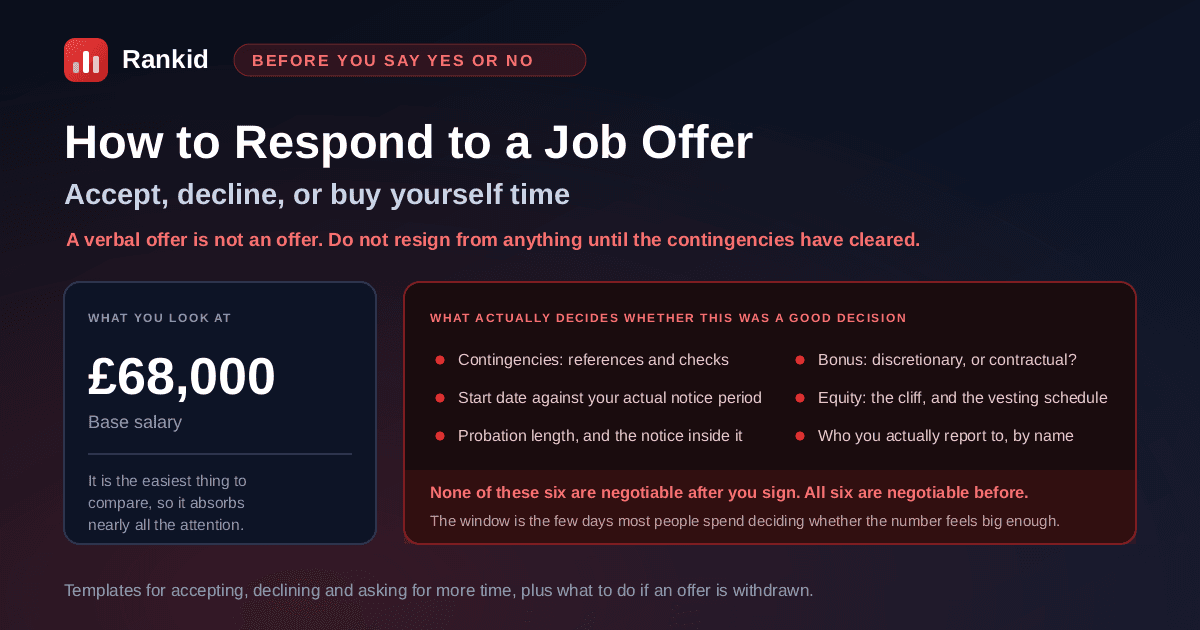
The email arrives on a Tuesday afternoon and everything narrows to one number. Is it enough? You screenshot it, send it to two people, and spend three days doing mental arithmetic about rent. Then you reply yes, because it felt like a good number and because saying yes is what you have been working towards for four months. Six of the things that will determine whether this was a good decision were in that email, and you read past all of them.
Quick answer
Reply the same day, decide over the next five. Acknowledge immediately, ask for a specific date if you need time, and never go quiet. Then work through four questions in order: is it in writing with the contingencies listed, does the guaranteed pay clear your walk-away number, would you take this job at your current salary, and is another process still live? The single rule that matters most: do not resign from anything until every contingency has cleared in writing. Templates for accepting, declining and buying time are below.
The first reply, within a few hours
Whatever you eventually decide, the first response should go out the same day, and it should do three things: thank them, express genuine interest, and either accept or name a date. It should not contain a decision you have not made yet.
The reason for the speed is not politeness. An employer who has made an offer is in a brief anxious window where they have stopped recruiting and have nothing signed. Silence in that window reads as ambivalence, and ambivalence is what makes a recruiter quietly re-engage their second choice. A three-line acknowledgement costs you nothing and buys you the whole week.
If the offer came verbally, this is the reply
What the offer is actually worth
Base salary is the easiest component to compare, so it absorbs nearly all the attention. It is also, for many offers, less than three quarters of the real number, and the rest varies enormously in how likely you are to ever see it.
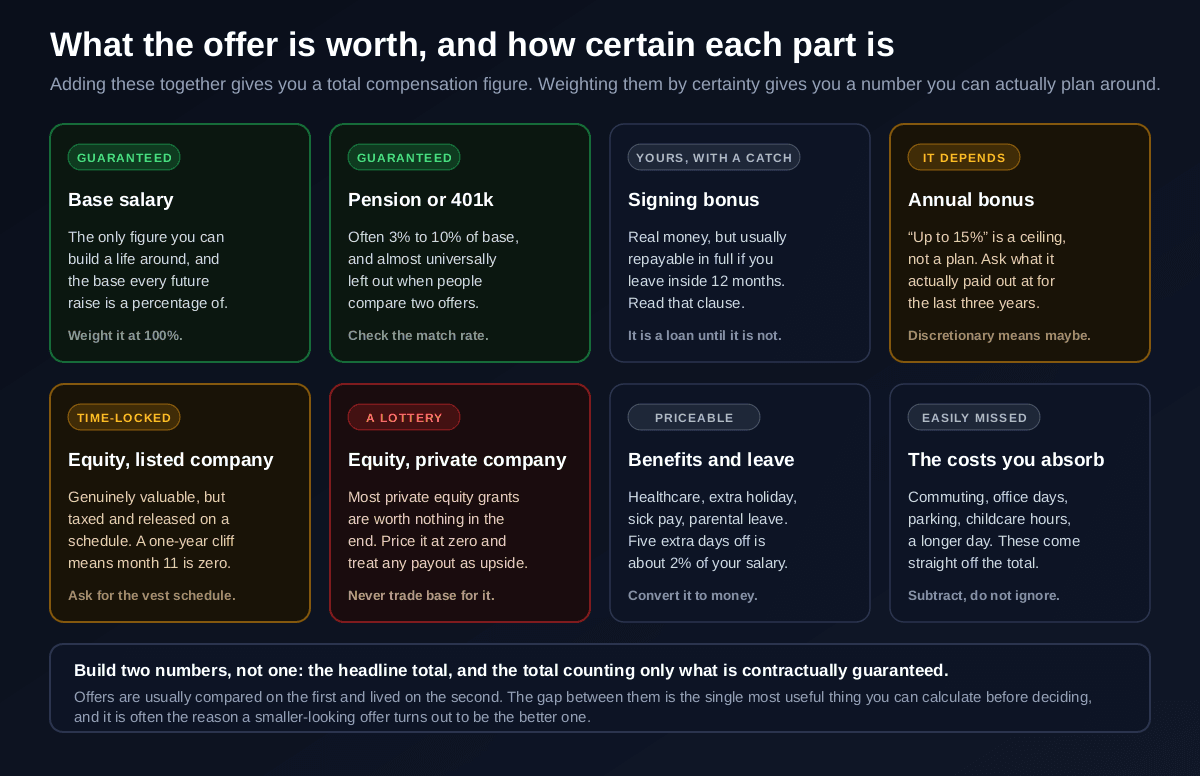
Build two numbers. The headline total is what a recruiter quotes you. The guaranteed total counts only what is contractual, which usually means base plus pension match plus anything explicitly promised in writing. Then subtract what the job costs you to do: commuting, office days, parking, extra childcare hours.
Three specific traps are worth naming, because they are the ones people discover afterwards. A signing bonus is almost always repayable in full if you leave inside twelve months, which makes it a loan that converts to income on your first anniversary. "Up to 15%" is a ceiling, not a forecast, and the useful question is what the scheme actually paid out at for each of the last three years. And a one-year equity cliff means that leaving in month eleven, voluntarily or otherwise, gets you nothing at all. If pay is the part you most want to move, how to negotiate salary covers the conversation itself in detail; this piece is about everything around it.
Score the eight things that are not the salary
People who regret a move almost never regret the pay. They regret the manager, or the scope, or discovering that the team gets reorganised every six months. Those are all knowable before you accept, and most of them are answerable from what you already saw during the process.
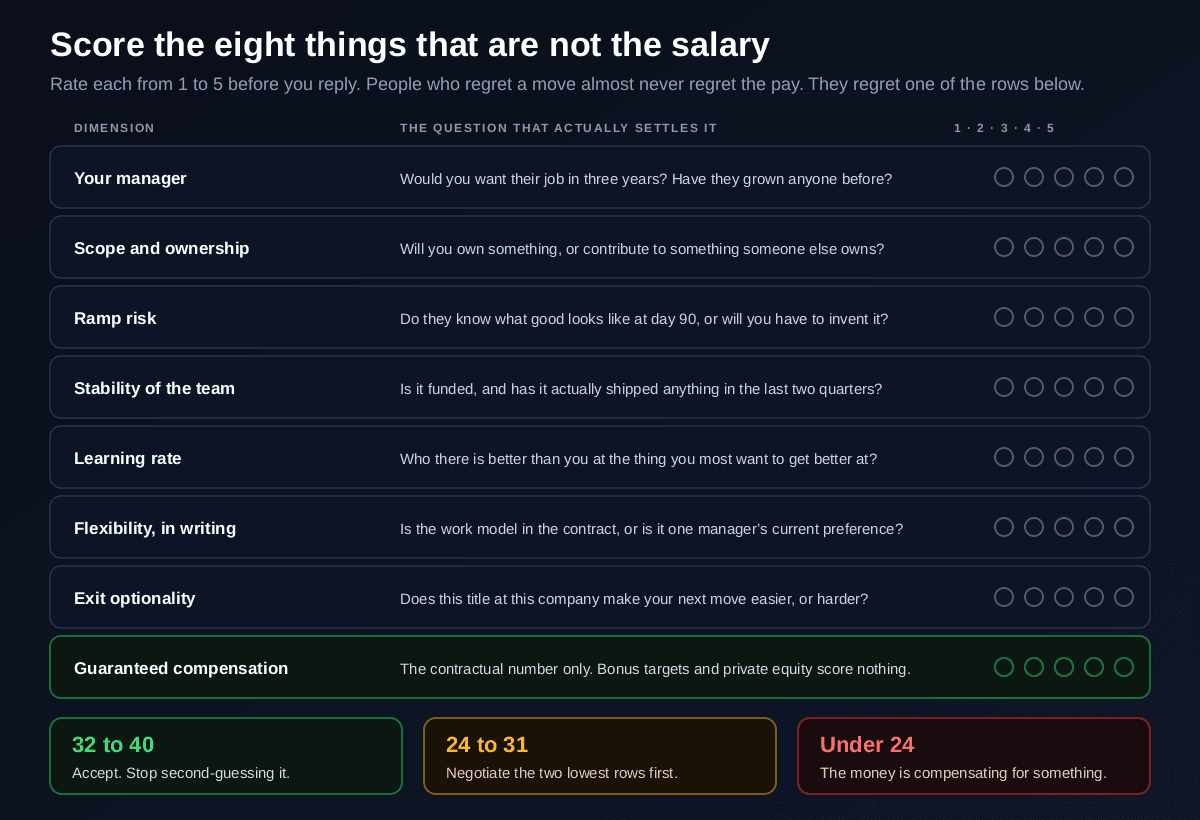
Two rows deserve a note. Ramp risk asks whether they know what good looks like at day 90 or whether you will have to invent it. A team that cannot answer that question is not necessarily a bad team, but you will be doing extra work that nobody has priced, and it is worth walking in knowing that. Writing your own 30-60-90 day plan before you accept is a fast way to find out: if you cannot fill in the day 60 column from what they told you, neither can they.
Exit optionality is the one nobody scores and everybody eventually cares about. Does this title at this company make your next move easier or harder? A slightly lower offer at a company whose name opens doors is often worth more over five years than the higher one that pigeonholes you.
Four questions, in this order
Once you have the numbers and the scores, the decision itself is more mechanical than it feels. Work down these four before you reply to anyone, because your first substantive reply sets the terms of everything after it.
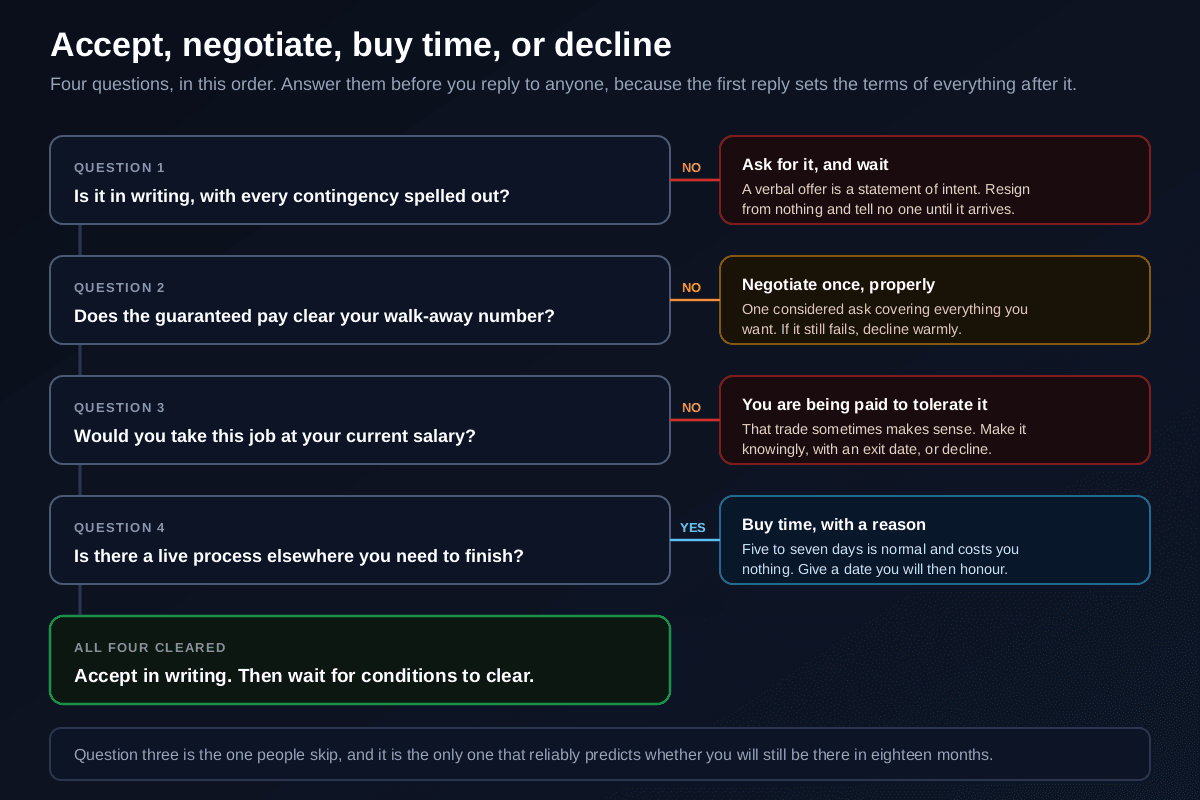
Question three is the one people skip and the only one that reliably predicts whether you will still be there in eighteen months. If you would not take this job at your current salary, the pay rise is compensating you for something. That can be a perfectly rational trade, and plenty of good careers include a deliberate stint of it. It goes wrong when you make the trade without noticing, because then you have no exit date and no idea why the job feels worse than the offer did.
Still weighing this against a process you have not finished
If you are buying time to let another application land, spend it on the one that is closest. Paste your resume and that job description into Rankid for a match score out of 100 and the specific requirements you are missing, so you know whether it is realistically going to convert before you turn anything down.
Check your match freeThe three emails
All three are short on purpose. Length reads as negotiation in the first, hesitation in the second, and guilt in the third.
Buying time
Subject: Re: Offer, [Job title]
Hi [Name],
Thank you, I am really pleased to receive this and [one specific, genuine thing about the role or team].
I want to give it the attention it deserves, and I have one process finishing this week. Could I confirm my decision by [specific day and date]?
In the meantime, could you confirm [the one or two things you genuinely need, such as the bonus terms or the probation notice period]?
Thanks again, [Your name]
Name a date rather than "a few days", and then honour it exactly, including if the answer turns out to be no. Attaching a real question to the request also makes the delay obviously purposeful rather than evasive.
Accepting
Hi [Name],
I am delighted to accept the offer for [job title], at [confirmed salary] with a start date of [date], as set out in your letter of [date].
My understanding is that the offer remains subject to [list the contingencies stated in the letter]. Could you confirm once those have cleared, as I will hand in my notice at that point?
Please let me know what you need from me in the meantime. I am looking forward to starting.
Best, [Your name]
The second paragraph is the important one and almost nobody includes it. Restating the conditions puts your understanding on the record, and telling them you will resign once cleared is a completely normal thing to say that quietly protects you from being pressured to resign early.
Declining
Hi [Name],
Thank you for the offer, and for [something specific about the process, the team, or a conversation you genuinely valued].
After a lot of thought I have decided not to accept, as I have taken another role that is closer to [direction, scope, or whatever is true and brief].
I really enjoyed meeting the team and I hope our paths cross again. Thank you again for your time.
Best, [Your name]
Send it the day you decide. Do not itemise the comparison, because a detailed reason invites a counter-offer conversation you have already resolved. And send it even if the process ended badly, because the recruiting world is small and the people who decline gracefully are the ones who get approached again.
The sequence that protects you
This is the part of the article that will save someone a genuinely terrible year. Accepting an offer does not make you employed. Almost every offer is conditional on something, and until those conditions clear you are in a gap where you have committed and they have not.
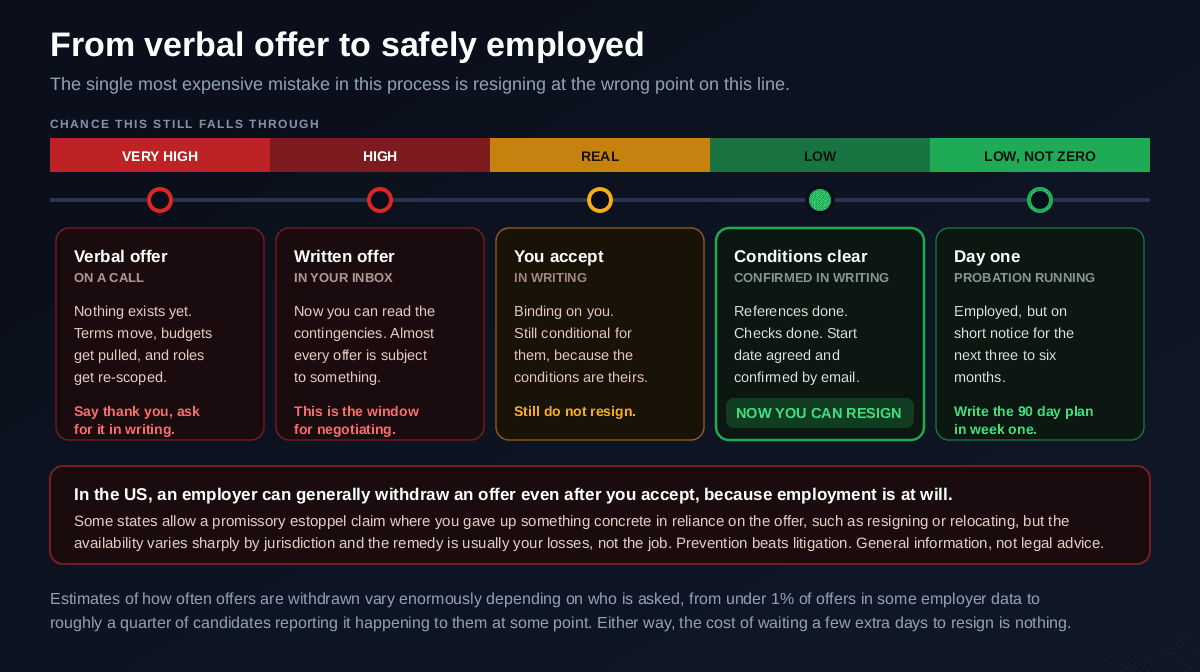
- Do not resign on a verbal offer. Ever, under any amount of enthusiasm from the recruiter. Terms move between verbal and written more often than anyone admits.
- Do not resign on an accepted but unconditional offer either. Your acceptance binds you. The contingencies still protect them.
- Get the clearance in writing.One line by email: "can you confirm that references and the background check are complete and the start date is confirmed?" That email is your green light.
- Then resign, and only then. Our guide to writing a resignation letter covers the next step, and how long a background check takes explains the delay you are waiting through.
On the legal position, briefly and without pretending to be a lawyer. In the US, employment is at will in most states and an employer can generally withdraw an offer even after acceptance. Some states allow a promissory estoppel claim where you gave up something concrete in reliance on the offer, such as resigning or relocating, but availability varies sharply and courts in some jurisdictions have rejected it outright. Even where the claim exists, the remedy is normally your losses rather than the job itself. Sequencing is a much better protection than litigation.
If the offer is withdrawn
Estimates of how often this happens vary wildly depending on who is asked. Employer-side data often puts it under a few percent of offers, while candidate surveys have found a quarter or more of respondents saying it has happened to them at some point. Either way it is common enough to know the drill, and it is very rarely about you.
- Ask for the reason in writing. Politely, once. A budget freeze, a reorganisation and a failed check are three entirely different situations, and only one of them is worth addressing.
- If you already resigned, call your current employer today. Withdrawing a resignation is frequently possible and gets much harder after the first few days, once the role has been advertised.
- Ask whether it is deferred rather than cancelled, and whether they will cover concrete costs you incurred. Companies will sometimes cover relocation or similar to close the matter cleanly.
- Restart everything immediately. Reactivate paused processes and tell recruiters plainly what happened. It carries no stigma, because everyone in hiring has seen it.
- If it was a failed reference or check, find out what it said. That is a problem that will recur at the next offer if you do not resolve it, and our guide to job references covers how to get ahead of it.
Five ways people lose an offer they had won
- Going quiet for a week. The most common one. No news reads as no interest, and the employer starts hedging.
- Negotiating in instalments. Three separate asks over four days is the pattern that genuinely irritates hiring managers. Make one considered request covering everything.
- Accepting while another process is live. This is how people end up reneging, which is expensive in a small industry. Buy time instead, or withdraw from the other process honestly.
- Resigning before the contingencies clear. Covered above, and worth repeating because the downside is unbounded.
- Treating the offer letter as a formality. The clauses you skim are the ones that turn out to matter: probation notice, the bonus being discretionary, a start date that does not fit your notice period.
Key takeaways
- Reply the same day, even if only to acknowledge. Silence reads as ambivalence and restarts their search.
- Five to seven days to decide is normal. Ask with a reason and a specific date, then honour that date exactly.
- A verbal offer is a statement of intent, not an offer. Ask for it in writing with the contingencies listed.
- Build two numbers: the headline total and the guaranteed total. Offers are compared on the first and lived on the second.
- A signing bonus is usually repayable if you leave inside a year, and a one-year equity cliff means month 11 is worth zero.
- Score the eight non-pay dimensions. People regret the manager, the scope and the stability, almost never the salary.
- Ask whether you would take the job at your current pay. If not, the rise is compensating you for something.
- Negotiate once and comprehensively, not three times. Start date, probation notice and flexibility often move more easily than base.
- Never resign until every contingency has been confirmed cleared in writing. In most US states an accepted offer can still be withdrawn.
- Decline fast, warmly and briefly. People who decline well get approached again for better roles later.
Turn one offer into a choice between two
The strongest position in any offer conversation is having somewhere else to go. Paste your resume and a target job description into Rankid to see your match score and the requirements you are missing, so the applications you send while deciding are the ones most likely to land.
Try Rankid freeFrequently asked questions
How long do you have to accept a job offer?
Five to seven days is the normal, uncontroversial window for a professional role, and most employers expect you to take some of it. Exploding offers that demand an answer within 24 or 48 hours exist, but outside high-volume graduate schemes and some sales roles they are a pressure tactic and they tell you something about how the company operates. You almost always get more time simply by asking for it with a reason and a date: "could I come back to you by Thursday?" is a normal sentence that recruiters hear constantly. What damages you is going quiet. Silence reads as ambivalence, and ambivalence is what makes an employer start warming up their second choice.
How do you ask for more time to decide on a job offer?
Reply the same day, thank them properly, confirm you are genuinely interested, give one honest reason, and name a specific date. For example: "Thank you, I am really pleased and I want to give this the attention it deserves. I have one process finishing this week, so could I confirm by Thursday the 14th?" Three things make this work. Same-day acknowledgement, so you never look ambivalent. A concrete date rather than "a few days", because a date is easy to agree to. And honouring the date exactly, even if the answer is a decline. You do not have to disclose which other company is involved, and a recruiter who pushes hard for that detail is negotiating, not helping.
What is the difference between a verbal offer and a written offer?
A verbal offer is a statement of intent. A written offer is a document you can act on. Between the two, terms move more often than people expect: the level gets adjusted, the start date shifts, the bonus turns out to be discretionary, or the budget gets pulled entirely. Until the written offer arrives, treat the job as likely rather than certain. Do not resign, do not tell your team, do not sign a tenancy, and do not withdraw from other processes. When the verbal offer comes, the correct response is warm and brief: thank them, say you are excited, and ask them to send the full written offer including the start date and any conditions.
Can a company rescind a job offer after you accept it?
In the US, generally yes. Employment is at will in most states, and that logic extends backwards to the pre-employment period, so an accepted offer can usually be withdrawn. There are exceptions. If the withdrawal is discriminatory or retaliatory it is unlawful. And some states allow a promissory estoppel claim where you gave up something concrete in reliance on the offer, such as resigning from a job or relocating, though availability varies sharply by jurisdiction and courts in some states have rejected it outright. Even where a claim exists, the remedy is usually your losses rather than the job. The practical protection is sequencing: do not resign until every contingency in the offer has cleared in writing. This is general information rather than legal advice.
When should you resign after accepting a job offer?
Only after every condition in the offer has been confirmed as satisfied, in writing. Almost every offer is contingent on something: references, a background check, right to work, sometimes a medical or a professional registration. Accepting does not clear those conditions, it just commits you. The safe sequence is: written offer received, you accept in writing, contingencies confirmed cleared by email, start date confirmed, then you resign. The gap between accepting and clearing is usually one to two weeks and it feels like an eternity, but resigning inside it is the single most expensive mistake available in this process, because you can end up with neither job and very little recourse.
How do you calculate total compensation?
Build two numbers rather than one. The headline total adds base salary, pension or 401k match, target bonus, the annual value of any equity grant, and the cash value of benefits such as extra leave. The guaranteed total counts only what is contractual: base, pension match, and anything explicitly promised in writing. Bonus targets, discretionary schemes and private company equity score zero. Then subtract the costs the job imposes on you, such as commuting, parking, office days and childcare. Offers get compared on the first number and lived on the second, and the gap between them is the most useful thing you can calculate before deciding. It is frequently the reason a smaller-looking offer is the better one.
How do you decline a job offer politely?
Fast, warm, short, and by the same channel the offer arrived on. Four sentences is plenty: thank them and name something specific you valued about the process, say clearly that you have decided not to accept, give a brief and non-negotiable reason, and leave the door open. You do not owe anyone a detailed comparison, and giving one invites a counter-offer conversation you have already decided against. Do not disappear instead, and do not delay for days hoping it gets easier. The hiring manager needs to move to their second choice, and the graciousness of a fast decline is remembered. People who decline well get approached again, often for a better role a year or two later.
Should you accept a job offer without negotiating?
Usually not, but negotiate once and properly rather than repeatedly. The window between the written offer and your acceptance is the only moment in the whole relationship when your leverage is at its maximum, and it closes permanently the moment you sign. That said, negotiating badly is worse than not negotiating: coming back three separate times with new asks is the pattern that genuinely irritates employers. Make one considered request that covers everything you want, ranked, and be clear about what would make it a yes. Also remember that pay is not the only negotiable term. Start date, notice inside probation, work model, leave and title are often easier to move than base salary.
What should you check in a job offer letter?
Six things beyond the salary. The contingencies, because they tell you what still has to happen before the job is real. The start date, checked against your actual notice period rather than the one you hope to negotiate. The probation length and the notice period inside it, which is often one week and much shorter than the post-probation term. Whether the bonus is contractual or discretionary, since "up to 15%" is a ceiling and not a plan. The equity details, specifically the cliff and the vesting schedule. And who you actually report to, by name, because a reporting line that changed between interview and offer is worth a question. None of these are negotiable after you sign, and all of them are before.
How do you compare two job offers?
Score them rather than agonising over them, because two offers held in your head collapse into a comparison of salaries. Write out the guaranteed compensation for each, then rate both from one to five on the things that actually predict whether you will still be there in eighteen months: the manager, scope and ownership, ramp risk, team stability, learning rate, flexibility in writing, and exit optionality. Then apply the test most people skip: would you take each job at your current salary? An offer that fails that question is paying you to tolerate something, which can be a rational trade if you make it knowingly and with an exit date, and is a bad one if you make it by accident.
What should you do if your job offer is rescinded?
Move quickly and in parallel. Ask for the reason in writing, which is useful both for your own understanding and for anything that follows. If you had already resigned, contact your current employer immediately, because withdrawing a resignation is often possible and is far easier in the first days than the second week. Ask the rescinding company whether the role is deferred rather than cancelled, and whether they will cover concrete costs you incurred, such as relocation, which some will do to avoid a dispute. Reactivate every process you paused and tell recruiters plainly what happened, since it is common enough that it carries no stigma. If you resigned or relocated in reliance on the offer, it is worth a conversation with an employment lawyer.
Is it bad to accept a job offer and then back out?
It is legally straightforward in most at-will jurisdictions and reputationally expensive, so treat it as a last resort rather than an option you keep open. If a materially better offer lands after you have accepted, the cost is real: the employer has stopped their search, told their second choice no, and may have started onboarding. In a small industry, the recruiter and hiring manager will remember. If you must do it, do it immediately rather than a week later, by phone rather than email, without elaborate justification, and accept that the relationship is over. The much better answer is to avoid the situation by asking for time upfront and by not accepting anything while a process you care about is still live.