30-60-90 Day Plan: Template and Examples for the Interview and the Job (2026)
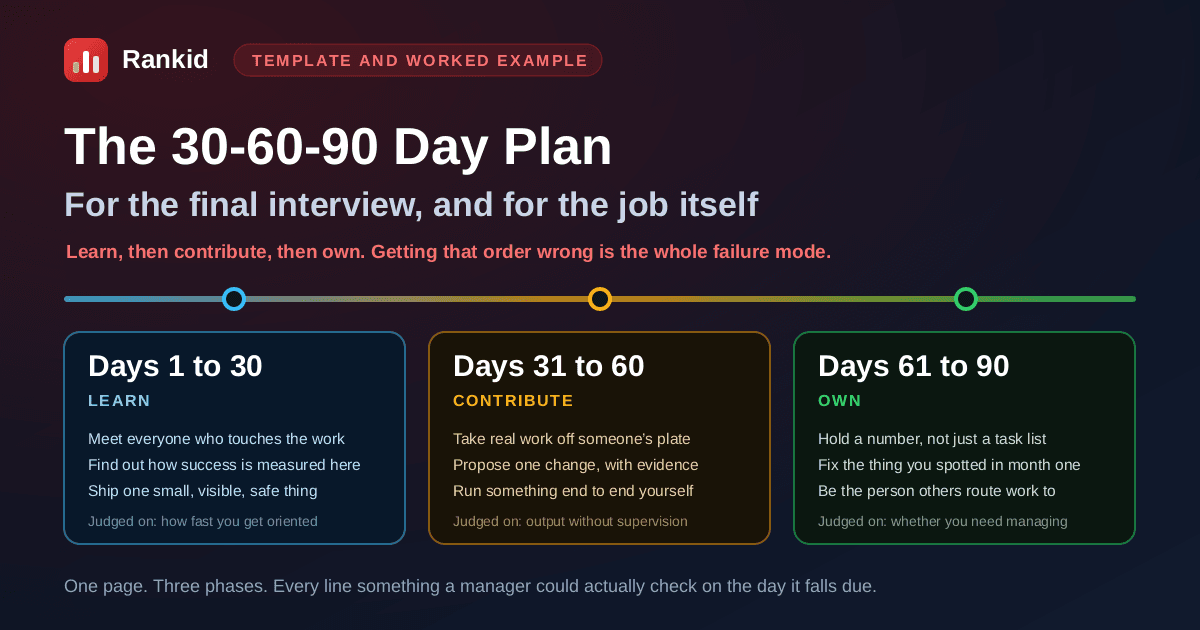
Ask ten people for a 30-60-90 day plan and eight will hand you the same document: month one, meet the team and learn the systems. Month two, deepen relationships and continue learning. Month three, become a trusted partner. It is confident, it is tidy, and it commits to nothing that could ever be checked. The hiring manager nods, thanks you, and never opens it again. The problem is not effort. It is that all three phases are the same phase wearing different labels.
Quick answer
Learn, then contribute, then own. Each phase answers a different question your manager is quietly asking: does this person understand what we do, can they produce work without me checking it, and was hiring them the right call? One page, three or four lines per phase, and every line something a third party could verify on the day it falls due. Keep the first 60 days inside your own authority so nothing depends on a budget approval you cannot get yet. Template, a filled-in example, and variants for new managers, sales roles and internal promotions below.
What is a 30-60-90 day plan, and which one are you writing?
A 30-60-90 day plan is a one-page statement of what you will do in your first three months, split into three phases that do different jobs. That much is uncontroversial. What causes most of the confusion is that the same name is used for two documents with almost nothing in common.
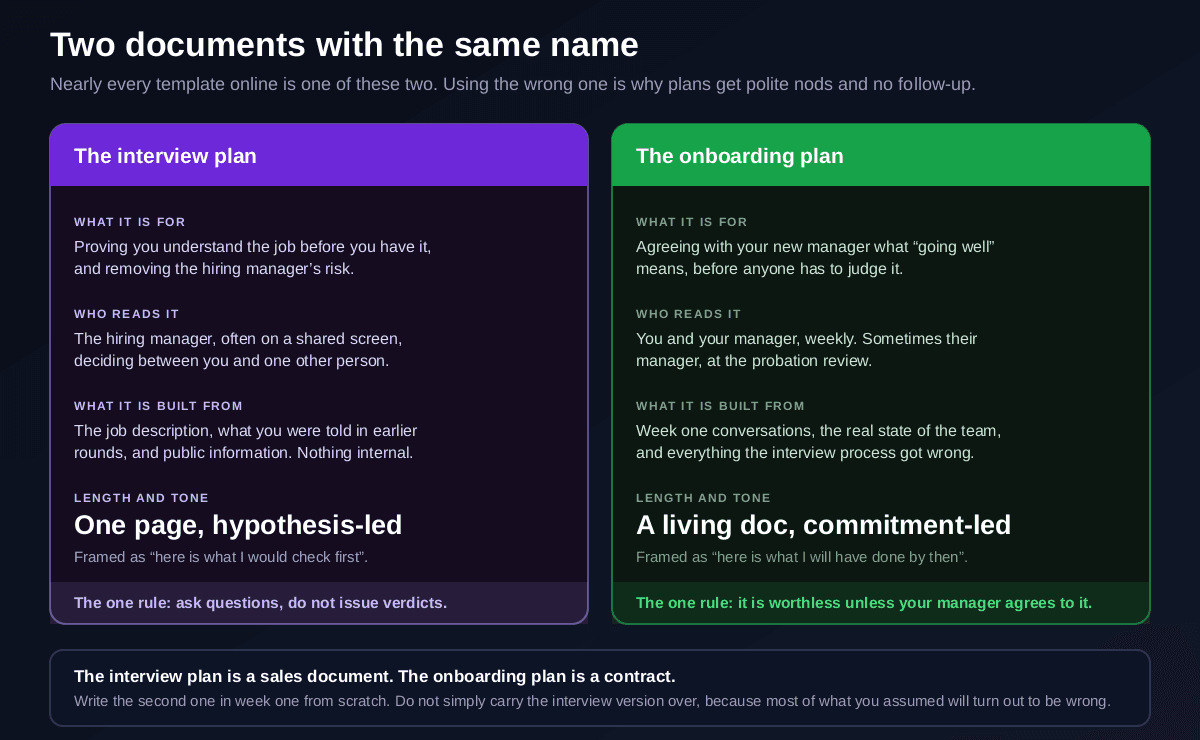
The distinction matters practically, not just conceptually. The interview plan is written from outside with public information, and its purpose is to lower the hiring manager's sense of risk. The onboarding plan is written in week one from real conversations, and its purpose is to get you and your manager to agree what "going well" means before anyone has to judge whether it is happening.
The most common mistake is carrying the first straight into the second. Most of what you assumed from outside will turn out to be wrong within a fortnight, and a plan built on stale assumptions gets quietly abandoned. Write the onboarding version fresh in week one. It takes an hour and it is the single highest-return hour of your first month.
What each phase is actually for
The phases are not three equal thirds of the same job. Each one is being assessed against a different question, and knowing which question you are answering is what stops a plan from turning into a reading list.
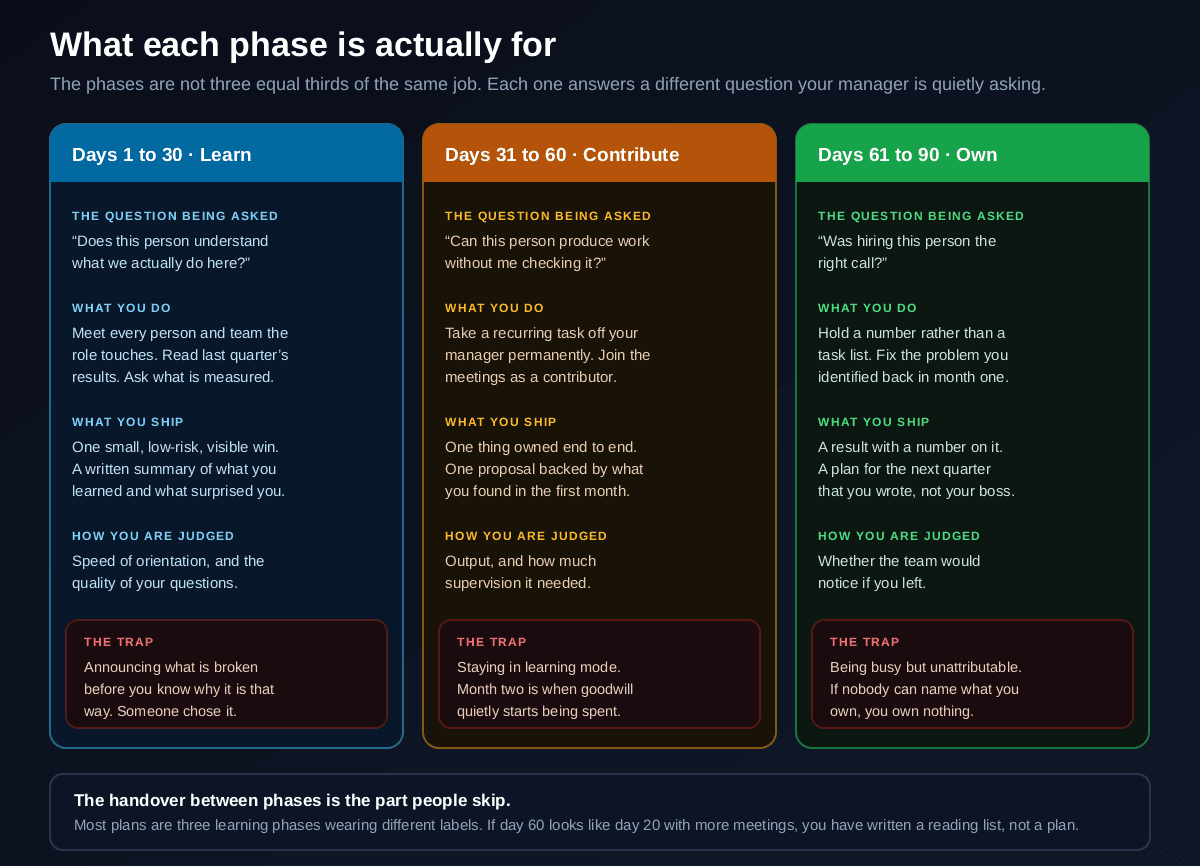
The handover between phases is the part people skip. If day 60 looks like day 20 with more meetings in it, you have written a plan to be onboarded rather than a plan to do the job. A quick self-check: circle the main verb in every line. If the same verb appears in all three phases, the plan is not real yet.
Why the 90 day mark specifically
How to write a 30-60-90 day plan in five steps
Start from the job description, not a template
The requirements list tells you what the company believes this role is for, which is the thing your plan has to be about. Pull out the three outcomes the role exists to produce. If the description is a wish list of twenty unranked bullets, that is information too: it usually means the role has not been fully thought through, and your plan can quietly do that thinking for them, which is unusually persuasive. Our guide to how job descriptions are writtenshows you what the well-constructed ones look like from the employer's side, which makes the gaps in a weak one much easier to spot.
Ask what evidence could exist at each checkpoint
For each of those three outcomes, ask a narrow question: what could realistically be true on day 30 that is not true on day 1? Then the same for day 60 and day 90. This produces concrete lines almost automatically, because you are describing states of the world rather than intentions. "I will have sat in on 15 customer calls including two churn exits" is a state. "I will immerse myself in the customer base" is a feeling.
Keep the first 60 days inside your own authority
Anything that needs a budget, a headcount approval or another team's roadmap slot belongs in the day 61 to 90 block, if it belongs in the plan at all. This is the most commonly skipped rule and it matters because a plan that depends on approvals you cannot get will fail for reasons nobody will attribute correctly. Your first two months should be almost entirely things you can do on your own initiative.
Run the verification test on every line
For each line, ask whether a third party could confirm on the day it falls due whether it happened. "Run the weekly ops review by day 60 with finance and sales attending without chasing" passes. "Establish myself as a trusted partner" fails, because nobody can check it and therefore it cannot be a commitment. This test alone removes most of the filler from most plans. It is the same discipline as quantifying achievements on a resume, applied forwards in time instead of backwards.
Add the questions you cannot answer
Two or three, at the bottom. "I have assumed renewals sit with CS rather than sales, is that right?" This is counterintuitive but it is the strongest part of an interview plan, because it demonstrates that you can tell the difference between what you know and what you are assuming. Candidates who present a plan with no uncertainty in it are telling the room they have not noticed how much they do not know.
The template, ready to copy
Replace everything in brackets. Keep it to one page. If a phase has more than four lines, you have written a task list, and task lists do not survive contact with a real first month.
[Role title] · 30-60-90 day plan · [your name]
Built from the job description and my conversations with [names]. Assumptions flagged at the end.
Days 1 to 30 · Learn
[Who you will meet, named by team or role, and the one question you will ask each of them.]
[The thing you will find out about how performance is measured here.]
[One small, low-risk, visible thing you will ship.]
Done when: [something a third party could confirm].
Days 31 to 60 · Contribute
[The recurring piece of work you will take off someone permanently.]
[The one thing you will own end to end, start to finish.]
[The proposal you will bring, based on what month one turned up.]
Done when: [work ships without being reviewed first].
Days 61 to 90 · Own
[The number you will hold, and where you will report it.]
[The problem from month one you will have fixed, and how the fix is measured.]
[What you will have taken off your manager for good.]
Done when: [nobody is checking your work].
What I am assuming
[Assumption 1, phrased as a question.] [Assumption 2.] [Assumption 3.]
A worked example
Templates are easy to nod at and hard to fill in, so here is the same structure with real content in it. The role is deliberately specific, because specificity is the entire point.
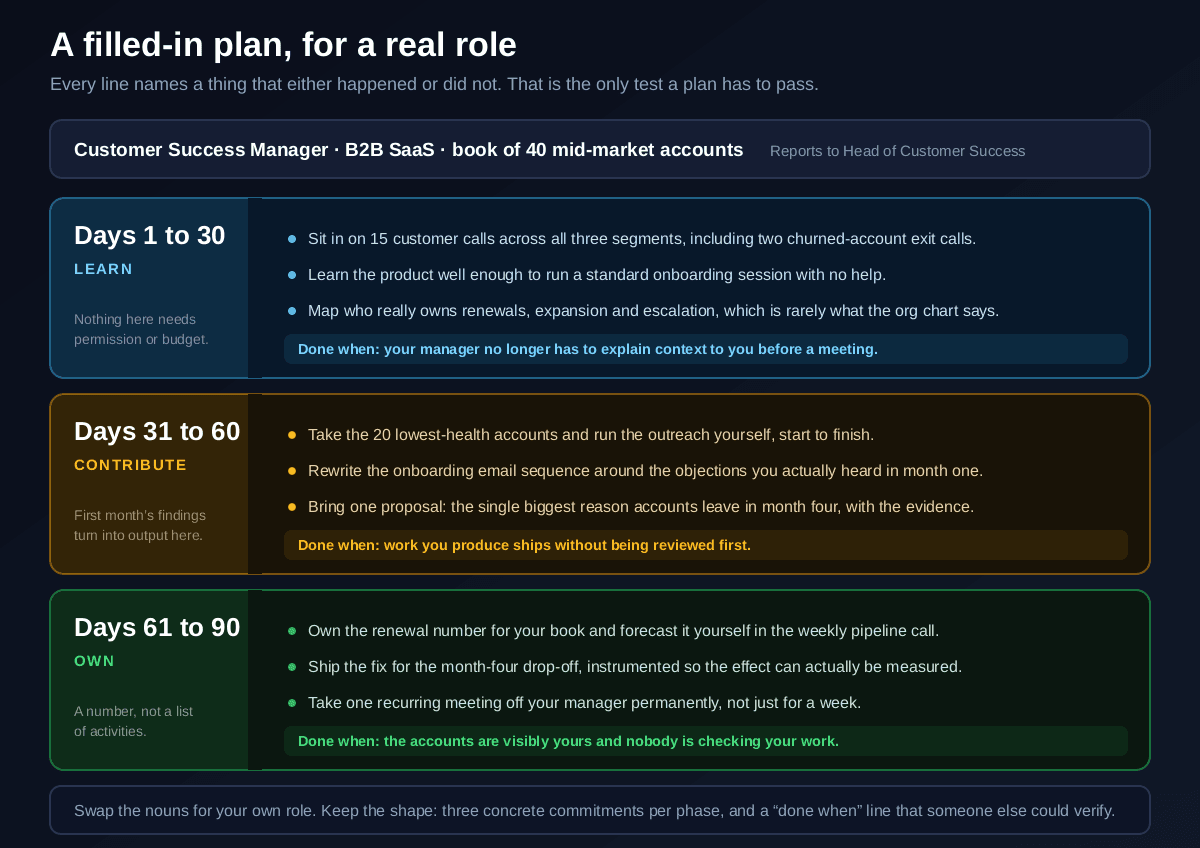
Notice what is absent. There is no percentage improvement, because an outside candidate has no baseline to improve on and inventing one undermines everything else. There is no restructuring. Nothing in the first 60 days requires anyone's approval. And every phase ends with a condition somebody other than you could confirm.
Make sure the plan and the resume are answering the same question
A plan is built from the job description, and so is a good resume. Paste both into Rankid to see which requirements you already evidence and which ones you do not, so your plan can address the gaps the hiring manager is actually worried about.
Check your match freeVariants: new manager, sales, internal promotion, career change
The three-phase shape holds everywhere. What changes is what counts as evidence in each phase.
- A new manager.Month one is one-to-ones with every report, asking what they are working on, what is in the way, and what they want next, plus the team's last two quarters of output. Month two is your operating rhythm: meeting cadence, how decisions get made, how work gets reviewed, and taking one escalation off your own manager. Month three is the first real judgement calls. Do not reorganise anything before day 60, because you cannot yet tell which of the team's oddities are dysfunction and which are load-bearing.
- A sales role. The easiest to make concrete and the one where vagueness is punished hardest. Month one is product certification, a set number of recorded calls, the qualification criteria and the objection set. Month two is your own pipeline built to a stated coverage ratio and discovery calls run solo. Month three is a proportion of full quota and one deal you sourced yourself. Ask in the interview what their actual ramp expectation is and build around their number, because an invented target reveals that you are guessing.
- An internal promotion. You can write a genuinely informed plan here, and that is the argument for promoting you. Structure it around the gap between the job you do now and the one you are asking for, and be explicit about what you will stop doing, because carrying the old role forward alongside the new one is the standard way internal promotions fail. If you are also making the financial case, how to ask for a raise covers how to evidence scope you are already operating at.
- A career changer. Front-load the learning phase honestly and compensate with speed elsewhere. Name the specific gap and how you will close it by a date, then show what you bring that the incumbent path does not. Our guide to the career change resume covers the same translation problem at the application stage, and the plan is where you prove you have thought past it.
The five lines that quietly weaken a plan
Each of these reads as ambitious to the person writing it. None of them reads that way to the person deciding whether to hire.
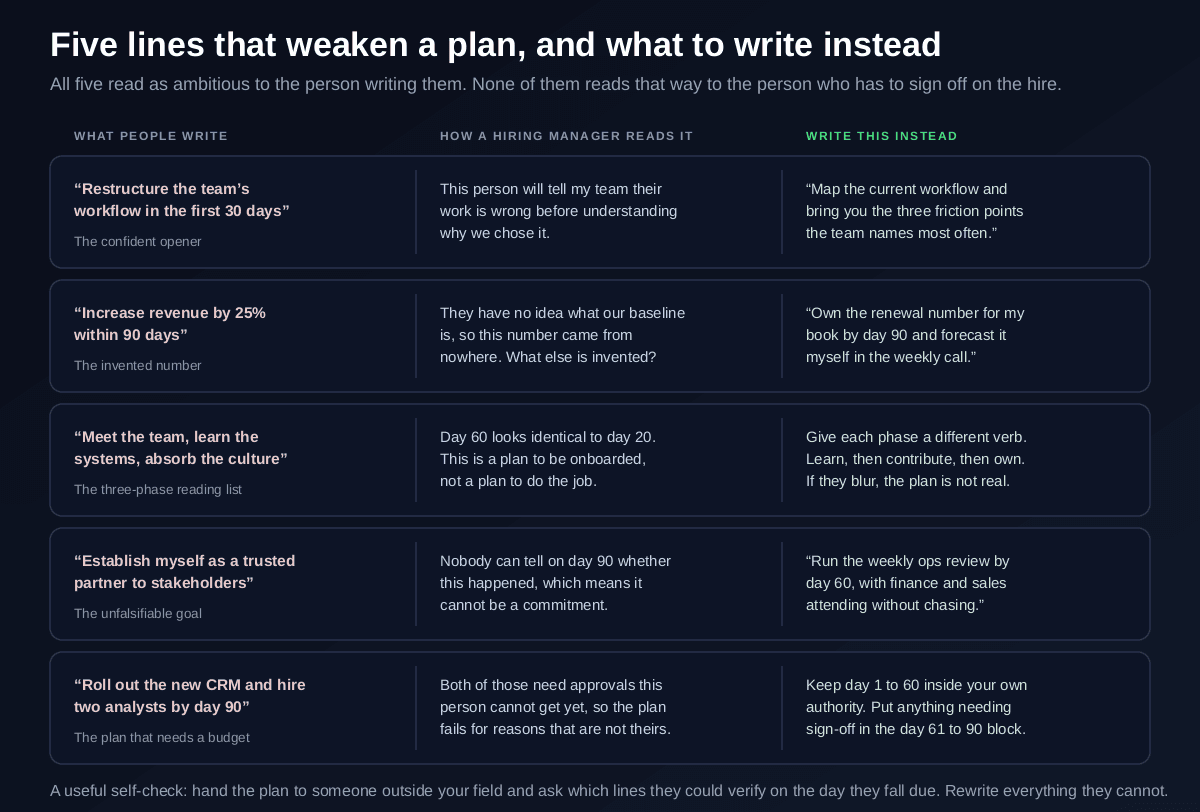
There is a sixth that does not fit a table. Plans written entirely about you. Everything a hiring manager reads is filtered through what it does for their team, so "complete the internal certification" and "build my network across the business" are costs to them, not benefits, unless you say what they enable. Keep your own development out of the document, or attach it to an outcome.
How to present it without stalling the room
The delivery matters as much as the content, and the failure mode is predictable: the candidate hands over a document and the room goes quiet while three people read it. You have just spent four minutes of a forty-five-minute conversation on silence.
- Introduce it late, not first.Around the point where they ask if you have any questions. "I sketched out how I would approach the first three months. Can I walk you through it and get your reaction?"
- Summarise the shape in 30 seconds, then go deep on one phase. Walking all three at equal depth is the least interesting version. Pick the phase most relevant to whatever they seemed most worried about earlier in the process.
- Invite correction explicitly."This is built from the job description and what I heard last round, so tell me where I have it wrong." An interviewer who starts correcting you is engaged, and their corrections are the most useful information you will get about the role all process.
- Leave it with them, or send it after. A plan is one of very few artefacts a hiring manager can forward to someone who was not in the room. Attaching it to your follow-up email gives that email a reason to exist beyond politeness.
If you are still a round or two away from this, the groundwork sits in interview preparation, and the material you need in order to write a plan that is not generic mostly comes from the questions you ask in earlier rounds. Asking "what would a great first 90 days look like to you?" in round two is how you get the answers to write round three's plan.
Week one on the job: converting the plan into an agreement
You start. Now the plan changes status: it stops being persuasion and becomes something you will be measured against, so it needs your manager's signature on it, figuratively at least.
- Rewrite it from scratch after your first five conversations. Not edited, rewritten. The outside-in version was built on assumptions and several of them will already have collapsed.
- Take it to your manager in week one or two and ask them to change it.The specific ask matters: "what have I got in the wrong phase?" and "what is missing that you would notice the absence of?" A plan your manager edited is a plan your manager owns.
- Get the measurement stated out loud. Ask directly what would make them say at day 90 that this hire went well. Write down the answer in their words. This is the single question most new starters never ask, and the one that most often turns out to have had a surprising answer.
- Review it at 30 and 60, not just 90. Fifteen minutes each time. Anything you are behind on is much cheaper to raise at day 35 than to explain at day 90, and the review itself signals a level of seriousness most new hires do not display.
- Keep the receipts as you go. The evidence you collect for your day 90 review is the same evidence you will want at the first performance cycle, and writing a self-evaluation is vastly easier when the record already exists.
If the job turns out to be different from the advert
Key takeaways
- Three phases with three different verbs: learn, contribute, own. If day 60 looks like day 20, the plan is a reading list.
- The interview plan and the onboarding plan are different documents. Write the second one from scratch in week one.
- Every line must pass one test: could a third party confirm on the day it falls due whether it happened?
- Keep days 1 to 60 inside your own authority. Anything needing budget or headcount goes in the final block.
- Never invent a percentage target for a company whose baseline you cannot see. It makes the rest of the plan look invented too.
- Include two or three stated assumptions. Knowing what you do not know is most of what the plan is testing.
- Present it late in the conversation, cover one phase in depth rather than all three, and explicitly invite correction.
- Once you start, get your manager to edit it. A plan they changed is a plan they own, and it becomes your probation criteria.
- Ask what would make them call this hire a success at day 90, then write down their exact words.
- Review at day 30 and day 60. Problems raised at day 35 are cheap, and the same problems at day 90 are not.
Build the plan from the same source the interview is judged against
The job description drives the screen, the interview scorecard and your 30-60-90 plan. Paste your resume and the description into Rankid to see the requirements you already evidence and the ones you do not, so you know which gaps your plan needs to answer.
Try Rankid freeFrequently asked questions
What is a 30-60-90 day plan?
A 30-60-90 day plan is a one-page document setting out what you will do in your first three months in a role, split into three phases with a different purpose each. Days 1 to 30 are for learning: meeting the people the role touches, finding out how success is measured, and shipping one small visible thing. Days 31 to 60 are for contributing: taking real work off someone else permanently and running something end to end. Days 61 to 90 are for owning: holding a number rather than a task list and fixing the problem you identified in month one. It is used in two quite different situations, as a document you present in a final-round interview and as a working agreement with your manager once you start, and the two versions should not be the same document.
How do you write a 30-60-90 day plan?
Start from the job description rather than a template, because the requirements list tells you what the company thinks the role is for. Pull out the three outcomes the role exists to produce, then ask what evidence of each one could realistically exist at day 30, day 60 and day 90. Give each phase a different verb, learn then contribute then own, and check that day 60 does not look like day 20 with more meetings. Keep everything in the first 60 days inside your own authority, so nothing depends on a budget or a headcount approval you cannot get yet. Then apply the verification test to every line: could someone else confirm on the day it falls due whether this happened? Rewrite anything that fails.
What should be in a 30-60-90 day plan for an interview?
Less certainty than people think. An interview plan is built entirely from public information, the job description and what you were told in earlier rounds, so it should read as hypothesis-led rather than as a set of verdicts about a company you have not worked at. One page, three phases, three or four lines each. Frame the early phases as what you would check first, name the specific people or teams you would want to talk to, and reserve concrete commitments for the day 61 to 90 block where you would actually have context. Include one or two questions you cannot answer from outside, which signals that you know the difference between what you know and what you are assuming. That distinction is most of what the plan is really testing.
How long should a 30-60-90 day plan be?
One page for the interview version, and one page for the onboarding version too. The interview plan will often be read on a shared screen during a conversation, so it needs to be scannable in about 60 seconds, which in practice means three phases, three or four lines each, and no paragraphs. A deck is acceptable if the company asked for a presentation, in which case three or four slides is the right size. The onboarding version can grow slightly because it becomes a working document you and your manager revisit, but if it passes two pages it has stopped being a plan and become a task list, and nobody will reread it.
Should you bring a 30-60-90 day plan to an interview if they did not ask for one?
For most mid-level and senior roles, yes, and it is one of the highest-leverage unprompted things you can bring. It changes the conversation from whether you could do the job to how you would do it, which is a much better conversation to be having in a final round. Two cautions. Do not hand it over at the start and expect them to read it in silence, because that stalls the room. Introduce it near the end as something you sketched out and would like their reaction to. And keep it genuinely provisional in tone, because a confident plan for a company you have never worked inside reads as arrogance rather than preparation. For junior roles and high-volume hiring processes it is usually unnecessary.
What is the difference between an interview 30-60-90 plan and an onboarding plan?
Purpose, sources and status. The interview plan is a sales document written from outside with public information, designed to reduce the hiring manager's sense of risk, and its job is finished the moment you get the offer. The onboarding plan is a contract, written in week one from what you learn in your first real conversations, and its job is to get you and your manager to agree what going well means before anyone has to judge whether it is. The most common error is carrying the interview version straight over into the job. Most of what you assumed from the outside will be wrong within a fortnight, and a plan built on those assumptions will quietly stop being referred to.
What should you do in your first 30 days at a new job?
Three things, in this order. Meet every person and team the role touches, not just your immediate team, and ask each of them what they wish this role did differently. Find out how success is actually measured here, which is often not what the job description said, and get your manager to state it out loud so you can write it down. Then ship one small, low-risk, visible thing, because being useful early buys you the credibility to ask harder questions later. What you should avoid is announcing what is broken. Every odd process you find was chosen by somebody, usually for a reason that is not visible yet, and diagnosing publicly before you understand the history is the fastest way to spend goodwill you will need in month two.
What does a 30-60-90 day plan look like for a new manager?
The phases stay the same but the content shifts from doing to diagnosing people and systems. Days 1 to 30 are one-to-ones with every direct report, asking what they are working on, what is getting in the way and what they want next, plus a read of the team's last two quarters of output and any performance history you are entitled to see. Days 31 to 60 are for establishing your own operating rhythm, the meeting cadence, how decisions get made and how work is reviewed, and for taking one escalation off your own manager. Days 61 to 90 are for the first real judgement calls: a hiring decision, a reprioritisation, or an honest conversation with an underperformer. Resist reorganising anything before day 60, because you will not yet know which of the team's oddities are dysfunction and which are load-bearing.
What does a 30-60-90 day plan look like for a sales role?
Sales plans are the easiest to make concrete because everything is countable, and interviewers expect specificity. Days 1 to 30: complete product training, listen to a set number of recorded calls, learn the qualification criteria and the objection set, and shadow closes. Days 31 to 60: build your own pipeline to a stated coverage ratio, run discovery calls without a co-pilot, and get your first opportunity to a defined stage. Days 61 to 90: hit a proportion of full quota, typically a ramped target your employer will already have in mind, and close at least one deal you sourced yourself. The strongest move is to ask in the interview what their actual ramp expectation is and build the plan around their number rather than inventing one, because an invented number tells them you are guessing.
What are the most common mistakes in a 30-60-90 day plan?
Five recur. Promising to restructure something in the first 30 days, which reads as a plan to tell the team their work is wrong before understanding why they chose it. Inventing a percentage improvement when you have no access to the baseline, which makes everything else in the plan look invented too. Writing three learning phases with different labels, so day 60 is indistinguishable from day 20. Unfalsifiable goals such as becoming a trusted partner, which nobody can verify on the day they fall due. And committing to anything requiring budget or headcount approval inside the first 60 days, which sets the plan up to fail for reasons that are not yours. The underlying test for all five is the same: could a third party confirm whether this happened?
Do you need a 30-60-90 day plan for an internal promotion?
Yes, and it is more useful internally than externally, because you can write a genuinely informed one. You already know the baseline numbers, the politics and where the bodies are buried, so your plan can be specific in ways an outside candidate's cannot, and that specificity is itself the argument for promoting you. Structure it around the gap between the job you do now and the job you are asking for, and be explicit about what you will stop doing, since the most common failure in internal promotions is carrying the old role forward alongside the new one. If you are also making the case for the move, our guide to asking for a raise covers how to frame evidence of scope you are already operating at.
How do you present a 30-60-90 day plan in an interview?
Talk, do not read. Put the page in front of them, give a 30 second summary of the shape, learn then contribute then own, and then spend the remaining time on one phase rather than walking through all three. Invite correction early with a line like: this is built from the job description and what I heard in the last round, so tell me where I have it wrong. Interviewers who correct you are engaging, which is the outcome you want, and their corrections tell you more about the role than anything in the posting. Leave the document with them or send it afterwards with your follow-up note, because the plan is one of the few artefacts a hiring manager can forward to a decision maker who was not in the room.