Job References: Who to Ask, How to List Them, and What the Reference Check Actually Asks (2026)
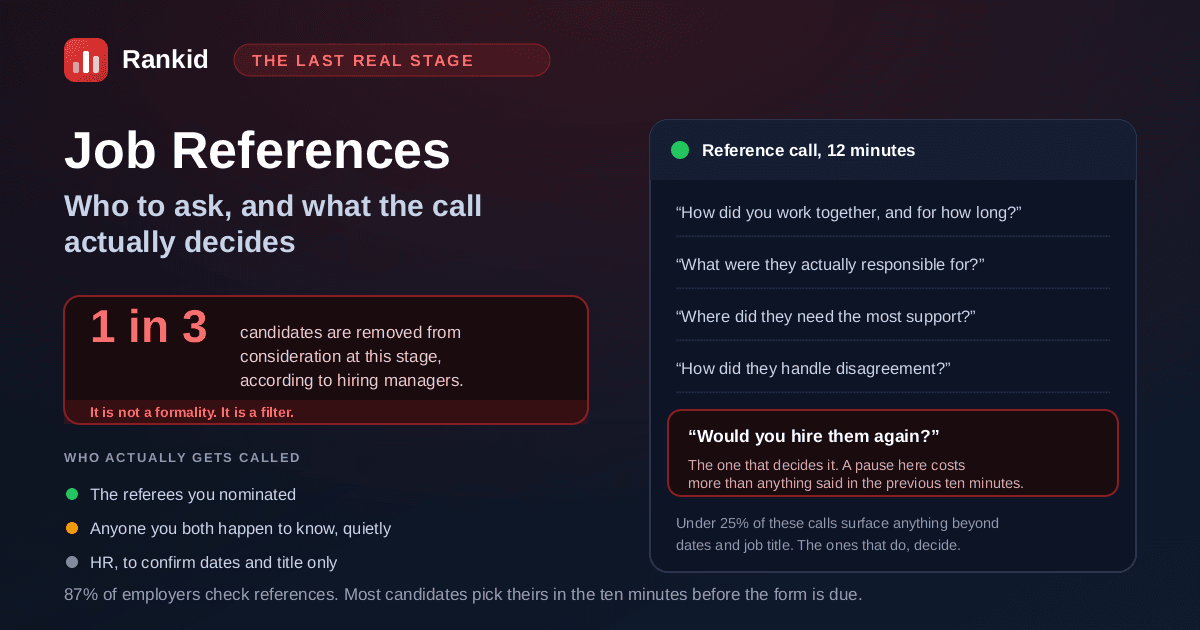
The offer is basically agreed. HR sends a form asking for three references, due today. You scroll your contacts, pick the manager you liked, a colleague from two jobs ago, and someone who owes you a favour, type in three phone numbers that may or may not still work, and hit submit. Then you tell people you have got the job. About a third of candidates who reach this stage do not, and almost none of them are told that the reference call is why.
Quick answer
References are the last real gate, not paperwork. Around 87% of employers check them, and hiring managers say they remove roughly one in three candidates at this stage. Pick for proximity to your work, not seniority: your direct manager first, then a cross-functional partner who depended on you. Keep them off your resume and supply a separate page when asked. Brief every referee a week ahead with the job description, the two or three things you want confirmed, and the weakness you would like them to use, because "no weaknesses" makes a checker discount the whole call. And the rule that a former employer can only confirm your dates is not a law anywhere.
Why the reference stage decides more than people think
Three numbers explain the gap between how candidates treat references and how employers use them. Around 87% of employers check references, according to SHRM survey data. Senior managers report removing about one in three candidates from consideration after those checks. And fewer than a quarter of reference calls surface anything beyond employment verification.
Read together, those tell you something specific. Most reference calls are indeed a formality that confirms dates and produces nothing. But the minority that do surface something are decisive, and you cannot tell in advance which of your referees will turn out to be in that minority. The asymmetry is what makes preparation worth an hour: the downside of a bad call is the whole offer, and the cost of preventing it is one email.
The stage where you have the least visibility
Who to ask, ranked by how much the answer counts
The instinct is to reach for the most senior person who thinks well of you. That is usually the wrong trade. A reference is only as strong as the specific claim it can credibly make, and a director who managed you at two removes cannot make any.
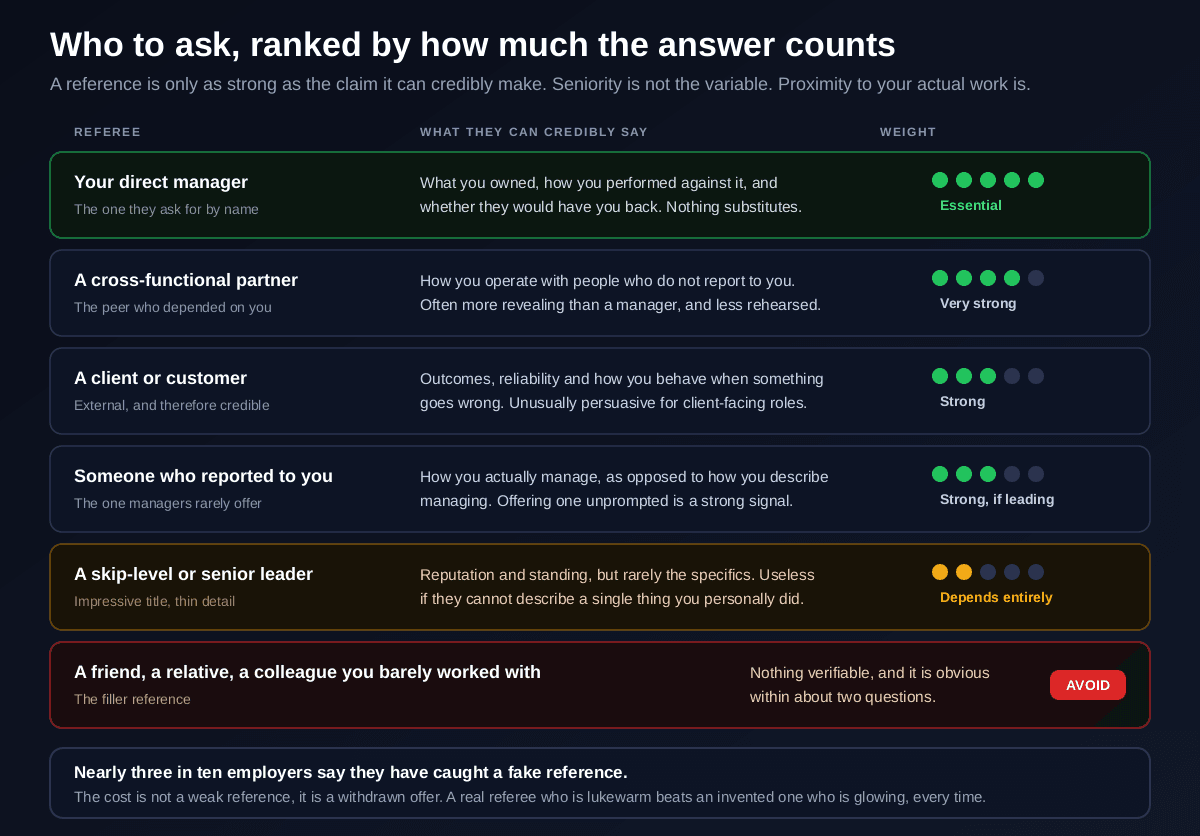
Two of these are worth expanding on. The cross-functional partner is undervalued by almost everyone. A checker hears a manager praise you and applies a discount, because managers are expected to be positive about people they hired and kept. A finance partner or a product counterpart who depended on your work has no such incentive, sounds unrehearsed, and is often the most credible voice on the list.
The former direct report is the one almost nobody offers. If you are moving into any role with management in it, volunteering someone who reported to you is a strong signal on its own, before they say a word, because candidates who manage badly never make that offer.
How to list references on a resume (do not)
References do not belong on your resume. They take space you need for evidence, they expose your referees' contact details to anyone who receives the file, and they create a real risk that someone calls before you have warned them. Every line on a resume is competing for a recruiter's very short first scan, and a reference block wins nothing in that scan.
Drop "references available upon request" as well. It is assumed by default, it consumes a line, and it signals that you are working from an older template. If you are still deciding what earns space on the page, our guide to how long a resume should be covers the trade-offs.
Instead, keep a separate reference page you send when asked. Match the header to your resume so it looks like part of one set, and give five things per referee:
- Full name and current job title, with their current employer, which may not be the employer you shared.
- The relationship and the dates."My direct manager at Acme, March 2023 to June 2025." This single line tells the checker how much weight to give everything that follows.
- A phone number and an email, both confirmed with the referee in the last month. Dead contact details are the most common and most avoidable delay at this stage.
- A note on availabilityif it is relevant. "Best reached after 4pm UK time."
- Nothing else. No summary of what they will say. It reads as coaching, and it invites the checker to test whether the reference matches your description of it.
The eight questions, and what each one is really testing
Reference calls are more standardised than candidates expect. Most run 10 to 15 minutes and work through roughly the same sequence, with the checker listening for hesitation as much as for content.
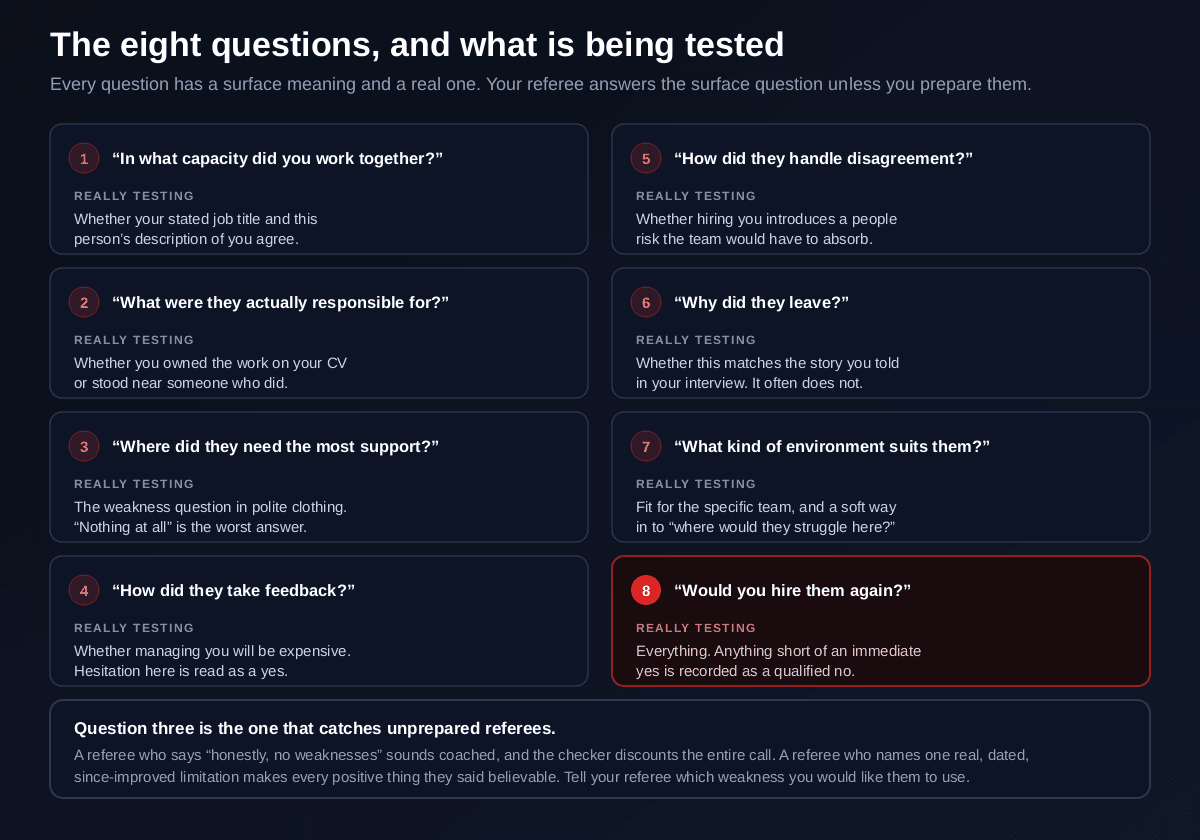
Question three is where unprepared referees do the damage, and it is counterintuitive. A referee who says "honestly, I cannot think of any weaknesses" sounds coached, and an experienced checker discounts the entire call on the strength of it. A referee who names one real, dated, since-improved limitation makes every positive thing they have said credible. This is why the single most valuable line in your brief is telling your referee which weakness you would like them to use.
Question six is where candidates get caught. The checker already has your version of why you left, from the interview. If your stated reason for leavingand your former manager's version differ in any material way, the discrepancy is the finding, not either version on its own.
How to brief a referee, and when
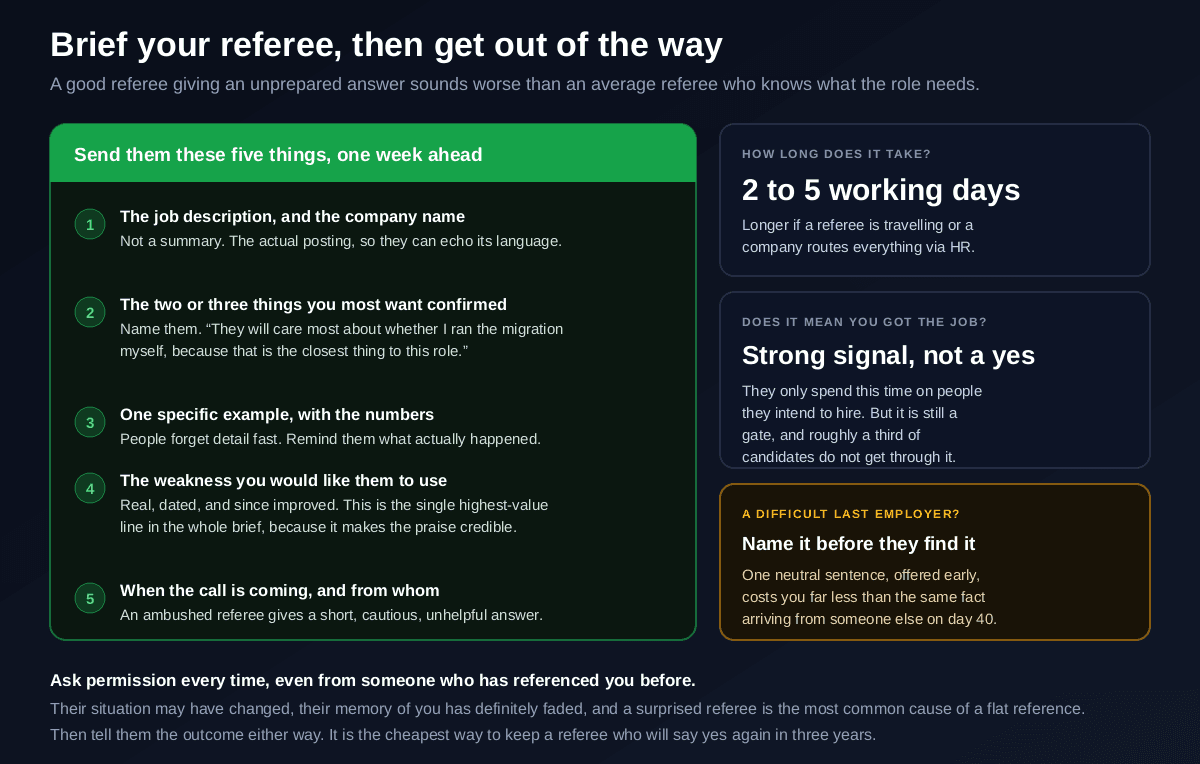
This is the entire intervention, and it takes about fifteen minutes. A good referee giving an unprepared answer sounds worse than an average referee who knows what the role needs.
Ask permission properly, and make declining easy
Not "can I put you down as a reference?" but "would you feel comfortable speaking positively about my work?" The second version gives someone a graceful exit, and you want them to take it if they were going to be lukewarm. A reluctant yes from someone who felt cornered is worse than a no, because you will never know it happened.
Send the brief about a week before the call
The job description itself, not your summary of it. The two or three things you most want confirmed, named explicitly. One specific example with the numbers in it, because people forget detail much faster than they think. The weakness you would like them to use. And who will be calling and roughly when.
Tell them what the job actually needs
A referee who knows the role is about migrating a legacy system will talk about the migration you ran. A referee who does not will talk about how organised you were. Both are true and only one of them is useful. If you want a shortcut to what to emphasise, look at what the posting ranks as its must-haves, the same way you would when tailoring a resume to a job description.
Close the loop, whatever happens
Tell them the outcome. It takes one line, and it is the difference between a referee who says yes again in three years and one who has quietly decided you only make contact when you need something.
Make sure your referee is confirming the right things
Paste your resume and the job description into Rankid to see which requirements you already evidence and which you do not. The gaps are exactly what you should be asking your referee to speak to, because those are the doubts the hiring manager is trying to resolve on the call.
Check your match freeCan a former employer give you a bad reference?
Almost everyone believes that a company can only legally confirm your dates and job title. That is not a law in the US, the UK, or anywhere else in common use. It is an internal policy some employers adopt to limit their own exposure, and plenty of employers do not adopt it.
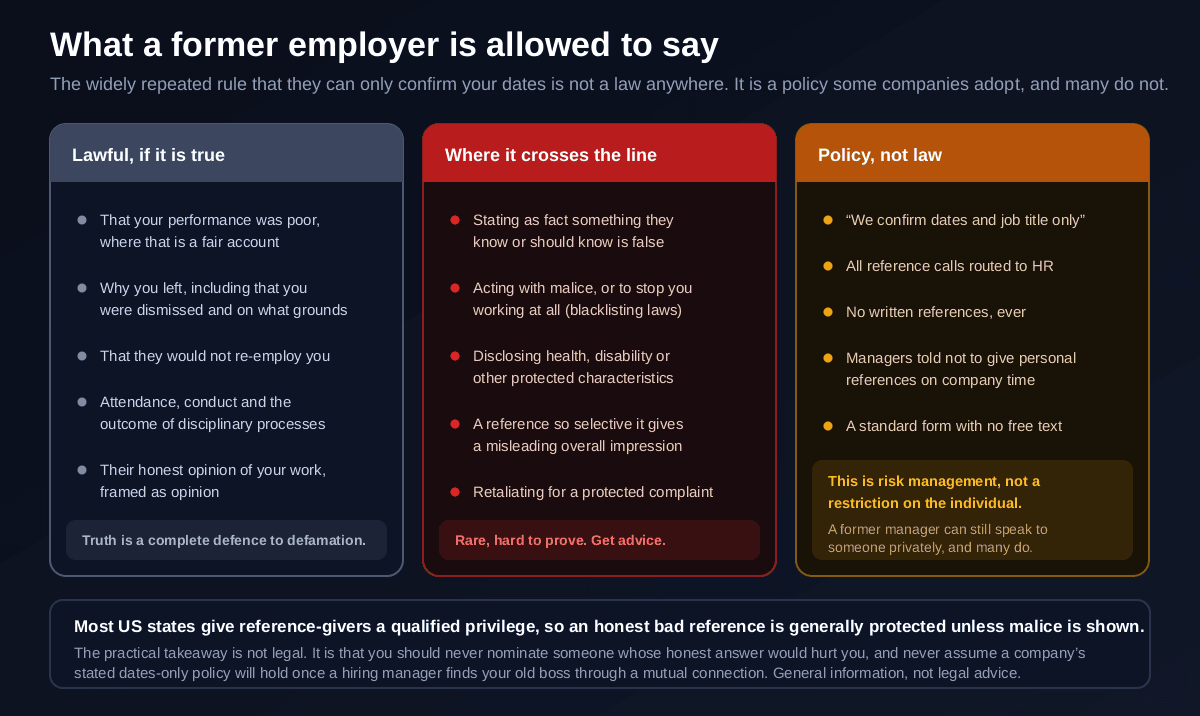
The practical implications are more useful than the legal ones. First, never nominate someone whose honest answer would hurt you, because honesty is protected and you have no recourse against it. Second, do not rely on a company's dates-only policy to shield you, because that policy binds the HR department, not the former manager who takes an informal call from someone they know. Third, if you genuinely believe a former employer has said something false and damaging, that is worth proper legal advice rather than a blog post, though be aware such claims are difficult to prove.
The references you did not nominate
Backchannel references are the part of this process nobody mentions in the process. A hiring manager spots a mutual connection, or realises a colleague used to work where you work now, and makes an informal call. It is common at senior level, near-universal in small industries, and it carries more weight than your nominated list precisely because you did not choose the person.
You cannot prevent it, and attempting to is the wrong instinct. What you can do is stop treating your nominated references as a controllable surface:
- Never tell a story in an interview that a former colleague would contradict. Not because they are checking, but because they might casually mention the real version to someone who is.
- Assume the small-world case. Before your final round, look at who at the hiring company is connected to people at your current or previous employer. If there is an obvious link, you have effectively already been referenced.
- Keep former colleagues warm. This is the actual reason to maintain those relationships, and it is the same investment that makes you findable by recruiters in the first place.
- Curate less. Candidates who get hurt by backchannels are almost always the ones whose nominated list was carefully built to route around something.
Difficult cases, and how to handle each
- You were fired, or left on bad terms. Get ahead of it in one neutral sentence and offer a substitute from the same employer, a skip-level or a senior peer, so the period is still covered by someone who was there. Silence about the obvious missing person is louder than the explanation.
- The company no longer exists. Use the individual rather than the organisation. A former manager is a valid referee regardless of whether their employer still trades, and this is one of the few situations where a LinkedIn profile confirming their old role is genuinely useful supporting evidence.
- You cannot tell your current employer you are looking. Standard and well understood. Say so, offer references from previous employers, and offer your current manager conditionally on a signed offer. No competent recruiter will find this odd.
- You are early career with no work references. A tutor, a placement supervisor, a volunteer coordinator or a client from freelance work all count, and all are better than a family friend. Our guide to writing a resume with no experience deals with the same translation problem earlier in the process.
- Your referee has moved and you have lost touch. Reconnect properly before you need them. A reference request out of nowhere after four years of silence produces a polite, vague, low-value call.
If you are the one checking references
The reason so many reference calls produce nothing is that most are run as a compliance step with closed questions. Three changes fix most of it.
- Ask for comparison, not assessment."Where would you place them among the people you have managed at that level?" produces information that "were they a strong performer?" never will.
- Ask about the role you are hiring for, specifically. Read the referee one real requirement from the job description and ask for an example. Vague questions get vague answers, which is the same problem that ruins badly written job descriptions and unranked screening criteria.
- Listen for the pause, and follow it.The most useful thing in a reference call is rarely a sentence. It is a hesitation before an otherwise positive answer. "It sounded like there was a bit more to that" is the highest-yield question in the whole call.
And keep the check in proportion. References are a late-stage confirmation, not a substitute for structured assessment earlier. If candidates are reaching the reference stage and failing it often, the problem is usually upstream in how the shortlist was built rather than in the calls themselves.
Key takeaways
- References are a real gate, not paperwork. Employers say about one in three candidates are removed at this stage.
- Pick for proximity to your work, not seniority. A cross-functional partner beats a senior leader who cannot describe what you did.
- Keep references off your resume, and drop 'references available upon request'. Supply a separate page when asked.
- For each referee give name, title, employer, the relationship with dates, and contact details you confirmed this month.
- The call ends on 'would you hire them again?' and anything short of an immediate yes is recorded as a qualified no.
- Tell your referee which weakness to use. 'No weaknesses' sounds coached and gets the whole call discounted.
- Brief every referee a week ahead with the job description, what you want confirmed, and one example with numbers.
- A former employer can lawfully give a bad reference if it is true. The dates-only rule is company policy, not law.
- Backchannel references happen and you cannot control them, so never tell an interview story a former colleague would contradict.
- A reference check usually takes two to five working days and signals you are the preferred candidate, but it is not an offer.
Get to the reference stage more often
The reference call is the last gate. Getting to it consistently is a different problem. Paste your resume and a job description into Rankid for a match score out of 100, the requirements you evidence, and the ones you are missing before a recruiter notices them.
Try Rankid freeFrequently asked questions
How many references do you need?
Three is the standard ask, and three is what you should have ready. Most employers request two or three, and asking for more than four is unusual outside senior or regulated roles. The composition matters more than the count. Aim for at least one direct manager, because that is the one almost every employer asks for by name, plus one person who worked alongside you closely enough to describe what you actually did. If you have managed people, having one former direct report available is a genuine differentiator, because most candidates never offer one. Do not pad the list to reach a number, since a weak third reference actively costs you more than having only two strong ones.
Who should you use as a job reference?
Pick for proximity to your work, not for seniority. Your direct manager is the strongest and the one that is hardest to substitute, because they can speak to what you owned, how you performed against it, and whether they would have you back. Next strongest is a cross-functional partner who depended on your work, since they describe how you operate with people who do not report to you and they sound less rehearsed. A client or customer is unusually persuasive for client-facing roles. A former direct report is powerful if you are moving into a leadership role. A skip-level executive with an impressive title but no detail about your actual work is much weaker than people assume, and friends or relatives are worth nothing and are usually obvious within two questions.
How do you list references on a resume?
Do not put them on the resume at all. References belong on a separate page you supply when asked, which keeps your resume focused and stops referees being contacted before you have warned them. Skip the line "references available upon request" too. It is assumed, it wastes a line, and it reads as dated. When you do supply the page, match its header to your resume and give five things per referee: full name, current job title and company, the relationship and the period you worked together, and a phone number and email. That one line about the relationship, such as "my direct manager at Acme, 2023 to 2025", is what tells the checker how much weight the answers deserve.
What questions are asked in a reference check?
Eight recur, and each has a surface meaning and a real one. How did you work together and for how long, which checks your stated title against theirs. What were they responsible for, which checks whether you owned the work on your CV. Where did they need the most support, which is the weakness question in polite clothing. How did they take feedback, which asks whether managing you will be expensive. How did they handle disagreement, which probes people risk. Why did they leave, which is checked against the story you told in your interview. What environment suits them, which is a soft route into where you would struggle here. And finally, would you hire them again, which decides it. Anything short of an immediate yes on the last one is recorded as a qualified no.
How long does a reference check take?
Two to five working days is typical once you have supplied the names. The variable is almost never the employer, it is your referees. A referee who is travelling, on leave, or works somewhere that routes all reference requests through an HR shared inbox can add a week on their own. Companies using an automated reference platform that emails a form are often faster, sometimes 48 hours, though those forms surface much less than a phone call. If it has been more than about ten working days and nothing has moved, the usual cause is one unresponsive referee, and a short nudge from you to that person will unblock it faster than chasing the recruiter.
Does a reference check mean you got the job?
It is a strong signal but not a yes. Employers do not spend time on reference checks for candidates they are not planning to hire, so reaching this stage usually means you are the preferred candidate or one of two. But it remains a real gate rather than a formality: senior managers report removing roughly one in three candidates from consideration after checking references. Treat it as the last stage of the process rather than the paperwork after it. Until you have a written offer, keep your other applications live and do not resign from anything.
Can a former employer give a bad reference?
In most places, yes, provided what they say is true. The widely repeated rule that a company can only confirm your dates and job title is not a law anywhere, it is an internal policy that some employers adopt to limit their own legal exposure. A former employer can lawfully say that your performance was poor, that you were dismissed and why, that they would not re-employ you, and give their honest opinion of your work. Truth is a complete defence to defamation, and most US states additionally give reference-givers a qualified privilege, meaning they are protected unless malice can be shown. What is not permitted is stating as fact something false, acting maliciously to prevent you working, disclosing protected characteristics such as health or disability, or giving a reference so selective it creates a misleading overall impression. This is general information rather than legal advice.
What if you cannot use your last boss as a reference?
This is common and it is survivable, but only if you get ahead of it. Name it yourself, early, in one neutral sentence: "my last manager left the business six months before I did, so I have offered my skip-level and the head of ops instead, both of whom I worked with daily." Offered proactively that costs you almost nothing. Discovered later by a recruiter who wonders why the obvious person is missing, it costs a great deal. Substitute upward or sideways from the same employer, a skip-level, a senior peer, a client, so that the period is still covered by someone who was there. What you must not do is quietly omit the job or supply a friend posing as a manager.
What is the difference between a reference check and a background check?
A reference check is a conversation about how you work, run by the hiring team or a recruiter, and it is subjective by design. A background check is a records search run by a third-party screening company, covering things like employment dates, education, criminal records and sometimes credit, and it is a verification exercise with a yes or no answer. They often run in parallel after an offer, and they fail for completely different reasons: a reference check fails on judgement, a background check fails on a discrepancy. Employers also frequently run an employment verification, which only confirms dates and title, and is what many HR departments will provide instead of a full reference.
What is a backchannel reference?
A backchannel reference is a conversation with someone you did not nominate. A hiring manager notices a mutual connection on LinkedIn, or realises they know someone at your last company, and calls them informally. It happens frequently at senior level and in small industries, and it carries more weight than your nominated references precisely because you did not choose the person. You cannot prevent it and you should not try. What you can do is assume it will happen: never tell a story in an interview that someone at your old company would contradict, and keep former colleagues warm enough that an unplanned call goes well. The candidates who get hurt by backchannels are the ones whose nominated references were curated to hide something.
How do you ask someone to be a reference?
Ask before you list them, every time, including people who have referenced you before, because their situation may have changed and their memory of your work has definitely faded. Give them a genuine way to decline, such as "would you feel comfortable speaking positively about my work?", since a lukewarm reference from someone who felt obliged is worse than no reference. Once they agree, send a brief about a week ahead: the actual job description, the two or three things you most want confirmed, one specific example with the numbers so they are not reaching for detail on the call, the weakness you would like them to use, and when the call is coming and from whom. Then tell them the outcome either way.
What happens if you give a fake reference?
It ends the process, and it can end the job if it is discovered later. Nearly three in ten employers say they have caught a fake reference on an application, and checkers are alert to it, since a friend playing the part of a former manager typically falls apart within two questions about scope, dates or reporting lines. Reference platforms now verify that the responder's email domain matches the company. If the deception is found after you start, most employment contracts treat material misrepresentation in the hiring process as grounds for dismissal, and that dismissal follows you into your next reference check. A real referee who is merely lukewarm is a far better outcome than an invented one who is enthusiastic.