How to Write a Resume With No Experience (Step by Step, 2026)
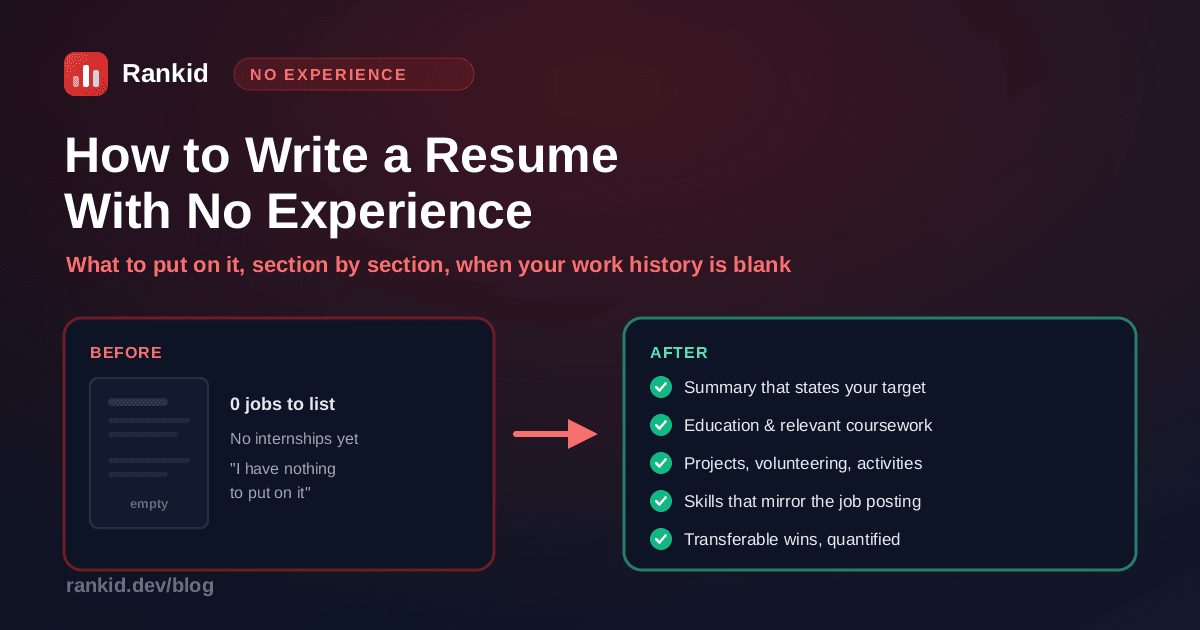
It is the most frustrating loop in job hunting: the posting wants experience, but you cannot get experience without someone giving you a first job. If you are staring at a blank page thinking "I have nothing to put on this," here is the reframe that changes everything. A resume with no experience is not an empty resume, it is a resume built from a different kind of proof. This guide walks you through exactly how to write a resume with no experience, step by step: what to put on it, the order to build the sections, how to turn coursework, projects, volunteering, and part-time work into real evidence of skill, and how to make sure it passes the applicant tracking system so a human actually sees it.
Quick answer
First, reframe what "experience" means
The single mistake that makes a first resume look empty is defining experience as "full-time jobs I have been paid for." By that definition, most students, recent graduates, and career starters have nothing, which is both untrue and unhelpful. Employers hiring for entry-level roles already know you do not have a decade of work behind you. What they are actually screening for is evidence that you can do the tasks the role requires: communicate, solve problems, use specific tools, hit deadlines, and work with people.
That evidence comes from many places that are not a salaried job. A class project where you built something real. A volunteer role where you organized an event. A part-time job where you handled money and customers. A club you led. A freelance gig, a personal website, a certification you earned on your own time. Each of these demonstrates a genuine, transferable skill, and each one belongs on your resume. Once you count all of it, the page is rarely as blank as it felt. Your job is to collect that proof and present it in the language recruiters and hiring software recognize.
What to put on a resume with no experience
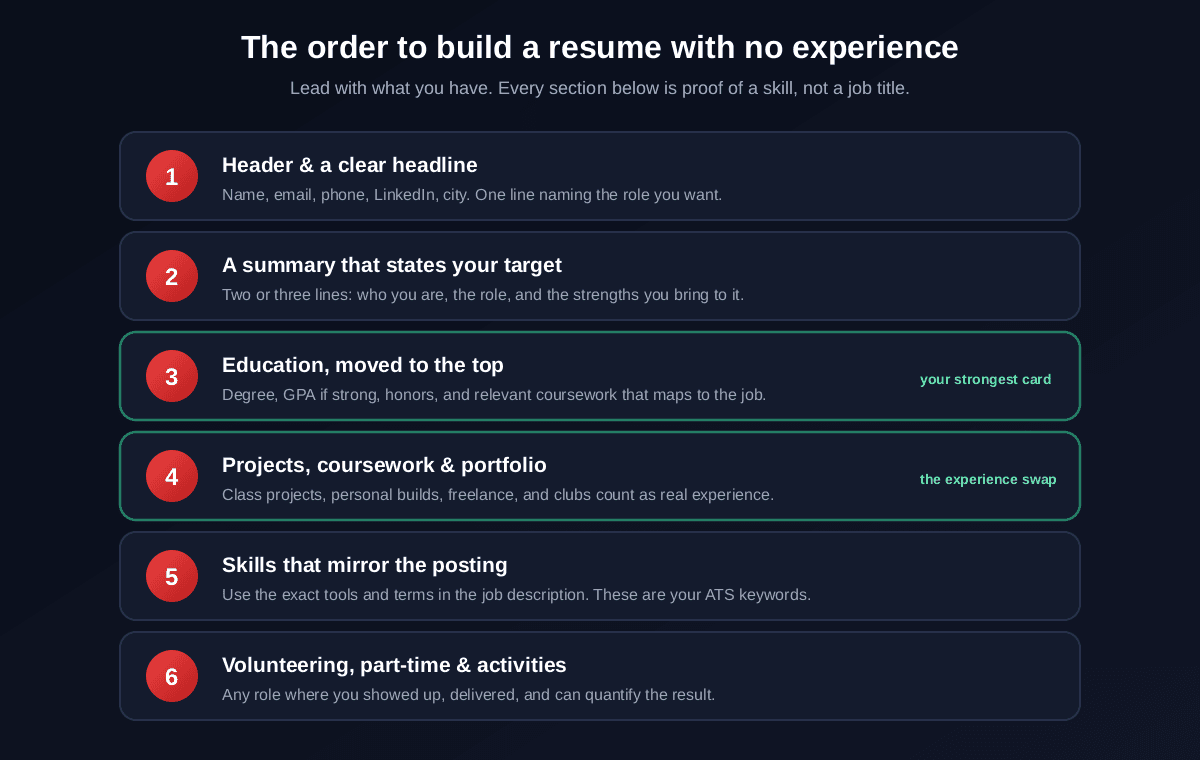
Here is the complete list of what belongs on a first resume, roughly in the order of how much weight it carries when you have no work history. You will not have every item, and that is fine. Use the ones you have and make them strong.
- Contact header and a target headline. Your name, email, phone, city, and LinkedIn, plus one line naming the role you are aiming for so the reader knows your goal immediately.
- A short summary.Two or three lines stating who you are, the role you want, and the strengths you bring. This replaces the "years of experience" opener that senior candidates use.
- Education, moved to the top. Your degree or program, school, expected or actual graduation date, GPA if it is strong, honors, and relevant coursework that maps to the job.
- Projects and coursework. Academic, personal, or freelance projects, described as achievements. For many first-timers, this is the section that does the heaviest lifting.
- Volunteering and extracurriculars. Community work, clubs, sports, student government, and any role where you showed responsibility, leadership, or teamwork.
- Part-time, seasonal, and gig work. Retail, hospitality, tutoring, delivery, babysitting, a campus job. All of it counts and all of it teaches transferable skills.
- Skills, certifications, and languages. The software, tools, methods, and spoken languages you know, matched to the terms in the posting.
How to write it, step by step
Now let us turn that list into a finished resume. Follow these steps in order and you will end up with a focused, one-page resume that reads like it belongs to someone ready for the role, not someone apologizing for a short history.
Write a header with the role you want
Put your name, a professional email, phone number, city, and LinkedIn URL at the top. Under or beside your name, add a one-line headline naming your target, for example "Aspiring Marketing Coordinator" or "Computer Science Graduate, Junior Software Developer." This tells the recruiter and the software what you are applying for before they read anything else.
Open with a short, targeted summary
Replace the experience-heavy summary that senior candidates use with a two or three line pitch built around your goal and strengths. Name the role, the field, and two or three abilities you can back up. Keep it specific to the job, not a generic "hardworking team player" line. If you want the exact structure, see our guide to writing a professional resume summary.
Move education to the top and make it work harder
With no work history, education is your strongest card, so it goes near the top. List your degree or program, school, and graduation date. Add GPA if it is 3.5 or higher, plus honors, scholarships, and relevant coursework that matches the job. A course called "Database Systems" on a resume for a data role is real, relevant proof, so name the courses that map to the posting instead of hiding them.
Turn projects and coursework into experience
This is the section that replaces a job history. Class projects, capstones, personal builds, freelance work, and hackathons all count. Write each one like a mini job entry: a title, a one-line context, and bullet points that say what you did and what came of it. "Built a budgeting app in a team of four using Python; presented to a panel and scored highest in the class" is real experience, described professionally.
Add volunteering, part-time, and activities
Include volunteering, clubs, sports, student government, and any part-time or seasonal job. A retail job teaches customer service, cash handling, and working under pressure. Organizing a charity event shows planning and leadership. Frame each with an action verb and a result. Strong verbs matter here, so borrow from our list of resume action verbs to describe what you did.
Finish with a skills section that mirrors the posting
List the tools, software, methods, and languages you know, using the exact wording from the job description. These are the keywords the applicant tracking system is scanning for. Only include skills you can genuinely back up, and prioritize the ones the posting names. Our guide to the skills to put on a resume shows how to choose them from the job rather than a generic list.
One page, always
How to turn everyday activities into transferable skills
The skill that separates a strong first resume from a weak one is translation: taking something ordinary and describing it in the professional language of the role. Recruiters do not need you to have done the exact job before. They need to see that the abilities transfer. Here is how the same activity reads before and after translating it into transferable-skill language.
- Weak: "Worked at a coffee shop." Strong:"Served 100-plus customers per shift in a fast-paced cafe, handled cash and card payments, and trained two new hires on the register." That shows reliability, customer service, and leadership.
- Weak: "Did a group project." Strong:"Led a four-person team to deliver a market-research report two days early, coordinating tasks and presenting findings to the class." That shows teamwork, project management, and communication.
- Weak: "Volunteered at an animal shelter." Strong:"Organized a weekend adoption drive that placed 12 animals and raised 800 dollars, managing a team of six volunteers." That shows initiative, organization, and results.
Notice the pattern: an action verb, what you did, and a number wherever one exists. Numbers are the fastest way to make a no-experience resume feel substantial, because they turn a vague claim into concrete proof. You do not need big corporate metrics. Customers per shift, dollars raised, people led, and days early all work.
See which skills your resume already matches
No work history yet? Paste your resume and a job posting into Rankid to see the exact skills you already match, the keywords you are missing, and a 0 to 100 match score, so you know your first resume is strong before you apply. Your first check is free, no signup.
Check your resume freeMake sure it passes the ATS
Here is what surprises most first-time applicants: even entry-level and internship applications usually go through an applicant tracking system that parses your resume and matches it against the job description before a human ever opens it. Having no experience does not exempt you from this filter. The upside is that entry-level postings screen for skills, coursework, and keywords rather than years, so a clean, well-matched first resume can score surprisingly well.
To make sure the software can read and match your resume, keep two things in mind:
- Keep the format parser-friendly. Use a simple single-column layout, standard fonts, clear headings, and normal bullets. Avoid tables, columns, text boxes, graphics, and skill-bar images, which break parsing. See our checklist for an ATS-friendly resume.
- Mirror the posting's language. Use the exact tools, titles, and terms from the job description in your skills section and bullets. Those are the keywords the ATS scans for, and matching them honestly is how you get found.
The most reliable way to know your resume works is to test it against the specific posting rather than guessing. You can check how well your resume matches a job description to see the text the system extracts and which required skills you match, then add the ones you honestly have before you apply.
Tailor it to every job you apply for
A single generic resume sent to 50 postings is the slowest way to get a first job. Because a no-experience resume leans on coursework, projects, and skills, it is unusually easy to tailor: you simply reorder and reword those sections to match each posting. A resume aimed at a marketing internship should foreground different courses, projects, and skills than one aimed at a data role, even if the underlying facts are the same.
Tailoring is what turns impressions into interviews. When your resume mirrors the specific role, both the software and the recruiter see an obvious match instead of a maybe. Our guide to tailoring your resume to the job description walks through the process, and understanding what a good resume match score looks like tells you when a version is strong enough to send.
Common mistakes to avoid
- Inventing jobs or exaggerating. Never fabricate work, titles, or dates. It is easy to verify and it collapses in interviews. Reframing what you really did is fine; inventing what you did not is not.
- Leaving the resume empty because "nothing counts." Projects, volunteering, coursework, and part-time work all count. If a section is thin, widen your definition of experience.
- Writing duties instead of achievements."Responsible for the register" is a duty. "Handled 200-plus transactions per shift with zero drawer errors" is an achievement. Aim for the second.
- Using a heavily designed template. Graphics, columns, and skill bars look nice and often fail the ATS. A clean single-column layout parses reliably.
- Sending the same resume everywhere. Tailor the summary, skills, and highlighted projects to each posting. It takes minutes and dramatically changes your results.
Key takeaways
- A resume with no experience is not empty. It is built from proof of skill: education, projects, volunteering, and part-time work.
- Lead with a header, a targeted summary, then move education to the top as your strongest card.
- Turn projects, coursework, and activities into achievement bullets using action verbs and numbers.
- Add a skills section that mirrors the exact words in the job posting, since those are your ATS keywords.
- Keep it to one page, and never invent jobs, titles, or dates. Reframe honestly instead.
- Even entry-level applications pass through an ATS, so keep the format simple and single-column.
- Tailor the resume to each job, then check it against the posting with Rankid before you apply.
You do not need years behind you to write a resume that gets read. You need to show, section by section, that you already have the skills the role requires, in the language recruiters and hiring software recognize. Lead with education, turn your projects and activities into real achievements, mirror the posting's keywords, and keep it to one focused page. When your first draft is ready, paste it and the job description into Rankid's free resume checker to see your match score and the skills you match versus miss, so your very first resume goes out strong enough to get you found.
Frequently asked questions
How do you write a resume when you have no experience?
Start by changing what counts as experience. When you have no paid work history, you build the resume around proof of skill instead of job titles: your education and relevant coursework, class or personal projects, volunteering, extracurricular leadership, freelance or gig work, and part-time or family responsibilities. The structure is: a clear header with the role you want, a short summary stating your target and strengths, then education moved to the top because it is your strongest card, followed by projects and activities written as achievements with numbers where you can. Finish with a skills section that mirrors the exact tools and terms in the job posting, since those are the keywords the applicant tracking system scans for. The goal is not to hide the lack of a job, it is to show, section by section, that you already have the abilities the role needs.
What do you put on a resume if you have no work experience?
Put the things that prove you can do the job, even if they did not come from a paid role. That includes: your degree, GPA if it is strong, honors, and coursework relevant to the position; academic, personal, or freelance projects described with what you did and the result; volunteering and community work; clubs, teams, and any leadership role; part-time, seasonal, or gig work of any kind; certifications and online courses; and a skills section listing the software, languages, and methods named in the job description. Each of these is a chance to demonstrate a real, transferable skill. A first resume is rarely empty once you count everything you have actually done outside a full-time job.
Should I lie or exaggerate to fill a resume with no experience?
No. Never invent jobs, titles, dates, or responsibilities. It is easy to verify, it collapses in interviews, and it can end an offer or a job later. You do not need to lie, because the honest version is stronger than most people think. Reframing is not lying: describing a class project, a volunteer role, or a part-time job in professional, results-focused language is completely legitimate and expected. The line is simple. Present what you genuinely did in its best, most relevant light, quantify it honestly, and use the real vocabulary of the field. That is reframing. Claiming work you never did is fabrication. Stay on the right side of that line and your resume is both honest and competitive.
How long should a resume with no experience be?
One page. With no work history, there is no reason to go longer, and a padded two-page resume actually signals inexperience more than a tight one page does. Fit everything on a single page: header, summary, education, projects and activities, and skills. If you are struggling to fill the page, widen what you count as experience (projects, volunteering, coursework, extracurriculars) rather than stretching margins or inflating font size. If you are struggling to fit it, keep only the most relevant items for the specific job you are applying to. One focused page beats a padded one every time.
Do resumes with no experience still need to pass the ATS?
Yes. Most employers, including entry-level and internship hiring, run applications through an applicant tracking system that parses your resume and matches it against the job description before a human sees it. A first-time applicant is not exempt. That is why the skills section and your bullet points should use the exact terms from the posting, why the layout must be simple single-column text with no graphics or columns that break parsing, and why you should confirm the file reads cleanly before you apply. The good news is that a clean, keyword-matched entry-level resume often scores well against entry-level postings, because those postings ask for skills and coursework rather than years of experience.
How can I check if my no-experience resume is good enough before applying?
Test it against the actual job description instead of guessing. Paste your resume and the posting into a resume checker and look at three things: whether the file parses into clean, readable text, which required skills and keywords you already match, and which ones are missing so you can add the ones you honestly have. This is especially useful with no experience, because it tells you objectively whether your projects, coursework, and skills line up with what the role asks for. You can run your resume and a job posting through Rankid's free resume checker to see the extracted text, a 0 to 100 match score, and your matched versus missing skills before you hit apply.