Skills-Based Hiring: How to Screen for Skills When 1,200 People Apply (2026)
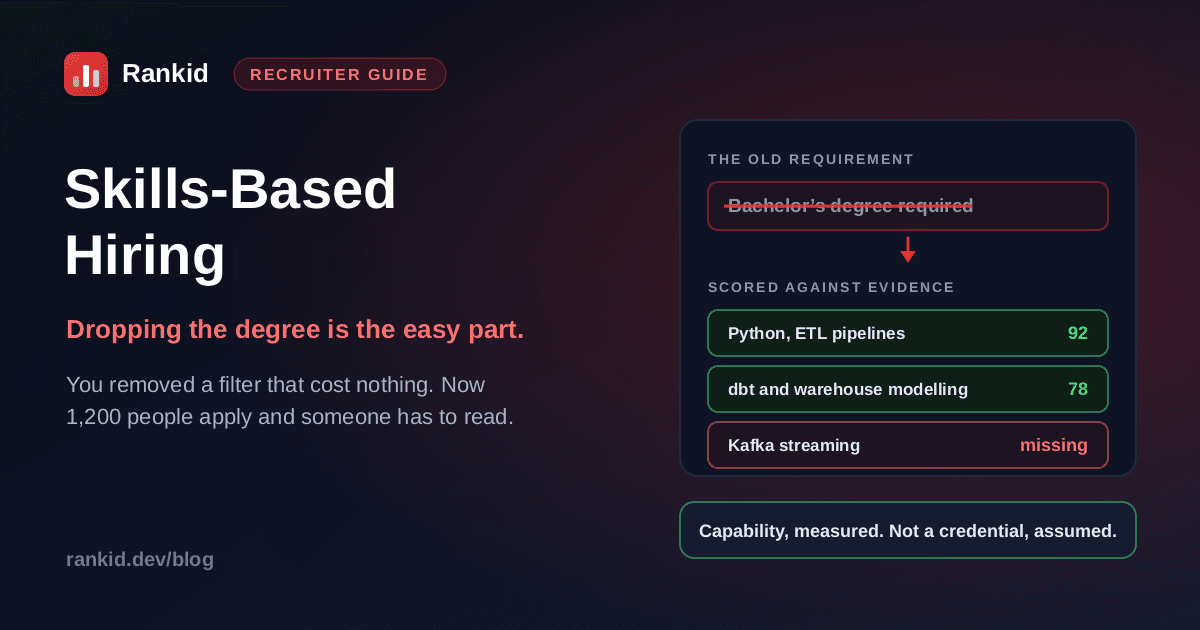
The memo went out and it was the right memo. Degree requirements are coming off the postings, the team is hiring for capability now, and nobody has to defend why a role that involves no academic work has required a bachelor's degree since 2011. Then the first req goes live under the new policy and 1,200 people apply instead of 400, and the recruiter who has to turn that into a shortlist by Friday discovers the part the memo left out. Skills-based hiring is not really a policy change. It is a screening change, and the screening is where it lives or dies.
Quick answer
What is skills-based hiring?
Skills-based hiring is the practice of evaluating candidates on evidence that they can do the job, rather than on proxies that correlate with being able to do the job. The proxies in question are familiar: a degree, a recognisable employer, a job title at the right level, years of tenure. The argument against them is not that they are meaningless. It is that they are indirect, and that filtering on an indirect signal discards people who have the direct one.
The case is strongest where the proxy has drifted furthest from the work. A support role that requires a bachelor's degree is usually not requiring anything about the degree; it is using the degree as a rough filter for written communication and reliability. Both of those can be evidenced directly, and by candidates who never enrolled anywhere. That gap between what the requirement says and what it is standing in for is the whole opportunity.
The distinction that matters
Why skills-based hiring stalls in practice
Here is the part that most write-ups on this topic skip, and it explains almost every failed rollout. The degree filter was not just inaccurate, it was also extraordinarily cheap. It was one boolean, applied instantly, before any human read anything. When you delete it you are not making a neutral swap. You are trading a free filter for an expensive evaluation.
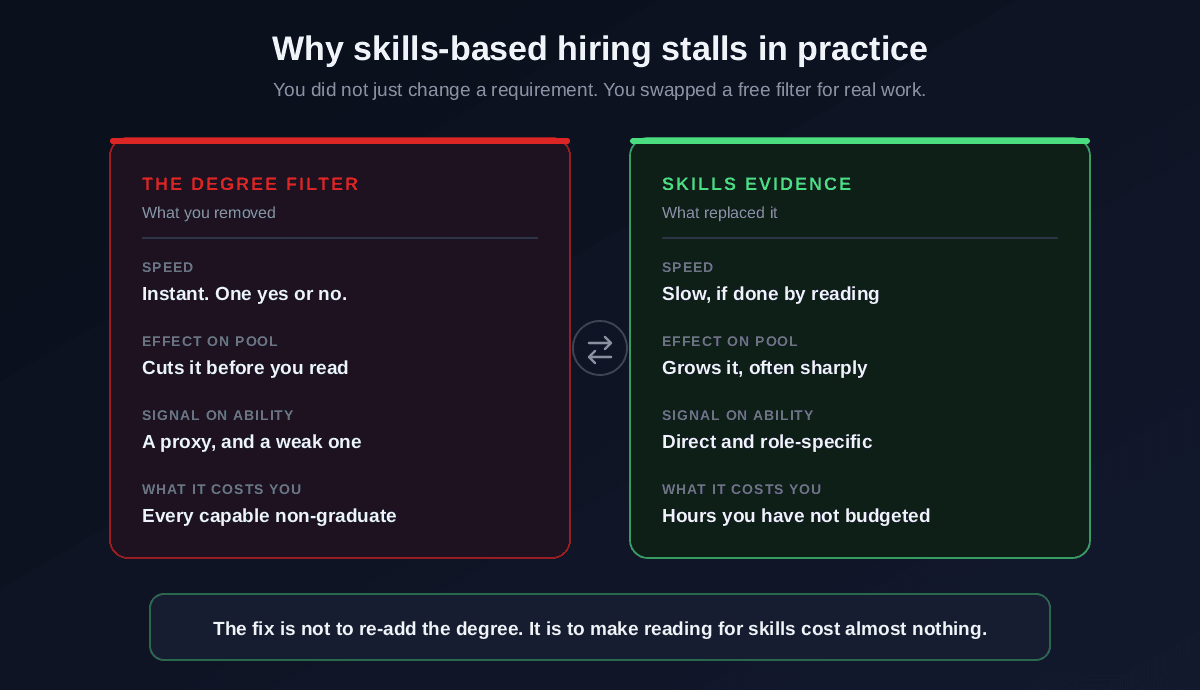
Both columns move against you at the same moment. The applicant pool grows, because you just made more people eligible, and that is the intended effect. But the cost of evaluating each applicant also rises, because skills evidence is buried in prose, phrased differently by every candidate, and cannot be assessed with a checkbox. Twice the applicants at several times the reading cost is not a marginal change to a recruiter's week. It is a different job.
So what actually happens? The policy stays on the careers page and the behaviour reverts. Under time pressure, a recruiter facing 1,200 unfiltered resumes starts scanning for the things that are fast to scan for: a familiar employer, a senior-sounding title, a name-brand school in the education block. Those are proxies. The credential filter did not get removed, it got moved from the job posting into the recruiter's eye movements, where nobody can audit it.
The real failure mode
What counts as skill evidence: the four levels
Before you can screen for skills you need to be precise about what a skill claim actually is, because the same skill can appear on a resume at four very different strengths.
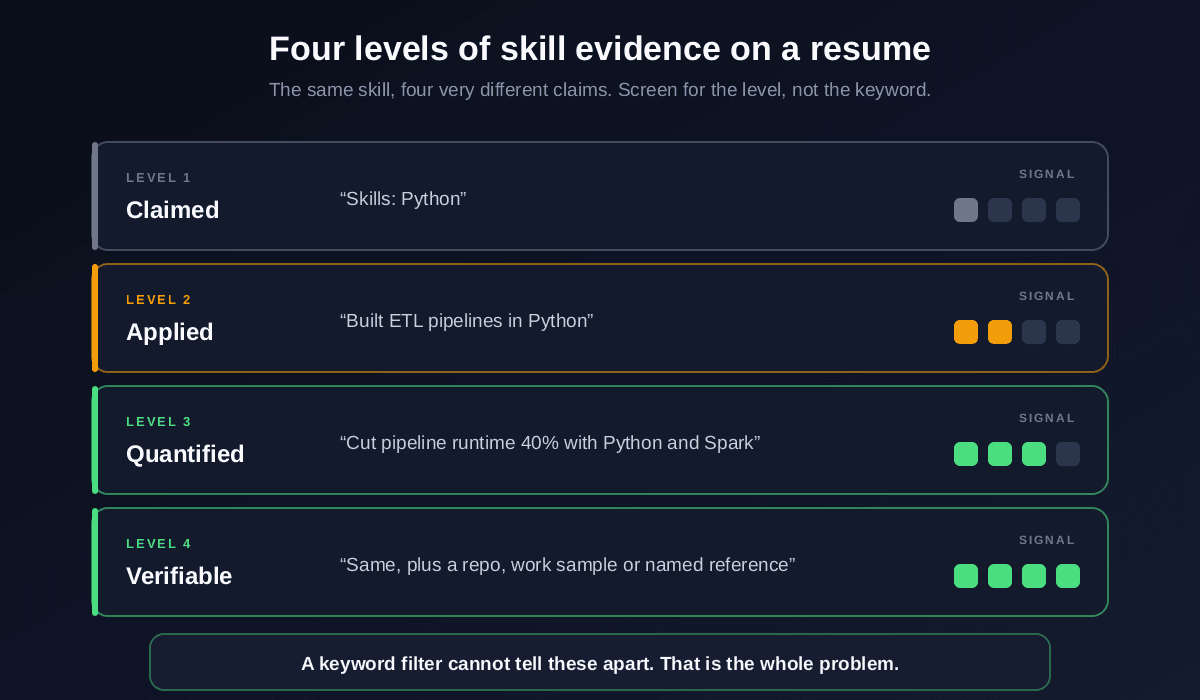
This is the sharpest available argument against calling keyword filtering skills-based. A keyword filter searching for “Python” returns all four of those candidates as identical matches. It cannot distinguish someone who listed a language once from someone who cut a pipeline's runtime by 40 percent with it. Worse, level one is the easiest to game: appending a skills list costs a candidate nothing, so a pure keyword match systematically favours the candidates who optimised their resume over the candidates who did the work.
Screening for the level rather than the presence of the word is what makes an evaluation genuinely skills-based. In practice that means looking at whether a skill appears inside a described responsibility and whether it is attached to an outcome, which is exactly the reasoning we walk candidates through in how to quantify achievements on a resume. The recruiter-side version of that advice is: reward level three, and do not let level one dominate your ranking.
How to run skills-based screening at volume
The goal of every step below is the same: make evaluating skills cheap enough that you can afford to do it for everyone, rather than only for the resumes that survived a proxy scan.
Define the competencies before applications open
List the skills the role genuinely depends on and cut anything you cannot describe how you would assess. That last test is the useful one: if nobody can say what evidence would satisfy a requirement, it is decoration, and it will quietly become a proxy during screening. Aim for around six real must-haves, separated clearly from nice-to-haves.
Write the job description in candidate language
Screening works by matching what candidates actually wrote, so internal jargon costs you real people. If the team says “data pipelines” and the market says “ETL,” put both in. A skills-based posting is also a screening instrument, which is why it pays to write it deliberately. Our guide on how to write a job description covers the structure.
Score the whole batch against the skill list in one pass
This is the step that resolves the cost problem. Upload every resume for the req, paste the job description, and score each candidate 0 to 100 on how well their evidence matches the required skills. Every applicant is evaluated against the same competencies, which is skills-based hiring applied consistently rather than aspirationally. With Rankid you can score up to 200 resumes per batch, and the mechanics are covered in how to screen resumes in bulk.
Read the matched and missing skills, not just the number
A score is a summary. The useful output is which specific skills each candidate matched and missed, because that is what tells you whether someone is a genuine gap or just phrased things differently. This is also your audit trail: a skills-based decision you can explain in terms of named competencies is defensible in a way that “strong background” never is. See bulk resume analysis for what that output looks like.
Deliberately review the middle band
Career changers, self-taught candidates and people from non-obvious backgrounds cluster in the middle of a ranking, because their evidence is real but described in unfamiliar language. These are precisely the people skills-based hiring exists to find. If you only ever read the top of the list, you get the efficiency of the new process and none of its actual benefit.
Spend expensive assessment only on the shortlist
Work samples and structured interviews carry the strongest signal and cost the most per candidate. Use them where the pool is already small. The sequencing principle is simple: cheap high-signal screening across everyone, expensive high-signal assessment across a few.
Screen on skills, not pedigree
Paste your job description, upload the batch, and Rankid scores every candidate on how well their evidence matches the skills the role actually requires, showing which skills each person matches and misses. Same criteria for applicant 1 and applicant 1,200. First 5 resumes free, no signup needed.
Try skills-based screening freeCandidate assessment methods, ranked by signal and cost
Most comparisons of candidate assessment tools rank methods purely by how predictive they are, which is only half the decision. The other half is what each one costs to run across an entire applicant pool, because a method you cannot afford to apply to everyone is not a screening method, it is a shortlist method.
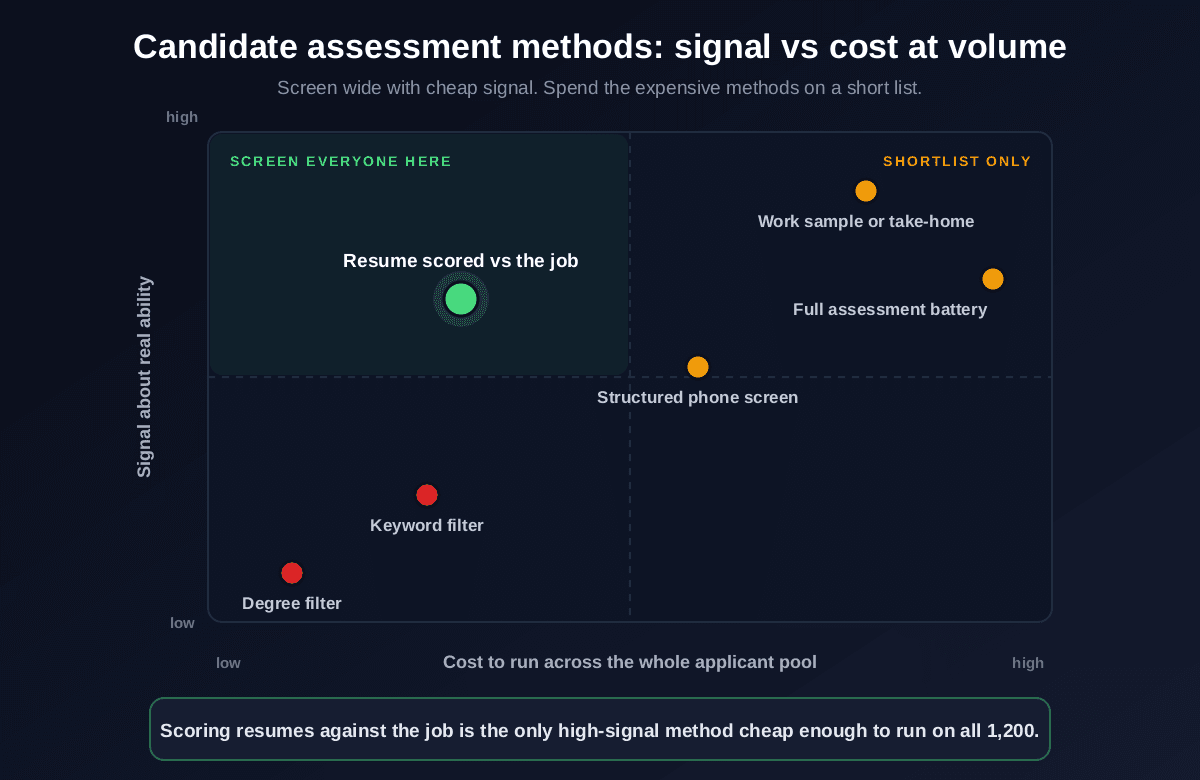
The bottom-left quadrant is where credential and keyword filters live: nearly free, and carrying little information about whether someone can do the work. The right-hand side is where the genuinely strong methods live, and they are strong, but a take-home exercise across 1,200 applicants is not a process, it is a fantasy. Those methods earn their cost on a shortlist of ten.
The quadrant that matters for skills-based hiring is the top-left: methods with meaningful signal that are still cheap enough to apply to everyone. Scoring each resume against the role's required competencies sits there, and it is largely alone. That position is the entire practical case for it: not that it is the most predictive method available, because it is not, but that it is the most predictive method you can afford to run on the whole pool. Everything else forces you back into filtering first, and filtering first is how the proxies return.
Does this mean degrees stop mattering?
No, and overstating this is how the idea loses credibility with hiring managers. Some requirements are genuine: licensure, accreditation, and roles where a specific qualification is legally or professionally mandatory. Those are not proxies, they are requirements, and skills-based hiring has nothing to say against them.
For everything else, the productive question is what the degree was standing in for. Usually it is something nameable: quantitative reasoning, structured writing, the ability to work through ambiguity over months. Once you name it, you can screen for it directly and accept evidence from any source, including a degree. A degree becomes one input among several rather than the gate in front of all of them.
The dishonest version, worth naming because it is common, is removing the requirement from the posting while continuing to reward it in screening. That produces the worst of both: a larger applicant pool who believe they have a real chance, evaluated by a process that still quietly prefers the credential. It also makes your funnel data meaningless, because the stated criteria and the applied criteria have diverged.
Skills-based hiring mistakes to avoid
- Calling keyword matching skills-based. A keyword filter cannot tell a listed skill from a demonstrated one, and it rewards resume optimisation over competence. It is a proxy with a modern name.
- Removing the requirement without funding the screening. The policy change without the capacity change reliably produces proxy-scanning under time pressure. Budget the screening stage or expect the old behaviour back within a quarter.
- Replacing one long requirement list with another. Twenty skill bullets is a credential filter wearing a different hat. If everything is required, the ranking cannot discriminate and recruiters fall back on gut feel.
- Only reading the top of the ranking. The candidates this approach was designed to surface tend to sit mid-list, because their evidence is real but unfamiliarly worded. Skip the middle band and you have bought efficiency, not access.
- Assessing everyone with expensive methods.Sending a take-home to a large pool wastes your team's time and burns candidate goodwill at scale. Match method cost to pool size.
- Not measuring whether it worked. Track the share of hires without the previously-required credential, and their performance and retention against everyone else. If you cannot show that, the policy is a press release.
How to tell if it is actually working
Three signals are worth watching, and none of them is applicant volume. First, the proportion of interviewed candidates who lack the credential you removed: if it has not moved, your screening did not change even if your posting did. Second, the interview-to-offer rate for that group compared with everyone else, which tells you whether your skills screening is surfacing genuinely capable people or just more people. Third, retention and performance at six and twelve months, which is the only measure that answers the original question.
These sit naturally alongside the funnel metrics in our guide to high-volume recruiting, and they are worth reviewing together, because skills-based hiring and volume hiring are the same operational problem viewed from two angles: both come down to whether your screening stage can evaluate everyone consistently instead of only the people who cleared a cheap filter.
Key takeaways
- Skills-based hiring means evaluating demonstrated ability rather than credentials, degrees, titles or employer prestige.
- It stalls because a degree filter is free and instant while skills evidence has to be read and assessed.
- Dropping the requirement grows your pool and raises your cost per applicant at the same time.
- Under that pressure recruiters revert to proxy-scanning, which hides the credential filter instead of removing it.
- Skill claims come in four levels: claimed, applied, quantified and verifiable. Keyword filters see all four as identical.
- Score every resume against the required competencies in one pass so skills evaluation costs about what the filter did.
- Screen everyone with a cheap high-signal method, and reserve work samples and interviews for the shortlist.
- Rankid scores up to 200 resumes per batch against your job description, first 5 free with no signup.
Bottom line: skills-based hiring is an operational commitment, not a wording change on a job posting. The moment you remove a credential filter you inherit the work it was doing, and the only way to keep the policy alive past the first busy quarter is to make skills evaluation cheap enough to apply to every single applicant. Define the competencies, write them in language candidates actually use, and score the whole pool against them. Run your next req through Rankid's bulk resume screening tool and see every candidate ranked by the skills the job really needs, with the matches and gaps spelled out for each one.
Frequently asked questions
What is skills-based hiring?
Skills-based hiring is the practice of evaluating candidates on demonstrated ability to do the job rather than on proxies such as degrees, job titles or employer prestige. In practice it means defining the specific competencies a role depends on, then looking for evidence of those competencies in every applicant, whether that evidence comes from formal education, self-teaching, previous roles, open-source work or a work sample. It is often described as prioritising capability over credentials. The core claim is that a degree requirement filters on correlation while a skills requirement filters on the thing you actually care about.
Why does skills-based hiring fail to stick at most companies?
Because removing a degree requirement is free and evaluating skills is not. A degree filter is a single yes or no that costs nothing to apply and shrinks the applicant pool before anyone reads anything. Skills evidence is buried in prose, phrased differently by every candidate, and has to be assessed individually. So when a company drops credential requirements, two things happen at once: the applicant pool grows, sometimes sharply, and the cost of evaluating each applicant goes up. Unless the screening stage is rebuilt to absorb that, recruiters quietly fall back to scanning for familiar employers and job titles, which is the same proxy problem in a new costume.
How do you screen for skills at volume?
You stop reading for skills one resume at a time and start scoring the whole batch against the role's required competencies. Define the must-have skills before applications open, write them into the job description in the language candidates would actually use, then upload the full batch of resumes and score every candidate against that skill list in one pass. What you get back is each applicant rated by fit with the specific skills they match and miss, which is a skills-based evaluation applied identically to applicant 1 and applicant 1,200. You then read from the top and spend expensive assessment methods, such as work samples, only on the shortlist.
What are the four levels of skill evidence on a resume?
Level one is claimed: the skill appears in a list, such as Skills: Python. Level two is applied: the skill appears inside a described responsibility, such as built ETL pipelines in Python. Level three is quantified: the skill is tied to an outcome, such as cut pipeline runtime 40 percent using Python and Spark. Level four is verifiable: the same claim with a repository, portfolio, work sample or named reference behind it. A keyword filter treats all four identically, which is precisely why keyword filtering is not skills-based hiring. Screening for the level rather than the presence of the word is what separates the two.
What are the best candidate assessment methods?
It depends where in the funnel you are, because methods differ enormously in cost per candidate. Degree and keyword filters are effectively free but carry very little signal about real ability. Work samples, take-home exercises and full assessment batteries carry strong signal but are far too expensive to run across an entire applicant pool. Scoring each resume against the role's required skills sits in the useful middle: meaningfully better signal than keyword matching, and cheap enough to apply to every applicant. The practical rule is to screen everyone with a cheap high-signal method and reserve expensive methods for the shortlist.
Does skills-based hiring mean you should ignore degrees entirely?
No. It means treating a degree as one possible piece of evidence rather than as a gate. Some roles have genuine licensure or accreditation requirements, and those are not proxies, they are actual requirements. For everything else, the useful question is what the degree was standing in for. If it was standing in for statistical literacy or written communication, screen for statistical literacy or written communication directly, and accept whatever evidence demonstrates it. The failure mode to avoid is deleting the requirement from the job posting while still quietly rewarding it during screening.
How do you write a skills-based job description?
Separate the requirements the role genuinely depends on from the ones that accumulated by habit, and cut anything you cannot describe how you would assess. Write each remaining skill in the language candidates use on their own resumes rather than internal jargon, because screening depends on matching what people actually wrote. State the level of evidence you expect, for example production experience versus familiarity. Then keep the list short: a posting with six real must-haves produces a far more screenable pool than one with twenty aspirational bullets, and it stops the requirement list from quietly rebuilding the credential filter you just removed.
Is there a free tool for skills-based candidate screening?
Yes. Rankid lets you paste your job description, upload a batch of resumes, and score every candidate 0 to 100 on how well their evidence matches the skills the role requires, showing exactly which skills each person matches and misses. Because the matched and missing skills are visible per candidate, you are screening on competencies rather than on pedigree, and you are doing it identically for everyone in the pool. Your first 5 resumes are free with no signup required, and you can score up to 200 resumes per batch once you sign up.