Workforce Planning: The Process, a Template, and the Capacity Nobody Plans (2026)
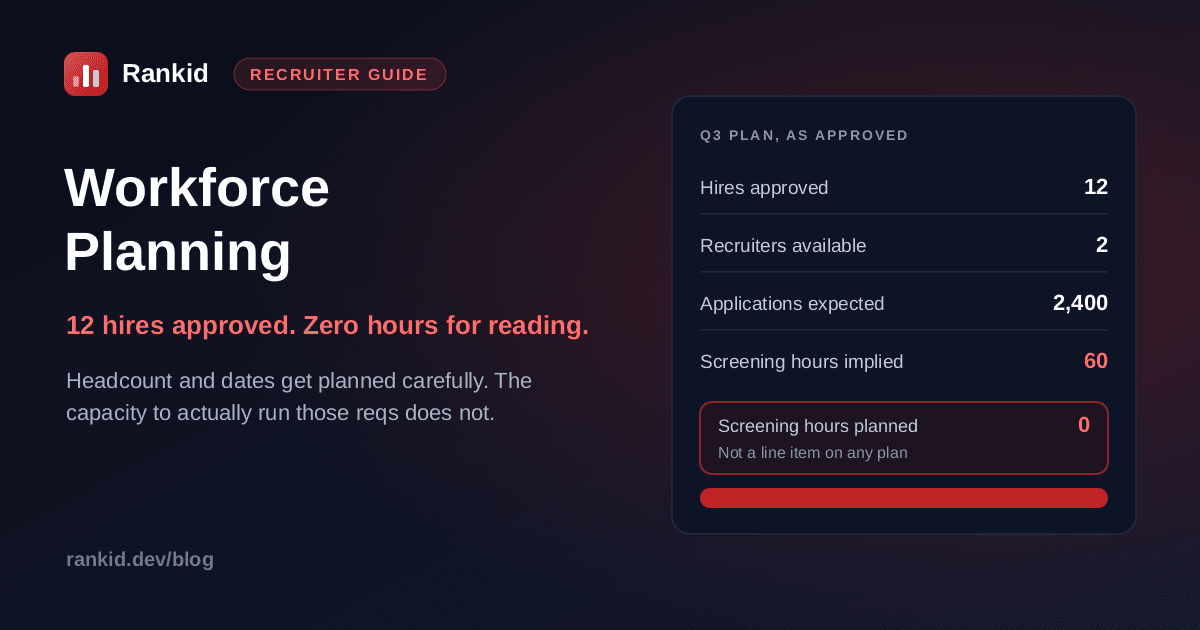
Workforce plans are unusually well made documents. They have scenarios, attrition assumptions, role families, budget envelopes, quarters and named owners. Finance has reviewed them and the executive team has signed them. Then two quarters later the same organisation is three hires behind on a plan that was fully approved and fully funded, and nobody can point to the moment it went wrong. It went wrong at approval, in the column that was never there: the hours required to actually run the processes the plan just committed to.
Quick answer
What is workforce planning?
Workforce planning is the process of establishing what people and capabilities an organisation will need, comparing that against what it currently has, and deciding deliberately how to close the difference. Done properly it answers three questions in order: what will we need, what do we have, and what are we going to do about the gap.
It is worth separating it from two things it gets confused with. It is not budgeting, because it deals in capabilities and timing rather than only in cost, and a plan that says twelve headcount without saying which capabilities is not a workforce plan. And it is not recruiting, because it decides what to hire and when, while recruiting decides how to fill a particular role. The handoff between those two is where most of the value gets lost, which is the theme of this article.
Strategic vs operational workforce planning
Almost every discussion of workforce planning is about the strategic half, which is the more intellectually interesting one and the one consultancies sell. The operational half is where plans succeed or fail.
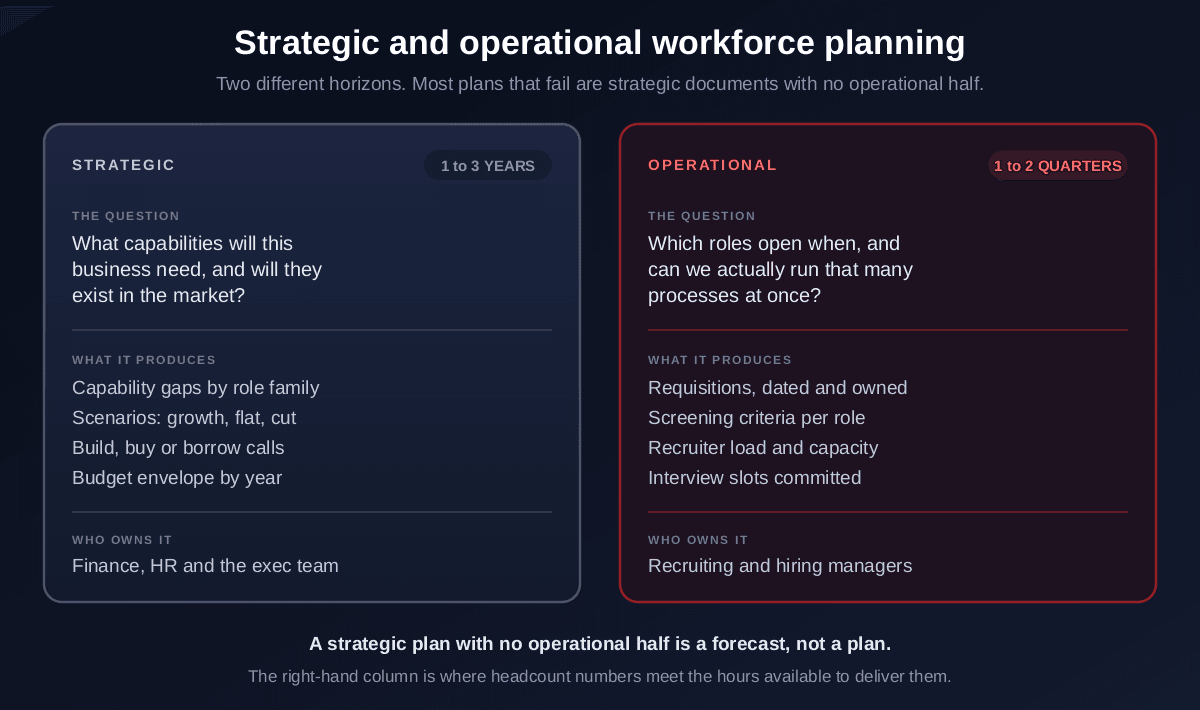
The strategic half asks what capabilities the business will need in one to three years and whether those people will exist in the market at a price you can pay. It produces capability gaps by role family, scenarios for growth, flat and reduced cases, and build-buy-borrow calls.
The operational half asks which roles open in which week, who owns each one, what the screening criteria are, and whether the recruiting team can actually run that many processes simultaneously. It produces requisitions rather than a document. Without it, a strategic plan is a forecast: interesting, defensible and unexecutable.
The workforce planning process
Five steps, run every quarter rather than annually, because an annual plan is stale by the second quarter and nobody re-opens it.
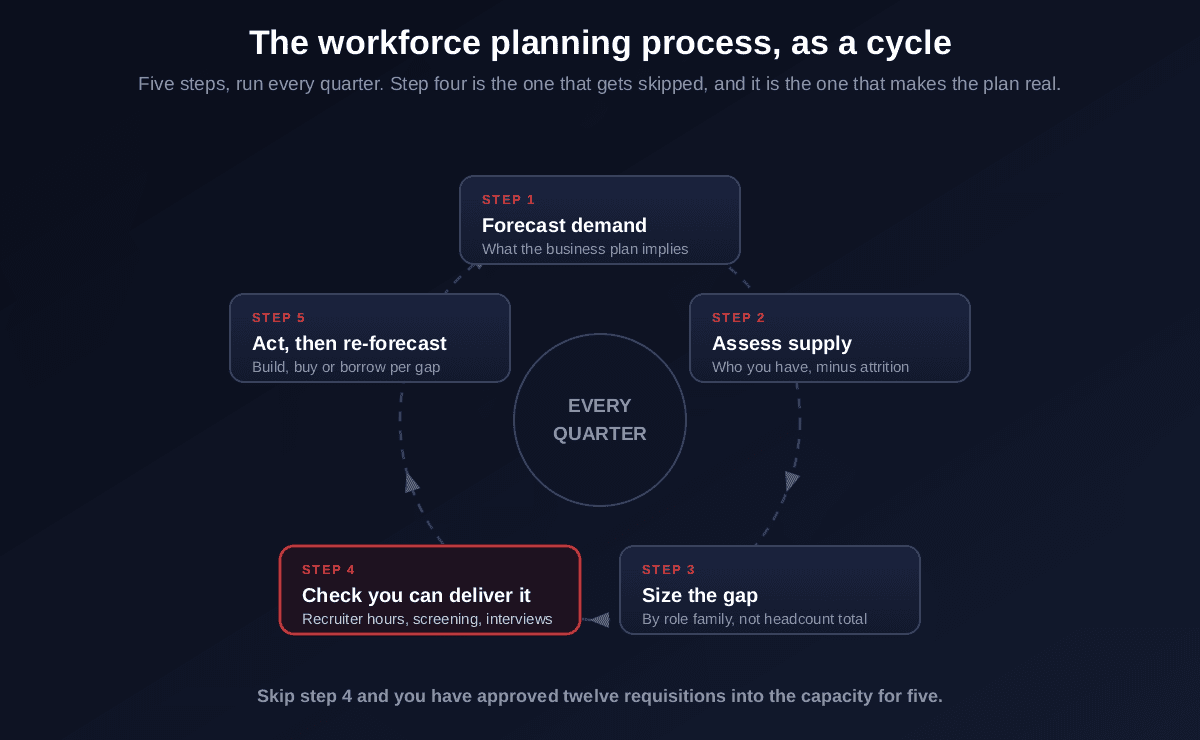
Forecast demand in capabilities, not headcount
Translate the business plan into what has to get done, then into the capabilities required to do it. “Six more engineers” is a conclusion someone already jumped to. “We need to support three new integrations and a compliance audit” is a demand statement you can test against alternatives.
Assess supply honestly, including attrition
Current headcount minus realistic attrition, by role family. Use your actual leaver rate per family rather than a company average, because the family with 30 percent attrition is the one that will quietly consume your entire hiring capacity on backfills.
Size the gap by role family
Needed, minus what you will still have. Do this per family, never as one company-wide number, since an aggregate gap of twenty can be four teams that are fine and one that is critically short.
Check you can actually deliver it
The step this article exists for. Convert the plan into hours: recruiter time, screening time, interviewer time and coordination. If the implied hours exceed what the team has, the plan is not funded no matter what the budget line says, and you have a choice to make now rather than an explanation to give in three months.
Act on each gap, then re-forecast
A build, buy or borrow decision per gap, then revisit next quarter with actuals. Planning is a loop, and the value comes from the second and third iterations when your assumptions have been tested.
A workforce planning template
One page, one row per role family. If a row cannot be filled in, that is not a formatting problem, it is the finding: it usually means nobody has defined the role well enough to hire against it.
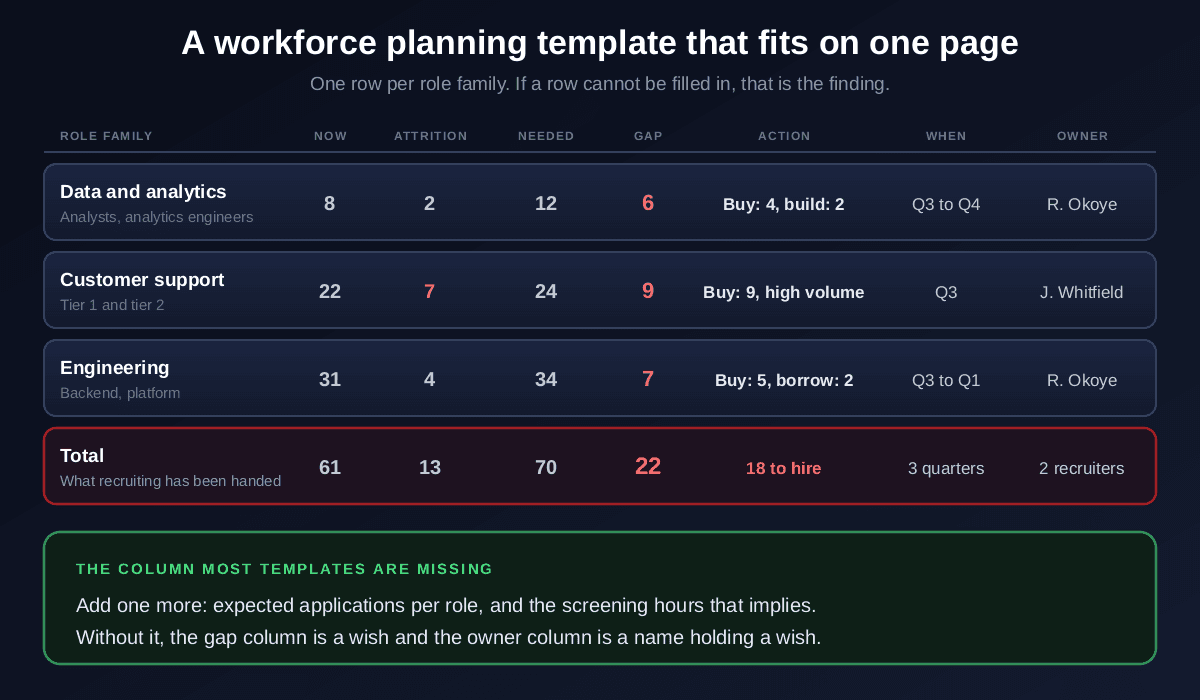
Two things in that table are worth dwelling on. First, the totals row is the one recruiting actually receives: 22 gaps, 18 of them to be hired externally, across three quarters, with two recruiters. That is the real plan, and it is the first time anyone has looked at the aggregate as a workload rather than as a budget.
Second, note how much of the gap is attrition rather than growth. Thirteen of the 22 come from people leaving. Backfills feel like less of an achievement than growth hires and consume exactly the same capacity, which is why a plan that only counts new roles understates the work by a wide margin.
Turning the plan into hours before you approve it
Here is step four, done with arithmetic. It takes about five minutes and it is the single highest value calculation in workforce planning.
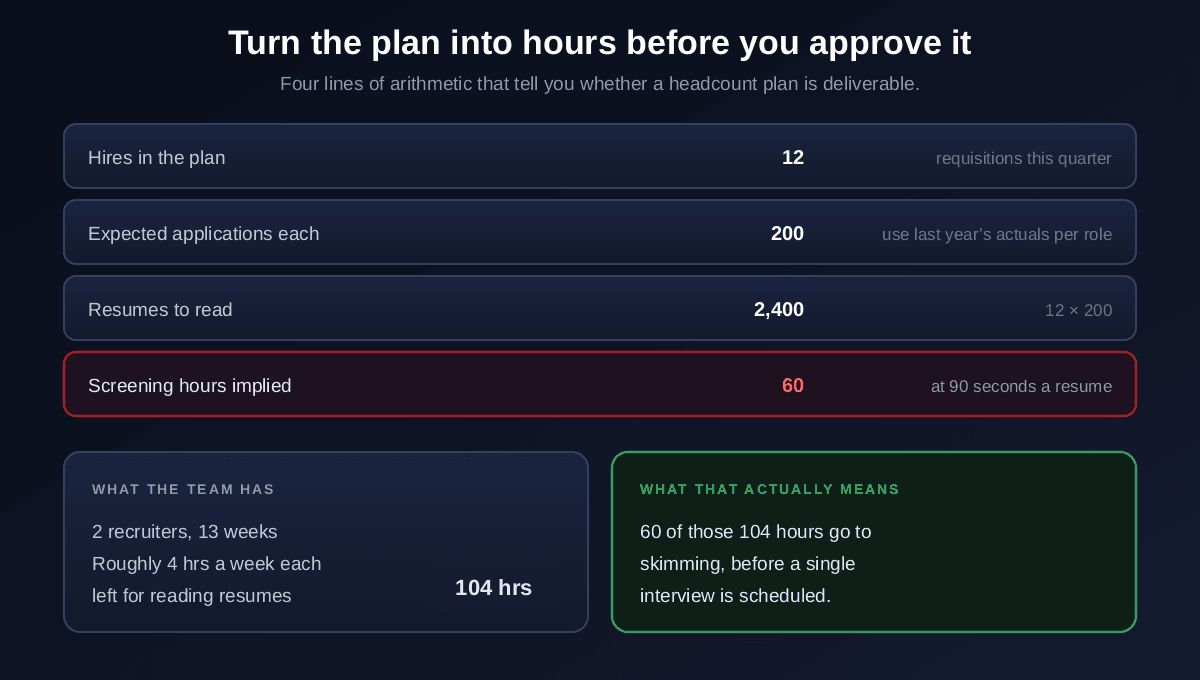
Twelve requisitions. Two hundred applications each, taken from last year's actuals for those role families rather than optimism. That is 2,400 resumes to read. A careful screen against real criteria runs 60 to 120 seconds, so call it 60 hours of reading for the quarter.
Now the other side. Two recruiters over thirteen weeks, with realistically about four hours each per week left for reading resumes once interviews, scheduling, offers, intake meetings and candidate communication are accounted for. That is roughly 104 hours of screening capacity, of which 60 would go to skimming before a single interview is scheduled.
A plan that consumes 58 percent of your recruiters' available reading time just to identify who to talk to is not a resourced plan, and the outcome is predictable: the piles get abandoned partway, the roles with the loudest hiring managers get the attention, and the rest slip a quarter while looking on paper like they are in progress. This is the same mechanism described in high-volume recruiting, seen from the planning side instead of the recruiter's desk.
What to do when the arithmetic does not work
Make the fourth step come out differently
Score the whole batch against the job description in one pass: every applicant rated 0 to 100 with the skills they match and miss. The 60 hours of reading your plan implies stops being the constraint on how many requisitions you can run. First 5 resumes free, no signup.
Screen a batch freeBuild, buy or borrow
For each gap there are three ways to close it, and defaulting to hiring is how recruiting teams end up with plans they cannot deliver.
- Build. Develop or promote someone you already employ. Cheapest per role, best for retention, and slowest. Requires knowing what your existing people can actually do, which most organisations do not record anywhere useful.
- Buy. Hire externally. Fastest route to a capability you genuinely do not have, and the most expensive per head once you count internal time, as the arithmetic in cost per hire shows.
- Borrow. Contractors, agencies or partners. Right for genuinely temporary or specialist needs, and a trap when used to avoid a headcount conversation, because the cost reappears every quarter without the capability ever transferring in-house.
The practical test for build-versus-buy is whether the capability is adjacent to something your team already does. Adjacent capabilities are usually cheaper and faster to build than the market rate suggests. Genuinely new ones are almost always faster to buy, and pretending otherwise costs you two quarters before you hire anyway.
Workforce planning tools and analytics
The tooling conversation is where planning projects go to die, so it is worth being blunt about what actually helps at what scale.
- A spreadsheet. Genuinely sufficient for most organisations up to a few thousand people. Role families as rows, the eight columns above, data pulled from your HR system and applicant tracking system quarterly. The constraint is rarely the modelling.
- Your HR and ATS reporting. Where attrition rates, time to fill and applications per requisition already live. These numbers are the inputs that make a plan realistic rather than aspirational, and most teams never pull them.
- Dedicated workforce planning platforms. Earn their cost at larger scale, where scenario modelling across many business units and integration with financial planning genuinely exceeds what a spreadsheet can hold.
- Screening and ranking tools. Not usually filed under workforce planning, which is precisely the oversight. They change the delivery capacity your plan depends on, which no forecasting tool does.
Metrics that tell you the plan is working
- Plan versus actual hires, by role family and quarter. The headline. Tracked by family, because a company-level number that looks close can hide one team getting nothing.
- Requisitions open per recruiter. The best single predictor of whether the plan will land. Past a certain load, every additional req reduces the throughput of all the others.
- Time to fill, measured from requisition approval. Not from posting, or you will hide the approval delay covered in the requisition process.
- Attrition by role family against forecast. The input most likely to be wrong, and the one that silently doubles your backfill workload.
- Screening coverage. The share of applicants actually evaluated. Low coverage means your plan is being delivered by sampling, not by selection.
- Internal fill rate. What proportion of gaps were closed by building rather than buying. If it is near zero, your build column was decoration.
Workforce planning mistakes to avoid
- Planning headcount without planning delivery capacity. The mistake this whole article is about. Approved and undeliverable is worse than not approved, because everyone believes it is happening.
- Planning annually. A twelve-month plan nobody re-opens is a document. Quarterly re-forecasting with actuals is the practice that makes it useful.
- One aggregate headcount number. Hides which families are short, which are over-hiring and where attrition is actually landing.
- Ignoring attrition until it shows up as backfills. Leavers usually generate more requisitions than growth does, and they arrive unannounced.
- Treating build as a real option without knowing your internal skills. You cannot promote from a population whose capabilities are undocumented, so the build column silently becomes a buy column.
- Approving requisitions with no screening criteria. The plan then reaches recruiting as a headcount number and a title, which is how screening becomes a proxy scan. Fix it with defined criteria at approval.
- Buying a planning tool to solve a capacity problem. A better forecast of a gap you cannot fill is still a gap you cannot fill.
Key takeaways
- Workforce planning forecasts needed capabilities, compares them with current supply, and closes the gap by building, buying or borrowing.
- Strategic planning spans 1 to 3 years; operational planning turns it into dated requisitions for the next quarter or two.
- The cycle is forecast, assess supply, size the gap, check you can deliver it, then act and re-forecast quarterly.
- Plan per role family, never as one aggregate headcount number.
- Attrition usually generates more requisitions than growth does, and backfills consume identical capacity.
- Convert the plan into hours: reqs times expected applications times 90 seconds. 12 reqs can imply 60 hours of reading.
- If implied hours exceed available hours, the plan is unfunded regardless of the budget line.
- Rankid scores up to 200 resumes per batch against your job description, first 5 free with no signup.
Bottom line: workforce planning fails far more often on delivery than on forecasting. The demand modelling is usually competent, the attrition assumptions are usually defensible, and the budget is usually real. What is missing is the five-minute calculation that turns approved headcount into the hours required to run those processes, and the screening stage is where most of those hours sit. Add that column to your template, and when the arithmetic does not work, fix it before approval rather than explaining it afterwards. Take the reading out of the equation with Rankid's bulk resume screening tool and find out how many requisitions your team can genuinely carry.
Frequently asked questions
What is workforce planning?
Workforce planning is the process of working out what people and capabilities an organisation will need, comparing that with what it already has, and deciding how to close the difference. In practice it produces a view of gaps by role family, a decision for each gap about whether to develop people internally, hire externally or use contractors, and a schedule with owners and budget attached. It is distinct from budgeting because it deals in capabilities and timing rather than only in cost, and it is distinct from recruiting because it decides what to hire and when rather than how to fill a specific role.
What is strategic workforce planning and how is it different from operational planning?
Strategic workforce planning looks one to three years out and asks what capabilities the business will need and whether those capabilities will exist in the market. It produces capability gaps, scenarios for growth, flat and reduced cases, build-buy-borrow decisions and a budget envelope, and it is usually owned by finance, HR and the executive team. Operational workforce planning covers the next one or two quarters and asks which specific roles open when, who owns them, what the screening criteria are and whether the team can actually run that many processes at once. A strategic plan with no operational half is a forecast rather than a plan.
What are the steps in the workforce planning process?
Five, run on a repeating cycle. Forecast demand from the business plan, expressed as capabilities rather than headcount totals. Assess current supply, meaning who you have now minus expected attrition. Size the gap by role family, because an aggregate number hides which teams are short. Check you can actually deliver it, which means comparing the implied recruiting workload against available recruiter, screening and interviewer hours. Then act on each gap with a build, buy or borrow decision and re-forecast the following quarter. Step four is the one most commonly skipped and the one that determines whether the plan survives contact with reality.
What is headcount planning?
Headcount planning is the operational half of workforce planning: converting agreed capability gaps into a specific list of approved positions with dates, salary bands, owners and budget. It is what turns a plan into requisitions. The common failure is treating it as purely a finance exercise, where numbers are approved in a spreadsheet without anyone checking whether the recruiting team has the hours to run twelve simultaneous processes. Approved headcount that cannot be delivered creates the worst of both outcomes: budget committed, roles unfilled and managers who believe hiring is in progress.
What goes in a workforce planning template?
One row per role family with eight columns: the role family, current headcount, expected attrition, headcount needed, the resulting gap, the action for each gap split into build, buy and borrow, the quarter it lands in, and a named owner. Add one column most templates omit: expected applications per role and the screening hours that implies. If a row cannot be filled in, that gap is the finding rather than an inconvenience, because it usually means nobody has defined what the role requires clearly enough to hire against.
How do you calculate recruiting capacity from a workforce plan?
Multiply the number of requisitions by the applications you expect each to attract, using last year's actuals per role family rather than a guess, then multiply by the time a careful screen takes, which is about 60 to 120 seconds per resume. Twelve requisitions at 200 applications each is 2,400 resumes, or roughly 60 hours of reading. Then compare that with what recruiters genuinely have available once interviews, coordination and offer work are accounted for, which is usually only a few hours a week each. If the implied hours exceed the available hours, the plan is not funded regardless of what the budget says.
What tools do you need for workforce planning?
Less than the software market implies. Most organisations under a few thousand people can plan effectively in a spreadsheet with headcount, attrition, gaps and actions by role family, drawing data from their HR system and applicant tracking system. Dedicated workforce planning and analytics platforms earn their cost at larger scale, where scenario modelling across many business units and integration with finance systems becomes genuinely hard by hand. The more useful question is not which planning tool to buy but whether you have the delivery capacity the plan assumes, because a better forecast does not create recruiter hours.
How does screening capacity affect a hiring plan?
It is usually the binding constraint and it is almost never in the plan. Every approved requisition generates applications that have to be read before anyone can be interviewed, and that reading scales with applicant volume rather than with the number of hires. A plan for twelve hires can imply sixty hours of screening, which does not fit alongside interviews and coordination, so in practice the piles are abandoned partway and roles slip. Rankid removes that constraint by scoring the whole batch against the job description in one pass, with each candidate rated 0 to 100 and their matched and missing skills listed. First 5 resumes free, no signup.