Job Requisition: What It Is, the Form, and the Approval Process (2026)
The requisition is the least interesting document in hiring and the most consequential. It gets drafted in ten minutes, usually by copying the last one, then routed through finance and HR and an approver, and once the number comes back everyone forgets it existed. Six weeks later a recruiter is staring at 412 applications for that requisition trying to work out what the hiring manager actually wanted, because the field where that was supposed to be written down was left blank. A requisition does not just authorise a hire. It decides whether the resulting applicant pool can be screened at all.
Quick answer
What is a job requisition?
A job requisition is the formal internal request to fill a position, and its function is authorisation. It is the document that turns “we need another analyst” into an approved, funded piece of headcount that recruiting is allowed to work on. It records the job title and level, the department and hiring manager, whether the headcount is new or a replacement, the approved salary band, where the money comes from, and who signed it off.
Two things follow from that definition and both matter in practice. First, a requisition is a financial and governance artefact, not a marketing one. It exists so that an organisation can control how many people it employs and what it pays them, which is why finance and HR sit in the approval chain and why the document contains information you would never publish. Second, approval creates a requisition number, usually formatted like REQ-2411, and that number becomes the spine of the whole hire. Postings, applications, interview records, the offer and eventually the payroll entry all hang off it. When a recruiter asks which req a candidate applied to, they are asking which authorised slot this person is competing for.
Why candidates sometimes see it
Job requisition vs job posting vs job description
These three get used interchangeably in conversation and they are not interchangeable at all. The cleanest way to hold the distinction is by asking who reads each one and when it stops existing.
- The job requisition. Internal. Read by finance, HR and an approver. Contains budget, headcount and authorisation. Ceases to matter once the role is filled and the req is closed.
- The job description. Internal and durable. Defines the work, the accountabilities and the level. Outlives the hire, because it is used for pay banding and performance reviews.
- The job posting. Public. Read by a candidate deciding in 30 seconds whether to apply. Written from the other two, and the only one of the three that is a piece of persuasion. Our guide to writing a job description covers how these three should be written in relation to each other.
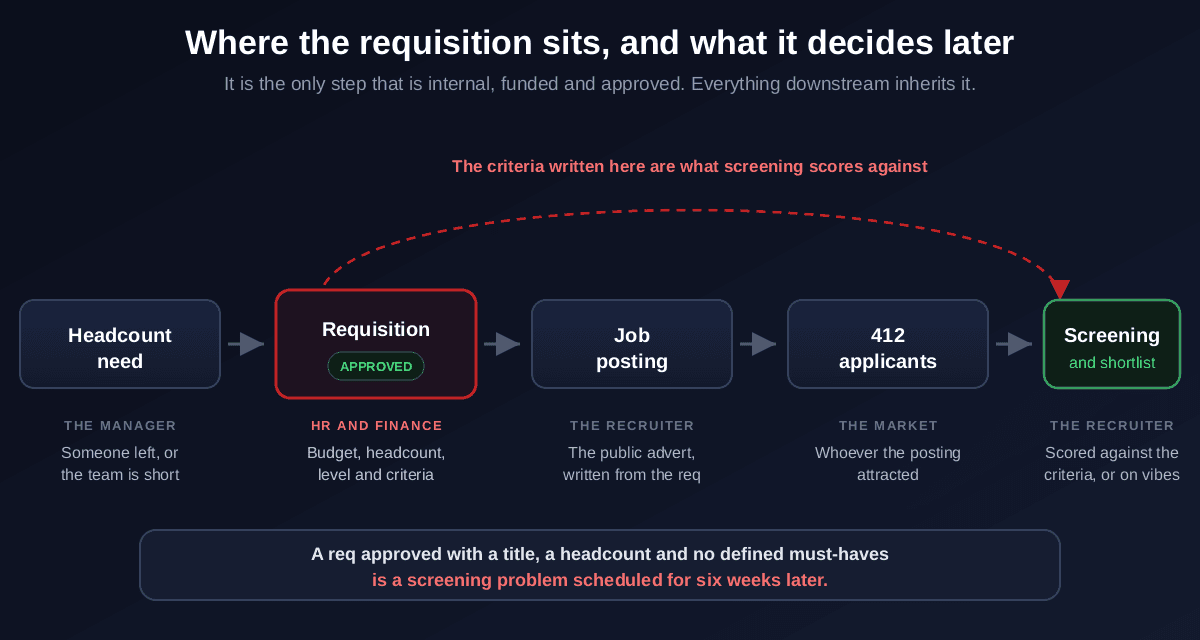
The dashed line in that diagram is the point of this article. Everything downstream inherits the requisition, including the screening stage, which happens weeks later and is usually treated as an unrelated activity. The requirements written at approval time are the criteria your shortlist will be argued about. If they were never written, that argument happens from scratch when the pile is already 400 deep.
What goes in a job requisition form
Most requisition forms are inherited from whoever configured the applicant tracking system, and they are optimised for approval rather than for hiring. Here is what the form should contain, grouped by what each part is for.
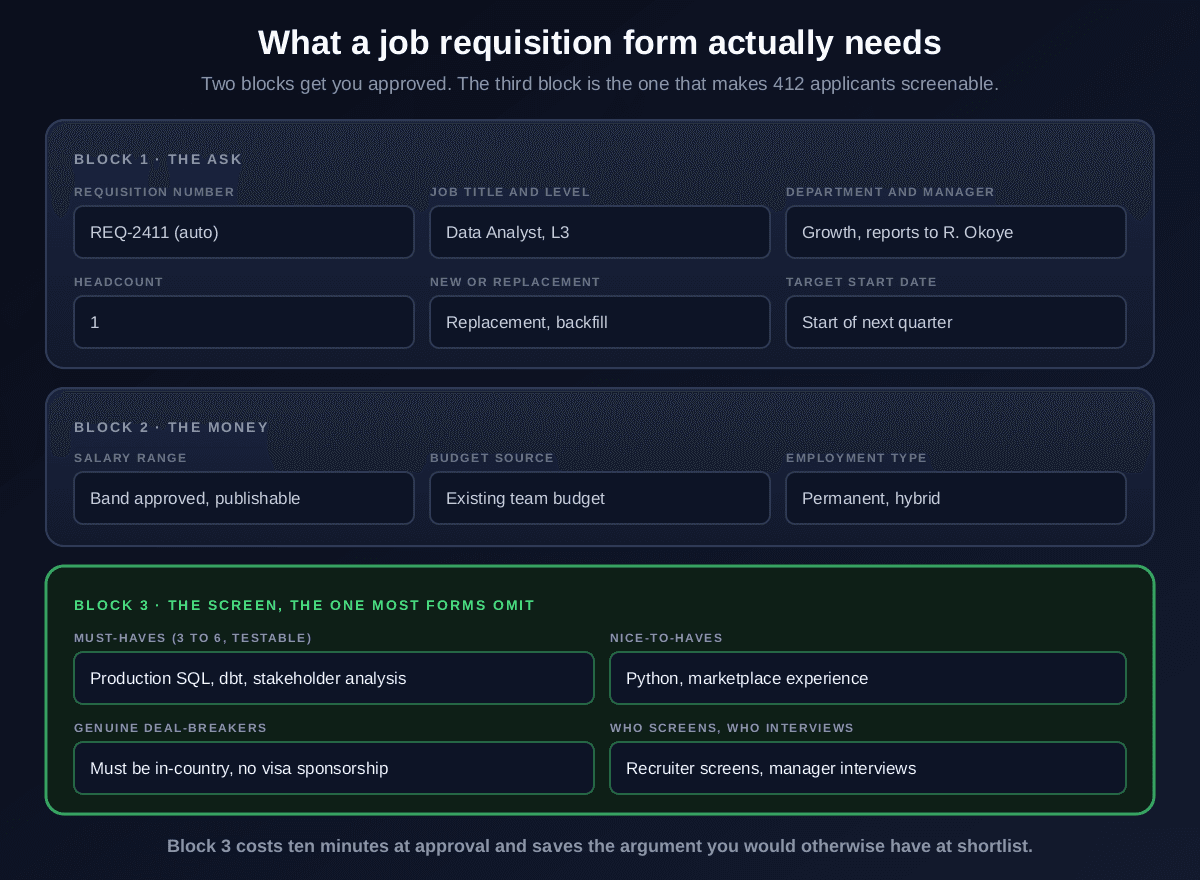
Block one, the ask. Requisition number, job title and level, department and hiring manager, headcount, new or replacement, target start date. This is what approvers actually read. The one field here that causes downstream pain is the title: an invented title that does not map to your job architecture triggers a compensation review and adds days.
Block two, the money. The approved salary range, the budget source and the employment type. Insist on a publishable range at this stage, not a vague band to be worked out later. A range agreed at approval prevents the worst late-stage failure in hiring, which is four interview rounds ending at a number that was never going to work.
Block three, the screen. Three to six testable must-haves, the nice-to-haves, genuine deal-breakers such as location or work authorisation, and who is responsible for screening. This block is missing from most requisition forms, and adding it is the highest-value change you can make to yours.
The job requisition approval process
The approval chain varies by company, but the shape is consistent: the manager raises it, a department head endorses it, finance confirms the budget, HR or compensation checks the title and band, and a senior leader signs off new headcount. Replacements usually travel a shorter path, because the money already exists.
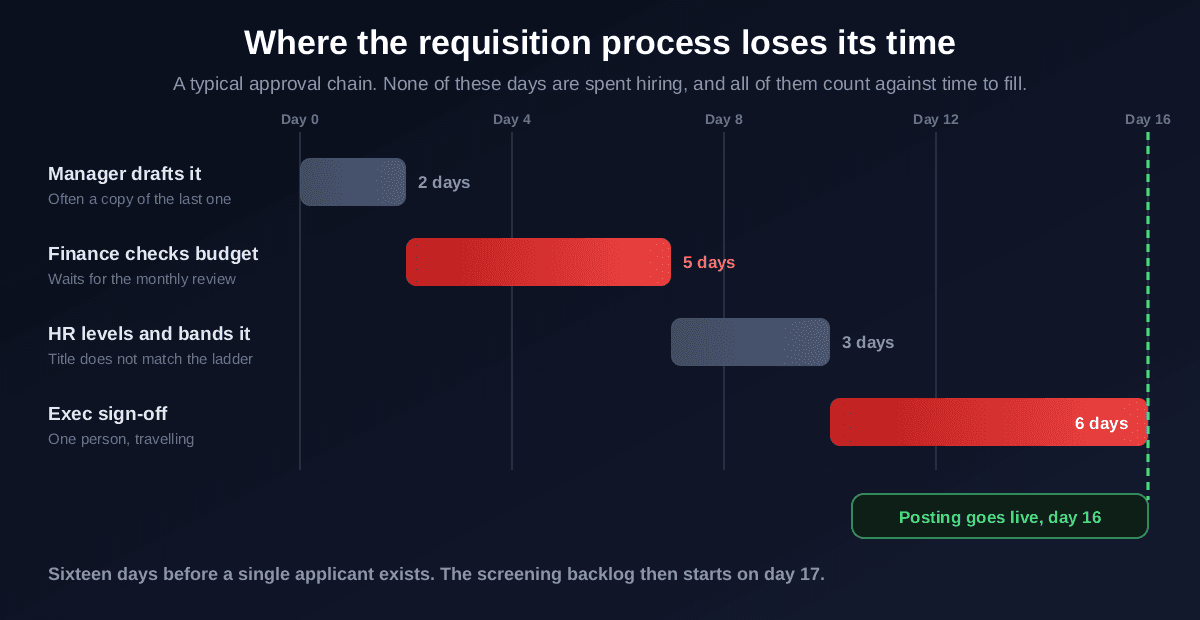
Notice what that timeline does to your metrics. Sixteen days elapse before a single applicant exists, and most teams measure time to fill from the day the posting went live, so those days are invisible on the recruiting dashboard while being extremely visible to the manager who is short-staffed. If your hiring feels slower than your numbers say it is, this gap is usually where the difference lives. The same measurement problem shows up across high-volume recruiting, where the stages nobody times are the stages that hurt.
Find out your real approval chain and write it down
Ask HR for the actual sequence, including the substitute approver for each step. Most requisition delay is not any single approver being slow, it is a recruiter discovering on day nine that compensation also needed to see it.
Raise it against the calendar, not the need
If finance reviews headcount monthly, a requisition submitted the day after the review waits four weeks for something that takes ten minutes. Learn the cycle dates and submit into them.
Use an existing title and band wherever you can
Novel titles are the most common cause of a compensation round trip. If the work fits an existing level, use the existing level and put the interesting bit in the posting, which is the document candidates actually read.
Fill in the screening block while the manager is still paying attention
This is the moment of maximum leverage in the entire hiring process. The hiring manager is engaged, the role is fresh in their mind, and they are already answering questions. Ten minutes here buys you the criteria you would otherwise reconstruct from guesswork at shortlist time. Ask one question repeatedly: what would I see on a resume that tells me this person can do it?
Agree the screening owner and the timeline in the same conversation
Who screens, who interviews, how many candidates the manager expects to see, and by when. Writing it on the requisition converts it from an assumption into an agreement, which is what you will want when the manager asks why the shortlist has eight people on it.
The block most requisitions leave blank
A requisition typically arrives at the recruiter with requirements that read like this: five plus years of experience, strong SQL skills, team player, bachelor's degree preferred. Every one of those is unusable as a screening criterion. Not because they are wrong, but because none of them tells you what to look for in a document.
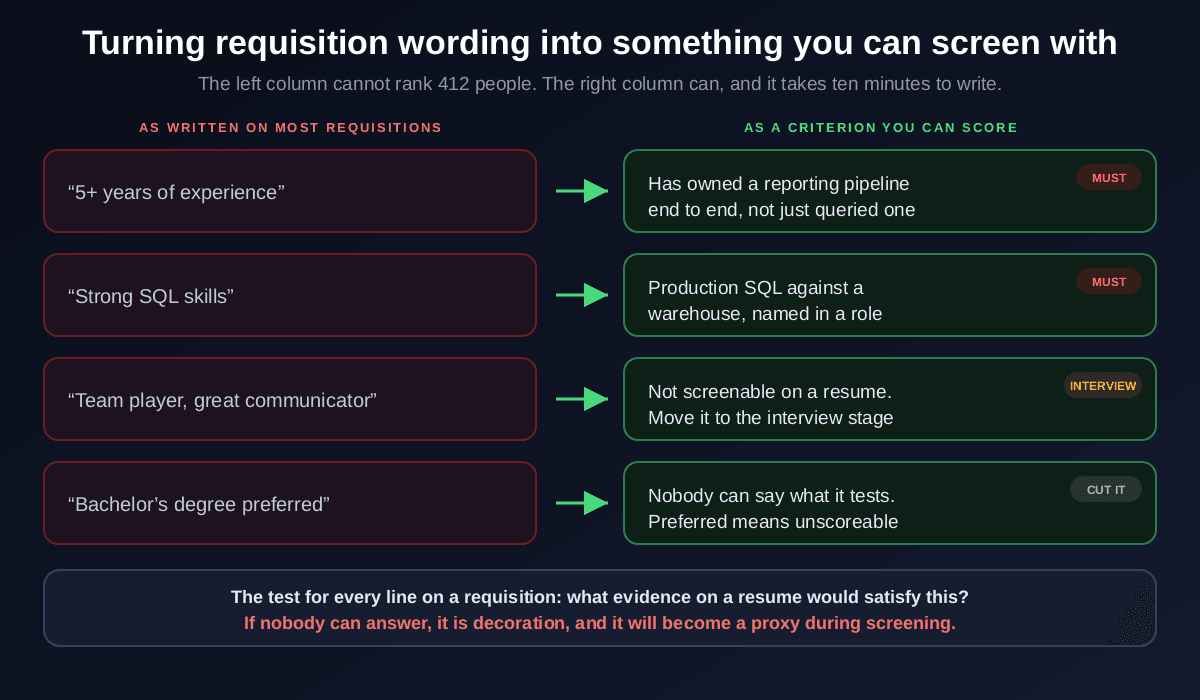
The test that fixes all four is one question asked of every line on the requisition: what evidence on a resume would satisfy this? If nobody can answer, the requirement is decoration, and decoration does not stay neutral during screening. It becomes a proxy, because a recruiter under time pressure who has no defined criteria will fall back on what is fast to scan for: a familiar employer, a senior-sounding title, a recognisable school. That is the same failure we traced in skills-based hiring, arriving through a different door.
Sorting each requirement into must-have, nice-to-have, test-at-interview or cut also does something useful to the requirement list itself. Managers ask for twenty things when the list costs nothing. Asking how each one would be evidenced usually reduces twenty to six, and six real must-haves produce a far more screenable pool than twenty aspirational bullets. Once the criteria exist, they feed directly into a weighted screening scorecard and the whole pool can be scored against the same standard rather than the first 80 getting a careful read and the rest getting a glance.
Score the whole pool against the criteria on the req
Paste the job description, upload every resume, and each candidate comes back rated 0 to 100 with the required skills they match and miss. The criteria you agreed at approval, applied identically to applicant 1 and applicant 412. First 5 resumes free, no signup.
Screen a batch freeA job requisition example, before and after
Two versions of the same requisition, both approvable. Only one of them is usable in six weeks.
As raised.Title: Senior Data Analyst. Headcount: 1, replacement. Band: approved. Requirements: 5+ years in analytics, strong SQL, experience with BI tools, excellent communication, bachelor's in a quantitative field preferred, thrives in a fast-paced environment.
As it should be raised.Title: Data Analyst, L3, mapped to the existing analyst ladder. Headcount: 1, replacement for R. Okoye's team, budget already in plan. Range: publishable band agreed. Must-haves: has owned a reporting pipeline end to end rather than only queried one; production SQL against a warehouse, named inside a role; has presented analysis directly to a non-technical stakeholder group. Nice-to-haves: dbt or an equivalent transformation tool, Python for analysis. Deal-breakers: must be in-country, no sponsorship available for this req. Test at interview: communication, handling ambiguous requests. Cut: the degree preference, because nobody could say what it was standing in for. Screening owner: recruiter, against the three must-haves. Manager expects to see 5 to 8 candidates by the end of week three.
The second version took about ten extra minutes in the intake conversation. It is also, by itself, a screening rubric, a posting brief and an interview plan, which means the recruiter is not reverse-engineering any of those things later from a title and a headcount.
Why requisitions get stuck, and how to unstick them
- An approver nobody knew about. Get the chain in writing once and reuse it. This single act removes more requisition delay than any other change.
- A title that does not exist in the job architecture. Triggers a compensation review. Use an existing title, or agree the new one before you raise the req rather than inside it.
- A missing business case for new headcount. Replacements sail through and new headcount does not. If you are asking for growth headcount, attach the workload evidence to the requisition rather than waiting to be asked for it.
- Budget that exists in a different cost centre. Resolve this before submission. It is a two-message fix beforehand and a two-week ping-pong afterwards.
- Vague requirements that HR or the approver queries. The screening block prevents this too, because a requisition with six testable must-haves reads like a considered request rather than a placeholder.
- Reqs left open after the hire. A closed role that stays live in your system keeps collecting applicants who will never hear back, which is exactly how a company ends up accidentally running ghost jobs it never intended to post.
What does requisition mean outside hiring?
Worth a short detour, because the word is used well beyond recruiting and the general meaning clarifies the hiring one. A requisition is a formal internal request for something that requires authorisation before it can be obtained. A purchase requisition asks for permission to buy something and, once approved, becomes a purchase order sent to a supplier. A lab requisition is a clinician's formal order for tests. A job requisition asks for permission to add a person.
The pattern is identical in all three: an internal request, an approval chain, a number assigned on approval, and a downstream artefact that the outside world actually sees. In purchasing that downstream artefact is the purchase order. In hiring it is the job posting. Understanding that a requisition is fundamentally an authorisation record explains why it contains budget information, why finance is involved, and why it is not the document you should be writing candidate-facing prose into.
Requisition metrics worth tracking
- Time to approve. Need identified to requisition approved. The invisible fortnight from the timeline above. Track it and the conversation about hiring speed changes.
- Open requisitions per recruiter. The single best predictor of whether applicants will be answered. A recruiter carrying 15 open reqs cannot give any of them a careful screen, and candidate experience collapses as a direct consequence.
- Requisition age. Days open, watched as a distribution rather than an average. The long tail is where roles quietly die.
- Applications per requisition. Your screening load, and the number that tells you whether manual review was ever realistic for this role.
- Requisitions closed unfilled or cancelled. High numbers mean headcount is being approved before the need is settled, which wastes recruiter capacity on roles that were never going to be hired.
Job requisition mistakes to avoid
- Copying the last requisition. The fastest way to inherit requirements nobody has examined since 2021, including the degree line everyone agrees is unnecessary.
- Publishing the requisition as the job posting. It reads like an internal form because it is one. This is the most common cause of postings that feel like HR paperwork.
- Leaving the salary band to be resolved later. Later means after four interview rounds, in front of a candidate.
- Twenty requirements, none ranked. An unranked list is not a specification, and at volume it guarantees the shortlist gets argued rather than agreed. Ranking them is what makes it possible to shortlist from the whole pool instead of the top of the pile.
- Approving headcount without deciding who screens. Ambiguity here reliably becomes a two-week stall after the applications arrive, with the manager waiting for a shortlist and the recruiter waiting for criteria.
- Treating the req as paperwork rather than the hiring brief. It is the only document in the process that every stakeholder has already read and signed. Putting the criteria in it means everyone has already agreed to them.
Key takeaways
- A job requisition is the internal, approved request to fill a role: title, level, headcount, budget, approver and a requisition number.
- It is not a job posting (public advert) and not a job description (the durable definition of the work).
- A good requisition form has three blocks: the ask, the money, and the screen. Most forms omit the third.
- Requisition approval commonly burns one to three weeks before a single applicant exists, and most dashboards do not count it.
- Test every requirement by asking what evidence on a resume would satisfy it. If nobody can answer, it becomes a proxy during screening.
- Sort requirements into must-have, nice-to-have, test-at-interview, or cut. Twenty asks usually reduce to six real ones.
- Track time to approve and open reqs per recruiter: both predict whether applicants ever get answered.
- Rankid scores up to 200 resumes per batch against your job description, first 5 free with no signup.
Bottom line: the requisition is the cheapest place in hiring to make a decision and the most expensive place to skip one. Approval already forces a conversation with the hiring manager, finance and HR in the same week, which is the only moment when everyone who has an opinion about this role is paying attention to it. Spend ten of those minutes writing down what a qualified candidate looks like in resume-shaped evidence, and the screening stage six weeks later stops being an argument and becomes a sort. Then run the pool through Rankid's bulk resume screening tool and see all 412 applicants ranked against the criteria you already agreed to.
Frequently asked questions
What is a job requisition?
A job requisition is the internal, formal request to fill a role, and it is what authorises hiring to begin. It records what the job is, which team it sits in, whether the headcount is new or a replacement, the approved salary band, who pays for it, and who signed it off. It is an internal financial and governance document rather than anything a candidate sees, and once it is approved it usually receives a requisition number that every downstream artefact, from the posting to the offer, is tracked against. Nothing about hiring is officially allowed to start until the requisition exists and has been approved.
Is a job requisition the same as a job posting?
No. The requisition is the internal approval to hire and the posting is the public advertisement that results from it. The requisition is read by finance, HR and an approver, and it contains budget and headcount information you would never publish. The posting is read by candidates and contains only what helps the right people apply. One requisition can produce several postings across different job boards, and in most applicant tracking systems the posting is a child record of the requisition, which is why the same role can appear on your careers page with one requisition number behind it.
What is a requisition number?
A requisition number is the unique identifier your system assigns to an approved requisition, usually something like REQ-2411. It exists so that everything attached to that specific hire, meaning the postings, the applications, the interview records, the offer and eventually the payroll entry, can be traced to one authorised piece of headcount. Candidates sometimes see it in a job posting or in an application confirmation email, and it is useful to quote when you contact a company about a specific role, because a recruiter can find it instantly whereas a job title alone may match several open requisitions.
What should a job requisition form include?
Three blocks. The ask: requisition number, job title and level, department and hiring manager, headcount, whether the role is new or a replacement, and the target start date. The money: the approved salary range, the budget source and the employment type. The screen, which most forms omit: the three to six testable must-have requirements, the nice-to-haves, any genuine deal-breakers such as location or work authorisation, and who is responsible for screening against them. The first two blocks get the requisition approved. The third block is what makes the resulting applicant pool possible to screen.
Who approves a job requisition?
Typically a chain rather than one person: the hiring manager raises it, their department head or director endorses it, finance confirms the budget exists, HR or compensation checks the title and band against the job architecture, and a senior leader gives final sign-off on new headcount. Replacement roles usually take a shorter path than new headcount because the budget already exists. The exact chain matters less than knowing it in advance, because the delay in most requisition processes comes from discovering an approver you did not know was in the sequence.
What is the difference between a job requisition and a job description?
A job requisition authorises the hire and a job description defines the work. The requisition is transactional and time-bound: it says one Data Analyst at level three, this band, this budget, approved on this date. The job description is durable and role-based: it says what the job involves, what it is accountable for and how it is levelled, and it continues to exist after the hire is made because it is used for pay banding and performance reviews. A requisition points to a job description. A job posting is then written from both of them for candidates to read.
How long does the job requisition approval process take?
Commonly one to three weeks, and it is almost never the writing that takes the time. The delays cluster in waiting for a finance review cycle, a compensation check when the proposed title does not map cleanly to an existing band, and a single senior approver who is travelling or out of office. Those days are invisible in most hiring metrics because time to fill is often measured from the day the posting goes live rather than from the day the need appeared, which is why a hiring process can feel slow to a manager and look fine on a recruiting dashboard.
How do you turn requisition requirements into screening criteria?
Rewrite each requirement as something a resume could actually satisfy, then rank them. Replace 5+ years of experience with the specific thing that experience was meant to guarantee, such as has owned a reporting pipeline end to end. Mark each line as a must-have, a nice-to-have, something to test at interview instead, or something to cut. Then score the whole applicant pool against that list rather than reading resumes until time runs out. Rankid does that scoring step: paste the job description, upload the batch, and every candidate comes back rated 0 to 100 with the criteria they match and miss, first 5 free with no signup.