Cost per Hire: The Formula, a Worked Example, and How to Cut It (2026)
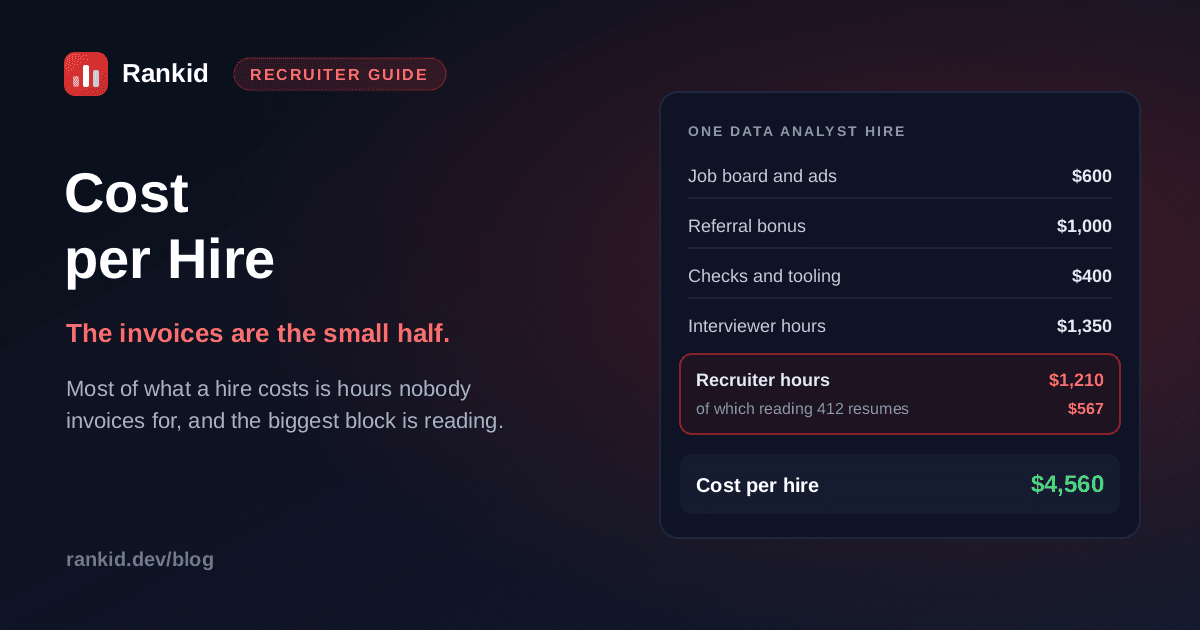
Ask a recruiting team what a hire costs and you will usually get the invoices: job board spend, maybe an agency fee, the referral bonus. Add them up, divide by hires, done. The number that comes out is tidy, defensible and roughly half the truth, because the larger share of what a hire costs is hours that were already on the payroll, and the single biggest block of those hours is a recruiter working through 412 resumes to find the eight people worth a conversation.
Quick answer
What is cost per hire?
Cost per hire is the average total spend required to fill a role, expressed per hire. It exists so recruiting can be discussed in the same units as everything else a business spends money on, which is why it turns up in budget conversations, tooling business cases and any argument about whether to use an agency.
Two properties are worth holding onto because most misuse comes from ignoring them. It is an average over a period, not a per-candidate cost, so it is calculated by totalling costs across a period and dividing by hires made in that same period. And it is an input measure: it tells you what hiring consumed, not what it produced. A very low cost per hire achieved by hiring the wrong people quickly is not a success, which is why it should always be read next to quality of hire and retention rather than on its own.
The cost per hire formula
The standard formula, and the one used by most HR benchmarking, is simple. The difficulty is entirely in what you agree to count.
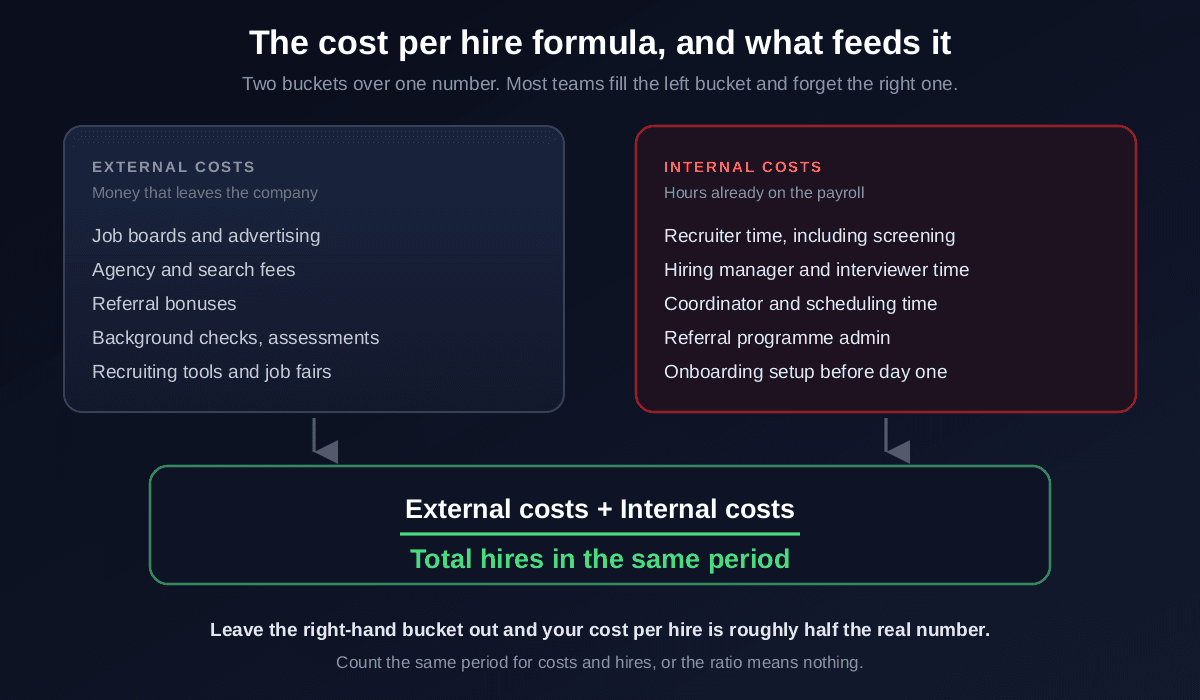
External costs are the ones everybody already tracks, because somebody had to approve a payment: advertising and job boards, agency or search fees, referral bonuses, assessments and background checks, recruiting software subscriptions, careers events.
Internal costsare salaried hours spent on hiring. Recruiter time across sourcing, screening, coordinating and closing. Hiring manager and interviewer time in interviews and debriefs. Coordinator time. The administrative work done before a new hire's first day. Nobody invoices for any of it, which is exactly why it goes missing, and it is routinely the larger half.
The two rules that keep the number honest
A worked example: what one hire actually cost
One data analyst requisition, filled. Every figure below is illustrative, but the shape is the point.
External costs. Job board and advertising 600. Referral bonus 1,000. Background check and assessment 150. Share of applicant tracking and careers-site subscription attributed to this req 250. Total external: 2,000.
Internal costs. Recruiter time: 22 hours at a loaded cost of about 55 an hour, which is 1,210, and of that 10.3 hours went on reading resumes. Hiring manager and interviewers: 14 hours at about 85 an hour, which is 1,190. Coordination: 4 hours at about 40 an hour, which is 160. Total internal: 2,560.
Cost per hire: 4,560 for this one hire. Note what happens if you only count the invoices: you report 2,000 and lose more than half the cost, most of it recruiter and interviewer hours. Note also which single activity is the largest identifiable block inside recruiter time.
The line item nobody counts
Screening is the biggest slice of recruiter time on any high-volume role, and it is the only slice that is pure overhead. Here is the arithmetic, done explicitly, because it is rarely written down anywhere a finance team can see it.
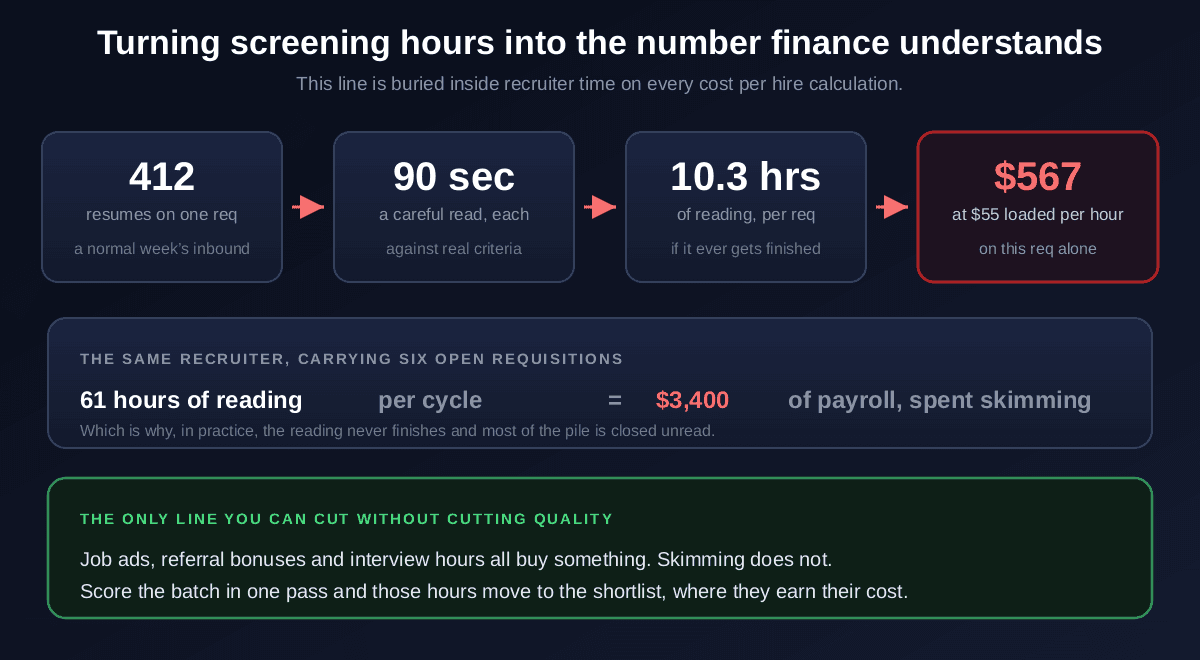
The reason this matters more than its dollar value is what happens next. That 10.3 hours per requisition, multiplied across a normal req load, does not fit into anyone's week. So it is not actually spent. The reading is abandoned partway through, a shortlist is assembled from whoever was read early, and the rest of the pile is closed unread when the role is filled. The cost does not disappear, it changes form: instead of paying it in hours you pay it in candidates you never saw and in the silence those applicants experienced.
This is also the distinguishing feature of the screening line. Job advertising buys reach. Referral bonuses buy warm candidates. Interview hours buy assessment. Hours spent skimming a pile to work out which resumes deserve a proper read buy nothing at all, which makes them the one cost you can remove without removing anything of value.
Take the biggest internal line item out of your cost per hire
Paste the job description, upload the whole batch, and every candidate comes back scored 0 to 100 with the skills they match and miss. Recruiter hours move from sorting the pile to talking to the people at the top of it. First 5 resumes free, no signup.
Screen a batch freeTime to hire vs time to fill
Cost and time are the same story told in different units, because most internal cost is time. The two standard time metrics get used interchangeably and they measure genuinely different windows.
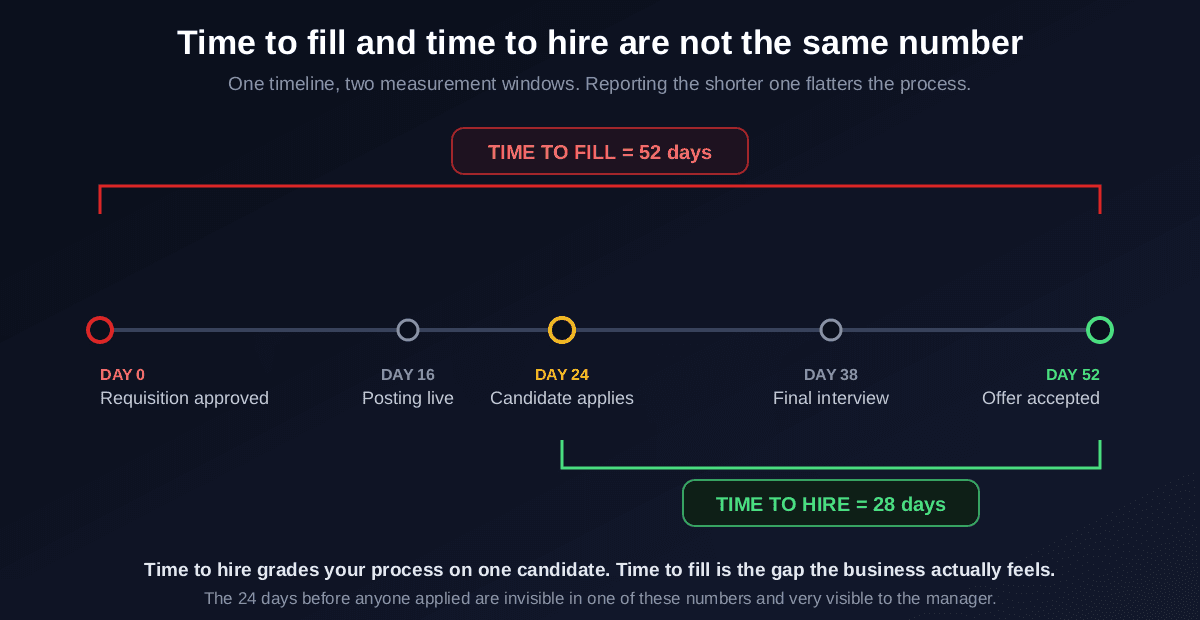
- Time to fill runs from requisition approved to offer accepted. It includes approval delays, posting time and the wait for applicants. It is the number the hiring manager experiences, because it is the length of the gap on their team.
- Time to hireruns from a candidate entering your process to that candidate accepting. It measures how efficiently you moved one person through, and it is the fairer measure of the recruiting team's own execution.
Both are legitimate. The problem is reporting only the second one, which in the example above turns a 52-day vacancy into a 28-day success story by excluding the 24 days before anyone applied. Those days are real, and a large share of them typically sit in requisition approval before the posting even went live. Track both, and if you can only show one to the business, show time to fill.
Where does screening sit in this? Squarely inside time to hire, and it is usually the longest single stage, because a resume submitted on day 24 is not read on day 24. It waits its turn in a queue behind five other requisitions. Cutting that queue shortens time to hire directly, which is the same mechanism at work in high-volume recruiting.
What is a good cost per hire?
The honest answer is that external benchmarks are close to useless for this metric, and it is worth understanding why rather than hunting for a better number. Published averages mix seniorities and role types with wildly different economics, they are dominated by whichever industries responded to the survey, they are usually several years old by the time they circulate, and many exclude internal time entirely, so they are not measuring the same thing you are.
What is worth doing instead is straightforward. Segment by role family, because a warehouse hire and a staff engineer are not comparable. Track your own trend over four or more quarters, since the direction is far more informative than the level. Split the number into external and internal so you can see which half is moving. And read it beside quality of hire and retention, so a fall in cost per hire that comes from lowering the bar shows up rather than being celebrated.
How to reduce cost per hire without lowering quality
Count internal time first
You cannot manage the larger half while it is invisible. A rough estimate of recruiter, manager and interviewer hours per hire is enough to start with, and it will immediately reframe which interventions are worth pursuing.
Cut the screening hours, not the screening
Score the whole applicant pool against defined criteria in one pass instead of reading until time runs out. This is the rare change that reduces cost and increases coverage at the same time, because the alternative was never a complete careful review, it was a partial one. The criteria to score against belong in your screening criteria.
Fix the posting so the pool is better, not just bigger
A vague posting with twenty requirements attracts volume that costs money to process. A specific one with six real must-haves and a salary range attracts fewer, better-matched applicants. See how to write a job description.
Shorten the interview loop by removing rounds, not rigour
Interviewer hours are the second-largest internal cost. Two well-structured rounds with prepared interviewers beat four unstructured ones on both cost and signal. Consolidating a fifth round that exists because nobody was willing to decide is almost always the cheapest hour you will ever save.
Use your own applicant database before paying for reach
Re-scoring people who already applied costs nothing per candidate and removes advertising and agency spend from the equation entirely for some roles. The mechanics are in candidate sourcing.
Reserve agencies for what your channels genuinely cannot fill
An agency fee is normally the single largest line on any hire that uses one. That is sometimes the right call. It should be a decision made after your own channels have demonstrably failed, not the default response to a role that feels difficult.
The metrics that belong next to it
- Quality of hire. Performance and retention of the people you hired. Without it, cost per hire rewards hiring cheaply and badly.
- Time to fill and time to hire. Both, for the reasons above. Most cost is time.
- Source of hire and cost by source. Which channels produced hires and what each one cost per hire produced. This is what turns cost per hire from a number into a decision.
- Offer acceptance rate. Declined offers are the most expensive event in recruiting, because you paid the entire cost and got nothing.
- Screening coverage. What share of applicants were actually evaluated. A low cost per hire achieved by never reading most of the pool is a cost deferred, not a cost saved.
Cost per hire mistakes to avoid
- Counting only external spend. The most common error, and it typically halves the reported figure while hiding the part you could act on.
- Mismatched periods. A year of costs over a quarter of hires, or costs booked in one quarter for hires that landed in the next.
- Blending all roles into one average. A single company-wide number moves whenever your role mix changes and tells you nothing about either segment.
- Chasing the benchmark instead of the trend. Your own direction of travel is the only comparison that controls for your roles, market and process.
- Optimising cost per hire alone. Every recruiting cost can be cut to zero by not hiring carefully. Pair it with quality of hire or it will quietly reward the wrong behaviour.
- Treating unread applications as free. They are the cost you did not pay in hours, and it reappears as missed candidates, longer time to fill and applicants who never got an answer.
Key takeaways
- Cost per hire is external costs plus internal costs, divided by hires made in the same period.
- Internal salaried time is usually the larger half and the half most often left out.
- In a worked example, one hire costs 4,560 in total but only 2,000 in invoices.
- Screening 412 resumes carefully is about 10.3 hours per requisition, or roughly 567 in recruiter payroll.
- Skimming is the only recruiting cost that buys nothing, which makes it the right one to remove.
- Time to fill runs from requisition approved; time to hire runs from a candidate applying. Report both.
- External benchmarks are near useless here. Segment by role family and track your own trend.
- Rankid scores up to 200 resumes per batch against your job description, first 5 free with no signup.
Bottom line: cost per hire is not really a procurement metric, it is a time metric wearing a dollar sign. Once internal hours are counted, the biggest controllable line is not the job board or even the agency, it is the hours a recruiter spends deciding which resumes deserve attention, and those hours are being partly paid already in the form of piles nobody finishes. Work out your own number with internal time included, then take the reading out of it. Put your next batch through Rankid's bulk resume screening tool and spend the hours you get back on the candidates who were worth them.
Frequently asked questions
What is cost per hire?
Cost per hire is the average total amount your organisation spends to fill a role, covering both money paid out and the value of internal time spent. It is the standard way to express recruiting spend in a form finance recognises, and it is used to set budgets, justify tooling and compare hiring channels. The important nuance is that it is an average across a period rather than a per-candidate figure, so it is calculated by totalling all recruiting costs for a period and dividing by the number of hires made in that same period.
What is the cost per hire formula?
Cost per hire equals total external costs plus total internal costs, divided by the total number of hires in the same period. External costs are money leaving the company, such as job board spend, agency fees, referral bonuses, background checks and recruiting tools. Internal costs are hours already on the payroll, including recruiter time, hiring manager and interviewer time, coordination and pre-start onboarding admin. The two rules that matter are to include the internal side, which most teams omit, and to use the same period for both the costs and the hire count.
What counts as an internal versus an external recruiting cost?
External costs are invoiced: job advertising, agency and search fees, referral bonuses, assessments and background checks, careers-site and applicant tracking subscriptions, and events. Internal costs are salaried time spent on hiring: the recruiter's hours on sourcing, screening, scheduling and closing; the hiring manager and interviewers' hours in interviews and debriefs; coordinator time; and the administrative work done before a new hire's first day. Internal costs are usually the larger of the two and are the ones most often left out, which is why many reported cost per hire figures are roughly half the real number.
What is a good average cost per hire?
There is no benchmark that survives contact with your own situation. Widely circulated industry averages tend to land in the low thousands of dollars per hire, but those figures are dated, are heavily skewed by which roles and seniorities are in the sample, and often exclude internal time entirely. A senior engineering hire filled through an agency and a warehouse hire filled through inbound applications can differ by an order of magnitude, and both can be well run. The useful benchmark is your own number, segmented by role family and tracked over time.
What is the difference between time to hire and time to fill?
Time to fill measures from the moment a requisition is approved to the moment an offer is accepted, so it includes the days spent writing the posting, waiting for approvals and waiting for applicants to arrive. Time to hire measures from the moment a specific candidate enters your process, usually when they apply or first respond, to the moment they accept, so it grades how efficiently you moved one person through. Time to hire is almost always the shorter number. Reporting it alone makes a hiring process look faster than the vacancy actually felt to the team waiting for the hire.
How do you reduce time to hire without lowering quality?
Attack the waiting, not the assessing. The longest delays in most processes are not interviews, they are the gaps between stages: resumes waiting to be read, candidates waiting for scheduling, and debriefs waiting for a meeting. Screen the entire applicant pool in one pass rather than reading until time runs out, agree the interview slots before the posting goes live, and set a debrief deadline of 48 hours after the final interview. None of those reduce how carefully anyone is evaluated, and together they usually remove more days than any change to the interview loop itself.
How much does resume screening actually cost?
Work it out directly. A careful screen against real criteria takes 60 to 120 seconds per resume, so 412 applications is about 10.3 hours of reading. At a loaded recruiter cost of roughly 55 dollars an hour, that is about 567 dollars of payroll for one requisition, and a recruiter carrying six open roles is looking at around 61 hours and 3,400 dollars per cycle. That cost is real whether or not anyone tracks it, and in practice it is rarely paid in full because the reading is abandoned partway, which converts the cost into unread applications instead.
How can bulk resume screening reduce cost per hire?
It targets the largest internal line item without touching the parts of hiring that add value. Interview hours, referral bonuses and job advertising all buy something specific, but hours spent skimming resumes to work out who is worth reading properly buy nothing on their own. Rankid scores the whole batch against your job description in one pass, so every applicant comes back rated 0 to 100 with the skills they match and miss, and recruiter hours shift from sorting the pile to talking to the people at the top of it. Your first 5 resumes are free with no signup, and you can score up to 200 per batch after that.