Workslop: What It Is, How to Spot AI Slop at Work, and How to Never Send It
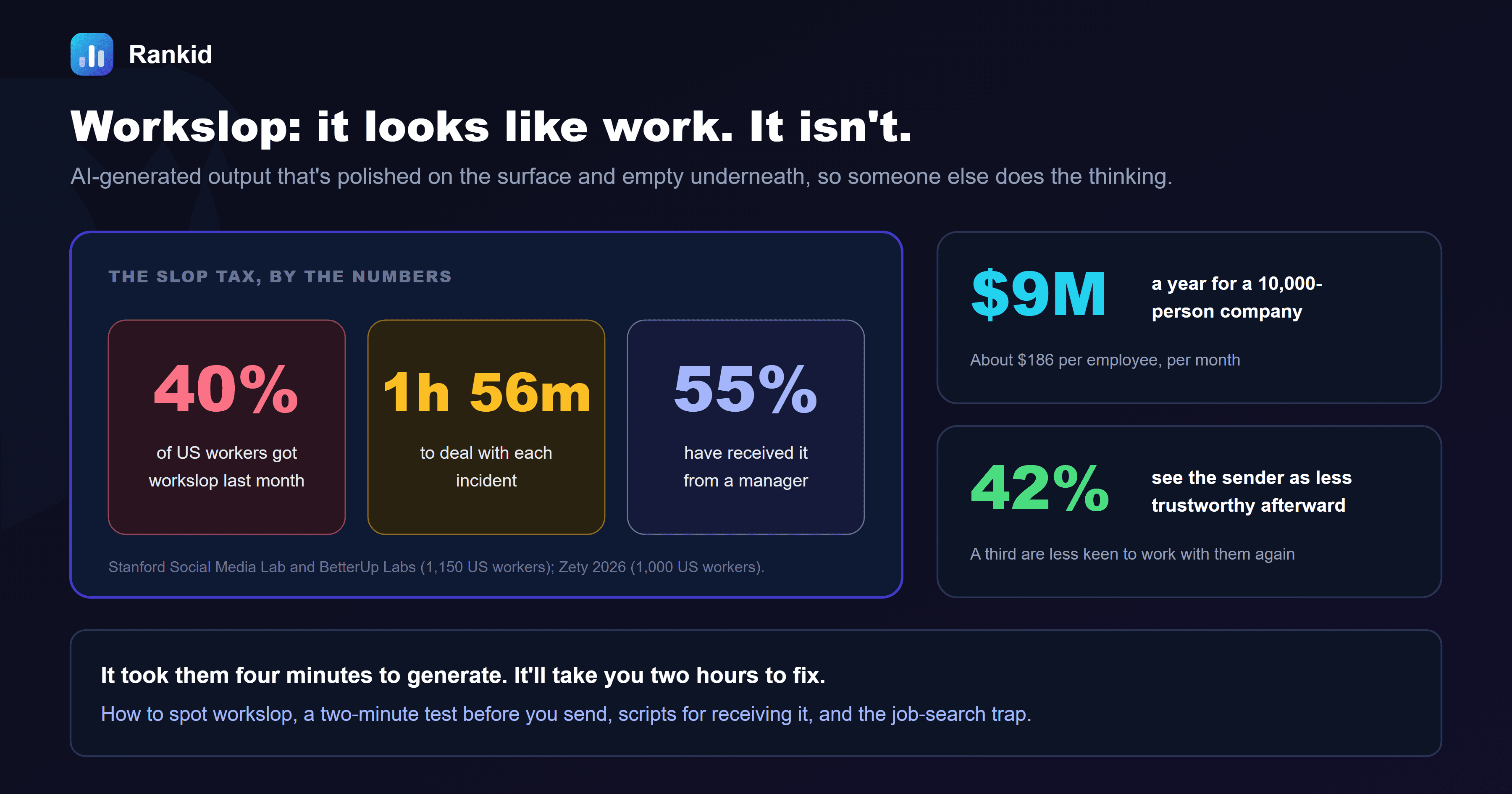
A colleague sends you a document. Six pages, crisp headers, bold bullet points, a section called "Key Strategic Considerations." You read it twice and still can't tell what they're recommending. It took them four minutes to generate. It will take you two hours to turn into something useful. Researchers have a name for this: workslop. And it may be the most expensive thing nobody's tracking.
Quick answer
Quick answer: workslop is AI-generated work that looks finished but isn't, leaving the receiver to do the real thinking. Stanford and BetterUp found 40% of US workers received it in the past month, each case took nearly two hours to fix, and it costs a 10,000-person company about $9 million a year. It also costs reputations: 42%see the sender as less trustworthy. Spot it by asking "do I know what to do next?" Avoid sending it with a two-minute test: cut it, verify it, add what only you know, and lead with your recommendation.
What is workslop?
The term was coined in September 2025 by researchers at Stanford's Social Media Lab and BetterUp Labs, writing in the Harvard Business Review. They defined workslop as AI-generated work content that masquerades as good work but lacks the substance to meaningfully advance a given task. The crucial part is where the effort goes: workslop doesn't remove work, it moves it downstream, to whoever has to read, decode, fact-check or redo it.
That's what makes it different from ordinary bad work. A sloppy human draft usually looks sloppy. Workslop looks excellent. It has structure, confident language and perfect grammar, so it passes a glance and fails on contact.
Workslop vs AI slop
How common is it, and what does it cost?
In the original survey of 1,150 US full-time employees, the researchers found:
- About 40% had received workslop in the last month, and they estimated about 15% of the content they receive at work qualifies.
- Each incident took an average of 1 hour and 56 minutes to deal with.
- It flows in every direction: about 40% between peers, 18% up to managers and 16% down from managers and executives.
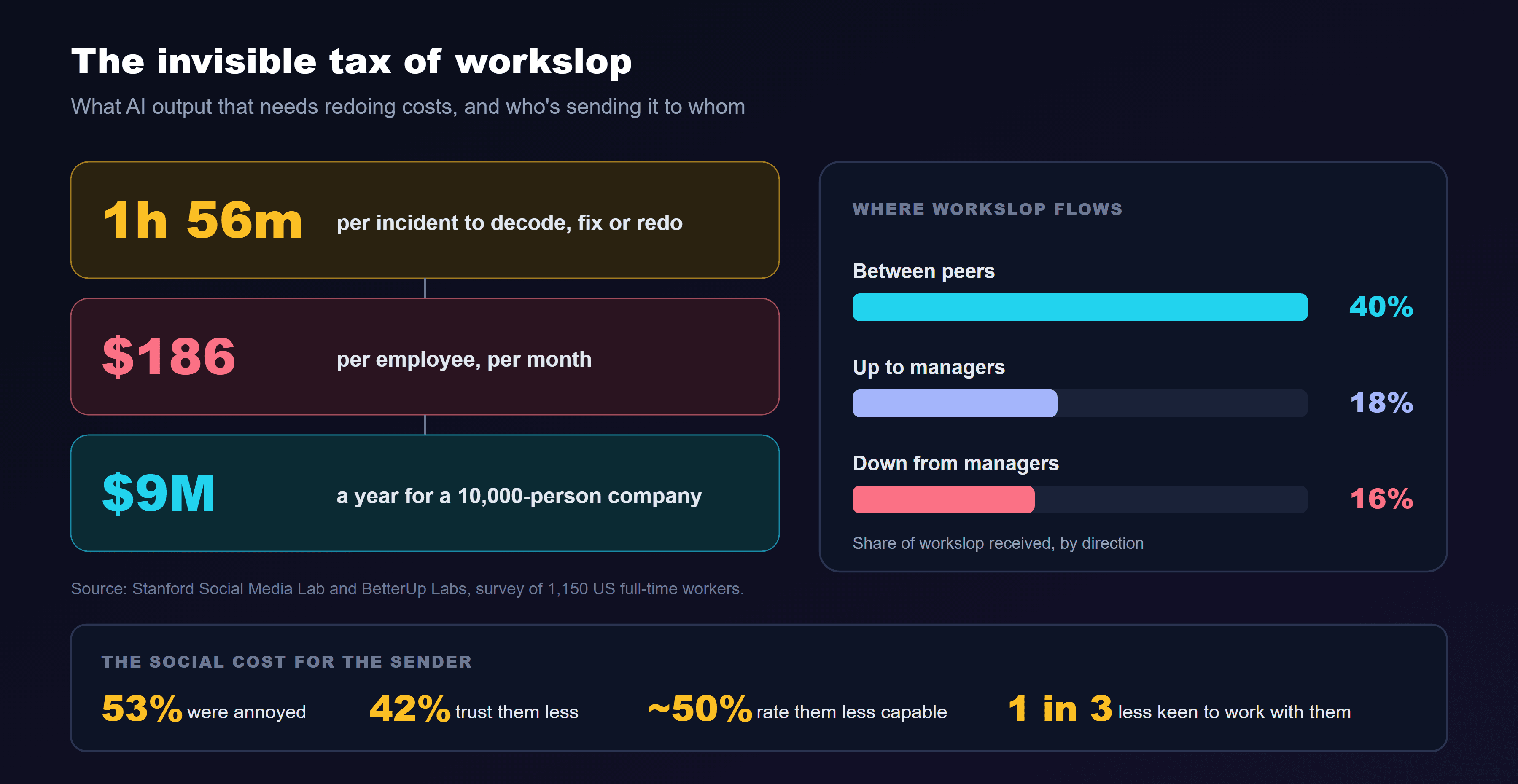
Put a price on that time and the researchers estimate an invisible tax of about $186 per employee per month, or roughly $9 million a year for a 10,000-person company. And the problem has grown with AI mandates. A 2026 Zety survey of 1,000 US workers found 55% had received workslop from a supervisor, while 24% had received no AI training at all. In September 2026, a Korn Ferry survey of more than 16,000 professionals found 52% said AI tools had increased the number of tasks expected of them, and only just over half felt adequately trained to use them.
That's the AI productivity paradox in miniature. Everyone is producing more, faster, and a growing share of it has to be cleaned up by someone else.
Why smart people send workslop
- "Use AI for everything" mandates. The researchers point to indiscriminate AI mandates, where leaders push AI everywhere without guidance on when and how, as a major driver. In the Zety survey, 41% said leadership encouraged AI use without detailed instructions.
- Volume looks like value. When people are judged on visible output, a ten-page AI document looks more impressive than a three-line recommendation, even though the three lines did more work.
- Overload.When you're doing more than one job, which 61% of Korn Ferry's respondents said they were, generating something and moving on feels like survival.
- Pilots vs passengers. BetterUp's research describes two mindsets. Pilots use AI purposefully, to enhance their own thinking. Passengersuse it to avoid work. The same tool produces great work or workslop depending on who's steering.
How to spot workslop: eight tells
No detector is reliable, and you don't need one. Workslop gives itself away through what's missing, not through any single phrase.
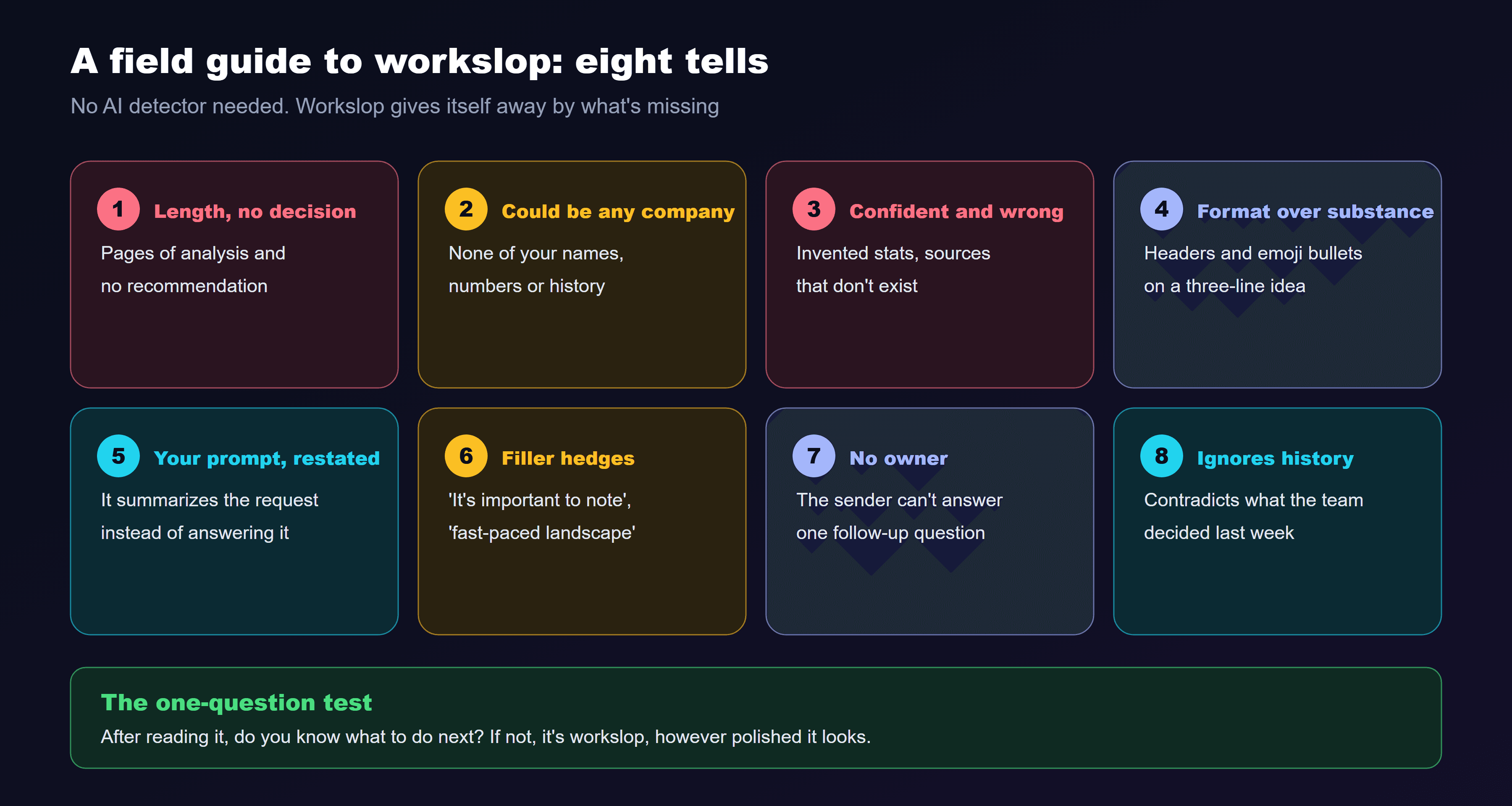
- Length without a decision. Lots of analysis, no recommendation.
- It could be about any company. No names, numbers, customers or history from your actual situation.
- Confident and wrong.A statistic you can't find, a source that doesn't exist, a number that doesn't match the spreadsheet.
- Formatting over substance. Headers, bold and emoji bullets wrapped around a three-sentence idea.
- Your prompt, restated. It summarizes what you asked for instead of answering it.
- Filler hedges."It's important to note," "in today's fast-paced landscape," "a multifaceted approach."
- No owner.Ask one follow-up question and the sender can't answer it without going back to the tool.
- It ignores history.It contradicts decisions the team made last week, because the AI wasn't in the room.
The hidden cost: what workslop does to your reputation
Here's the angle most people miss. Sending workslop doesn't just waste a colleague's afternoon. It changes how they see you. In the Stanford and BetterUp research, 53% of recipients were annoyed, 42% saw the sender as less trustworthy, about half saw them as less creative, capable and reliable, and roughly a third were less likely to want to work with them again.
For managers, the damage is bigger. In the Zety survey, 85%said unreviewed AI output from a boss hurt their trust, and 74% said it lowered their confidence in the manager's overall work. Reputations are built in small moments, and every forwarded wall of AI text is one of them. If you're early in your career, where AI is already squeezing the entry-level job market, being the person whose work is obviously your own is a real advantage.
The two-minute test before you hit send
Using AI isn't the problem. Shipping it raw is. Before anything AI-assisted leaves your hands, run these checks. It takes about two minutes, and it's the difference between a pilot and a passenger.
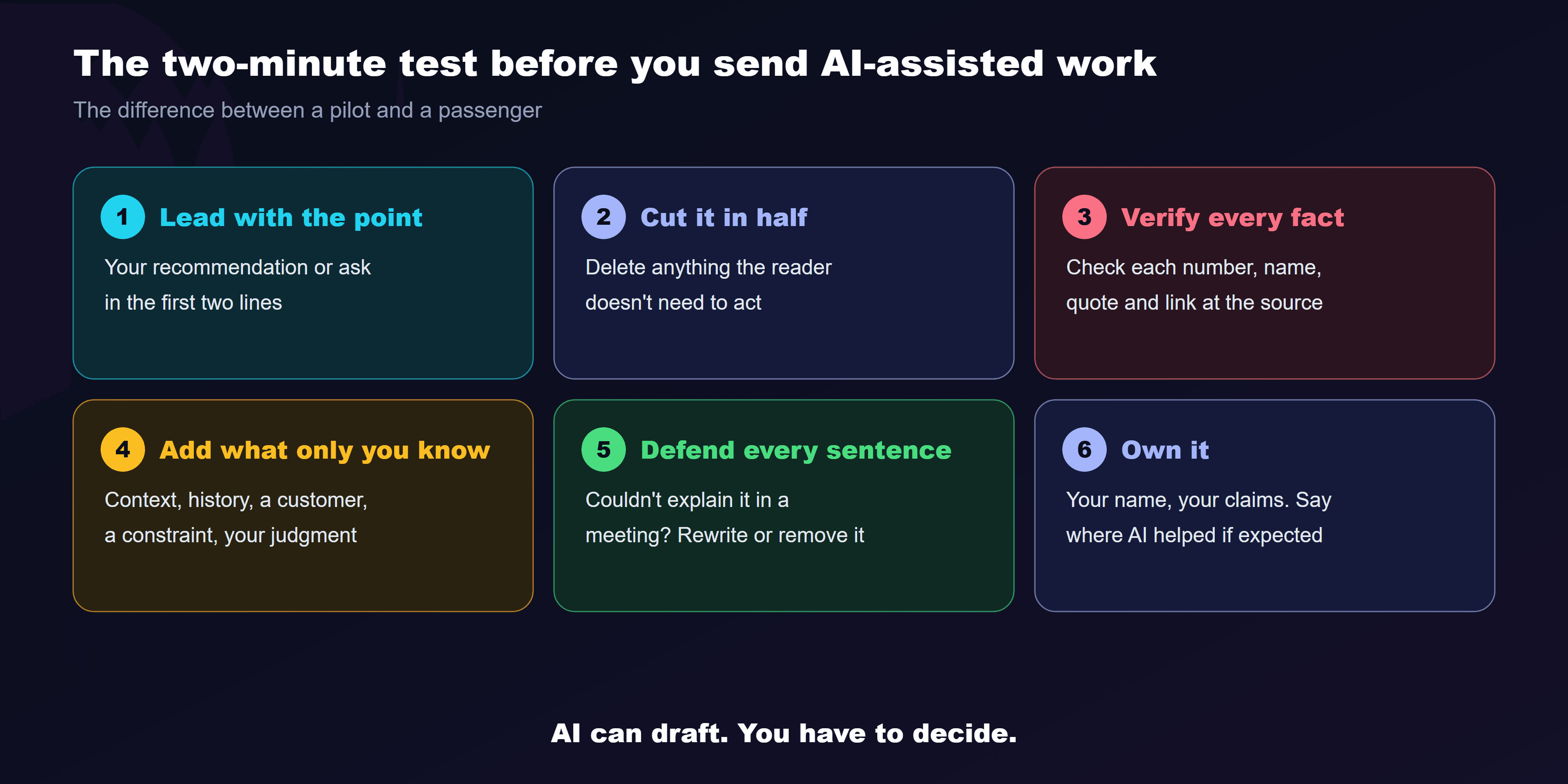
Lead with the point
Cut it in half
Verify every fact
Add what only you know
Defend every sentence
Own it
What to do when you receive workslop
The goal is to hand the thinking back without an accusation. You rarely know for sure that AI wrote something, and it doesn't matter. What matters is whether it's usable.
- From a peer:"Thanks for pulling this together. Before I dig in, could you give me your three-line take: what you recommend, why, and what you need from me?"
- From your manager:"I want to make sure I act on the right thing. Of these points, which two matter most to you, and what does a good outcome look like by Friday?"
- From a direct report:"There's good material here. I need your judgment on top of it, though. What would you do, and what's the riskiest assumption?" Then talk about norms, not blame.
- For the whole team:propose simple AI norms: lead with the point, the sender owns every claim, label AI drafts that haven't been checked, and judge work on outcomes, not volume.
Workslop in your job search: the resume and cover letter trap
Job applications are workslop's favorite habitat. Recruiters now read hundreds of AI-polished resumes and cover letters that say the same things: "spearheaded cross-functional initiatives," "results-driven professional," "I am thrilled to apply." Nobody needs a detector to spot them. They're generic, and generic loses.
- Use AI to tailor, not to invent. Our guide to using ChatGPT to tailor your resume shows prompts that keep your real experience at the center.
- Add numbers only you could know. Specific results are the opposite of slop. See how to quantify achievements.
- Don't mass-apply with AI. Auto-apply bots produce workslop at scale, and our guide to AI auto-apply tools explains why they often backfire.
Is your resume substance or slop?
Paste your resume and a job description into Rankid for a free 0-100 match score and the exact requirements you meet and miss. It checks evidence against the job, not polish, so you can see what's actually there. No signup required.
Check your match score freeFor employers and hiring teams: stop paying the slop tax
- Replace mandates with use cases."Use AI everywhere" produces workslop. "Use AI to draft first-pass customer replies, and a human checks every one" produces value.
- Train people. Nearly a quarter of workers in the Zety survey had no AI training. Teach verification and editing, not just prompting.
- Model it from the top. If managers forward unreviewed AI output, everyone will.
- Reward outcomes, not volume. A short, decisive memo should beat a long generated one in every review.
- Screen applications on evidence.When every cover letter sounds the same, polish is no signal. Score candidates against the job's actual requirements, as covered in our guide to resume screening criteria.
Cut through AI-polished applications
Rankid scores every resume against your job description on a consistent 0-100 scale and shows the exact requirements each candidate matched and missed, so you see real evidence instead of generic AI phrasing. First 5 resumes free, no signup.
Try bulk screening freeFrequently asked questions
What is workslop?
Workslop is AI-generated work content that looks polished but lacks the substance to meaningfully advance a task. The term was coined in 2025 by researchers at Stanford's Social Media Lab and BetterUp Labs in the Harvard Business Review. The key feature is that it shifts the real work onto the recipient, who has to decode, correct, research or redo it.
How common is workslop?
Very. In the Stanford and BetterUp survey of 1,150 US full-time employees, about 40% said they'd received workslop in the past month, and they estimated about 15% of the content they receive at work qualifies. Most of it moves between peers (about 40%), but 18% is sent up to managers and 16% flows down from managers. A 2026 Zety survey of 1,000 US workers found 55% had received workslop from a supervisor.
How much does workslop cost?
Recipients said each incident took an average of 1 hour and 56 minutes to deal with. Based on time lost and salaries, the researchers estimated an invisible tax of about $186 per employee per month, or roughly $9 million a year for a 10,000-person organization. That doesn't count the cost of damaged trust and collaboration.
How can you tell if work is AI-generated workslop?
Common tells include length without a decision or recommendation, generic phrases that could apply to any company, a lack of specific names, numbers and context, confident claims or sources that turn out to be wrong, heavy formatting on thin content, restating the request back to you, filler hedges like 'it's important to note,' and ignoring decisions you've already made. The real test is simple: after reading it, do you know what to do next?
Is it bad to use AI at work?
No. Using AI well can save real time. The problem is sending raw output without adding your own judgment, facts and decisions. The Stanford and BetterUp researchers describe 'pilots,' who use AI purposefully to enhance their work, and 'passengers,' who use it to avoid work. Be a pilot: use AI to draft, research or check, then edit, verify and own the result.
How do I tell a coworker their work is AI slop?
Focus on what you need, not on the tool. For example: 'Thanks for pulling this together. Before I dig in, could you give me your three-line take: what you recommend, why, and what you need from me?' This hands the thinking back without an accusation. If it keeps happening, suggest a team norm that AI drafts are labeled and that the sender owns every claim.
Does sending AI-generated work hurt your reputation?
It can. In the Stanford and BetterUp research, 42% of people who received workslop saw the sender as less trustworthy, about half saw them as less creative, capable and reliable, and roughly a third were less likely to want to work with them again. In the 2026 Zety survey, 85% said receiving unreviewed AI output from a manager damaged their trust.
Can recruiters tell if a resume or cover letter was written by AI?
Often, yes, not because of a detector but because the content is generic. Recruiters see the same phrases, such as 'spearheaded cross-functional initiatives' or 'I am thrilled to apply,' across hundreds of applications, with no specific numbers, tools or results. Using AI to tailor your resume is fine; sending an application with no concrete evidence of your work is the job-search version of workslop.
Key takeaways
- Workslop is AI-generated work that looks polished but lacks the substance to move a task forward, shifting the real work to the receiver.
- Stanford and BetterUp found about 40% of US workers received it in a month, and about 15% of the content people receive qualifies.
- Each incident takes 1 hour 56 minutes to handle, costing about $186 per employee per month, or $9 million a year for a 10,000-person company.
- It flows every direction, and 55% of workers have received it from a manager (Zety, 2026).
- Spot it with one question: after reading it, do you know what to do next? Watch for generic phrasing, no decision, and confident errors.
- Sending it costs reputation: 42% see the sender as less trustworthy and a third are less keen to work with them again.
- Run the two-minute test: lead with the point, cut it in half, verify facts, add what only you know, defend every sentence, own it.
- In job searches, generic AI resumes and cover letters are workslop. Specific evidence and numbers beat polish every time.
Frequently asked questions
What is workslop?
Workslop is AI-generated work content that looks polished but lacks the substance to meaningfully advance a task. The term was coined in 2025 by researchers at Stanford's Social Media Lab and BetterUp Labs in the Harvard Business Review. The key feature is that it shifts the real work onto the recipient, who has to decode, correct, research or redo it.
How common is workslop?
Very. In the Stanford and BetterUp survey of 1,150 US full-time employees, about 40% said they'd received workslop in the past month, and they estimated about 15% of the content they receive at work qualifies. Most of it moves between peers (about 40%), but 18% is sent up to managers and 16% flows down from managers. A 2026 Zety survey of 1,000 US workers found 55% had received workslop from a supervisor.
How much does workslop cost?
Recipients said each incident took an average of 1 hour and 56 minutes to deal with. Based on time lost and salaries, the researchers estimated an invisible tax of about $186 per employee per month, or roughly $9 million a year for a 10,000-person organization. That doesn't count the cost of damaged trust and collaboration.
How can you tell if work is AI-generated workslop?
Common tells include length without a decision or recommendation, generic phrases that could apply to any company, a lack of specific names, numbers and context, confident claims or sources that turn out to be wrong, heavy formatting on thin content, restating the request back to you, filler hedges like 'it's important to note,' and ignoring decisions you've already made. The real test is simple: after reading it, do you know what to do next?
Is it bad to use AI at work?
No. Using AI well can save real time. The problem is sending raw output without adding your own judgment, facts and decisions. The Stanford and BetterUp researchers describe 'pilots,' who use AI purposefully to enhance their work, and 'passengers,' who use it to avoid work. Be a pilot: use AI to draft, research or check, then edit, verify and own the result.
How do I tell a coworker their work is AI slop?
Focus on what you need, not on the tool. For example: 'Thanks for pulling this together. Before I dig in, could you give me your three-line take: what you recommend, why, and what you need from me?' This hands the thinking back without an accusation. If it keeps happening, suggest a team norm that AI drafts are labeled and that the sender owns every claim.
Does sending AI-generated work hurt your reputation?
It can. In the Stanford and BetterUp research, 42% of people who received workslop saw the sender as less trustworthy, about half saw them as less creative, capable and reliable, and roughly a third were less likely to want to work with them again. In the 2026 Zety survey, 85% said receiving unreviewed AI output from a manager damaged their trust.
Can recruiters tell if a resume or cover letter was written by AI?
Often, yes, not because of a detector but because the content is generic. Recruiters see the same phrases, such as 'spearheaded cross-functional initiatives' or 'I am thrilled to apply,' across hundreds of applications, with no specific numbers, tools or results. Using AI to tailor your resume is fine; sending an application with no concrete evidence of your work is the job-search version of workslop.