Is AI Killing Entry-Level Jobs? What the 2026 Data Really Shows, and How New Grads Still Get Hired
For decades the deal was simple: get the degree, take the junior job, learn on the work nobody senior wanted to do, and climb. In 2026 that first rung looks shaky. Graduate unemployment is higher than the overall rate, Big Tech barely hires new grads, and every week brings another headline that AI is coming for junior work. But the data tells a more interesting story than "robots took the jobs." There are three culprits, not one, and once you know which is which, you know exactly where the remaining doors are.
Quick answer
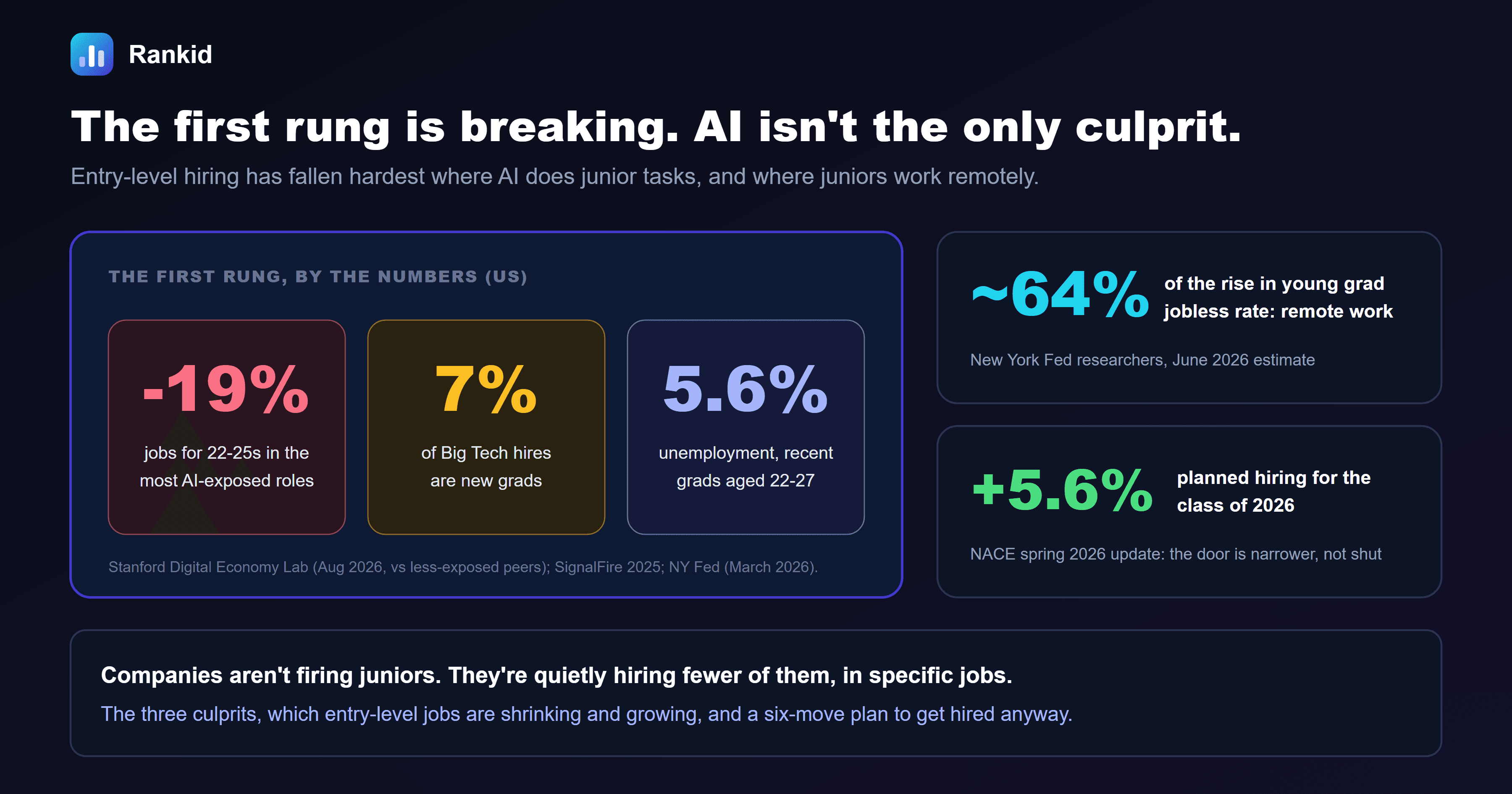
Quick answer: partly, yes. A Stanford study of ADP payroll data found employment for 22 to 25 year olds in the most AI-exposed jobs is 19% below less-exposed peers, up from 13% a year earlier, mainly through fewer hires, not layoffs. But New York Fed researchers estimate remote work explains about 64% of the rise in young-graduate unemployment, and employers still plan to hire 5.6% more of the class of 2026. The door is narrower, not shut. Get through it by choosing roles where juniors get trained, proving judgment rather than output, and targeting jobs where AI helps people instead of replacing them.
What the data actually says
Four sources do most of the work in this debate, and they don't all point the same way. That's the point.
- Stanford's "canaries" study. Erik Brynjolfsson, Bharat Chandar and Ruyu Chen at the Stanford Digital Economy Lab used payroll records from ADP, the largest US payroll provider. Their August 2026 update found that employment for 22 to 25 year olds in the most AI-exposed occupations is 19% below where it would be had it kept pace with less-exposed peers, up from 13% when they first reported it in 2025. Experienced workers in the same occupations show no comparable gap.
- The New York Fed. Unemployment for recent graduates aged 22 to 27 was 5.6% in March 2026, above the overall rate, a reversal of the usual pattern. And 41.5%of recent graduates were underemployed in jobs that don't need a degree.
- SignalFire.The venture firm's 2025 State of Talent report found new graduates made up just 7% of hires at the largest tech companies, with new-grad hiring down about half from 2019.
- NACE.And yet, in the National Association of Colleges and Employers' spring 2026 update, employers projected hiring 5.6% more graduates from the class of 2026 than the year before, up from a flat 1.6% forecast in the autumn.
Read the Stanford study carefully
Who broke the first rung? Three suspects
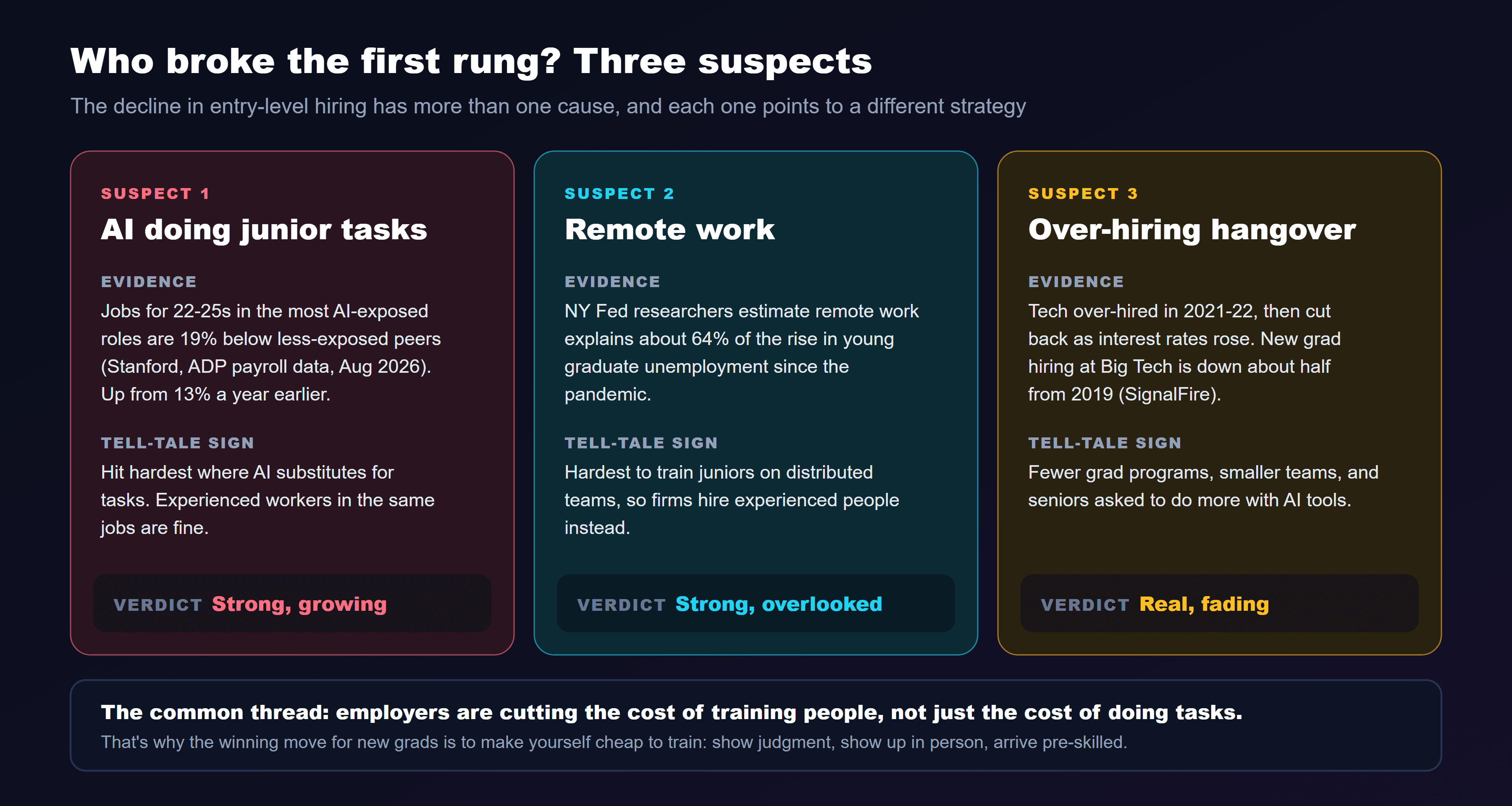
Blaming AI for everything is tempting, but it leads to bad strategy. There are at least three forces at work, and they overlap.
AI doing junior tasks
Remote work
The over-hiring hangover
The common thread
Which entry-level jobs are shrinking, and which are growing
The Stanford finding that matters most for your job search is the split between jobs where AI substitutes for people, where young-worker employment fell, and jobs where it complements them, where employment was flat or rising.
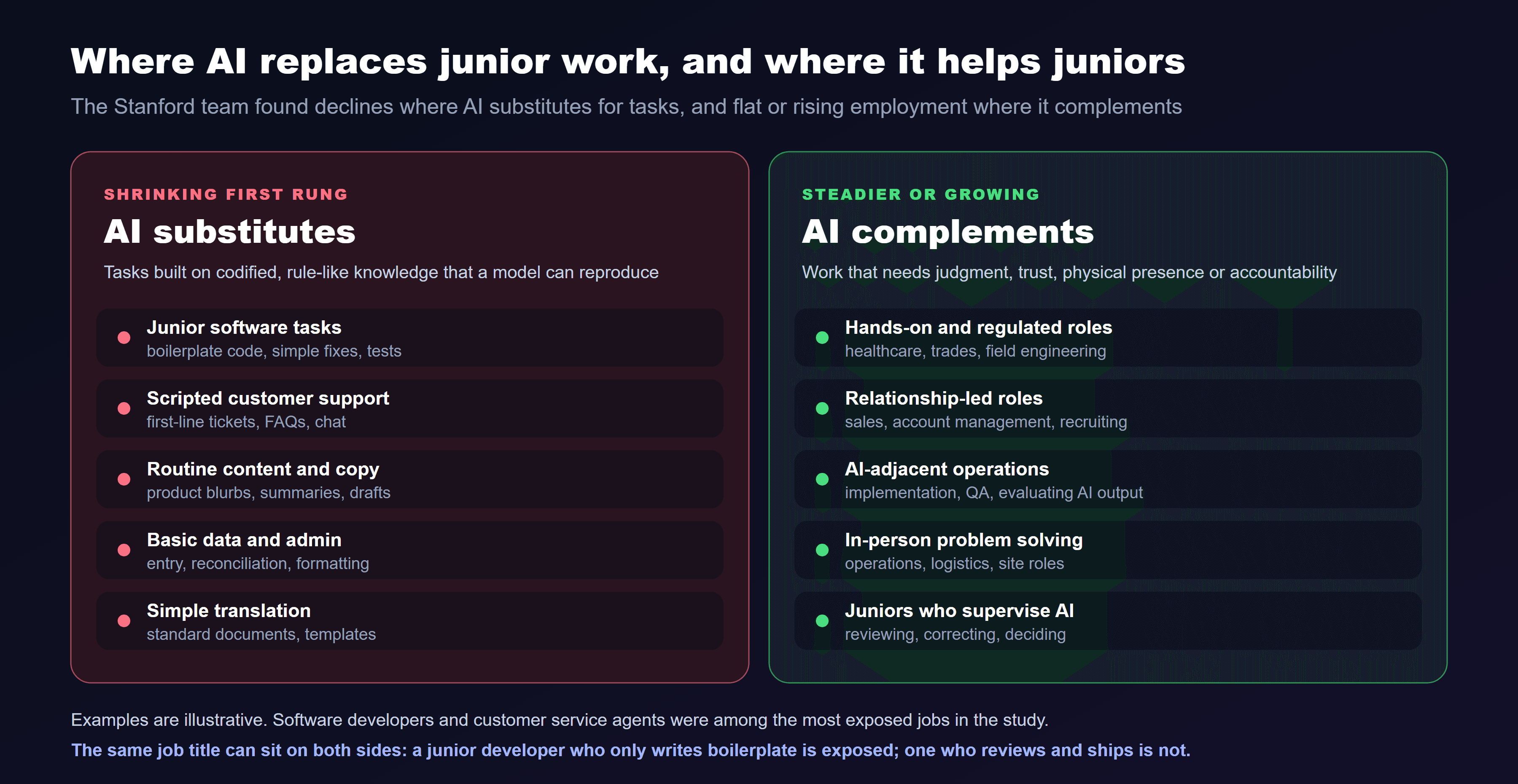
Notice the last line of that chart: the same job title can sit on both sides. A junior developer who only writes boilerplate is competing with a model. A junior developer who reviews AI-written code, catches the subtle bug, writes the tests that matter and ships is doing exactly the work that complements AI. Your job title matters less than which half of the work you can prove you do.
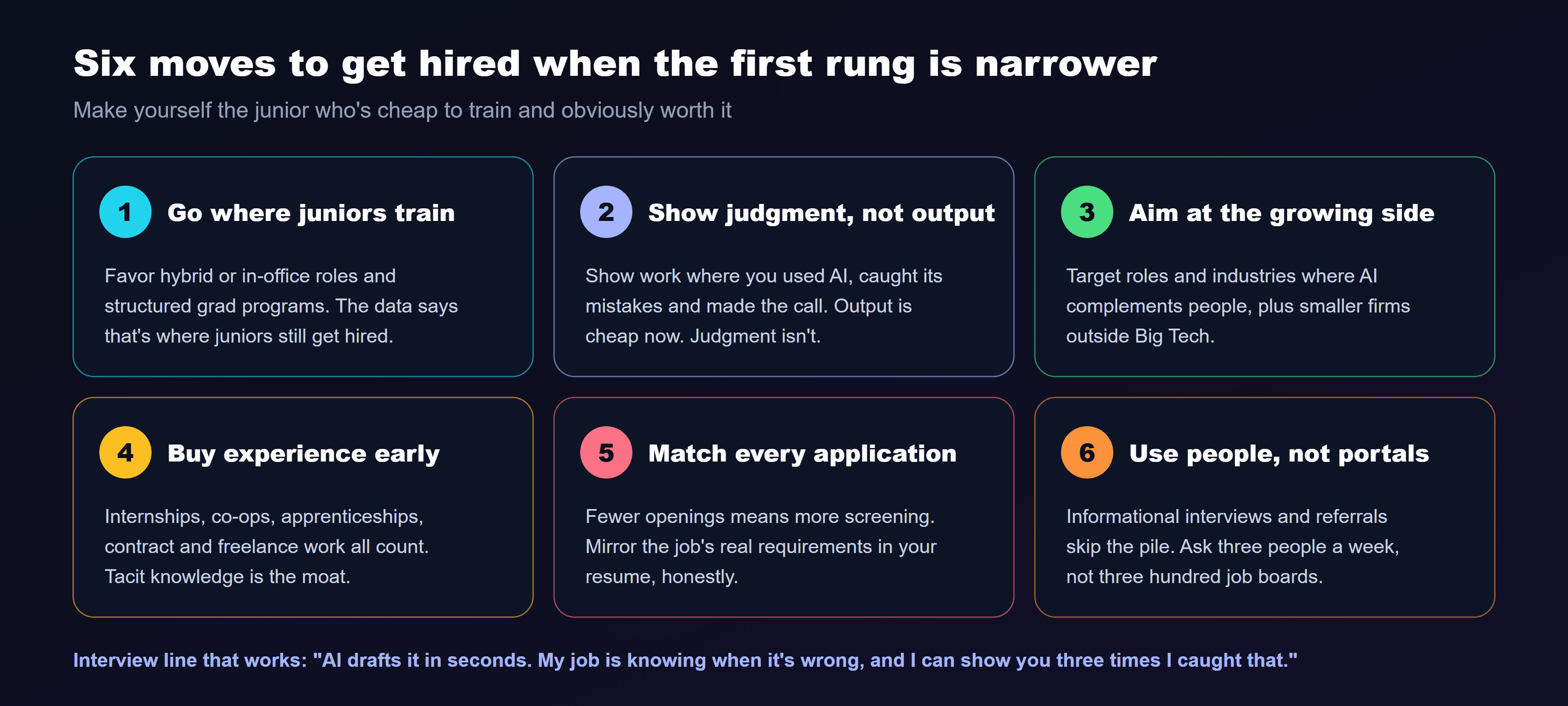
Six moves to get hired when the first rung is narrower
Go where juniors get trained
Show judgment, not output
Aim at the growing side
Buy experience early
Match every application
Use people, not portals
Fewer junior openings? Make each application land
Paste your resume and a job description into Rankid for a free 0-100 match score and the exact requirements you meet and miss, so every entry-level application shows the skills the employer is actually screening for. No signup required.
Check your match score freeHow to answer "why not just use AI for this?"
More interviewers now ask some version of this, directly or not. Don't compete with AI on speed or volume; you'll lose. Compete on the things it can't do: judging whether something is right, understanding context, taking responsibility and learning the business.
- Show you use it."I use AI every day for first drafts, research and code scaffolding. Pretending otherwise would be strange."
- Show where you add value."My job is knowing when its answer is wrong, and I can show you three times I caught that." Then tell one of those stories using the STAR method.
- Show you'll grow."The tools will keep changing. What I want is to learn how your business works, so in a year I'm the person who knows what good looks like here."
For employers: the 2030 talent gap you're building
Cutting junior hiring looks efficient on this year's budget. But every senior engineer, analyst and manager you'll need in five years is a junior somebody hires today. Stop hiring juniors and you don't eliminate that cost, you postpone it and pay more for it later when you compete for experienced people everyone else also failed to train.
- Redesign junior roles, don't delete them. Shift junior work from producing first drafts to reviewing, testing and improving AI output under supervision. That builds judgment faster.
- Make training deliberate.If your teams are remote, schedule in-person time for new hires, pair them with mentors, and make it someone's job to teach them.
- Plan the pipeline. Tie junior hiring to your succession planning and talent pipeline, not just this quarter's headcount.
- Hire for potential. When every graduate has a similar degree, look at evidence of judgment and learning speed. Our guide to skills-based hiring shows how.
Hundreds of grads for one junior role?
Rankid scores every resume against your job description on a consistent 0-100 scale and shows the exact requirements each candidate matched and missed, so you can find high-potential graduates in a huge applicant pile without skimming. First 5 resumes free, no signup.
Try bulk screening freeFrequently asked questions
Is AI taking entry-level jobs?
In some occupations, the evidence increasingly says yes. A Stanford Digital Economy Lab study using ADP payroll data found that, by its August 2026 update, employment for workers aged 22 to 25 in the most AI-exposed occupations was 19% below where it would have been had it kept pace with less-exposed peers, up from 13% a year earlier. The researchers stress that the evidence is descriptive rather than proof of cause, that there is no sign of economy-wide job loss, and that the effect works mainly through fewer hires rather than layoffs.
What did the Stanford 'Canaries in the Coal Mine' study find?
Economists Erik Brynjolfsson, Bharat Chandar and Ruyu Chen found that early-career workers aged 22 to 25 in AI-exposed occupations, such as software developers and customer service agents, saw relative employment declines while experienced workers in the same jobs did not. The declines were concentrated where AI substitutes for human tasks rather than complements them, came mainly through reduced hiring, and showed up in employment rather than pay. The August 2026 update put the gap at 19%, widening from 13% in 2025.
What is the unemployment rate for recent college graduates in 2026?
According to the New York Fed, unemployment for recent college graduates aged 22 to 27 was 5.6% in March 2026, above the overall unemployment rate, which historically has not been the norm. About 41.5% of recent graduates were underemployed, working in jobs that don't require a degree, in the first quarter of 2026.
Is remote work making it harder for new grads to get hired?
New York Fed researchers think so. In a June 2026 analysis they estimated that remote work explains about 64% of the increase in unemployment among young college graduates since the pandemic, because employers find it harder to train and mentor inexperienced workers on distributed teams and prefer to hire experienced people for remote roles. That suggests hybrid and in-office roles may be easier entry points for new graduates.
Are companies still hiring new graduates in 2026?
Yes, though selectively. In NACE's spring 2026 update, employers projected hiring 5.6% more graduates from the class of 2026 than from the class of 2025, with the strongest increases in information, engineering services, wholesale trade and construction. At the same time, new grads made up only about 7% of hires at the largest tech companies in SignalFire's 2025 report, so the opportunities have shifted rather than vanished.
Which entry-level jobs are most at risk from AI?
Jobs built mainly on codified, rule-like tasks that AI can reproduce are most exposed: junior coding tasks such as boilerplate and simple fixes, scripted customer support, routine content writing, basic data entry and simple translation. Roles that need judgment, trust, physical presence or accountability, such as healthcare, skilled trades, relationship-led sales and in-person operations, have been steadier. Within the same job title, people who review, correct and decide are less exposed than those who only produce first drafts.
How can new grads get hired when entry-level jobs are scarce?
Make yourself cheap to train and obviously valuable. Favor hybrid or in-office roles and structured graduate programs, show evidence of judgment such as times you caught and fixed AI mistakes, target roles where AI complements people, build real experience through internships, co-ops, apprenticeships or freelance work, tailor every application to the job's requirements, and use informational interviews and referrals rather than mass applying.
How should I answer 'why should we hire you instead of using AI?' in an interview?
Don't compete with AI on speed. Explain how you use it and where you add value it can't: judging whether output is right, understanding context, taking responsibility and learning the business. For example: 'AI drafts it in seconds. My job is knowing when it's wrong, and I can show you three times I caught that.' Then give a specific example.
Why should employers keep hiring entry-level workers if AI can do junior tasks?
Because today's juniors are tomorrow's seniors. Experienced workers rely on tacit knowledge that is built by doing junior work under supervision. Companies that stop hiring juniors save money now but face a shortage of mid-level and senior talent in a few years, and will pay more to hire it externally. The smarter move is to redesign junior roles around reviewing and supervising AI output rather than eliminating them.
Key takeaways
- Stanford's August 2026 update found employment for 22 to 25 year olds in the most AI-exposed jobs is 19% below less-exposed peers, up from 13% a year earlier. Experienced workers in the same jobs are unaffected.
- The effect works mainly through fewer hires, not layoffs, and the researchers stress it's descriptive evidence with no sign of economy-wide job loss.
- Recent-grad unemployment was 5.6% in March 2026, above the overall rate, and 41.5% of recent grads were underemployed (New York Fed).
- Remote work is the overlooked culprit: New York Fed researchers estimate it explains about 64% of the rise in young-graduate unemployment since the pandemic.
- Employers still plan to hire 5.6% more of the class of 2026 (NACE). The door is narrower, not shut.
- AI hits jobs where it substitutes for codified tasks. Where it complements judgment, trust or physical presence, employment is steadier.
- To get hired: go where juniors get trained, show judgment over output, target the growing side, buy experience early, match every application and use referrals.
- Employers that stop hiring juniors are building a mid-level and senior talent shortage. Redesign junior roles around supervising AI instead.
Frequently asked questions
Is AI taking entry-level jobs?
In some occupations, the evidence increasingly says yes. A Stanford Digital Economy Lab study using ADP payroll data found that, by its August 2026 update, employment for workers aged 22 to 25 in the most AI-exposed occupations was 19% below where it would have been had it kept pace with less-exposed peers, up from 13% a year earlier. The researchers stress that the evidence is descriptive rather than proof of cause, that there is no sign of economy-wide job loss, and that the effect works mainly through fewer hires rather than layoffs.
What did the Stanford 'Canaries in the Coal Mine' study find?
Economists Erik Brynjolfsson, Bharat Chandar and Ruyu Chen found that early-career workers aged 22 to 25 in AI-exposed occupations, such as software developers and customer service agents, saw relative employment declines while experienced workers in the same jobs did not. The declines were concentrated where AI substitutes for human tasks rather than complements them, came mainly through reduced hiring, and showed up in employment rather than pay. The August 2026 update put the gap at 19%, widening from 13% in 2025.
What is the unemployment rate for recent college graduates in 2026?
According to the New York Fed, unemployment for recent college graduates aged 22 to 27 was 5.6% in March 2026, above the overall unemployment rate, which historically has not been the norm. About 41.5% of recent graduates were underemployed, working in jobs that don't require a degree, in the first quarter of 2026.
Is remote work making it harder for new grads to get hired?
New York Fed researchers think so. In a June 2026 analysis they estimated that remote work explains about 64% of the increase in unemployment among young college graduates since the pandemic, because employers find it harder to train and mentor inexperienced workers on distributed teams and prefer to hire experienced people for remote roles. That suggests hybrid and in-office roles may be easier entry points for new graduates.
Are companies still hiring new graduates in 2026?
Yes, though selectively. In NACE's spring 2026 update, employers projected hiring 5.6% more graduates from the class of 2026 than from the class of 2025, with the strongest increases in information, engineering services, wholesale trade and construction. At the same time, new grads made up only about 7% of hires at the largest tech companies in SignalFire's 2025 report, so the opportunities have shifted rather than vanished.
Which entry-level jobs are most at risk from AI?
Jobs built mainly on codified, rule-like tasks that AI can reproduce are most exposed: junior coding tasks such as boilerplate and simple fixes, scripted customer support, routine content writing, basic data entry and simple translation. Roles that need judgment, trust, physical presence or accountability, such as healthcare, skilled trades, relationship-led sales and in-person operations, have been steadier. Within the same job title, people who review, correct and decide are less exposed than those who only produce first drafts.
How can new grads get hired when entry-level jobs are scarce?
Make yourself cheap to train and obviously valuable. Favor hybrid or in-office roles and structured graduate programs, show evidence of judgment such as times you caught and fixed AI mistakes, target roles where AI complements people, build real experience through internships, co-ops, apprenticeships or freelance work, tailor every application to the job's requirements, and use informational interviews and referrals rather than mass applying.
How should I answer 'why should we hire you instead of using AI?' in an interview?
Don't compete with AI on speed. Explain how you use it and where you add value it can't: judging whether output is right, understanding context, taking responsibility and learning the business. For example: 'AI drafts it in seconds. My job is knowing when it's wrong, and I can show you three times I caught that.' Then give a specific example.
Why should employers keep hiring entry-level workers if AI can do junior tasks?
Because today's juniors are tomorrow's seniors. Experienced workers rely on tacit knowledge that is built by doing junior work under supervision. Companies that stop hiring juniors save money now but face a shortage of mid-level and senior talent in a few years, and will pay more to hire it externally. The smarter move is to redesign junior roles around reviewing and supervising AI output rather than eliminating them.