Ghost Jobs: How to Tell If a Job Posting Is Real Before You Apply (2026)
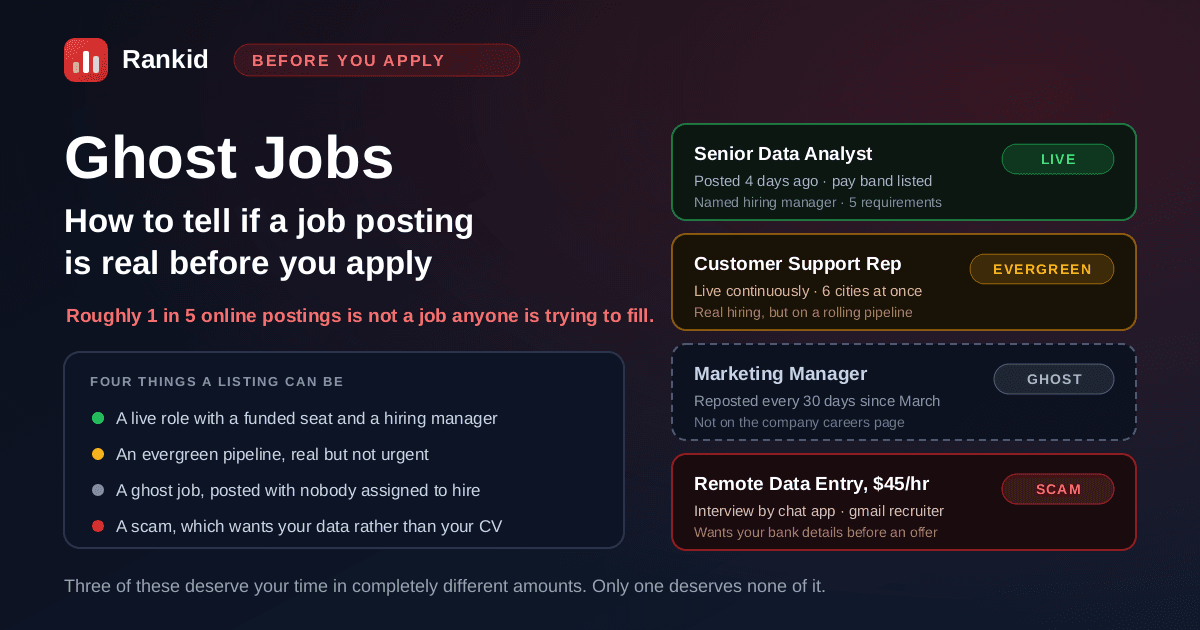
You find the role at 11pm. It fits. You spend an hour rewriting your resume against the description, draft a note that is not embarrassing, and submit. Nothing happens. Three weeks later the same listing appears in your feed again, posted today, as if it were brand new. The most common explanation people reach for is that their resume was not good enough. Often the real explanation is that no human being ever opened it, because there was nobody inside that company whose job it was to.
Quick answer
A ghost job is a real listing for a role nobody is currently trying to fill.Depending on how you count, somewhere between one in seven and one in three online postings qualifies. Before you apply, run a two-minute audit: is it on the company's own careers page, does the posted date match across two job boards, is there a pay band and a named team, and has the company announced a freeze? The output is not a verdict on whether the job is fake. It is a budget: how many of your limited tailoring hours this listing has earned. Scoring system, the ghost-versus-evergreen distinction, and the separate scam checklist below.
What is a ghost job?
A ghost job is a job posting from a real company for a role that nobody is actively hiring for. The requisition might be frozen by finance, cancelled outright, already promised to an internal candidate while policy requires a public advert, or kept live deliberately to keep resumes arriving. There is no fraud involved and no criminal on the other end.
That is precisely why it is expensive. A scam looks wrong if you know what to look for. A ghost job looks exactly like a real one, because it is a real one, just detached from any intention to hire. The whole problem lives in a place you cannot see from the outside: whether a specific person inside that company is accountable for making a hire from this pile.
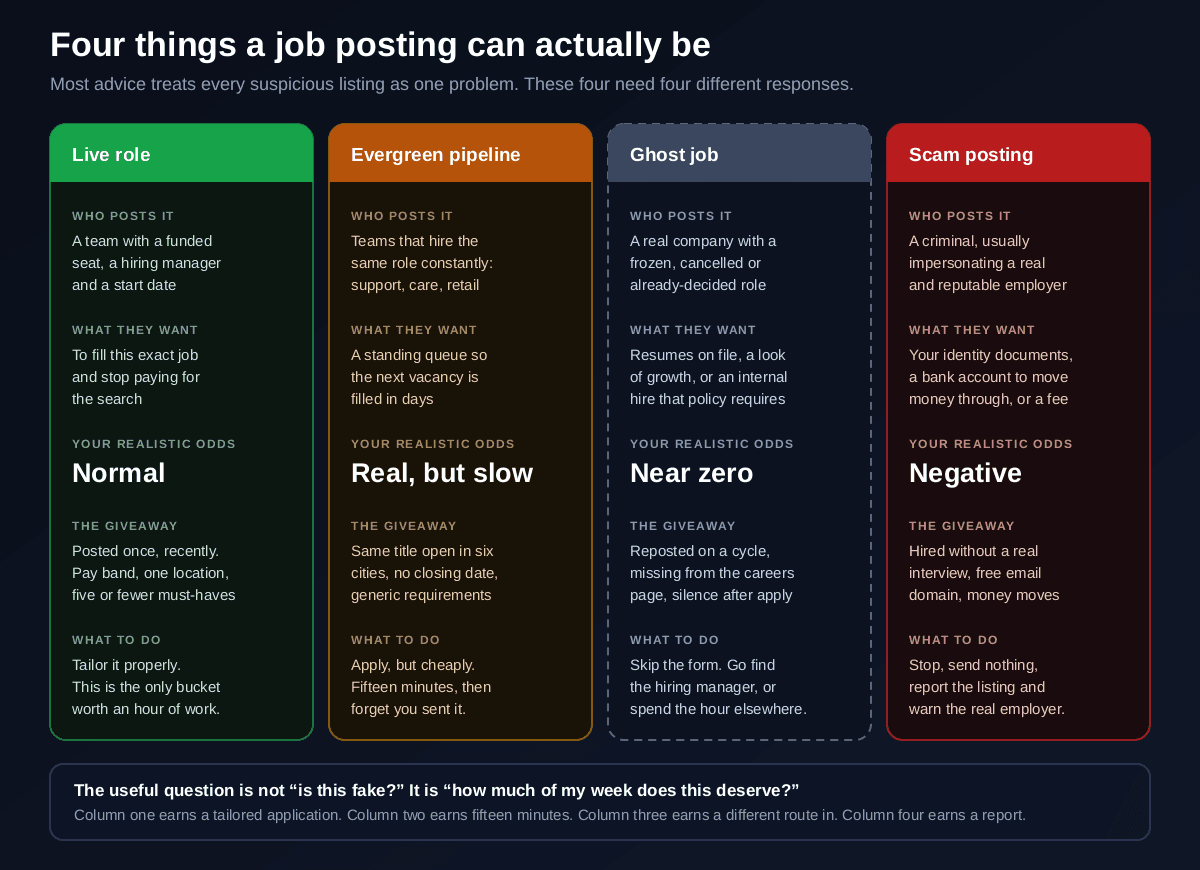
Most advice on this topic collapses everything suspicious into one category and tells you to avoid it. That is not useful, because the four things a listing can be call for four different responses, and only one of them is "avoid".
How common are ghost jobs? What the 2026 numbers actually say
You will see confident single figures quoted everywhere. Treat all of them with some suspicion, because "posted without intent to hire" is not something you can measure directly from the outside. What you can do is triangulate, and the estimates converge on a range rather than a number.
- 18% to 22%, from an internal analysis by the hiring platform Greenhouse, which can see whether a requisition on its own system ever results in a hire. This is the most methodologically direct estimate available, because it is not inferring intent, it is checking outcomes.
- 36% of job seekersreported applying to at least one role in the previous year that was never filled, in Greenhouse's 2025 candidate research. A different question, and it tells you the practical exposure: this is not a rare event you can plan around.
- Around 27% of US LinkedIn listings, in a ResumeUp.AI analysis. Higher, and based on inference rather than outcomes, so treat it as an upper bound rather than a finding.
- Roughly 30%, if you use the macro approach: the persistent monthly gap between reported US job openings and actual hires, which has held near that level since 2021. It overstates the case, because some of that gap is normal hiring lag rather than phantom roles, but the stability of the gap is itself interesting.
- About one in seven,in Clarify Capital's 2026 study, which is the most optimistic credible figure and suggests the practice may be easing slightly from its 2022 peak.
So: between one in seven and one in three, with the better-evidenced estimates sitting near one in five. There is also a sector pattern worth knowing. The openings-to-hires gap is widest in government, education and health, information and financial services, and narrowest in construction and hospitality, where roles get filled about as fast as they are posted. If you are job hunting in the first group, assume more of your applications are landing in empty queues than a friend in the second group experiences.
One number you can act on
Why do companies post jobs they are not hiring for?
The instinctive explanation is that employers are toying with people. Some are. But when employers are actually asked, the answers are mostly banal, which is more useful to know, because banal causes produce detectable patterns.
In Clarify Capital's survey of US employers, the leading reasons given were that the company is always open to good people (37%), that they want an active applicant pool in case of turnover (22%), and that they would move for an irresistible candidate (16%). Those are pipeline motives, and they are honest as far as they go. Less flattering: an earlier round of the same research found 43% admitted posting roles partly to give the impression the company was growing.
Add the operational causes nobody surveys for, and you have the full picture:
- The requisition was frozen and nobody closed the listing.Finance pauses hiring in week three of the quarter. The recruiter who opened the req is now working two funded roles. Taking down a posting is nobody's priority and nobody's metric.
- The role is already going to an internal candidate. Many companies require a public posting before an internal promotion, for fairness or for compliance. The advert is real, the process is real, and the outcome was decided before you saw it.
- Job board syndication keeps recycling it. A posting gets scraped and republished across aggregators, sometimes long after the original closed, which is why the same role can show wildly different posted dates in different places. Nobody at the company is even aware.
- Perpetual pipeline building. Legitimate for high-turnover roles, and something else for a single senior position that has been advertised continuously for eleven months.
- Internal signalling. The least defensible one, and it does exist: postings kept live to reassure investors that the company is expanding, or to remind existing staff that they are replaceable.
Ghost job or evergreen requisition? The distinction that matters most
This is where most ghost job advice does real damage, because it teaches people to discard perfectly good opportunities.
An evergreen requisition is a posting with no end date, kept live because the company hires that role continuously. Contact centres run on these. So do hospitals, warehouses, retail chains, delivery operations, staffing agencies, and any team with predictable churn or a hard-to-find skill. If you apply to one you may genuinely be hired. You simply are not being hired on a schedule that anybody will communicate to you, because your application is joining a rolling queue rather than a defined process with a closing date.
The two look similar and separate cleanly on three questions:
- Is it a high-volume role? Support agent, care worker, driver, warehouse operative, sales development rep, staff nurse. Evergreen makes obvious sense for these and almost none for a Head of Finance.
- Is the same title open in several locations at once? Genuine pipeline hiring is broad and geographically spread. A ghost job is more often one specific role in one place that keeps coming back.
- Does the company ever actually fill it? Check LinkedIn for people who joined that team in that role over the last six months. A pipeline that produces hires is a pipeline. One that never produces anyone is a ghost.
The response to an evergreen posting is not to skip it. It is to apply cheaply and stop tracking it. Fifteen minutes, your closest existing resume with the obvious keywords aligned, and then forget you sent it. If the queue reaches you in month three, that is upside. Building your week around it is the mistake.
How to tell if a job posting is real: the two-minute audit
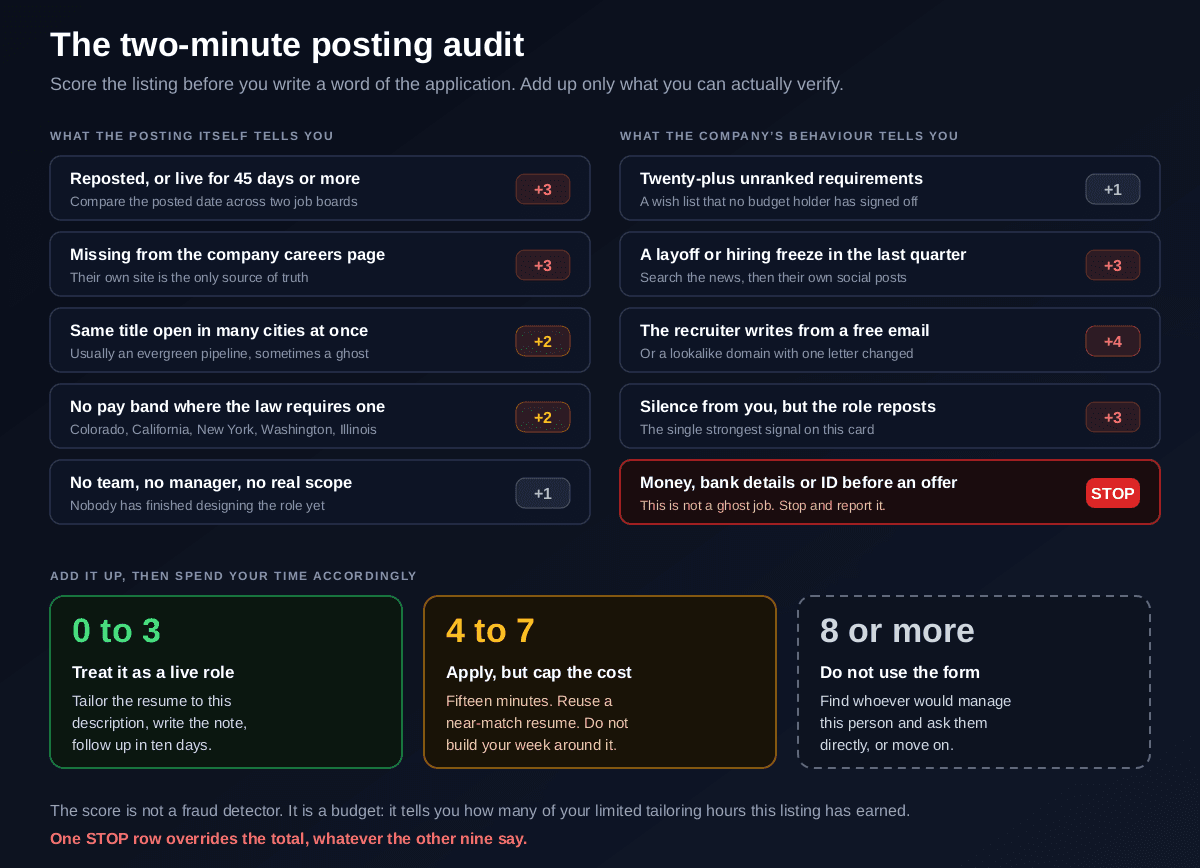
Here is the scoring card. It is deliberately not a fraud detector, because you cannot detect hiring intent from a webpage. It is a triage tool, and its output is a decision about effort. Score before you write anything.
Search the company's own careers page for the title
This single check catches more stale listings than everything else combined, and it takes fifteen seconds. Go to the employer's website, not the job board, and find the role. Their applicant tracking system is the source of truth. If the job is not there, you are almost certainly looking at a syndicated copy of something that closed, or a listing the company no longer maintains.
Compare the posted date across two job boards
Boards display the date they received the listing, not the date the role opened. A posting that reads "3 days ago" on LinkedIn and "51 days ago" on Indeed has been recycled, not reopened. Recycling is not automatically damning, but it moves the role from "new opportunity" to "something that has already been through a hiring cycle without producing a hire".
Look for the fingerprints of an approved requisition
Someone had to justify a real role to get budget for it, and that shows in the writing. A funded posting tends to name the team and who the person reports to, state one location, publish a pay band, and list a short set of specific requirements. A ghost posting drifts: no team, vague scope, twenty unranked bullets, and a title that could mean four different jobs. This is the same signal from the other direction as everything in our guide to writing a job description that screens for you, which is worth reading precisely because it shows you what a serious employer's posting looks like.
Check whether the salary is missing where it is legally required
Colorado, California, New York, Washington and Illinois all require a good-faith pay range in job postings, and the EU Pay Transparency Directive requires pay information before the interview stage. A good-faith range is difficult to publish for a role that does not have a budget. An omission where the law applies is a meaningful signal, whereas an omission in a jurisdiction with no such rule is just common practice.
Check the company's recent hiring news
Two minutes of searching for the company name with "layoffs" or "hiring freeze", plus a glance at their own LinkedIn page, tells you whether the requisition behind this listing plausibly survived the last budget review. A company that cut staff last quarter and is advertising nine new roles is either restructuring, which is real, or leaving old listings up, which is not.
Check whether anyone has actually joined that team recently
Search LinkedIn for the company and filter to people who started in the last six months. If a role has been advertised on and off for a year and nobody has joined into it, you now have outcome evidence rather than inference. This is the closest a candidate can get to seeing what Greenhouse sees from the inside.
What none of this tells you
What actually happens to your application behind a ghost posting
It helps to see the mechanism, because the mechanism explains why the silence feels so personal and so random when it is neither.
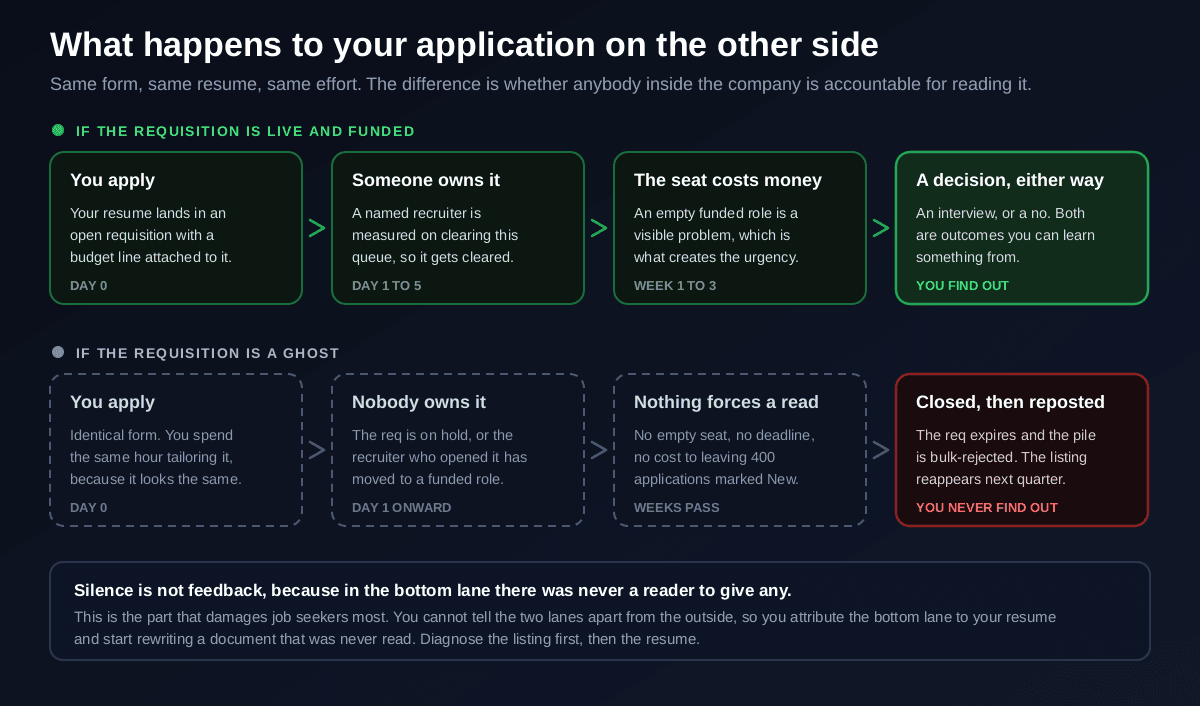
The important asymmetry is in the middle of each track. A live requisition has a cost attached to staying empty, and someone whose performance is measured on closing it. A ghost requisition has neither. Nothing anywhere in the system creates pressure to open your application, so nothing does, and eventually the requisition expires and the whole pile is bulk-rejected in a single click, months later, with a templated message that reads exactly like the templated message a real rejection would have produced.
This is the part that does lasting damage to job seekers. Because you cannot see which track you are on, you attribute the outcome to the only variable you control, and you start rewriting a document that was never read. Ten rewrites later, the response rate has not moved, and the reasonable conclusion you draw is that you are the problem. If you are in that loop, our guide to why you are not getting interviews separates the causes properly, and how long it actually takes to hear back gives you the timelines that make silence interpretable.
The productive response is to hold your resume constant and vary the listings. If you apply to fifteen roles that all score 0 to 3 on the audit above and still hear nothing, the resume is genuinely the problem and you have learned something real. If you have been applying mostly to old, recycled, careers-page-absent listings, you have not tested your resume at all yet.
Rule the resume out before you rewrite it again
Paste your resume and a job description you are confident is live. Rankid scores the match out of 100 and lists the requirements you hit and the ones you missed. If the score is strong and you are still getting silence, the listings are the variable worth changing, not the document.
Check your match freeFake job postings that are actually scams
Everything above is about wasted time. This section is about a different category, and the two get conflated constantly. A ghost job costs you an hour. A job scam is a crime with a victim, and the numbers have moved sharply: reported US losses to job and business opportunity scams rose from roughly $90 million in 2020 to about $501 million in 2024, with reports tripling over the same period. Typical individual losses run in the low thousands.
Scams have tells that ghost jobs do not, and none of them require any technical knowledge. Here is a composite of the message people actually receive, annotated.
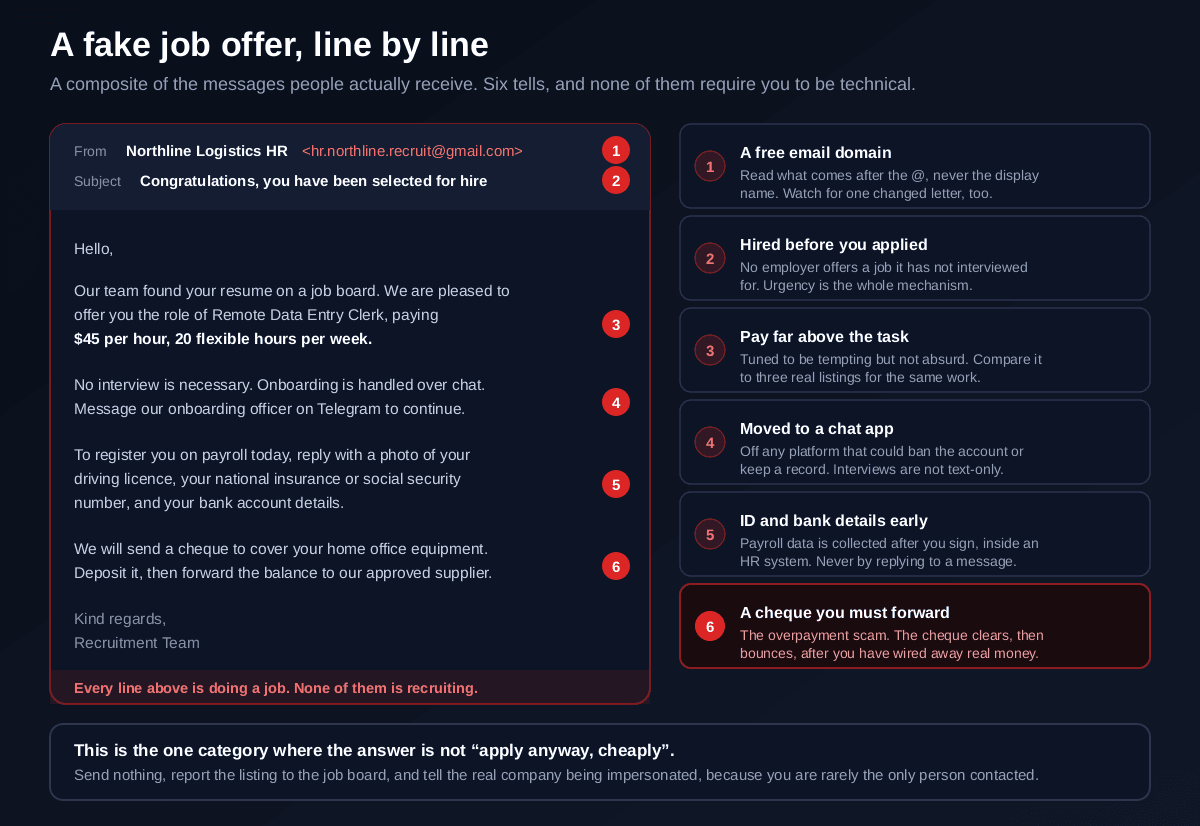
Two of those six deserve special attention because they are the ones people rationalise past. The first is being hired without an interview. It feels like luck, especially after a long search, and it is the single most reliable indicator that no employer is involved. The second is any movement of money in your direction before you have started work. The cheque clears at first, which is what makes it convincing, then bounces days later after you have wired real money to the "supplier", and the loss is yours.
- Read what comes after the @, never the display name. A display name is free to set to anything. Watch for lookalike domains with one letter added, removed or swapped.
- Verify sideways, not through the message.Do not use the phone number or link in the email. Go to the company's real website independently and check whether the role and the recruiter exist.
- Nobody legitimate collects your bank details or national ID by reply. Payroll data is collected after you sign, inside an HR system, usually by someone you have already met.
- Never pay for a job. Training, equipment, background checks, software licences, starter kits. Employers pay for those. There is no legitimate exception to this in normal employment.
If you have already sent something
What to do with each kind of listing
The point of the audit is that it ends in a different action rather than in a feeling. Four buckets, four responses.
- Live role, score 0 to 3. This is the only bucket that earns real work. Tailor the resume to this specific description, mirror the language of the must-haves, write the short note, and set a reminder to follow up in about ten days. Our guide to tailoring a resume to a job description covers how to do this in twenty minutes rather than two hours.
- Evergreen pipeline, score 4 to 7. Apply, cap it at fifteen minutes, reuse your closest existing resume with the obvious keywords aligned, and then genuinely forget about it. Do not follow up, do not track it, do not let it affect how many other applications you send that week.
- Probable ghost, score 8 or more. Change the channel rather than abandoning the company. The form has no reader; a human might. More on that below.
- Scam. Send nothing, report it in three places, and warn the impersonated employer. This is the only bucket where the correct number of minutes is zero.
How to get in when the posting looks like a ghost
A ghost listing does not always mean the company has no need. Frozen requisitions thaw, and internal candidates fall through. What it means is that the application form is a dead channel, so use a live one.
- Find whoever would manage this person. The team page or a LinkedIn search for the function plus the company usually gets you there in a couple of minutes. A director of the relevant team is a better target than the recruiter, who may no longer be assigned to the req at all.
- Ask a question they can answer in one line.Three or four sentences maximum: what you do, one specific result with a number in it, and "is this role actively being filled, or is it on hold?" That is a question people answer, partly because it is easy and partly because it is refreshingly direct.
- Treat a no as a real result."It is paused until Q4" saves you an hour now and gives you a reason to make contact in October. That is a better outcome than an application that vanishes.
- Make yourself findable instead of only applying. A significant share of hiring for frozen-then-unfrozen roles happens through search rather than through the applicant pile, which is why being findable by recruiters on LinkedIn compounds in a way that application volume does not.
And keep a record. A simple sheet with the company, the date, the audit score and whether you ever heard back turns this from a vibe into data within a month. You will find that some employers reliably respond and some reliably do not, and that knowledge is worth more than any individual application.
A note for the people posting them
If you run hiring, the trade being made here is worse than it looks. The pipeline you are building by leaving a req open is mostly people who will have taken other jobs by the time you need them, and the cost is paid in candidate trust that is spent on your next real search. Greenhouse's research found candidate ghosting of employers rising sharply, with half of US candidates having walked away from a process without notice, most often after poor communication or long delays. That is the same behaviour, learned and returned.
The fixes are cheap and mostly administrative. Close listings when the req is frozen and say so. Label evergreen postings as pipeline roles, which costs nothing and immediately makes candidates rate you higher than the employer who does not. Auto-expire anything past 45 days so nothing lingers by accident. And if you have a real role and a real pile of applications, read them, which is easier than it sounds once the requirements are tight enough to score against. We cover the mechanics in how to screen resumes in bulk and resume screening criteria.
Key takeaways
- A ghost job is a real listing with no hiring intent behind it. It is not a scam, which is exactly why it is hard to spot.
- Credible estimates range from one in seven to one in three postings, with the best-evidenced figures near one in five.
- The four categories, live, evergreen, ghost and scam, need four different responses. Only the last one deserves zero minutes.
- Fastest single check: search the company's own careers page. A listing that exists on a job board but not there is usually stale.
- Second fastest: compare the posted date across two job boards. A big gap means recycled, not reopened.
- Evergreen postings are legitimate. Apply cheaply, cap it at fifteen minutes, and do not build your week around them.
- Behind a ghost posting nobody is accountable for reading your application, so silence is not feedback and should not trigger another resume rewrite.
- Test your resume against listings that score as live. If those come back silent too, the document is genuinely the variable.
- Scam tells are different: free email domains, hiring without an interview, chat-app onboarding, ID or bank details before an offer, and any money moving toward you.
- If a listing scores badly, change the channel rather than the effort. Ask the hiring manager directly whether the role is live.
Spend your applications where they can actually land
Audit the listing first, then check the fit. Rankid scores your resume against any job description out of 100 and shows the requirements you match and the ones you miss, so the hour you do spend goes into a role that is real and a gap that is closable.
Try Rankid freeFrequently asked questions
What is a ghost job?
A ghost job is a real listing from a real company for a role nobody is currently trying to fill. The requisition may be frozen, cancelled, already promised to an internal candidate, or kept open purely to collect resumes. It is not a scam, because there is no criminal on the other end and nobody is trying to take anything from you. That is exactly what makes it costly: it looks identical to a live role from the outside, so you tailor a resume, write a note, and wait for a reply from a queue that has no reader assigned to it. The distinguishing feature of a ghost job is not deception about the company, it is the absence of anybody inside the company who is accountable for making a hire.
How many job postings are fake?
Estimates cluster between roughly 15% and 30% depending on how the count is done. An internal analysis by the hiring platform Greenhouse put ghost listings at 18% to 22% of job posts, and its 2025 candidate research found 36% of job seekers had applied to at least one role in the previous year that was never filled. A ResumeUp.AI analysis of LinkedIn listings put the figure higher, around 27%. A separate way of measuring it, the persistent gap between reported US job openings and actual hires, has sat near 30% every month since 2021. Clarify Capital's 2026 study came in lower, at about one in seven active posts. The honest summary is that nobody can give you a precise number, but every credible method lands somewhere between one in seven and one in three.
Why do companies post jobs they are not hiring for?
Mostly for mundane reasons rather than malicious ones. In Clarify Capital's survey of US employers, the most common answers were that the company is always open to good people (37%), that they want an active pool of applicants in case of turnover (22%), and that they would move for an irresistible candidate (16%). Beyond those, four patterns recur: a requisition gets frozen by finance but nobody takes the listing down, a role is already promised internally while policy requires a public posting, a job board contract runs on auto-renew and keeps recycling old listings, and, less charitably, a company wants to look like it is growing. An earlier Clarify Capital survey found 43% of employers admitted posting roles to create an impression of growth.
How can you tell if a job posting is real?
Run three checks that take about two minutes in total. First, open the company's own careers page and search for the title, because a listing that exists on a job board but not on the employer's site is usually stale or syndicated rather than live. Second, compare the posted date across two job boards, since a role showing four days old on one and fifty on another is a repost rather than a new opening. Third, look for the fingerprints of a real requisition: a named hiring manager or team, a pay band, one location rather than nine, and a short list of specific requirements. Postings with a budget behind them tend to be specific, because someone had to justify the spend to get them approved.
What is the difference between a ghost job and an evergreen job posting?
An evergreen posting is a legitimate recruiting tool, not a trick. Some roles are hired continuously because turnover is predictable, so the listing stays up permanently and the company works through a rolling queue. Call centres, retail chains, hospitals, warehouses and staffing agencies all run this way, and if you apply you may genuinely be hired, just not on a timeline anyone will tell you. A ghost job has no hiring intent at all behind it right now. The practical tell is consistency: an evergreen posting is usually the same title open across many locations with generic requirements and an obviously high-volume role, while a ghost job is typically a single specific senior role that keeps reappearing without ever being filled.
Should you apply to a job that was posted 30 days ago?
Usually yes, but cheaply. Age alone is weak evidence, because plenty of real hiring processes run long, particularly for senior or specialist roles where the manager is interviewing slowly. Age becomes meaningful when it combines with other signals: the listing is missing from the company's own careers page, the posted date differs across boards, the same title has been recycled several times, or the company announced a hiring freeze. What should change with age is your effort, not your decision. A month-old posting with no other red flags deserves a fifteen-minute application with a near-match resume, not the hour you would spend on a role posted last week with a named hiring manager.
Why do I never hear back from job applications?
There are three separate causes and they need different responses. Your application was read and rejected, which usually means a genuine gap between the resume and the requirements. Your application was never read, because the requisition was a ghost, on hold, or already decided internally. Or your application was filtered before a human saw it, which is a formatting and keyword problem. The reason this matters is that most job seekers assume cause one, rewrite their resume repeatedly, and see no change, because a meaningful share of their applications went into the second bucket where there was never a reader. Diagnose the listing before you diagnose the document.
How do you spot a fake job posting that is actually a scam?
Scam postings are a different category from ghost jobs and they have their own tells, most of which do not require any technical skill to catch. The recruiter writes from a free email address such as gmail or a lookalike domain with one letter changed. You are offered the role without a real interview, or the entire process happens over a chat app such as Telegram or WhatsApp. The pay is noticeably above market for the task. You are asked for identity documents, a national insurance or social security number, or bank details before any signed offer exists. Or money moves in your direction first, typically a cheque to buy equipment from an approved supplier, which is the classic overpayment scam. Any request for money or identity documents before a signed offer means stop.
Are ghost jobs illegal?
In most places, no. Posting a job you are not actively filling is not itself unlawful in the US or UK, which is why the practice is so widespread. There are narrower rules that can apply around the edges. Pay transparency laws in states including Colorado, California, New York, Washington and Illinois require a good-faith salary range in postings, and a good-faith range is hard to publish for a role that does not exist. Some jurisdictions have begun to look at whether indefinitely stale listings amount to deceptive advertising. But as things stand in 2026, a ghost job is a norm problem and a wasted-time problem rather than a legal one, and enforcement is essentially nonexistent.
How long do job postings usually stay up?
A genuinely live posting is typically filled or closed within about 30 to 45 days, because an empty funded seat is a visible cost that someone is accountable for. Senior, technical and niche roles run longer, sometimes two or three months, without that being suspicious. What is suspicious is a listing that stays up indefinitely with no closing date and no change, or one that disappears and reappears on a regular cycle. Clarify Capital found the share of employers keeping postings live for more than 30 days fell from 68% in 2022 to roughly 33% in 2025, so a very old listing is now more of an outlier than it used to be.
What should you do if you think a job is a ghost job?
Change the route rather than the effort. Skip the application form, which is the channel with no reader, and find the person who would actually manage this role, usually identifiable from the team page or LinkedIn. Send them three or four sentences: what you do, one specific result, and a direct question about whether the role is actively being filled. You will often get a straight answer, and the answer is useful either way. If you cannot find anyone, submit a fifteen-minute application with your closest existing resume and remove the role from your mental list of live prospects. What you should not do is spend an hour tailoring for a listing that scored badly on every check, or interpret the silence that follows as feedback on your resume.
Where can you report a fake job posting?
Report it in three places, because they do different things. Report the listing on the job board itself, since LinkedIn, Indeed and the rest all have a report option on the posting and this is what gets it removed fastest. Tell the real company being impersonated, usually through their security or careers contact, because they can issue a public warning and are rarely aware they are being used. And if money or personal data changed hands, report it to your national fraud body: the FTC at ReportFraud.ftc.gov in the US, Action Fraud in the UK. Reported losses to job and business opportunity scams in the US have risen sharply, from around $90 million in 2020 to roughly $501 million in 2024, so these reports are genuinely used.