Candidate Experience: How to Improve It When 400 People Apply (2026)
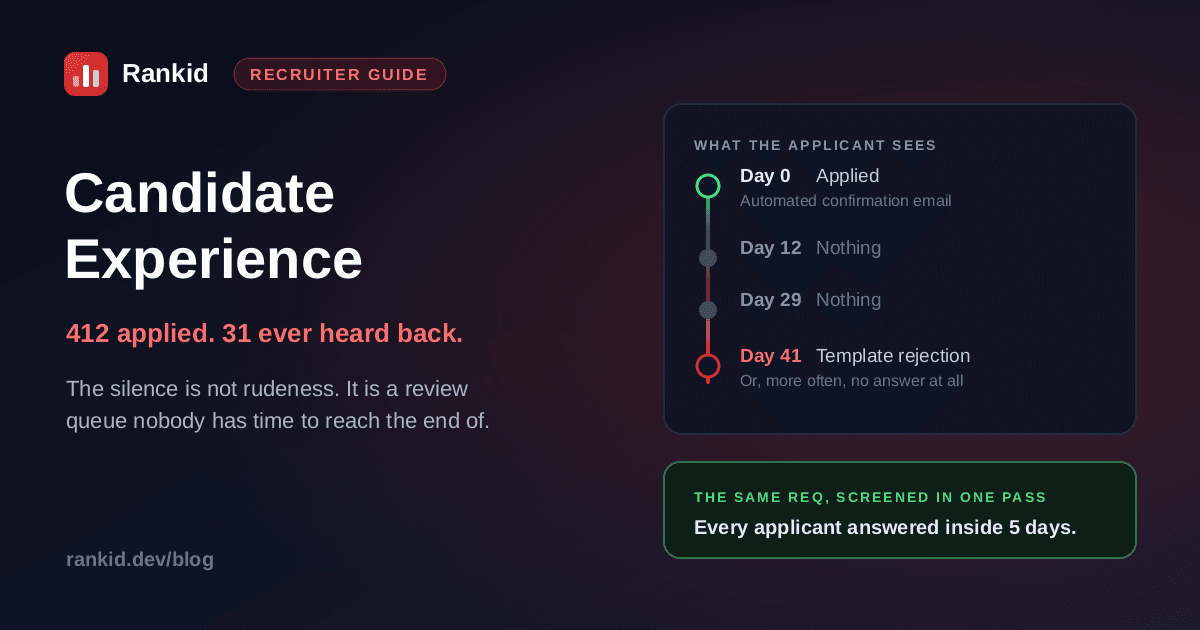
Ask a recruiting team whether candidate experience matters and you will get a yes with no hesitation. Ask them how many of last quarter's applicants received an answer of any kind and the room goes quiet, because for most teams the honest number is somewhere under half. That gap is not hypocrisy and it is not laziness. It is arithmetic. A careful resume screen takes about 90 seconds, 412 people applied to one req, and nobody has 10 spare hours this week. Candidate experience is mostly a throughput problem wearing a manners costume, and it is fixable at the point where the throughput actually breaks.
Quick answer
What is candidate experience?
Candidate experience is the sum of everything a person encounters while dealing with your hiring process: the job posting they read, the form they fill in, the wait they sit through, the interviews they attend, and the way the answer eventually arrives. It includes the tone of your recruiters and the load time of your careers page, but those are the small components. The large ones are clarity and time.
The definition that actually changes behaviour has one extra clause in it: candidate experience is measured across everyone who applied, not across the people you interviewed. This is the distinction most teams get wrong. A hiring process can be genuinely excellent for the six people who reached an onsite loop, with fast scheduling, prepared interviewers and a same-week decision, while being a black hole for the 406 people who never heard anything at all. Averaged across the pool, that is a poor candidate experience, and the pool is what talks to other candidates.
It helps to see the same process from the other side. We wrote how long it takes to hear back after applying for candidates, and the questions in it are the ones your applicants are asking about you right now: is anyone reading this, does silence mean no, and how long should I wait before assuming the worst. Every one of those questions is answerable in a single sentence from your side. Almost none of them get answered.
Why candidate experience is really a throughput problem
Here is the mechanism, with the numbers written out, because the numbers are the whole argument.
A req attracts 412 applications. A careful screen against real criteria, meaning you actually open the resume and check it against what the role needs, takes 60 to 120 seconds. Call it 90. That is 10.3 hours of focused reading for one requisition. The recruiter who owns it also owns five other open roles, an interview schedule, two offer negotiations and an intake meeting. The realistic capacity for reading this particular pile is maybe three or four hours a week, and applications keep arriving while the reading happens.
So the pile is never finished. It is abandoned. The first 60 or 80 resumes get a real look, a shortlist emerges, interviews start, someone gets hired, and the requisition is closed with 300 or more applications still sitting unopened. Those people are not rejected in any meaningful sense. Nobody made a decision about them at all. That is the true origin of the “black hole”, and it explains the thing that seems inexplicable from outside: not the rejection, but the total absence of an answer.
The uncomfortable version
This is also why the usual advice fails. Telling an overloaded recruiter to “keep candidates warm” adds work to the week that caused the problem. Buying a tool that sends nicer automated emails makes the silence better written. Neither one changes the fact that 300 resumes were never read. The only interventions that move candidate experience at volume are the ones that reduce the cost of producing a decision, which is the same operational problem we cover in high-volume recruiting.
The candidate experience journey: four moments that decide it
A candidate experience journey map is useful right up to the point where it becomes a 14-stage diagram nobody acts on. In practice four moments carry almost all of the weight, and they are not equally expensive to fix.
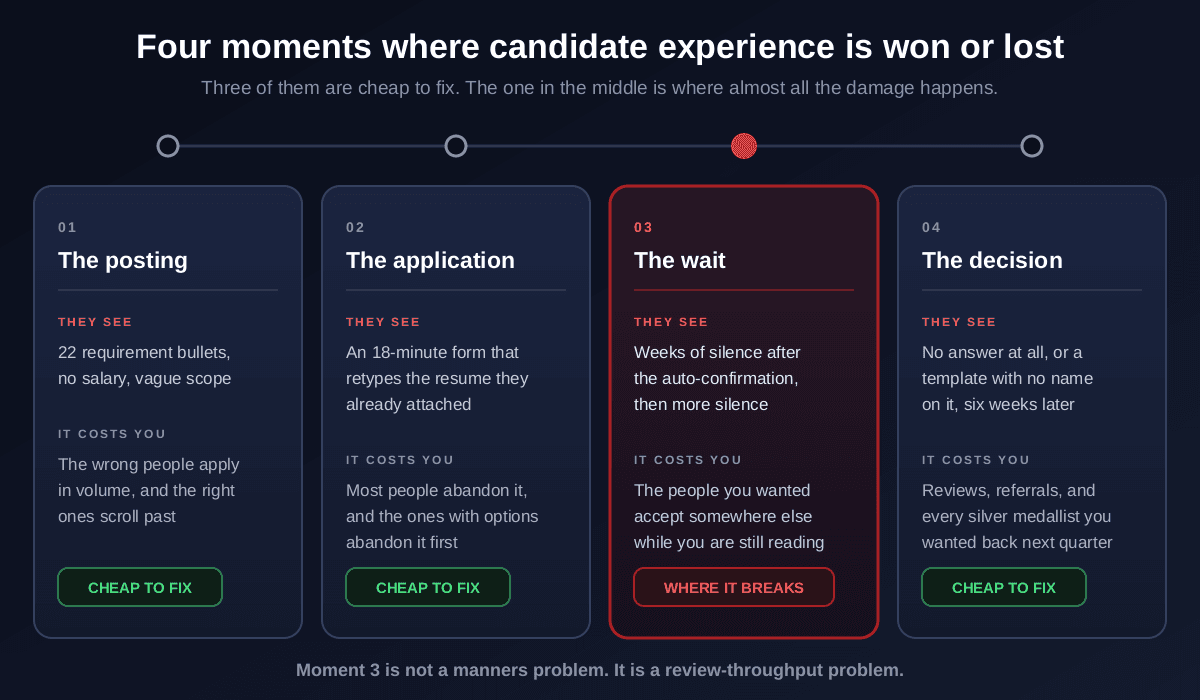
The posting. Before anyone applies, the posting sets the expectation for everything after it. A list of 22 requirements with no salary range and a vague scope produces two effects at once: the people who read requirements as strict criteria opt out even when they can do the job, and the people who read them as suggestions apply in volume. You get a bigger, worse pool and a slower screen, which then feeds the wait. Our guide to writing a job description covers the fix in detail, but the short version is that a posting with six real must-haves screens better than one with twenty aspirational bullets.
The application. If your form asks people to retype the employment history that is already in the resume they just uploaded, you are charging every applicant 15 minutes for the convenience of your database. The candidates most likely to abandon a long form are the ones with other options, which is a filter that runs precisely backwards.
The wait. This is the moment that matters most and the only one that is genuinely expensive to fix, because it is not a communication failure, it is a capacity failure. Everything else on this list is a policy decision you can make on a Tuesday afternoon. This one requires changing how screening works.
The decision. How the answer arrives, and whether it arrives at all. Cheap to fix, and almost free once a decision exists for everyone, which is why it is the natural second thing to change after throughput.
How to improve candidate experience, in effort order
These are ordered by return on effort rather than by where they sit in the funnel. If you only do two, do steps three and four.
Put a salary range and a real scope in the posting
A range does more for candidate experience than any communication policy, because it prevents the worst possible outcome: four rounds of interviews ending in a number that was never going to work. Add two or three sentences describing what the person will actually do in the first six months. Vague postings do not just annoy people, they inflate your applicant pool with mismatches you then have to read.
Cut the application to what you will genuinely use
Time the form yourself. If it takes more than five minutes for someone who already has a resume ready, delete fields until it does not. Resume plus contact details plus two or three questions that genuinely change your decision is enough for a first pass. Every screening question you add because it might be useful later is paid for by every applicant, forever.
Produce a decision for the whole pool, not the top of the pile
This is the one that unlocks everything else. Instead of reading resumes one at a time until time runs out, score the entire batch against the role's requirements in a single pass, so every applicant has a position and a reason rather than only the first 80. Once a decision exists for all 412 people, answering them stops being a heroic effort and becomes an email. The mechanics are in how to screen resumes in bulk, and the criteria to score against are in resume screening criteria.
Answer everyone within five business days
Set it as a standard and measure it. Five days is roughly the window before an applicant concludes they have been ignored. Tier the effort: candidates who were screened out on the resume get a clear, decent, templated no; candidates who spoke to a human get a personal note from the human they spoke to. Both are fast. The second one is what people remember.
Tell people the timeline, then tell them again when it slips
At every stage, say what happens next and when. “You will hear from us by Thursday the 14th” is worth more than any amount of warmth, because it lets a candidate stop refreshing their inbox. When it slips, and it will, send a two-line update before the deadline rather than an apology after it. A missed date you flagged in advance costs almost nothing. A missed date followed by silence costs the candidate.
Make the interview loop feel prepared
Send the format, the names and roles of interviewers, and what each stage is assessing. Ask the same core questions of every candidate so the comparison is fair and the candidate can tell it was fair, which is the practical case for the structured approach in interview questions to ask candidates. An interviewer who has clearly not read the resume is one of the most reliably reported candidate experience complaints, and it takes four minutes to prevent.
Close the loop with the people you said no to
The rejected pool is where employer reputation is actually written, because it is 95 percent of everyone who dealt with you. A specific, quick no keeps a strong candidate available for the next req instead of pushing them into a competitor's pipeline with a story about your process.
Give every applicant a decision, not silence
Paste the job description, upload the whole batch, and every candidate comes back scored 0 to 100 with the skills they match and miss. A decision for the full pool in minutes, so you can answer everyone while they still care. First 5 resumes free, no signup.
Screen a batch freeHow to reject candidates without burning them
The rejection email is the single highest-leverage piece of writing in recruiting, because more people read it than read anything else you send. Most versions of it fail in the same three ways: it arrives weeks after the decision, it is addressed to nobody, and it says the applicant did not closely match requirements without ever naming one.
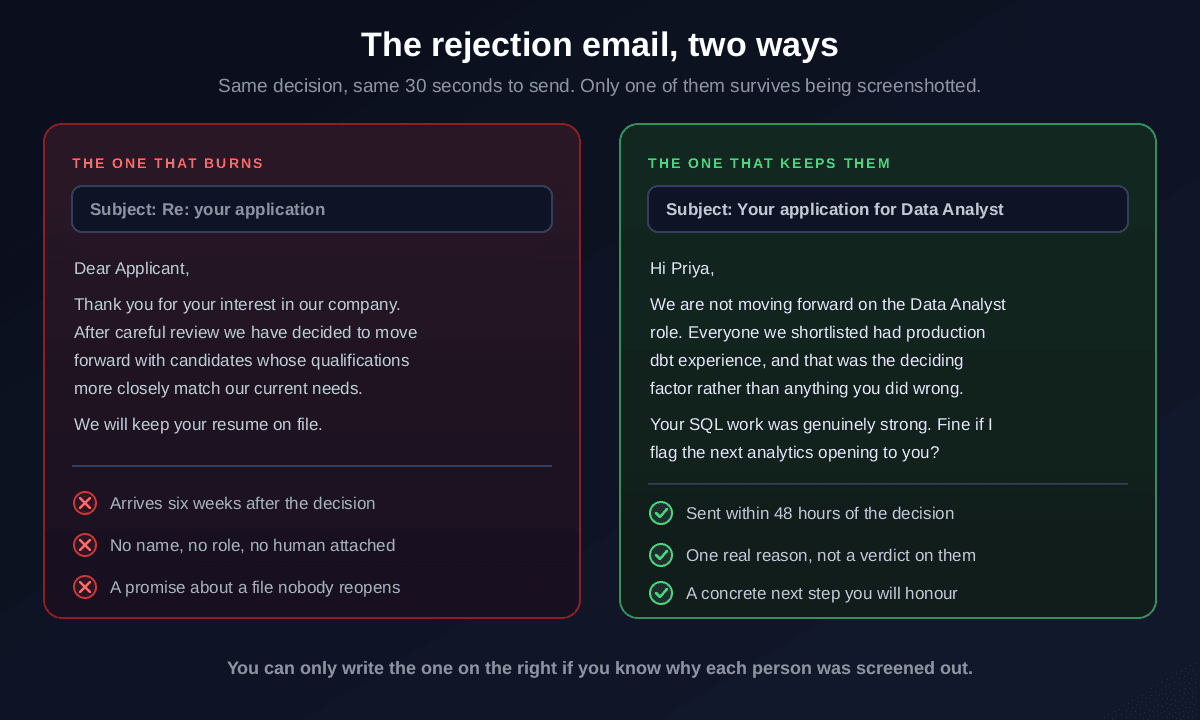
The version on the right takes no longer to send. It is only possible, though, if you know why each person was screened out, which is another reason scoring the whole pool matters: a ranked pool with matched and missing skills attached to each candidate gives you the sentence to write. Silence is usually not a decision to withhold feedback. It is the absence of anything to say.
Three templates worth keeping, tiered by how much of your time the candidate spent:
- Screened out on the resume.“Hi [name], thanks for applying for [role]. We are not taking your application forward this time. The shortlist we built all had [specific requirement], which was the deciding factor for this particular role. I have kept your details and will get in touch when something closer to your background opens up.” Send within five days, in bulk, with the name and role merged in.
- Rejected after a screening call or first interview. Same structure, plus one concrete observation from the conversation and the stage they reached. Two extra sentences, written by whoever spoke to them.
- Rejected at final stage. A phone call if they went through several rounds, followed by an email. Name what was strong, name the one thing that decided it, and if you would genuinely hire them for something else, say so explicitly rather than implying it.
Two phrases to delete
Seven full templates covering every stage, the timing each one needs, which reasons are safe to put in writing and how to send several hundred without them reading as bulk are in the candidate rejection email guide.
How to measure candidate experience
Most candidate experience measurement starts and ends with a satisfaction survey, which is the slowest and least actionable signal available. Process metrics move first, you already have the data for them, and they tell you where the problem is rather than that a problem exists.
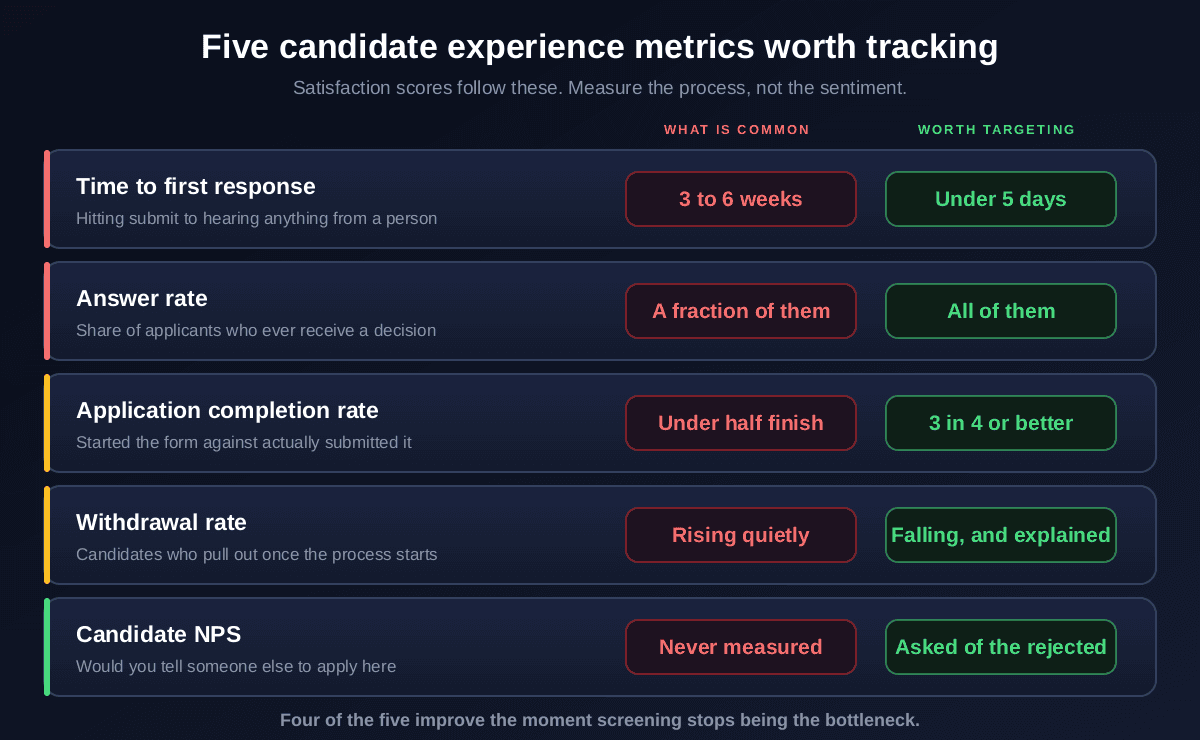
- Time to first response. Submitted to hearing from a human. The headline candidate experience metric, because it is what the wait feels like from the outside. Measure the median and the 90th percentile, because the average hides the people who never hear anything.
- Answer rate. The share of applicants who ever receive a decision. Almost nobody tracks this and it is the most revealing number in the set. If it is 40 percent, then 6 in 10 people who dealt with your brand got nothing, and no amount of interview polish offsets that.
- Application completion rate. People who started your form against people who submitted it. A low number is a direct measurement of how much your application is costing candidates, and it is the easiest metric on this list to fix.
- Withdrawal rate. Candidates who pull out after entering the process. Rising withdrawals almost always mean your process is slower than the market you are hiring in, not that candidates changed their minds.
- Candidate NPS. Would you encourage someone else to apply here, on a 0 to 10 scale. Only meaningful if you send it to rejected candidates too, because a score collected from hires measures your offer, not your process.
Four of those five improve as a direct consequence of screening faster, which is worth noticing before you buy anything: they are downstream of throughput, not of communication style.
The candidate experience survey: what to actually ask
A candidate experience survey is worth running if it is short, sent quickly, and sent to people you rejected. Six questions, delivered within a week of the decision, will tell you more than a 20-question annual survey with a 4 percent response rate.
- How clearly did the job posting describe the role you would actually be doing? (1 to 5)
- How did the length of the application compare with what you expected? (shorter, about right, longer)
- At each stage, did you know what the next step was and roughly when to expect it? (1 to 5)
- Did the process give you a fair chance to show what you can do? (1 to 5)
- How would you rate the way the final decision was communicated? (1 to 5)
- What is the one change that would have most improved this process for you? (open text, and the only question anyone will remember answering)
Add the standard recommendation question on a 0 to 10 scale if you want a candidate NPS to trend. Then read the open text answers yourself rather than in aggregate. In practice they cluster hard around two themes: nobody told me anything, and the process took months. Both point back to the same bottleneck.
Candidate experience tools: what actually changes the number
This category is confusing because most products sold as candidate experience platforms improve the wrapper rather than the wait. It is worth being blunt about what each type does.
- Applicant tracking systems. They store, route and track applications, and a good one makes bulk communication and status updates easy. What they do not do is read resumes and decide anything, so an ATS alone does not shorten the wait. Our list of applicant tracking systems covers which families do what.
- Scheduling tools. Genuinely useful, and they fix a real irritation in the interview stage. They affect the experience of the small group who reach interviews.
- Texting and nurture tools. They make communication faster to send. If there is nothing to communicate because the pile is unread, they automate the sound of silence.
- Screening and ranking tools. The category that changes time to first response and answer rate, because it produces the decision that everything else communicates. This is where Rankid's bulk resume screening sits: up to 200 resumes per batch scored against your job description, each with matched and missing skills, so a full pool has an answer in minutes.
If you are evaluating tools specifically to improve candidate experience, ask one question of each vendor: which of the five metrics above does this move, and by what mechanism. Anything that cannot answer that is improving the wrapper.
Candidate experience mistakes that quietly make it worse
- Auto-rejecting on a keyword filter to reduce the pile. It produces fast answers and rejects good people for phrasing, which is a worse outcome than slowness. If you rank instead of filter, you get the speed without the false negatives, which is the argument in AI resume screening.
- Measuring candidate experience only among finalists. It reliably produces a healthy-looking score for a process that is failing most of the people in it.
- Posting roles you are not actively hiring for. Pipeline-building postings are the fastest way to teach candidates that your listings are not real, which is the phenomenon we documented in ghost jobs.
- Adding a communication policy without adding capacity. A rule that everyone gets an update every 10 days, imposed on a team that cannot finish the screening, generates updates that say nothing has happened yet, which reads worse than silence.
- Treating the rejection email as a legal document. Over-lawyered wording is exactly what makes a rejection feel like it came from a building rather than a person.
- Never re-contacting the silver medallists. If somebody reached your final two and you told them you would be in touch, being in touch six months later when the role reopens is the cheapest sourcing you will ever do.
Does candidate experience actually affect hiring outcomes?
It affects three things you can see in your own funnel, which is a more useful case than any industry statistic.
The first is offer acceptance. Candidates weigh how they were treated during the process as evidence about how they will be treated as employees, and a drawn-out, uncommunicative process is read correctly as a signal about the organisation. The second is withdrawal, which is the same effect happening earlier and less visibly: the strongest candidates leave slow processes first because they have somewhere else to be. The third is your future pool. Every applicant is a person who might apply again, refer someone, or become a customer, and the rejected group is by far the largest constituency your employer brand has.
There is a fairness dimension too. When screening capacity runs out, what actually happens is that the first 80 resumes get a careful read and the rest get a glance or nothing, which means the decisive factor for most applicants was arrival time rather than fit. Scoring the whole pool against the same criteria is a candidate experience improvement and a consistency improvement at the same time, for the same reason it helps skills-based hiring work: everyone is evaluated on the same basis instead of on whether anyone got to them.
Start by measuring two numbers for your last closed requisition: how many people applied, and how many of them ever received an answer. If the second number is not close to the first, you do not have a communication problem to solve with better templates. You have a pile that nobody could finish, and that is a fixable operational fact rather than a permanent feature of hiring at volume. Once you can shortlist from the whole pool instead of from the top of it, the answer to everyone else writes itself.
Key takeaways
- Candidate experience is measured across everyone who applied, not across the few who reached an interview.
- The black hole is capacity, not rudeness: nobody can carefully read 412 resumes inside a working week.
- Four moments decide it: the posting, the application form, the wait, and the decision. The wait does most of the damage.
- Fix throughput first, because you cannot communicate a decision that does not exist yet.
- Answer every applicant within five business days, tiering effort by how much of your time they spent.
- Send rejections fast and specific: one real reason beats a paragraph of careful nothing.
- Track time to first response, answer rate, completion rate, withdrawal rate and candidate NPS, and survey the rejected.
- Rankid scores up to 200 resumes per batch against your job description, first 5 free with no signup.
Bottom line: candidate experience does not improve because a team agrees it should. It improves when producing a decision for every applicant stops being unaffordable, because everything candidates actually complain about, the silence, the six-week template, the sense that nobody read it, is downstream of that one constraint. Fix the throughput and the good behaviour becomes easy to sustain. Run your next req through Rankid's bulk resume screening tool, get the whole pool ranked with the reasons attached, and give all 412 people an answer while it still means something to them.
Frequently asked questions
What is candidate experience?
Candidate experience is the sum of everything an applicant sees, does and waits through when they deal with your hiring process, from reading the job posting to receiving a final answer, including the people who never get past the resume stage. It covers the clarity of the posting, how long the application form takes, how quickly and how often someone communicates, how the interviews are run, and how the decision is delivered. The important detail is that it is measured across everyone who applies rather than across the handful you interview, which is why a process that feels smooth to your finalists can still be producing a poor candidate experience for the other 95 percent of the pool.
Why is candidate experience important?
Because it compounds in both directions and it costs you real hires. Candidates who are left in silence withdraw from processes, decline offers they would otherwise have accepted, warn other people in their network, and do not reapply when you post the role they actually fit. It also affects the quality of your pool over time: the people with the most options are the fastest to walk away from a slow or opaque process, so a bad candidate experience filters out exactly the candidates you were competing hardest for. And it is cheap to fix relative to what it costs, because most of the damage comes from silence rather than from rejection.
How do you improve candidate experience?
Fix the four moments that actually decide it: the posting, the application form, the wait, and the decision. Write a posting with a real scope and a salary range. Cut the application to what you will genuinely use, so people are not retyping a resume they already attached. Then attack the wait, because that is where nearly all the damage happens: screen the whole applicant pool in one pass rather than reading it one resume at a time, so a decision exists for everyone within days. Finally, answer everyone, including the people you screened out, with a short specific note rather than silence or a six-week template.
How do you measure candidate experience?
Track five things: time to first response, meaning how long from submitting an application to hearing from a human; answer rate, meaning what share of applicants ever receive a decision at all; application completion rate, meaning how many people who start your form actually finish it; withdrawal rate, meaning how many candidates pull out once the process starts; and candidate NPS, which asks whether someone would encourage another person to apply. The first four are process metrics you already have the data for, and they move before sentiment does. Candidate NPS is only meaningful if you also survey the people you rejected.
What questions should a candidate experience survey ask?
Keep it to five or six questions and send it within a week of the decision, to rejected candidates as well as hires. Ask how clear the job posting was about the actual role, how long the application took relative to what they expected, whether they knew what the next step and timeline were at each stage, whether the interviews gave them a fair chance to show what they can do, how the final decision was communicated, and one open text box asking what single change would have improved the process. Then ask the standard recommendation question on a 0 to 10 scale to get a candidate NPS you can trend over time.
How quickly should you respond to job applicants?
Every applicant should hear something within five business days, and candidates who reach an interview should hear back within two business days of it. Five days is not an arbitrary target: it is roughly the point at which people conclude they have been ignored and start committing to other processes. The reason most teams miss it is arithmetic rather than intent, because a careful manual screen takes about 90 seconds a resume and a few hundred applicants will not fit into the hours anyone actually has. Fixing the response time means fixing the screening throughput first.
How do you reject a candidate without damaging your employer brand?
Send it quickly, make it specific enough to be useful, and give it a name. Speed matters most: a clear no within 48 hours of the decision is received far better than a polite paragraph six weeks later. Name the role, give one real reason the shortlist was built the way it was, avoid vague phrasing such as more closely matched our needs, and do not promise to keep a resume on file unless you genuinely re-contact people. For anyone who spent time in an interview, a personal note from the person who interviewed them is worth the two minutes it takes.
What is the best tool for improving candidate experience at high volume?
The tool that matters is whichever one removes the review bottleneck, because response time is what candidates actually experience. An applicant tracking system stores and routes applications but does not read them, so it does not by itself shorten the wait. Rankid does the reading part: paste the job description, upload the batch, and every candidate is scored 0 to 100 with the skills they match and miss made explicit, so a decision exists for the whole pool in minutes rather than weeks and you can answer everyone while they still care. Your first 5 resumes are free with no signup, and you can score up to 200 resumes per batch after that.