How to Prepare for a Job Interview: A Day-by-Day Plan (2026)
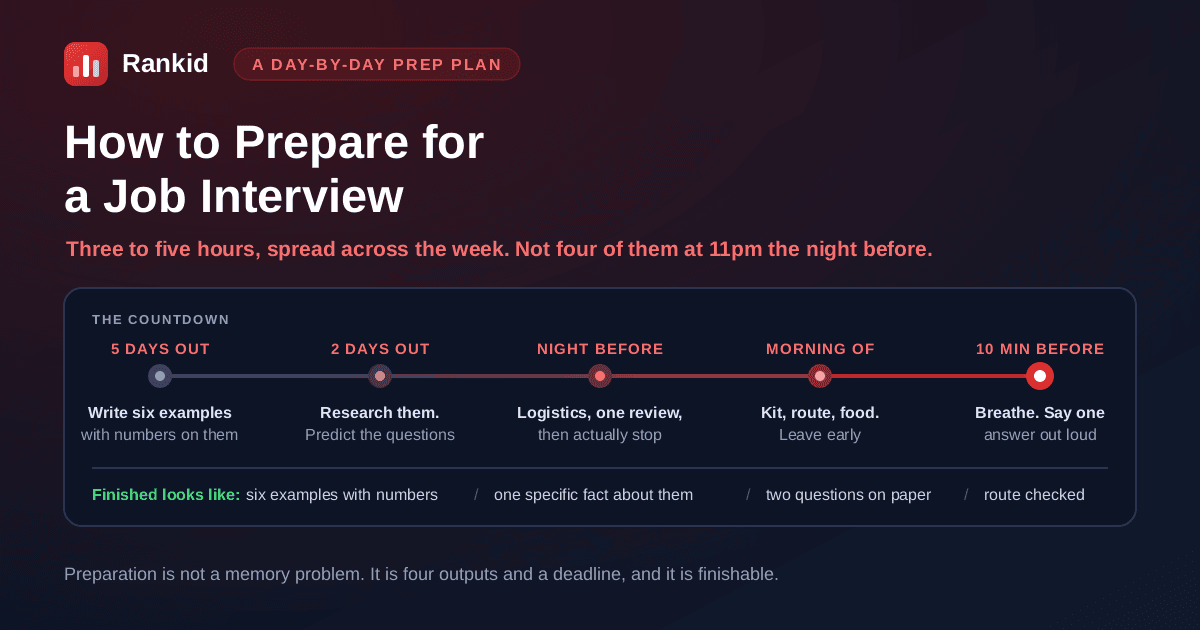
Ask most people how they prepared for their last interview and the honest answer is that they reread the job posting, skimmed a list of common questions somewhere around 11pm, and hoped. That is not laziness. It is what happens when preparation is framed as a memory problem, because memorising is unpleasant and there is no obvious point at which you are finished. Preparation is really a logistics problem with a deadline. There are four things it has to produce, and once you know what they are, the work becomes finite, schedulable, and considerably shorter than the dread suggests.
Quick answer
Budget three to five hours, spread across the week, not crammed the night before. Preparation has to produce exactly four things: evidence (six examples with numbers), one specific fact about this employer that a competitor could not claim, two questions to ask them, and settled logistics (route or link, clothes, printed resume). The night before is for review and sleep, not new material. If you only have 30 minutes, do evidence first and skip the list of a hundred questions entirely.
How long should you prepare for a job interview?
Three to five hours in total for a job you actually want. That surprises people in both directions: some have never spent more than 40 minutes, and others block out an entire weekend and arrive exhausted. The reason the range is fairly narrow is that preparation has sharply diminishing returns after the evidence is written down. The first 90 minutes change your performance a great deal. Hours six through ten change almost nothing an interviewer can perceive, and they measurably increase the odds of sounding rehearsed.
- 90 minutes on evidence. The examples and numbers you will cite. This is the part that cannot be improvised in the room, so it goes first.
- 45 minutes on company research. Enough to find one specific thing worth mentioning.
- 30 minutes practising out loud. Out loud, timed, recorded. Not in your head.
- 20 minutes on logistics. Route, parking, link, clothes, printouts, contact number.
- 20 minutes writing questions for them. Two good ones, written down, not improvised.
The floor, when an interview lands at short notice, is 60 to 90 minutes, and the order above is also the priority order: cut from the bottom. The ceiling, past which you are managing anxiety rather than preparing, is about six hours.
The day-by-day interview preparation plan
Spreading the work matters more than the total. Preparation done in one block the night before produces material you have thought about once. The same hours spread across five days produce material your brain has quietly revisited between sessions, which is the difference between answers you retrieve and answers you actually believe.
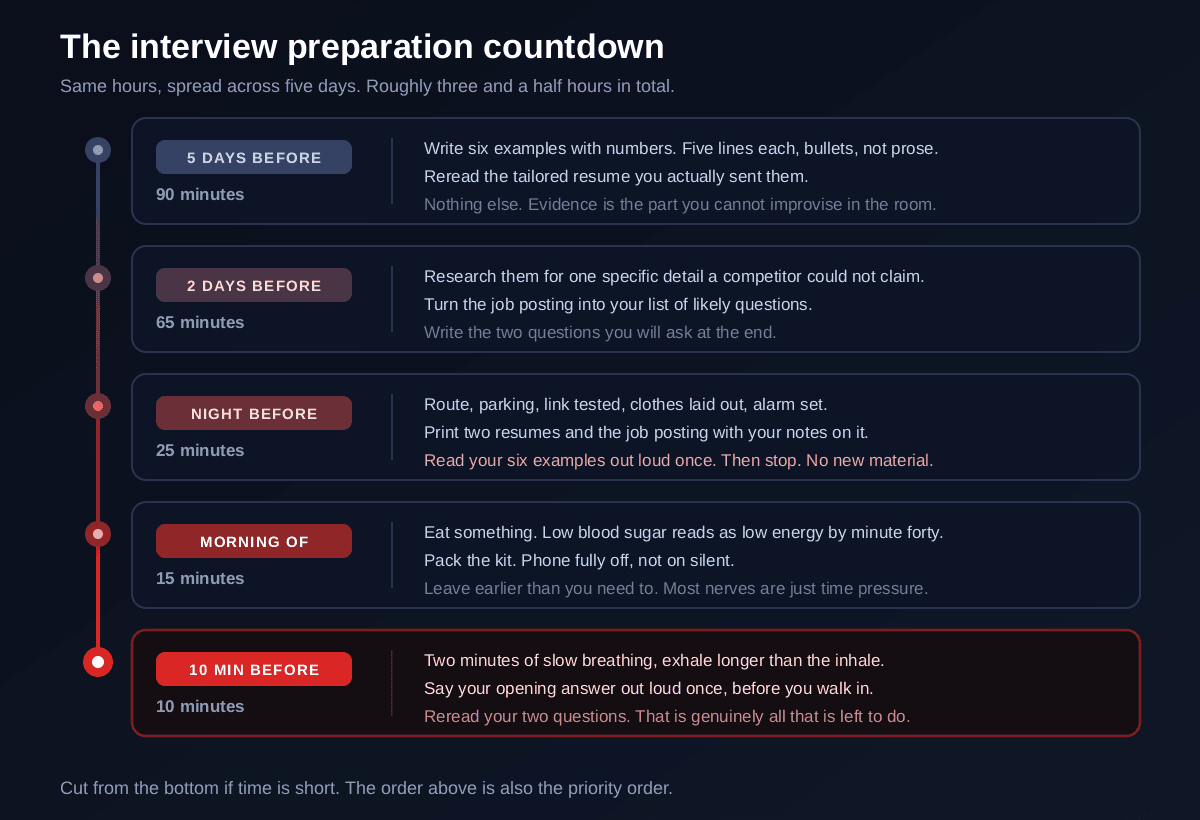
Five days before: build your evidence
Write six short examples in bullet form: a win with a number attached, something that went wrong and what you changed, a disagreement you resolved, a time you led without authority, something you learned quickly, and a time you chose what not to do. Five or six lines each. These cover almost every behavioural question you will be asked, and building them is the same work as quantifying achievements on a resume, so it pays twice.
Then reread the resume you actually sent. Not your master copy, the tailored version that went to this employer. Interviewers ask about the document in front of them, and being surprised by your own resume is a bad look that is entirely avoidable.
Two days before: research them and predict the questions
Forty-five minutes on the company, aimed at one specific detail rather than general familiarity. Then twenty minutes reverse-engineering the job posting into a list of the questions you are likely to get, which is the step almost nobody does and the one with the best return. Both are covered in detail below.
Finish by writing two questions to ask them. Our list of questions to ask in an interview sorts them by who is in the room, since a recruiter and a hiring manager can answer completely different things.
The night before: logistics, one review, then stop
Confirm the time, format and names. Check the route and parking, or test the video link. Lay out what you are wearing so the decision is made. Print two copies of your resume and one of the job description with your notes on it. Read your six examples once, out loud.
Then stop. Writing new answers late at night is where confidence goes to die, and sleep will do more for tomorrow than a third hour of rehearsal.
The morning of: kit, route, food
Eat something, even if you are not hungry, because interviews often run over and low blood sugar reads as low energy. Pack the kit list below. Leave earlier than you need to, since almost all interview nerves are time pressure wearing a costume.
Ten minutes before: breathe, speak once, phone off
Two minutes of deliberately slow breathing with a longer exhale than inhale. Say your opening answer out loud once, in the car or before you join the call, so the first sentence you speak in the room is not the first sentence you have spoken all day. Phone fully off, not on silent. Reread your two questions. That is all.
How to research a company before an interview
Company research fails in a predictable way: people read the About page, absorb some mission language, and arrive able to say the company is innovative and people-focused, which is true of every company and therefore evidence of nothing. The goal is not familiarity. The goal is one specific, verifiable detail that a competitor could not also claim, because that single detail is what makes your answer to "why do you want to work here" impossible to fake and impossible to recycle.
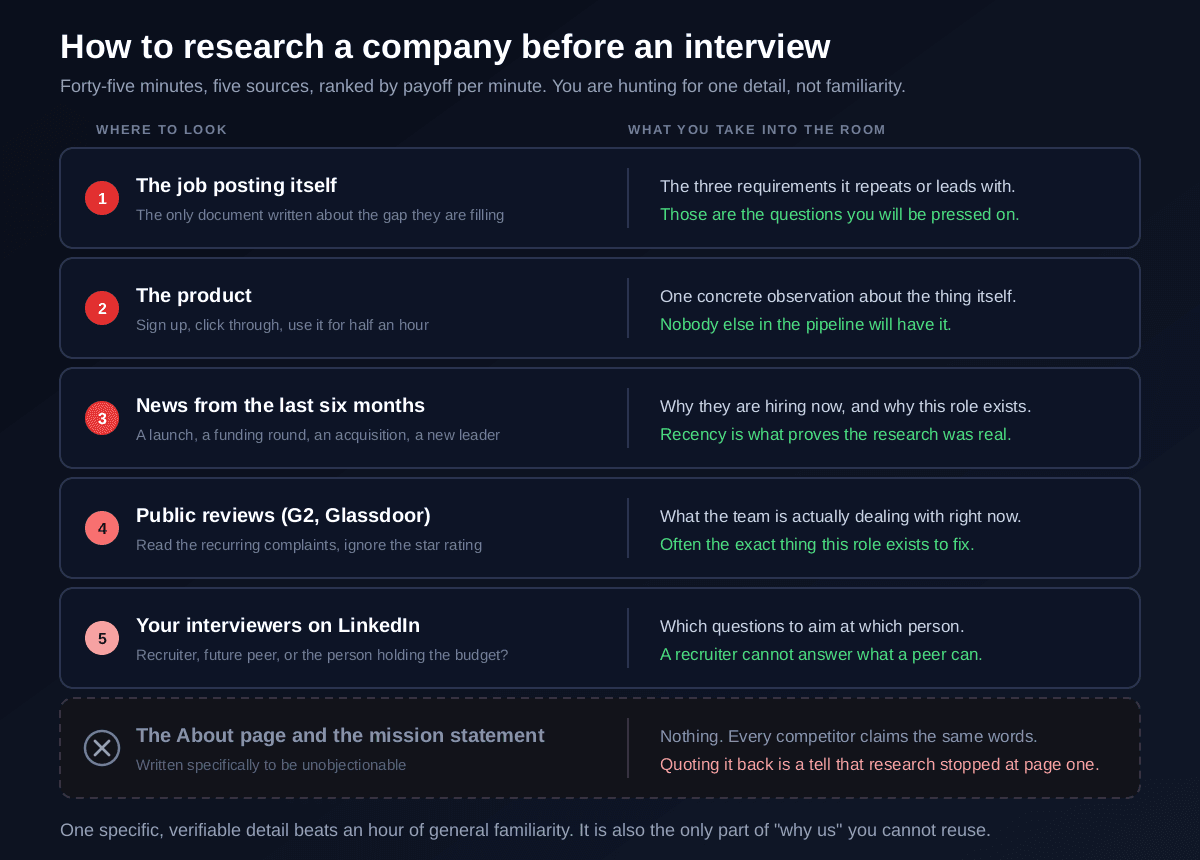
Work through the five sources in the order above and write one line of notes from each. The job posting is first for a reason: it is the only document written specifically about the gap they are trying to fill, and the requirement they repeat or lead with is nearly always the thing you will be pressed on. The product comes second because concrete beats abstract, and thirty minutes of actually using the thing gives you observations nobody else in the pipeline will have.
The reviews trick
Skip the About page and the mission statement. They are written to be unobjectionable, which makes them useless as differentiators, and quoting a mission statement back at an interviewer is a well-known tell that the research stopped at the first page.
How to predict the questions from the job description
A job posting is a list of the things the employer is worried about. Every requirement in it is a question waiting to be asked, and the ones they lead with, repeat, or attach a number to are the ones that will come up. This is a twenty-minute exercise and it is worth more than reading two hundred sample questions.
- Mark the three requirements that repeat. If stakeholder management appears in the summary and again in the responsibilities, you will be asked to evidence stakeholder management.
- Turn each one into a question."Experience owning a roadmap" becomes "tell me about a roadmap you owned". It is almost that mechanical.
- Map each question to one of your six examples. If a requirement has no example against it, that is your weak spot, and you now know it before the interviewer does.
- Prepare the gap answer. For anything you genuinely cannot evidence, prepare the honest version: the nearest thing you have done, plus how fast you closed a comparable gap before.
The gaps matter more than the matches. Candidates rarely lose on the requirements they meet, they lose on the one they were not ready to discuss and visibly improvised around. Knowing your gaps in advance turns the worst moment of the interview into a prepared one.
See which requirements you cover, and which you will be asked about
Paste your resume and the job description into Rankid's free checker. You get a 0-100 match score, the requirements you already evidence, and the exact gaps worth preparing an answer for before you walk in.
Check your match freeWhat to bring to an interview
The kit list is short, and the point of packing it the night before is that none of it should occupy any of your attention on the day.
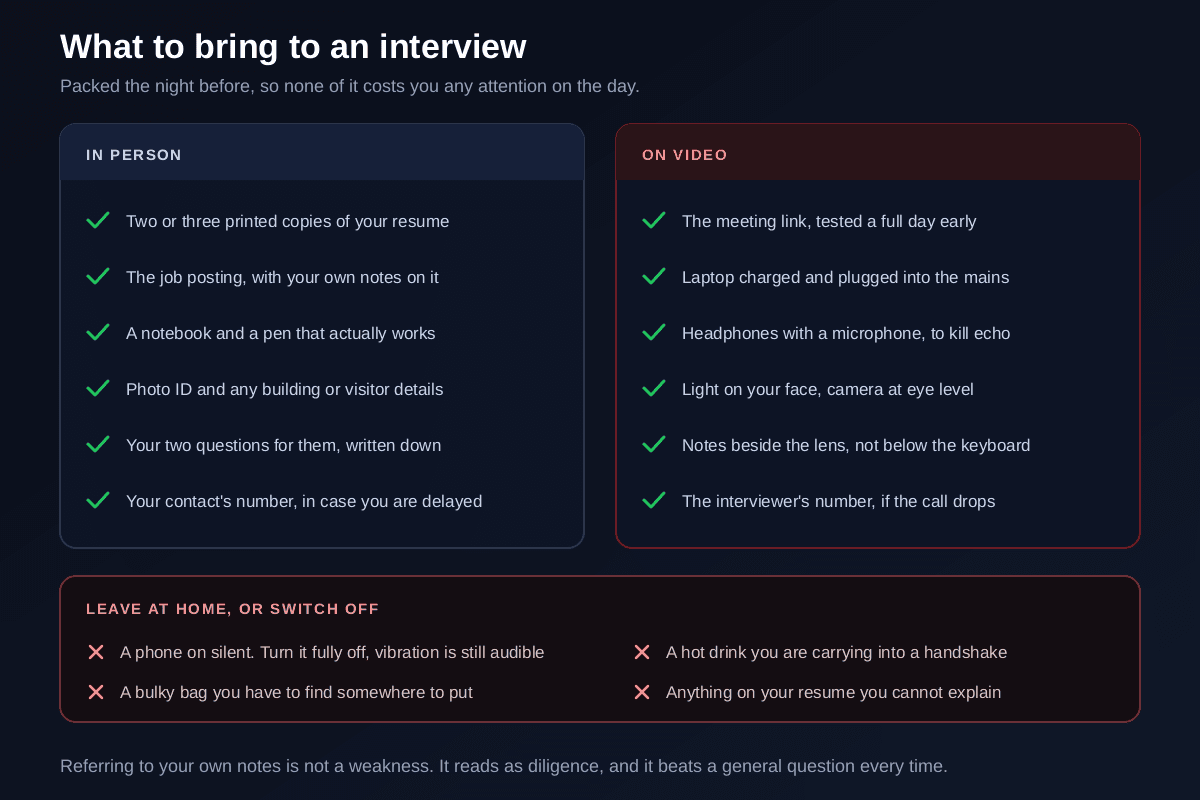
Two details people get wrong. First, switch your phone fully off rather than to silent, because a phone vibrating on a table is still an interruption and everyone in the room hears it. Second, bring the job description with your own notes on it. Referring to your notes is not a weakness, it reads as diligence, and it means you can ask a question about a specific line in the posting rather than a general one.
What you are wearing is worth deciding the night before rather than the morning of, and if the dress code is ambiguous our guide to what to wear to an interview covers each one including the awkward middle grounds.
How to prepare for a virtual or video interview
Video interviews are lost to preventable technical friction far more often than to bad answers, and the fixes take fifteen minutes the day before.
- Test the actual platform, not just your webcam. Teams, Zoom and Meet all fail differently and some want to install something. Do this a day early, not five minutes before.
- Light on your face, not behind you. Sit facing a window or a lamp. A bright window behind you turns you into a silhouette.
- Camera at eye level. Stack books under the laptop. Filming up your nose is unflattering in a way that quietly costs you.
- Headphones with a microphone. Kills echo, which is the single most fatiguing thing for the person listening to you.
- Notes beside the lens, not below the keyboard. Your eyes stay near the camera instead of visibly reading downwards.
- Close everything else. Notifications during a screen share are the classic disaster.
- Look at the lens for the first and last sentence. That is what registers as eye contact. Watching their face for the rest is fine and more natural.
Have a fallback
How to run a mock interview on your own
You do not need a partner and you do not need a coach. You need to speak out loud and hear yourself back, which is uncomfortable enough that most people skip it, and it is the highest-yield thirty minutes in the whole plan.
- Write eight to ten likely questions from the job description exercise above, on separate lines, and pick them in a random order so you cannot rehearse a sequence.
- Answer each into your phone's voice recorder without restarting. Restarting defeats the point, because you cannot restart in the room.
- Listen back once with a stopwatchand check three things only: did any answer run past two minutes, did you say "we" when you meant "I", and did each answer end with a result rather than trailing off.
- Do two passes, not five. A third pass starts producing answers that sound recited, which is a different and harder problem to fix.
For what actually goes inside those answers, our guide to answering common interview questions covers the structure for each of the questions you will almost certainly be asked.
How to calm nerves before an interview
The advice to just relax is useless because nerves are not a decision. What works is physical and mechanical.
- Two minutes of slow breathing with a longer exhale than inhale. This lowers heart rate measurably, which is a physiological effect rather than a mood one.
- Arrive early enough not to rush. A large share of interview nerves is simply time pressure. Removing it removes them.
- Speak one answer out loud beforehand. The voice tends to shake on the first sentence spoken aloud, so spend that sentence in the car park.
- Change the goal from impressive to useful. Trying to be impressive is a performance and it raises the stakes. Trying to be useful is a conversation.
- Accept a shaky first minute. Interviewers expect nerves and discount them heavily. Almost nobody is rejected for being visibly nervous at the start.
Second interviews, panels and internal interviews
The plan above is the base case. Three common variants need a different emphasis rather than more hours.
A second interviewis a different assessment, not a repeat. Round one established that you can do the job; round two is usually about depth, judgment and the people you would work with, often with more senior interviewers who have read the first round's notes. Prepare deeper versions of your two strongest examples, a specific view on what you would do in the first 90 days, and sharper questions. Assume anything you said in round one can be quoted back to you, so reread your own notes first.
A panel interview mostly needs a delivery adjustment. Answer to the person who asked, then include the rest of the panel with your eyes over the course of the answer, and finish back with the asker. Write the names down as they introduce themselves, because you will not remember four names under pressure and using one correctly at the end is disproportionately effective.
An internal interview is the one candidates most reliably under-prepare, on the assumption that their track record speaks for itself. It does not, because the panel knows your reputation rather than your evidence. Write your achievements out with numbers exactly as you would for an outside employer, talk about the new role rather than your current one, and address the obvious risk directly if there is one, such as managing people who used to be peers. Same preparation, same structure, same clothes.
Can you over-prepare for an interview?
Yes, and it fails in a specific and recognisable way. Word-for-word answers collapse the moment a question is worded differently, because you are retrieving a script rather than thinking, and heavy rehearsal makes people sound like they are performing rather than talking. The distinction that matters:
- Cannot be overdone: your evidence, your examples, the numbers, your questions for them, your research, your logistics.
- Can be overdone: your exact sentences. Prepare bullets you can reconstruct, not paragraphs you recite.
- The one exception:your answer to "tell me about yourself", which is worth learning close to word for word because it comes first and sets the frame for everything after it.
If you have been preparing for six hours and are still going, you have crossed from preparation into anxiety management. Stopping is the better use of the evening, and it is a real decision rather than laziness.
The preparation mistakes that cost most
- Reading a list of a hundred common questions. It feels productive and produces nothing you can use, because you cannot hold a hundred answers and you never wrote any of them down.
- Preparing answers without preparing evidence. Answers without numbers are opinions about yourself.
- Doing it all the night before. Same hours, much worse result, worse sleep.
- Researching the About page instead of the product. Mission language is interchangeable and interviewers know it.
- Not rereading the resume you actually sent. Especially if you tailored it, which you should have.
- Practising silently. Reading answers in your head trains nothing. The gap between an answer that reads well and one that speaks well is large.
- No questions ready for them. Saying you have none reads as indifference even when it is politeness.
- Ignoring the logistics until the morning. Every minute of route panic comes directly out of your composure in the first answer.
What to do straight after
Preparation has a short tail worth budgeting for. Within a few hours, write down what they asked, what you answered badly and anything you promised to send. That page is most of the preparation for round two, and it is gone by tomorrow if you do not write it now. Then send a thank you email within 24 hours, and if you are wondering when to chase, our guide to how long it takes to hear back has the realistic timelines by stage.
Key takeaways
- Budget three to five hours total, spread across the week. The floor is 60 to 90 minutes, the ceiling is about six hours.
- Preparation must produce four things: evidence, one specific fact about them, two questions, and settled logistics.
- Write six examples with numbers before you do anything else. Evidence cannot be improvised in the room.
- Research for one specific detail a competitor could not claim, not general familiarity. Skip the About page.
- Reverse-engineer the job description into likely questions. The requirements it repeats are the ones you will be asked.
- Your gaps matter more than your matches. Prepare the honest answer for the requirement you cannot evidence.
- Practise out loud and record it. Two passes, checking length, "I" versus "we", and whether answers end with a result.
- The night before is logistics, one review and sleep. New material at 11pm makes tomorrow worse, not better.
The reason interview preparation feels bottomless is that nobody tells you what finished looks like. It looks like this: six examples written down, one specific thing about this employer, two questions on paper, your clothes out and your route checked. That is a finishable list, it takes an afternoon spread over a week, and it puts you ahead of most of the people you are competing with, who will be reading a list of a hundred questions at 11pm. Start with the part that actually decides the questions you will get: paste your resume and the job description into Rankid's free resume checker and prepare against the gaps it finds, not the ones you are guessing at.
Frequently asked questions
How long should you prepare for a job interview?
Between three and five hours in total for a role you genuinely want, split across the week rather than done in one sitting the night before. A workable split is 90 minutes on your evidence, meaning the stories and numbers you will actually cite, 45 minutes on company research, 30 minutes practising out loud, 20 minutes on logistics such as route, kit and what you are wearing, and 20 minutes writing the questions you will ask them. The absolute floor, if the interview was scheduled at short notice, is 60 to 90 minutes, and the priority order in that case is evidence first, one specific fact about the company second, logistics third. Beyond about six hours you are usually rehearsing anxiety rather than adding anything the interviewer will notice, and heavily over-rehearsed answers start to sound recited.
What should you do the day before an interview?
Treat the day before as logistics and light review, not new preparation. Confirm the time, the format and who you are meeting, and reply to the scheduling email if anything is ambiguous. Check the route and the parking, or for a video call check the link, the camera and the microphone. Lay out what you are wearing so the decision is already made. Print two copies of your resume and reread the one you actually sent, since the interviewer will ask about the version in front of them, not the version in your head. Reread your six stories once, out loud, and then stop. Do not write new answers the night before: late preparation is where people talk themselves into nerves, and sleep does more for your performance the next morning than a third hour of rehearsal.
How do you research a company before an interview?
Spend 45 minutes and look in five places, in this order: the job posting itself, which tells you what problem they are hiring to solve; the product, which you should sign up for or at least click through so you can speak about it concretely; their recent news, meaning a launch, a funding round, an acquisition or a leadership change in the last six months; their public reviews on sites like G2 or Glassdoor, where the recurring complaints tell you what the team is dealing with; and the LinkedIn profiles of the people interviewing you, so you know whether you are talking to a recruiter, a future peer or the budget holder. You are hunting for one specific, verifiable detail that a competitor could not claim, because that detail is what makes your answer to "why do you want to work here" impossible to fake.
What should you bring to an interview?
For an in-person interview: two or three printed copies of your resume, a printed copy of the job description with your notes on it, a notebook and a working pen, your ID and any building or visitor details, a written list of the questions you plan to ask, and the name and number of your contact in case you are delayed. Bring a portfolio or work samples only if the role is one where they are normally expected. Leave out anything bulky, and switch your phone fully off rather than to silent, since a vibrating phone on a table is still a distraction. For a video interview the equivalent kit is the meeting link tested in advance, a charged laptop on mains power, your notes on a second screen or on paper beside you, and a phone number for the interviewer as a fallback if the call drops.
How early should you arrive for an interview?
Arrive in the area 15 to 20 minutes early, but present yourself at reception five to ten minutes before the scheduled time. Turning up much earlier than that is a small imposition, because someone has to decide what to do with you, and it occasionally means being taken in before you have settled. Use the buffer to sit somewhere nearby, silence your phone, reread your notes once and drink some water. For a video interview the equivalent is joining the call one to two minutes before the start time, having already tested the camera, the microphone and the link about 15 minutes earlier so there is time to fix anything that is broken.
How do you calm nerves before an interview?
The most reliable fixes are physical and mechanical rather than psychological. Slow your breathing deliberately for two minutes, making the exhale longer than the inhale, which measurably lowers heart rate. Get there early enough that you are not rushing, since most interview nerves are actually time pressure wearing a costume. Say your first answer out loud in the car or before you join the call, because the voice tends to shake on the first sentence spoken in the room and it helps to have spent that first sentence somewhere else. Reframe the goal from being impressive to being useful, which is both truer and easier. And accept a slightly shaky opening: interviewers expect nerves, they discount them, and almost nobody is rejected for being visibly nervous in the first minute.
How do you prepare for a virtual or video interview?
Test the actual platform, not just your webcam, at least a day ahead, because Teams, Zoom and Google Meet all fail in different ways and some of them want to install something. Sit facing a window or a lamp so the light is on your face rather than behind you, put the camera at eye level so you are not filming your ceiling, and use a plain background rather than a blurred one if you have the choice, since blur artefacts around a moving head are distracting. Wear headphones with a microphone to kill echo. Close every other application so notifications cannot appear while you are sharing a screen. Look at the camera lens rather than the face on screen for the first and last sentence of each answer, which is what reads as eye contact. Keep your notes just beside the lens, not below the keyboard, so your eyes stay near the camera.
How do you run a mock interview on your own?
You do not need a partner, and the two things that matter most are speaking out loud and recording yourself. Write eight to ten likely questions on separate lines, pick them in a random order, and answer each one into your phone's voice recorder without stopping to restart. Then listen back once with a stopwatch. You are checking three things: whether any answer runs past two minutes, whether you say "we" when you mean "I", and whether each answer ends with a result rather than trailing off. Playback is uncomfortable and it is also the fastest feedback available to you, since the problems are usually obvious within ten seconds of hearing yourself. Two passes are enough. A third starts producing answers that sound rehearsed.
How do you prepare for a second interview?
A second interview is a different assessment, not a repeat of the first, so preparing the same material again is the common mistake. The first round established whether you can do the job; the second is usually about depth, judgment and fit with the people you would work alongside, and it is often with more senior interviewers who have read the first round's notes. Prepare three things: a deeper version of your two strongest examples, including the parts you skipped for time; a specific view on how you would approach the actual problem in the role during your first 90 days, which is what separates candidates at this stage; and sharper questions, since generic ones look worse the further you get. Assume anything you said in round one may be quoted back to you, so reread your own notes before you go in.
How do you prepare for an internal interview?
Prepare as though the panel knows nothing about your work, because in practice they know your reputation rather than your evidence. Internal candidates lose most often by assuming their track record speaks for itself and giving thin, informal answers while an external candidate presents a structured case. Write out your achievements with numbers exactly as you would for an outside employer, and be ready to talk about the new role rather than the current one, since the question being tested is whether you can operate at the next level rather than whether you are good at your existing job. Address the obvious risk directly if it exists, such as moving from doing the work to managing people who used to be peers. And keep it formal: same preparation, same clothes, same structure you would use for an external interview.
Can you over-prepare for an interview?
Yes, and it shows up in a specific way. Word-for-word memorised answers collapse the moment the question is phrased differently, because you are retrieving a script rather than thinking, and heavy rehearsal makes you sound like you are performing rather than talking. The line is roughly this: preparing your evidence, your examples and your questions cannot be overdone, while preparing your exact sentences can. The one exception is your answer to "tell me about yourself", which is worth learning close to word for word because it always comes first and it sets the frame. Everything else should be prepared as bullet points you can reconstruct in the moment. If you have been at it for six hours and are still rehearsing, you have moved from preparation into anxiety management, and stopping is genuinely the better use of the evening.
How do you prepare for an interview in 30 minutes?
Do four things in this order and skip everything else. Ten minutes: write down three achievements with numbers attached, in bullet form, because evidence is the thing you cannot invent under pressure. Eight minutes: reread the job posting and mark the three requirements it repeats or leads with, since those are what you will be asked about. Seven minutes: find one specific fact about the company, ideally something from the last six months, and one sentence about why it matters to you. Five minutes: say your opening answer out loud once, and write two questions to ask at the end. Do not spend any of the 30 minutes reading a list of a hundred common questions, which feels like preparation and produces nothing you can use in the room.