Why Employers Ghost You After an Interview (And What Actually Works) (2026)
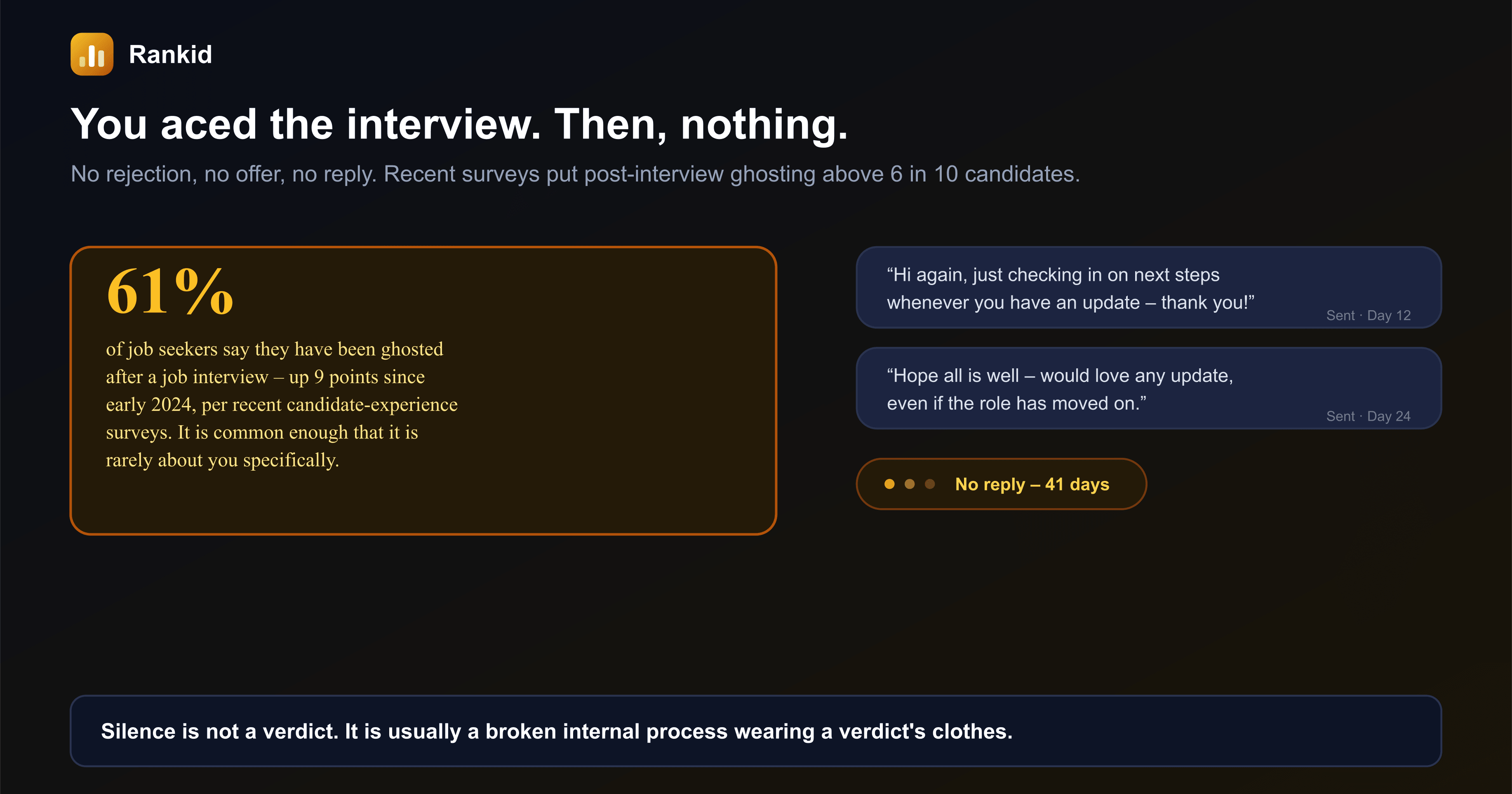
You walked out of the interview feeling good about it. The recruiter said they'd follow up by the end of the week. That was three weeks ago. No rejection email, no offer, not even an automated "we've moved forward with other candidates." Just silence, and the specific kind of silence that makes you replay every answer you gave, looking for the mistake. Here's what's actually happening on the other side of it, most of the time.
Quick answer
Quick answer: post-interview ghosting is now common enough that recent surveys put it above 6 in 10 candidates, and it is climbing. Most of the time it traces back to something on the company's side, not your interview: a frozen budget, an internal hire, a departed hiring manager, or a recruiter buried under too many open roles. Send onewell-timed, low-pressure follow-up at the right interval for the stage you're at. If that gets no response after another two to three weeks, it's reasonable to consider the process closed and keep moving.
What counts as being "ghosted" in a hiring process
Interview ghostingis when an employer stops all communication with a candidate after meaningful contact, usually after at least one interview, with no rejection, no offer, and no further update, despite a promise or reasonable expectation that one would come. It's worth separating from a slow response, which is annoying but not the same thing, and from the silence after a first application with no contact at all, which is closer to the ordinary noise of a large applicant pool than a broken promise.
It is also, worth saying plainly, not unique to job seekers anymore. Surveys of hiring teams increasingly find candidates ghosting employers too, sometimes after accepting an offer and never showing up on day one. Both directions have gotten more common as hiring has sped up in some places and slowed to a crawl in others, and each side increasingly points to the other as justification.
How common this actually is
The numbers are worth sitting with, because they change how you should read your own silence. Recent candidate-experience surveys put the share of job seekers who say they've been ghosted specifically after an interview above 6 in 10, an increase of roughly nine percentage points from just two years earlier. Separately, employer-side surveys have tracked candidate-reported ghosting climbing three years running, reaching a new high in 2026.
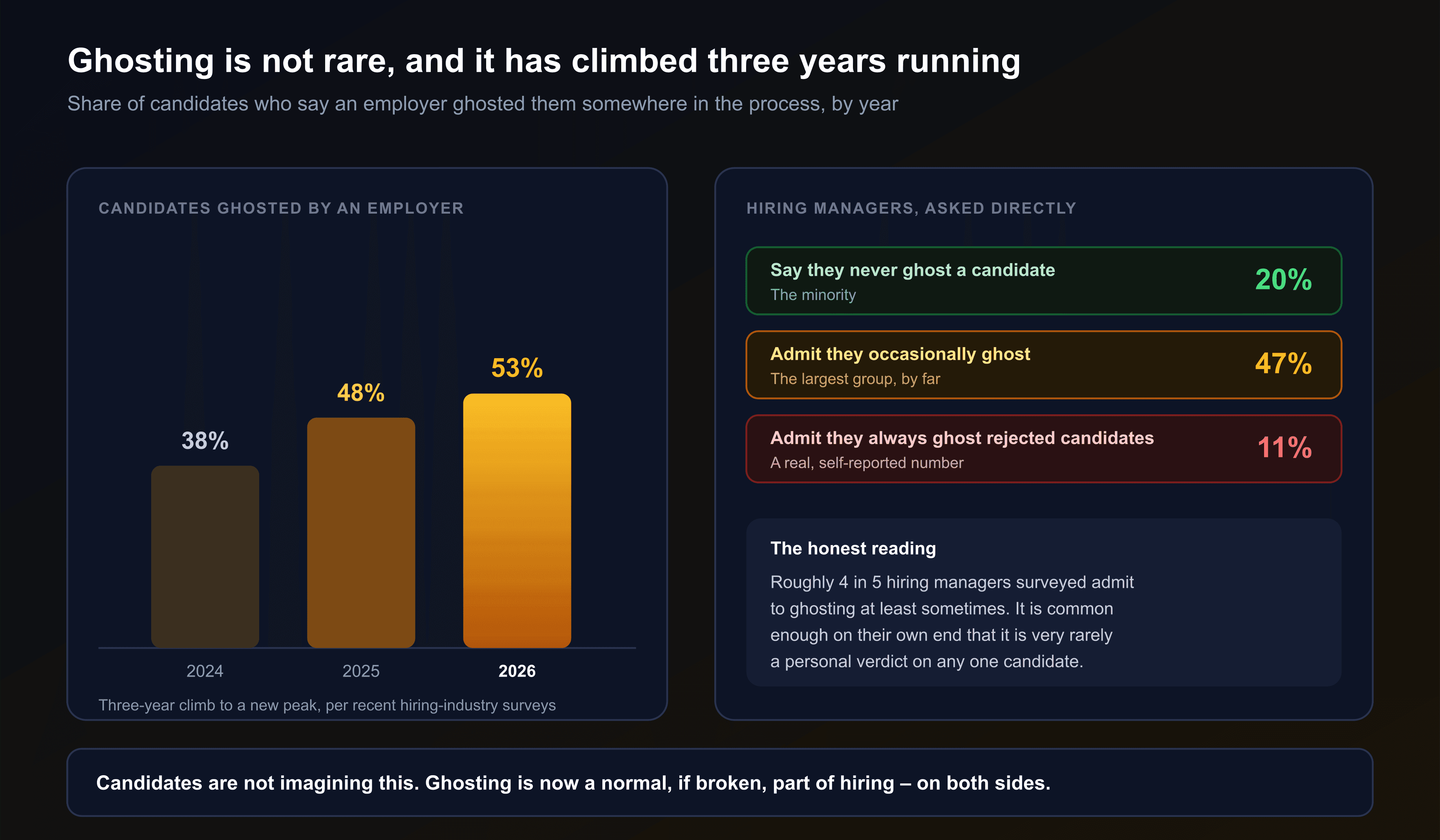
Maybe the most useful number in the whole conversation comes from asking hiring managers directly. Only about 1 in 5 say they never ghost a candidate. Roughly half admit they do it occasionally, and about 1 in 9 admit they do it as a matter of course. Read together, that means the large majority of the people on the other side of your silence have done exactly this to someone else recently, which is a strong signal it is rarely a personal verdict on you specifically.
The reframe that actually helps
Six reasons a company goes quiet that have nothing to do with your interview
None of these are visible from the outside while they're happening, which is exactly why the silence feels personal when it usually isn't.
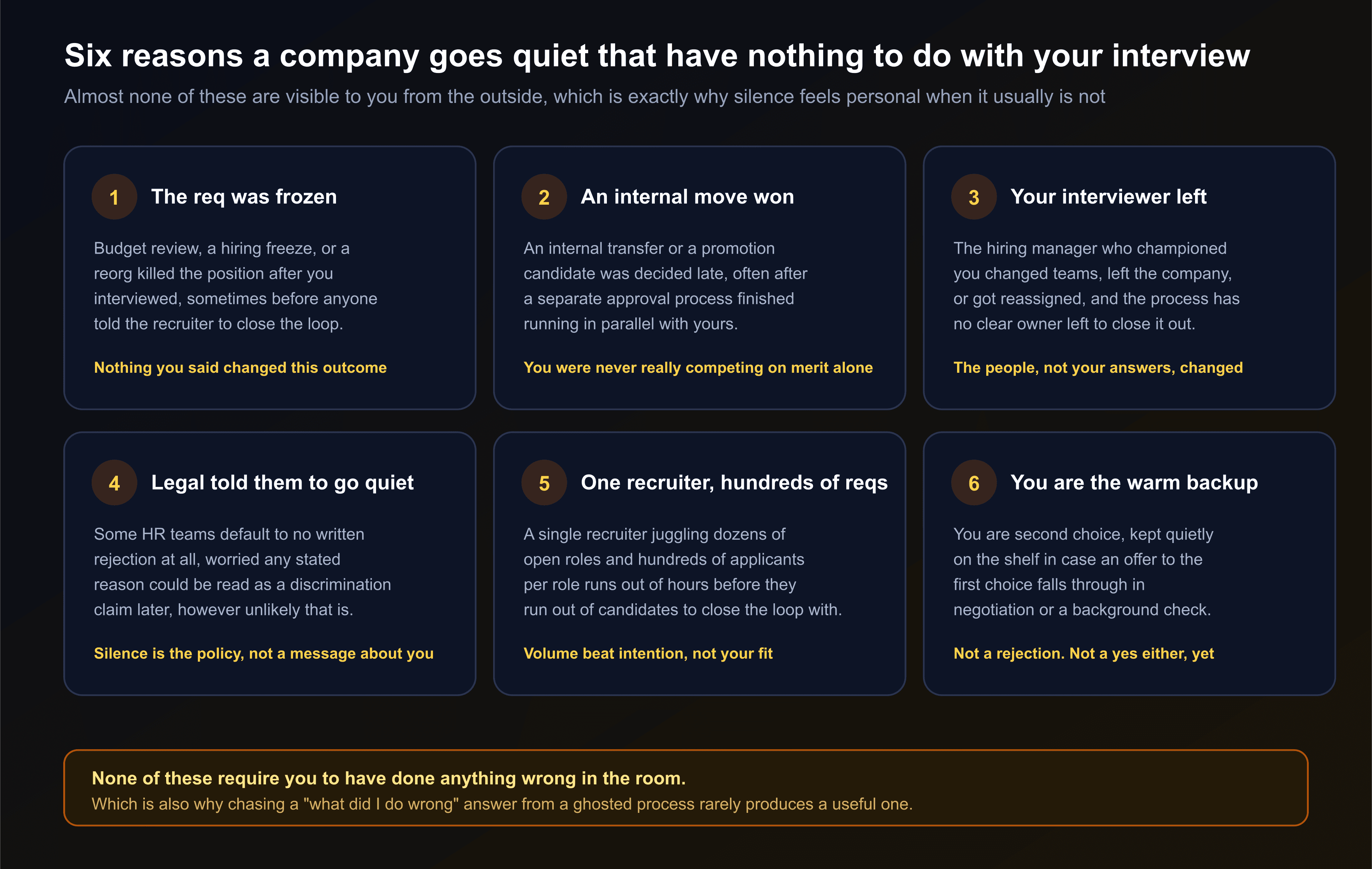
- The req was frozen or cancelled.A budget review, hiring freeze, or reorg can kill a role after you've interviewed for it, sometimes before anyone remembers to tell the recruiter to close the loop with you.
- An internal candidate won. A transfer or promotion candidate is often decided through a separate, parallel approval process, which can conclude after your external interviews wrap.
- Your champion left. If the hiring manager who liked you changes teams, leaves the company, or gets reassigned, the process can lose its owner entirely.
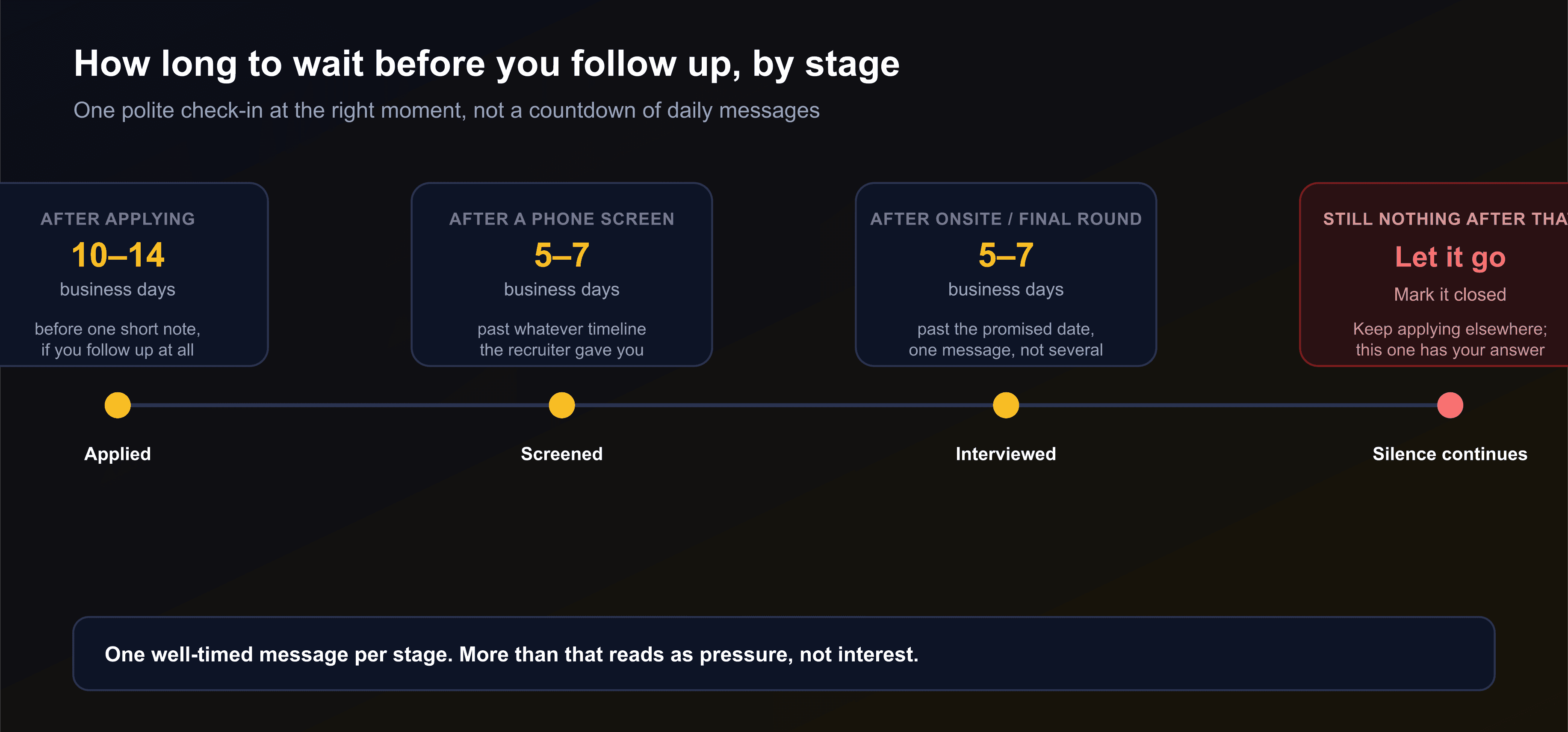
How long to wait before you follow up, by stage
One well-timed message per stage tends to work better than several. Use the interval below as a floor, not a target to hit exactly.
Wait the full interval for the stage you're at before sending anything
Send exactly one message, in the channel you've already been using
Keep the ask small: status, not urgency
Keep applying elsewhere the entire time you're waiting
Give it two to three weeks after your one follow-up, then let it go
While you wait on one process, make sure the next one doesn't stall at the resume stage
Paste your resume and a job description into Rankid for a free 0-100 match score and the exact keywords you're missing, so the applications you send while you wait don't quietly get filtered out before a human ever sees them.
Check your match score freeThe follow-up that gets a reply, and the one that doesn't
The difference between the message that works and the one that doesn't is rarely the underlying request. It's the pressure the wording carries.
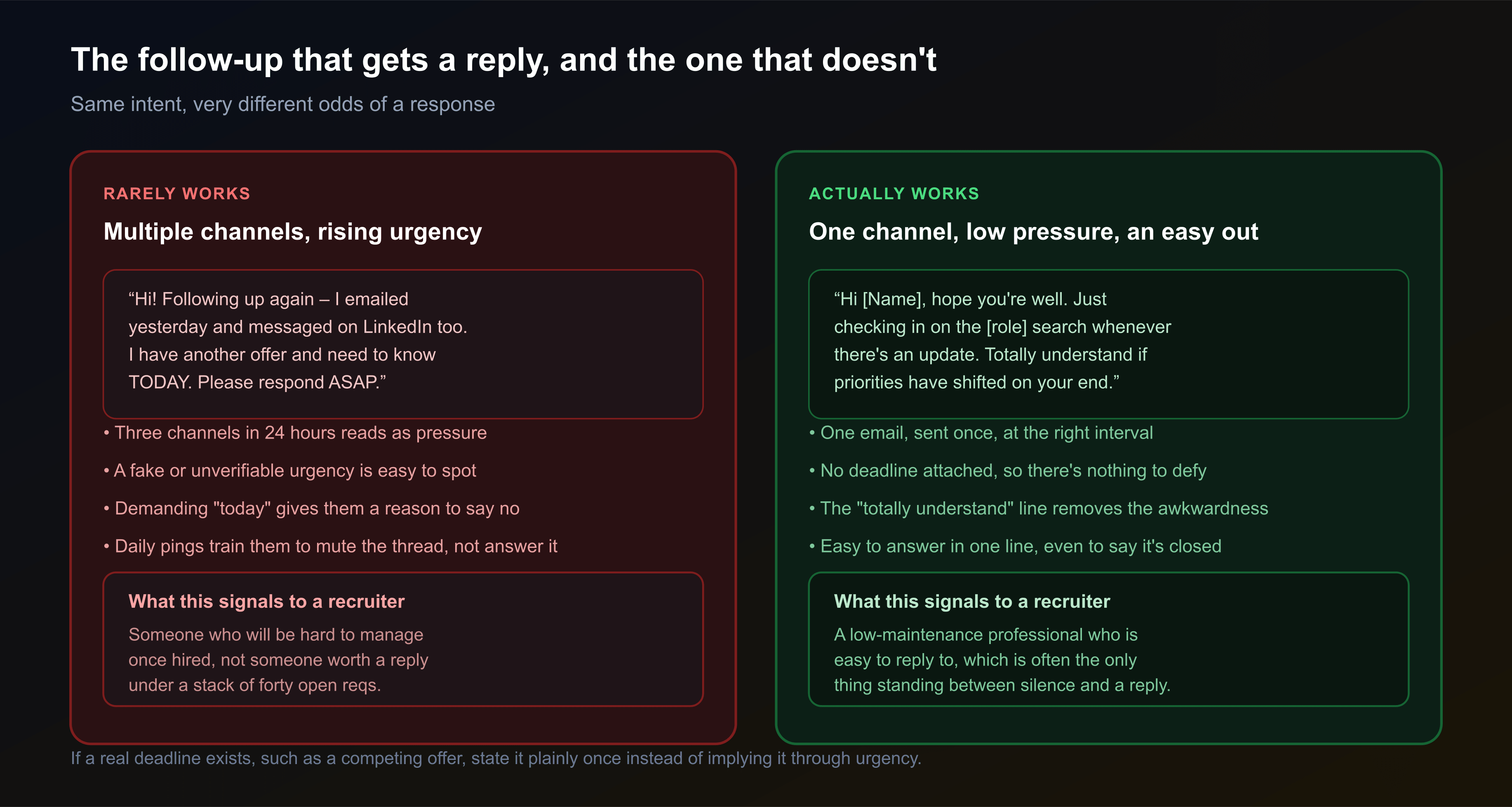
If you do have a real deadline, such as a decision date on another offer, state it plainly once rather than implying urgency through repetition. See our guides on responding to a recruiter and negotiating salary for related wording that works in adjacent moments of a job search.
When silence is actually telling you something
Most ghosting is process failure, not signal. But a few patterns are worth noticing, because they do carry real information. If the silence started right after you asked about compensation or a start date, it can sometimes mean the budget wasn't actually approved for the role before you interviewed, which is a company problem, not a you problem. If you were told you were a top candidate and then heard nothing at all, even a template rejection, that specific combination is more often a frozen req or a departed hiring manager than a quiet no. There is rarely a reliable way to tell the difference from outside, which is exactly why a single calm follow-up is worth more than trying to interpret the silence itself.
For employers: ghosting candidates isn't free, even when it feels like the path of least resistance
It is easy to see why ghosting happens on the employer side. Nobody budgets time for closing loops with candidates who didn't get the role, and a generic templated rejection can feel worse to send than nothing at all to someone who made it to a final round. But candidate experience is far more visible now than it used to be, and the cost shows up later, not immediately.
- Word travels, especially in specialized fields. A ghosted senior candidate in a small industry often knows, or becomes, the next candidate you want to reach.
- It closes the door on a future boomerang hire. Our guide on boomerang employees covers how often companies now rehire people who previously interviewed or worked there; a badly closed process makes that pipeline smaller.
- It usually reflects a process problem worth fixing anyway.If ghosting happens because recruiters are drowning in unscreened volume, that's the same bottleneck showing up as a candidate experience problem and a hiring speed problem at once. See our guide on candidate experience at volume for more on this exact overlap, and our guide to ghost jobs for the related but distinct problem of postings that were never real to begin with.
If volume is why your team goes quiet on candidates, the fix starts upstream
Upload the applicant pool and the job description. Rankid scores every resume 0 to 100 against the actual requirements with the evidence attached, so your team spends time on outreach and closing loops instead of sorting a pile that never stops growing. First 5 resumes free, no signup.
Try bulk screening freeFrequently asked questions
How common is it to get ghosted after a job interview?
More common than most candidates assume, and it has been getting worse. Recent candidate-experience surveys put the share of job seekers who say they've been ghosted after an interview above 6 in 10, a meaningful increase from just a couple of years earlier. On the employer side, surveys of hiring managers found that roughly 4 in 5 admit to ghosting a candidate at least occasionally, with only a small minority saying they never do it. If it happened to you, you are in the majority, not an outlier.
Is it something I said or did in the interview if they never got back to me?
Usually not, and this is the hardest part to internalize in the moment. Most post-interview silence traces back to something happening on the company's side that has nothing to do with your answers: a frozen budget or cancelled requisition, an internal candidate who won the role through a separate process, a hiring manager who left or got reassigned mid-search, a blanket no-response policy from legal or HR, or simply a recruiter managing far more open roles and applicants than they have hours to close the loop with. None of those require you to have done anything wrong in the room.
How long should I wait before following up after an interview?
It depends on the stage. After an initial application with no contact yet, 10 to 14 business days is reasonable before a first light touch. After a phone screen or recruiter call, wait 5 to 7 business days past whatever timeline you were given. After an onsite, panel, or final round, the same 5 to 7 business days past the promised date applies, with one message, not several. If you have followed up once at the right interval and still hear nothing, it's usually time to treat the process as closed rather than sending a second or third message.
What should my follow-up message actually say?
Short, low-pressure, and give them an easy out. Something like: "Hi [Name], hope you're well. Just checking in on the [role] search whenever there's an update. Totally understand if priorities have shifted on your end." One channel, sent once. Avoid multiple channels in the same week, avoid an implied or explicit deadline unless a real one exists, and avoid escalating tone on a second message. Recruiters managing dozens of open roles are more likely to answer a message that's easy to reply to in one line than one that reads as pressure.
Should I message the hiring manager directly on LinkedIn if the recruiter isn't responding?
One polite, brief message is reasonable if you've already given the recruiter a fair chance to respond through the normal channel. Keep it short, reference the specific role and interview date so it's easy to place, and don't message every person you met in the process separately, which tends to read as chasing rather than following up. If the hiring manager also goes quiet, that's a stronger signal the process has genuinely stalled internally rather than a reason to keep escalating.
Does following up too much hurt my chances?
Yes, past a certain point. A single well-timed message rarely hurts and sometimes helps, since it can genuinely surface your resume in an inbox that got buried. Multiple messages across email, LinkedIn, and a phone call within the same week, or messages with an artificial deadline attached, tend to read as pressure rather than interest, and some hiring managers describe this specifically as a reason not to move a candidate forward, since it previews what they'd be like to manage day to day.
Is it okay to just stop responding to a recruiter I'm no longer interested in, since companies do it to candidates?
It happens, and surveys show a majority of job seekers now consider it a fair response to being ghosted themselves, but it's worth separating what's common from what serves you best long-term. A one-line note declining or withdrawing costs you thirty seconds and keeps a relationship with a recruiter who may have other roles later, or move to a company you want to work for next. Ghosting them back settles a score in the moment but has no real upside beyond that.
How do I know when to stop waiting and consider the process closed?
If you've followed up once at the appropriate interval for that stage and heard nothing for another 2 to 3 weeks, it's reasonable to mentally close the loop and stop factoring that role into your plans, even without formal confirmation. This isn't about giving up on the company forever, since roles do sometimes reopen or resurface, but about not letting an open-ended maybe quietly stall your job search while you wait for an answer that may never come.
Can I apply again to the same company later if I was ghosted the first time?
Usually yes, and it happens more often than people expect. A ghosted process is frequently a symptom of an internal breakdown, a frozen budget, or a departed hiring manager rather than a rejection of you specifically, so a role reopening six months or a year later under new ownership is a real possibility. If you reapply, there's no need to reference the earlier silence; treat it as a fresh application unless a recruiter you have a genuine relationship with brings it up first.
Why do some companies have a policy of never responding to rejected candidates?
Usually a mix of legal caution and volume. Some HR and legal teams worry that any stated reason for rejection, however accurate and reasonable, could later be cited in a discrimination claim, so the safest policy on paper becomes silence rather than a written explanation. Separately, a recruiter handling dozens of open roles and hundreds of applicants per role simply runs out of hours to send individual, meaningful rejections, and a generic auto-rejection to everyone who wasn't hired can feel worse than nothing to the specific candidates who made it deep into the process.
Does interview ghosting mean I'm the backup candidate in case the top choice falls through?
It's one possibility among several, and it's genuinely hard to distinguish from the outside. Companies sometimes keep a strong second-choice candidate warm, deliberately vague, while they finalize negotiations or a background check with their first choice. If that's what's happening, following up professionally rather than going quiet yourself keeps you in consideration if the first choice falls through, which does happen often enough to be worth the patience.
As an employer, why does ghosting candidates actually cost us something?
Because candidate experience is far more visible now than it used to be. Ghosted candidates talk, post reviews on sites job seekers check before applying, and remember the experience the next time your company has an opening they'd be a fit for, including as a future boomerang hire. Losing candidates to word of mouth about a bad process is a real, if hard to measure, cost, and it compounds specifically in tight talent markets where the same specialized candidates resurface across multiple open roles at your company over the years.
Key takeaways
- Post-interview ghosting is common: recent surveys put it above 6 in 10 candidates, and the rate has climbed three years running.
- Roughly 4 in 5 hiring managers surveyed admit to ghosting a candidate at least sometimes, which is strong evidence it's rarely personal.
- Most ghosting traces to internal causes: a frozen req, an internal hire, a departed hiring manager, legal caution, or a recruiter buried in volume.
- Wait 10-14 business days after applying, 5-7 business days past the given timeline after a phone screen, and the same after an onsite or final round.
- Send one low-pressure message per stage, in the channel you've already used, asking for status rather than issuing a deadline.
- Multiple channels, daily messages, or an implied fake urgency tend to reduce your odds of a reply, not improve them.
- If a follow-up gets no response after another two to three weeks, it's reasonable to consider the process closed and stop planning around it.
- A role can reopen later even after a ghosted process, so there's rarely a reason to burn the relationship by ghosting back.
- Employers: ghosting candidates has a real, if delayed, cost through word of mouth, review sites, and a smaller future boomerang-hire pipeline.
Frequently asked questions
How common is it to get ghosted after a job interview?
More common than most candidates assume, and it has been getting worse. Recent candidate-experience surveys put the share of job seekers who say they've been ghosted after an interview above 6 in 10, a meaningful increase from just a couple of years earlier. On the employer side, surveys of hiring managers found that roughly 4 in 5 admit to ghosting a candidate at least occasionally, with only a small minority saying they never do it. If it happened to you, you are in the majority, not an outlier.
Is it something I said or did in the interview if they never got back to me?
Usually not, and this is the hardest part to internalize in the moment. Most post-interview silence traces back to something happening on the company's side that has nothing to do with your answers: a frozen budget or cancelled requisition, an internal candidate who won the role through a separate process, a hiring manager who left or got reassigned mid-search, a blanket no-response policy from legal or HR, or simply a recruiter managing far more open roles and applicants than they have hours to close the loop with. None of those require you to have done anything wrong in the room.
How long should I wait before following up after an interview?
It depends on the stage. After an initial application with no contact yet, 10 to 14 business days is reasonable before a first light touch. After a phone screen or recruiter call, wait 5 to 7 business days past whatever timeline you were given. After an onsite, panel, or final round, the same 5 to 7 business days past the promised date applies, with one message, not several. If you have followed up once at the right interval and still hear nothing, it's usually time to treat the process as closed rather than sending a second or third message.
What should my follow-up message actually say?
Short, low-pressure, and give them an easy out. Something like: "Hi [Name], hope you're well. Just checking in on the [role] search whenever there's an update. Totally understand if priorities have shifted on your end." One channel, sent once. Avoid multiple channels in the same week, avoid an implied or explicit deadline unless a real one exists, and avoid escalating tone on a second message. Recruiters managing dozens of open roles are more likely to answer a message that's easy to reply to in one line than one that reads as pressure.
Should I message the hiring manager directly on LinkedIn if the recruiter isn't responding?
One polite, brief message is reasonable if you've already given the recruiter a fair chance to respond through the normal channel. Keep it short, reference the specific role and interview date so it's easy to place, and don't message every person you met in the process separately, which tends to read as chasing rather than following up. If the hiring manager also goes quiet, that's a stronger signal the process has genuinely stalled internally rather than a reason to keep escalating.
Does following up too much hurt my chances?
Yes, past a certain point. A single well-timed message rarely hurts and sometimes helps, since it can genuinely surface your resume in an inbox that got buried. Multiple messages across email, LinkedIn, and a phone call within the same week, or messages with an artificial deadline attached, tend to read as pressure rather than interest, and some hiring managers describe this specifically as a reason not to move a candidate forward, since it previews what they'd be like to manage day to day.
Is it okay to just stop responding to a recruiter I'm no longer interested in, since companies do it to candidates?
It happens, and surveys show a majority of job seekers now consider it a fair response to being ghosted themselves, but it's worth separating what's common from what serves you best long-term. A one-line note declining or withdrawing costs you thirty seconds and keeps a relationship with a recruiter who may have other roles later, or move to a company you want to work for next. Ghosting them back settles a score in the moment but has no real upside beyond that.
How do I know when to stop waiting and consider the process closed?
If you've followed up once at the appropriate interval for that stage and heard nothing for another 2 to 3 weeks, it's reasonable to mentally close the loop and stop factoring that role into your plans, even without formal confirmation. This isn't about giving up on the company forever, since roles do sometimes reopen or resurface, but about not letting an open-ended maybe quietly stall your job search while you wait for an answer that may never come.
Can I apply again to the same company later if I was ghosted the first time?
Usually yes, and it happens more often than people expect. A ghosted process is frequently a symptom of an internal breakdown, a frozen budget, or a departed hiring manager rather than a rejection of you specifically, so a role reopening six months or a year later under new ownership is a real possibility. If you reapply, there's no need to reference the earlier silence; treat it as a fresh application unless a recruiter you have a genuine relationship with brings it up first.
Why do some companies have a policy of never responding to rejected candidates?
Usually a mix of legal caution and volume. Some HR and legal teams worry that any stated reason for rejection, however accurate and reasonable, could later be cited in a discrimination claim, so the safest policy on paper becomes silence rather than a written explanation. Separately, a recruiter handling dozens of open roles and hundreds of applicants per role simply runs out of hours to send individual, meaningful rejections, and a generic auto-rejection to everyone who wasn't hired can feel worse than nothing to the specific candidates who made it deep into the process.
Does interview ghosting mean I'm the backup candidate in case the top choice falls through?
It's one possibility among several, and it's genuinely hard to distinguish from the outside. Companies sometimes keep a strong second-choice candidate warm, deliberately vague, while they finalize negotiations or a background check with their first choice. If that's what's happening, following up professionally rather than going quiet yourself keeps you in consideration if the first choice falls through, which does happen often enough to be worth the patience.
As an employer, why does ghosting candidates actually cost us something?
Because candidate experience is far more visible now than it used to be. Ghosted candidates talk, post reviews on sites job seekers check before applying, and remember the experience the next time your company has an opening they'd be a fit for, including as a future boomerang hire. Losing candidates to word of mouth about a bad process is a real, if hard to measure, cost, and it compounds specifically in tight talent markets where the same specialized candidates resurface across multiple open roles at your company over the years.