How to Respond to a Recruiter: Templates for LinkedIn, Email and Every Situation (2026)
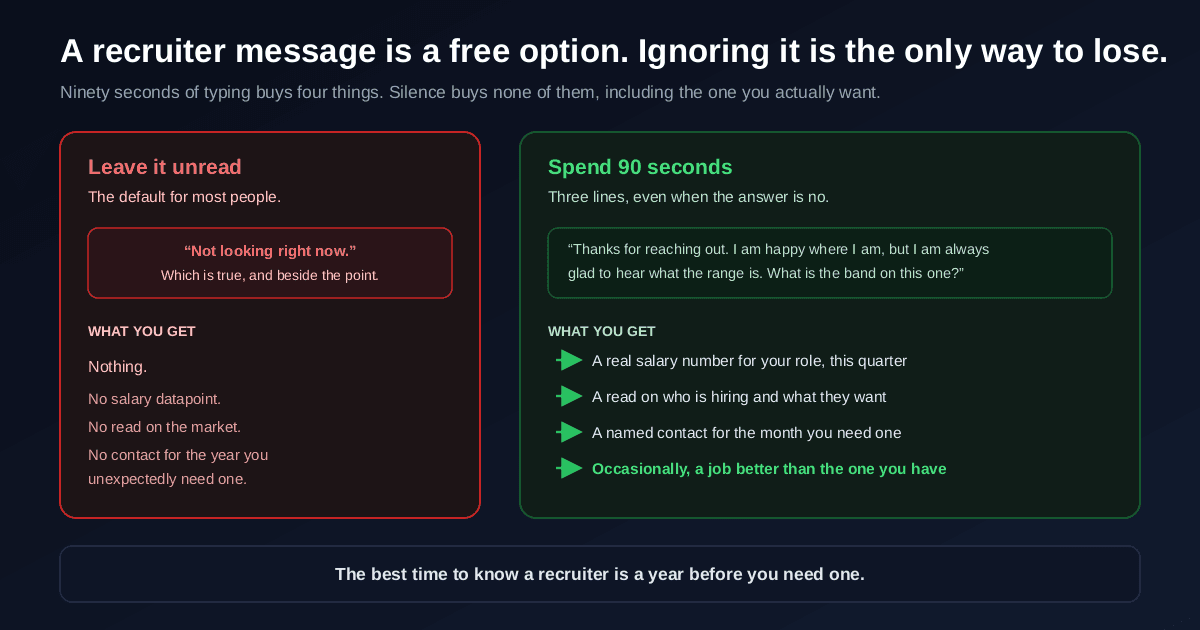
It arrives on a Tuesday afternoon, and you are busy. A recruiter has an exciting opportunity with a fast-growing company, thinks you would be a great fit, and would love a quick chat this week. There is no company name, no job title, no salary, and no indication that anyone has read anything you have ever done. So you do what almost everybody does, which is nothing at all. That is usually the wrong move, and not for the reason recruiters normally give. It is the wrong move because a message like that is a free option, and the only way to lose money on a free option is to leave it unexercised.
Quick answer
Quick answer: reply within 24 to 48 hours, in three to five sentences, and end with questions rather than a yes to a call. Thank them, state your position in one line, then ask for the company, the salary band, the real office expectation, the stage of the process, and why you specifically. Reply even when you are not looking, because the range and the contact are worth having. Never agree to a call before you know the band, never give a single salary number, and never give your current salary. Say no in three warm sentences instead of going silent.
Should you reply to recruiters at all?
Yes, including when the answer is no, and the argument is not about politeness. Ninety seconds of typing buys three things that are genuinely hard to get any other way.
- A real salary number for your role, this quarter. Not a survey, not a range on a job board, but what a company is actually willing to pay for your job right now. That number is the most useful input you will have the next time you ask for a raise, and it is almost impossible to obtain honestly anywhere else.
- A read on the market. Who is hiring, for what, at what level, with what requirements. This is market intelligence arriving unsolicited in your inbox.
- A named contact for the month you need one. Layoffs, reorganisations and bad new managers do not schedule themselves. The best time to know a recruiter is about a year before you need one, and the only route to that position is having replied when you did not need anything.
The one genuinely bad option is the slow fade: leaving it unread for three weeks and then sending a long apologetic message. A clean no on day one is better for both of you, and recruiters keep notes, including the note that says you never answered.
Work out who actually messaged you
Before you write anything, spend ten seconds identifying what kind of recruiter this is, because it changes both how much they can tell you and what you need to be careful about.
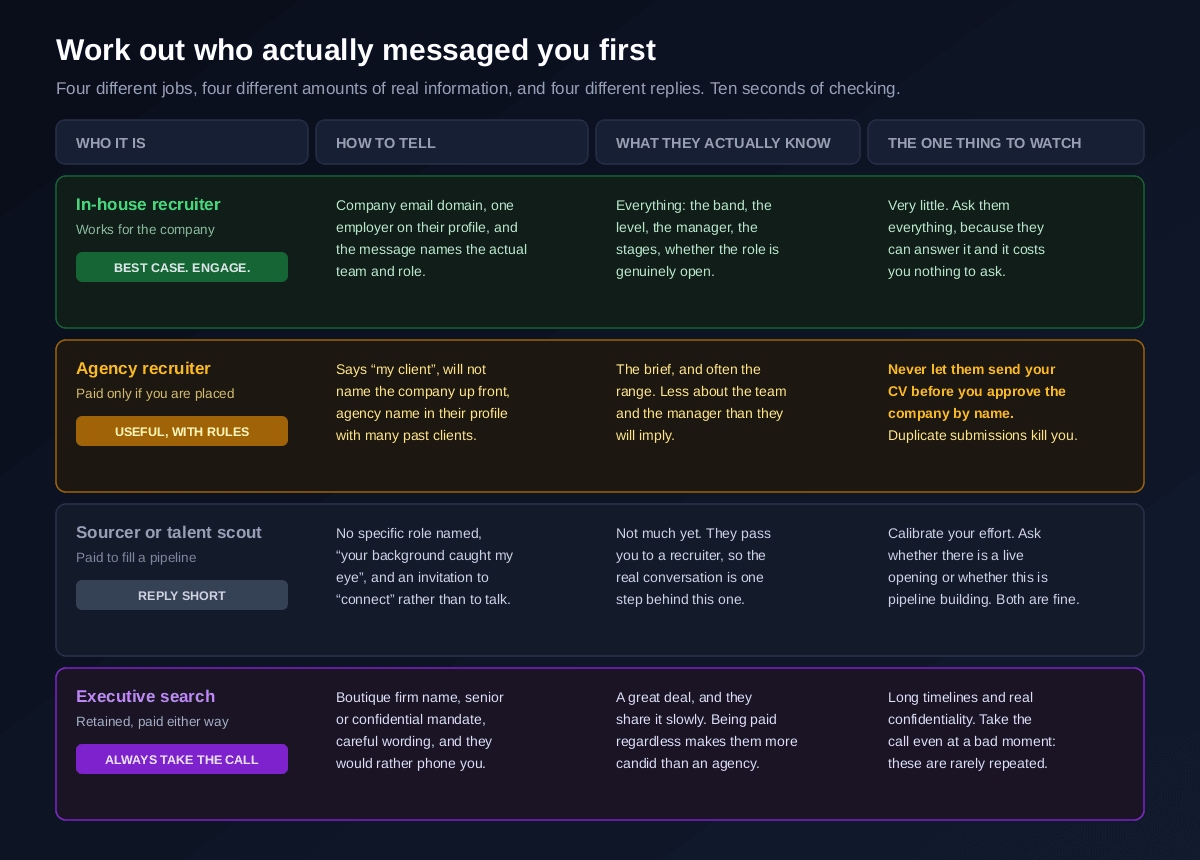
The distinction that costs people real money is the agency one. Agency recruiters are usually paid only if you are placed, which gives them a genuine interest in getting you submitted somewhere quickly. That produces one non-negotiable rule: never let an agency send your CV anywhere before you have approved the company by name. If you have already applied directly, or another agency has already put you forward, some employers will disqualify you outright rather than adjudicate a fee dispute.
The ten-second check
What to put in your first reply
Five questions, all of which fit in one short message, and all of which you should send before agreeing to any call. The answers decide whether there should be a call at all.
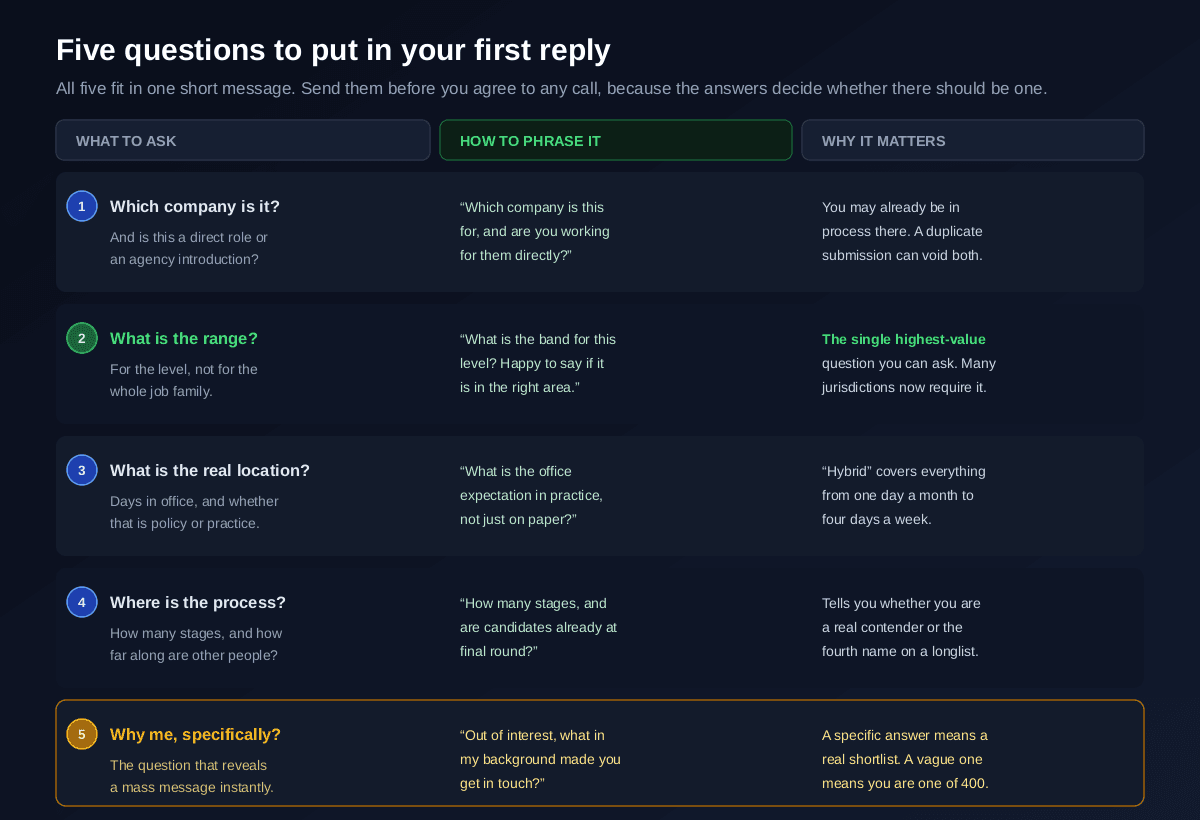
The range is the highest-value question, because it can end the conversation in a single exchange and save everybody a week. And the last question is the cheapest test available: a recruiter who can point at something specific in your work has a real shortlist, while a vague answer tells you that you are one of several hundred. Both are worth knowing before you spend an evening on it.
Nine templates for every situation
Every one of these follows the same shape: thank them, state your position in one line, ask for what you need, make the next step easy. Adapt the specifics and keep the length.
Interested, and you want the details
Hi [Name], thanks for reaching out, this does sound worth a conversation. Before we book anything, could you tell me which company it is, the band for the level, and what the office expectation is in practice? Also useful to know how many stages there are and whether anyone is already at final round. If it lines up I am very happy to talk this week.
Interested, but currently employed and you need discretion
Hi [Name], thanks for getting in touch. I am open to hearing about it, with one request: I am employed and my search is confidential, so please do not share my details with anyone without checking with me first, and email rather than calling during the day is much easier for me. Could you send over the company, the level and the range, and I will come back to you this evening?
Not interested now, but keeping the door open
Hi [Name], thanks for thinking of me. I am happy where I am at the moment, so this is not the right time. For future reference, I would look seriously at a step up in scope, or anything above [number]. Out of interest, what is the band on this one? Useful for me to know either way, and do keep me in mind.
Not interested at all, and you want the messages to stop
Hi [Name], thanks for reaching out. This is not a fit for me and I am not looking more broadly, so please do take me off your list for this search. If something at [level or specialism] comes up in future I would be glad to hear about it, but otherwise no need to follow up.
Clear beats vague here. A soft no invites three follow-ups, which is worse for both of you than a plain one.
Wrong role, right company
Hi [Name], thanks for this. The role itself is not right for me, it is a step sideways rather than forward. That said, I have been interested in [Company] for a while, particularly [specific thing]. If anything opens up in [area or level], I would genuinely like to hear about it. Happy to pass this one to someone in my network if that helps.
You already applied there, or you are already in a process
Hi [Name], thanks for reaching out. Worth flagging straight away that I applied for this directly on [date], so I may already be in your system, and I have not been put forward by any agency. Are you able to check where that application got to? Happy to pick it up from wherever it stalled.
Say this first, before anything else in the conversation. With an agency recruiter it is essential rather than polite, and it also gives you a legitimate way to ask what happened to an application you never heard back about.
They asked for your salary expectations in the first message
Hi [Name], thanks for the details. Before I give you a number, what is the band for this level? Happy to confirm quickly whether that is in the right area, and it will save us both some time if it is not.
If they insist you go first: "Based on what I am seeing for this scope in this market, I am looking at [X to Y]. Where does that sit against your range?" A band, a justification, and the question handed back.
An agency recruiter, before they submit you anywhere
Hi [Name], happy to hear more. Two things first: which company is this for, and are you working with them directly or through another party? And please do not send my CV to anyone until I have confirmed I want to be put forward for that specific company. I may already be in process elsewhere and I do not want to create a duplicate.
Reconnecting months or years later
Hi [Name], we spoke last [month] about the [role] at [Company] and I was happy where I was at the time. That has changed and I am starting to look properly. Since then I have [the specific thing you did], so that work is now most of what I do. Is there anything open at that level, and is now a reasonable time to talk?
How to handle the salary question
The question arrives early and it unsettles people, mostly because it feels like the negotiation has started. It has not. In the first message it is a filter, not a negotiation, and the correct response is a filter answer.
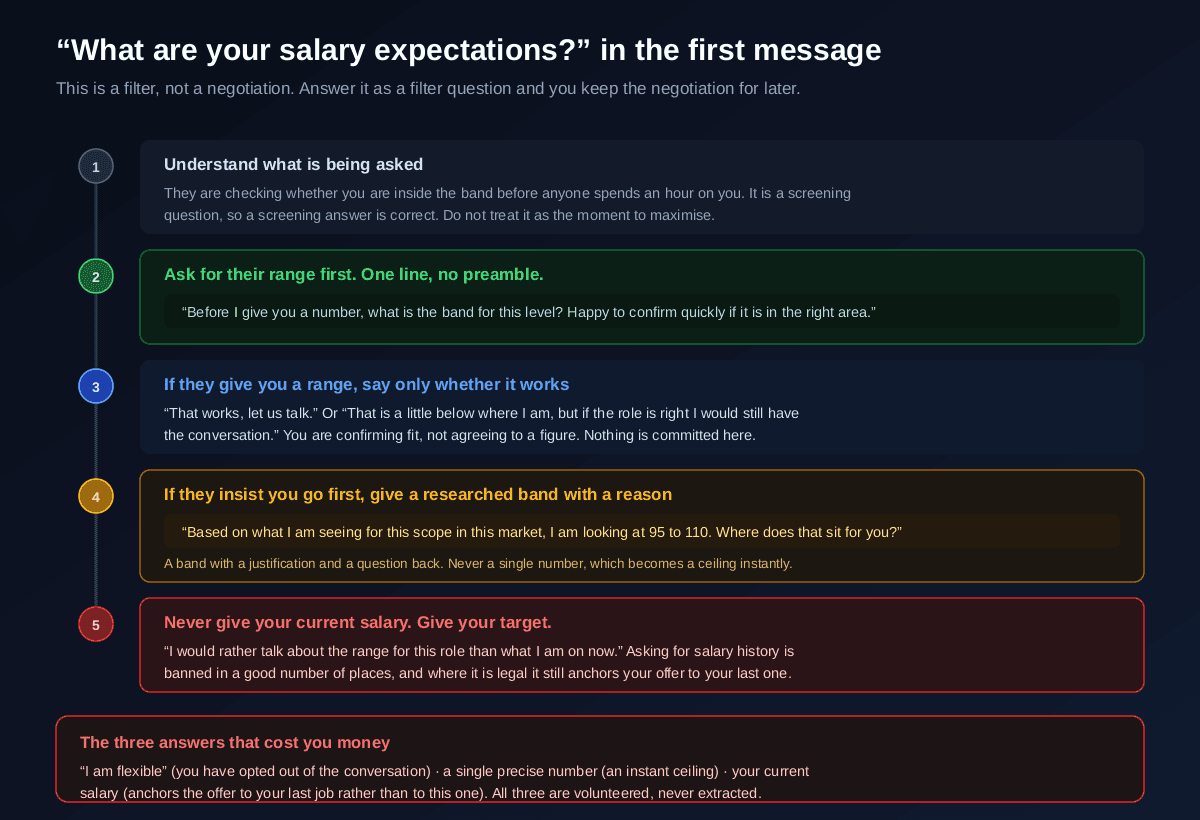
Two rules do most of the work. Never a single number, because a precise figure becomes a ceiling within seconds. And never your current salary: asking for salary history is banned in a substantial number of US states and cities and elsewhere besides, and where it is still legal it anchors your next offer to your last job rather than to this one, which hurts most if you are underpaid now, which is a common reason to be talking to a recruiter in the first place.
This is the screening stage only. The actual negotiation happens after an offer, and how to negotiate salary covers it, while salary bands and compa-ratio explains what the band they are quoting from actually is.
How to spot a message not worth your evening
Grading a recruiter message takes about ten seconds once you know the tells. Here are two real-shaped examples side by side.
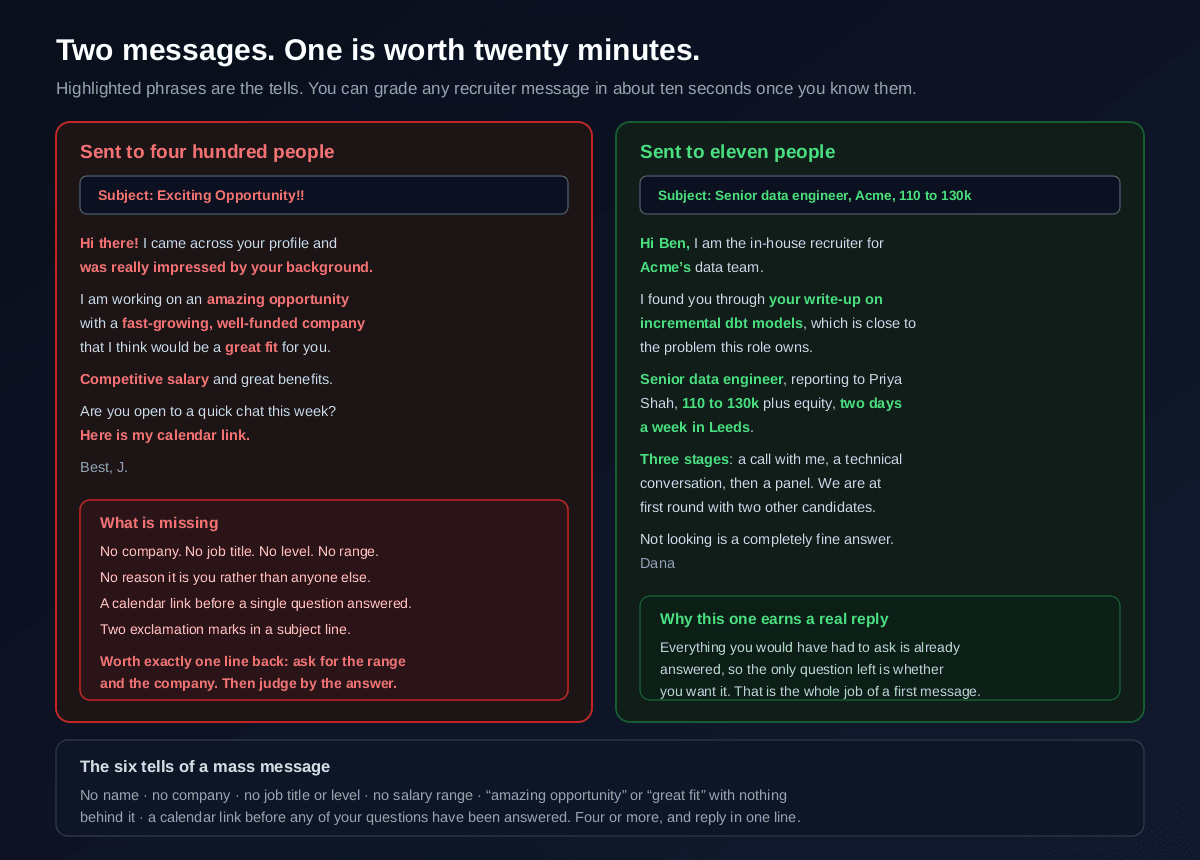
Importantly, a weak message is not proof of a bad job. Busy in-house recruiters write thin messages about real roles all the time. That is why the correct response to a vague message is one line, not silence: ask for the company and the range, then judge by the answer, which is far more diagnostic than the original message.
Two things do deserve real suspicion rather than a follow-up question. Pressure to move quickly on a role you cannot verify exists, which is worth reading ghost jobs about. And any request for bank details, identity documents or a passport copy before there is a written offer, which is the standard shape of recruitment fraud rather than an unusual process.
If you take the call, treat it as a stage
Once the range, the company and the location check out, take the call. Twenty minutes gets you things a written exchange will not: how the manager talks about the role, why the last person left, what the team is actually struggling with.
But be clear about what it is. That call is a screening interview, it is scored, and the recruiter is deciding whether to pass you to the hiring manager. Have a two-minute version of your background ready, two or three real questions about the team, and a number you are targeting. Preparing for a job interview applies in a lighter form, and questions to ask in an interview has more of them. If the process goes forward, later stages often include a one-way video interview, a take-home assignment, or a panel interview.
One tell worth noticing: if a recruiter will only speak by phone and refuses to put the band or the company in writing beforehand, that is information. A real role has a real band, and someone who will not put it in an email may not have one.
Saying no without closing the door
Most of the value in these conversations does not land in the month they happen. It lands eighteen months later, and only if you did two minutes of filing at the time.
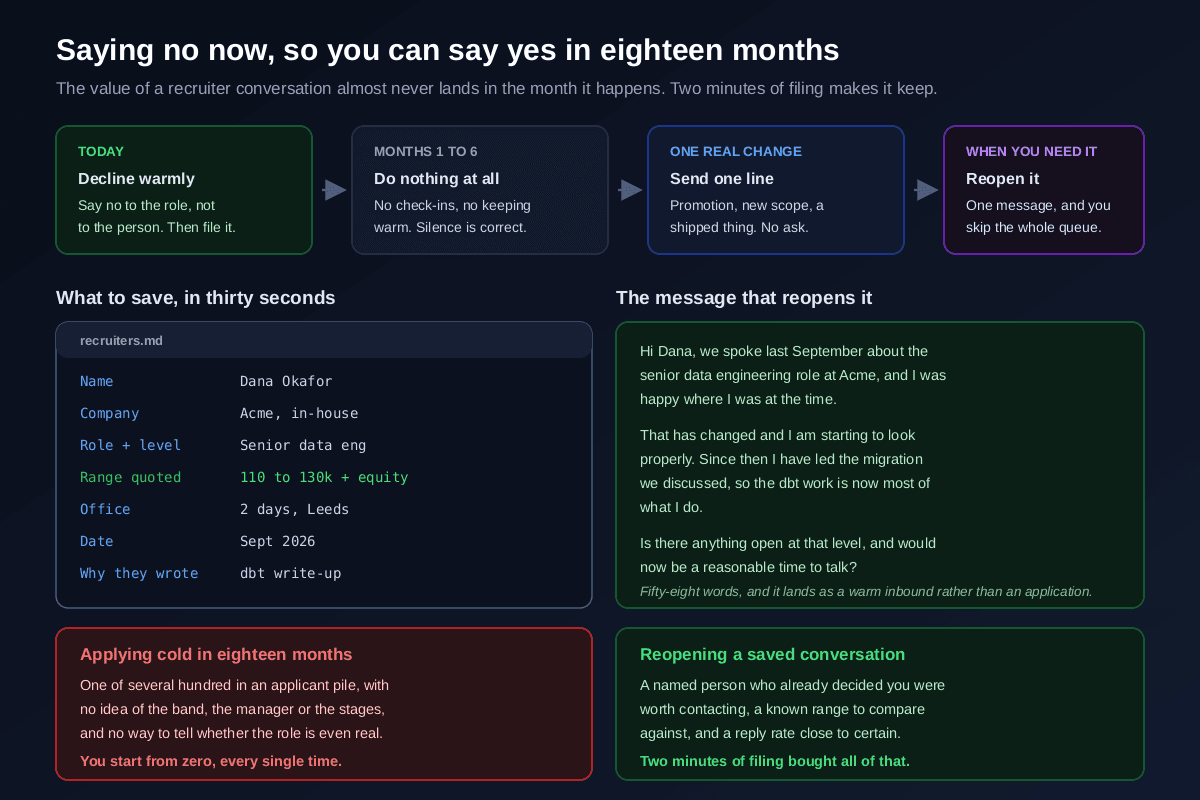
The habit is small: seven fields in a note. Name, company, whether in-house or agency, role and level, the range they quoted, the office expectation, the date, and one line on why they contacted you. Eighteen months later that file is the difference between reopening a conversation with someone who already decided you were worth contacting, and starting from zero in a pile of several hundred applications.
What not to do is "keep warm" with quarterly check-ins that contain no information. Silence between real events is correct. Send one line when something actually changes, which is the same discipline that makes an informational interview compound rather than expire.
Mistakes that cost you the option
- Ignoring it because you are not looking. The reply is 90 seconds and the salary datapoint alone is worth more than that.
- Agreeing to a call before you know the band. How people end up spending half an hour discovering the role pays well below their current job.
- Giving a single salary number. It becomes a ceiling immediately, and you will not get it back.
- Saying you are flexible. This sounds accommodating and functions as opting out of the conversation entirely.
- Letting an agency submit you blind. Duplicate submissions get candidates disqualified, and you will not be told why.
- Not mentioning that you already applied. Cheap to say, occasionally saves the whole opportunity.
- Writing six paragraphs about your career. They asked a question. Answer it and ask five back.
- Attaching a resume unprompted. Send it when they ask, once you know which company it is going to.
- Ghosting after two exchanges. The one thing recruiters reliably remember, and they keep notes.
A note on the underlying problem, if recruiters never contact you at all: getting found by recruiters on LinkedIn covers the search side of it, and why you are not getting interviews covers the applications side.
Before you reply, check how you actually read on paper
A recruiter conversation ends with your resume being compared to a job description. Paste both into Rankid for a 0-100 match score, the requirements you have evidenced, and the exact keywords you are missing. One check free, no signup.
Check your resume freeFor recruiters: what actually earns a reply
Flipping this round, because the same analysis explains why most outreach fails. Reply rates on passive candidates are driven overwhelmingly by one thing, and it is the thing most messages leave out.
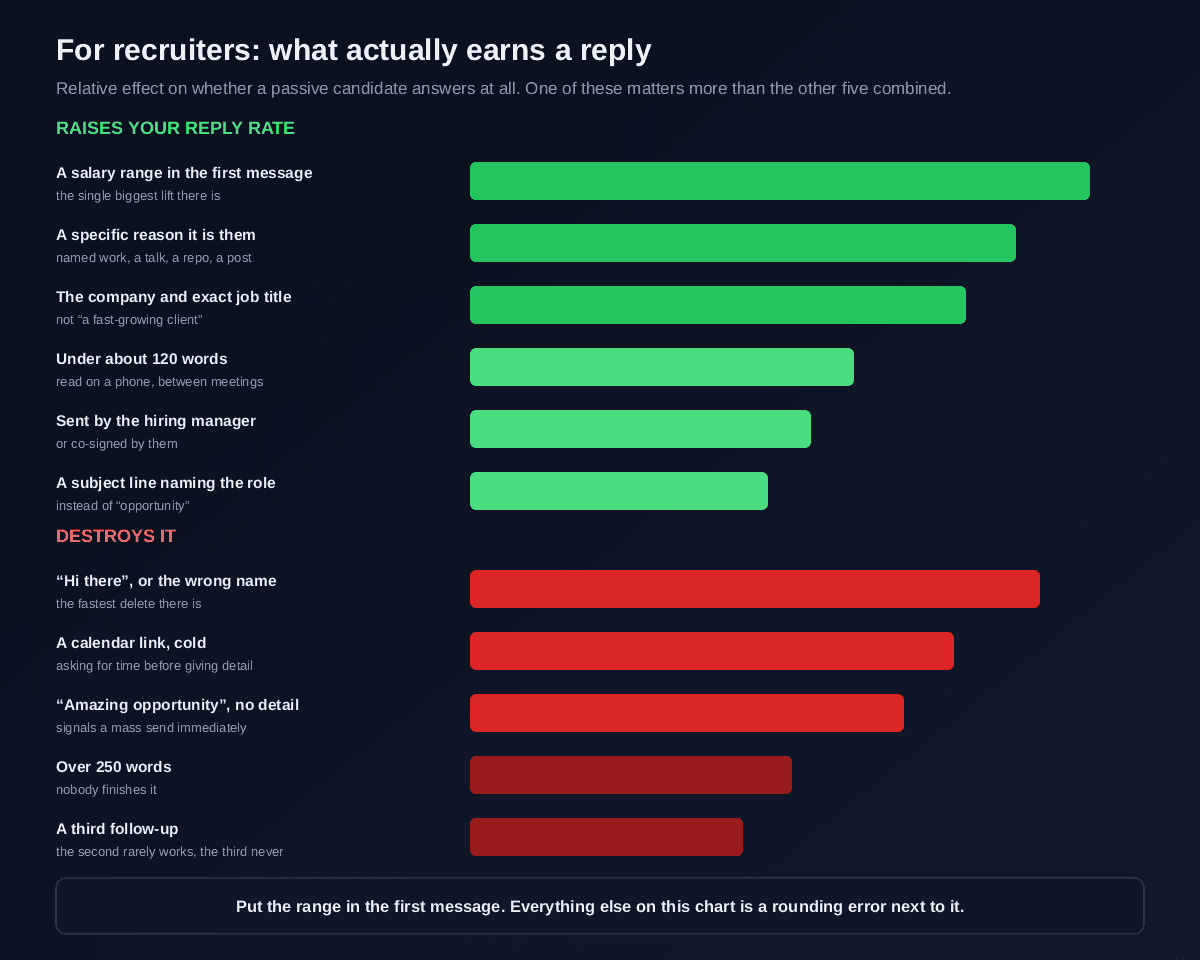
Put the range in the first message. Everything else on that chart is a rounding error next to it. A passive candidate who is not looking has no reason to spend an exchange discovering that the role pays less than their current job, and asking them to do that is asking them to volunteer for disappointment.
Two more things that are cheap and underused. Say explicitly that not looking is a fine answer, which raises replies because it lowers the cost of engaging at all. And reply to the people who say no, because they are your pipeline for next year: a candidate who declined warmly and got a warm reply is the cheapest source of hire you have, which is the whole logic of a talent pipeline and of candidate sourcing done properly.
And treat outreach as part of your candidate experiencerather than as a volume activity. Mass messaging is cheap per send and expensive in aggregate, because every unanswered mass message trains a market of candidates to ignore your company's name in an inbox. If volume is genuinely the constraint, high-volume recruiting and recruitment automation cover how to get leverage without spending your reputation to get it.
Frequently asked questions
How do you respond to a recruiter on LinkedIn?
Reply within a day or two, in three to five sentences, and end with questions rather than with a yes to a call. The structure that works in every case is the same: thank them, state your position in one line, ask for the specifics you need, and make the next step easy. Something like: 'Thanks for reaching out. I am not actively looking, but I am happy to hear about the right thing. Could you tell me which company it is, the band for the level, and what the office expectation is in practice? If it lines up I am glad to have a call.' That message takes ninety seconds and does four useful things. It keeps you in the conversation without committing you to anything, it gets you a salary datapoint for your own market awareness, it filters out mass messages instantly because a recruiter who cannot answer those three questions was never really talking to you specifically, and it leaves a named contact you can come back to in a year. Do not open with your resume, do not agree to a call before you know the range, and do not write six paragraphs about your career.
Should you respond to a recruiter if you are not looking for a job?
Yes, and the case for it is stronger than most people assume. Replying to say no costs you about ninety seconds, and it buys three things you cannot easily get otherwise. First, a salary datapoint for your actual role in the current market, which is the single most useful number in any future pay conversation and is very hard to obtain honestly anywhere else. Second, a read on who is hiring for what, which is genuine market intelligence delivered to your inbox for free. Third, and most valuable over a career, a named human contact for the month you unexpectedly need one, because layoffs, reorganisations and bad new managers do not schedule themselves. The best time to know a recruiter is about a year before you need one, and the only way to be in that position is to have answered when you did not. The one thing not to do is a slow fade: leaving a message unread for three weeks and then replying is worse than a clean no on day one, both for them and for you.
How do you respond to a recruiter when you are happy in your current job?
Say you are happy, say what would change your mind, and ask for the range anyway. The line that does all the work is a specific version of what you would move for: 'I am happy at the moment. Realistically I would only move for a step up in scope, or something above X. What is the band on this one?' That is honest, it does not waste anyone's time, and it converts a dead end into a useful exchange, because a recruiter who knows your bar will come back with something that clears it rather than with the next requisition on their list. Being specific also protects you from the version of this exchange that helps nobody, which is 'not looking, thanks' followed by the same recruiter messaging you about the same unsuitable role in six months. And ask about the range even when you are certain you will say no, because knowing what the market pays for your job is useful whether or not you ever move, particularly the next time you are preparing to ask for a raise.
How do you tell a recruiter you are not interested politely?
Be clear, be brief, be warm, and be specific about the future. Three sentences: 'Thanks for thinking of me. This is not the right move for me at the moment, mainly because [one real reason]. Do keep me in mind if something at [level or type] comes up, and I am glad to pass this on to someone in my network if that would help.' That message closes the current conversation cleanly while explicitly keeping the relationship, and the offer to refer someone is genuinely valued rather than a platitude, because filling roles is their job and a referral costs you nothing. Give one honest reason if you can, since 'the location does not work' or 'that is a step sideways for me' tells them how to target you next time. What to avoid: vagueness that invites three follow-ups, and silence. Ghosting a recruiter you might want in a year is a small and unnecessary cost, and recruiters keep notes, including the note that says you never replied.
How quickly should you reply to a recruiter?
Within 24 to 48 hours for anything you might be interested in, and within a few days for a clean no. Speed matters more than people expect at this stage, because live roles have a queue and a recruiter working a shortlist this week will simply move down the list. It is also the cheapest possible signal of professionalism, since a fast three-line reply reads as someone organised. That said, do not confuse replying fast with committing fast: replying quickly with questions is the right combination, and answering within an hour with an enthusiastic yes to a call you know nothing about is worse than replying tomorrow with the five questions that matter. If you genuinely need time, say so in one line and give a date, because 'I am mid-quarter and cannot look at this properly until next week, is that any use to you?' keeps the door open and lets them tell you if the timeline does not work. The one thing to avoid is the three-week silence followed by a long apologetic message.
What should you ask a recruiter first?
Five things, all of which fit in one short message: which company it is and whether they represent it directly, the salary band for the level, the real location and office expectation, where the process is and how many stages there are, and why they contacted you specifically. The range is the highest-value question because it can end the conversation in one exchange and save everybody a week, and in a growing number of places employers are legally required to disclose it anyway. The company question matters more than people realise, because you may already be in a process there and a duplicate submission through an agency can jeopardise both. The office question is worth asking in a specific way, since 'hybrid' covers everything from one day a month to four days a week, so ask what it is in practice rather than on paper. And the last question is the cheapest test available: a recruiter who can point to something specific about your work has a real shortlist, while a vague answer tells you that you are one of several hundred, which is useful for calibrating how much of your evening this deserves.
How do you respond when a recruiter asks for your salary expectations?
Ask for their range first, in one line, without apologising for it. 'Before I give you a number, what is the band for this level? Happy to confirm quickly whether that is in the right area.' Most recruiters will simply tell you, because they have a band and their job is to establish fit rather than to squeeze you, and in many jurisdictions they are now required to publish it. If they give you a range, respond only on whether it works rather than negotiating anything: 'that works, let us talk' or 'that is a little below where I am, but if the role is right I would still have the conversation.' Nothing is committed by that. If they genuinely insist you go first, give a researched band with a justification and hand the question back: 'based on what I am seeing for this scope in this market, I am looking at 95 to 110. Where does that sit against your range?' Never give a single precise number, because it becomes a ceiling within seconds, and never say you are flexible, which just removes you from the conversation entirely.
Should you tell a recruiter your current salary?
No. Give your target, not your history. Asking for salary history is now banned in a substantial number of US states and cities and in other jurisdictions besides, so in many places the question should not be asked at all, and where it is still legal it works against you for a structural reason: it anchors your next offer to your last job rather than to the value of this one. That is especially damaging if you are underpaid now, which is one of the most common reasons people are talking to a recruiter in the first place. The redirect is simple and nobody takes offence at it: 'I would rather talk about the range for this role than what I am on now. What is the band?' If they push, you can be slightly firmer while staying pleasant: 'I keep my current package private, but I can tell you what I am targeting, which is 95 to 110 for this kind of scope.' That answers the question they actually need answered, which is whether you are inside their band, without handing over the number that caps you.
What is the difference between an internal recruiter and an agency recruiter?
An internal or in-house recruiter works for the company and gets paid regardless; an agency recruiter works for a third party and is usually paid only if you are placed. That difference in incentive changes what each one is useful for. An in-house recruiter can tell you the band, the level, who the manager is, how many stages there are and whether the role is genuinely open, so ask them everything. An agency recruiter knows the brief and often the range, but tends to know less about the team and the manager than they will imply, and the commission structure means they have a real interest in getting you submitted. That produces the one rule that matters with agencies: never let them send your CV anywhere before you have approved the company by name. Duplicate submissions are a genuine risk, because if you have already applied directly, or another agency has already put you forward, some companies will disqualify you entirely rather than adjudicate a fee dispute. You can tell them apart in about ten seconds: an agency recruiter says 'my client' and will not name the company up front.
How do you respond to a recruiter about a job you already applied for?
Say so immediately, before anything else in the conversation happens. 'Thanks for reaching out. Worth flagging that I applied for this directly on the 14th, so I may already be in your system. Are you able to check where that application got to?' If they are the in-house recruiter, this is straightforwardly good news, because an inbound message from the company usually means someone actually looked at your application, and you have just skipped the queue. If they are an agency recruiter, the flag is essential rather than merely polite: a company that receives you from an agency after you already applied directly may owe a fee it did not agree to, and the common resolution is to drop the candidate rather than argue. The same applies if another agency has already submitted you. Being upfront costs you nothing and occasionally saves the whole opportunity, and it also gives you a legitimate reason to ask what happened to an application you never heard back about, which is information you would otherwise never get.
Should you accept a call with a recruiter?
Take the call once the range, the company and the location check out, and not before. A 20-minute screening call is cheap and it gets you information a written exchange will not: how the manager talks about the role, why the last person left, what the team is actually struggling with. But agreeing to a call before you know the band is how people end up spending half an hour discovering the role pays 30 percent below their current job, which is a filter that one written question would have applied for free. When you do take it, treat it as a real stage rather than a chat, because it is one: it is a screening interview, it is scored, and the recruiter is deciding whether to pass you to the hiring manager. Have a two-minute version of your background ready, have two or three questions about the team, and know what you are targeting on money. If they only offer a phone call and refuse to put anything in writing beforehand, that itself is worth noting, because a real role has a real band and someone who will not tell you it in an email may not have one.
What are the red flags in a recruiter message?
Six tells, and four or more together means the message went to several hundred people. No name, or the wrong name. No company named. No job title or level. No salary range. Vague enthusiasm doing the work of information, such as 'amazing opportunity', 'great fit' or 'fast-growing, well-funded client'. And a calendar link asking for your time before a single one of your questions has been answered. None of those are individually disqualifying, and a busy in-house recruiter can write a thin message about a real job, which is why the right response to a weak message is one line rather than nothing: ask for the company and the range, then judge by the answer. The answer is far more diagnostic than the original message. Two things do deserve more suspicion: pressure to move fast on a role you cannot verify exists, and any request for personal details such as bank information, identity documents or a copy of your passport before there is an offer, which is a common shape for recruitment fraud rather than an unusual process.
How do you reconnect with a recruiter months later?
Reference the specific earlier conversation, say what has changed, and ask directly. Something like: 'Hi Dana, we spoke last September about the senior data engineering role at Acme and I was happy where I was at the time. That has changed and I am starting to look properly. Since then I have led the migration we discussed, so that work is now most of what I do. Is there anything open at that level, and is now a reasonable time to talk?' Around sixty words, and it lands as a warm inbound rather than as an application, which is a completely different queue. This only works if you kept a record at the time, which is why the two-minute habit matters: save their name, the company, the role and level, the range they quoted, the office expectation, the date, and one line on why they contacted you. Seven fields in a note. Eighteen months later that file is the difference between reopening a conversation with someone who already decided you were worth contacting, and starting from zero in an applicant pile of several hundred.
How should recruiters write outreach that gets replies?
Put the salary range in the first message. It matters more than everything else combined, and leaving it out is the most common self-inflicted wound in recruiting outreach, because a passive candidate has no reason to spend an exchange discovering the role pays less than their current job. After that, in rough order: give a specific reason it is this person, referencing something they actually made, wrote or shipped; name the company and the exact job title rather than 'a fast-growing client'; keep it under about 120 words so it can be read on a phone between meetings; have the hiring manager send it or co-sign it; and write a subject line that names the role rather than promising an opportunity. What destroys reply rates: 'Hi there' or the wrong name, a calendar link before you have given any detail, enthusiasm with no information behind it, anything over 250 words, and a third follow-up. Two more things worth doing: say plainly that not looking is a fine answer, which raises replies because it lowers the cost of engaging, and reply to the people who say no, because they are your pipeline for next year.
Key takeaways
- A recruiter message is a free option. Reply in 90 seconds even when you are not looking, because the salary datapoint and the named contact are worth having on their own.
- Reply within 24 to 48 hours, in three to five sentences, and end with questions rather than with a yes to a call.
- Ask five things first: which company, the band for the level, the real office expectation, how many stages and where the process is, and why you specifically.
- The range is the highest-value question. It can end the conversation in one exchange, and many jurisdictions now require it to be disclosed anyway.
- 'Why me specifically?' is the cheapest test there is. A specific answer means a real shortlist; a vague one means you are one of several hundred.
- Identify the type in ten seconds. In-house recruiters can answer everything. Agency recruiters say 'my client' and are paid on placement.
- Never let an agency send your CV before you approve the company by name. Duplicate submissions get candidates disqualified without explanation.
- If you already applied there, say so in the first line. It is essential with an agency and it gets you news on an application you never heard about.
- On salary: ask for their range first, never give a single number, and never give your current salary. Give a researched band with a reason and hand the question back.
- 'I am flexible' is not accommodating, it is opting out of the conversation.
- Only take the call once the range, company and location check out. Then treat it as a screening interview, because that is what it is.
- Say no in three warm sentences with one honest reason, and offer to refer someone. Never go silent on someone you might want in a year.
- Save seven fields in a note: name, company, in-house or agency, role and level, range quoted, office expectation, date, and why they wrote. That file is worth more in 18 months than the conversation was on the day.
- Recruiters: put the range in the first message. It outweighs every other factor combined, and saying 'not looking is a fine answer' raises replies further.
Frequently asked questions
How do you respond to a recruiter on LinkedIn?
Reply within a day or two, in three to five sentences, and end with questions rather than with a yes to a call. The structure that works in every case is the same: thank them, state your position in one line, ask for the specifics you need, and make the next step easy. Something like: 'Thanks for reaching out. I am not actively looking, but I am happy to hear about the right thing. Could you tell me which company it is, the band for the level, and what the office expectation is in practice? If it lines up I am glad to have a call.' That message takes ninety seconds and does four useful things. It keeps you in the conversation without committing you to anything, it gets you a salary datapoint for your own market awareness, it filters out mass messages instantly because a recruiter who cannot answer those three questions was never really talking to you specifically, and it leaves a named contact you can come back to in a year. Do not open with your resume, do not agree to a call before you know the range, and do not write six paragraphs about your career.
Should you respond to a recruiter if you are not looking for a job?
Yes, and the case for it is stronger than most people assume. Replying to say no costs you about ninety seconds, and it buys three things you cannot easily get otherwise. First, a salary datapoint for your actual role in the current market, which is the single most useful number in any future pay conversation and is very hard to obtain honestly anywhere else. Second, a read on who is hiring for what, which is genuine market intelligence delivered to your inbox for free. Third, and most valuable over a career, a named human contact for the month you unexpectedly need one, because layoffs, reorganisations and bad new managers do not schedule themselves. The best time to know a recruiter is about a year before you need one, and the only way to be in that position is to have answered when you did not. The one thing not to do is a slow fade: leaving a message unread for three weeks and then replying is worse than a clean no on day one, both for them and for you.
How do you respond to a recruiter when you are happy in your current job?
Say you are happy, say what would change your mind, and ask for the range anyway. The line that does all the work is a specific version of what you would move for: 'I am happy at the moment. Realistically I would only move for a step up in scope, or something above X. What is the band on this one?' That is honest, it does not waste anyone's time, and it converts a dead end into a useful exchange, because a recruiter who knows your bar will come back with something that clears it rather than with the next requisition on their list. Being specific also protects you from the version of this exchange that helps nobody, which is 'not looking, thanks' followed by the same recruiter messaging you about the same unsuitable role in six months. And ask about the range even when you are certain you will say no, because knowing what the market pays for your job is useful whether or not you ever move, particularly the next time you are preparing to ask for a raise.
How do you tell a recruiter you are not interested politely?
Be clear, be brief, be warm, and be specific about the future. Three sentences: 'Thanks for thinking of me. This is not the right move for me at the moment, mainly because [one real reason]. Do keep me in mind if something at [level or type] comes up, and I am glad to pass this on to someone in my network if that would help.' That message closes the current conversation cleanly while explicitly keeping the relationship, and the offer to refer someone is genuinely valued rather than a platitude, because filling roles is their job and a referral costs you nothing. Give one honest reason if you can, since 'the location does not work' or 'that is a step sideways for me' tells them how to target you next time. What to avoid: vagueness that invites three follow-ups, and silence. Ghosting a recruiter you might want in a year is a small and unnecessary cost, and recruiters keep notes, including the note that says you never replied.
How quickly should you reply to a recruiter?
Within 24 to 48 hours for anything you might be interested in, and within a few days for a clean no. Speed matters more than people expect at this stage, because live roles have a queue and a recruiter working a shortlist this week will simply move down the list. It is also the cheapest possible signal of professionalism, since a fast three-line reply reads as someone organised. That said, do not confuse replying fast with committing fast: replying quickly with questions is the right combination, and answering within an hour with an enthusiastic yes to a call you know nothing about is worse than replying tomorrow with the five questions that matter. If you genuinely need time, say so in one line and give a date, because 'I am mid-quarter and cannot look at this properly until next week, is that any use to you?' keeps the door open and lets them tell you if the timeline does not work. The one thing to avoid is the three-week silence followed by a long apologetic message.
What should you ask a recruiter first?
Five things, all of which fit in one short message: which company it is and whether they represent it directly, the salary band for the level, the real location and office expectation, where the process is and how many stages there are, and why they contacted you specifically. The range is the highest-value question because it can end the conversation in one exchange and save everybody a week, and in a growing number of places employers are legally required to disclose it anyway. The company question matters more than people realise, because you may already be in a process there and a duplicate submission through an agency can jeopardise both. The office question is worth asking in a specific way, since 'hybrid' covers everything from one day a month to four days a week, so ask what it is in practice rather than on paper. And the last question is the cheapest test available: a recruiter who can point to something specific about your work has a real shortlist, while a vague answer tells you that you are one of several hundred, which is useful for calibrating how much of your evening this deserves.
How do you respond when a recruiter asks for your salary expectations?
Ask for their range first, in one line, without apologising for it. 'Before I give you a number, what is the band for this level? Happy to confirm quickly whether that is in the right area.' Most recruiters will simply tell you, because they have a band and their job is to establish fit rather than to squeeze you, and in many jurisdictions they are now required to publish it. If they give you a range, respond only on whether it works rather than negotiating anything: 'that works, let us talk' or 'that is a little below where I am, but if the role is right I would still have the conversation.' Nothing is committed by that. If they genuinely insist you go first, give a researched band with a justification and hand the question back: 'based on what I am seeing for this scope in this market, I am looking at 95 to 110. Where does that sit against your range?' Never give a single precise number, because it becomes a ceiling within seconds, and never say you are flexible, which just removes you from the conversation entirely.
Should you tell a recruiter your current salary?
No. Give your target, not your history. Asking for salary history is now banned in a substantial number of US states and cities and in other jurisdictions besides, so in many places the question should not be asked at all, and where it is still legal it works against you for a structural reason: it anchors your next offer to your last job rather than to the value of this one. That is especially damaging if you are underpaid now, which is one of the most common reasons people are talking to a recruiter in the first place. The redirect is simple and nobody takes offence at it: 'I would rather talk about the range for this role than what I am on now. What is the band?' If they push, you can be slightly firmer while staying pleasant: 'I keep my current package private, but I can tell you what I am targeting, which is 95 to 110 for this kind of scope.' That answers the question they actually need answered, which is whether you are inside their band, without handing over the number that caps you.
What is the difference between an internal recruiter and an agency recruiter?
An internal or in-house recruiter works for the company and gets paid regardless; an agency recruiter works for a third party and is usually paid only if you are placed. That difference in incentive changes what each one is useful for. An in-house recruiter can tell you the band, the level, who the manager is, how many stages there are and whether the role is genuinely open, so ask them everything. An agency recruiter knows the brief and often the range, but tends to know less about the team and the manager than they will imply, and the commission structure means they have a real interest in getting you submitted. That produces the one rule that matters with agencies: never let them send your CV anywhere before you have approved the company by name. Duplicate submissions are a genuine risk, because if you have already applied directly, or another agency has already put you forward, some companies will disqualify you entirely rather than adjudicate a fee dispute. You can tell them apart in about ten seconds: an agency recruiter says 'my client' and will not name the company up front.
How do you respond to a recruiter about a job you already applied for?
Say so immediately, before anything else in the conversation happens. 'Thanks for reaching out. Worth flagging that I applied for this directly on the 14th, so I may already be in your system. Are you able to check where that application got to?' If they are the in-house recruiter, this is straightforwardly good news, because an inbound message from the company usually means someone actually looked at your application, and you have just skipped the queue. If they are an agency recruiter, the flag is essential rather than merely polite: a company that receives you from an agency after you already applied directly may owe a fee it did not agree to, and the common resolution is to drop the candidate rather than argue. The same applies if another agency has already submitted you. Being upfront costs you nothing and occasionally saves the whole opportunity, and it also gives you a legitimate reason to ask what happened to an application you never heard back about, which is information you would otherwise never get.
Should you accept a call with a recruiter?
Take the call once the range, the company and the location check out, and not before. A 20-minute screening call is cheap and it gets you information a written exchange will not: how the manager talks about the role, why the last person left, what the team is actually struggling with. But agreeing to a call before you know the band is how people end up spending half an hour discovering the role pays 30 percent below their current job, which is a filter that one written question would have applied for free. When you do take it, treat it as a real stage rather than a chat, because it is one: it is a screening interview, it is scored, and the recruiter is deciding whether to pass you to the hiring manager. Have a two-minute version of your background ready, have two or three questions about the team, and know what you are targeting on money. If they only offer a phone call and refuse to put anything in writing beforehand, that itself is worth noting, because a real role has a real band and someone who will not tell you it in an email may not have one.
What are the red flags in a recruiter message?
Six tells, and four or more together means the message went to several hundred people. No name, or the wrong name. No company named. No job title or level. No salary range. Vague enthusiasm doing the work of information, such as 'amazing opportunity', 'great fit' or 'fast-growing, well-funded client'. And a calendar link asking for your time before a single one of your questions has been answered. None of those are individually disqualifying, and a busy in-house recruiter can write a thin message about a real job, which is why the right response to a weak message is one line rather than nothing: ask for the company and the range, then judge by the answer. The answer is far more diagnostic than the original message. Two things do deserve more suspicion: pressure to move fast on a role you cannot verify exists, and any request for personal details such as bank information, identity documents or a copy of your passport before there is an offer, which is a common shape for recruitment fraud rather than an unusual process.
How do you reconnect with a recruiter months later?
Reference the specific earlier conversation, say what has changed, and ask directly. Something like: 'Hi Dana, we spoke last September about the senior data engineering role at Acme and I was happy where I was at the time. That has changed and I am starting to look properly. Since then I have led the migration we discussed, so that work is now most of what I do. Is there anything open at that level, and is now a reasonable time to talk?' Around sixty words, and it lands as a warm inbound rather than as an application, which is a completely different queue. This only works if you kept a record at the time, which is why the two-minute habit matters: save their name, the company, the role and level, the range they quoted, the office expectation, the date, and one line on why they contacted you. Seven fields in a note. Eighteen months later that file is the difference between reopening a conversation with someone who already decided you were worth contacting, and starting from zero in an applicant pile of several hundred.
How should recruiters write outreach that gets replies?
Put the salary range in the first message. It matters more than everything else combined, and leaving it out is the most common self-inflicted wound in recruiting outreach, because a passive candidate has no reason to spend an exchange discovering the role pays less than their current job. After that, in rough order: give a specific reason it is this person, referencing something they actually made, wrote or shipped; name the company and the exact job title rather than 'a fast-growing client'; keep it under about 120 words so it can be read on a phone between meetings; have the hiring manager send it or co-sign it; and write a subject line that names the role rather than promising an opportunity. What destroys reply rates: 'Hi there' or the wrong name, a calendar link before you have given any detail, enthusiasm with no information behind it, anything over 250 words, and a third follow-up. Two more things worth doing: say plainly that not looking is a fine answer, which raises replies because it lowers the cost of engaging, and reply to the people who say no, because they are your pipeline for next year.