Boomerang Employees: Should You Rehire Someone Who Already Quit? (2026)
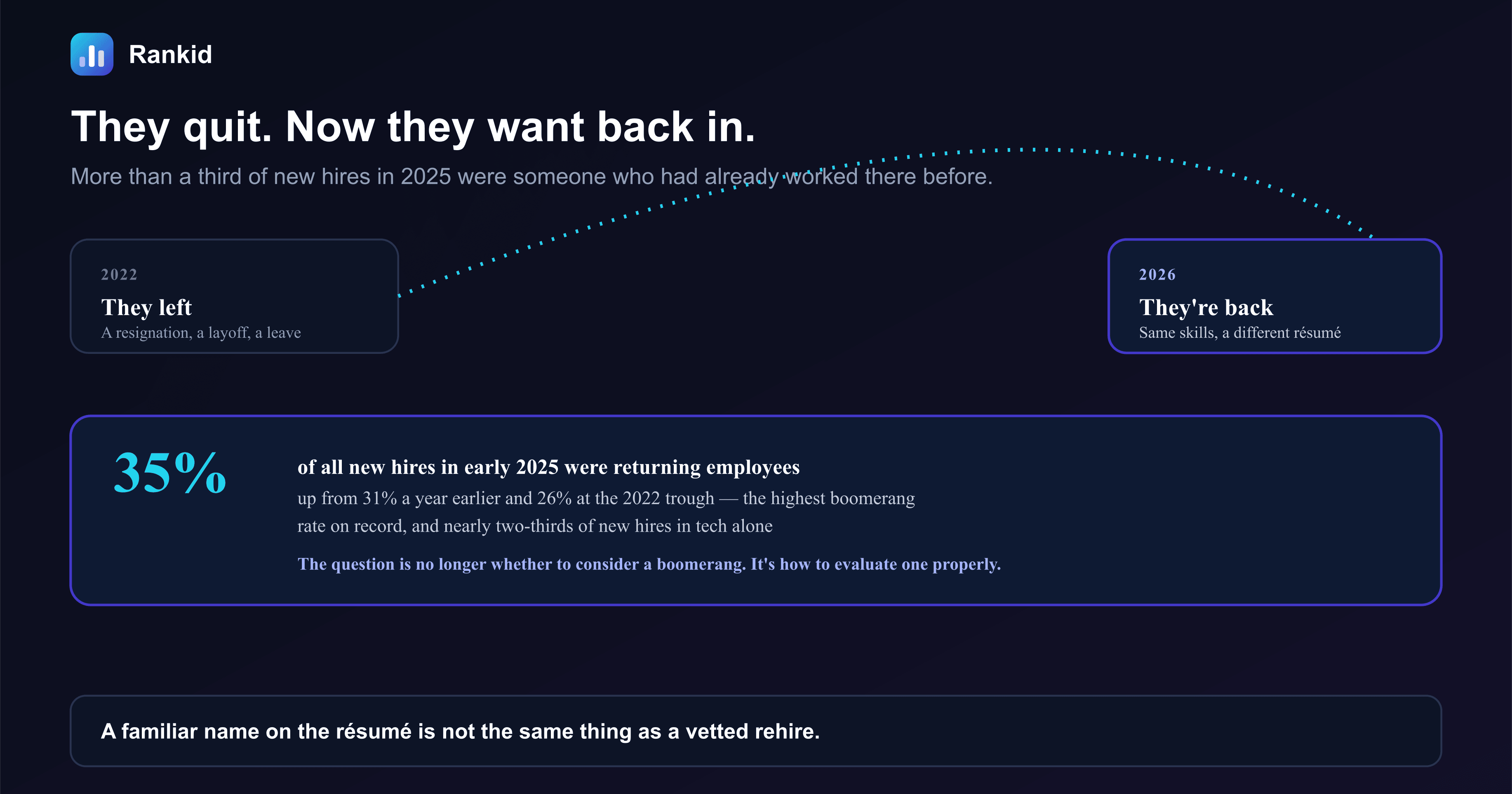
Two years ago they resigned, or got caught in a layoff, or simply moved on. Now they're back in your inbox, asking about the same team, sometimes the same role. It feels like a shortcut: no search, no onboarding risk, no interview gamble on a stranger. It can be exactly that. It can also be a rerun of whatever made them leave the first time, quietly delayed by a couple of years. The difference comes down to whether you evaluate the rehire, or just recognize the name.
Quick answer
Quick answer: boomerang hiring has surged to roughly 35% of all new hires in early 2025, far higher in tech. Rehiring a former employee is frequently a genuinely good bet: they ramp faster and stay longer than a comparable outside hire on average. But treat it as a real evaluation, not a formality. Ask what changed since they left, score their updated resume against today's role, check a recent reference, and anchor compensation to the current market and team, not to what they made when they left.
What counts as a boomerang employee
A boomerang employeeis someone rehired by a company they previously worked for full-time, after a real gap, following a resignation, a layoff, or the end of a role. It's a narrower category than it sounds: it doesn't include someone returning from a short leave of absence, and it's distinct from an alumni network member who simply refers candidates or stays socially connected without ever coming back onto payroll. A boomerang specifically means they left, and now they're employed there again.
Why boomerang hiring is surging right now
This isn't a fringe trend anymore. Payroll data tracked through early 2025 found that boomerang hires made up roughly a third of all new hires across the workforce, the highest share on record, and a sharp climb from just a few years earlier.
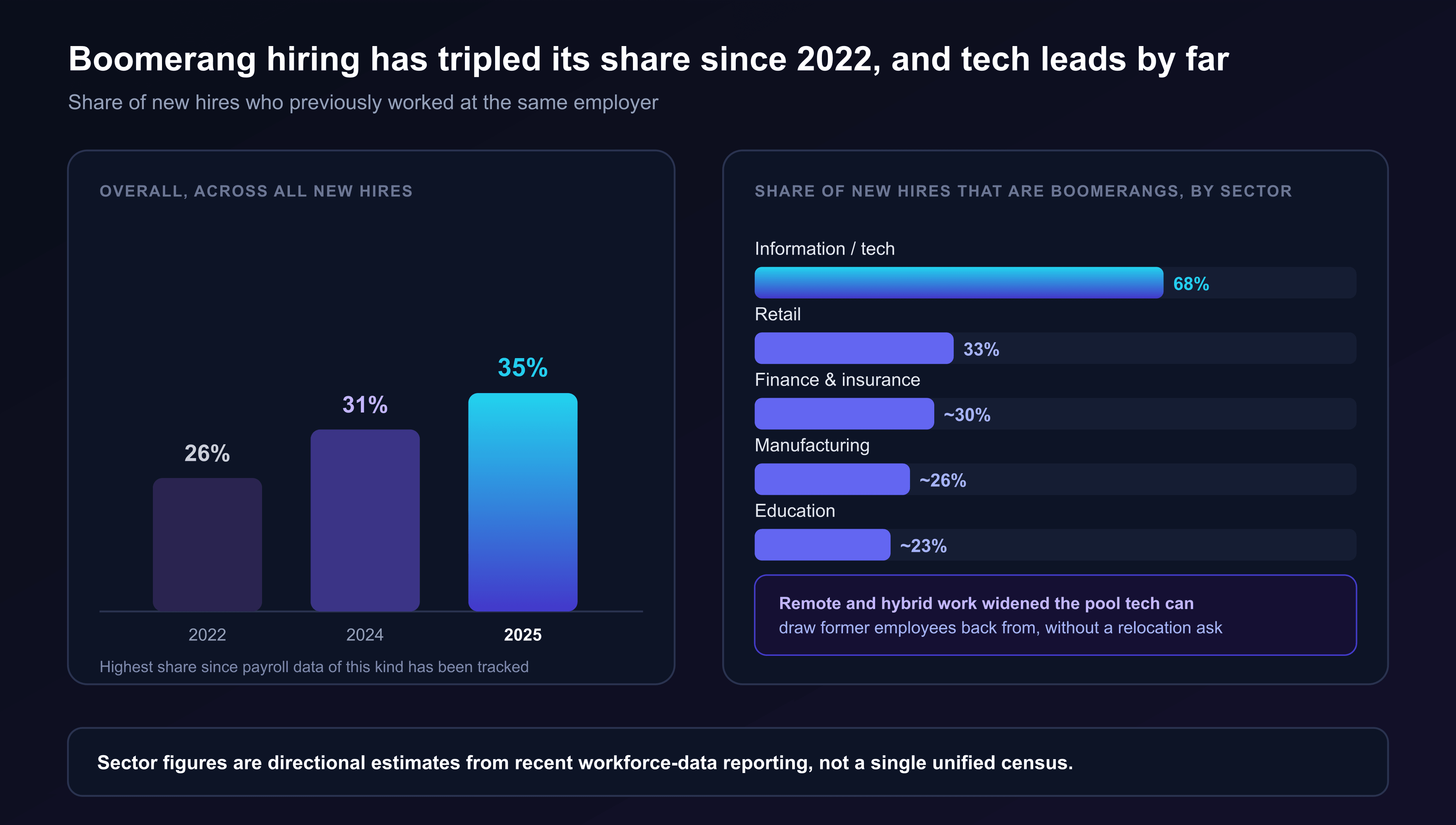
The trend is heavily concentrated by sector. Information and technology roles lead by a wide margin, with boomerang hires making up well over half of new hires in some recent periods, roughly double the rate from a year before. Retail, finance and insurance, manufacturing, and education are all seeing a visible boomerang rise as well, though at a lower level than tech.
A few forces are compounding at once: several years of layoffs have built a large pool of former employees who left involuntarily and remain open to returning; remote and hybrid work removed the relocation barrier that used to make rehiring someone who'd moved away impractical; specialized skills remain scarce enough that a known quantity is genuinely valuable; and overall voluntary quitting has slowed, pushing companies to look harder at people they already have some history with.
The real case for rehiring, and the real risk
Both sides of this are legitimate. The mistake most hiring teams make isn't choosing the wrong side, it's only weighing one of them.
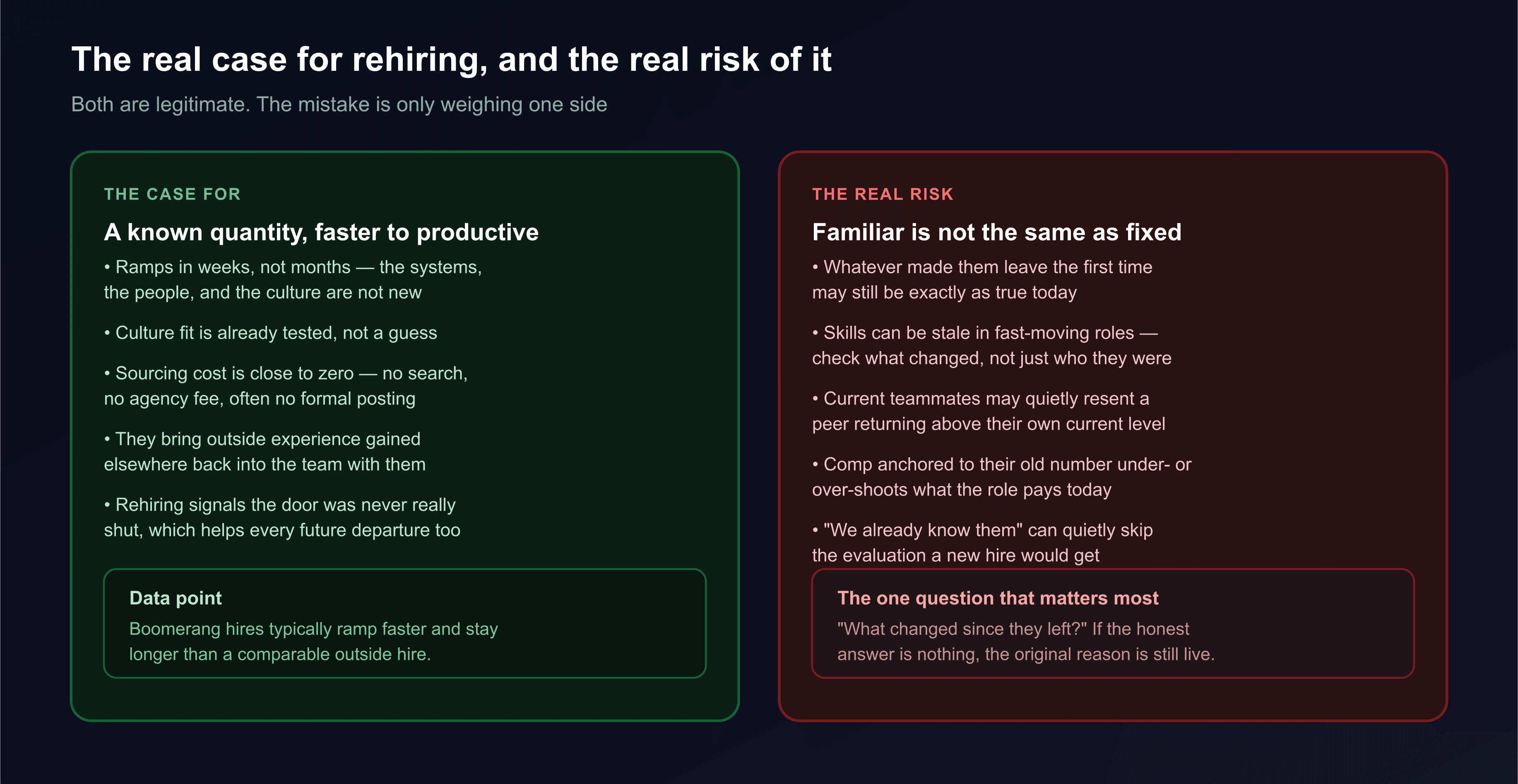
- Ramp speed is the clearest, most consistent advantage.The systems, the people, and the culture aren't new, which routinely compresses time-to-productive from months to weeks.
- Sourcing cost approaches zero.No search, often no agency fee, and frequently no formal posting required at all, which matters most when you're also tracking cost per hire closely.
- The risk is rarely visible until after the offer.Stale skills, an unresolved original grievance, or quiet team resentment don't show up in a friendly reunion conversation; they show up three months into the second stint.
The one question to ask before you extend the offer
How to evaluate a returning candidate differently than a stranger
Familiarity should change how you evaluate a boomerang candidate, not whetheryou evaluate them at all. "We already know them" is exactly the sentence that causes hiring teams to skip steps a first-time candidate would automatically go through.
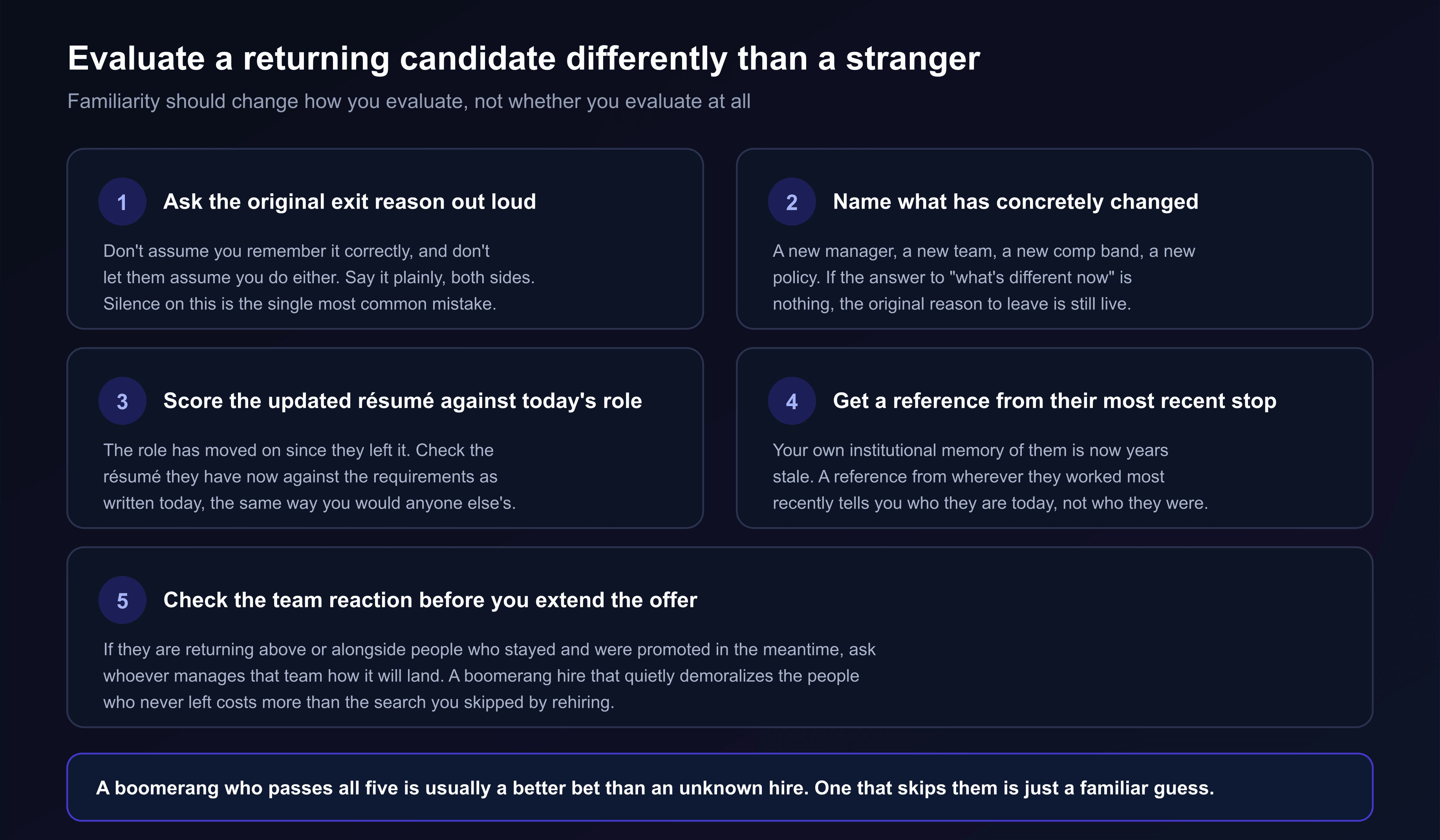
Ask the original exit reason out loud, on both sides
Name what has concretely changed
Score the updated résumé against today's role, not the old one
Get a reference from their most recent stop
Check the team reaction before you finalize the offer
Score a boomerang candidate's résumé the same rigorous way you'd score anyone else's
Familiarity is not the same as fit for the role as it exists today. Upload their updated resume and the current job description, and Rankid returns a 0-100 match score with the specific requirements they meet and the ones that have shifted since they left. First 5 resumes free, no signup.
Try bulk screening freeSetting compensation without anchoring to the past
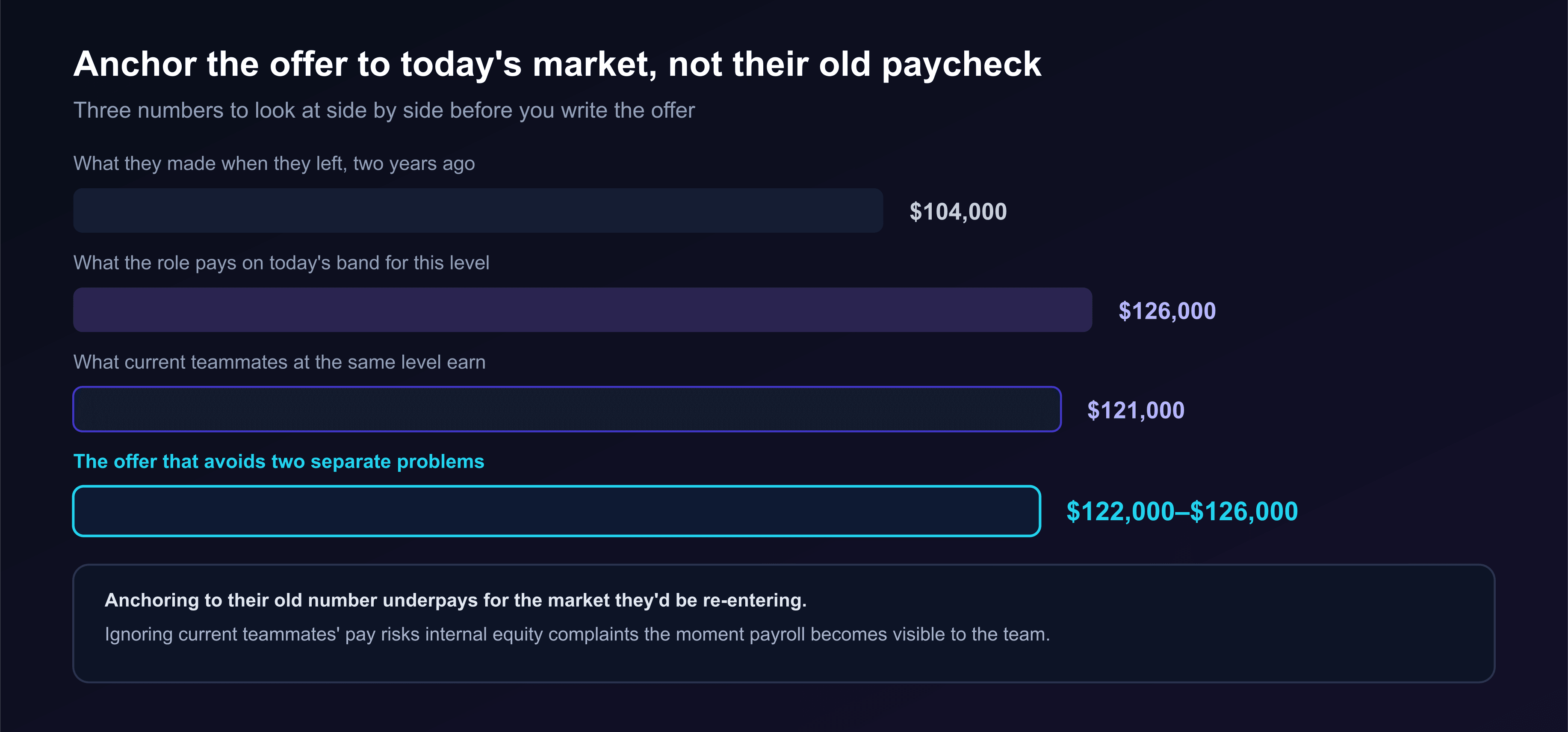
The most common comp mistake with a boomerang hire is anchoring to what they made when they left, which almost always underpays relative to the market they're re-entering after a multi-year gap. The second most common mistake is ignoring what current teammates at the same level earn, which risks a real internal equity problem the moment pay becomes visible to the team, as it usually does eventually.
Our guide on salary bands and compa-ratiocovers how to check a specific offer against a role's band before you send it, which is worth doing for every boomerang hire even when the number feels obvious because "that's roughly what they made before."
For candidates: approaching a former employer about coming back
If you're the one considering a return, reach out directly to someone you have a genuine relationship with, ideally your former manager or a colleague still there, rather than relying only on a cold application through the careers page. Be honest about why you're interested in returning, and if something about what you want from a role has changed since you left, say so plainly rather than letting them assume nothing has shifted. Expect a real evaluation rather than an automatic yes; treat it the way you'd treat any other application, updated résumé included. If your original departure involved a difficult conversation, our guides on explaining a reason for leaving and job references cover how to frame that honestly without it working against you, and our guide on counteroffers covers the mirror-image situation of staying rather than leaving in the first place.
Building an alumni pipeline on purpose, not reactively
Companies with meaningful churn benefit from treating boomerang hiring as a real channel rather than a one-off surprise every time a former employee resurfaces. A structured exit interviewis the first data point in that pipeline; a warm, well-documented offboarding process is the second. Staying genuinely in touch through an alumni list or occasional outreach means you hear about a strong former employee's interest in returning before a competitor does. Our guides on talent pipeline and succession planning cover how to treat past employees as a standing part of your broader talent strategy rather than a one-time exception.
Considering asking for your old job back?
Paste your updated resume and the current job posting into Rankid for a free 0-100 match score and the exact skills you've gained, or that the role now requires, since you left. Know where you stand before you make the ask.
Check your match score freeFrequently asked questions
What exactly counts as a boomerang employee?
A boomerang employee is someone rehired by an employer they previously worked for full-time, after a gap of at least a few months, typically following a voluntary resignation, a layoff, or the end of a fixed-term role. It's distinct from an internal rehire after a short leave of absence, and distinct from simply staying in touch with a former colleague who refers other candidates; a boomerang specifically returns to employment at the same company.
How common is boomerang hiring right now?
Significantly more common than it was just a few years ago. Payroll data tracked through early 2025 found that roughly 35 percent of all new hires were returning employees, up from about 31 percent a year earlier and 26 percent at the 2022 trough, the highest share on record in that data. The trend is far more concentrated in some sectors than others; information and technology roles in particular have seen boomerang rates climb toward two-thirds of new hires in some periods, roughly double the rate from a year prior.
Why is boomerang hiring rising so fast, especially in tech?
A few forces are compounding. Waves of layoffs over the past several years created a large pool of former employees who left involuntarily rather than by choice, meaning many are open to returning if asked. Remote and hybrid work removed the geographic barrier that used to make rehiring someone who relocated impractical. Specialized skills remain scarce enough that a known quantity who already understands your systems is genuinely valuable. And overall voluntary quitting has slowed industry-wide, which pushes companies to look harder at candidates they already have some history with rather than compete as aggressively for entirely new talent.
What's the strongest argument for rehiring someone who already quit?
Speed and reduced risk on several fronts at once. A boomerang employee typically ramps to full productivity in weeks rather than months, because the systems, the people, and the culture aren't new to them. Culture fit is already tested rather than a guess based on interview performance. Sourcing cost is close to zero, since there's often no search, agency fee, or formal posting required. And they frequently bring back outside experience gained at whatever company they worked for in between, which can benefit the team in ways a first-time hire wouldn't.
What's the real risk of rehiring someone who left?
The core risk is assuming familiarity is the same as a fixed problem. Whatever originally drove them to leave, whether it was a manager relationship, a growth ceiling, burnout, or compensation, can still be exactly as true today if nothing structural has changed. Skills can also be stale in fast-moving roles even after a relatively short gap. And there are people-side risks too: current teammates may quietly resent a peer returning at or above their own current level, and "we already know them" can cause a hiring team to skip evaluation steps a first-time candidate would go through.
What's the single most important question to ask before rehiring someone?
"What has concretely changed since they left?" Not a vague sense that things are better, but a specific answer: a new manager, a different team, a revised comp band, a policy change, or something about the person's own goals or circumstances that shifted. If the honest answer is nothing, the original reason for their departure is very likely still live, and a rehire risks repeating the same outcome on a delay.
How should I evaluate a returning candidate differently than a first-time applicant?
Familiarity should change how you evaluate, not whether you evaluate at all. Ask the original exit reason out loud rather than assuming you both remember it the same way. Name what's concretely different now. Score their updated resume against the role's current requirements the same way you would a stranger's, since the role has likely moved on since they left it. Get a reference from wherever they worked most recently, since your own institutional memory of them is now stale. And check with whoever currently manages the team how the rehire will land before you extend the offer, particularly if they're returning above people who stayed.
How should compensation be set for a boomerang hire?
Anchor to what the role pays on today's band for the level, not to what the person made when they left, and cross-check against what current teammates at the same level earn. Anchoring to their old number typically underpays relative to the market they're re-entering, especially after a multi-year gap during which pay for the role likely moved. Ignoring current teammates' pay risks an internal equity problem the moment compensation becomes visible to the team, which it usually does eventually.
Does rehiring someone above their old title or level cause problems with the rest of the team?
It can, particularly if people who stayed through the period the boomerang employee was gone were passed over for the same level or title in the meantime. Before finalizing an offer that returns someone above their prior level, check with the manager how it's likely to land with the team, and be prepared to explain the decision in terms of what changed, not just convenience. Silence on this specific point is one of the more common, avoidable causes of resentment after a rehire.
Should a company build a formal boomerang or alumni program, or handle rehires case by case?
A formal program tends to outperform ad hoc rehiring once a company has meaningful churn, because it turns exit interviews and offboarding into the first data point of a future recruiting channel rather than a one-time formality. Staying genuinely in touch with strong departing employees, through an alumni list, occasional outreach, or simply a warm offboarding process, keeps the door open without pressure, and means the company hears about a former employee's interest in returning before a competitor does.
As a candidate, how should I approach a former employer about coming back?
Reach out directly to someone you have a genuine relationship with, ideally your former manager or a colleague still there, rather than only submitting a cold application through the careers page. Be honest about why you're interested in returning and, if relevant, what's different about what you're looking for now versus when you left. Expect to be evaluated seriously rather than waved back in automatically; treat the process the way you would any other application, including updating your resume to reflect what you've done since you left.
If I was laid off, does that hurt my chances of being rehired later compared to someone who resigned voluntarily?
Generally no, and in many cases it helps. A layoff is widely understood as a business decision rather than a reflection of performance, and companies rehiring from their own layoff alumni pool is now common enough to be a recognized part of the broader boomerang trend. If you were let go for performance reasons specifically, that's a different conversation, and it's worth being honest with yourself about which category applies before you reach out.
Key takeaways
- Boomerang hires made up roughly 35% of all new hires in early 2025, up from 31% a year earlier and 26% at the 2022 trough.
- Information and technology roles lead by far, with boomerang rates climbing toward two-thirds of new hires in some recent periods.
- The case for rehiring is real: faster ramp time, tested culture fit, near-zero sourcing cost, and outside experience gained elsewhere.
- The risk is just as real: the original reason they left can still be true, and "we already know them" often causes evaluation steps to get skipped.
- Ask what has concretely changed since they left before extending an offer. If the honest answer is nothing, the old reason is likely still live.
- Score a boomerang candidate's updated resume against today's role requirements, and get a reference from their most recent employer, not just your own memory.
- Anchor compensation to today's band and current teammates' pay, not to what the person made when they left, to avoid underpaying and internal equity problems.
- Check how a rehire will land with the current team before finalizing an offer, especially if they're returning above people who stayed.
- A structured exit interview and warm offboarding process turn departing employees into a deliberate future pipeline rather than a reactive surprise.
Frequently asked questions
What exactly counts as a boomerang employee?
A boomerang employee is someone rehired by an employer they previously worked for full-time, after a gap of at least a few months, typically following a voluntary resignation, a layoff, or the end of a fixed-term role. It's distinct from an internal rehire after a short leave of absence, and distinct from simply staying in touch with a former colleague who refers other candidates; a boomerang specifically returns to employment at the same company.
How common is boomerang hiring right now?
Significantly more common than it was just a few years ago. Payroll data tracked through early 2025 found that roughly 35 percent of all new hires were returning employees, up from about 31 percent a year earlier and 26 percent at the 2022 trough, the highest share on record in that data. The trend is far more concentrated in some sectors than others; information and technology roles in particular have seen boomerang rates climb toward two-thirds of new hires in some periods, roughly double the rate from a year prior.
Why is boomerang hiring rising so fast, especially in tech?
A few forces are compounding. Waves of layoffs over the past several years created a large pool of former employees who left involuntarily rather than by choice, meaning many are open to returning if asked. Remote and hybrid work removed the geographic barrier that used to make rehiring someone who relocated impractical. Specialized skills remain scarce enough that a known quantity who already understands your systems is genuinely valuable. And overall voluntary quitting has slowed industry-wide, which pushes companies to look harder at candidates they already have some history with rather than compete as aggressively for entirely new talent.
What's the strongest argument for rehiring someone who already quit?
Speed and reduced risk on several fronts at once. A boomerang employee typically ramps to full productivity in weeks rather than months, because the systems, the people, and the culture aren't new to them. Culture fit is already tested rather than a guess based on interview performance. Sourcing cost is close to zero, since there's often no search, agency fee, or formal posting required. And they frequently bring back outside experience gained at whatever company they worked for in between, which can benefit the team in ways a first-time hire wouldn't.
What's the real risk of rehiring someone who left?
The core risk is assuming familiarity is the same as a fixed problem. Whatever originally drove them to leave, whether it was a manager relationship, a growth ceiling, burnout, or compensation, can still be exactly as true today if nothing structural has changed. Skills can also be stale in fast-moving roles even after a relatively short gap. And there are people-side risks too: current teammates may quietly resent a peer returning at or above their own current level, and "we already know them" can cause a hiring team to skip evaluation steps a first-time candidate would go through.
What's the single most important question to ask before rehiring someone?
"What has concretely changed since they left?" Not a vague sense that things are better, but a specific answer: a new manager, a different team, a revised comp band, a policy change, or something about the person's own goals or circumstances that shifted. If the honest answer is nothing, the original reason for their departure is very likely still live, and a rehire risks repeating the same outcome on a delay.
How should I evaluate a returning candidate differently than a first-time applicant?
Familiarity should change how you evaluate, not whether you evaluate at all. Ask the original exit reason out loud rather than assuming you both remember it the same way. Name what's concretely different now. Score their updated resume against the role's current requirements the same way you would a stranger's, since the role has likely moved on since they left it. Get a reference from wherever they worked most recently, since your own institutional memory of them is now stale. And check with whoever currently manages the team how the rehire will land before you extend the offer, particularly if they're returning above people who stayed.
How should compensation be set for a boomerang hire?
Anchor to what the role pays on today's band for the level, not to what the person made when they left, and cross-check against what current teammates at the same level earn. Anchoring to their old number typically underpays relative to the market they're re-entering, especially after a multi-year gap during which pay for the role likely moved. Ignoring current teammates' pay risks an internal equity problem the moment compensation becomes visible to the team, which it usually does eventually.
Does rehiring someone above their old title or level cause problems with the rest of the team?
It can, particularly if people who stayed through the period the boomerang employee was gone were passed over for the same level or title in the meantime. Before finalizing an offer that returns someone above their prior level, check with the manager how it's likely to land with the team, and be prepared to explain the decision in terms of what changed, not just convenience. Silence on this specific point is one of the more common, avoidable causes of resentment after a rehire.
Should a company build a formal boomerang or alumni program, or handle rehires case by case?
A formal program tends to outperform ad hoc rehiring once a company has meaningful churn, because it turns exit interviews and offboarding into the first data point of a future recruiting channel rather than a one-time formality. Staying genuinely in touch with strong departing employees, through an alumni list, occasional outreach, or simply a warm offboarding process, keeps the door open without pressure, and means the company hears about a former employee's interest in returning before a competitor does.
As a candidate, how should I approach a former employer about coming back?
Reach out directly to someone you have a genuine relationship with, ideally your former manager or a colleague still there, rather than only submitting a cold application through the careers page. Be honest about why you're interested in returning and, if relevant, what's different about what you're looking for now versus when you left. Expect to be evaluated seriously rather than waved back in automatically; treat the process the way you would any other application, including updating your resume to reflect what you've done since you left.
If I was laid off, does that hurt my chances of being rehired later compared to someone who resigned voluntarily?
Generally no, and in many cases it helps. A layoff is widely understood as a business decision rather than a reflection of performance, and companies rehiring from their own layoff alumni pool is now common enough to be a recognized part of the broader boomerang trend. If you were let go for performance reasons specifically, that's a different conversation, and it's worth being honest with yourself about which category applies before you reach out.